Solar Energy | Australia | Updated March 2026

How Long Does a Solar Battery Last in Australia? (Real Answers)

When you spend $8,000-$14,000 on a solar battery, the lifespan question is completely reasonable. You want to know if it will still be doing its job in year 8. Year 10. Maybe beyond.

The honest answer: most quality solar batteries installed in Australia today will last between 10 and 15 years in real-world conditions. The 10-year warranty you see on most brands is not just marketing — it is a legally binding capacity guarantee. But there is a lot of nuance between ‘lasts 10 years’ and ‘performs well for 10 years.’

This guide covers what actually determines how long a battery lasts, what affects performance over time, what your warranty really covers (and what it does not), and the questions to ask before you buy.

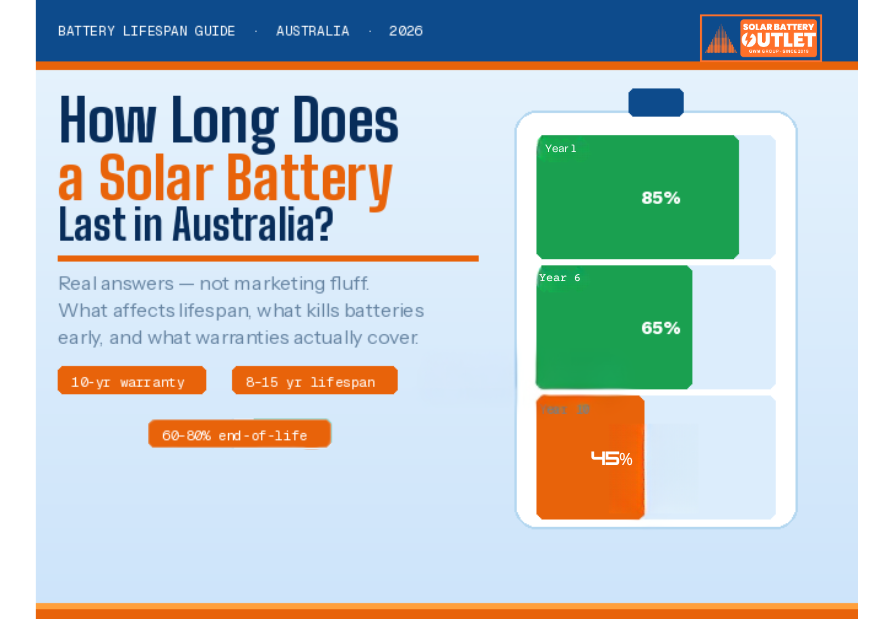
Quick answer for busy homeowners: A quality LFP solar battery installed correctly in Australia will typically retain 70-80% of its original capacity after 10 years. That means if you install a 10 kWh battery today, expect it to deliver 7-8 kWh in year 10. Most warranties guarantee at least 60-70% capacity at the end of the warranty period. After that, the battery continues working — just with gradually reduced storage.

The Short Version: Battery Chemistry Is the Starting Point

Almost every quality solar battery sold in Australia in 2026 uses LFP chemistry — Lithium Iron Phosphate. This matters because LFP is fundamentally more stable, safer, and longer-lived than older lithium-ion chemistries.

LFP batteries do not overheat and fail in the same ways older chemistries did. They handle more charge cycles without as much degradation. And they do not carry the same fire risk that made earlier batteries concerning for home installation.

If a salesperson is talking to you about a non-LFP battery for home storage in 2026, ask why. The answer should be very specific.
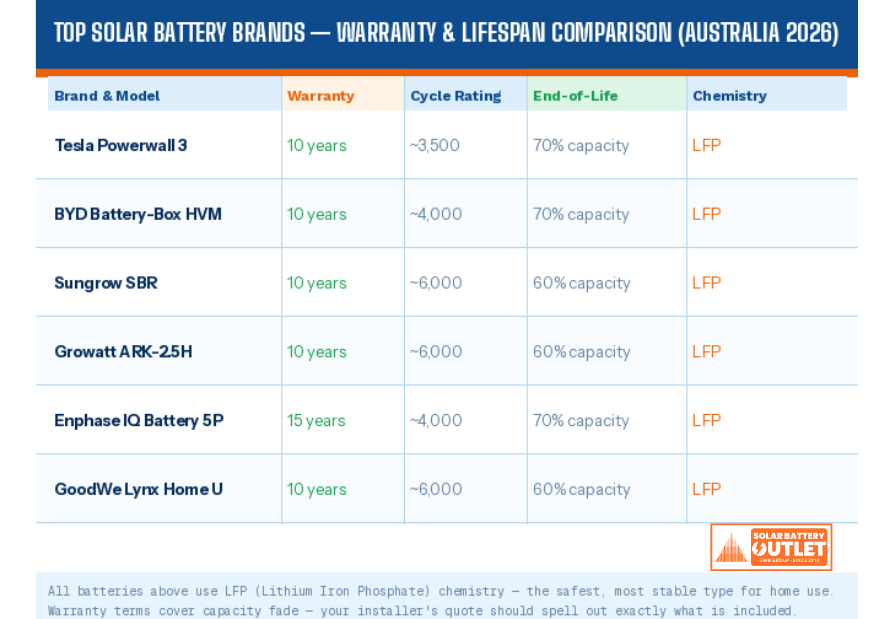
top solar battery brands

What the Numbers Actually Mean

When a battery manufacturer says ‘4,000 cycles at 80% depth of discharge’, here is how to read that:

  • 4,000 cycles means 4,000 full charge/discharge cycles before capacity falls to the warranted threshold
  • One cycle per day = roughly 11 years of daily use before hitting that threshold
  • 80% depth of discharge means they tested by draining 80% of capacity each cycle
  • Real-world usage is typically less aggressive — real-world lifespan is often longer than the cycle rating implies

The Enphase IQ Battery 5P is notable for offering a 15-year warranty — the longest available in Australia right now. That is a genuine differentiator if long-term peace of mind is your priority. The trade-off is higher upfront cost compared to 10-year options.

Six Things That Actually Determine How Long Your Battery Lasts
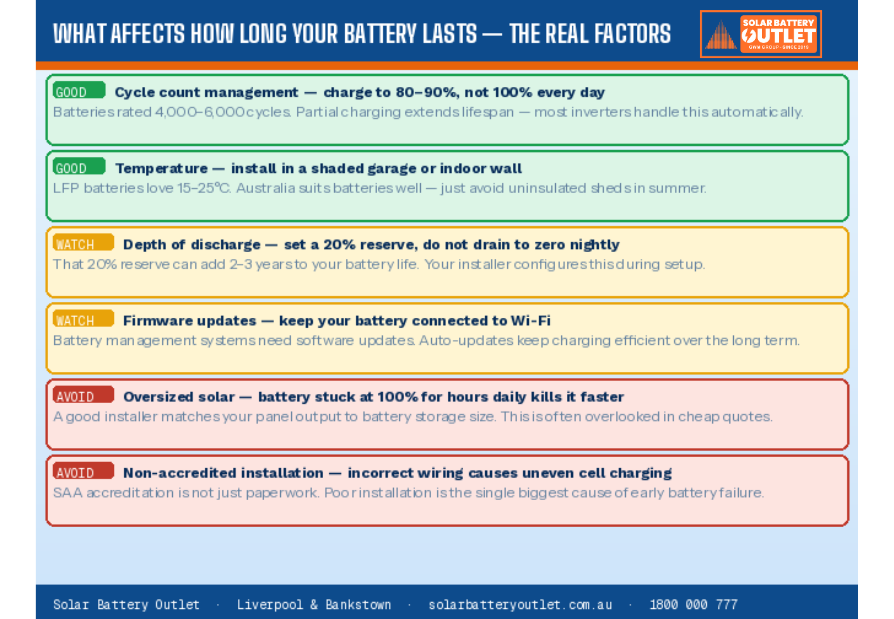
1. How You Charge It — Partial vs Full Cycles

This is the single biggest factor most homeowners do not know about. Charging your battery to 100% every single day and draining it to 0% every night is the fastest way to reduce its lifespan — the battery equivalent of redlining your car engine daily.

Most good inverters have a setting to cap charging at 80-90% and keep a reserve of 10-20% at the bottom. Your installer should configure this during setup. If they do not mention it, ask them to.

Practical tip: Ask your installer what depth of discharge and charge ceiling they recommend for your specific battery and inverter combination. This one conversation could add years to your battery’s life.

2. Temperature — Where You Install It Matters

LFP batteries perform best between 15 and 25 degrees Celsius. Australia’s climate is actually well-suited to battery storage — most of the country stays comfortably within that range for most of the year.

The issue is installation location. A battery bolted to an uninsulated shed wall in Penrith or Bankstown in January, facing west, can hit 45 degrees on a hot afternoon. That repeated heat stress accelerates capacity fade significantly.

  • Best locations: internal garage wall, laundry, shaded external wall under an eave
  • Avoid: uninsulated sheds, west-facing external walls in direct afternoon sun, under roof spaces with no ventilation
  • In QLD and SA especially: ask your installer about thermal management for your specific install location

3. Depth of Discharge — The Reserve Setting

Every battery has a ‘depth of discharge’ setting — how far down it depletes before stopping. Running at 100% depth of discharge every day will measurably shorten lifespan compared to running at 80%.

Most installer setups include a default reserve of 10-20%. That is not dead capacity — that is protection for the battery cells. Think of it like keeping your car fuel above the ‘E’ instead of running it dry every time.

4. Firmware and Software Updates

Solar batteries have battery management systems (BMS) — software that controls how the battery charges, discharges, and protects itself. That software receives updates, just like your phone.

Missing firmware updates can mean your battery is not charging as efficiently as it should, or is not applying the cell-balancing algorithms that protect long-term health. Most brands push updates automatically via your home Wi-Fi. Keep your battery app connected and check occasionally that it is running current firmware.

5. Solar Panel Sizing — Do Not Go Too Big

Counterintuitively, a solar system that is much larger than your battery can shorten the battery’s life. If your panels generate far more than the battery can absorb, the battery reaches 100% early in the day and then sits there for hours — stressing the cells over time.

A well-designed system matches panel output to battery storage capacity. This is something a competent installer considers during system design. If you are retrofitting a battery to an existing large solar system, ask specifically whether the panel output is appropriate for the battery you are choosing.

6. Quality of Installation

Incorrect wiring — including improper cell connections, wrong inverter configuration, or poor earthing — causes uneven charging across battery cells. This accelerates capacity fade and in worse cases causes premature failure.

This is the practical reason SAA (Solar Accreditation Australia) accreditation matters for battery installation. It is not bureaucracy — it is the technical standard that prevents installation errors that shorten lifespan. You can verify any installer’s accreditation at saaustralia.com.au before accepting a quote.

What Your Warranty Actually Covers
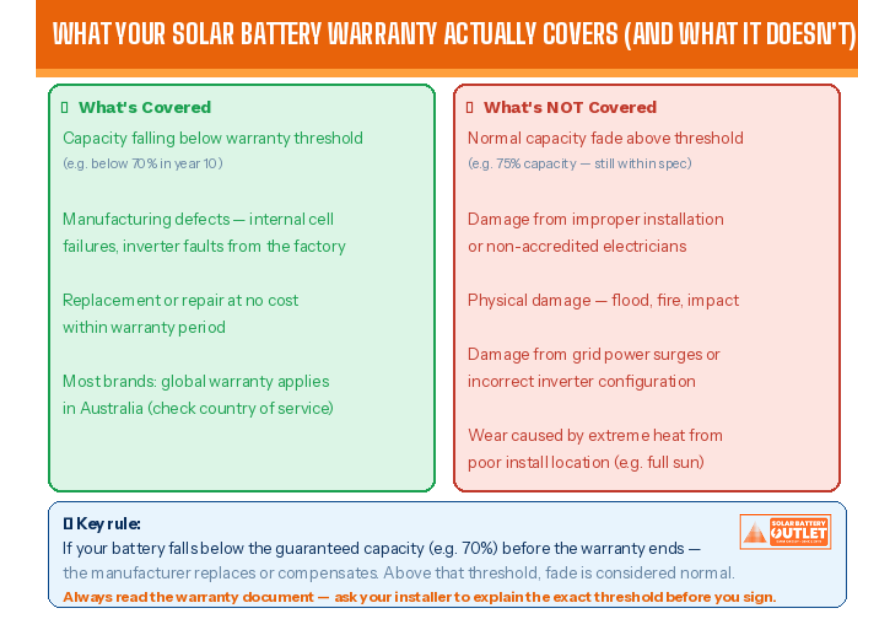
what your solar battery actually coversery warranty

Capacity Warranty vs Product Warranty

Capacity warranty — the more important one — guarantees that your battery will retain a minimum percentage of its original storage capacity for a set number of years. Common thresholds are 60% or 70% of original capacity at the end of year 10.

Product warranty — covers manufacturing defects, component failures, and premature failure. This is standard and typically runs 10 years for most brands.

If your battery falls below the guaranteed capacity threshold before the warranty ends, the manufacturer is obligated to replace it or compensate you. If it stays above that threshold — even at 72% capacity in year 9 — that is within spec and not a warranty claim.

The Question to Ask Before You Sign

Ask: “What is the exact capacity threshold in the warranty, and at what year?”

Some brands warrant 70% at year 10. Others warrant 60% at year 10. A battery that retains 70% of 10 kWh is giving you 7 kWh in year 10. A 60% threshold battery might only deliver 6 kWh. For most households — especially with growing EV use — that difference matters.

What happens after the warranty period? The battery keeps working — it just continues degrading gradually without the manufacturer’s capacity guarantee. Most quality LFP batteries continue functioning well beyond their warranty period. A 10 kWh battery at 65% capacity in year 12 is still delivering 6.5 kWh — still useful, just less than day one.

How to Get the Most Life Out of Your Battery — Practical Tips

  • Ask your installer to configure the charge ceiling at 80-90% and a 10-20% reserve at the bottom
  • Keep your battery monitoring app installed and check firmware update notifications
  • Choose an install location that stays under 35 degrees in summer — shaded garage or indoor wall
  • If your solar system is over 10 kW, confirm with your installer that battery sizing is appropriate
  • Do not skip maintenance checks — most brands recommend a system check at year 5
  • If you notice the battery depleting faster than usual, check the monitoring app for error codes before calling a technician

Frequently Asked Questions

Can I replace the battery cells when they degrade, rather than the whole unit?

For most residential batteries, no — they are sealed units. BYD Battery-Box is modular, meaning you can add capacity or swap modules, but individual cell replacement is not a standard consumer option. When a battery reaches end-of-life, the whole unit is replaced or recycled.

Does the battery still work during a blackout as it gets older?

Yes — backup capability is not directly related to capacity degradation. A battery at 70% capacity still provides blackout protection, just for a shorter duration than when new. If your 10 kWh battery is at 7 kWh capacity in year 10, it will keep your essentials running for about 70% of the time it originally could.

What happens to the battery at the end of its life?

LFP batteries are recyclable. Australia’s battery recycling infrastructure has improved significantly — most installers and manufacturers have take-back or recycling programs. Ask about this when getting quotes. Reputable installers will have a clear answer.

Is a 15-year warranty worth paying extra for?

It depends on your situation. If you are planning to stay in your home for 15+ years and want certainty, the Enphase IQ Battery 5P’s 15-year warranty is a genuine differentiator. If your planning horizon is 10 years, or you expect to upgrade technology at the 10-year mark anyway, the standard 10-year options deliver very strong value.

Do batteries degrade faster in hot climates like Queensland or South Australia?

They can — if the install location is poor. The solution is not to avoid batteries in hot climates; it is to install them correctly. SA homeowners actually have some of the strongest battery economics in the country thanks to high electricity prices, despite the warm climate.

Want a Quote for a Solar Battery in Sydney or South West NSW?
We are based in Liverpool and Bankstown, servicing all of South West Sydney and beyond. Our team will recommend the right battery size for your home and handle all rebate paperwork — federal and NSW VPP incentive.
Call us: 1800 000 777
Or visit: solarbatteryoutlet.com.au
About Solar Battery Outlet We are a Liverpool-based solar battery installer, part of GWM Group Pty Ltd, servicing homes across South West Sydney, Bankstown, Campbelltown, and the greater NSW region. All installations are done by SAA-accredited electricians. We handle all rebate paperwork so you do not have to.

Solar Battery Guide | NSW | Updated March 2026

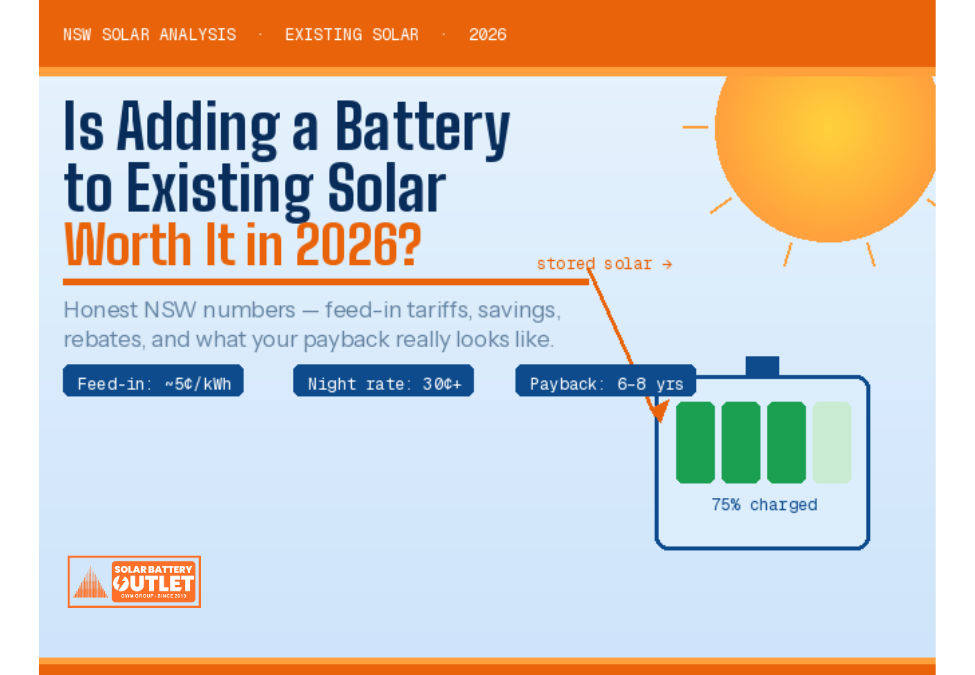
Is Adding a Battery to Existing Solar Worth It in 2026? (NSW Analysis)

You already have solar panels. Good. They’ve been doing their job — generating power during the day, cutting your bills, and for a while there, earning you a decent feed-in tariff.

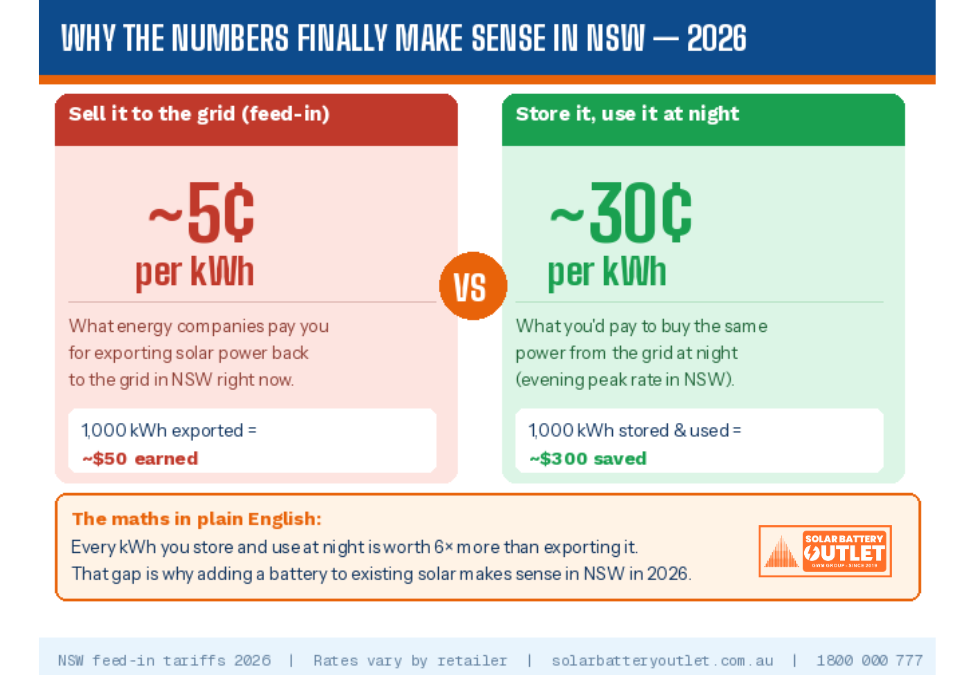
But here’s what’s changed. The money you get for sending power back to the grid has dropped to almost nothing. Most NSW households are now getting 5 to 8 cents per kilowatt-hour — while buying power at night for 30 cents or more. You’re giving away solar energy for almost nothing, then paying full price to run your house after dark.

That gap — and the government rebate that now makes batteries roughly 30% cheaper upfront — is why the question of adding a battery to existing solar has shifted from ‘probably not yet’ to ‘this actually makes sense for a lot of homes’.

This guide is for NSW homeowners who already have solar and want an honest look at whether a battery is worth it in 2026. No fluff, no sales pitch. Just the numbers and the honest answer.

The Short Answer For most NSW households who use power mainly in the evenings, have a feed-in tariff below 8¢/kWh, and get electricity bills above $300/quarter despite having solar — yes, adding a battery in 2026 is worth it. The combination of low feed-in tariffs, rising grid electricity prices, and the current government rebate makes the payback period shorter than it has ever been.

Why the Numbers Finally Make Sense in NSW

For years, solar batteries were the answer to a question the maths hadn’t quite justified yet. The panels paid for themselves easily, but the batteries were expensive and the payback stretched beyond the warranty period.

Two things changed that:

  • Feed-in tariffs collapsed. Where NSW households were once earning 15–20¢ per kWh for exported solar, most are now on 5–8¢. Some retailers are offering as little as 3¢. The incentive to send power to the grid has almost disappeared.
  • The federal rebate arrived. From July 2025, the Cheaper Home Batteries Program cut roughly 30% off the upfront cost of an eligible battery — applied directly to your invoice. That one change shortened payback periods by years.

The core reason a battery makes sense in NSW: every kWh you store is worth 6× more than every kWh you export

The maths is this simple: right now in NSW, every kilowatt-hour of solar you export earns you roughly 5 cents. Every kilowatt-hour you store in a battery and use at night saves you roughly 30 cents. That’s a 6-to-1 difference in value.

A household that exports 4,000 kWh per year earns about $200 from the grid. That same 4,000 kWh stored and used at night saves roughly $1,200 off the electricity bill. Same solar energy. Very different outcome.

Is a Battery Actually Worth It for Your Home?

The honest answer depends entirely on your usage patterns, your existing solar system, and your electricity bills. Here’s a plain breakdown:

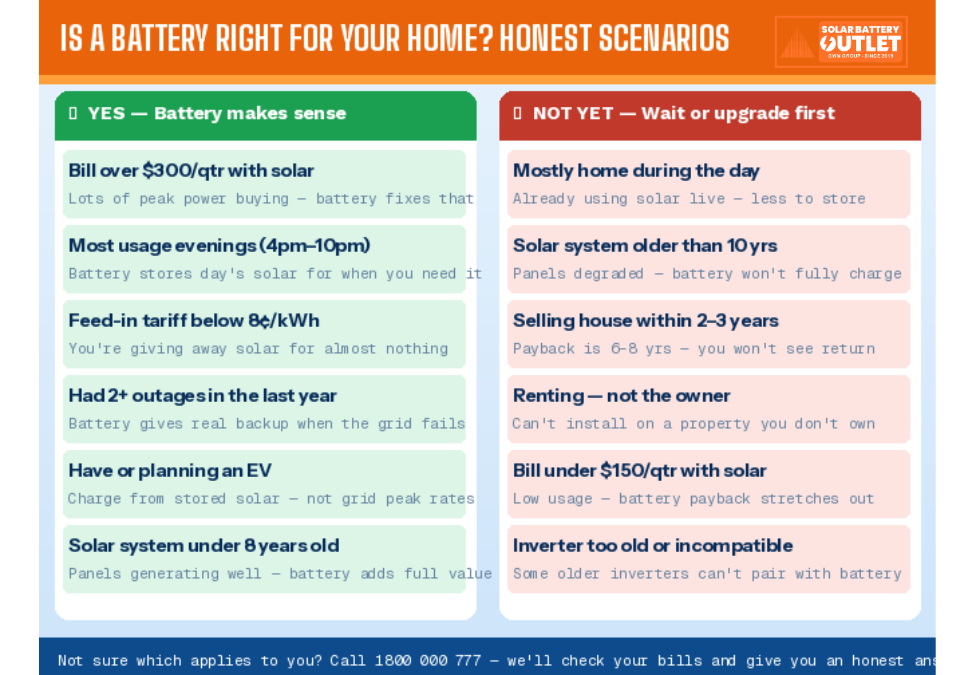
When a battery makes sense for your NSW home — and when it’s better to wait

The situations where it makes the most sense

  • Your electricity bill is still over $300 per quarter despite having solar. This tells us you’re drawing a lot of power from the grid — usually in the evenings. A battery captures your daytime solar and uses it to power those evening hours instead of buying grid power at peak rates.
  • Most of your household usage happens between 4pm and 10pm. Families with kids home from school, people finishing work in the evening — this is the most common pattern in Liverpool and South West Sydney. It’s also the most expensive time to use grid power. A battery flips that.
  • Your feed-in tariff is below 8 cents per kWh. If you’re getting 5–8¢ for every kWh you export, you’re effectively gifting your solar energy to the grid for a fraction of its real value. Storing it instead is the financially smarter move.
  • You have an electric vehicle, or you’re planning to get one. Charging an EV overnight from the grid at peak rates costs significantly more than charging it from stored solar. If an EV is on your radar in the next year or two, a battery starts paying back even faster.
  • You’ve experienced power outages. South West Sydney gets more grid outages than people realise, especially in summer storms. A battery with backup capability keeps your lights, fridge, and essentials running when the grid goes down.

The situations where it’s better to wait

  • Your solar system is older than 10 years. Panels degrade over time — typically losing around 0.5% output per year. A system that’s 10-plus years old might be generating 30–40% less than it did when new. Adding a battery to a weak solar system means the battery may rarely fully charge. In this case, a full solar and battery upgrade together often makes more financial sense.
  • You’re mostly home during the day. If you work from home and run appliances through the day, you’re already using your solar as it generates. There’s less surplus to store — and a battery adds less value than it would for a household that’s out all day.
  • You’re planning to sell within 2–3 years. Battery payback periods in NSW currently sit at 6–8 years. If you’re selling before you see the return, the investment benefits the next owner more than you. It may add some value to the property, but not dollar for dollar.
  • Your inverter is very old or incompatible. Some older inverters — particularly those more than 8–10 years old — can’t integrate with a modern battery. Ask an installer to check your existing inverter before you commit to anything. You may need an inverter upgrade, which adds cost.

What the Rebates Actually Mean for Your Out-of-Pocket Cost

The cost conversation changed significantly when the federal Cheaper Home Batteries Program launched. Here’s what’s currently available for NSW homeowners:

  • Federal Cheaper Home Batteries Program: Roughly 30% off the upfront installed cost of an eligible battery. Applied directly to your invoice — you don’t apply for it separately. For a 10 kWh system that’s around $3,100 off automatically.
  • NSW VPP Incentive (Peak Demand Reduction Scheme): Up to $1,500 for connecting your battery to a Virtual Power Plant. A VPP just means your battery joins a software network that helps stabilise the grid at peak times. Your battery stays in your home. Most homeowners are comfortable with it, and you can claim this on top of the federal rebate.
Important: Rebate Rate Drops After 1 May 2026 The federal rebate is currently at $311 per usable kWh of battery capacity. From 1 May 2026, this drops to $252 per usable kWh — and will decrease again every 6 months after that. If you’re seriously considering a battery this year, getting your installation done before May 2026 locks in the higher rate. For a 10 kWh battery, the difference is around $600.

What Does the Payback Actually Look Like?

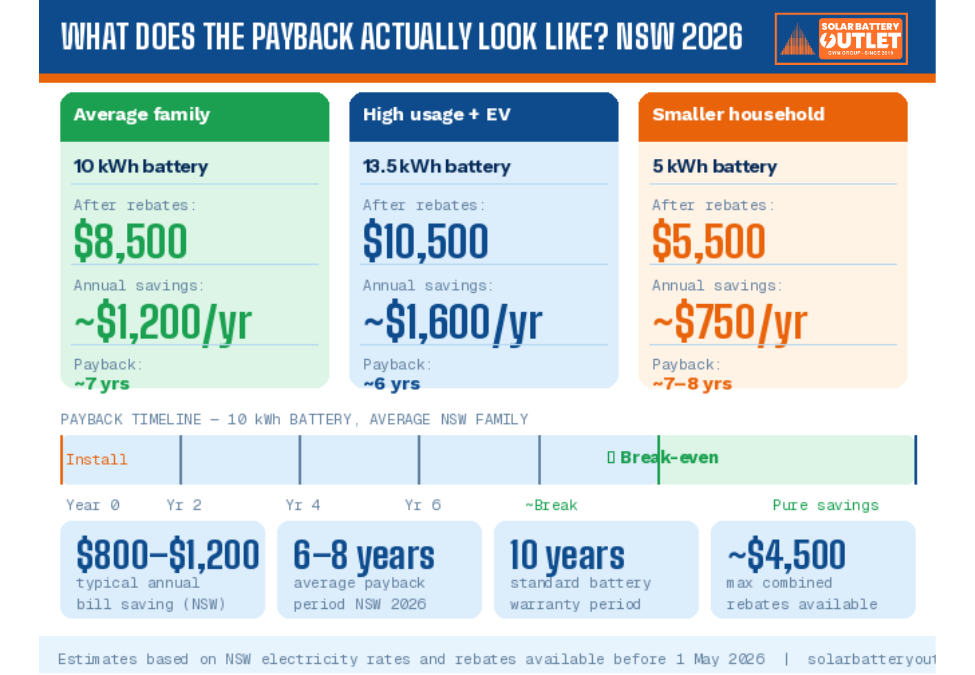
This is the question that matters most. Here’s an honest picture for three common NSW household types:

Estimated payback scenarios for NSW households adding a battery to existing solar in 2026

A few important notes on those numbers:

  • These figures assume NSW electricity rates of around 30¢/kWh at peak times, which is consistent with what most Liverpool and South West Sydney households are currently paying
  • Annual savings can increase over time as electricity prices rise — which they have done consistently in NSW
  • Joining a VPP adds modest ongoing payments or bill credits on top of the bill savings shown above
  • The payback clock starts from installation day — not from when you first get interest in buying

Does Your Existing Solar System Work With a Battery?

This is a practical question many homeowners skip, and it matters. Not every existing solar setup is battery-ready without changes.

  • Inverter compatibility: Battery-ready hybrid inverters are now standard in new installs, but older systems often have a basic string inverter that can’t directly interface with a battery. You may need an AC-coupled battery (which works alongside your existing inverter) or an inverter replacement. A good installer will tell you which applies before you sign.
  • Solar system size: Most batteries work best when paired with at least 6.6 kW of solar panels. If your existing system is smaller — say 3–4 kW — it may not generate enough surplus to charge a 10 kWh battery fully each day. A battery sized to match your actual solar output is worth discussing with your installer.
  • System age and output: Ask your installer to check your current generation data before recommending a battery size. If your panels are performing well, great. If output has degraded significantly, a smaller battery — or a full system upgrade — may be the smarter path.
What to Ask Your Installer Before You Commit Before agreeing to anything, ask your installer three questions specific to your existing system: (1) Is my current inverter compatible with the battery you’re recommending? (2) Is my solar system generating enough to fully charge a battery most days? (3) Does my switchboard need upgrading before installation? Any reputable installer will check all three before quoting — not after you’ve signed.

The Right Battery Size for an Existing Solar Home

Bigger isn’t always better. The right battery size depends on how much solar surplus you generate and how much power you use after dark.

A rough guide for NSW homes adding a battery to existing solar:

  • 5 kWh battery: Good for smaller households with lower evening usage. Lower upfront cost, shorter payback. Less useful if you have high power loads after dark or an EV.
  • 10 kWh battery: The sweet spot for most average NSW families. Covers typical evening usage, charges reasonably from a standard 6.6 kW solar system, and qualifies for good rebate value.
  • 13–15 kWh battery: Worth considering if you have high evening usage, an EV, or you want stronger blackout protection. Make sure your solar system is large enough to charge it reliably.

The most common mistake we see is homeowners buying the largest battery available because it feels like better value. A battery that doesn’t fully charge every day because your solar system can’t fill it is not giving you the return the numbers suggest.

Frequently Asked Questions

Can I add a battery if I already claimed the old NSW battery rebate?

The old NSW Empowering Homes program ended on 30 June 2025. If you claimed that previously, you may still be eligible for the current NSW VPP Incentive — provided your battery meets the technical requirements for VPP participation. Ask an installer to check your existing setup.

Do I need to switch electricity retailers to get a battery?

Not necessarily, but some VPP providers do require you to use their energy retail partner to join the VPP incentive. This is worth understanding before signing up — some VPP offers are genuinely good value, others are less clear. Ask your installer to explain the full terms of any VPP they recommend.

Will a battery work during a blackout?

Only if it’s installed with blackout protection capability enabled — and not all battery and inverter combinations support this by default. When getting quotes, always ask specifically: ‘Does this installation include automatic blackout protection?’ and confirm it’s included in the system design, not an optional extra.

How long does the installation take on an existing solar home?

For a home with a compatible inverter and a switchboard that’s already up to standard, a battery installation typically takes 4 to 6 hours. If a switchboard upgrade is needed or the inverter needs replacing, it may take a full day. Your installer should give you a clear time estimate when they quote.

What happens to my feed-in tariff when I add a battery?

Your feed-in tariff stays the same. Adding a battery doesn’t change your contract with your energy retailer. What changes is how much you export — because instead of sending surplus solar to the grid for 5¢, you’re storing it for use at night instead. You’ll likely export less, which is the whole point.

Want to Know If a Battery Makes Sense for Your Specific Home?
We’re a Liverpool-based installer servicing all of South West Sydney. We’ll check your existing solar system, your bills, and your inverter compatibility before recommending anything. No obligation, no pressure.

Call us: 1800 000 777

Or fill in our 60-second eligibility check at solarbatteryoutlet.com.au
About Solar Battery Outlet We’re a Liverpool-based solar battery installer, part of GWM Group Pty Ltd, servicing homes across South West Sydney, Bankstown, Campbelltown, Mudgee, and the greater NSW region. All installations by SAA-accredited electricians. We handle federal rebate and NSW VPP incentive paperwork so you don’t have to.

Solar Battery Comparison | Sydney NSW | Updated March 2026

Tesla Powerwall 3 vs BYD Battery: Which Is Better for Sydney Homes in 2026?

If you’ve gotten past the ‘should I get a battery?’ question and now you’re comparing brands, you’ve probably landed on these two names. Tesla Powerwall. BYD Battery-Box. They come up in every online comparison, and half the time those comparisons leave you more confused than when you started.

So here’s a straight answer, written for NSW homeowners — not for people who enjoy reading spec sheets.

Short version: both are excellent batteries. The differences are real, but they’re not dramatic. Which one is right for you comes down to your budget, your existing solar setup, and what you actually want the battery to do.

Let’s go through it properly.

What Both Batteries Have in Common Before we compare them, it helps to know what they share. Both Tesla Powerwall 3 and BYD Battery-Box HVM use LFP (lithium iron phosphate) chemistry — which means they’re safe, long-lasting, and thermally stable in Australian heat. Both carry 10-year warranties. Both are on the CEC approved product list and eligible for the federal Cheaper Home Batteries rebate and the NSW VPP incentive. Neither is a bad choice. The question is which one fits your situation better.

Quick Specs Side by Side

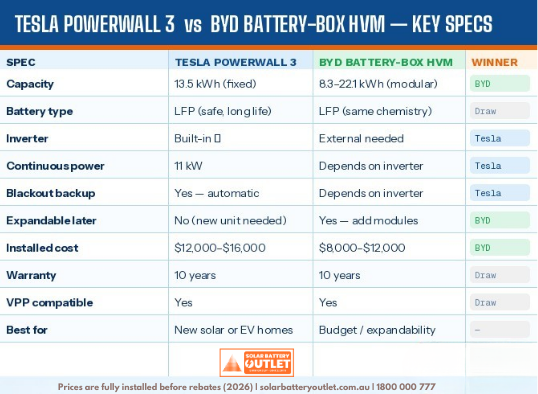
Let’s get the technical stuff out of the way first. Here’s how they compare on the key numbers:

Tesla Powerwall 3 vs BYD Battery-Box HVM — full specs comparison including winner per category

A few things worth explaining from that table:

  • The built-in inverter is Tesla’s biggest practical advantage. Most batteries need a separate ‘hybrid’ inverter to work. Tesla has one built in. If you’re installing from scratch or your old inverter is due for replacement anyway, this saves you $1,500–$2,500 right away.
  • BYD’s modularity is its biggest practical advantage. You can start with a 10 kWh system and add more modules later without replacing the whole battery. Tesla requires a whole new unit if you want to expand beyond 13.5 kWh.
  • ‘Blackout backup’ depends on your setup. Tesla handles this automatically — if the grid goes down, it switches instantly. BYD can do it too, but only if paired with the right inverter. Ask your installer to confirm before buying.

What Does Each Battery Actually Cost in 2026?

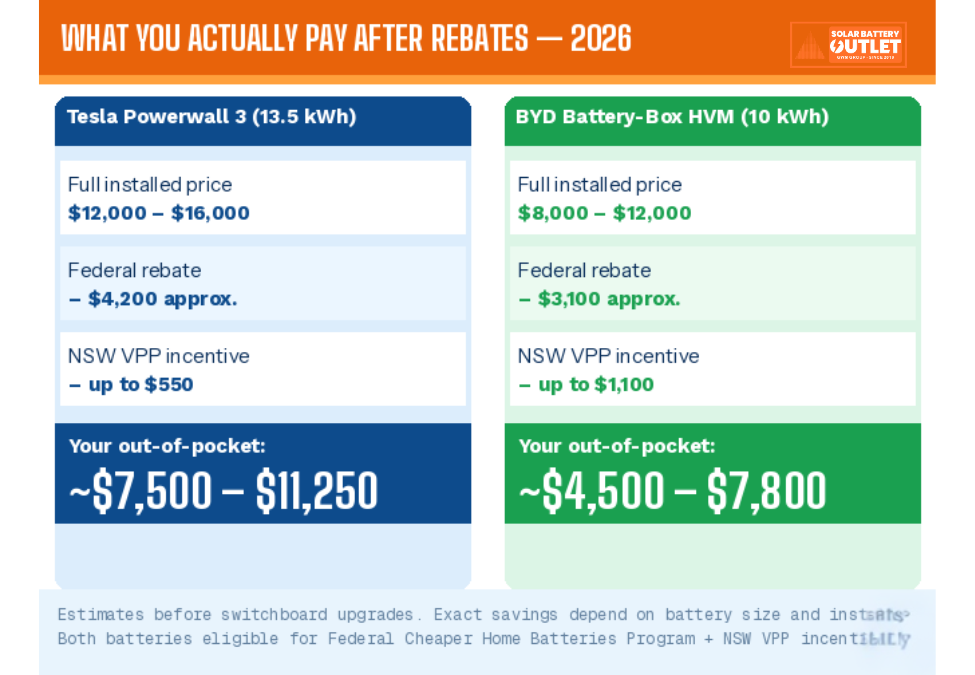
This is what most people really want to know. Here’s the honest pricing picture after rebates are applied:

What you actually pay after the federal rebate and NSW VPP incentive — Tesla vs BYD 2026

The BYD comes in meaningfully cheaper — typically $2,000–$4,000 less out of pocket than Tesla after rebates. For a lot of Liverpool and South West Sydney families, that gap matters.

The Tesla commands a premium because of the integrated inverter, the polished app, and the brand name. If you’re doing a fresh solar + battery install or your old inverter needs replacing, that premium shrinks significantly — because you’d have to buy an inverter for BYD anyway.

Bottom line: if budget is your main concern, BYD wins clearly. If you’re doing a full system install and want one product to do everything, Tesla’s price gap narrows fast.

The 1 May 2026 Rebate Deadline — Applies to Both The federal Cheaper Home Batteries rebate rate drops from 1 May 2026. This applies equally to Tesla and BYD. Getting your installation confirmed before that date locks in the current (higher) rebate regardless of which brand you choose. If you’re reading this in March or April 2026, now is the time to get your quotes sorted.

Which One Should You Actually Buy?

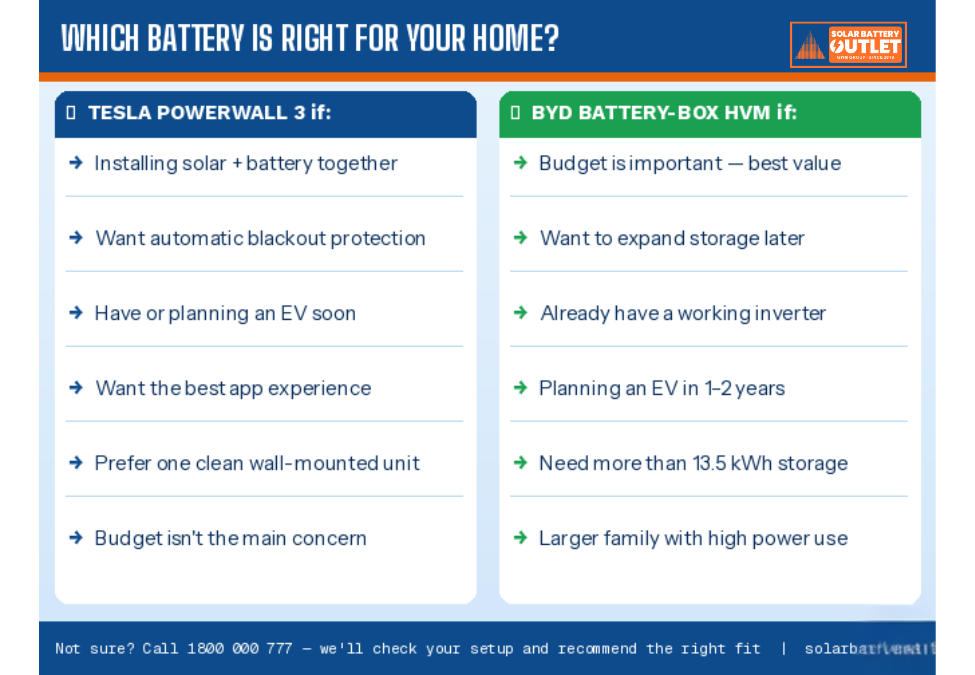
Honest answer: it depends on your situation. Here’s our plain-English guide:

Decision guide — choose Tesla Powerwall 3 or BYD Battery-Box based on your actual situation

Choose Tesla Powerwall 3 if:

  • You’re installing solar panels and a battery together (the integrated inverter saves real money)
  • You want true automatic blackout protection — Tesla switches seamlessly, no configuration needed
  • You have an EV or plan to get one — Tesla’s app handles smart EV charging really well
  • You want the cleanest, most user-friendly app experience for monitoring your energy
  • Your existing inverter is old and needs replacing anyway — factor that cost in
  • Design matters to you — the Powerwall is wall-mounted and genuinely looks good

Choose BYD Battery-Box HVM if:

  • Budget is your priority — BYD is typically $2,000–$4,000 cheaper after rebates
  • You want to expand your storage capacity later as your needs grow (e.g. when you get an EV)
  • You already have a compatible hybrid inverter (Fronius, Sungrow, GoodWe, etc.) working fine
  • You’re a larger family or run a home office and need more than 13.5 kWh of storage
  • You want a proven, reliable system without paying for the Tesla brand premium
  • Your installer is more experienced with BYD — installation quality matters more than brand

What About Other Brands?

Tesla and BYD get most of the attention, but they’re not the only strong options available in NSW. If you’re getting quotes, it’s worth asking about:

  • Sungrow SBR: The best value per kWh on the market right now. Requires a Sungrow hybrid inverter, so it’s most cost-effective if you’re doing a combined solar + battery install. Excellent reliability.
  • Growatt ARK: Newer to the Australian market but growing fast. Good tech at a competitive price point. Worth considering for smaller homes or tighter budgets.
  • Enphase: The premium modular option — each panel gets its own microinverter and battery module. More expensive, but the most resilient system design. Good for shaded roofs.

We install all of these. The ‘best’ brand for your home really does depend on what inverter you already have, your storage needs, and your budget. A good installer will go through this with you honestly — not just push the brand with the highest margin.

Questions to Ask Before You Decide

Before you lock in any brand, ask your installer these questions:

  • “What inverter do I currently have — and is it compatible with this battery?” If you have a working hybrid inverter, BYD might pair perfectly at lower cost. If you don’t, Tesla’s all-in-one is worth considering.
  • “Does this battery support automatic blackout switching?” Tesla yes. BYD depends on inverter — confirm this explicitly before buying.
  • “Is this battery modular? Can I add capacity later?” BYD yes. Tesla requires a second unit. Important if you’re planning an EV in the next 2–3 years.
  • “What’s the net cost after the federal rebate and NSW VPP incentive?” Always compare after-rebate prices. The sticker price gap between Tesla and BYD is bigger than the real gap after rebates.

Frequently Asked Questions

Can I retrofit either battery to my existing solar system?

Yes — both can be added to an existing system. Tesla is AC-coupled, meaning it connects directly without needing a new inverter. BYD is DC-coupled, which means it needs a compatible hybrid inverter. If you already have a compatible inverter, BYD is a great retrofit option. If you don’t, you’ll need to factor in the inverter cost.

Which battery has better blackout protection?

Tesla Powerwall 3 handles blackouts automatically — the switch happens within milliseconds and most people don’t even notice the grid went down. BYD can provide blackout protection too, but it depends entirely on the inverter it’s paired with. If blackout backup is important to you, confirm this in writing before you sign any quote.

Is BYD a reliable brand?

Absolutely. BYD (Build Your Dreams) is one of the largest battery manufacturers in the world — they also make EV batteries for Toyota, Ford, and their own electric cars. Their battery tech is mature, widely tested, and the Battery-Box has a strong track record in Australia. The 10-year warranty is solid and backed by their Australian office.

What if I want more than 13.5 kWh of storage?

BYD is the better choice here. You can expand a BYD system by adding modules — either at installation or later. Tesla Powerwall 3 is fixed at 13.5 kWh per unit. You can install a second Powerwall to get 27 kWh, but that’s a much bigger upfront investment.

Which brand holds its value better if I sell my house?

Tesla has stronger brand recognition with buyers, which may add slightly more perceived value to a property listing. That said, any quality battery brand adds value — the bigger factor is the age of the system and remaining warranty at point of sale.

Not Sure Which Battery Is Right for Your Home?
We install both Tesla and BYD across Liverpool, Bankstown, Campbelltown, and South West Sydney. We’ll check your existing setup, compare the real after-rebate costs, and recommend the battery that gives you the best return — not the one with the highest margin.
Call us: 1800 000 777
Or fill in our 60-second eligibility form at solarbatteryoutlet.com.au
About Solar Battery Outlet We’re a Liverpool-based solar battery installer, part of GWM Group Pty Ltd, servicing homes across South West Sydney, Bankstown, Campbelltown, Mudgee, and the greater NSW region. All installations by SAA-accredited electricians. We handle all rebate paperwork — federal and NSW — so you don’t have to.

Solar Battery Rebates | NSW | Updated March 2026

Federal Battery Rebate NSW 2026: Who Qualifies and How to Claim It

Go and search ‘battery rebate NSW’ and within about 30 seconds you’ll want to close the tab. One site says you can get $7,000 off. Another says the NSW rebate ended. A third talks about STCs, VPPs, and PRCs like you’re supposed to already know what those mean.

You’re not confused because you’re missing something. You’re confused because the information online is a mess.

So let’s cut through it. This is a plain-English guide to the two rebates NSW homeowners can actually access in 2026, who qualifies for each, how much you can realistically save, and the exact steps to claim them — without needing to call a government hotline.

We service homeowners across Liverpool, South West Sydney, Bankstown, and Mudgee, and these are the same questions we get asked every single week. Here are the straight answers.

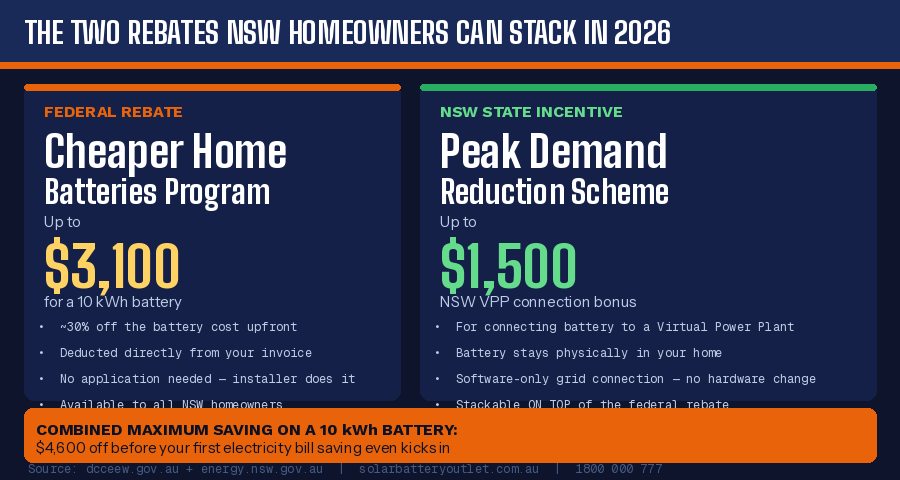
The Short Version (Read This First) There are two rebates NSW homeowners can stack in 2026. First: the Federal Cheaper Home Batteries Program — around 30% off the cost of your battery, applied directly at point of sale. Second: the NSW VPP Incentive — up to $1,500 for connecting your battery to a Virtual Power Plant. Combined on a 10 kWh battery, that’s over $4,000 in savings before a single bill comes in. The federal rate drops after 1 May 2026 — more on that below.

What Is the Federal Battery Rebate?

The federal government launched the Cheaper Home Batteries Program in July 2025. The idea is simple: Australia has 4.2 million homes with rooftop solar but only a fraction have batteries. The program gives homeowners a roughly 30% discount on the cost of installing an eligible battery.

The discount works through something called Small-scale Technology Certificates (STCs). Don’t worry too much about what those are — the practical effect is that your installer deducts the rebate amount straight off your invoice. You never pay the full sticker price.

For a standard 10 kWh battery, that’s roughly $3,100 off the upfront cost. For a 13–15 kWh system, it’s closer to $3,700–$4,500.

The program runs until 2030, but the discount rate decreases over time. The highest rate is right now — before 1 May 2026.

Who Actually Qualifies — The Full Checklist

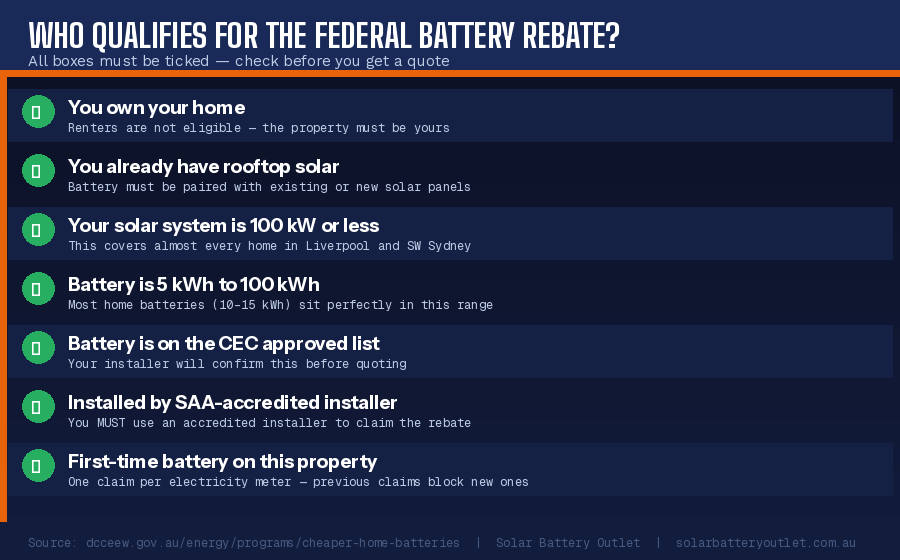
This is where a lot of homeowners get caught out. The rebate isn’t available to everyone. Here’s the exact eligibility list:

Full eligibility checklist for the Federal Cheaper Home Batteries Program 2026 — tick all boxes before requesting quotes

A few of those are worth unpacking:

  • You need existing solar. The battery must be paired with rooftop solar panels — new or existing. A battery without solar attached is not eligible. If you don’t have solar yet, you can install both together and the rebate still applies to the battery portion.
  • The installer must be SAA-accredited. This is Solar Accreditation Australia — the body that replaced the old CEC accreditation system for battery installations. If your installer isn’t accredited, you cannot claim the rebate. Always ask for their accreditation number before signing anything.
  • One claim per property. The rebate is tied to your electricity meter (NMI). If a previous owner already claimed a battery rebate on that address, you’re locked out. A good installer will check this before quoting.
  • The battery must be on the CEC approved product list. Most major brands (Tesla, BYD, Sungrow, Growatt, Sigenergy) are approved. Your installer should confirm this before recommending any brand.

The Two Rebates You Can Stack — Federal + NSW

Here’s where Liverpool homeowners are ahead of the game — NSW offers an additional incentive on top of the federal one. Most people only find out about the second rebate by accident, or not at all.

The two rebates NSW homeowners can combine in 2026 — federal program plus the NSW VPP incentive

The NSW Peak Demand Reduction Scheme (PDRS) pays you for connecting your battery to a Virtual Power Plant (VPP). Here’s what a VPP actually is in plain terms:

Your battery stays physically in your home. Nothing changes about the hardware. A VPP is a software connection that lets your battery join a network of thousands of other batteries across NSW. During peak demand periods — like hot summer afternoons — the operator can draw a small amount of power from the network to help stabilise the grid. In return, you get paid.

The VPP incentive payment is up to $1,500 for most standard home batteries. You receive this as a payment after installation, separate from the federal rebate.

Can You Claim Both? Yes — and you should. The federal discount and the NSW VPP incentive stack on top of each other. They are completely separate schemes. On a 10 kWh battery, combining both could save you over $4,600 before your first electricity bill saving even kicks in. The only catch: some VPP operators take a small fee for managing the connection. Ask your installer to clarify what the net payment will be after any operator fees.

How Much Will You Actually Save? Real Numbers

Let’s put real figures on a typical Liverpool home scenario. Assume you’re installing a 10 kWh battery alongside an existing solar system.

  • Battery cost before rebates: ~$11,000–$12,000 fully installed (varies by brand and your switchboard setup)
  • Federal Cheaper Home Batteries rebate: ~$3,100 deducted upfront from your invoice
  • NSW VPP incentive: ~$1,000–$1,100 paid after installation (for a 10 kWh system)
  • Your actual out-of-pocket cost: ~$7,000–$8,000 depending on brand and any switchboard work needed
  • Estimated annual electricity savings: $1,800–$2,300 per year for a typical Liverpool household using power in the evenings
  • Estimated payback period: 5–7 years, shortening as electricity prices continue to rise

That payback period is based on current electricity prices. NSW tariffs have been increasing roughly 10–15% per year. Every time your electricity rate goes up, your battery saves you more — which means the payback period gets shorter, not longer.

The 1 May 2026 Deadline — Why It Actually Matters

You’ve probably seen installers and comparison sites mentioning this date. Here’s what’s actually happening, without the hype.

The federal rebate is calculated using STCs. From 1 May 2026, the government is changing two things:

  • The STC rate drops faster: Before May, the rate decreases annually. From May onwards, it drops every six months. That means each six-month delay costs you a bit more.
  • Larger batteries get tapered rebates: Systems over 14 kWh will see a lower rebate per kWh on the capacity above that threshold. For a typical 10 kWh battery, nothing changes. For a 15 kWh system, you lose some of the rebate on the extra 1 kWh above 14 kWh.

If you’re looking at a battery under 14 kWh — which is most Liverpool homes — the May deadline is relevant but not dramatic. You’ll save a modest amount by acting before May. If you’re looking at a larger 15 kWh+ system, acting before May is more meaningful.

What we tell customers honestly: if you’re genuinely ready to buy, now is the best time. If you’re still not sure, it’s better to take another few weeks and get it right than to rush into a $10,000 decision.

What Changed with the Old NSW Empowering Homes Program? If you’ve been Googling for a while, you might have seen references to the old NSW Empowering Homes Program — interest-free loans of up to $14,000 for solar battery installs. That program ended on 30 June 2025 and is no longer available. It’s been replaced by the federal rebate + NSW VPP incentive combination described in this guide. Any website still advertising the Empowering Homes loan is out of date.

How to Claim the Rebate — Step by Step

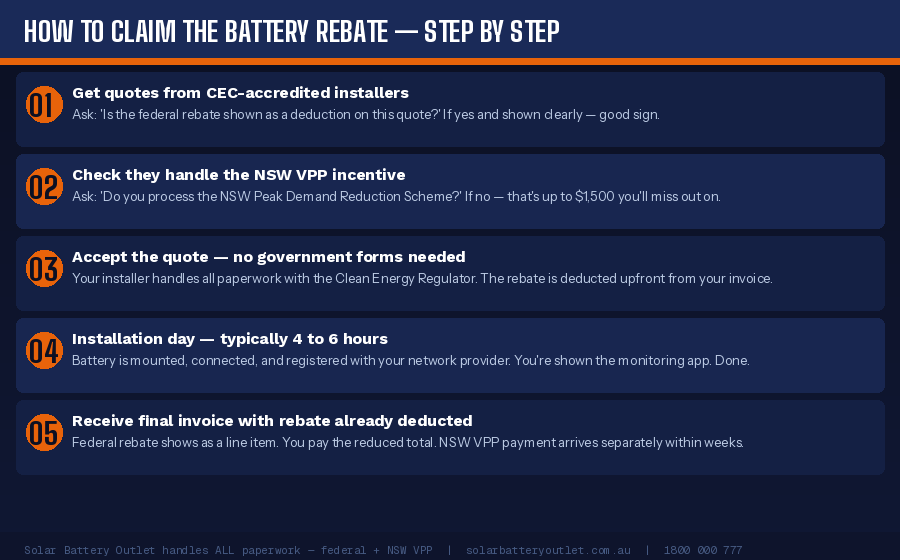
The good news: you don’t have to navigate any government portals or fill in complex forms. Here’s exactly how it works:

How to claim the federal battery rebate and NSW VPP incentive — your installer handles the heavy lifting

The most important thing to understand is that your accredited installer does almost all of the work. Your job is to:

  • Get at least two quotes from SAA-accredited installers
  • Confirm the federal rebate is shown as a deduction on the quote (not a cashback after)
  • Confirm they will also process the NSW VPP incentive paperwork
  • Accept the quote and book the install
  • That’s it — you pay the reduced invoice amount and receive the VPP payment within weeks

Questions to Ask Every Installer Before You Sign

Not all installers are equal. Some offer the federal rebate but skip the NSW VPP incentive because it requires extra compliance steps. Here are the four questions that separate good installers from average ones:

  • “Is the federal rebate shown as a line item deduction on this quote?” It should be clearly deducted on the invoice — not a vague mention that you’ll get money back later.
  • “Do you process the NSW Peak Demand Reduction Scheme incentive?” If they look confused or say they don’t handle it, find another installer. That’s your $1,500.
  • “Is there any switchboard upgrade needed for my property?” Liverpool homes from the 80s and 90s often need a switchboard upgrade ($500–$1,500). A good installer tells you upfront.
  • “Where is your service team based and what’s your response time?” An installer with no local team in South West Sydney is a risk for the next 10 years of service calls.

Common Mistakes NSW Homeowners Make

We see these regularly. Avoid them:

  • Assuming the cheapest quote includes everything. Some quotes look cheap because they exclude switchboard work, inverter upgrades, or monitoring setup. Read the detail.
  • Signing on the same day as a door knock. We’ve had customers tell us they signed at the door, paid a deposit, and only later discovered the company had no local team and no way to contact them after installation. Never sign on the spot.
  • Not asking about VPP eligibility. Some battery models are not VPP-capable. If you want the NSW incentive, confirm your battery choice supports VPP before buying.
  • Waiting for the ‘perfect time’ to buy. Electricity prices go up. Battery prices don’t drop dramatically year-on-year anymore. The best time to install was a year ago. The second best time is before 1 May 2026.

Frequently Asked Questions

Does the rebate apply if I don’t have solar yet?

The federal rebate requires the battery to be paired with solar panels — either existing or being installed at the same time. If you’re installing solar and a battery together in 2026, the rebate applies to the battery component. It’s actually a great time to do a combined install.

Can I claim the rebate on a second property?

Yes — each property has its own electricity meter (NMI) and can make one claim. So if you own a rental property that also has solar, it could qualify independently. The property must meet all the same eligibility criteria.

Is the rebate income-tested?

No. The federal Cheaper Home Batteries Program is not means-tested. It doesn’t matter how much you earn — eligibility is based on your property and installation, not your income.

What if I claimed the old NSW Empowering Homes loan?

The old program ended on 30 June 2025. If you claimed that loan, you may still be able to access the NSW VPP incentive (PDRS) separately, as long as your battery is VPP-capable. It’s worth asking an installer to check your specific situation.

How long does the rebate take to appear?

The federal discount is applied upfront — you’ll see it as a deduction on your final invoice on installation day. The NSW VPP incentive payment comes separately and usually takes a few weeks after your battery is registered with an approved VPP operator.

What if my installer doesn’t process the VPP incentive?

Find a different installer. Processing the NSW VPP paperwork is part of the job for any competent, fully accredited installer in NSW. If they’re not doing it, they’re either inexperienced or cutting corners.

Want Us to Check Your Eligibility for Both Rebates? We’re based in Liverpool and service all of South West Sydney. We handle the federal rebate and NSW VPP incentive paperwork — you don’t have to do anything except choose your battery. Call us: 1800 000 777 Or fill in our 60-second eligibility form at solarbatteryoutlet.com.au
About Solar Battery Outlet We’re a Liverpool-based solar battery installer, part of GWM Group Pty Ltd, servicing homes across South West Sydney, Bankstown, Campbelltown, Mudgee, and the greater NSW region. All installations by SAA-accredited electricians. We handle all rebate paperwork — federal and NSW — so you don’t have to.

So, you’ve done your research. You know you need a solar battery, and you’ve narrowed it down to two of the most talked-about names in the Australian market: Sigenergy and Solis.

Congratulations! You’re at the final, most important step. But this is also where the confusion can peak. Both are excellent choices, but they represent two very different approaches to home energy storage. One is a sleek, all-in-one innovator, while the other is a flexible, proven workhorse.

Choosing between them isn’t about picking a “winner” – it’s about picking the right system for your home, your budget, and your future energy needs.

As expert installers of both Sigenergy and Solis systems, we’ve seen firsthand where each one shines. In this head-to-head comparison, we’ll give you the honest, insider’s breakdown to help you make the perfect choice with confidence.

Meet the Contenders

First, let’s get to know our two challengers.

Team Sigenergy: The All-in-One Innovator

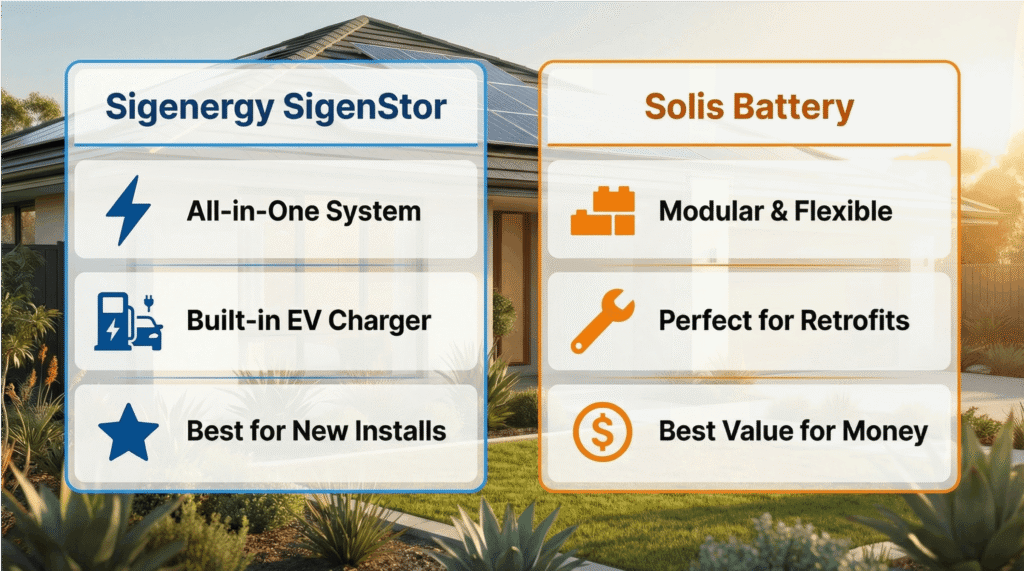
Think of Sigenergy as the “smart-home” approach to energy. Their flagship product, the SigenStor, integrates the battery, inverter, and even an EV charger into a single, elegant unit. It’s designed for seamless simplicity and is packed with cutting-edge technology.

Team Solis: The Flexible Workhorse

Solis has been a trusted name in the solar industry for years, famous for its reliable and cost-effective inverters. Their battery systems are built on a philosophy of flexibility and modularity. They offer a wide range of battery sizes and configurations that can be tailored to almost any home, making them a go-to choice for custom setups and retrofits.

The Head-to-Head Breakdown: Sigenergy vs. Solis

Let’s break down the key differences that will impact your decision.

FeatureSigenergy SigenStorSolis Battery Systems
System DesignAll-in-One: Battery, inverter, and EV charger are integrated into one unit.Modular: Separate battery and inverter components.
Best ForNew solar installations where simplicity is key.Retrofitting existing solar systems or complex custom builds.
Capacity & ScalabilityExcellent. Start with 5kWh and easily stack modules up to 30kWh.Excellent. Highly flexible, with options from 5kWh to over 37kWh.
PerformanceHigh efficiency (>95%) and powerful output.High efficiency and reliable performance from a trusted brand.
Warranty10 Years / 6,000 Cycles10 Years / 6,000+ Cycles
Key TechnologyBuilt-in EV charger, AI-powered energy management.Broad compatibility with many leading inverter brands.
AestheticsSleek, minimalist, and modern. A single, stylish unit on your wall.More industrial. Typically involves two separate units (battery and inverter).


Still not sure which philosophy fits your home?
Our experts can analyze your energy usage and system goals to give you a clear, personalized recommendation.

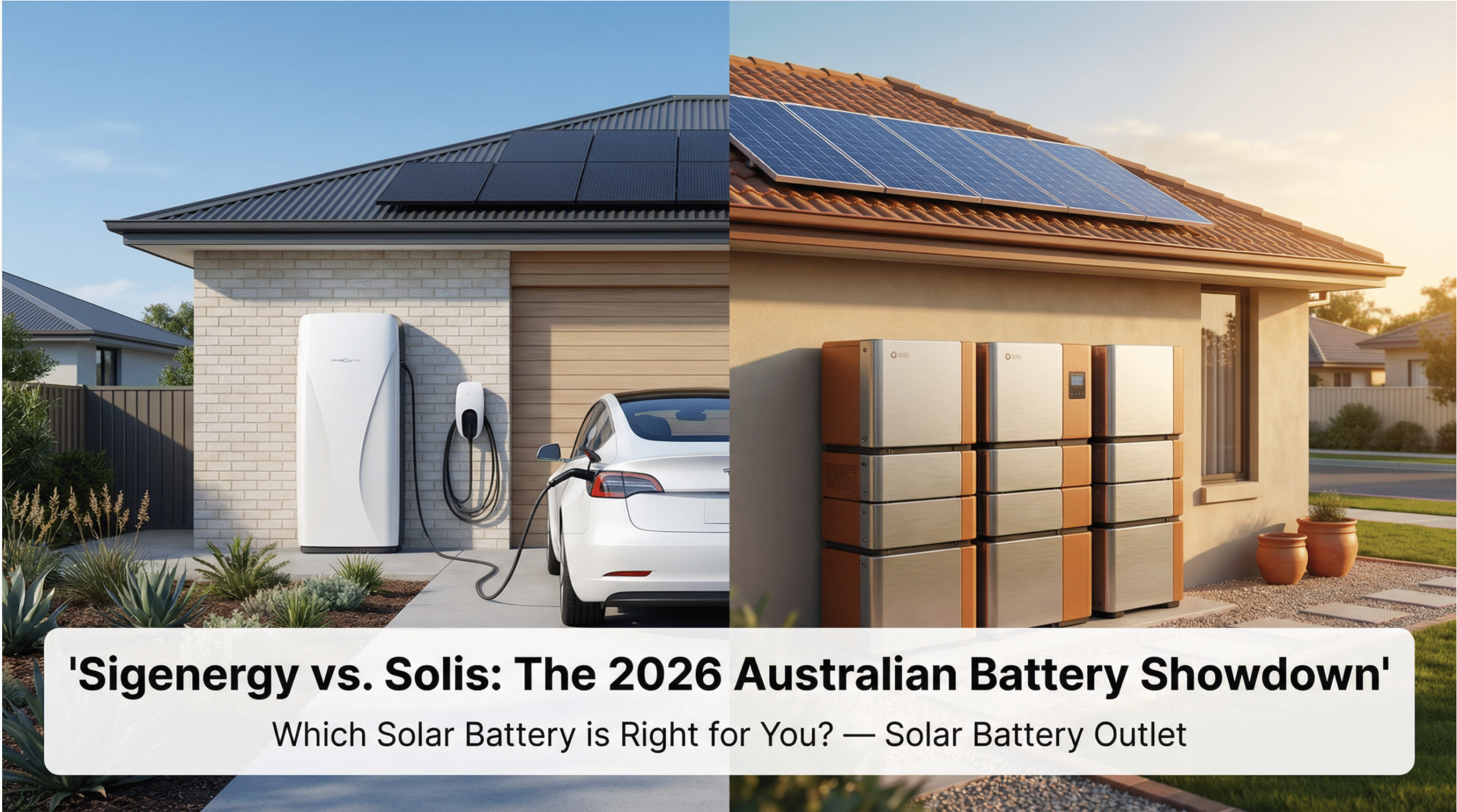
Siegnergy vs solis which is the best option to buy in 2026

Who is Sigenergy Best For? The Future-Focused Homeowner

The Sigenergy SigenStor is the perfect choice for you if:

  • You’re Installing a Brand New System: The all-in-one design simplifies installation, reduces costs, and provides a clean, minimalist look.
  • You Own (or Plan to Own) an Electric Vehicle: The integrated EV charger is a game-changer, allowing you to charge your car directly from your solar panels or battery.
  • You Love Smart Technology: Sigenergy’s AI-powered app gives you incredibly detailed control and optimization over your home’s energy usage.
  • Aesthetics Matter: You want a single, sleek unit on your wall that complements your modern home.

In short, Sigenergy is for those who want the latest technology in a simple, elegant, and future-proof package.

Sigenergy Quote
Ready for a seamless, all-in-one energy hub?
Get a free, no-obligation quote for a Sigenergy SigenStor system custom-designed for your home.

Who is Solis Best For? The Practical & Value-Conscious Homeowner

A Solis battery system is the ideal solution for you if:

  • You Already Have Solar Panels: Solis inverters and batteries are renowned for their compatibility, making them perfect for retrofitting to an existing system without needing a complete overhaul.
  • You Need a Custom Solution: Have a tricky installation space or unique energy needs? The modular nature of Solis components gives us the flexibility to design a perfectly tailored system.
  • You’re Focused on Proven Reliability and Value: Solis has a long-standing reputation in Australia for producing affordable, rock-solid products that deliver exceptional long-term value.
  • You Prefer a Mix-and-Match Approach: You want the freedom to pair a best-in-class inverter with a best-in-class battery, rather than being locked into a single ecosystem.

In short, Solis is for those who prioritize flexibility, proven reliability, and getting the most bang for their buck.


Looking for a flexible, reliable, and high-value battery system?
Get a free, no-obligation quote for a Solis battery system tailored to your specific needs and budget.

Our Expert Verdict: You Can’t Go Wrong, But You Can Choose Better

At Solar Battery Outlet, we confidently install both Sigenergy and Solis systems because they are both fantastic products that use safe LiFePO4 chemistry and offer industry-leading warranties.

Our recommendation comes down to your specific situation:

  • For new homes and customers who want the ultimate in simplicity and future-ready tech (especially EV owners), we lean towards the Sigenergy SigenStor. Its integrated design is simply a smarter, more elegant solution from the ground up.
  • For customers adding a battery to an existing solar system or those on a tighter budget who need a flexible, no-nonsense workhorse, we recommend Solis. Its proven reliability and modularity offer unbeatable value and customization.

Your Final Step: Get a Quote and Compare for Yourself

The best way to make your final decision is to see how each system stacks up for your home specifically. A personalized quote will break down the exact costs, projected savings, and payback period for both options.

Option 1: Compare Both Systems Head-to-Head

Let our experts design two custom systems for your home – one Sigenergy, one Solis. We’ll provide a detailed quote comparing both, so you can make a fully informed decision.

Option 2: Talk to an Expert

Still have questions? Book a free, no-pressure consultation. We’ll walk you through the pros and cons of each system based on your unique needs.

Blog Post Tags

Sigenergy vs Solis, Solar Battery Comparison, Solar Battery Review, Sigenergy, Solis, Home Battery Storage, Solar Power Australia, Best Solar Batteries 2026, EV Charging, Solar Retrofit

It’s the first question on everyone’s mind, yet it’s the hardest one to get a straight answer for: “So, how much does a solar battery actually cost?

You’ve seen the vague estimates and the “contact us for pricing” buttons. It’s frustrating. You’re trying to make a smart financial decision for your family, but the industry seems determined to hide the ball.

Let’s change that.

We’re the team at Solar Battery Outlet, and our mission is to give you the transparent, no-nonsense information you deserve. In this guide, we’re pulling back the curtain to reveal the true cost of a solar battery in Australia for 2026. We’ll show you what you’re actually paying for, what the sticker price doesn’t tell you, and how to find the best value for your money.

The Price Illusion: Why Upfront Cost is the Wrong Number to Look At

The biggest mistake homeowners make is comparing batteries based on their upfront price. It seems logical, but it’s like buying a car based only on the sticker price without considering its fuel efficiency, servicing costs, or resale value.

A cheap battery that dies in five years is far more expensive than a quality battery that powers your home for fifteen.

The Single Most Important Number: Cost Per Warranted Kilowatt-Hour (kWh)

To find the true value, you need to look at the cost per warranted kWh. This number tells you exactly how much you are paying for every unit of energy the battery is guaranteed to provide over its lifetime.

It’s calculated like this:

(Total System Cost) ÷ (Usable Capacity in kWh × Warranty Cycles × Depth of Discharge)

Don’t worry, you don’t need to calculate this yourself. We’ve done the hard work for you. Just know that a lower cost per kWh means a better long-term investment.

What Are You Actually Paying For? A Full Cost Breakdown

When you get a quote, the total price includes more than just the battery itself. Understanding the components helps you see where your money is going.

  • The Battery: The unit itself, which accounts for 60-70% of the total cost.
  • The Inverter: The “brain” of your system that converts DC power from your solar panels and battery into AC power for your home. Some batteries (like Sigenergy) have this built-in.
  • Installation: The labour from certified, expert installers. This is not an area to cut corners. A poor installation can void your warranty and create a safety hazard.
  • Balance of System (BOS): All the other bits and pieces – wiring, mounts, switches, etc.
  • GST: The 10% Goods and Services Tax.

2026 Solar Battery Price Brackets: What to Expect

Okay, let’s get to the numbers you’re looking for. Based on our experience installing hundreds of systems, here are the typical price ranges for a fully installed, quality solar battery system in Australia for 2026.

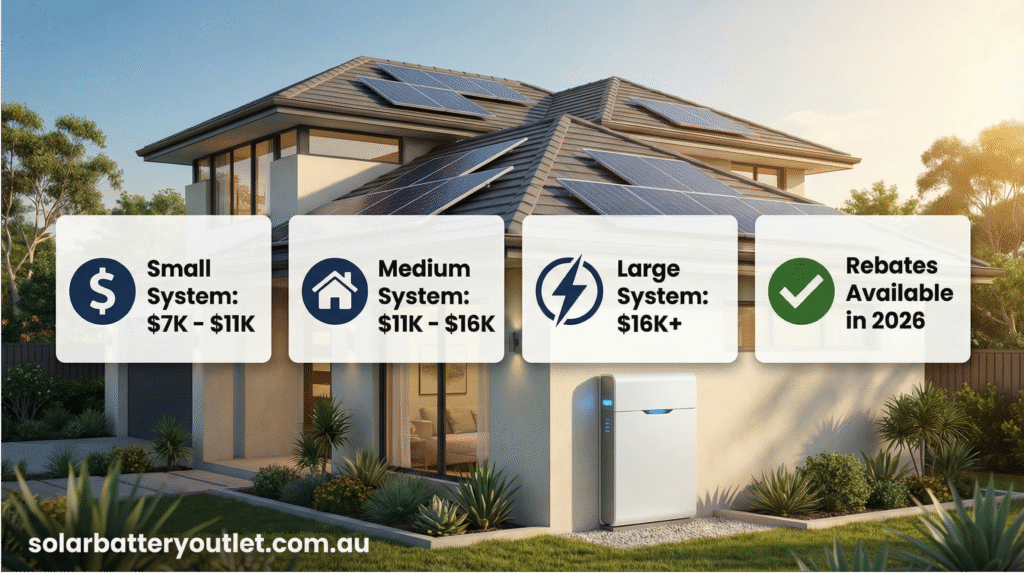
System SizeUsable CapacityBest ForFully Installed Price Range
Small5-8 kWhSmaller households, offsetting evening peak usage$7,000 – $11,000 (~)
Medium9-13 kWhAverage families, significant bill reduction$11,000 – $16,000 (~)
Large14+ kWhLarge homes, EV owners, near-total energy independence$16,000+ (~)

Important: These are ballpark figures. The only way to know the exact cost for your home is to get a personalized quote.

Quote Request
Want a precise, fixed-price quote for your home?
Our experts can provide a detailed quote within 24 hours, showing your exact costs, potential savings, and payback period.

The “True Cost” Comparison: Finding the Smartest Investment

Now, let’s apply the “cost per kWh” logic to three of Australia’s most popular batteries. This is where you can see the real value emerge.

Battery ModelUpfront Cost (Medium System)WarrantyCost per Warranted kWhOur Verdict
Sigenergy SigenStor (10kWh)~$12,50010 Years / 6,000 Cycles~$0.21🏆 Best Overall Value
Sungrow SBR (9.6kWh)~$13,50010 Years / 4,000 Cycles~$0.35Proven Workhorse
Tesla Powerwall 3 (13.5kWh)~$16,00010 Years / Unlimited Cycles*~$0.30 – $0.40+💎 Premium Brand

Tesla’s “unlimited cycles” warranty is great marketing, but most homes will only cycle a battery once per day (3,650 cycles over 10 years), making the real-world value comparable to high-cycle brands.

The Verdict is Clear:

While the Tesla Powerwall has the brand recognition, the Sigenergy SigenStor offers significantly better long-term value, giving you more guaranteed power for your money. The Sungrow SBR remains a rock-solid choice from a trusted brand, offering a fantastic balance of performance and reliability.

At Solar Battery Outlet, we specialize in installing Sigenergy and Sungrow systems because our analysis shows they consistently provide the best financial outcome for our customers.

Wondering which system is the perfect fit for your home and budget?
Let our experts design a custom system for you. We’ll compare your options and show you the long-term financial breakdown for each.

Maximizing Your Investment: Rebates & Installers

  • Government Rebates: Don’t forget to factor in federal and state rebates, which can reduce your upfront cost by thousands. But be quick – many of these are being phased out in 2026!
  • Choose the Right Installer: A quality installation by a certified expert is crucial. It ensures your system performs efficiently, meets safety standards, and protects your warranty. Choosing the cheapest installer is often the most expensive mistake you can make.

The Final Verdict: Focus on Value, Not Price

Hopefully, you can now see why the “sticker price” of a solar battery is only a small part of the story. To make a truly smart investment, you must look at the long-term value.

A battery with a lower cost per warranted kWh, from a reputable brand with strong local support, will always be the better financial choice.

Your Next Step: Get Clarity and Take Control

Ready to stop guessing and get a clear, fixed price for your home? The time to act is now, before rebates disappear and electricity prices rise again.

Option 1: Get a Quick, Personalized Recommendation

Take our 60-second quiz to discover which battery system is the perfect fit for your home, energy use, and budget.

Option 2: Get a Free, Detailed Quote

Let our experts provide a free, no-obligation quote. You’ll get a fixed price, a detailed savings projection, and a custom system design.

Option 3: Talk to an Honest Expert

Have questions? Book a free, no-pressure consultation with one of our solar experts. We’re here to help you make the right decision.

Questions? We’re here to help.

Solar Battery Outlet
📞 1800 000 777
📧 support@solarbatteryoutlet.com.au
🌐 solarbatteryoutlet.com.au

Proudly serving Australian families with expert solar solutions since 2019.

An Insider’s Guide from Your Friends at Solar Battery Outlet

That sinking feeling when you open your power bill. It’s a familiar story for millions of Australians. Prices go up, but the service stays the same, leaving you feeling powerless. But what if you could change the story?

What if you could capture the abundant Aussie sun, store it for when you need it most, and tell your power company, “Thanks, but no thanks”?

Welcome to the world of home battery storage, your ticket to energy independence.

But here’s the catch, choosing the wrong battery can be a costly mistake, leaving you with a system that underperforms and a warranty that isn’t worth the paper it’s written on. That’s where we come in.

We’re the team at Solar Battery Outlet, and for years, we’ve been on the front lines, installing and servicing solar systems for families just like yours. We’ve seen what works, what doesn’t, and what the big brands don’t want you to know. This isn’t another generic review site. This is our expert, insider’s guide to the best solar batteries in Australia for 2026 – the ones we’d confidently install in our own homes.

FREE SURVEY GUIDE

Ready to dive deep? Before we get to the reviews, grab our FREE 2026 Solar Battery Buyer’s Guide. It’s packed with everything you need to know to make a smart choice.


What Our Experts Demand in a Battery (And You Should Too)

We don’t just sell batteries; we install them, we service them, and we live with them. Our reputation is on the line with every system we recommend. That’s why our standards are non-negotiable. Here’s the checklist every battery must pass before we even consider it for our customers:

Rock-Solid Performance & Real Value

It’s not about the cheapest price tag; it’s about the most power for your dollar over the next decade. We look for a low cost per warranted kilowatt-hour (kWh), ensuring your investment pays you back year after year.

A Warranty You Can Actually Count On

A 10-year warranty is useless if the company disappears in three. We only partner with brands that have a proven track record and a dedicated, on-the-ground support team right here in Australia. If something goes wrong, you call us, and we handle it. Simple as that.

Future-Proof Technology

Your family’s energy needs will change. That’s why we prioritize modular, expandable systems. You should be able to start with a size that fits your budget today and easily add more storage as your needs grow, without having to replace your entire system.

Proven in Aussie Conditions

From scorching summer heat to coastal air, Australian conditions are tough. We demand batteries with high IP ratings and robust construction that are built to last, ensuring reliable power when you need it most.

Confused about what size you need? Stop guessing. Take our 60-second quiz to get a personalized battery recommendation tailored to your home and energy use.


Our Top Picks for 2026: The Batteries We Trust for Our Customers

After rigorously testing and installing countless systems, we’ve narrowed it down. These are the batteries that consistently deliver on their promises and provide real, long-term value for Australian homeowners.

The Smart All-Rounder: Sigenergy SigenStor

Best For: Homeowners who want a seamless, all-in-one system that’s ready for the future.

Every so often, a product comes along that just makes sense. The Sigenergy SigenStor is that product. It’s not just a battery; it’s a complete energy hub. By integrating the battery, a high-efficiency inverter, and even a built-in EV charger into one sleek package, it eliminates complexity and saves you money on installation.

What we love most is its “building block” design. You can start with a 5kWh unit to fit your budget today, and as your family grows or you add an electric vehicle, you can effortlessly stack more modules to increase your storage. It’s the definition of a future-proof investment.

Key Benefits

  • All-in-One Simplicity: Less clutter on your wall, a faster and cleaner installation, and one simple app to control your entire home’s energy.
  • Unbeatable Long-Term Value: With a massive 6,000-cycle warranty, this battery is built to work hard for over a decade, delivering one of the lowest costs per kWh we’ve seen.
  • Future-Proof Your Home: Start with the power you need and scale up anytime. This system grows with you, protecting your investment for the long haul.

Sigenergy Quote

Could the Sigenergy SigenStor be your ticket to energy freedom? Our experts can design a custom system for your home and provide a free, no-obligation quote. See exactly how much you could save.


The Proven Workhorse: Sungrow SBR Series

Best For: Homeowners who value proven reliability and want to add a top-tier battery to their existing solar setup.

In the solar world, Sungrow is a name synonymous with trust. They’ve been making world-class inverters for decades, and their SBR battery series is built with the same bulletproof engineering. If you already have solar panels and are looking for a robust, high-performance battery to complete your system, the Sungrow SBR is often our go-to recommendation.

Its modular design gives us the flexibility to design a system that perfectly fits your home’s unique layout and energy needs. While some brands are new to the scene, Sungrow has a long-standing presence in Australia with a dedicated local support team, which gives both us and our customers incredible peace of mind.

Key Benefits

  • Bankable Reliability: With Sungrow, you’re investing in a brand with a rock-solid reputation for quality and longevity, backed by a fantastic Australian support team.
  • Flexible & Powerful: Whether you have a large family or high-powered appliances, the SBR’s high-performance output and flexible design mean we can build a system that never leaves you in the dark.
  • Seamless Integration: This battery is designed to work flawlessly with Sungrow’s award-winning hybrid inverters, creating a powerful and efficient energy ecosystem for your home.

Sungrow Quote

Looking for a proven, high-performance battery from one of the most trusted names in solar? Let our team show you how a Sungrow SBR system can integrate with your home. Get your free, no-obligation quote today.

The Premium Brand: Tesla Powerwall 3

Best For: Homeowners who prioritize brand recognition and are willing to pay a premium for the Tesla experience.

The Tesla Powerwall is undoubtedly the most famous home battery in the world. Its sleek design and powerful marketing have made it a status symbol for the eco-conscious homeowner. The Powerwall 3 is an AC-coupled battery, which means it can be conveniently added to any existing solar panel system, regardless of the brand.

While it comes with a premium price tag, it also offers an industry-leading warranty of 10 years with unlimited cycles. For those deeply invested in the Tesla ecosystem, the seamless integration with the Tesla app is a major drawcard.

Our Expert Take

The Powerwall is a great product, but it’s not always the best value for every homeowner. Its fixed capacity means you can’t easily expand your storage without buying a whole new unit. For many of our customers, the modularity and superior cost-per-kWh of brands like Sigenergy and Sungrow offer a more practical and financially savvy long-term solution. We believe in giving you the full picture so you can make the best choice, not just the most famous one.

Consultation

Is the Powerwall right for you, or could another battery offer better value? It’s a big decision. Talk to one of our independent solar experts. We’ll give you a straight, honest comparison based on your specific needs, with no sales pressure.

The Bottom Line: Your Energy Independence Starts Here

Choosing the right solar battery is one of the most important decisions you’ll make for your home’s energy future. It’s not just about picking the cheapest option or the most famous brand. It’s about finding the system that will reliably power your home, save you money for years to come, and give you the peace of mind that comes with true energy independence.

At Solar Battery Outlet, we’ve spent years helping families just like yours navigate this decision. We’ve seen what works, what doesn’t, and what the marketing hype doesn’t tell you. Our mission is simple: to help you find the perfect battery for your home and install it with the expertise and care you deserve.

Whether you’re leaning towards the all-in-one simplicity of the Sigenergy SigenStor, the proven reliability of the Sungrow SBR, or you’re still exploring your options, we’re here to guide you every step of the way.

Ready to Take Control of Your Energy?

The time to act is now. With the federal battery rebate being phased out in 2026, the window of opportunity is closing. The sooner you invest in a quality battery system, the sooner you start saving money and enjoying the freedom of energy independence.

Option 1: Get Personalized Advice (Right Now)

Take our 60-second quiz to discover which battery is the perfect fit for your home and energy needs. You’ll get an instant, personalized recommendation based on your unique situation.

Option 2: Get a Free Quote & System Design

Ready to move forward? Let our expert solar team design a custom system for your home and provide a detailed, no-obligation quote. You’ll see exactly how much you could save and how quickly your investment will pay for itself.

Option 3: Talk to an Expert

If you have questions or want to discuss your specific situation with one of our solar experts, we’re here to help. No pressure, no sales pitch – just honest, expert advice.

Why Choose Solar Battery Outlet?

Local Experts

We’re not a faceless online company. We’re your neighbors, and we’ve been installing solar systems in Australian homes for years.

Honest Advice

We don’t push the most expensive option or the highest-margin product. We recommend what’s right for you.

Expert Installation

A great battery is only as good as its installation. Our certified installers ensure your system is set up perfectly.

Local Support

Something goes wrong? You call us, and we’re there to help. No waiting on hold with an overseas call center.

Transparent Pricing

No hidden fees, no surprise costs. You’ll know exactly what you’re paying for.

The Next Step Is Yours

Your journey to energy independence and lower power bills starts with a single decision: to take control. Don’t let another month of high power bills pass you by. Don’t let the rebate window close without taking action.


Questions? We’re Here to Help.

Solar Battery Outlet
📞 1800 000 777
📧 support@solarbatteryoutlet.com.au
🌐 www.solarbatteryoutlet.com.au

Proudly serving Australian families with expert solar solutions since 2019.

Quick Comparison Table

FeatureSigenergy SigenStorSungrow SBRTesla Powerwall 3
Best ForNew installations, future-proofingExisting systems, high performanceBrand enthusiasts, premium experience
Usable Capacity5–30 kWh (modular)9.6–25.6 kWh (modular)13.5 kWh (fixed)
Warranty10 years / 6,000 cycles10 years / 4,000 cycles10 years / unlimited cycles
Cost Per kWh$$ (Excellent Value)$$$ (Good Value)$$$$ (Premium)
Scalability⭐⭐⭐⭐⭐⭐⭐⭐⭐
Local Support⭐⭐⭐⭐⭐⭐⭐⭐⭐⭐⭐⭐⭐
Installation ComplexityLowMediumMedium
Our Recommendation✅ Expert’s Choice✅ Expert’s Choice✓ Premium Option

If you’ve been searching for Australian electricity cost-saving tips, you’ve probably noticed one thing, there’s too much advice and very little clarity.

Turn off the lights.
Run appliances at night.
Upgrade everything.

Yet for many households, the bills keep rising anyway.

This guide cuts through the noise and focuses on what actually works for real Australian homes, without pushing you into rushed or expensive decisions.

Start With This: Not All Energy-Saving Tips Are Equal

Before diving into tactics, it’s important to understand one thing:

Some tips help you use less electricity,
others help you pay less for electricity,
and only a few help you protect yourself long term.

Knowing the difference saves you time, money, and regret.

Practical Australian Electricity Cost-Saving Tips You Can Trust

cost saving tips for australians

1. Understand When Your Home Uses the Most Power

Many households focus on how much electricity they use, but when you use it matters just as much.

Peak-time usage often costs more and increases reliance on the grid. Identifying these patterns is one of the simplest ways to reduce electricity expenses without changing your lifestyle.

2. Reduce Dependence on the Grid (Not Just Usage)

Turning appliances off helps…but it doesn’t protect you from future price rises.

Homes that rely entirely on the grid remain exposed to:

  • Network charges
  • Peak pricing
  • Ongoing electricity increases

Reducing grid dependence, even partially, is where long-term savings start to appear.

3. Avoid “Cheap Fixes” That Don’t Last

Many popular tips promise quick wins but fade fast.

For example:

  • Ultra-cheap upgrades that underperform
  • One-off changes that don’t scale with your household
  • Solutions that don’t adapt as energy prices rise

Real energy bill savings strategies are designed to work year after year, not just next quarter.

4. Match Solutions to Your Actual Home

What works in one house may fail completely in another.

Your results depend on:

  • Roof type and orientation
  • Household size
  • Daily energy habits
  • Future plans (like EV charging or home offices)

This is why one-size-fits-all advice often leads to disappointment.

Energy Bill Savings Strategies That Support Long-Term Stability

save money in long term.

If your goal is to lower electricity costs in Australia consistently, focus on strategies that bring predictability.

These strategies:

  • Reduce exposure to price rises
  • Make monthly expenses more stable
  • Help your home work with you, not against you

Many Australian families are now shifting from “cutting usage” to creating control over how their home consumes and sources power.

Affordable Energy-Saving Solutions: What “Affordable” Really Means

Affordable doesn’t always mean cheap.

True affordable energy-saving solutions are:

  • Designed for Australian conditions
  • Backed by performance data
  • Supported over time
  • Built to adapt as your household changes

A solution that costs less upfront but fails to deliver long-term savings often ends up being the most expensive option of all.

Common Mistakes That Cancel Out Savings

Many households unknowingly undo their own efforts by:

  • Chasing trends instead of fit
  • Choosing systems that are too small or poorly matched
  • Making decisions without understanding long-term costs

This is why understanding the bigger picture matters. If you want a broader overview of how everything fits together, this guide on how to save money on electricity bills explains the full decision framework.

The Real Goal: Confidence, Not Just Lower Bills

Cost-saving tips are useful, but confidence is what actually changes outcomes.

When you understand:

  • Why your bills are rising
  • Which tips genuinely work
  • How to avoid short-term fixes

You’re far less likely to make rushed or regret-driven decisions.

Final Thoughts

Australian electricity cost-saving tips work best when they’re applied with context, not pressure.

You don’t need to overhaul everything overnight.
You don’t need to chase every new idea.

What you do need is clarity — and a strategy that makes sense for your home, your family, and your future.