Something significant is happening in Australian homes right now. Walk down any street in Western Sydney, Brisbane’s outer suburbs, or Adelaide’s growth corridors and you’ll notice it — gleaming solar panels on rooftops, flanked increasingly often by a white or grey box on the garage wall. That box is a home battery. And in 2026, more Australians are installing them than at any point in history.

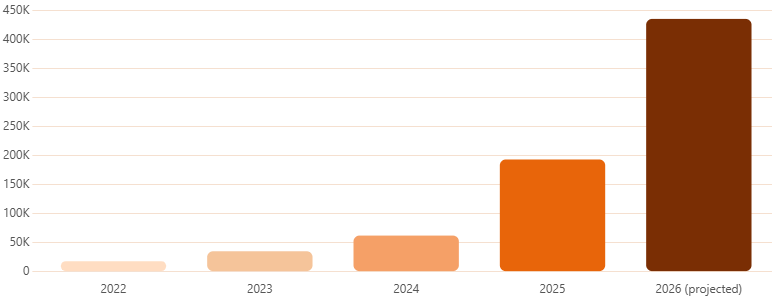
The numbers are striking. In March 2026 alone, NSW recorded over 600 megawatt-hours of new battery installations — a 44% monthly increase and a new state record. Nationwide, the Clean Energy Regulator is projecting up to 520,000 home battery installations this year alone, compared to just 193,000 in all of 2025. Australia’s residential battery storage market — already worth billions — is on track to reach USD 3 billion by 2034.

The rapid adoption of solar batteries is driving Australia’s energy shift in 2026, as homeowners look for smarter ways to store excess solar power and reduce reliance on the grid. With feed-in tariffs dropping and electricity prices rising, households are prioritising energy independence and better use of their rooftop solar systems. This isn’t a blip. 2026 is a genuine structural turning point for home energy storage in Australia. Here’s exactly why — and what it means if you’re still sitting on the fence.

Reason 1: The Government Finally Made It Worth It

For years, the economics of home batteries were marginal for most Australian households. The hardware was expensive, payback periods stretched to 12–15 years, and the financial case relied on a lot of optimistic assumptions.

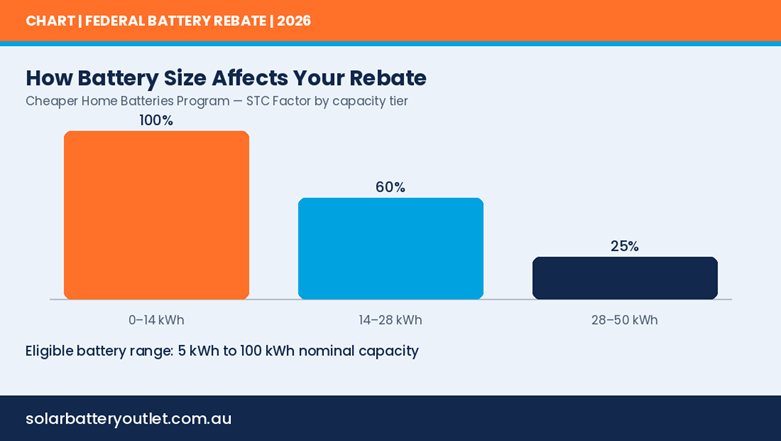
That changed in July 2025 when the federal government launched the Cheaper Home Batteries Program (CHBP) — making home batteries eligible for Small-scale Technology Certificates (STCs) under the Small-scale Renewable Energy Scheme for the first time. In plain English: the government is subsidising roughly 30% of the upfront cost of any eligible battery from 5 kWh to 100 kWh. On a standard 10 kWh system, that’s roughly $3,100 off the invoice before you even start talking about state-level incentives.

The results were immediate. Installations in the final quarter of 2025 alone were approximately three times higher than the total for all of 2024. The program has already supported more than 300,000 battery installations nationally since launch — and 2026 is on pace to dwarf that figure entirely.

Important for NSW homeowners: There’s also a separate NSW Peak Demand Reduction Scheme (VPP incentive) worth up to $1,500 on top of the federal rebate. Most homeowners don’t know about it until their installer tells them — or doesn’t. Read our full guide to the NSW VPP incentive here.

Australian residential battery installations 2022–2026

Australian residential battery installations 2022–2026 (2026 is CER midpoint projection). Sources: Clean Energy Regulator, SunWiz.

Reason 2: Feed-in Tariffs Have Collapsed — And That Changes Everything

Ask any solar installer what the number one question they get today is, and most will say some version of: “I already have solar but I feel like I’m not getting much back for what I’m exporting.”

With feed-in tariffs dropping and electricity prices rising, installing solar batteries allows households to use their own energy during peak evening hours instead of buying expensive power. This shift is helping many Australians reduce grid dependence while improving overall energy efficiency at home.

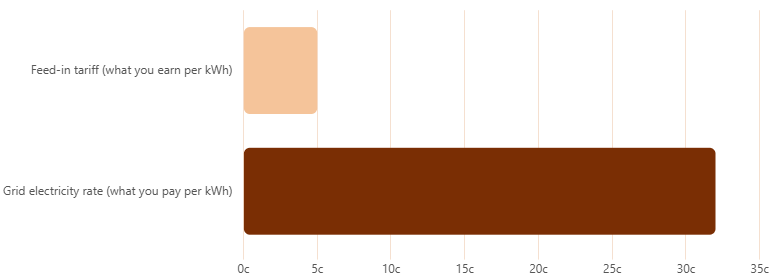
They’re right. Feed-in tariffs across Australia have dropped roughly 50% since 2022–23. In most states in 2026, you’re receiving somewhere between 3 cents and 10 cents per kilowatt-hour for electricity you export to the grid. Meanwhile, when you buy that same electricity back from the grid in the evening, you’re paying 28 to 45 cents per kilowatt-hour.

That gap — earning 5 cents, spending 35 cents — is the financial engine of the battery revolution. Every kilowatt-hour you store in your battery instead of exporting is worth six to ten times more than selling it. A 10 kWh battery that runs your house through an evening instead of drawing from the grid can save $8 to $14 in a single night. Run the numbers across a year and you can see why payback periods have compressed dramatically.

Average feed-in tariff vs. average grid electricity rate in NSW/VIC/QLD (2026)

Average feed-in tariff vs. average grid electricity rate in NSW/VIC/QLD (2026). Self-consumption via battery is worth 6–10× more than exporting. Sources: VoltFlow, IMARC Group.

Reason 3: Battery Costs Have Fallen to a Tipping Point

The third major shift in 2026 is on the cost side of the ledger. Battery hardware prices have followed the same downward curve as solar panels did a decade ago — a steep, sustained decline driven by scale manufacturing, improved chemistry, and fierce competition between BYD, Tesla, Sungrow, Enphase, and a growing field of challengers.

A 10 kWh battery system that would have cost $14,000–$18,000 installed five years ago now retails for around $10,000–$12,000 before rebates. After the federal CHBP rebate, the net cost drops to roughly $7,000–$9,000 for most households. For NSW homeowners who stack the VPP incentive on top, the net cost can fall below $6,000.

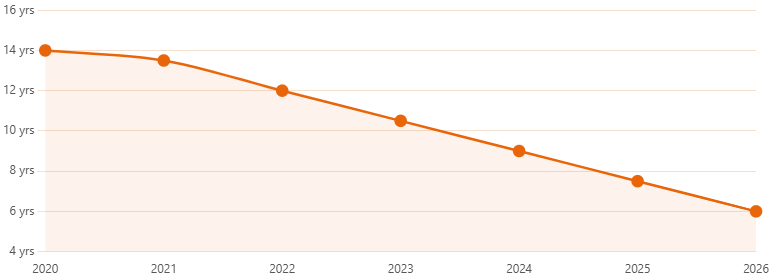
At those numbers, with current electricity prices and the end of meaningful feed-in tariffs, payback periods of five to eight years are realistic for a well-matched system. For high-consumption households or those in states with stronger incentives, payback of three to four years is achievable.

Popular Battery Models and Indicative 2026 Pricing (NSW)

BatteryUsable CapacityPre-Rebate (est.)After Federal RebateAfter Federal + NSW VPP
BYD Battery-Box HVM 10 kWh10 kWh~$10,500~$7,400~$6,300
Tesla Powerwall 313.5 kWh~$14,000~$10,280~$8,930
Sungrow SBR 9.6 kWh9.6 kWh~$9,800~$6,830~$5,770
Enphase IQ Battery 5P (10 kWh)10 kWh~$11,200~$8,100~$7,000

Prices are indicative estimates for installed systems including labour. Always request an itemised quote from your installer.

Government rebates and falling hardware costs have made solar batteries more affordable than ever, which is why many Australians are now pairing them with existing rooftop systems to maximise savings and improve backup reliability during outages.

Reason 4: The Grid Is Becoming Less Reliable — And Australians Know It

Beyond the financial case, there’s a growing practical motivation driving battery uptake: blackout anxiety. Australia’s electricity grid is under structural pressure. Coal plants are retiring faster than replacement capacity is being built. Extreme weather events — heatwaves, storms, cyclones — are becoming more frequent and more intense, placing higher peak demands on infrastructure that wasn’t designed for a 42-degree day.

For many Australians, the memory of being without power for hours or days is the final push they needed. A home battery with adequate backup capacity keeps the lights on, the refrigerator running, and the phone charged when the rest of the street goes dark. That resilience value is real and it’s something that doesn’t show up cleanly in payback period calculations — but it matters enormously to families with young children, medical equipment, or simply a home office they can’t afford to lose for a day.

Blackout note: If backup power is your priority, make sure your battery is configured as a “whole home backup” system. Some battery installations are grid-tied only and won’t power your home during an outage. Always confirm backup capability with your installer before signing a contract.

Estimated average battery payback period for a standard 10 kWh system

Estimated average battery payback period for a standard 10 kWh system (NSW, typical household). Reflects falling hardware costs, rising grid prices, and government rebates. Sources: Gridly, Solutions4Solar.

Reason 5: 2026 Is the Peak Incentive Window — And It’s Closing

Here’s the thing most homeowners don’t realise until it’s too late: the federal rebate is designed to step down every six months until 2030. The rate that applies now, in April 2026, is the highest it will ever be. After 1 May 2026, the rebate value drops by roughly $1,000 on a typical 13.5 kWh system. It drops again in November. And again every six months after that.

This isn’t conjecture — it’s by design. The government structured the program to front-load the incentive to kick-start the market, then gradually reduce it as costs fall and the market matures. Which means the window to capture the maximum rebate is now, in early to mid 2026.

This is why March 2026 saw a record-breaking surge in installations. The SunWiz industry analyst firm reported that Australia registered 341 megawatts of small-scale solar in March — more than ever recorded in a single month — with batteries surging 35% month-on-month. Homeowners are reading the data correctly and acting on it.

Federal Battery Rebate Step-Down Schedule (Approximate, 13.5 kWh System)

Installation PeriodEstimated Rebate Valuevs. April 2026
Before 1 May 2026~$4,557Maximum — current window
May – Oct 2026~$3,488–$1,069
Nov 2026 – Apr 2027~$2,800–$1,757
2028+Declining furtherStepped reductions continue

How Much Can You Actually Save?

The question every homeowner eventually asks is: what does this mean for my electricity bill? The honest answer is that it depends on your consumption patterns, your current tariff, whether you’re on time-of-use pricing, and how well your battery is sized against your usage. But some ballpark numbers help calibrate expectations.

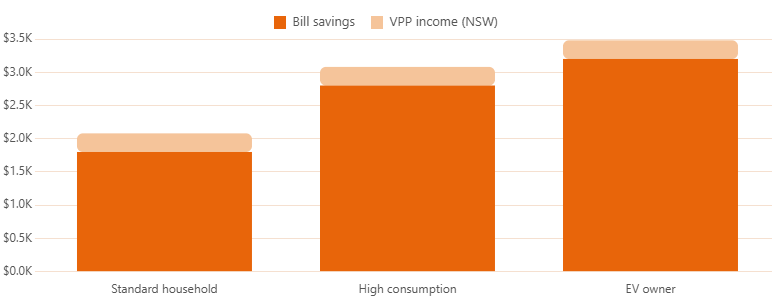
A typical Australian household on a time-of-use tariff, with a 6.6 kW solar system and a 10 kWh battery, can expect to reduce their annual electricity bill by $1,500 to $2,300. Higher-consumption households — those running air conditioning heavily, with an EV, or with pools — typically land in the $2,000 to $3,500 range. On top of bill savings, NSW homeowners enrolled in a VPP can earn an additional $130 to $450 per year from grid participation events.

Add it up: at the current rebate levels, a typical NSW household installing a 10 kWh system could recover their net investment in five to seven years — and then enjoy free or near-free electricity for the remaining 7–10 years of the battery’s warranty period.

Estimated annual electricity bill savings with a 10 kWh battery system

Estimated annual electricity bill savings with a 10 kWh battery system (NSW, time-of-use tariff). VPP income shown as additional layer. Sources: Gridly, Solutions4Solar, Solar Battery Outlet installs data.

What Does This All Mean for You?

If you already have solar and you’re exporting most of your generation at 4–6 cents per kWh, you’re leaving money in the grid every day. A battery doesn’t just save money — it recaptures value you’ve already generated and are currently giving away.

If you don’t have solar yet, 2026 is also an exceptional time to install solar and battery together. Combined packages often attract better pricing from installers, and the incentive structures for solar (STCs) remain strong alongside the battery rebate.

The structural forces driving the boom — a 30% government rebate, collapsing feed-in tariffs, rising grid prices, falling hardware costs, and a growing awareness of blackout risk — aren’t going away. But the specific rebate level that exists today in early 2026 is the most generous it will ever be. The market is telling you that clearly.

As one industry analyst put it plainly: the households that install in the first half of 2026 will look back at this window the way early solar adopters in 2012 looked back at the feed-in tariff era. The numbers will eventually change. Right now, they’re exceptional.

Ready to find out what you’d save?

We process both the federal Cheaper Home Batteries rebate AND the NSW VPP incentive on every installation. No chasing paperwork. Just a cleaner electricity bill.

Get a free quote — takes 60 seconds

Or call us on 1800 000 777

Frequently Asked Questions

Is 2026 really the best time to install a solar battery in Australia?

For most households, yes. The federal rebate is at its highest point and steps down every six months from May 2026. Grid electricity prices are at historic highs while battery hardware costs continue to fall. The combination of these factors creates a financial case that is better in early 2026 than it has ever been — and better than it will be by the end of the year.

Do I need to already have solar panels to install a battery?

No — you can install a battery without existing solar. Some households do this to take advantage of cheaper off-peak electricity rates. However, the payback case is strongest when you pair a battery with an existing or new solar system, because the battery stores your self-generated power rather than cheap grid electricity.

What’s the difference between the federal rebate and the NSW VPP incentive?

They are completely separate programs run by different governments. The federal rebate reduces your upfront invoice by around 30% on any eligible battery. The NSW VPP incentive pays you up to $1,500 separately after installation when your battery is connected to a Virtual Power Plant network. Both can be claimed together. See our NSW VPP guide for the full detail.

How long do solar batteries last?

Most major battery brands — BYD, Tesla Powerwall, Sungrow, Enphase — come with 10-year warranties and are typically rated for 3,000 to 6,000 charge cycles. In real-world Australian conditions, batteries are lasting 12–15 years in many installations. The warranty period is the floor, not the ceiling.

What size battery do I need?

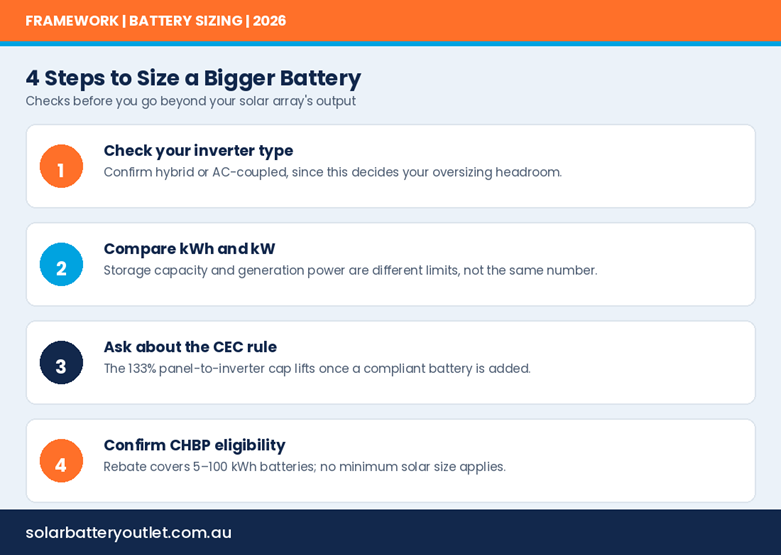
For a typical Australian home using 20–28 kWh per day, a 10–13.5 kWh battery will cover most evening and overnight usage. If you have an electric vehicle, air conditioning running heavily in summer, or a larger property, you may benefit from a larger system or stacked batteries. A good installer will analyse your actual usage data before recommending a size.

Solar Battery Comparison | Sydney NSW | Updated March 2026

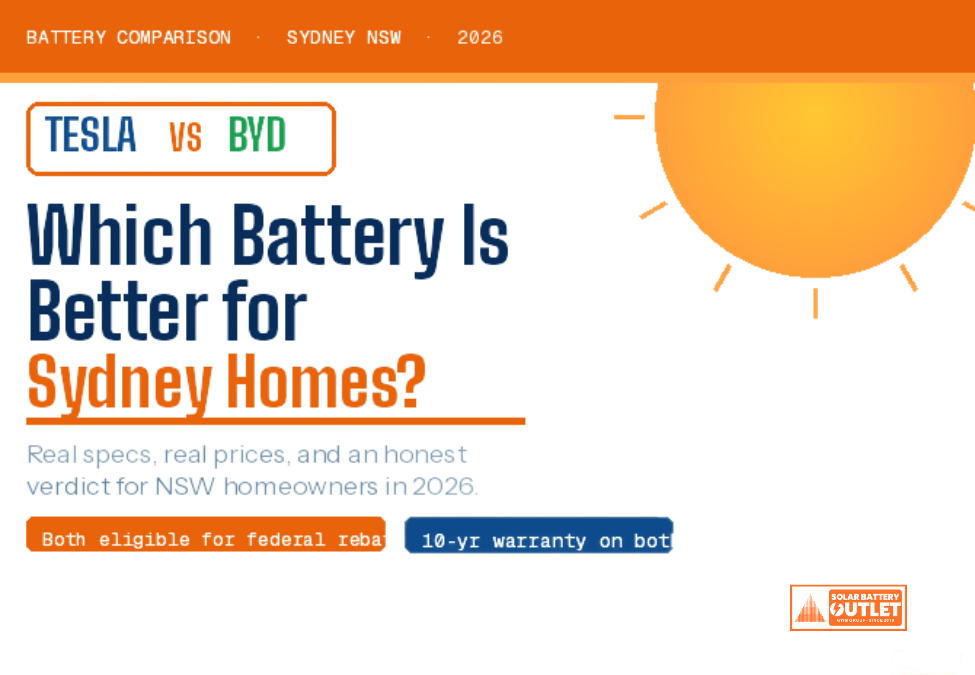
Tesla Powerwall 3 vs BYD Battery: Which Is Better for Sydney Homes in 2026?

If you’ve gotten past the ‘should I get a battery?’ question and now you’re comparing brands, you’ve probably landed on these two names. Tesla Powerwall. BYD Battery-Box. They come up in every online comparison, and half the time those comparisons leave you more confused than when you started.

So here’s a straight answer, written for NSW homeowners — not for people who enjoy reading spec sheets.

Short version: both are excellent batteries. The differences are real, but they’re not dramatic. Which one is right for you comes down to your budget, your existing solar setup, and what you actually want the battery to do.

Let’s go through it properly.

What Both Batteries Have in Common Before we compare them, it helps to know what they share. Both Tesla Powerwall 3 and BYD Battery-Box HVM use LFP (lithium iron phosphate) chemistry — which means they’re safe, long-lasting, and thermally stable in Australian heat. Both carry 10-year warranties. Both are on the CEC approved product list and eligible for the federal Cheaper Home Batteries rebate and the NSW VPP incentive. Neither is a bad choice. The question is which one fits your situation better.

Quick Specs Side by Side

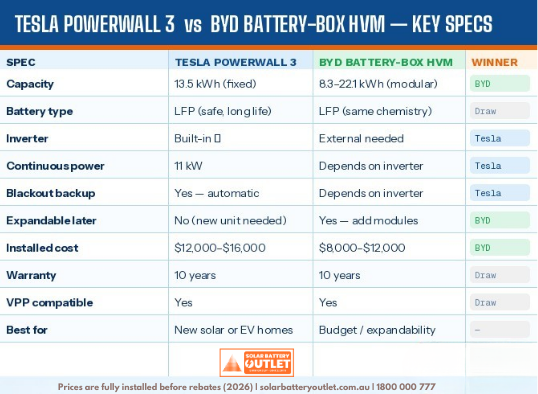
Let’s get the technical stuff out of the way first. Here’s how they compare on the key numbers:

Tesla Powerwall 3 vs BYD Battery-Box HVM — full specs comparison including winner per category

A few things worth explaining from that table:

  • The built-in inverter is Tesla’s biggest practical advantage. Most batteries need a separate ‘hybrid’ inverter to work. Tesla has one built in. If you’re installing from scratch or your old inverter is due for replacement anyway, this saves you $1,500–$2,500 right away.
  • BYD’s modularity is its biggest practical advantage. You can start with a 10 kWh system and add more modules later without replacing the whole battery. Tesla requires a whole new unit if you want to expand beyond 13.5 kWh.
  • ‘Blackout backup’ depends on your setup. Tesla handles this automatically — if the grid goes down, it switches instantly. BYD can do it too, but only if paired with the right inverter. Ask your installer to confirm before buying.

What Does Each Battery Actually Cost in 2026?

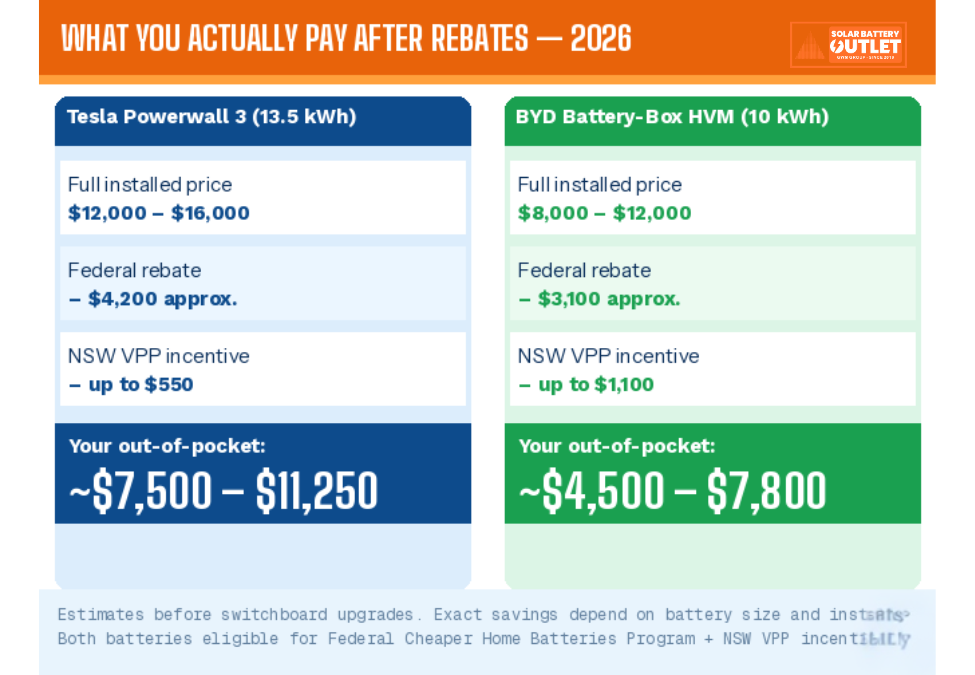
This is what most people really want to know. Here’s the honest pricing picture after rebates are applied:

What you actually pay after the federal rebate and NSW VPP incentive — Tesla vs BYD 2026

The BYD comes in meaningfully cheaper — typically $2,000–$4,000 less out of pocket than Tesla after rebates. For a lot of Liverpool and South West Sydney families, that gap matters.

The Tesla commands a premium because of the integrated inverter, the polished app, and the brand name. If you’re doing a fresh solar + battery install or your old inverter needs replacing, that premium shrinks significantly — because you’d have to buy an inverter for BYD anyway.

Bottom line: if budget is your main concern, BYD wins clearly. If you’re doing a full system install and want one product to do everything, Tesla’s price gap narrows fast.

The 1 May 2026 Rebate Deadline — Applies to Both The federal Cheaper Home Batteries rebate rate drops from 1 May 2026. This applies equally to Tesla and BYD. Getting your installation confirmed before that date locks in the current (higher) rebate regardless of which brand you choose. If you’re reading this in March or April 2026, now is the time to get your quotes sorted.

Which One Should You Actually Buy?

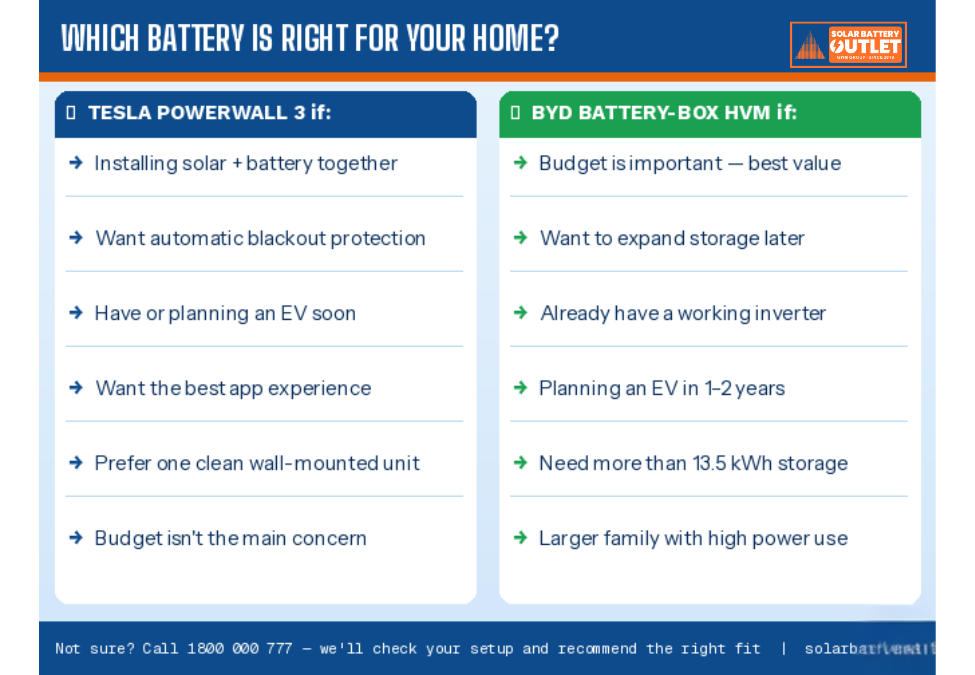
Honest answer: it depends on your situation. Here’s our plain-English guide:

Decision guide — choose Tesla Powerwall 3 or BYD Battery-Box based on your actual situation

Choose Tesla Powerwall 3 if:

  • You’re installing solar panels and a battery together (the integrated inverter saves real money)
  • You want true automatic blackout protection — Tesla switches seamlessly, no configuration needed
  • You have an EV or plan to get one — Tesla’s app handles smart EV charging really well
  • You want the cleanest, most user-friendly app experience for monitoring your energy
  • Your existing inverter is old and needs replacing anyway — factor that cost in
  • Design matters to you — the Powerwall is wall-mounted and genuinely looks good

Choose BYD Battery-Box HVM if:

  • Budget is your priority — BYD is typically $2,000–$4,000 cheaper after rebates
  • You want to expand your storage capacity later as your needs grow (e.g. when you get an EV)
  • You already have a compatible hybrid inverter (Fronius, Sungrow, GoodWe, etc.) working fine
  • You’re a larger family or run a home office and need more than 13.5 kWh of storage
  • You want a proven, reliable system without paying for the Tesla brand premium
  • Your installer is more experienced with BYD — installation quality matters more than brand

What About Other Brands?

Tesla and BYD get most of the attention, but they’re not the only strong options available in NSW. If you’re getting quotes, it’s worth asking about:

  • Sungrow SBR: The best value per kWh on the market right now. Requires a Sungrow hybrid inverter, so it’s most cost-effective if you’re doing a combined solar + battery install. Excellent reliability.
  • Growatt ARK: Newer to the Australian market but growing fast. Good tech at a competitive price point. Worth considering for smaller homes or tighter budgets.
  • Enphase: The premium modular option — each panel gets its own microinverter and battery module. More expensive, but the most resilient system design. Good for shaded roofs.

We install all of these. The ‘best’ brand for your home really does depend on what inverter you already have, your storage needs, and your budget. A good installer will go through this with you honestly — not just push the brand with the highest margin.

Questions to Ask Before You Decide

Before you lock in any brand, ask your installer these questions:

  • “What inverter do I currently have — and is it compatible with this battery?” If you have a working hybrid inverter, BYD might pair perfectly at lower cost. If you don’t, Tesla’s all-in-one is worth considering.
  • “Does this battery support automatic blackout switching?” Tesla yes. BYD depends on inverter — confirm this explicitly before buying.
  • “Is this battery modular? Can I add capacity later?” BYD yes. Tesla requires a second unit. Important if you’re planning an EV in the next 2–3 years.
  • “What’s the net cost after the federal rebate and NSW VPP incentive?” Always compare after-rebate prices. The sticker price gap between Tesla and BYD is bigger than the real gap after rebates.

Frequently Asked Questions

Can I retrofit either battery to my existing solar system?

Yes — both can be added to an existing system. Tesla is AC-coupled, meaning it connects directly without needing a new inverter. BYD is DC-coupled, which means it needs a compatible hybrid inverter. If you already have a compatible inverter, BYD is a great retrofit option. If you don’t, you’ll need to factor in the inverter cost.

Which battery has better blackout protection?

Tesla Powerwall 3 handles blackouts automatically — the switch happens within milliseconds and most people don’t even notice the grid went down. BYD can provide blackout protection too, but it depends entirely on the inverter it’s paired with. If blackout backup is important to you, confirm this in writing before you sign any quote.

Is BYD a reliable brand?

Absolutely. BYD (Build Your Dreams) is one of the largest battery manufacturers in the world — they also make EV batteries for Toyota, Ford, and their own electric cars. Their battery tech is mature, widely tested, and the Battery-Box has a strong track record in Australia. The 10-year warranty is solid and backed by their Australian office.

What if I want more than 13.5 kWh of storage?

BYD is the better choice here. You can expand a BYD system by adding modules — either at installation or later. Tesla Powerwall 3 is fixed at 13.5 kWh per unit. You can install a second Powerwall to get 27 kWh, but that’s a much bigger upfront investment.

Which brand holds its value better if I sell my house?

Tesla has stronger brand recognition with buyers, which may add slightly more perceived value to a property listing. That said, any quality battery brand adds value — the bigger factor is the age of the system and remaining warranty at point of sale.

Not Sure Which Battery Is Right for Your Home?
We install both Tesla and BYD across Liverpool, Bankstown, Campbelltown, and South West Sydney. We’ll check your existing setup, compare the real after-rebate costs, and recommend the battery that gives you the best return — not the one with the highest margin.
Call us: 1800 000 777
Or fill in our 60-second eligibility form at solarbatteryoutlet.com.au
About Solar Battery Outlet We’re a Liverpool-based solar battery installer, part of GWM Group Pty Ltd, servicing homes across South West Sydney, Bankstown, Campbelltown, Mudgee, and the greater NSW region. All installations by SAA-accredited electricians. We handle all rebate paperwork — federal and NSW — so you don’t have to.