Quick answer: Solar installation robots could speed up and de-risk parts of large solar builds. However, published Australian trials so far focus on big solar farms, not commercial rooftops. On rooftops, falls from height remain the biggest hazard, and robots do not replace proper fall protection.
Australia is installing solar at record pace. SunWiz data shows installers registered about 311.8 MW of small-scale solar (systems up to 100 kW) in September 2026. Meanwhile, January to September ran 43% ahead of the same period in 2025. ARENA has now backed robot manufacturing to help ease workforce constraints on large solar builds.
So, could solar installation robots make commercial solar projects faster and safer? This guide separates what works today from what remains early-stage. It also explains what a 10-year warranty actually covers, because that detail matters no matter who builds your system.
What Are Solar Installation Robots?
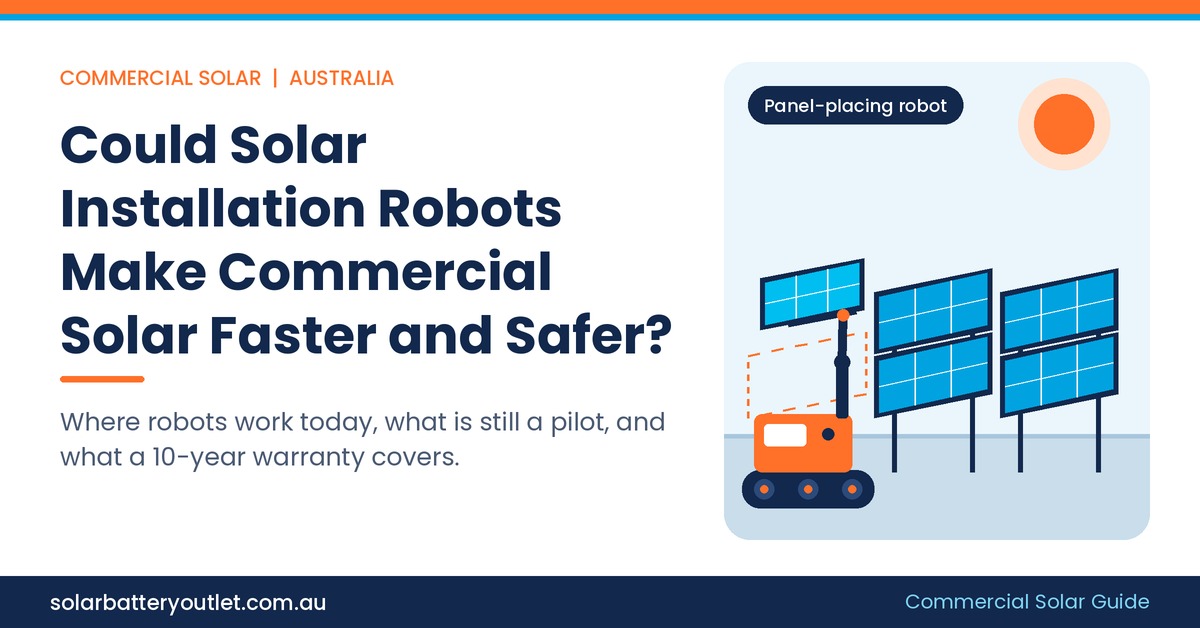
Solar installation robots are machines that automate heavy, repetitive steps in a solar build. Most fall into two groups. First, panel-placing robots lift modules and set them onto racking. Second, piling robots drive the foundation piles that hold the racking.
Luminous Robotics makes LUMI, a panel-placing robot. Built Robotics makes autonomous piling systems. For LUMI, human crews still complete the final securing of each panel. In fact, Luminous says LUMI helps existing crews install panels rather than replacing them.
Where Do Solar Installation Robots Work in Australia Today?
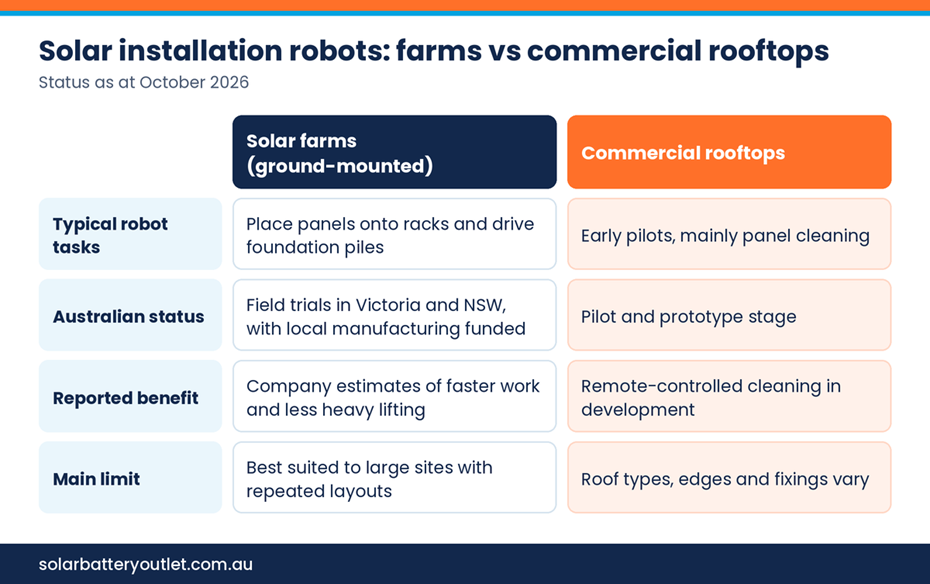
Robots have already worked on Australian solar farms. Luminous trialled its LUMI fleet at Engie’s 250 MW Goorambat East Solar Farm near Benalla, Victoria. The site installed almost 500,000 panels, with LUMI robots helping, and Luminous reported that LUMI exceeded its target production rate. ARENA also supported LUMI demonstrations in New South Wales.
Then, on 13 October 2026, ARENA committed up to $31.1 million to build solar robots locally. That includes up to $17.8 million for Luminous to support about 100 LUMI robots, made in Melbourne, by 2029. It also includes up to $13.3 million for a Built Robotics Brisbane hub that will manufacture 12 piling systems.
ARENA CEO Darren Miller called foundations and panel placement “two of the most labour-intensive parts of solar farm construction.” Accordingly, ARENA’s new funding targets those two steps.
What Do the Early Numbers Say?
Companies also publish performance estimates. Luminous says LUMI can help crews install panels up to 3.5 times faster, based on United States tests. Built Robotics estimates its piling robots could cut piling time by about 82% and labour costs by 88%. However, treat these figures as company estimates. Results can vary by site, crew and layout.
Can Solar Installation Robots Speed Up Commercial Rooftop Projects?
Not yet, based on published Australian trials. Those trials focus on large ground-mounted farms with repeated layouts. Commercial rooftops differ. Each roof has its own structure, edges, fixings and access limits. Consequently, a robot that suits an open field may not suit a warehouse roof. So far, reported rooftop robots mainly target tasks such as panel cleaning.
Panel placement is also only one stage of a project. Design, approvals, network connection and commissioning take time too. Therefore, faster placing does not automatically mean a faster handover. Likewise, ARENA expects the new robot facilities to ease workforce constraints on large-scale solar. Whether that frees capacity for rooftop projects remains unproven.
Could Solar Installation Robots Make Commercial Solar Safer?
They could reduce some hazards, but they cannot remove the biggest rooftop risk. Falls from height remain the major danger. WorkSafe Victoria reported on 26 August 2026 that, since 2021, falls from height injured over 2,300 workers. Another 20 died. These figures cover Victorian construction, which includes solar installation. Over the same period, WorkSafe prosecuted 42 solar companies for failing to manage falls risks.
SafeWork NSW has also named falls and electrical contact as the two biggest risks in rooftop solar. It adds that most serious falls happen from four metres or less. Robots help most with manual handling. For example, Luminous says LUMI lifts panels weighing about 36 kg, so crews avoid heavy lifting.
However, robots add new risks, such as machines moving near workers. Therefore, site teams still need to assess those risks. WorkSafe Victoria’s Sam Jenkin said “saving 10 or 20 minutes is never worth someone’s life.” That principle applies to any build method.
Importantly, the sources reviewed include no independent injury data for robot-assisted solar sites. So treat safety benefits as company and agency statements, not measured results.
What Do 10-Year Warranties Actually Cover?
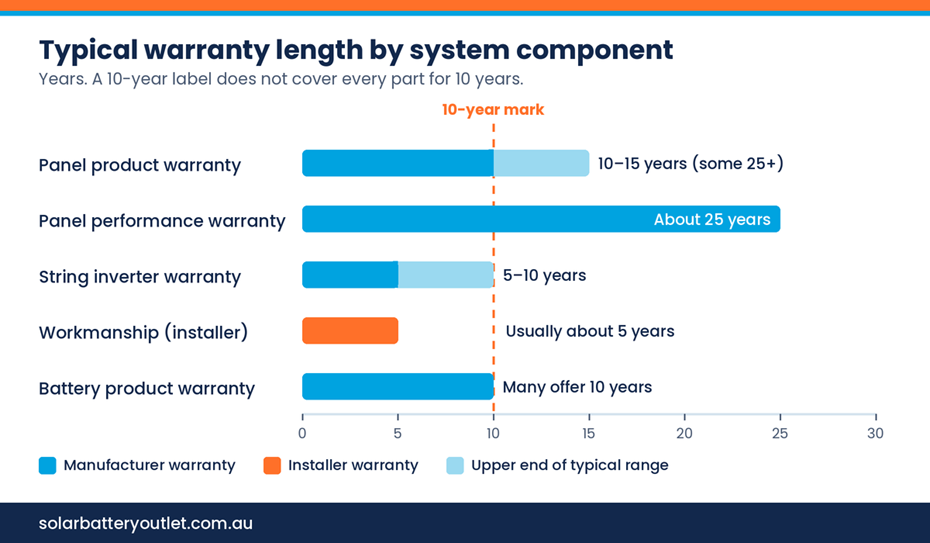
Whoever builds your system, the warranty decides who pays when something fails. However, a 10-year headline does not cover every part for the same period. The Australian Government’s Energy.gov.au warranty guide explains why.
Product Warranties
A product warranty covers faulty products. Many panels carry 10 to 15 years, while some reach 25 years or more. Many batteries also carry a 10-year product warranty. However, a maker may guarantee a fixed term or a minimum number of cycles, whichever comes first. Throughput warranties instead cap the total energy delivered.
Performance and Capacity Warranties
A performance warranty promises minimum panel output. Almost all panels carry one for 25 years. A standard example is 90% of output to year 10 and 80% to year 25. Yet Energy.gov.au notes that performance claims can be difficult to enforce. Battery capacity warranties work in a similar way. For example, a maker may guarantee 60% of original capacity for 10 years.
Workmanship Warranties
A workmanship warranty covers installation faults, such as a leaking roof from cracked tiles. It usually lasts about five years. Therefore, a 10-year manufacturer warranty does not extend your installer’s cover.
What a 10-Year Warranty Usually Excludes
Most panel warranties exclude hail damage. Energy.gov.au also notes that warranties may not cover damage you or the weather cause. Moreover, many battery warranties add conditions of use. These can limit daily charge cycles, grid charging or weather exposure. Insurance, rather than a warranty, usually covers hail and storm damage. When you compare quotes from any solar battery company, ask for these limits in writing.
How the Australian Consumer Law Fits In
A warranty adds to your rights under the Australian Consumer Law. It does not replace them. The ACCC says consumer guarantees cover goods and services that cost $100,000 or less. Many large commercial systems cost more than $100,000. Consequently, contract warranty terms carry more weight on bigger projects.
How Can You Check a 10-Year Warranty Before You Sign?
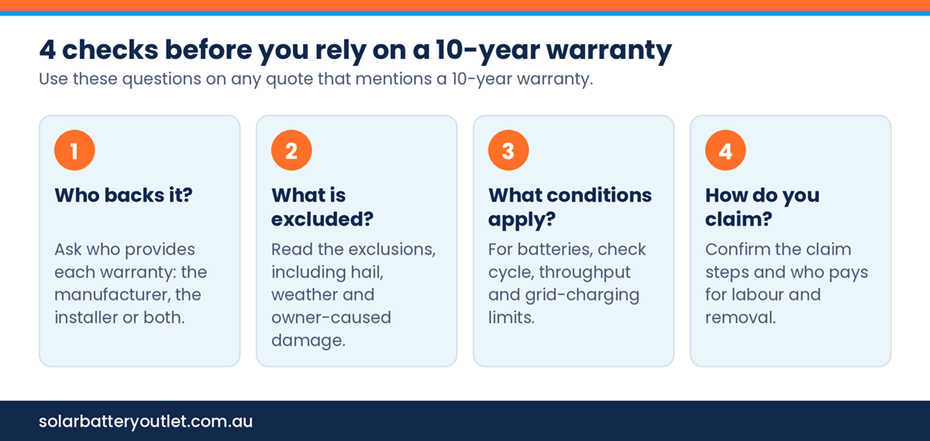
Use four checks on any quote that mentions a 10-year warranty.
- First, ask who provides each warranty. The manufacturer usually backs the product, while the installer backs the workmanship.
- Second, read the exclusions. Look for hail, weather and owner-caused damage.
- Third, check the conditions of use. For batteries, look for cycle, throughput and grid-charging limits.
- Finally, ask how to claim. Confirm who pays for labour and removal.
What Should Commercial Buyers Do Now?
You do not need to wait for robots to plan a commercial solar project. Instead, focus on the factors you can control today. Ask your installer how they manage work at height on your roof. Also ask for the safe work method statement that covers the job. Then compare each warranty against the four checks above.
Planning solar or battery storage for your business? Solar Battery Outlet’s team in Liverpool, Bankstown and Mudgee can talk through your quote. Bring your warranty and installation safety questions. As a local solar battery company, we welcome questions about every warranty line. Contact us to start the conversation.
Frequently Asked Questions
Solar installation robots are machines that automate heavy, repetitive build steps. Some place panels onto racking, while others drive foundation piles. Crews still supervise the work and finish tasks such as securing panels.
Yes, on large solar farms. Luminous trialled LUMI robots in Victoria and New South Wales. On 13 October 2026, ARENA committed up to $31.1 million to build solar robots locally.
Published Australian trials focus on ground-mounted solar farms. Reported rooftop robots mainly target tasks such as cleaning. Rooftop installs therefore still rely on human crews and on-site safety controls.
Robots can reduce heavy lifting on solar farms, which companies and agencies describe as a safety benefit. However, independent injury figures remain limited. On rooftops, falls from height stay the main hazard, so fall protection still matters.
It typically covers faulty batteries. Some warranties also guarantee minimum capacity, such as 60% after 10 years. Makers may also cap cycles or total energy throughput, so read the exclusions and conditions of use.
Usually not. Energy.gov.au notes that most panel warranties exclude hail, and insurance often covers storm damage instead. Check both your policy and your warranty wording.
Yes. A warranty adds to your Australian Consumer Law rights and cannot remove them. The guarantees cover goods and services costing $100,000 or less, so larger commercial purchases may depend more on contract terms.
Disclaimer
This article gives general information about solar installation robots, commercial solar safety and warranty terms in Australia. It does not describe Solar Battery Outlet’s own products, prices or warranty terms. Robot performance figures come from companies and trial sites, and results vary by project. Safety duties, warranty terms and consumer rights depend on your contract, your site and current law, which can change. Nothing here guarantees a faster build, a safer site, savings or any warranty outcome. Information is current as at 16 October 2026. Always seek personalised advice before making a purchasing decision.