Every sunny afternoon, NSW rooftops produce more solar power than the grid will accept. Your panels keep working. But an invisible ceiling stops the surplus from going anywhere. That ceiling is your solar export limit, and your network sets it, not you. Solar battery curtailment NSW-wide is the direct result, and it is the single biggest reason storage now pays off. Once you understand why the grid caps your exports, storing that surplus instead of losing it becomes the obvious move for solar batteries NSW households in 2026.

What Is a Solar Export Limit, and Why Does NSW Have One?

A solar export limit is the maximum power your inverter can send to the grid at any moment. Ausgrid, Endeavour Energy and Essential Energy set these caps to protect local infrastructure. Suburban power lines were built decades before rooftop solar existed. They carried electricity one way, from substation to home. They were never designed for the reverse flow. When too many homes export at once, voltage on the line can climb too high. Networks respond by capping how much each household can push back. Your inverter still generates power. It simply throttles what leaves your property.

NSW Government energy planners acknowledge this tension directly. Their Consumer Energy Strategy notes that sunny, low-demand periods create real network risks. That is why measures like the Emergency Backstop Mechanism are rolling out across the state.

NSW Export Limits by Network: Ausgrid vs Endeavour vs Essential Energy

Your export limit depends on which network covers your street. Ausgrid services Sydney’s east, the Central Coast and the Hunter. It generally applies the highest fixed limit of the three, up to 10 kW per phase for single-phase homes. Endeavour Energy covers western Sydney and the Illawarra. It defaults to a lower 5 kW per phase. Flexible exports can lift this to 10 kW when the local network has spare capacity. That flexible option is set to become standard for new and upgraded systems from late 2026. Essential Energy serves regional NSW, including Mudgee. It also defaults to 5 kW per phase. Some weaker rural lines restrict exports to as little as 3 kW.

The chart below compares these limits across all three networks.
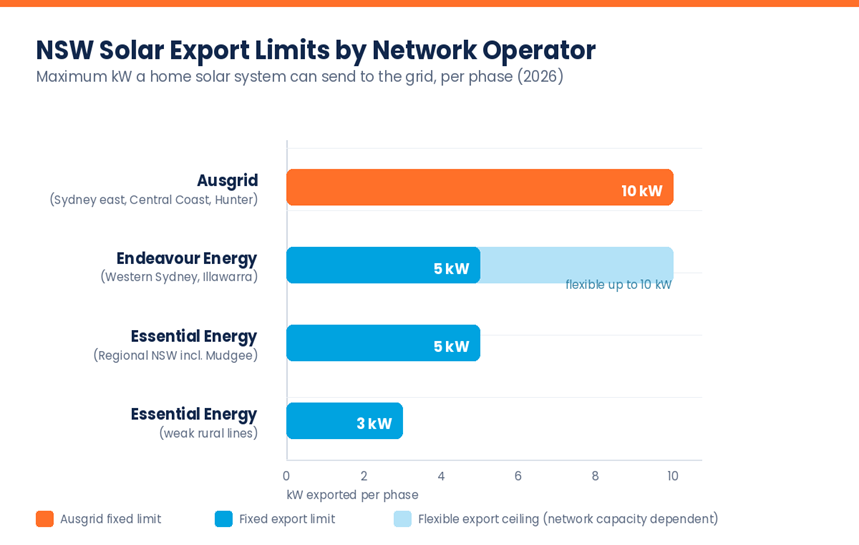
NSW solar export limits by network operator: Ausgrid, Endeavour Energy and Essential Energy

Check your latest bill, or your network’s connection portal, before assuming what your system can export.

The Real Cost of Solar Battery Curtailment in NSW

Curtailment happens when your panels generate more than your export limit allows. If your household is not using that excess, it simply disappears. The inverter throttles output smoothly. Nothing trips or shuts down. But the unused generation converts to heat, not savings.

Consider a typical 8 kW system in Sydney behind a fixed 5 kW export cap. On a sunny day, it might export 12 to 16 kWh. That earns roughly one to two dollars at today’s feed-in tariff rates of 2 to 10 cents per kWh. Anything above the cap that the household is not using is curtailed. It never becomes savings or income.

This is not a rare edge case. The Australian Energy Regulator reports the average static export limit sits at just 5.7 kVA nationally. Only 27% of network customers currently use export services at all. Just 4% of customers have paired their solar with a battery. Yet batteries are the most direct way to capture what would otherwise be lost.
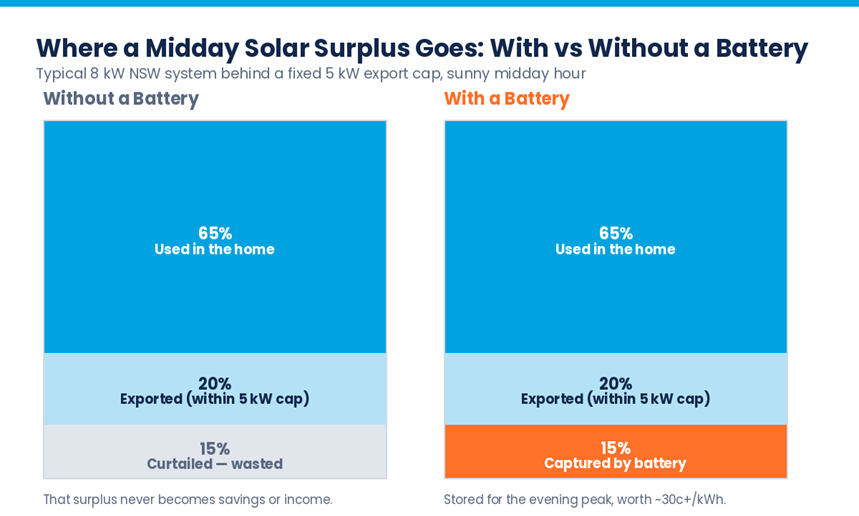
Where a midday solar surplus goes, with and without a home battery, on a 5kW NSW export cap

Why a Home Battery Turns a Limit Into an Opportunity

Here is the detail that changes the maths for solar batteries NSW owners: self-use beats export every time. NSW feed-in tariffs currently sit between roughly 4.8 and 7.3 cents per kWh. Evening grid electricity often costs 30 cents or more per kWh. A battery does not just store your surplus. It shifts that surplus from a low-value export slot into a high-value evening slot.

Ausgrid’s two-way tariff, sometimes called the “sun tax”, adds pressure on midday exports. It pays more for exports later in the day instead. Independent estimates put the average annual bill impact at around $6.60 for an unchanged 5 kW system. That is a modest number alone, but it signals where the market is heading. Our guide to solar export limits across NSW networks covers this shift in more detail. Exporting is becoming a smaller part of the value equation. Self-consumption through storage is becoming the bigger one.

Case Example: A Bankstown Household on an Endeavour Energy Connection

Picture a Bankstown family running an 8 kW solar array on an Endeavour Energy connection. Their fixed export limit sits at 5 kW. On sunny days, 2 to 3 kW of generation regularly exceeds that cap. This happens right in the middle of the day, when nobody is home to use it. Without storage, that power is wasted. With a 10 kWh battery, the same household can capture a meaningful share of that curtailed energy. It can then shift that energy to the 5pm to 9pm window. NSW electricity prices peak in that window. Endeavour Energy’s own evening export rate climbs as high as 11.71 cents per kWh in summer. Before locking in a system size, ask a licensed provider about solar batteries installation matched to your real curtailment pattern.

2026 Rebate Timing Makes Storage More Affordable Right Now

The federal Cheaper Home Batteries Program currently provides roughly $250 per usable kWh of storage. This applies to the first 14 kWh, then tapers above that threshold. The rebate factor steps down every six months. Earlier solar batteries installation generally locks in a larger discount than waiting. Combine that with an export limit already capping your midday generation. The case for adding storage sooner, rather than later, becomes considerably stronger. Our guide on deciding whether to rush before rebate changes walks through these numbers step by step.

A 4-Step Framework to Size a Battery Around Your Export Limit

Work through these four checks before committing to a system size.

  • Step 1: Confirm your export limit. Call your DNSP, or ask your installer to confirm it in writing.
  • Step 2: Compare your panel capacity to that limit. A 10 kW array behind a 5 kW cap will curtail often.
  • Step 3: Estimate your midday curtailment. A good installer can model this from your roof size and usage.
  • Step 4: Match your battery size to that surplus. Do not simply choose the biggest option available.

Homeowners who follow this order avoid paying for capacity they will never fill. They also avoid under-sizing a system and leaving real savings on the table.

Frequently Asked Questions

What is the solar export limit in NSW?

It ranges from 3 to 10 kW per phase, depending on your network. Ausgrid generally allows up to 10 kW. Endeavour Energy and Essential Energy default to 5 kW. Some rural Essential Energy lines cap at 3 kW.

Does export curtailment really cost homeowners money?

Yes. Generation above your export limit that your home is not using earns nothing. On an oversized system, this can waste a noticeable share of annual generation.

Can I apply for a higher export limit in NSW?

In some cases, yes. Endeavour Energy allows customers to apply for special permission for extra inverter capacity or a higher limit. Approval depends on local network capacity.

Do export limits affect my feed-in tariff payments?

Indirectly, yes. A lower export limit caps how much solar can earn a tariff at all, regardless of the rate itself. This is one reason storage often beats chasing a higher limit.

Will flexible or dynamic export limits replace fixed limits in NSW?

Flexible exports are already expanding across Endeavour Energy’s network. They are expected to become standard for new and upgraded systems from late 2026. Fixed limits will likely remain the default elsewhere for longer.

Get Your Export Limit Checked, Free

Not sure what your export limit is, or whether a battery makes sense for your home? Solar Battery Outlet offers free, no-obligation assessments across Liverpool, Bankstown and Mudgee. We check your network’s export limit, model your curtailment, and recommend a system sized around your real usage. Call 1800 000 777, or visit solarbatteryoutlet.com.au to book your assessment.

Disclaimer

This article is general information only. It does not constitute financial, legal or engineering advice. Export limits, feed-in tariff rates and rebate amounts referenced here are current as of publication. They vary by network operator, property and time of year, and may change without notice. Curtailment and payback figures are illustrative estimates based on a typical system. They are not a guarantee of savings for any specific property. Always confirm current export limits, tariffs and rebate eligibility with your network operator, retailer or a licensed solar provider. Always seek personalised advice before making a purchasing decision.
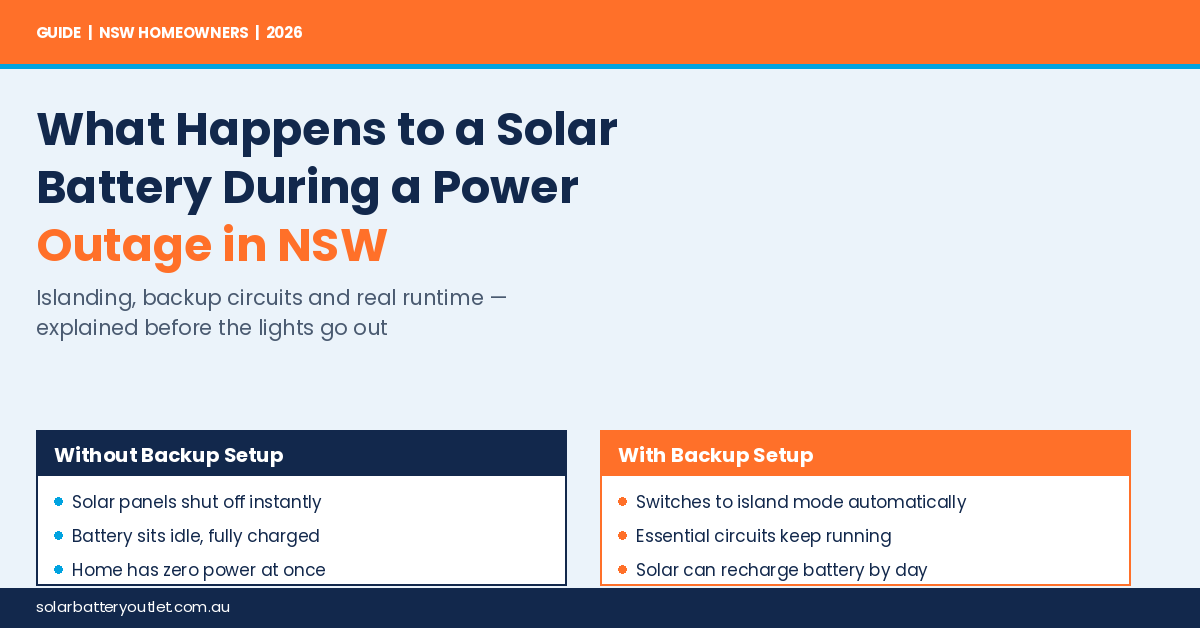
When the grid goes down across New South Wales, most homeowners assume their rooftop solar and battery will simply keep the lights on. In reality, that isn’t automatic. Every standard grid-connected solar system in Australia includes a safety feature called anti-islanding, and it switches your panels off the instant the grid fails, even if the sun is shining and your battery is sitting fully charged. Whether your home actually stays powered during a blackout depends entirely on how your solar batteries installation is configured. This guide walks through exactly what happens, second by second, when the power goes out, how long a typical battery can realistically keep your home running, and the framework our team uses with NSW customers to make sure their system is genuinely blackout-ready before the next storm season arrives.

Why Your Solar Panels Shut Off the Moment the Grid Fails

Under Australian Standard AS/NZS 4777, every grid-connected inverter must disconnect automatically the instant it detects the grid has failed. This rule exists to protect the linespeople who may be repairing damaged infrastructure nearby. If an inverter kept exporting electricity into a supposedly dead line, it could re-energise that line and put a repair crew at serious risk.

The Victorian Government’s official solar and battery backup guidance confirms that standard solar systems are designed to switch off during an outage unless the battery has specifically been configured for backup, sometimes called island mode. This is one of the most common points of confusion for homeowners: owning a battery does not automatically mean backup power. Two extra components are required — a hybrid or multi-mode inverter capable of islanding and a backup switchboard or gateway that physically isolates your home’s wiring from the grid. Backup capability is still frequently sold as an optional extra on solar batteries in NSW quotes, rather than included by default, so it pays to ask directly instead of assuming it’s covered.

Without both components, your panels and battery behave like a standard grid-tied system. They shut down together during an outage. Your home stays dark despite stored battery energy. Ausgrid confirms standard solar systems shut down automatically during outages. The inverter’s built-in safety system handles the shutdown.

How Islanding Mode Actually Takes Over

When a backup-capable system is installed correctly, the transition happens automatically, without any input from you. The inverter continuously monitors grid voltage and frequency, and the moment it detects an outage, a backup gateway isolates your home’s essential circuits from the broader network. Switchover speed varies by product: some gateways switch in a fraction of a second, fast enough that most fridges, routers and LED lights don’t even flicker, while others can take a few seconds, which may cause sensitive electronics like computers to briefly restart. It’s worth asking your installer what switchover time to expect for the specific hardware you’re quoted.

Your home briefly becomes a small, self-contained electrical network. It draws power from the battery instead of Ausgrid, Essential Energy, or Endeavour Energy. During daylight outages, rooftop panels can keep generating and recharge the battery while it remains islanded. This is one of a battery’s biggest advantages over a petrol generator. During overnight outages, the battery works alone until sunrise. Runtime depends on battery size and the number of connected circuits.

Essential Circuits vs Whole-Home Backup: What Actually Stays On

Not every appliance needs power during a blackout. Most NSW systems use one of two backup levels. Essential-circuit backup is the more affordable and common option. It powers the fridge, freezer, lighting, internet, and selected power points. Whole-home backup requires a larger battery and a more powerful inverter. It can run air conditioning, ovens, and hot water systems. However, it drains the battery much faster.

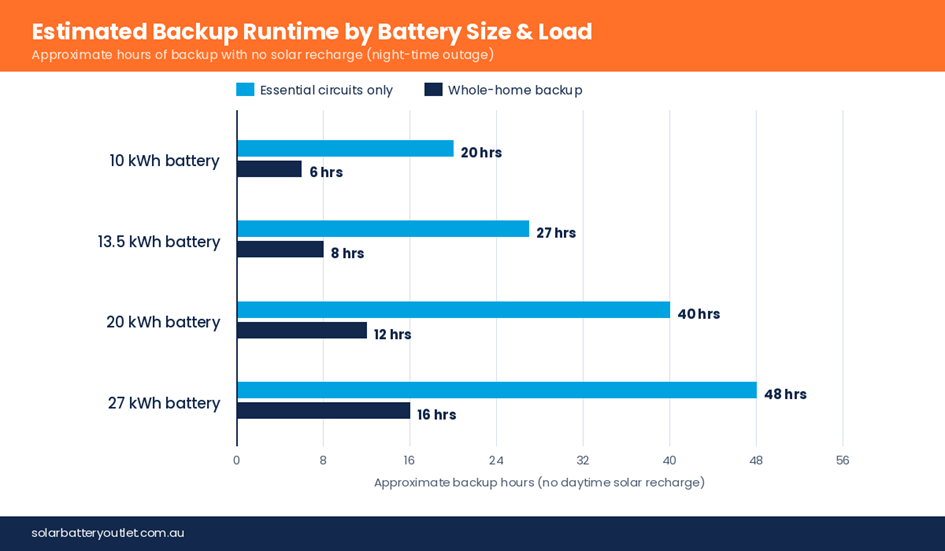
The chart below shows roughly how long four common battery sizes can support each tier during an overnight outage, assuming no solar recharge is available.

Estimated backup runtime by battery size and load tier — Solar Battery Outlet

As the numbers show, a 10kWh battery might comfortably run essential circuits for around 20 hours but only about 6 hours of whole-home load. That gap becomes far more meaningful once you factor in how long NSW outages actually last, which is exactly why local outage data matters when planning a solar batteries installation around genuine backup, rather than best-case assumptions.

Real NSW Outage Data: How Long Blackouts Actually Last

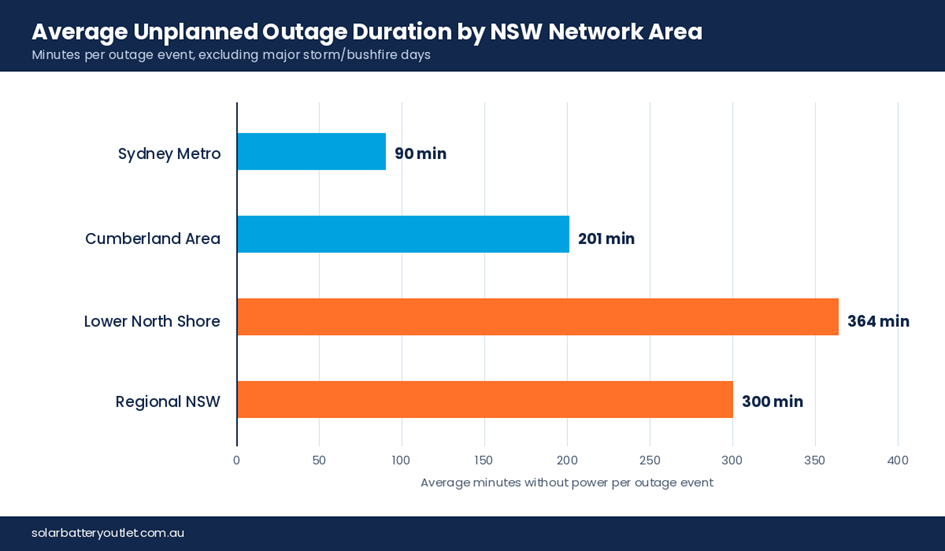
Outage duration varies across NSW. Ausgrid’s Sydney network usually records some of the state’s shortest outages. However, metro suburbs can still experience multi-hour interruptions. Some Sydney areas average more than three hours per outage. Essential Energy serves larger and more exposed regional areas. Crews travel farther, and weather causes longer restoration times.

Average unplanned outage duration by NSW network area

The takeaway is simple. A battery for a short outage is not the same as one for a major NSW blackout. Many NSW areas experience long outages regularly. This is common across Western Sydney, the Blue Mountains, the Hunter, and regional areas. Essential-circuit backup is usually the more practical choice. A mid-sized battery can support essential loads during longer outages.

A Worked Example: What This Looks Like in Practice

To make the numbers easier to understand, consider a hypothetical NSW example rather than a real customer case. Imagine a Bankstown home with a 13.5kWh battery and essential-circuit backup. A summer storm cuts grid power at 9 pm, and electricity returns just after 2 am. The outage lasts five hours. The battery keeps the fridge, freezer, lights, NBN modem, and home office power points running without interruption. These essential loads use relatively little power, so the battery still has useful capacity when the grid returns. If the household had chosen whole-home backup and run air conditioning during the outage, the battery would likely have drained well before sunrise.

A 4-Step Framework to Make Your Battery Blackout-Ready

Use this simple sequence with your installer before signing off on a battery quote or to check an existing system:

  1. Confirm the backup capability in writing. Ask whether the quoted inverter and battery support islanding and whether backup is included or sold separately.
  2. Choose your circuit tier deliberately. Decide, circuit by circuit, what genuinely needs to survive a blackout, such as the fridge, lighting, medical equipment and internet, rather than defaulting to whole-home backup you may not need yet.
  3. Size around realistic outage length for your postcode, not the best-case scenario. If you’re in a longer-outage area of NSW, size for multi-hour events rather than a brief 20-minute interruption.
  4. Test islanding mode at least once a year, ideally before storm season. A battery that has never been tested for backup can fail silently at the exact moment you need it most.

If you’re weighing up battery size against budget, it’s also worth factoring in how the federal rebate tiering affects larger systems. We’ve broken that timing decision down in ” Should I rush to get a solar battery before the rebate drops, which is worth reading before you lock in a battery size purely for backup reasons.

Our team at Solar Battery Outlet installs and configures backup-ready battery systems for homes across Liverpool, Bankstown and Mudgee and can walk you through exactly which circuits make sense to protect based on your household and your local outage history.

Frequently Asked Questions

Does a solar battery keep working during a blackout in NSW?

Only if it’s specifically configured for backup. A standard battery without a compatible inverter and backup switchboard shuts down at the same moment as your solar panels because of the mandatory anti-islanding safety rule. A correctly configured backup-capable system switches to island mode automatically.

How long will a solar battery last during a power outage?

It depends on battery size, the circuits you’re backing up, and whether solar can recharge it during daylight hours. As a rough guide, a 10kWh battery can typically support essential circuits like the fridge, lights and internet for around 20 hours overnight, but only a fraction of that running whole-home loads such as air conditioning.

Do my solar panels still work if the grid goes down but my battery is full?

No, not unless your system has backup hardware installed. Anti-islanding rules mean the panels shut down with the grid regardless of battery charge, unless a backup gateway has isolated your home into its own self-contained circuit.

Can I add blackout backup to an existing solar system in NSW?

In most cases, yes. Many existing solar systems can be retrofitted with a compatible battery, inverter and backup switchboard, though compatibility depends on your existing inverter brand and switchboard setup, so it’s worth confirming with a licensed installer before assuming it’s plug-and-play.

Is backup power the same as a virtual power plant (VPP)?

No. A VPP is about your battery exporting stored energy to the grid to earn credits or support the network at peak times, while backup power is about your battery isolating from the grid to keep your home running during an outage. A well-configured system can do both, but they are separate functions.

Disclaimer

This article is general information only and does not constitute personal financial, electrical or engineering advice. Backup runtime figures are estimates based on typical battery specifications and average NSW outage data; actual performance depends on your specific battery, inverter, household energy use and installation configuration. Always confirm backup capability, circuit configuration and expected runtime with a licensed, SAA-accredited installer before purchasing. Always seek personalised advice before making a purchasing decision.
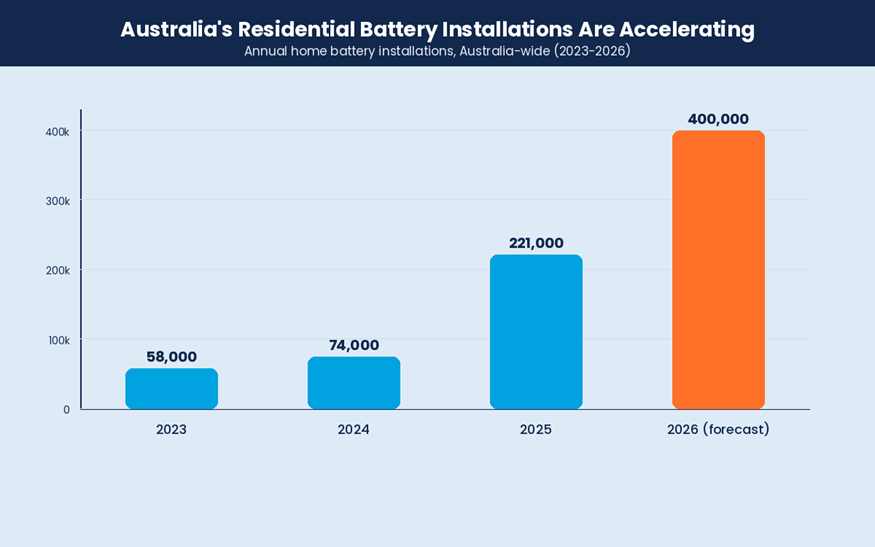
Home battery sales in Australia are no longer a niche trend — they are a mainstream shift in how solar households manage power. In 2025, Australians installed a record 221,000 residential battery systems, almost three times the volume installed in 2024, and industry analyst SunWiz expects the 2026 calendar year to add roughly 400,000 more. For NSW homeowners who already have rooftop solar, or are weighing it up, this surge changes the maths, the market, and the timing of a smart decision. Here is what is actually driving the boom, what it means for your household, and how to use the momentum to your advantage.

Australia's residential battery installations rising from 58,000 in 2023 to a forecast 400,000 in 2026

The scale of the shift is hard to overstate. Australians spent close to $8.69 billion on home batteries in just the first five months of 2026, according to a Reuters calculation built on SunWiz installation data. Between January and May 2026 alone, households installed 7.7 gigawatt-hours of battery storage — more than the previous six years combined. By mid-2026, more than 466,000 residential battery systems had been connected under the federal Cheaper Home Batteries Program since it launched in July 2025, delivering over 12 gigawatt-hours of new storage capacity nationwide.

NSW is playing a leading role in that growth. Government data to March 2026 shows four of the twelve highest-uptake postcode regions in the country sit in outer and western Sydney, accounting for 6,590 installations between them. Today, roughly one in twenty Australian homes has a battery, up from a small fraction just two years ago, and the trajectory keeps climbing. This is not a short-lived spike. It reflects a structural change in how solar households value the power they generate.

Why NSW Homeowners Are Buying Now, Not Later

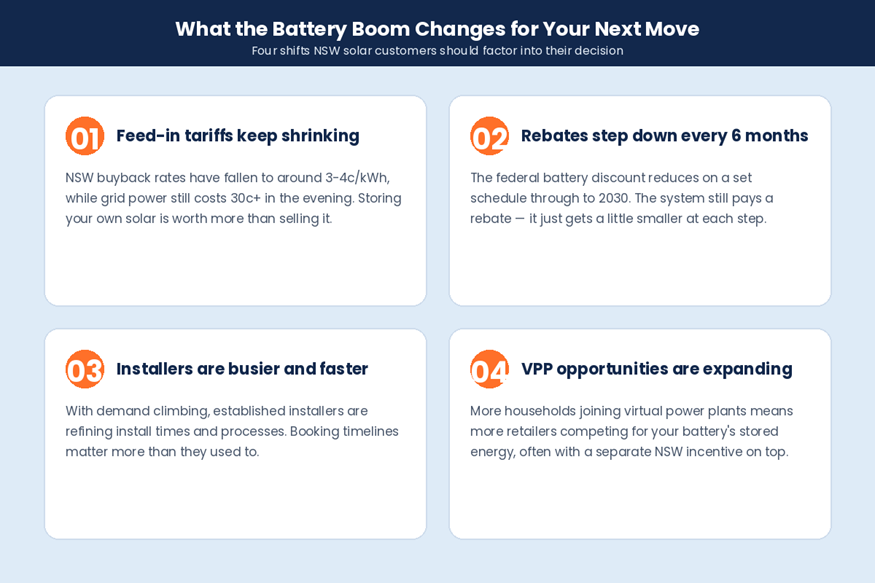
Three forces are converging at once, and together they explain why so many solar owners are moving from “maybe one day” to “book a quote.”

1. Feed-in tariffs have kept shrinking

From 1 July 2026, NSW solar buyback rates dropped again, to as low as 3c/kWh on many plans, while the same household still pays roughly 30 to 40c/kWh to buy power back after dark. That gap is the entire financial case for storage: a solar-only home effectively gives away its cheap daytime power and buys it back at ten times the price a few hours later.

2. Electricity bills remain historically elevated

The average NSW household is paying close to $1,450 a year on a market offer, and while the 2026-27 Default Market Offer trimmed flat rates by roughly 3.4 to 5.0 percent, that follows a much larger increase the year before. A battery reduces exposure to further rises because it lets you use your own stored solar instead of buying from the grid at peak.

3. The federal rebate steps down on a schedule

Since 1 May 2026 the Cheaper Home Batteries Program has used a tiered structure, still discounting eligible systems by around 30 percent, with the rate reducing every six months through to 2030. Waiting does not remove the rebate; it just shrinks it a little further each cycle, which is exactly why installation volumes keep climbing rather than tapering off.

What the Surge Means If You Already Have Solar

If your panels have been running solar-only for a few years, you are part of the group installers now describe as their fastest-growing customer base. Industry reporting shows a majority of battery installations are retrofits onto existing rooftop solar rather than new combined systems, which means you do not need to replace your panels to benefit. Most modern inverters and panel setups are compatible with a retrofitted battery.

The surge also strengthens your negotiating position. More installers are competing for retrofit customers, more battery brands are available at competitive pricing, and virtual power plants (VPPs) are actively recruiting existing solar households to join, often stacking a separate NSW incentive on top of the federal rebate. That combination, a mature retrofit market plus rising VPP demand, means existing solar owners are, in many cases, well placed to get a fast, well-priced install.

What the Surge Means If You’re Still Deciding

four ways rising battery sales change the decision for NSW solar customers

If you have not installed solar and a battery yet, the calculation has shifted from “is this worth it” to “what size and when.” Feed-in tariffs will likely keep falling rather than recovering, which increases the value of storing your own power over time. The rebate step-down is scheduled and predictable, so you can plan around it rather than react to it. Reputable installers are refining their processes to handle higher demand, so booking early in a rebate cycle tends to mean a shorter wait for your installation date. And VPP participation is becoming a genuine income stream, not just a bill offset, as more retailers compete for access to household batteries during peak demand periods.

None of this means every household should rush. It means the case for comparing a proper, itemised quote has become stronger, because the gap between a well-sized system and an oversized or poorly matched one is now worth more than it used to be.

Three Steps Before You Get a Quote

1. Pull your last 12 months of electricity bills and check how much power you use after sunset. This is what actually determines whether a battery pays for itself.

2. Confirm your existing solar system’s age and output before adding storage, since a battery cannot fix an underperforming or degraded solar array.

3. Compare at least three written quotes that show the federal rebate as a dollar figure, not a verbal promise, and ask each installer how the NSW VPP incentive applies to your postcode.

Working through these three steps before you sign anything protects you from both extremes: rushing into an oversized system, and delaying so long that a rebate step-down costs you more than waiting was worth.

You can see how this plays out in practice in our related breakdown of why home battery uptake in Australia is surging, and if your panels have been running solar-only for a while, our guide on adding a battery to an existing rooftop solar system walks through the retrofit process step by step.

Frequently Asked Questions

Is now a good time to buy a solar battery in NSW?

For many households, yes. Feed-in tariffs are low, bills remain elevated, and the federal rebate is still active. But “good time” depends on your usage pattern and your solar system’s condition, so compare written quotes before committing to a size or brand.

Why are so many more Australians installing batteries in 2026?

A combination of the federal Cheaper Home Batteries Program discount, falling feed-in tariffs, and elevated retail electricity prices has made storing solar power more valuable than exporting it. SunWiz data shows installations roughly tripled between 2024 and 2025.

Do I need new solar panels to add a battery?

Usually not. Most battery installations recorded in the last two years have been retrofits onto existing rooftop solar systems. A qualified installer can confirm your inverter and panels are compatible before quoting.

Will the battery rebate run out if I wait?

No. The Cheaper Home Batteries Program runs until 2030. The discount rate reduces gradually every six months rather than ending suddenly, so waiting reduces your rebate slightly but does not remove it.

How do I know if a battery will actually save me money?

It depends on how much electricity you use in the evening after your solar stops generating. A reputable installer should review your last 12 months of bills before recommending a battery size.

Disclaimer

This article is general information about home battery trends in NSW and is not personal financial, legal, or energy advice. Rebate rates, feed-in tariffs, and electricity prices referenced here were accurate at the time of publication and are subject to change by the relevant government body or your retailer. Every home’s usage pattern, solar system, and eligibility differ, so actual savings and payback periods will vary. Always seek personalised advice before making a purchasing decision.

php