Australia has crossed a line few countries have reached. More than 500,000 home batteries now sit on walls and in garages nationwide. The Prime Minister marked the milestone on 14 August 2026, roughly 13 months after the Cheaper Home Batteries Program opened. Naturally, the celebration focused on power bills and evening peak demand. However, a second question now carries equal weight. With half a million lithium-ion systems installed this quickly, what happens to home battery safety?
Fortunately, we do not have to guess. The Clean Energy Regulator inspects a sample of subsidised installations and publishes the findings. Therefore, this guide walks through what that data actually shows. It also covers what regulators changed during 2026. Finally, it lists what you should verify before signing a quote.
Australia Passed 500,000 Home Batteries in 13 Months
The Cheaper Home Batteries Program opened on 1 July 2025. By 14 August 2026, the Prime Minister and Energy Minister confirmed the half-million mark. Meanwhile, the Clean Energy Regulator recorded 478,176 batteries installed to 30 June 2026, equal to 13.58 GWh of storage.
That growth reshaped the industry quickly. For instance, the number of accredited battery installers doubled to 8,846 across the same period. In addition, the Government reported that more than three quarters of installations landed in outer suburban and regional communities.
Consequently, home batteries stopped being an early-adopter product. They became mainstream household infrastructure in barely more than a year. Rapid scaling always brings a workforce question, though. Specifically, can installation quality keep pace with demand?
What the National Data Says About Home Battery Safety
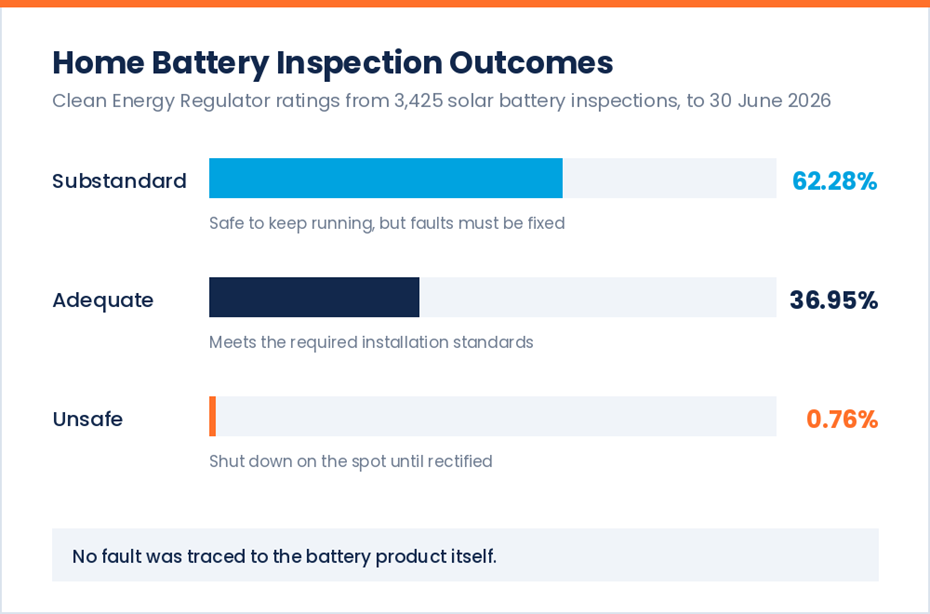
The Clean Energy Regulator completed 3,425 solar battery inspections to 30 June 2026. Importantly, it selects most installations randomly from rebate claims. Additionally, it targets extra inspections at installers already found non-compliant.
Of the installations rated so far, 36.95% were adequate and safe. Meanwhile, 62.28% were rated substandard. That label means technically non-compliant, yet safe to remain in operation. Finally, 0.76% were rated unsafe. An unsafe rating triggers an immediate shutdown by the inspector.
At first glance, that substandard figure looks alarming. However, context matters. A substandard rating does not condemn the whole system. Typically, inspectors flag one or two items that do not affect performance. Those items can still create risk for electricians or emergency crews later, so installers must rectify them.
You can review the full dataset, including the state-by-state breakdown, on the Clean Energy Regulator’s solar battery inspection results report. NSW recorded the largest share, with 926 inspections.
The Batteries Passed. The Installations Did Not.
This is the finding that deserves the most attention. The regulator stated it plainly: no installations had issues with the solar battery itself. Instead, every problem traced back to non-compliant installation practices and substandard workmanship.
That distinction changes how you should shop. Product risk is already tightly controlled. Every battery claiming the federal rebate must appear on the Clean Energy Council approved product list. Manufacturers reach that list by passing international cell and system safety testing. A reputable solar battery company will confirm that listing in writing.
The product safety net also works when something slips through. As of 30 June 2026, only one eligible product under the scheme had been recalled. In November 2025, the ACCC issued a voluntary electrical safety recall. It covered certain Sigenergy single-phase energy controllers. Regulators, the manufacturer and installers then worked through rectification.
Therefore, your real variable is not the brand on the wall. It is the quality of the hands that installed it.
Most Faults Were Labelling, Not Live Danger
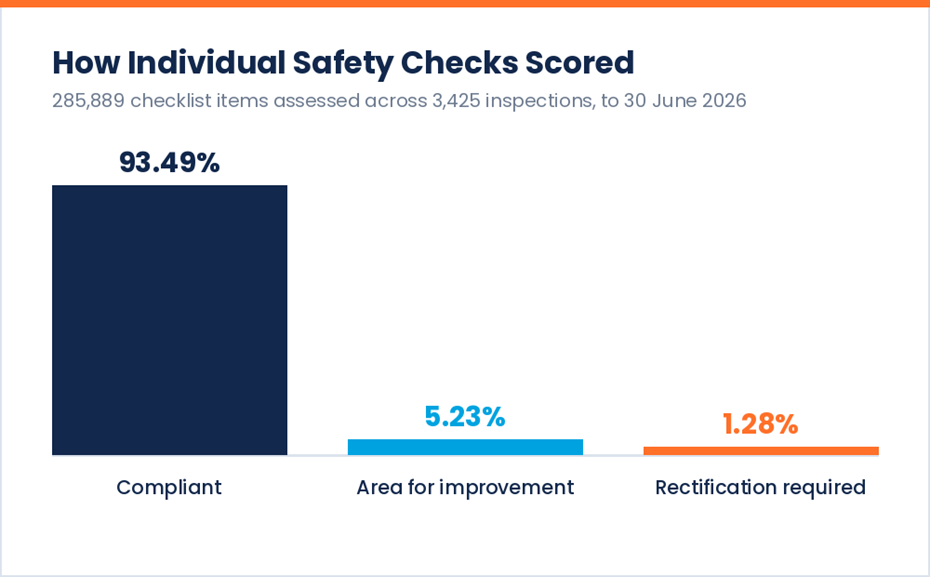
The system-level percentages tell only half the story. Inspectors also score each installation against a checklist of more than 90 items. Across 3,425 inspections, they assessed 285,889 individual items.
Of those items, 93.49% were compliant. A further 5.23% were flagged as areas for improvement, which installers do not have to fix. Only 1.28% required rectification.
Moreover, labelling drove most of the non-compliance. Three faults appeared repeatedly. First, missing or incorrect warning labels at the main switchboard. Second, backed-up circuits that were neither labelled nor grouped together. Third, a missing or badly placed green reflective ‘ES’ label near the meter box.
Labels sound trivial, yet they protect people. Backed-up circuits can stay live even after someone throws the main switch. Some systems also re-energise after a short delay. Consequently, an electrician or firefighter who misses that warning faces a genuine shock risk.
What Made an Installation Unsafe
Only 22 systems earned the unsafe rating in the published state breakdown. Still, the causes are worth understanding, because they are all preventable.
The regulator grouped them under two headings. Under wiring, inspectors found loose connections in pre-assembled battery systems. Associated cabling also showed signs of heat. In addition, some electrical work on pre-assembled systems did not follow Australian Standards. Under protections, inspectors found neutral continuity that was not maintained on alternative supply circuits.
When an inspector finds an unsafe installation, the system gets shut down or otherwise made safe on the spot. The installer must then rectify the fault before the system runs again.
The regulator has not been quiet about enforcement either. Executive General Manager Carl Binning publicly put installers on notice. He warned that unsafe and non-compliant work would be identified. He added that the regulator would not hesitate to use its compliance powers. Those powers include removing an installer from the scheme entirely.
How Regulators Tightened Home Battery Safety Through 2026
The rules did not stand still while volumes climbed. In fact, 2026 brought several meaningful changes.
- Amendment 1 to AS/NZS 5139:2019 was published on 19 December 2025. It clarified location rules, clearance distances and restricted zones around a battery. NSW treats the amendment as mandatory. Western Australia required full compliance from 19 June 2026.
- From 1 March 2026, the Clean Energy Regulator made label photos mandatory. Installers must now submit clear, geotagged and timestamped photos of required labels with every claim.
- The regulator expanded inspections sharply, from 846 in February 2026 to 3,425 by 30 June 2026.
- It also began formal compliance action against repeat offenders, including warning notices and suspension from the scheme.
- Alongside Solar Accreditation Australia, it developed additional mandatory training modules targeting the exact faults inspections keep finding.
Politically, the scheme has faced scrutiny too. In September 2026, Energy Minister Chris Bowen defended it in Parliament. He described the Small-scale Renewable Energy Scheme as one of the world’s most rigorous compliance schemes. Moreover, he cited 315 complaints against 800,000 installations over the previous year.
Four Home Battery Safety Checks Before You Sign
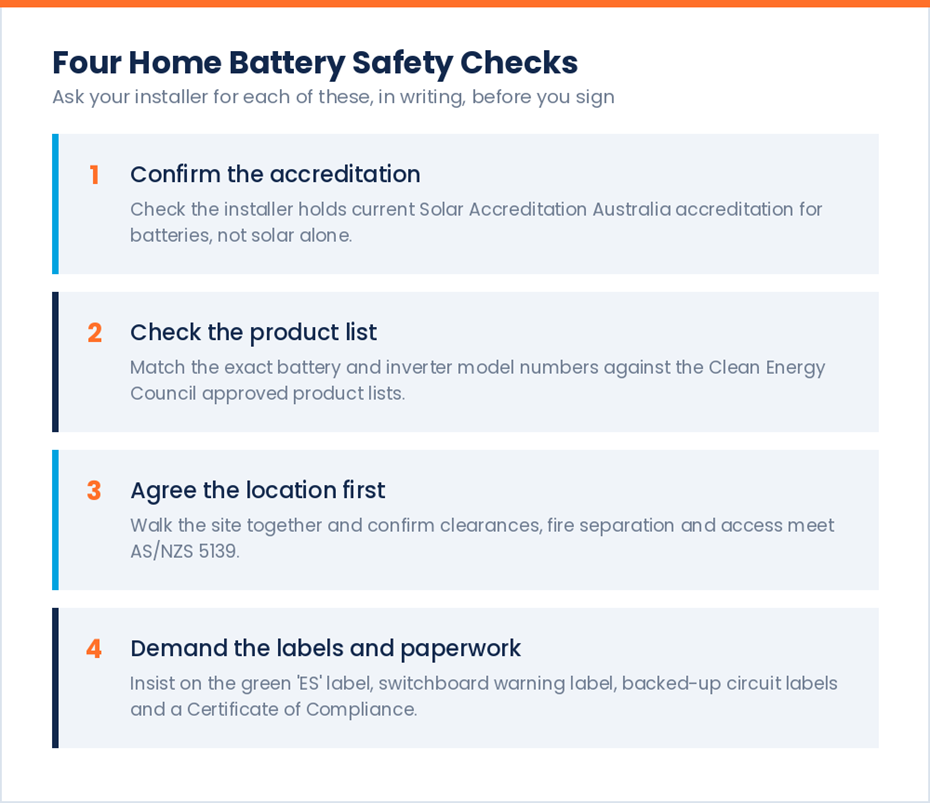
You do not need to become a standards expert. However, four questions will filter out most weak operators quickly.
Ask for the installer’s Solar Accreditation Australia number and confirm it covers batteries, not solar alone. Next, match the exact battery and inverter model numbers to the Clean Energy Council approved lists. Then walk the proposed location together before install day. Finally, insist that labelling and your Certificate of Compliance form part of the handover.
A reputable solar battery company will answer all four without hesitation. In contrast, a rebate chaser will rush you toward a deposit instead.
Does a Home Battery Still Make Sense in 2026?
On this evidence, yes. The hardware performed. The regulatory net caught the one product issue that arose. Furthermore, the workmanship problems are visible, measurable and fixable.
The lesson is simple. Your installer matters as much as your battery. Choosing the best solar battery installer in your area protects your safety. Equally, it protects your rebate, since a failed inspection can put certificates at risk.
So treat the decision as two decisions. Start by comparing the best solar batteries available in Australia for 2026 and their real-world running costs. Afterwards, apply the same scrutiny to the person installing it.
Frequently Asked Questions
Australian home batteries are regulated products. Every battery claiming the federal rebate must sit on the Clean Energy Council approved list. An accredited installer must also fit it. In inspections to 30 June 2026, no fault was traced to a battery product itself. The regulator rated 0.76% of inspected installations unsafe. Those faults came from workmanship rather than hardware.
The regulator completed 3,425 solar battery inspections to 30 June 2026. Of the installations rated so far, 36.95% were adequate. A further 62.28% were substandard but safe to keep operating. Only 0.76% were unsafe. Across 285,889 checklist items, 93.49% were compliant. Another 5.23% were flagged for improvement, and 1.28% required rectification.
Substandard means the installation breaches at least one clause of an Australian Standard or industry guideline. However, it remains safe to keep running. Labelling faults are the most common cause. Typical examples include a missing green ES label or an incorrect switchboard warning label. Unlabelled and ungrouped backed-up circuits also appear often.
The regulator listed three causes. First, loose connections in pre-assembled battery systems, with wiring showing signs of heat. Second, electrical work on pre-assembled systems that ignored Australian Standards. Third, neutral continuity that was not maintained on alternative supply circuits.
Amendment 1 to AS/NZS 5139:2019 was published on 19 December 2025. It clarified location, clearance and restricted-zone requirements. NSW treats it as mandatory. Western Australia required full compliance from 19 June 2026. Separately, the Clean Energy Regulator introduced mandatory geotagged and timestamped label photos from 1 March 2026.
Start at the meter box. Look for a green reflective ES label that is visible as you approach. Also check for a warning label at the main switchboard. Next, confirm that backed-up circuits are labelled and grouped. Then verify your battery appears on the Clean Energy Council list. Finally, confirm your installer held current battery accreditation on install day. If something is missing, contact your original installer to arrange rectification.
Get Your Installation Checked by an Accredited Local Team
Solar Battery Outlet designs and installs accredited battery systems across Liverpool, Bankstown and Mudgee. Perhaps you are planning a new system. Alternatively, you may want a second opinion on an existing one. Either way, our team explains the compliance detail in plain language. Speak with us about a site assessment. Then choose the best solar battery installer for your home, with the paperwork to back it up.
Disclaimer
This article provides general information about home battery safety in Australia. It reflects publicly available data at the time of writing. That includes Clean Energy Regulator inspection results published to 30 June 2026. It is not electrical, safety, legal or financial advice. Inspection percentages come from a sample of installations, not from every system nationally. Therefore, they are not the compliance rate across all Australian home batteries. Standards, rebate settings and eligibility rules can change, and requirements differ between states and territories. Battery suitability, performance and any bill impact depend on your own household, tariff, site conditions and system design. If you believe your installation may be faulty or unsafe, contact your original installer or a licensed electrician. Always seek personalised advice before making a purchasing decision.