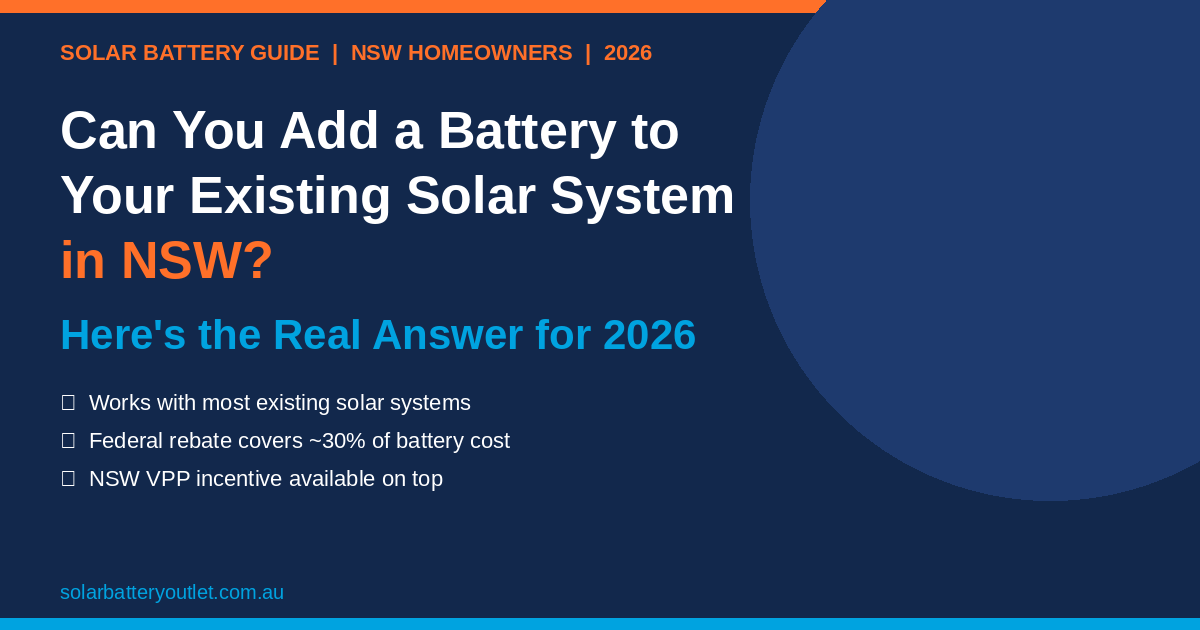
If you installed solar panels three, five, or even eight years ago, you have a new opportunity. Feed-in tariffs in NSW have fallen to 4–7 cents per kWh. However, grid electricity still costs 31–43 cents per kWh. A battery stores excess solar energy generated during the day. You can then use that stored power in the evening. This helps reduce electricity costs when grid prices are highest.
The good news is that yes, most existing solar systems in NSW can accept a battery—and the federal Cheaper Home Batteries Program gives an upfront discount based on the battery’s usable size. This guide walks you through exactly how it works, what it costs, how long payback takes, and what questions to ask your installer before you sign anything.
Yes, You Can Retrofit a Battery—Here Is How It Works
The most important thing to understand is the concept of coupling type. When you add a battery to an existing solar system, you choose between two technical paths: AC-coupled or DC-coupled. Each has different cost implications and compatibility requirements.
AC-coupled batteries connect on the AC side of your switchboard. They include their own built-in inverter and work with most existing grid-connected solar setups. Your installer will still check your inverter, switchboard and network export limits first. This is the most common retrofit path for NSW homeowners and keeps installation costs lower because you do not need to replace your solar inverter.
DC-coupled batteries connect through a hybrid inverter that manages both the solar panels and the battery as a unified system. They deliver slightly higher efficiency but require a compatible hybrid inverter. In most retrofit situations, this means replacing your existing solar inverter, which adds several thousand dollars to the project.
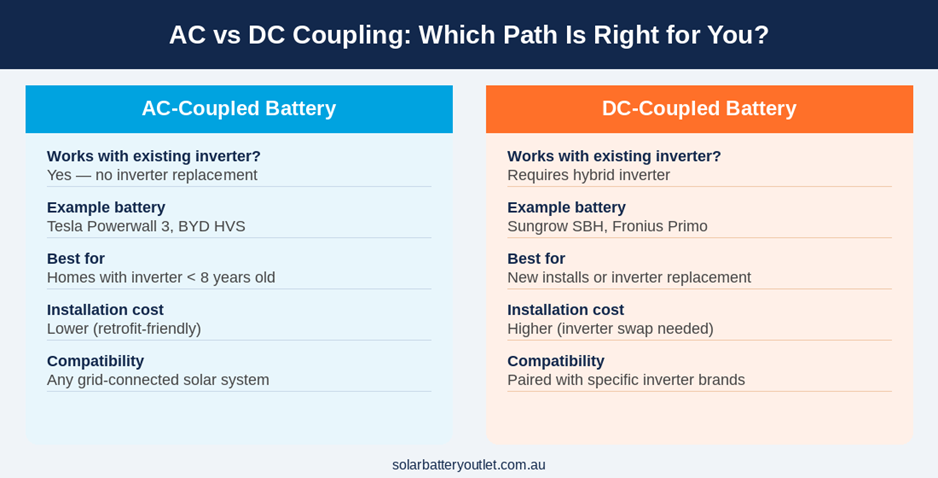
For most homeowners doing a solar system upgrade in NSW, AC coupling is the simpler and more cost-effective choice. A qualified installer will assess your switchboard, existing inverter, and roof wiring before recommending which path makes sense for your home.
The Federal Battery Rebate Makes This More Affordable Than Ever
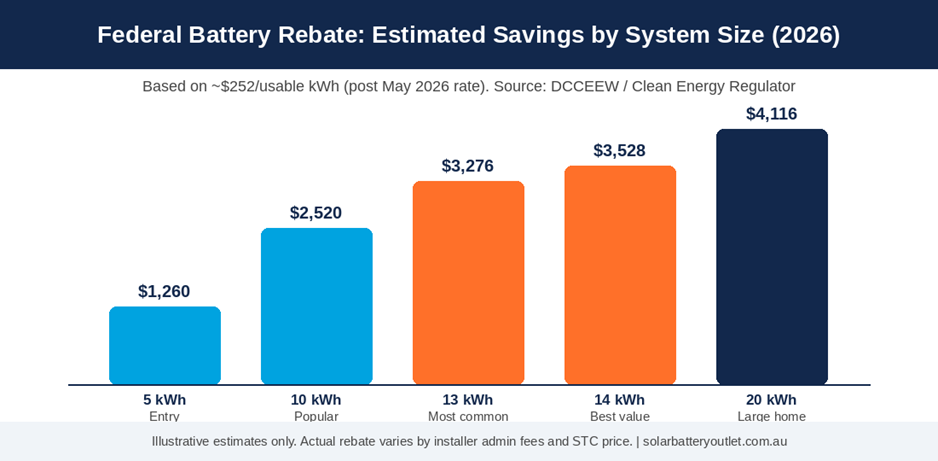
Since July 2025, the Australian Government’s Cheaper Home Batteries Program has given an upfront discount on eligible home batteries. The rebate runs to 2030 and steps down every six months, so your quote will show the current amount.
The rebate works through Small-scale Technology Certificates (STCs). Your installer applies the discount directly on your invoice, meaning you never have to claim anything back. As of mid-2026, the rebate is worth approximately $252 per usable kWh for the first 14 kWh of storage. For a 13 kWh battery—one of the most popular sizes for NSW households—the saving comes to around $3,276 upfront.
| NSW-Specific Note: VPP Incentive The NSW Government ended its direct battery rebate in June 2025, but it significantly expanded the Virtual Power Plant (VPP) incentive from 1 July 2025. NSW homeowners who install a battery and connect it to an approved VPP program can stack the federal rebate with additional NSW VPP payments. Ask your installer whether your chosen battery model qualifies. |
What Battery Size Do You Actually Need in NSW?
Battery sizing depends on three things: how much power your household consumes in the evening, how much your existing solar system generates during the day, and whether you want backup power during blackouts.
Many NSW households use roughly 15–20 kWh a day, but families with pools, EVs or ducted air use more. Check your bill for your own number. A 10–14 kWh battery usually covers most evening energy demand. A larger battery may suit homes with an EV, higher electricity use, or a need for backup power during extended outages.
If you are looking for a solar battery installer in Western Sydney, ask for a bill analysis first. This applies whether you live in Liverpool, Bankstown, or nearby suburbs. A bill analysis helps determine the right battery size. A well-matched battery often delivers better savings than an oversized battery that stays partly unused.
The key practical tip: bigger is not always better. The federal rebate also tapers for batteries above 14 kWh of usable capacity, so right-sizing your battery around that threshold often delivers the best combination of coverage and rebate value under the current rules.
How Long Until a Battery Pays for Itself in NSW?
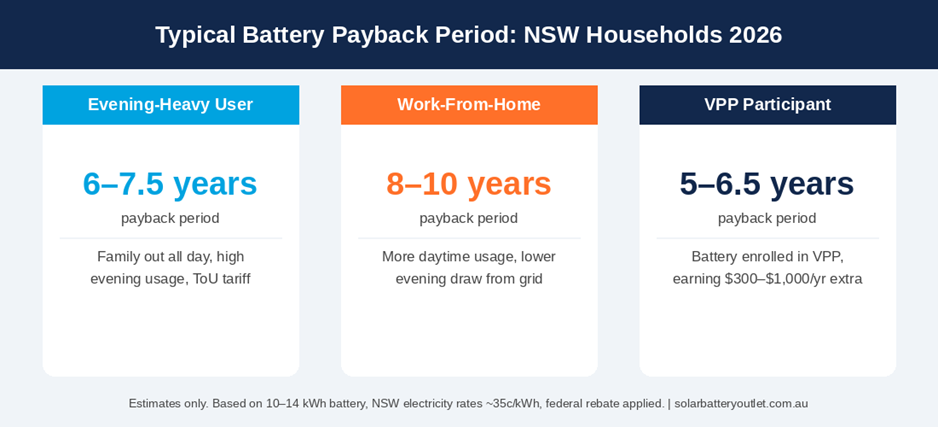
The honest answer depends on your usage pattern, your tariff structure, and whether you participate in a VPP.
According to the Australian Energy Regulator, NSW grid electricity now costs between 31 and 43 cents per kWh, depending on your retailer and plan.
Example: a 13 kWh battery that is mostly emptied on 300 evenings a year could replace about 3,500 kWh of grid power (after charging losses). At 35c/kWh, minus the feed-in credit you give up (about 6c), that is roughly $1,000 a year. A VPP may add some extra credit — ask what your chosen VPP actually pays.
4 Questions to Answer Before You Call an Installer
Before you book a consultation, work through these practical questions. The answers will help you have a better conversation and avoid the most common mistakes NSW homeowners make when adding storage.
- 1. What is my evening electricity consumption? Check your most recent bill and look for usage after 5pm if your retailer provides that breakdown.
- 2. How old is my solar inverter? AC-coupled batteries work with virtually any inverter. But if yours is over 10 years old, it may be worth discussing replacement at the same time.
- 3. Do I want blackout protection? Not all batteries provide backup power during a grid outage by default. If blackout protection matters to you, confirm this at the quote stage — it can change both the equipment and the price.
- 4. Am I willing to join a VPP? NSW homeowners can access the state VPP incentive by enrolling their battery in an approved program. Many VPPs let you keep a reserve level for your home and pay credits or other rewards — check the terms of the VPP you join.
Example: What This Could Look Like for a Real NSW Household
This is an illustrative example not a real customer, consider a family in Bankstown with a 6.6 kW solar system installed in 2019. Their inverter is in good working order, and their evening usage averages around 14 kWh per day. Feed-in tariff payments bring in roughly $180 per year, while their nightly grid purchases cost them over $1,500 annually.
They added a 13.5 kWh battery through AC coupling, so no inverter replacement was needed. The battery now covers most evening electricity demand using stored solar energy. The federal rebate reduces the installed cost to about $7,000–$8,500. VPP income of around $500 per year further improves the return. The estimated payback period is 6 to 7 years. If you are comparing solar battery options in Bankstown or nearby suburbs, ask for this type of bill analysis with every installation quote.
Frequently Asked Questions
In most cases, yes. AC-coupled batteries are compatible with virtually all existing grid-connected solar systems regardless of inverter brand. DC-coupled batteries require a hybrid inverter. Your installer will assess compatibility during the quote stage.
Absolutely. Adding a battery does not change how your solar panels generate power. The battery simply stores excess generation that would otherwise be exported to the grid at a low feed-in tariff rate, so you can use it in the evening instead.
Yes — the Cheaper Home Batteries Program applies to batteries added to existing solar systems as long as the system meets eligibility requirements. The battery must have 5 to 100 kWh of usable capacity, be on the approved product list, be installed by an SAA-accredited installer, and be VPP-capable. Only the first 50 kWh gets the rebate.
Look for installers accredited by Solar Accreditation Australia (SAA). Get at least three written quotes. A good installer will review your electricity bills, assess your existing system, and recommend a battery size based on your actual usage pattern — not just a standard package.
It depends on the battery and how it is configured. Many batteries include a backup mode that isolates your home from the grid during an outage. You must specify this requirement before installation, as it can affect both the equipment choice and the wiring. Not all standard installations include blackout protection by default.
| Ready to Find Out If Your System Qualifies? Solar Battery Outlet serves homeowners across NSW including Liverpool, Bankstown, Mudgee, and surrounding areas. We assess your existing system, recommend the right battery for your actual usage, and handle the federal rebate paperwork for you. Get a Free Quote Today → solarbatteryoutlet.com.au/contact/ | 1800 000 777 |
Disclaimer: The savings estimates, payback periods and rebate amounts in this article are illustrative examples based on a hypothetical NSW household and are not a guarantee of actual results. The Cheaper Home Batteries Program and NSW Peak Demand Reduction Scheme are subject to eligibility criteria and may change without notice. Actual outcomes vary based on your location, usage, tariff, system size, and weather conditions. Please seek personalised advice before making a purchasing decision.