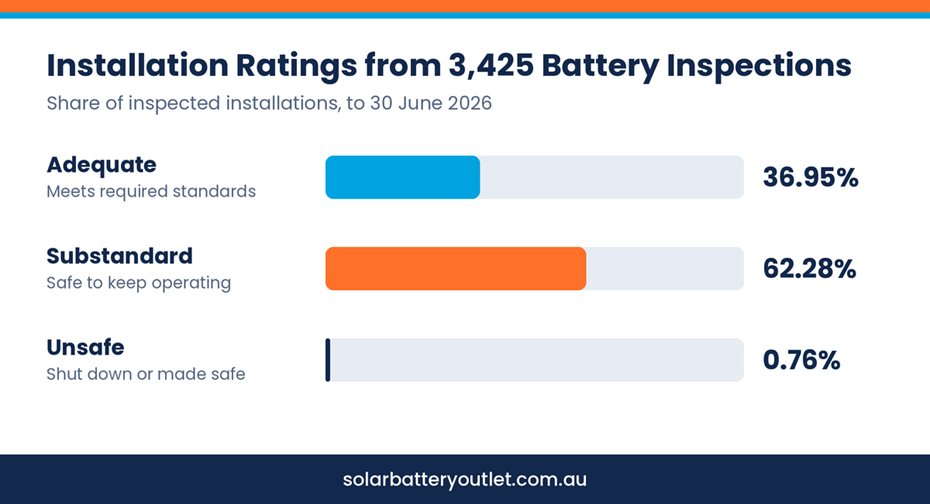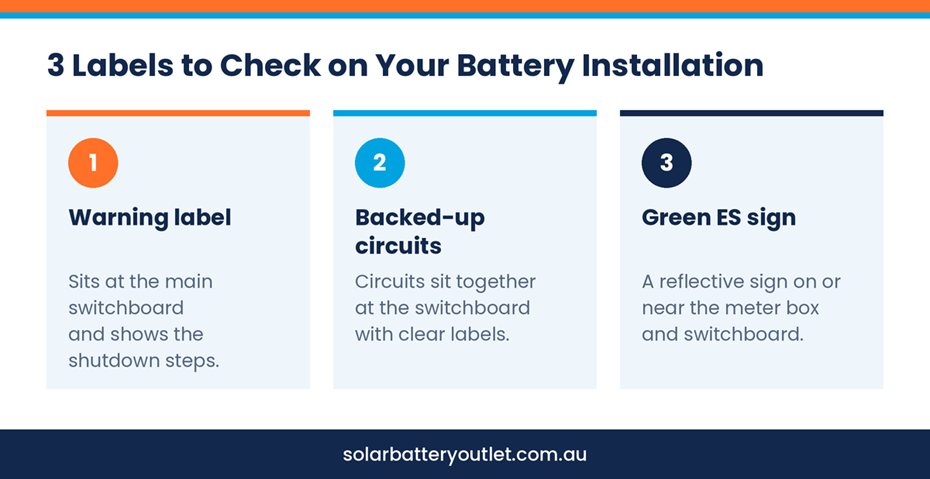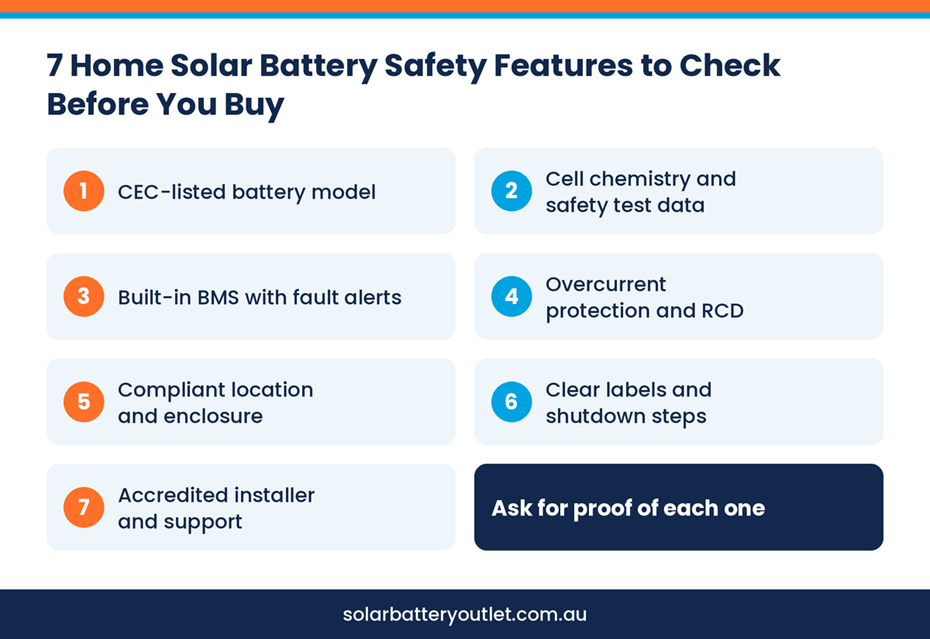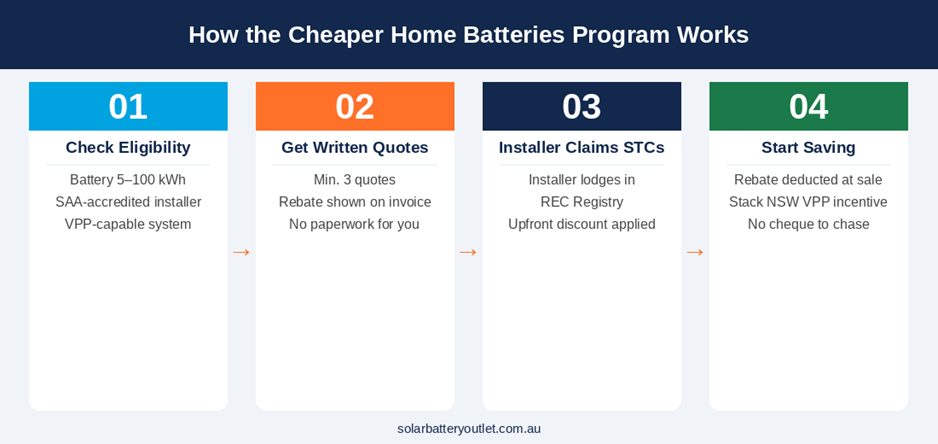

When homeowners think about solar battery safety, they usually think about fire risk from the battery itself — a legitimate concern and one that good brands like BYD and Sungrow take seriously. But there is a second risk that almost nobody talks about: the wiring behind the wall.

Across New South Wales, a significant number of solar battery installations are wired incorrectly. Not badly — incorrectly. There is a specific Australian Standard that governs how batteries must be wired into your home, and many homeowners have no idea it exists, let alone whether their own installer followed it.

This article explains what the standard is, what it requires, and the three questions you should ask any installer before you sign anything.

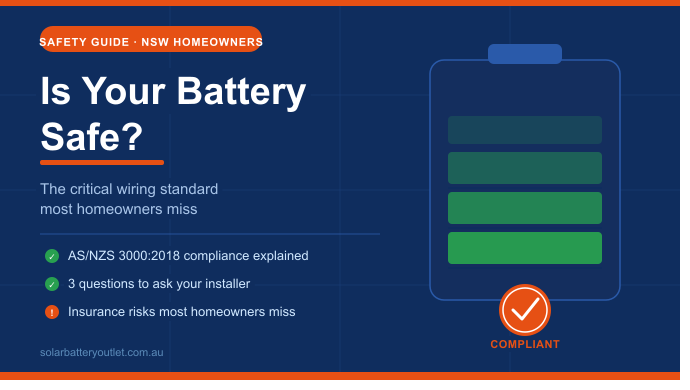
Battery Safety Guide

The Standard You Have Never Heard Of: AS/NZS 3000:2018

Australian electrical installations — including solar battery storage systems — are governed by AS/NZS 3000:2018, commonly known as the Wiring Rules. Every licensed electrician in NSW is legally required to follow it. The problem is not that the standard does not exist. The problem is that nobody tells homeowners about it, which means nobody thinks to check.

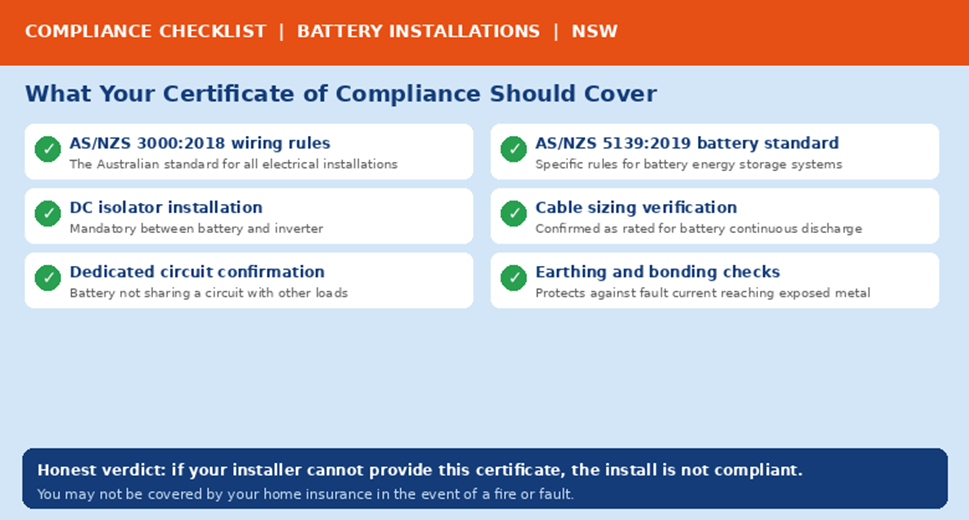
In 2019, the standard was updated with a companion document specifically for battery energy storage systems: AS/NZS 5139:2019. Together, these two documents set out exactly how a battery must be wired — from the cable sizing, to the isolator placement, to the earthing arrangement — to be considered safe and compliant.

Why Most Homeowners Miss It

The solar and battery industry in NSW has grown rapidly. With that growth has come pressure on installers to move quickly, keep costs low, and compete on price. In that environment, some corners get cut — and wiring compliance is one of the first places shortcuts appear.

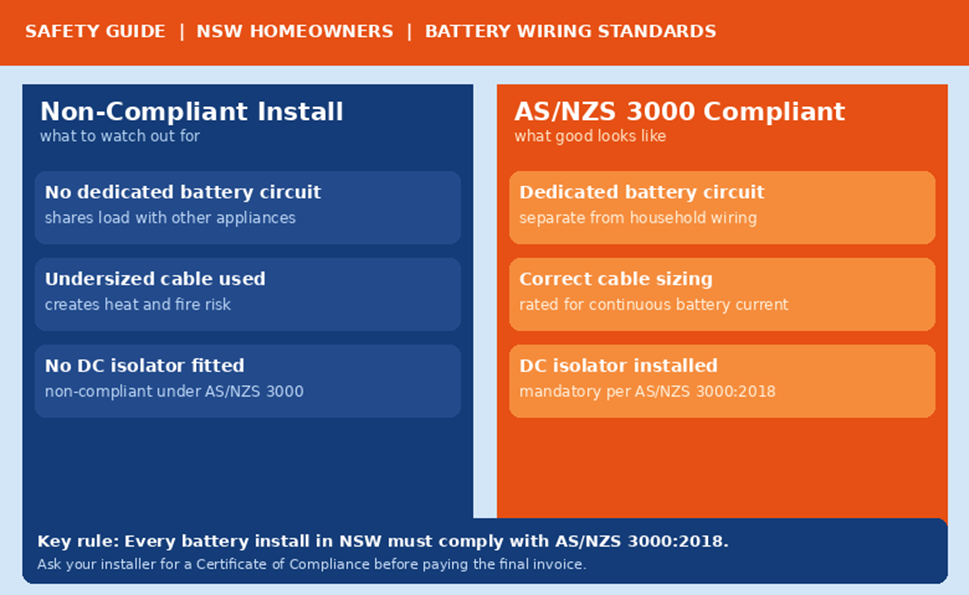
Here is what non-compliant wiring typically looks like in practice:

  • The installation connects the battery to an existing circuit that already serves other loads, instead of using a dedicated run
  • The cable used is undersized for the continuous discharge current of the battery — creating heat at the cable over time
  • The DC isolator is missing, poorly placed, or not rated for the battery’s voltage and current
  • No Certificate of Compliance is issued after the install — meaning there is no official record that the work meets the standard

None of these shortcuts are visible once the wall is closed. You would not know. Your installer might not even acknowledge the issue. But your insurer might — particularly if something goes wrong.

The Insurance Problem Nobody Warns You About

Home insurance policies in Australia typically contain a clause that voids coverage for damage caused by non-compliant electrical work. If your battery is wired incorrectly and causes a fire or electrical fault, your insurer can — and in some cases will — refuse to pay.

This is not about fearmongering. The vast majority of battery installations are done correctly. But a ‘mostly fine’ installation rate is not the same as a ‘yours is definitely fine’ guarantee. Given that a compliant install and a non-compliant install often look identical from the outside, the only way to know is to ask the right questions before you sign.

Compliance Checklist

The Three Questions to Ask Any Installer

You do not need to become an electrician to protect yourself. These three questions will quickly tell you whether an installer knows their obligations — and whether they are willing to meet them.

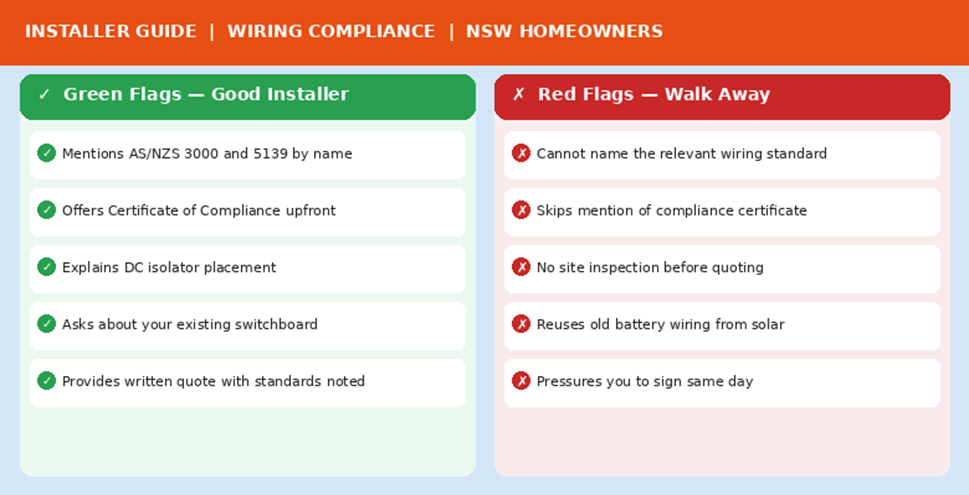
Question 1: Which wiring standard governs battery installations in NSW?

The correct answer is AS/NZS 3000:2018 (the Wiring Rules) and AS/NZS 5139:2019 (the battery-specific standard). An installer who cannot name either document — or who looks uncertain — is a red flag. This is not obscure knowledge. It is the legal foundation of their work.

Every licensed installer in NSW should hold current accreditation. You can verify your installer’s accreditation here before you agree to anything — it takes less than a minute and gives you immediate peace of mind.

Question 2: Will you provide a Certificate of Compliance after installation?

This certificate, sometimes called a Certificate of Compliance for Electrical Work (CCEW), is issued by a licensed electrician to confirm that the installation meets the required standard. It is not optional. If an installer says they do not usually provide one, or that you can request it separately, be cautious. It should be offered as standard.

Question 3: Will the battery have its own dedicated circuit?

A compliant battery installation requires a dedicated circuit — not a circuit shared with other appliances or with your existing solar setup. If the answer is vague or the installer suggests they will reuse existing wiring, that is a flag worth exploring further before proceeding.

Solar Installer Guide

A Note on NSW VPP Incentives and Compliance

If you plan to participate in a Virtual Power Plant (VPP) to access the NSW VPP battery incentive — which can add up to $1,500 on top of the federal rebate — you must ensure your battery installation passes a network assessment before enrollment.

That assessment includes a review of how the system is wired. If your installation doesn’t meet AS/NZS 3000 or 5139 standards, it won’t pass the network check. A simple wiring shortcut could end up costing you the entire incentive If you want to understand more about how the VPP incentive works in NSW, this guide to the NSW VPP battery incentive explains the full requirements and eligibility process.

What a Compliant Installation Includes

To be clear about what you should expect from a professional battery installation in NSW. Here is what the standards require:

  • A dedicated battery circuit, separate from all other household wiring
  • AC and DC cables sized correctly for the battery’s continuous discharge current
  • A DC isolator installed between the battery and inverter, rated for the system voltage
  • Correct earthing and bonding in line with AS/NZS 3000:2018
  • Battery location meeting the clearance and ventilation requirements of AS/NZS 5139:2019
  • A Certificate of Compliance issued by the licensed electrician who performed the work

None of this is expensive or time-consuming when done from the start. The problem only arises when an installer tries to save time by skipping steps — and the homeowner does not know what to ask.

The Honest Bottom Line

Solar batteries are safe when installed correctly. The Australian standards exist precisely because someone — or many someones — worked out what ‘correctly’ looks like in detail. They are not bureaucratic box-ticking. They are the engineering consensus on what a battery installation needs to look like to be reliably safe over its working life.

The single most effective thing you can do as a homeowner is ask the three questions above before you sign. A good installer will answer them clearly and confidently. A poor installer will not.

Ask anyway. The answer will tell you everything you need to know.

Something significant is happening in Australian homes right now. Walk down any street in Western Sydney, Brisbane’s outer suburbs, or Adelaide’s growth corridors and you’ll notice it — gleaming solar panels on rooftops, flanked increasingly often by a white or grey box on the garage wall. That box is a home battery. And in 2026, more Australians are installing them than at any point in history.

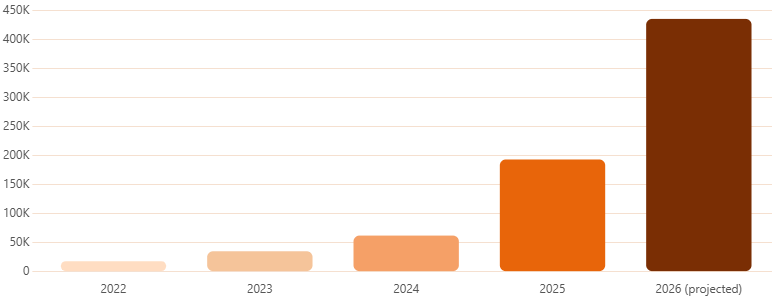
The numbers are striking. In March 2026 alone, NSW recorded over 600 megawatt-hours of new battery installations — a 44% monthly increase and a new state record. Nationwide, the Clean Energy Regulator is projecting up to 520,000 home battery installations this year alone, compared to just 193,000 in all of 2025. Australia’s residential battery storage market — already worth billions — is on track to reach USD 3 billion by 2034.

The rapid adoption of solar batteries is driving Australia’s energy shift in 2026, as homeowners look for smarter ways to store excess solar power and reduce reliance on the grid. With feed-in tariffs dropping and electricity prices rising, households are prioritising energy independence and better use of their rooftop solar systems. This isn’t a blip. 2026 is a genuine structural turning point for home energy storage in Australia. Here’s exactly why — and what it means if you’re still sitting on the fence.

Reason 1: The Government Finally Made It Worth It

For years, the economics of home batteries were marginal for most Australian households. The hardware was expensive, payback periods stretched to 12–15 years, and the financial case relied on a lot of optimistic assumptions.

That changed in July 2025 when the federal government launched the Cheaper Home Batteries Program (CHBP) — making home batteries eligible for Small-scale Technology Certificates (STCs) under the Small-scale Renewable Energy Scheme for the first time. In plain English: the government is subsidising roughly 30% of the upfront cost of any eligible battery from 5 kWh to 100 kWh. On a standard 10 kWh system, that’s roughly $3,100 off the invoice before you even start talking about state-level incentives.

The results were immediate. Installations in the final quarter of 2025 alone were approximately three times higher than the total for all of 2024. The program has already supported more than 300,000 battery installations nationally since launch — and 2026 is on pace to dwarf that figure entirely.

Important for NSW homeowners: There’s also a separate NSW Peak Demand Reduction Scheme (VPP incentive) worth up to $1,500 on top of the federal rebate. Most homeowners don’t know about it until their installer tells them — or doesn’t. Read our full guide to the NSW VPP incentive here.

Australian residential battery installations 2022–2026

Australian residential battery installations 2022–2026 (2026 is CER midpoint projection). Sources: Clean Energy Regulator, SunWiz.

Reason 2: Feed-in Tariffs Have Collapsed — And That Changes Everything

Ask any solar installer what the number one question they get today is, and most will say some version of: “I already have solar but I feel like I’m not getting much back for what I’m exporting.”

With feed-in tariffs dropping and electricity prices rising, installing solar batteries allows households to use their own energy during peak evening hours instead of buying expensive power. This shift is helping many Australians reduce grid dependence while improving overall energy efficiency at home.

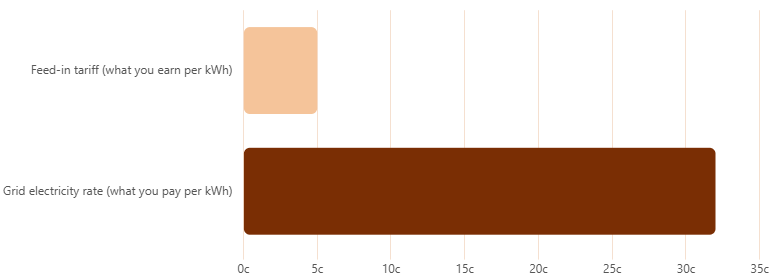
They’re right. Feed-in tariffs across Australia have dropped roughly 50% since 2022–23. In most states in 2026, you’re receiving somewhere between 3 cents and 10 cents per kilowatt-hour for electricity you export to the grid. Meanwhile, when you buy that same electricity back from the grid in the evening, you’re paying 28 to 45 cents per kilowatt-hour.

That gap — earning 5 cents, spending 35 cents — is the financial engine of the battery revolution. Every kilowatt-hour you store in your battery instead of exporting is worth six to ten times more than selling it. A 10 kWh battery that runs your house through an evening instead of drawing from the grid can save $8 to $14 in a single night. Run the numbers across a year and you can see why payback periods have compressed dramatically.

Average feed-in tariff vs. average grid electricity rate in NSW/VIC/QLD (2026)

Average feed-in tariff vs. average grid electricity rate in NSW/VIC/QLD (2026). Self-consumption via battery is worth 6–10× more than exporting. Sources: VoltFlow, IMARC Group.

Reason 3: Battery Costs Have Fallen to a Tipping Point

The third major shift in 2026 is on the cost side of the ledger. Battery hardware prices have followed the same downward curve as solar panels did a decade ago — a steep, sustained decline driven by scale manufacturing, improved chemistry, and fierce competition between BYD, Tesla, Sungrow, Enphase, and a growing field of challengers.

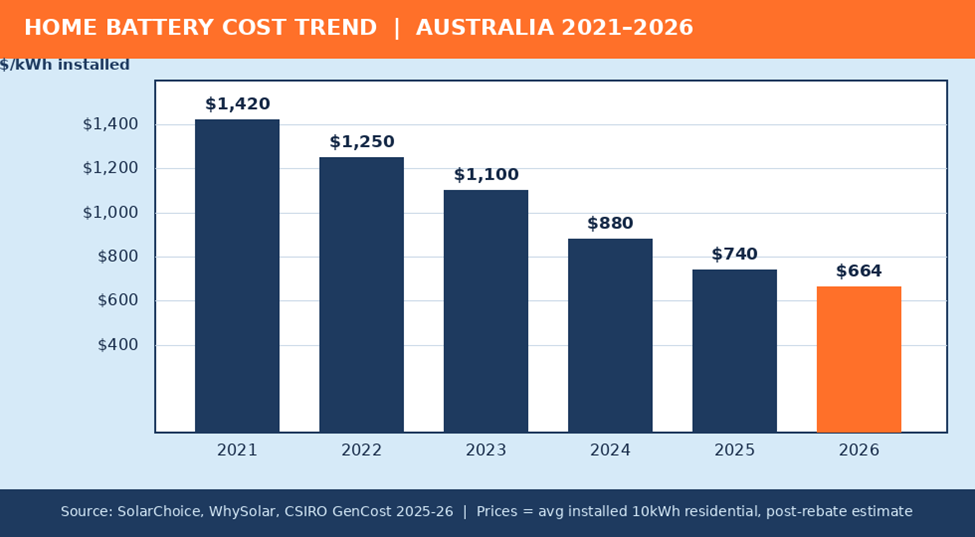
A 10 kWh battery system that would have cost $14,000–$18,000 installed five years ago now retails for around $10,000–$12,000 before rebates. After the federal CHBP rebate, the net cost drops to roughly $7,000–$9,000 for most households. For NSW homeowners who stack the VPP incentive on top, the net cost can fall below $6,000.

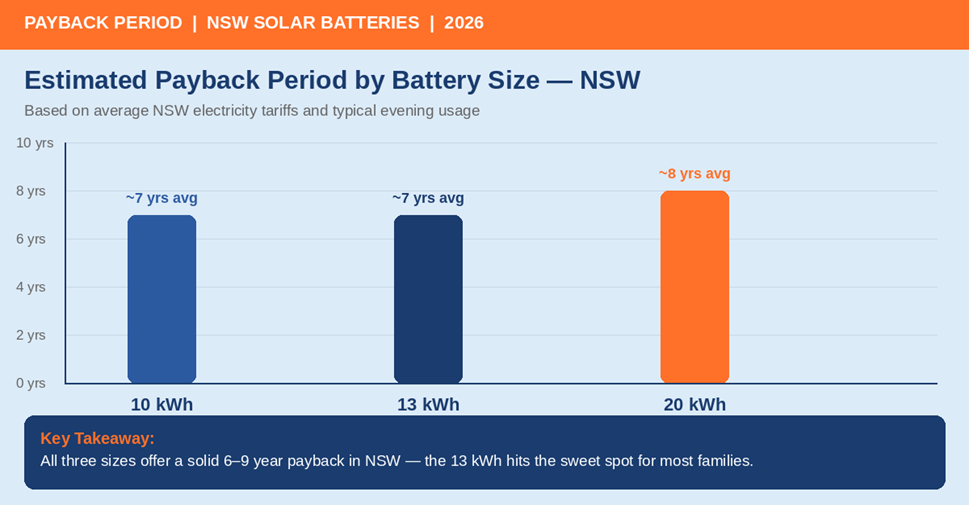
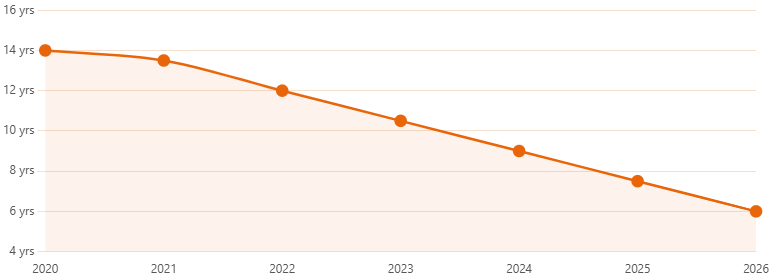
At those numbers, with current electricity prices and the end of meaningful feed-in tariffs, payback periods of five to eight years are realistic for a well-matched system. For high-consumption households or those in states with stronger incentives, payback of three to four years is achievable.

Popular Battery Models and Indicative 2026 Pricing (NSW)

BatteryUsable CapacityPre-Rebate (est.)After Federal RebateAfter Federal + NSW VPP
BYD Battery-Box HVM 10 kWh10 kWh~$10,500~$7,400~$6,300
Tesla Powerwall 313.5 kWh~$14,000~$10,280~$8,930
Sungrow SBR 9.6 kWh9.6 kWh~$9,800~$6,830~$5,770
Enphase IQ Battery 5P (10 kWh)10 kWh~$11,200~$8,100~$7,000

Prices are indicative estimates for installed systems including labour. Always request an itemised quote from your installer.

Government rebates and falling hardware costs have made solar batteries more affordable than ever, which is why many Australians are now pairing them with existing rooftop systems to maximise savings and improve backup reliability during outages.

Reason 4: The Grid Is Becoming Less Reliable — And Australians Know It

Beyond the financial case, there’s a growing practical motivation driving battery uptake: blackout anxiety. Australia’s electricity grid is under structural pressure. Coal plants are retiring faster than replacement capacity is being built. Extreme weather events — heatwaves, storms, cyclones — are becoming more frequent and more intense, placing higher peak demands on infrastructure that wasn’t designed for a 42-degree day.

For many Australians, the memory of being without power for hours or days is the final push they needed. A home battery with adequate backup capacity keeps the lights on, the refrigerator running, and the phone charged when the rest of the street goes dark. That resilience value is real and it’s something that doesn’t show up cleanly in payback period calculations — but it matters enormously to families with young children, medical equipment, or simply a home office they can’t afford to lose for a day.

Blackout note: If backup power is your priority, make sure your battery is configured as a “whole home backup” system. Some battery installations are grid-tied only and won’t power your home during an outage. Always confirm backup capability with your installer before signing a contract.

Estimated average battery payback period for a standard 10 kWh system

Estimated average battery payback period for a standard 10 kWh system (NSW, typical household). Reflects falling hardware costs, rising grid prices, and government rebates. Sources: Gridly, Solutions4Solar.

Reason 5: 2026 Is the Peak Incentive Window — And It’s Closing

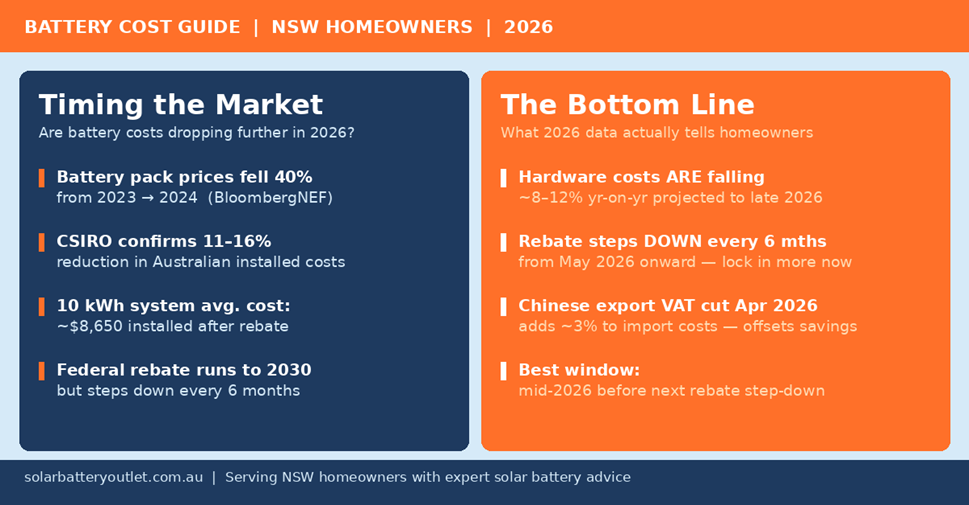
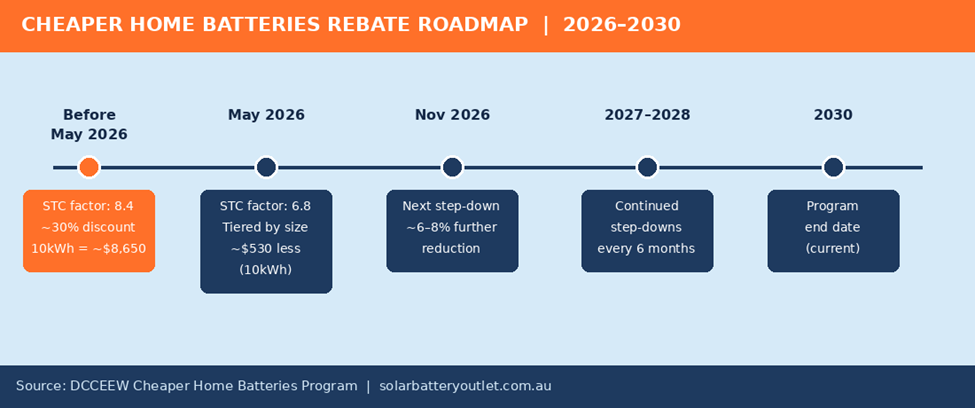
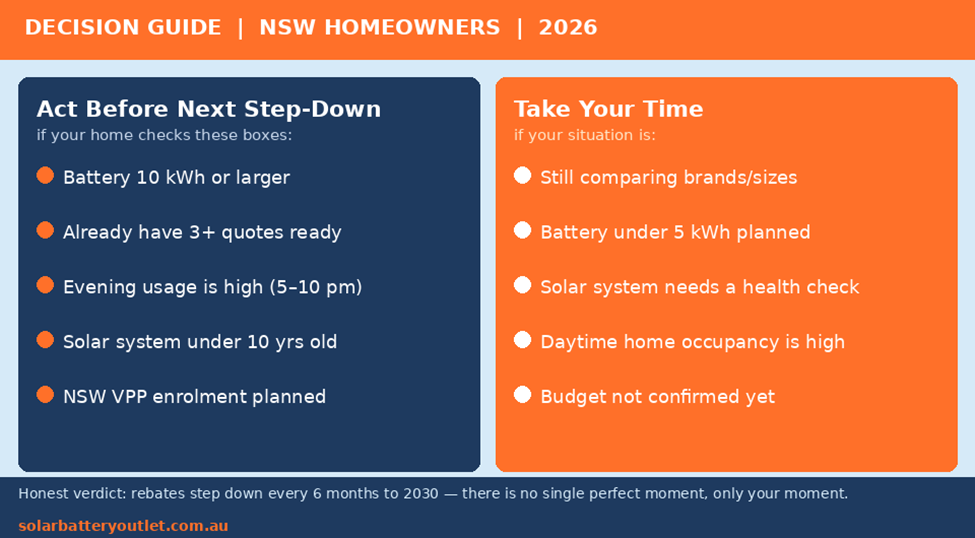
Here’s the thing most homeowners don’t realise until it’s too late: the federal rebate is designed to step down every six months until 2030. The rate that applies now, in April 2026, is the highest it will ever be. After 1 May 2026, the rebate value drops by roughly $1,000 on a typical 13.5 kWh system. It drops again in November. And again every six months after that.

This isn’t conjecture — it’s by design. The government structured the program to front-load the incentive to kick-start the market, then gradually reduce it as costs fall and the market matures. Which means the window to capture the maximum rebate is now, in early to mid 2026.

This is why March 2026 saw a record-breaking surge in installations. The SunWiz industry analyst firm reported that Australia registered 341 megawatts of small-scale solar in March — more than ever recorded in a single month — with batteries surging 35% month-on-month. Homeowners are reading the data correctly and acting on it.

Federal Battery Rebate Step-Down Schedule (Approximate, 13.5 kWh System)

Installation PeriodEstimated Rebate Valuevs. April 2026
Before 1 May 2026~$4,557Maximum — current window
May – Oct 2026~$3,488–$1,069
Nov 2026 – Apr 2027~$2,800–$1,757
2028+Declining furtherStepped reductions continue

How Much Can You Actually Save?

The question every homeowner eventually asks is: what does this mean for my electricity bill? The honest answer is that it depends on your consumption patterns, your current tariff, whether you’re on time-of-use pricing, and how well your battery is sized against your usage. But some ballpark numbers help calibrate expectations.

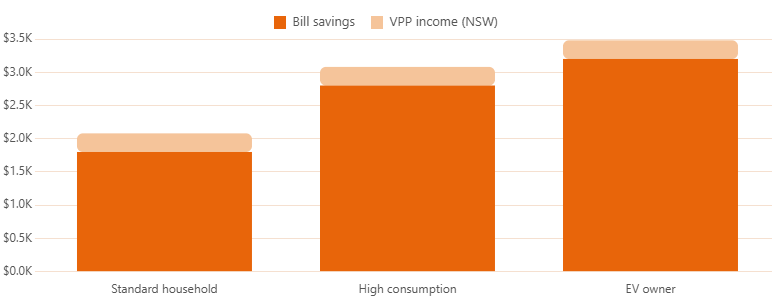
A typical Australian household on a time-of-use tariff, with a 6.6 kW solar system and a 10 kWh battery, can expect to reduce their annual electricity bill by $1,500 to $2,300. Higher-consumption households — those running air conditioning heavily, with an EV, or with pools — typically land in the $2,000 to $3,500 range. On top of bill savings, NSW homeowners enrolled in a VPP can earn an additional $130 to $450 per year from grid participation events.

Add it up: at the current rebate levels, a typical NSW household installing a 10 kWh system could recover their net investment in five to seven years — and then enjoy free or near-free electricity for the remaining 7–10 years of the battery’s warranty period.

Estimated annual electricity bill savings with a 10 kWh battery system

Estimated annual electricity bill savings with a 10 kWh battery system (NSW, time-of-use tariff). VPP income shown as additional layer. Sources: Gridly, Solutions4Solar, Solar Battery Outlet installs data.

What Does This All Mean for You?

If you already have solar and you’re exporting most of your generation at 4–6 cents per kWh, you’re leaving money in the grid every day. A battery doesn’t just save money — it recaptures value you’ve already generated and are currently giving away.

If you don’t have solar yet, 2026 is also an exceptional time to install solar and battery together. Combined packages often attract better pricing from installers, and the incentive structures for solar (STCs) remain strong alongside the battery rebate.

The structural forces driving the boom — a 30% government rebate, collapsing feed-in tariffs, rising grid prices, falling hardware costs, and a growing awareness of blackout risk — aren’t going away. But the specific rebate level that exists today in early 2026 is the most generous it will ever be. The market is telling you that clearly.

As one industry analyst put it plainly: the households that install in the first half of 2026 will look back at this window the way early solar adopters in 2012 looked back at the feed-in tariff era. The numbers will eventually change. Right now, they’re exceptional.

Ready to find out what you’d save?

We process both the federal Cheaper Home Batteries rebate AND the NSW VPP incentive on every installation. No chasing paperwork. Just a cleaner electricity bill.

Get a free quote — takes 60 seconds

Or call us on 1800 000 777

Frequently Asked Questions

Is 2026 really the best time to install a solar battery in Australia?

For most households, yes. The federal rebate is at its highest point and steps down every six months from May 2026. Grid electricity prices are at historic highs while battery hardware costs continue to fall. The combination of these factors creates a financial case that is better in early 2026 than it has ever been — and better than it will be by the end of the year.

Do I need to already have solar panels to install a battery?

No — you can install a battery without existing solar. Some households do this to take advantage of cheaper off-peak electricity rates. However, the payback case is strongest when you pair a battery with an existing or new solar system, because the battery stores your self-generated power rather than cheap grid electricity.

What’s the difference between the federal rebate and the NSW VPP incentive?

They are completely separate programs run by different governments. The federal rebate reduces your upfront invoice by around 30% on any eligible battery. The NSW VPP incentive pays you up to $1,500 separately after installation when your battery is connected to a Virtual Power Plant network. Both can be claimed together. See our NSW VPP guide for the full detail.

How long do solar batteries last?

Most major battery brands — BYD, Tesla Powerwall, Sungrow, Enphase — come with 10-year warranties and are typically rated for 3,000 to 6,000 charge cycles. In real-world Australian conditions, batteries are lasting 12–15 years in many installations. The warranty period is the floor, not the ceiling.

What size battery do I need?

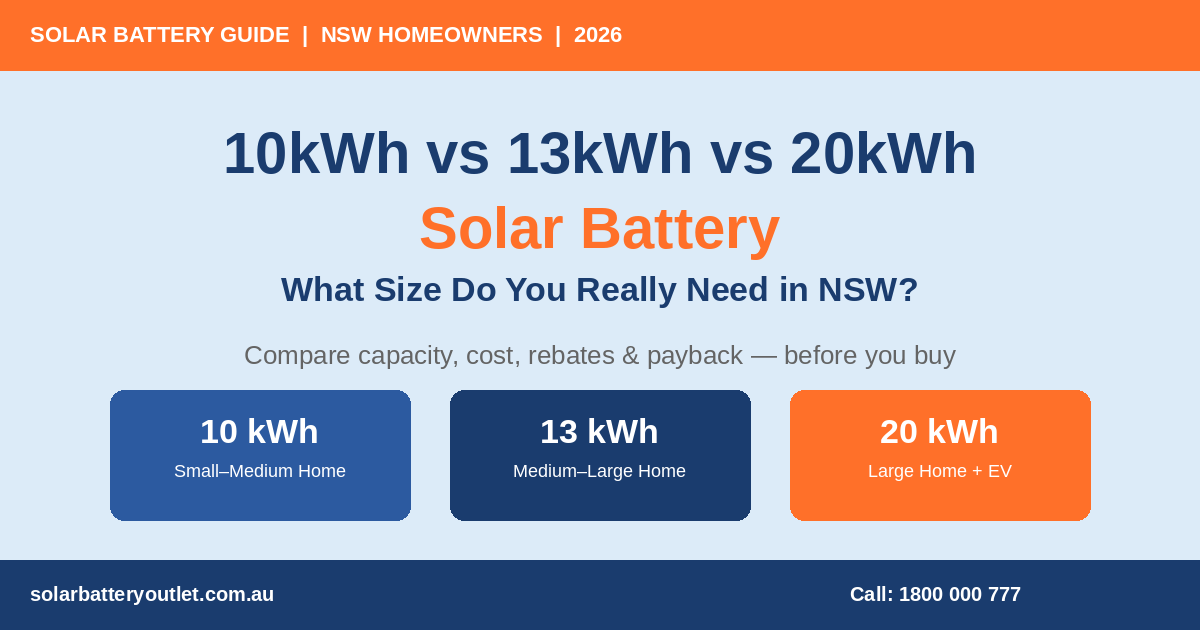
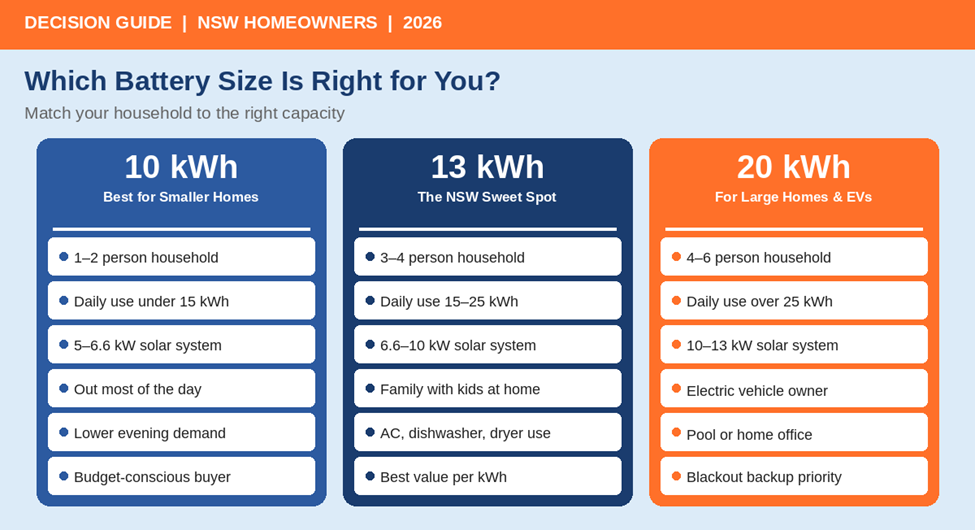
For a typical Australian home using 20–28 kWh per day, a 10–13.5 kWh battery will cover most evening and overnight usage. If you have an electric vehicle, air conditioning running heavily in summer, or a larger property, you may benefit from a larger system or stacked batteries. A good installer will analyse your actual usage data before recommending a size.

Most NSW homeowners buying a solar battery in 2026 know about the federal rebate. They’ve seen the ads, they’ve had the conversations with installers, they know roughly what to expect off the invoice.

What a lot of them don’t know — until someone tells them — is that there’s a second payment available on top of that. From the NSW government. Up to $1,500. And you can stack it with the federal rebate.

It’s called the NSW VPP incentive. It comes through the Peak Demand Reduction Scheme. And the reason most people miss it is simple — their installer either doesn’t bother processing it because it takes extra paperwork, or they mention it once in passing and the homeowner forgets to follow up.

This guide explains exactly what a VPP is in plain English, how much the incentive is actually worth for your battery size, what you need to qualify, and the step-by-step process to make sure you actually receive it. Because a lot of NSW homeowners are leaving $1,500 on the table without realising it.

Quick note on timing: The federal battery rebate rate drops after 1 May 2026. The NSW VPP incentive is completely separate and is NOT affected by that change — you can still claim the full amount after May. But if you’re installing before May anyway, you capture both the higher federal rate AND the full VPP payment. More on the federal rebate deadline here.

What Is a VPP?

Virtual Power Plant sounds complicated. It’s actually a straightforward concept.

Your battery sits in your garage or on your wall. That doesn’t change. The hardware stays exactly where it is. What a VPP does is connect your battery — through software — to a network of thousands of other home batteries across NSW.

During peak demand periods, usually hot summer afternoons when everyone is running air conditioning at once, the grid comes under pressure. The VPP operator can draw a small amount of stored power from the network of batteries to help stabilise it. In practice, your battery might contribute a small discharge during these events — you probably won’t even notice.

In return for making your battery available to the network, the NSW government pays you. That’s the VPP incentive. It’s not charity — it’s a genuine payment for a service your battery is providing to the grid.

You stay in control. You can set minimum charge reserves so your battery never drops below a level you’re comfortable with. You’re not handing over your battery to a stranger. You’re joining a coordinated network with clear rules about how and when it can be accessed.

How Much Is the NSW VPP Incentive Worth?

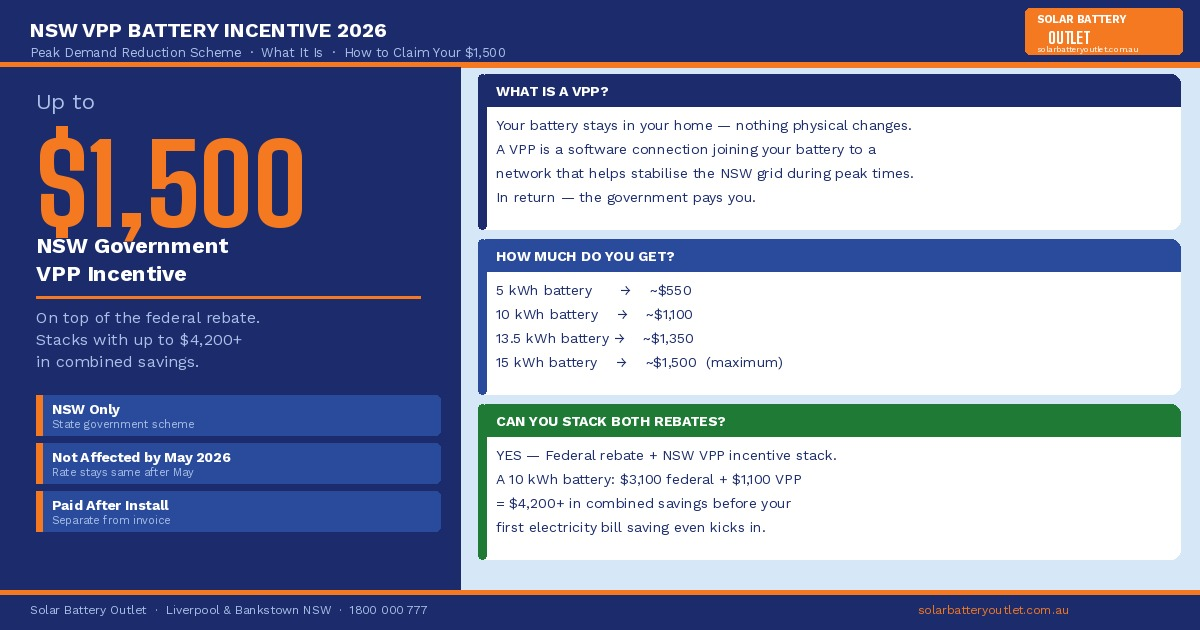
The NSW Peak Demand Reduction Scheme pays a point-of-sale incentive based on your battery’s usable capacity. Here’s what that looks like in real numbers:

Battery SizeVPP IncentiveFederal Rebate (before May)Combined Saving
5 kWh~$550~$1,550~$2,100
10 kWh~$1,100~$3,100~$4,200
13.5 kWh~$1,350~$3,720~$5,070
15 kWh~$1,500~$4,200~$5,700

The $1,500 is the cap — you hit that around 13 to 15 kWh of usable capacity. Most standard 10 kWh batteries land around $1,100 in VPP incentive.

These are estimates — the exact amount depends on your battery’s certified usable capacity as registered with the scheme. Your installer will confirm the exact figure for your specific battery model before installation.

For a full breakdown of what these rebates mean for your out-of-pocket cost, our Solar Battery Cost Sydney 2026 guide has the complete numbers.

Who Qualifies for the NSW VPP Incentive

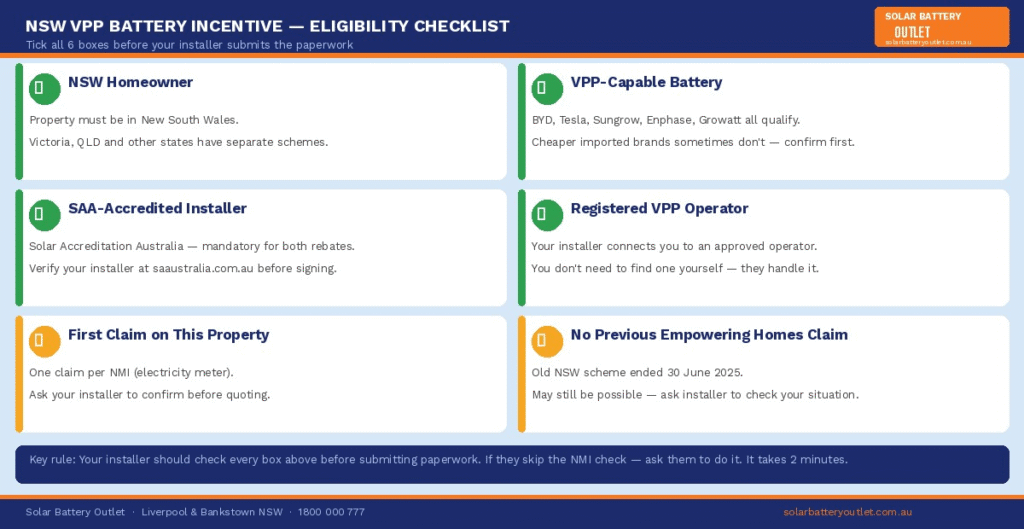
NSW VPP incentive eligibility checklist 2026

Not every battery installation qualifies. Here’s the exact checklist:

You must be a NSW homeowner. The Peak Demand Reduction Scheme is a NSW state program. Properties in Victoria, Queensland or other states don’t qualify — those states have their own separate schemes.

Your battery must be VPP-capable. This means the battery’s firmware and hardware support remote dispatch by a VPP operator. Every major brand we install — BYD, Tesla, Sungrow, Enphase, Growatt — qualifies. Cheaper imported brands sometimes don’t. Your installer should confirm this before quoting.

Your battery must be connected to a registered VPP operator. There are several approved VPP operators in NSW — your installer will connect you to one as part of the installation process. You don’t need to go find one yourself.

The battery must be installed by an SAA-accredited installer. Same requirement as the federal rebate. If your installer isn’t SAA-accredited, you can’t access either scheme. Verify at saaustralia.com.au before signing anything.

One claim per property. The incentive is tied to your property’s electricity meter (NMI). If a previous owner already claimed it, you can’t claim again on the same address. A good installer checks this upfront.

You must not have previously claimed the old NSW Empowering Homes battery rebate on this property. If the old scheme was claimed, the VPP incentive may still be accessible separately depending on your battery specifications — worth asking your installer to check your specific situation.

The Federal Rebate vs The NSW VPP Incentive — What’s the Difference

People often confuse these two. They’re completely separate schemes run by different governments. Here’s the clearest way to think about them:

Federal Cheaper Home Batteries Program:

  • Run by the Australian federal government
  • Gives you roughly 30% off the upfront cost of an eligible battery
  • Applied directly off your invoice by your installer — you never see the money, it just reduces what you pay
  • Rate drops after 1 May 2026 and steps down every six months until 2030
  • Available across all of Australia

NSW Peak Demand Reduction Scheme (VPP Incentive):

  • Run by the NSW state government
  • Pays you up to $1,500 as a separate payment after installation
  • Paid out after your battery is connected to a VPP and registered with the scheme
  • Not affected by the 1 May federal changes — rate stays the same
  • Only available in NSW

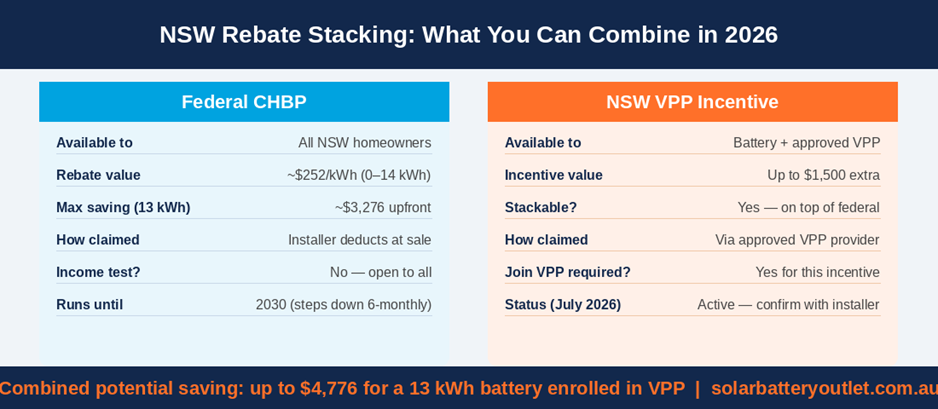
The key point: you can claim both. They are designed to stack. A typical NSW homeowner installing a 10 kWh battery captures around $3,100 from the federal scheme and around $1,100 from the NSW VPP scheme — over $4,200 in combined savings before a single electricity bill reduction kicks in.

Our Federal Battery Rebate NSW 2026 guide walks you through the federal rebate step by step and explains exactly who qualifies and how it’s applied.

How to Claim the NSW VPP Incentive — Step by Step

Good news: most of this happens automatically when you use a good installer. Here’s the process so you know what to expect and what to ask.

Step 1 — Choose an SAA-accredited installer who processes both rebates.

This is the most important step. Not all installers bother with the VPP incentive because it involves extra compliance and registration steps. Before you accept any quote, ask directly: “Do you process the NSW Peak Demand Reduction Scheme incentive?” If they hesitate or look confused — find a different installer.

Step 2 — Choose a VPP-capable battery.

Your installer will confirm this. Every battery we recommend — BYD, Tesla Powerwall 3, Sungrow SBR, Enphase IQ 5P — qualifies. The installer will specify a registered VPP operator at the time of installation. You sign a VPP agreement, which covers how your battery can be dispatched and sets your minimum reserve levels.

Step 3 — Installation day.

Your battery is installed and connected. The installer registers the system with Ausgrid (your local network operator across most of NSW) and with the VPP operator. Both registrations are handled by your installer — not you.

Step 4 — VPP incentive payment.

After installation and registration are confirmed, the NSW incentive payment is processed. This typically takes a few weeks and comes through as a payment separate from your installation invoice. Your installer should give you a clear timeline on when to expect it.

Step 5 — You’re done.

Your battery runs normally. You keep full visibility of your charge levels through your battery’s app. The VPP operator can access your battery during peak events — but you set the floor on how low it can go.

Will Being in a VPP Affect My Battery Performance?

This is the question we get asked most often once people understand what a VPP is. The honest answer is — minimally, and usually in your favour.

VPP dispatch events typically happen a handful of times per year during extreme peak demand. Each event might draw 1 to 2 kWh from your battery. In practice, your battery recharges from solar the next day and you’re back to normal.

Some VPP arrangements also pay you ongoing payments or bill credits each time your battery is dispatched — on top of the upfront $1,500 incentive. This varies by VPP operator, so ask your installer which operator they use and what the ongoing earning structure looks like.

The one thing to confirm is your minimum reserve setting. If you want blackout protection — and you should, given South West Sydney’s storm season — make sure your VPP agreement lets you set a minimum charge reserve to keep enough backup power available. A good installer configures this during setup.

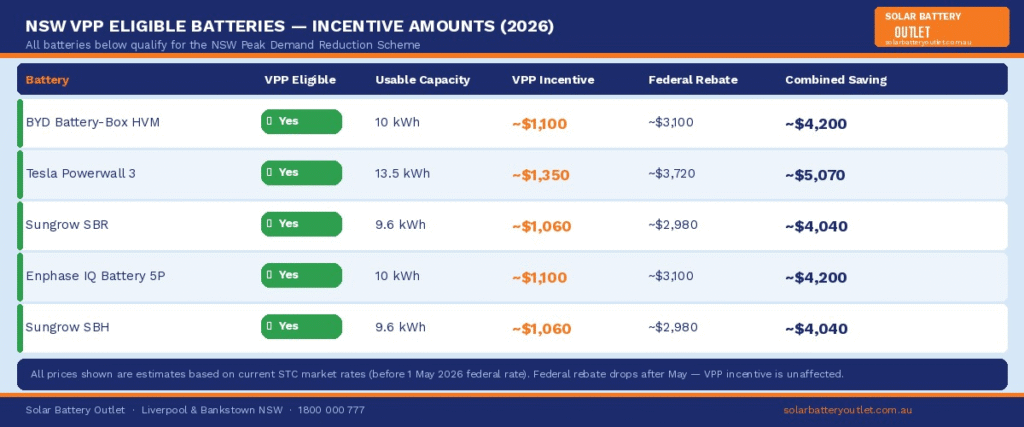
Which Batteries Qualify for the NSW VPP Incentive in 2026

NSW VPP eligible batteries 2026 comparison

Every battery we stock and install qualifies. Here’s the confirmed list:

BatteryVPP EligibleUsable CapacityApprox. VPP Incentive
BYD Battery-Box HVM 10 kWh✅ Yes10 kWh~$1,100
Tesla Powerwall 3✅ Yes13.5 kWh~$1,350
Sungrow SBR 9.6 kWh✅ Yes9.6 kWh~$1,060
Enphase IQ Battery 5P (10 kWh)✅ Yes10 kWh~$1,100
Sungrow SBH 9.6 kWh✅ Yes9.6 kWh~$1,060

For a full comparison of these batteries including prices and performance, our Best Solar Battery NSW 2026 guide has everything side by side.

What About VPP Ongoing Earnings — Is It Worth Staying In?

The $1,500 upfront incentive is the main headline. But some VPP programs also pay you on an ongoing basis each time your battery contributes to a grid event.

The exact amount varies by operator and by how active your battery is in dispatch events. Some households earn an extra $50 to $200 per year through ongoing VPP participation. It’s not life-changing money on its own — but it’s passive income from a battery you already own.

The key question to ask your installer is: which VPP operator are we being connected to, and what’s the ongoing payment structure after the upfront incentive is paid?

Some operators give you bill credits. Some pay direct. Some offer a hybrid arrangement. It’s worth understanding before you sign the VPP agreement — not because any of them are bad, but because you want to know what you’re getting.

Frequently Asked Questions

Does the NSW VPP incentive drop after 1 May 2026 like the federal rebate?

No. The federal rebate rate drops on 1 May 2026 — the NSW VPP incentive is completely separate and is not affected by that date. You can claim the full VPP incentive amount whether you install before or after May. The only reason to rush for May is the federal rebate component.

Can I claim the VPP incentive if I already have a battery installed?

Generally no — the NSW Peak Demand Reduction Scheme incentive is designed for new battery installations. If you have an existing battery that’s already registered with a VPP, you may have already received it or been ineligible depending on when it was installed. Worth asking your installer to check your specific situation.

What if I don’t want to join a VPP?

You can still claim the federal rebate without joining a VPP — the two are separate. You simply won’t receive the $1,500 NSW incentive. For most homeowners the VPP agreement is a straightforward arrangement and the $1,500 is well worth it. But it’s your choice.

How long does the VPP incentive payment take to arrive?

Typically 2 to 6 weeks after your installation is registered and confirmed. Your installer handles the registration — ask them for a specific timeline at the time of installation so you know what to expect.

Will the VPP drain my battery during a blackout?

No. VPP dispatch only operates when the grid is running — not during a blackout. If the grid goes down, your battery automatically switches to backup mode and the VPP connection is inactive. Your stored power is yours during an outage.

Does joining a VPP affect my battery warranty?

It shouldn’t if you’re using an approved VPP operator and your battery is installed correctly. The VPP dispatch events are within the normal operating parameters of the battery. Confirm this with your installer and check your battery’s warranty documentation to be sure.

Want us to handle both rebates for your NSW home?

We process the federal Cheaper Home Batteries rebate AND the NSW VPP incentive as standard on every installation. You don’t chase paperwork. We handle it.

Call 1800 000 777 or fill in our 60-second form at solarbatteryoutlet.com.au

Best Solar Battery NSW 2026: What We Actually Recommend After Installing Hundreds of Them

Here’s the honest truth about “best solar battery” lists you find online.

Most of them are written by people who’ve never installed a battery in their life. They copy spec sheets, rank by storage capacity, and slap an affiliate link at the bottom. The brand that pays the most commission usually wins.

We do this differently.

Our team installs solar batteries every week across Liverpool, Bankstown, Campbelltown and South West Sydney. We see which batteries perform quietly for years. We see which ones throw error codes at 2am. We see which brands actually show up when something goes wrong under warranty — and which ones leave homeowners waiting months for a response.

This guide is based on that experience. Not sponsored rankings. Not manufacturer spec sheets. Just what we’ve genuinely seen work well in NSW homes in 2026 — and what the right choice looks like depending on your situation.


Before we get into it: The federal battery rebate rate drops after 1 May 2026. Every battery on this list qualifies for it. For a 10 kWh system, installing before May saves around $530 compared to waiting. All prices in this guide are shown after the current rebate rate. See exactly how the rebate works here.


First — What Makes a Battery “Best” in NSW Specifically?

This matters because NSW has specific conditions that affect which battery suits your home.

Heat. Western Sydney summers are brutal. Batteries sitting in garages or on west-facing walls in Bankstown, Liverpool and Campbelltown experience higher ambient temperatures than coastal suburbs. Heat degrades batteries faster. Battery chemistry and thermal management matter more here than they do in Melbourne or Adelaide.

Ausgrid network requirements. Most of NSW — including all of South West Sydney — runs on the Ausgrid network. Ausgrid has specific requirements around how batteries connect and register. Not every battery brand’s firmware plays nicely with every network. An experienced local installer knows which combinations work cleanly.

VPP eligibility. The NSW Peak Demand Reduction Scheme pays you up to $1,500 for connecting your battery to a Virtual Power Plant. Not all batteries are VPP-capable under the scheme. Every battery we recommend below qualifies — but it’s worth knowing this is a NSW-specific filter that rules out some cheaper imported options.

Storm season backup. South West Sydney gets hit hard in summer storms. Blackout protection isn’t just a nice feature here — for a lot of families it’s the whole point. How reliably a battery switches to backup mode when the grid drops is a real performance question, not a marketing checkbox.

With that context, here’s what we actually recommend.

The Best Solar Batteries for NSW Homes in 2026

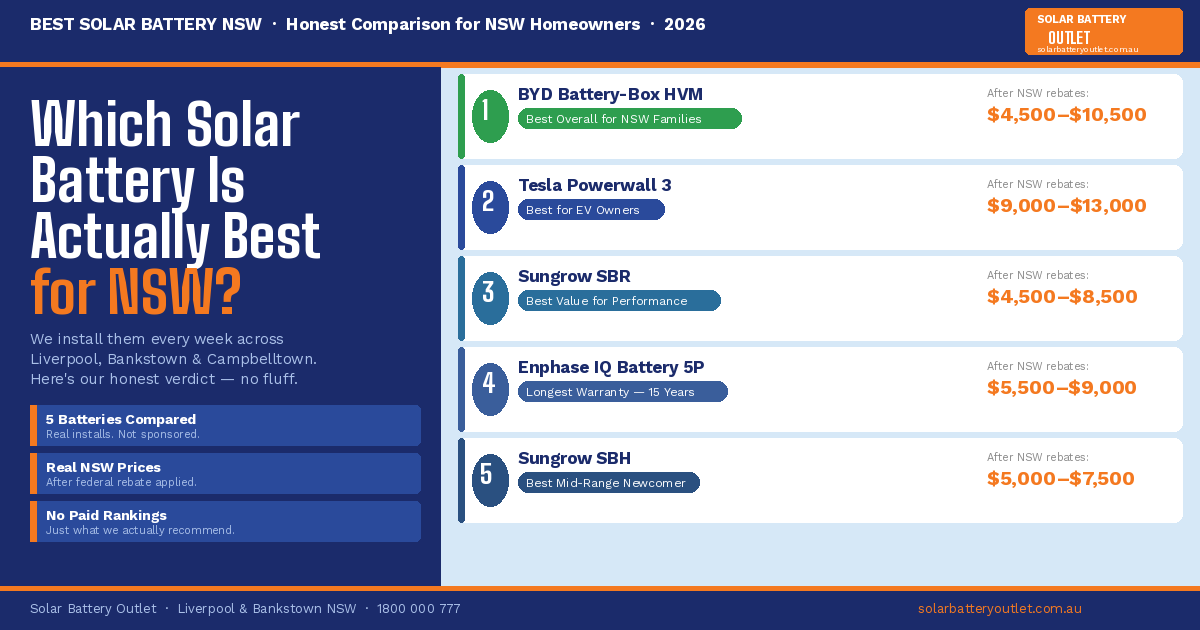
best solar battery NSW comparison

1. BYD Battery-Box HVM — Best Overall for NSW Families

Best for: Most NSW homeowners. Families wanting flexibility. Anyone planning an EV in the next few years.

If we had to recommend one battery to the average NSW family in 2026 — this is it. Not because it’s the flashiest. Because it’s the most sensible combination of performance, price, flexibility and warranty we’ve seen at this price point.

BYD is the world’s largest battery manufacturer. They make batteries for everything from home storage to electric buses to grid-scale projects. That manufacturing scale shows up in consistent quality and genuinely responsive warranty support in Australia.

The modularity is the standout. You start at 8.3 kWh and add modules later up to 22.1 kWh. If you’re not sure how much storage you need right now — or if an EV is coming in the next couple of years — this lets you start with what makes sense today and grow without replacing anything.

The 10-year warranty covers 70% capacity retention. That’s the higher threshold among mid-range options and it means in year 10, your battery should still hold more than two-thirds of its original capacity.

Real numbers for NSW after rebates:

  • 8.3 kWh: approximately $4,500–$6,500 installed
  • 10 kWh: approximately $5,500–$8,000 installed
  • 13.8 kWh: approximately $7,500–$10,500 installed

Watch out for: Needs a compatible hybrid inverter. If you have an older string inverter, confirm compatibility before accepting a quote. This is the most common issue we see with BYD retrofits.

2. Tesla Powerwall 3 — Best Premium Option and Best for EV Owners

Best for: EV owners. Families who want automatic blackout protection. Homes wanting a single all-in-one unit.

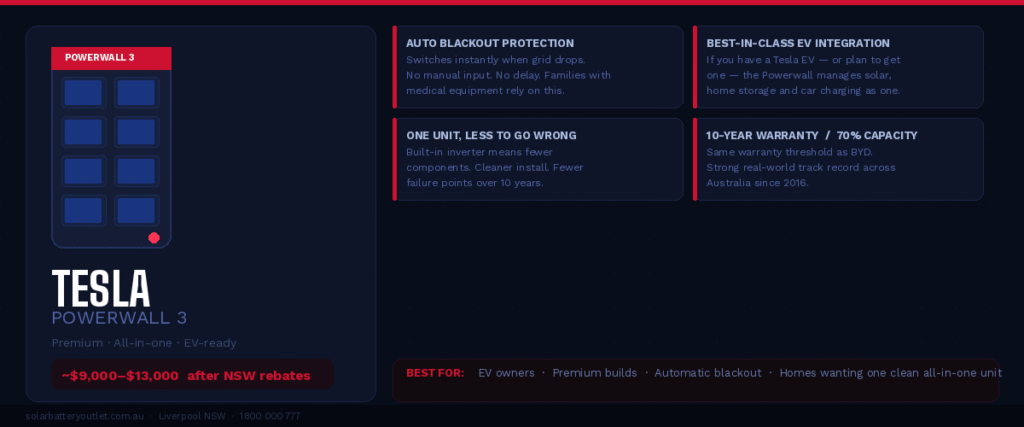
The Powerwall 3 earns its reputation. It’s a single 13.5 kWh unit with a built-in inverter — everything in one box, fewer components, cleaner installation, fewer failure points over 10 years.

The blackout protection is the best we’ve seen in a residential battery. When the grid drops, the Powerwall switches automatically. No manual input, no delay, no noticing it happened. For families with medical equipment or just anyone who’s been through one too many summer blackouts in South West Sydney, this matters.

The EV integration is genuinely useful if you’re in the Tesla ecosystem. The Powerwall manages solar generation, home storage and car charging as one system through the Tesla app — deciding when to charge the car from solar versus battery versus grid based on your usage patterns and time-of-use pricing. No other battery on this list matches that level of integration.

Real numbers for NSW after rebates:

  • 13.5 kWh: approximately $9,000–$13,000 installed

Watch out for: Fixed capacity — you can’t expand it modularly. If your storage needs grow significantly, you add a second unit. Also the most expensive option on this list. If you’re not in the Tesla EV ecosystem, you’re paying a premium for features you may not fully use.

For a full head-to-head between Powerwall 3 and BYD, we’ve written a detailed Tesla Powerwall 3 vs BYD Battery-Box comparison specifically for NSW homeowners.

3. Sungrow SBR — Best Value for Performance

Best for: Value-focused buyers. Homes already running a Sungrow inverter. Households wanting larger storage without Tesla’s price tag.

Sungrow is the world’s largest solar inverter manufacturer. Their SBR battery range is built on the same engineering heritage — and it shows. The cycle rating on the SBR is among the best in this price bracket, rated at around 6,000 cycles. Over a 10-year period, that’s solid.

It scales from 9.6 kWh up to 25.6 kWh, which makes it a strong option for larger homes or households with higher evening usage. If you’ve already got a Sungrow inverter from a previous solar install — which is common across South West Sydney — the SBR is usually the cleanest and most cost-effective battery to add. No inverter replacement needed.

The 10-year warranty covers 60% capacity retention — slightly lower than BYD and Tesla’s 70% threshold, but at this price point the trade-off is reasonable for most households.

Real numbers for NSW after rebates:

  • 9.6 kWh: approximately $4,500–$7,000 installed
  • 12.8 kWh: approximately $6,000–$8,500 installed

Watch out for: Works best with Sungrow inverters. AC-coupling to other brands is possible but adds cost and complexity. Confirm your inverter compatibility before getting a quote.

4. Enphase IQ Battery 5P — Best for Long-Term Peace of Mind

Best for: Long-term homeowners who want the longest warranty available. Retrofits onto any existing inverter. Fire-safety conscious buyers.

The Enphase IQ Battery 5P is the only battery available in Australia right now with a 15-year warranty. Everything else on this list is 10 years. If you’re planning to stay in your home for 15 years and you want certainty over that entire window, that warranty alone is a significant differentiator.

It’s fully AC-coupled, which means it connects to almost any existing solar inverter without replacing anything. If your current setup is a few years old and you want to add a battery with the least disruption, Enphase is often the cleanest retrofit technically.

Fire safety credentials are worth mentioning given how hot South West Sydney gets. The IQ 5P carries UL 9540 and UL 9540A certification — the highest fire safety standard available for residential batteries. For homes in bushfire-adjacent areas west of Sydney, this isn’t a small thing.

Real numbers for NSW after rebates:

  • 10 kWh setup: approximately $5,500–$9,000 installed

Watch out for: Higher cost per kWh than BYD or Sungrow. Each module is a separate physical unit — you can’t stack them, they sit side by side. For tight spaces this can be a consideration.

5. Sungrow SBH — Best Mid-Range Newcomer Worth Watching

Best for: Mid-range buyers wanting newer technology. Homes with Sungrow inverters wanting an upgrade path.

The SBH is Sungrow’s newer residential battery range and it’s been getting strong reviews from installers across NSW. Better thermal management than the SBR, slightly cleaner firmware, and good compatibility with Sungrow’s latest hybrid inverters.

We’ve been installing it for a few months now and the early feedback from customers has been solid. It’s not as proven in the long-term as BYD or Tesla simply because it hasn’t been around as long — but the engineering behind it is strong and Sungrow’s local support in Australia is responsive.

Real numbers for NSW after rebates:

  • 9.6 kWh: approximately $5,000–$7,500 installed

Watch out for: Shorter Australian track record than BYD and Tesla. Ask your installer specifically about local warranty support before committing.

Quick Comparison — All Five Side by Side

BatteryCapacityExpandableWarrantyAfter NSW RebatesBest For
BYD Battery-Box HVM8.3–22.1 kWhYes10yr / 70%$4,500–$10,500Most NSW families
Tesla Powerwall 313.5 kWhNo (add unit)10yr / 70%$9,000–$13,000EV owners, premium
Sungrow SBR9.6–25.6 kWhYes10yr / 60%$4,500–$8,500Value, Sungrow homes
Enphase IQ 5P5–15 kWhYes15yr / 70%$5,500–$9,000Long-term owners
Sungrow SBH9.6–19.2 kWhYes10yr / 70%$5,000–$7,500Mid-range upgrade

How to Choose the Right One for Your NSW Home

how to choose best solar battery NSW 2026 guide

Stop looking at the spec table and ask yourself these four questions instead. They’ll narrow it down faster than any comparison chart.

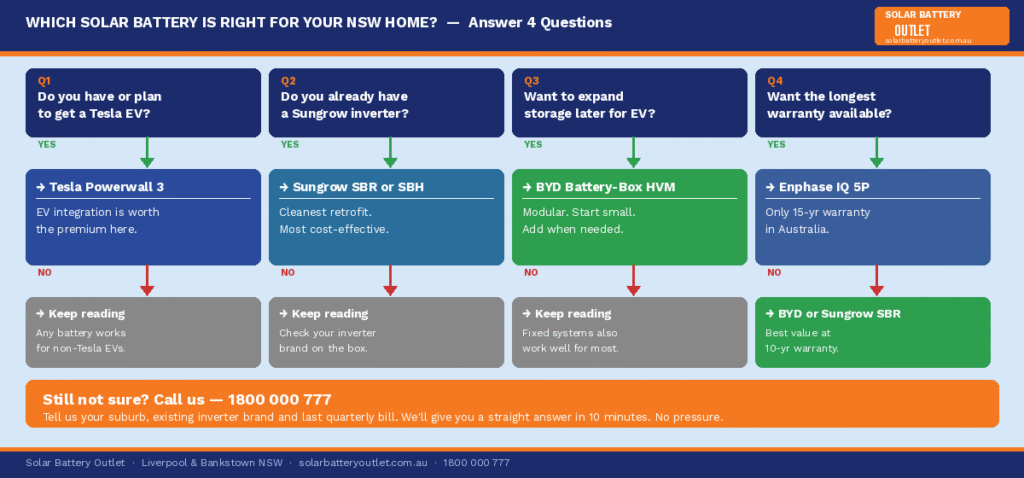
Do you have or plan to get a Tesla EV? Yes → Powerwall 3. The integration is genuinely worth the premium in this case.

Do you already have a Sungrow inverter? Yes → Sungrow SBR or SBH. Cleanest retrofit, most cost-effective.

Do you want to expand storage later — especially for an EV? Yes → BYD Battery-Box HVM. Start where you need to and add modules.

Do you want the longest warranty and simplest retrofit onto any existing system? Yes → Enphase IQ Battery 5P.

Is value your main driver and you want solid performance without the premium? Sungrow SBR or BYD depending on your inverter.

If you’ve answered those questions and you’re still not sure — that’s what a no-obligation quote call is for. Any reputable installer, including us, should be able to look at your existing setup and give you a straight recommendation in 10 minutes.

What the NSW Rebates Look Like for Each Battery

Every battery on this list qualifies for both the federal Cheaper Home Batteries Program and the NSW VPP incentive. Here’s how that stacks for a typical 10 kWh install:

  • Federal rebate: ~$3,100 off upfront (applied directly on your invoice by your installer)
  • NSW VPP incentive: up to $1,500 paid to you after installation for connecting to a Virtual Power Plant

Combined: up to $4,600 in savings before your first electricity bill reduction kicks in.

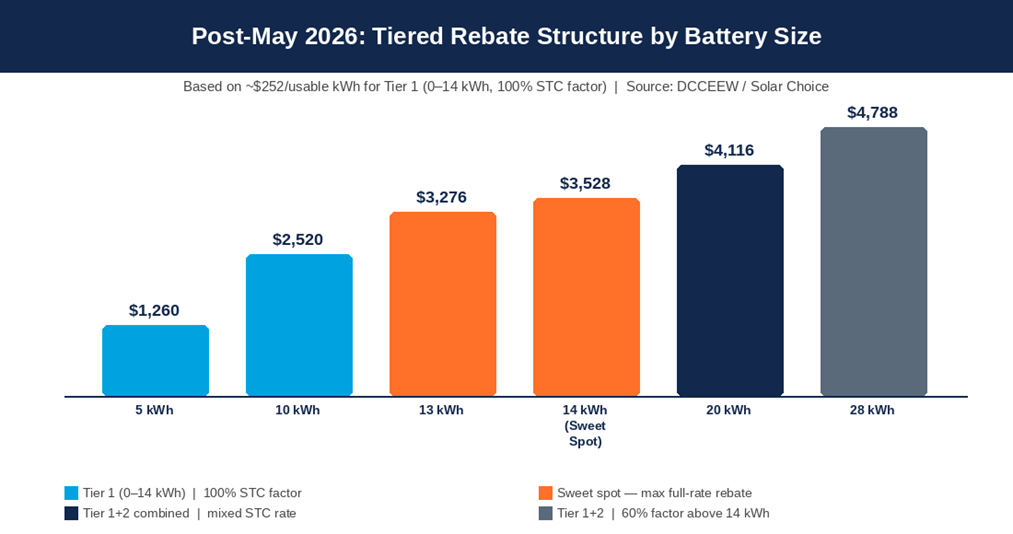
The federal rate drops after 1 May 2026. For anything over 14 kWh — like the Powerwall 3 — the drop is more significant because of the new tiered structure. For standard 10 kWh batteries, it’s around $530 less if you wait past May. Not a cliff, but real money.

For the exact numbers on what changes and when, our Solar Battery Rebate Drops 1 May 2026 guide has the full breakdown.

What to Ask Any Installer Before You Sign

A few things we see trip people up when getting quotes for any of these batteries across NSW:

The cheapest quote is not always the best value. A BYD installed with the wrong inverter or poor cable management will give you more headaches than a Sungrow installed properly at a higher price.

Make sure the federal rebate shows as a line item on the quote — not a verbal promise. You should be able to see exactly how much the rebate is reducing your invoice.

Ask specifically: does this installation include blackout protection? Not all system designs include automatic backup even when the battery supports it.

Confirm the installer is SAA-accredited before signing anything. Verify at saaustralia.com.au — takes 30 seconds. Without SAA accreditation your installer cannot process the federal rebate.

Ask who handles the NSW VPP paperwork. Some installers skip this step because it’s extra compliance work. A good installer processes both rebates as standard.

For everything else to check — including the questions that catch installers out — our Solar Battery Installer Liverpool NSW guide covers what to look for and what to avoid.


Frequently Asked Questions

Is the BYD Battery-Box actually as good as Tesla?

For most NSW families — yes. Tesla wins on automatic blackout switching and EV integration. BYD wins on price, flexibility and the ability to expand. If you’re not in the Tesla ecosystem, BYD gives you equivalent quality at a lower cost. That’s why it’s our most installed battery across Liverpool, Bankstown and Campbelltown.

Which battery lasts longest in Australian heat?

All five batteries on this list use LFP chemistry, which handles heat better than older lithium-ion. Enphase has the longest warranty at 15 years. In terms of real-world longevity in hot Western Sydney conditions, BYD and Sungrow have the largest local install base and the longest track record in Australian conditions. For more on what actually affects lifespan, see our How Long Does a Solar Battery Last in Australia guide.

Can I get a solar battery without existing solar panels?

No — the federal rebate requires existing or simultaneously installed solar panels. A battery alone doesn’t qualify. If you don’t have panels yet, a combined solar and battery install is actually good timing and the rebate applies to the battery portion. For the full eligibility checklist, see our Federal Battery Rebate NSW 2026 guide.

What size battery do I actually need for a NSW home?

For most families in South West Sydney using power mainly in evenings, 10 kWh covers the majority of overnight usage comfortably. If you have an EV or high usage, 13–15 kWh makes more sense. A good installer will look at your last 3 electricity bills and size it properly rather than just recommending the biggest option. Our Solar Battery Cost Sydney 2026 guide breaks down sizing and cost together.

Are solar batteries worth it in NSW right now?

For most homeowners with existing solar and evening-heavy usage — yes. The combination of low feed-in tariffs, high evening rates and the current rebate makes the numbers work better than they have at any point in the last five years. For an honest payback analysis, our Are Solar Batteries Worth It in Australia guide covers the full case.


Want a straight recommendation for your home? Tell us your suburb, your existing inverter brand, and your last quarterly bill — and we’ll tell you exactly which battery makes sense and what it’ll cost after rebates.

Call 1800 000 777 or fill in our 60-second form at solarbatteryoutlet.com.au We’re based in Liverpool and Bankstown. No pressure, no pushy sales.


Here’s a question we get asked almost every week at our Liverpool office.

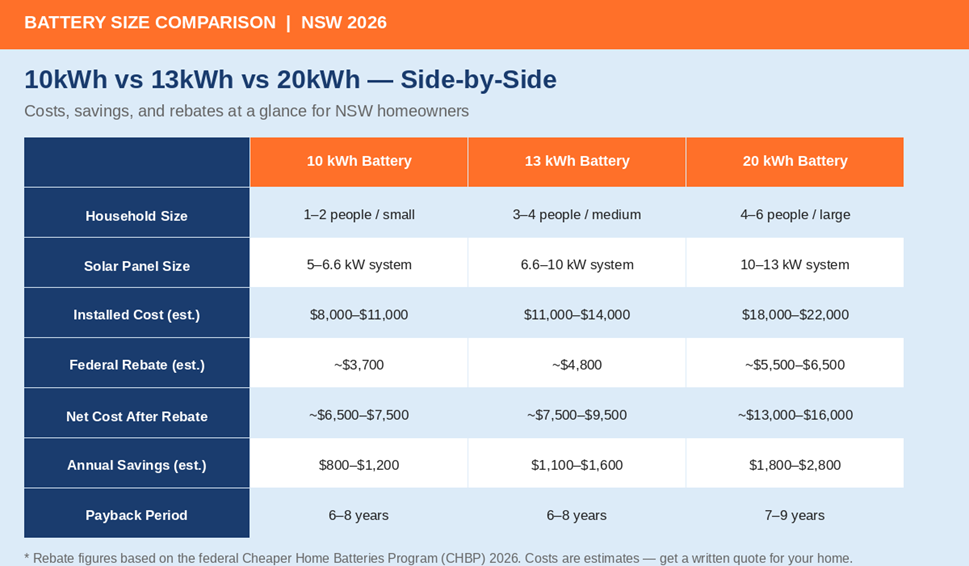
Someone’s done their research, they’ve got a couple of quotes in hand, and they’ve narrowed it down to two batteries — Tesla Powerwall 3 or BYD Battery-Box. And then they ring us and ask: “Mate, which one should I actually go with?”

The honest answer is — it depends. But not in a wishy-washy way. There are genuinely specific situations where one beats the other, and we’re going to walk through exactly that here.

We install both of these batteries every week across Liverpool, Bankstown, Campbelltown and South West Sydney. This comparison is based on what we actually see on the job — not spec sheets from a manufacturer’s website.


Quick heads up on timing: The federal battery rebate rate drops after 1 May 2026. If you’re seriously comparing these two batteries right now, getting your quote locked in before that date means more money in your pocket — regardless of which one you choose. More on the rebate deadline here.


The Quick Side-by-Side

Before we get into the detail, here’s where they sit head to head:

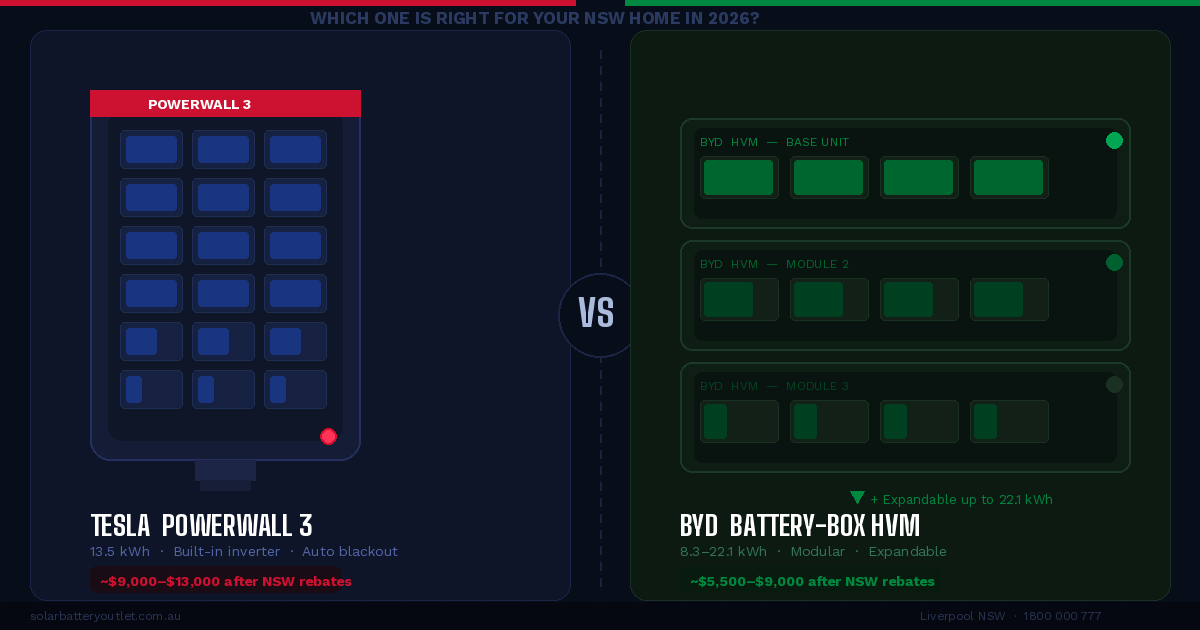
Comparison InTesla Powerwall 3BYD Battery-Box HVM
Capacity13.5 kWh (fixed)8.3 kWh – 22.1 kWh (modular)
ChemistryLFPLFP
Inverter includedYes — built inNo — needs separate inverter
Blackout protectionAutomaticAvailable (confirm with installer)
ExpandableNo (add second unit)Yes — add modules
Warranty10 years / 70% capacity10 years / 70% capacity
EV integrationExcellent (Tesla app)Good
Approx. cost after rebates (NSW)$9,000 – $13,000 installed$5,500 – $9,000 installed

Both use LFP chemistry — the safer, longer-lasting standard for home batteries in Australia. Both carry a solid 10-year warranty. On paper they look similar. In real life, the differences matter quite a bit.

What the Tesla Powerwall 3 Does Really Well

The Powerwall 3 is the most complete single-unit home battery available in Australia right now. Everything — the battery, the inverter, and the backup switching — is built into one box. That means fewer components, a cleaner installation, and fewer things that can go wrong over 10 years.

The blackout protection is genuinely impressive. When the grid goes down, the Powerwall switches over automatically. Most homeowners don’t even notice it happened. For families with someone who relies on medical equipment, or just anyone who’s sick of sitting in the dark during a South West Sydney storm, that seamless switchover matters.

The EV integration is also in a league of its own. If you have a Tesla vehicle — or you’re planning to get one — the Powerwall and the car talk to each other through the Tesla app. It decides when to charge the car from solar, when to pull from the battery, and when to use the grid based on time-of-use pricing. That level of automation is genuinely useful, not just a marketing gimmick.

Where it falls short:

The Powerwall 3 is fixed at 13.5 kWh. You can’t expand it — if you need more storage down the track, you add a second unit. That’s fine for most households, but if you’re not sure how your energy needs might grow, it’s worth thinking about.

It’s also the more expensive option. After the federal rebate, you’re generally looking at $9,000 to $13,000 installed in NSW. That’s not outrageous for what you’re getting — but it’s real money.

What the BYD Battery-Box Does Really Well

BYD is the largest battery manufacturer in the world. That’s not a marketing line — they produce batteries for everything from home storage to electric buses. The Battery-Box HVM is built on that same manufacturing foundation, and it shows in the consistency.

The biggest advantage of BYD over Tesla for a lot of NSW families is the modularity. You can start at 8.3 kWh and add modules up to 22.1 kWh as your needs change. Planning to get an EV next year? Just add a module. Energy usage going up as the kids get older? Add a module. You’re not locked into a fixed decision made in 2026.

It also tends to come in at a lower price point — $5,500 to $9,000 after rebates for a comparable setup. For households where the Powerwall’s premium price is a stretch, BYD gives you quality storage without compromising on warranty or safety.

Compatibility is another plus. BYD works with a wide range of inverters, which makes it a cleaner retrofit option if you already have an existing solar system. You’re less likely to need an inverter replacement alongside it.

Where it falls short:

BYD doesn’t include a built-in inverter — you need a separate compatible hybrid inverter. This adds to the installation complexity slightly, and if you don’t already have a compatible inverter, it adds to the cost. Always confirm inverter compatibility before you accept a quote.

The app and the EV integration, while solid, doesn’t match Tesla’s seamless experience if you’re in the Tesla ecosystem.

Who Should Get the Tesla Powerwall 3?

Get the Powerwall 3 if:

  • You already have a Tesla EV, or you’re buying one in the next 12 months
  • You want the best automatic blackout protection available — no fiddling, no manual switching
  • You want the cleanest single-unit installation with the fewest components
  • Budget isn’t your primary concern and you want the premium option
  • You have a larger home and 13.5 kWh fits your storage needs well

Who Should Get the BYD Battery-Box?

Get the BYD if:

  • You want flexibility to expand storage later — especially if an EV is on the horizon but not confirmed yet
  • You’re working with a tighter budget but don’t want to compromise on quality or warranty
  • Your existing solar system already has a BYD-compatible inverter
  • You’re looking at larger storage above 13.5 kWh — BYD scales better at the bigger end
  • You want strong value from a globally proven manufacturer without paying Tesla’s premium

What About the Rebate — Does It Affect the Choice?

Both batteries qualify for the federal Cheaper Home Batteries Program rebate, so you get the same percentage discount regardless of which one you choose.

For the Powerwall 3 at 13.5 kWh, the rebate works out to around $3,600–$4,200 off the upfront cost before 1 May 2026. For a 10 kWh BYD setup, it’s around $2,800–$3,100 off.

On top of that, both qualify for the NSW VPP incentive — up to $1,500 extra for connecting to a Virtual Power Plant. That stacks with the federal rebate. So before your first electricity bill saving even kicks in, you could be $4,000 to $5,500 better off than the sticker price.

For the full breakdown on how the rebate works and what you actually need to do to claim it, read our Federal Battery Rebate NSW 2026 guide here.

The Price Gap — Is It Worth It?

This is the real question most people are sitting with.

The Powerwall 3 typically costs $2,000 to $4,000 more than a comparable BYD setup after rebates. Whether that’s worth it comes down to one main thing: the Tesla ecosystem.

If you’re an EV owner or planning to be one — that gap narrows fast. The energy management you get from pairing a Powerwall with a Tesla vehicle saves a meaningful amount in optimised charging over time, and that’s before you factor in the convenience of managing everything from one app.

If you’re not in the Tesla ecosystem and you just want reliable, expandable home battery storage with a strong warranty — BYD closes that gap completely. You’re not giving up quality. You’re just not paying for features you won’t use.

We’ve helped hundreds of families in Liverpool and South West Sydney work through exactly this decision. Most EV owners land on Powerwall. Most everyone else lands on BYD. That’s a genuine pattern, not a sales pitch.

A Note on Installation

Both batteries need to be installed by an SAA-accredited installer. This is not optional — if your installer isn’t SAA-accredited, you won’t qualify for the federal rebate. Full stop.

You can verify any installer’s accreditation at saaustralia.com.au before signing anything.

For what to look for (and what to avoid) when choosing an installer in the Liverpool area, our Solar Battery Liverpool NSW guide covers that in detail.

Frequently Asked Questions

Which lasts longer — Tesla Powerwall 3 or BYD Battery-Box?

Both carry a 10-year warranty with 70% capacity retention — so on paper they’re equal. Real-world lifespan for both is typically 10 to 15 years. For a deeper look at what actually affects battery lifespan in Australian conditions, see our How Long Does a Solar Battery Last in Australia guide.

Can I add more storage to the Tesla Powerwall 3?

Not in the traditional sense. You can add a second Powerwall 3 unit, which gives you 27 kWh total. It’s not modular like BYD — you’re adding a complete second unit rather than a storage module. For most households, one Powerwall 3 at 13.5 kWh is enough.

Does BYD work with any solar inverter?

Not any — but it works with a wide range. It’s compatible with most hybrid inverters from Sungrow, Fronius, SolarEdge and others. Your installer should confirm compatibility before quoting. If you already have solar and you’re not sure what inverter you have, check the brand name on the grey box near your switchboard.

Which battery is better for blackouts?

Tesla Powerwall 3 wins here. It switches to backup mode automatically with no manual input needed. BYD can handle blackouts too, but you need to confirm with your installer that backup mode is included in the system design — it’s not automatic on all setups.

Is either battery worth it if I’m adding to existing solar?

Yes — both are strong options for retrofitting onto an existing solar system. Whether adding a battery makes financial sense for your specific situation is a separate question worth working through. Our Is Adding a Battery to Existing Solar Worth It guide has the honest numbers on that.


Ready to get a quote for Liverpool or South West Sydney?

We install both Tesla Powerwall 3 and BYD Battery-Box HVM. We’ll tell you honestly which one suits your home — and we handle all the rebate paperwork so you don’t have to.

Call 1800 000 777

or fill in our 60-second form at solarbatteryoutlet.com.au