

If you are a NSW homeowner with solar panels, you have almost certainly asked this question: Should you install a battery now, or wait another year for prices to fall? It sounds like a simple cost-benefit decision. In reality, the answer involves several moving parts—hardware trends, government rebates, import costs, and your household’s own usage pattern.
This article cuts through the noise. It draws on data from CSIRO’s GenCost report. It also uses BloombergNEF’s 2025 Energy Storage Outlook and the Australian Government’s updated Cheaper Home Batteries Program. Together, these sources show where battery prices are heading. They also explain what that means for your timing decision.
What Has Happened to Battery Prices So Far?
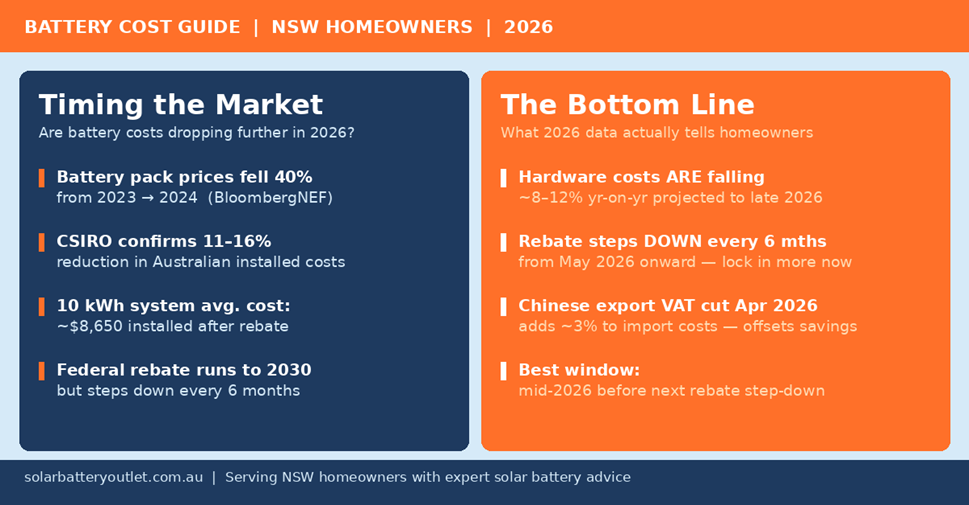
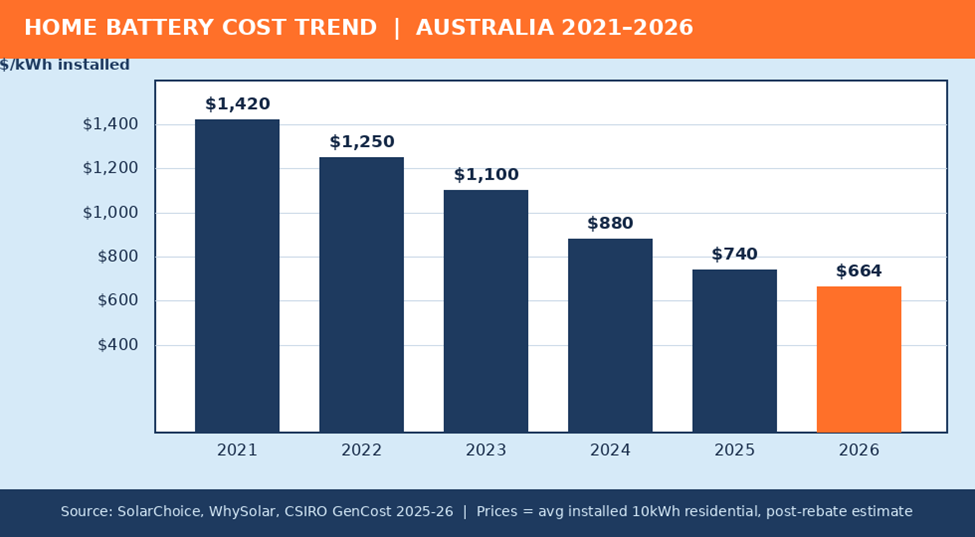
The short version is that prices have fallen dramatically over the past five years. According to BloombergNEF, lithium battery costs declined by more than 40% between 2020 and 2025 globally. In Australia specifically, CSIRO’s GenCost 2025–26 draft report confirmed residential battery storage costs dropped 11 to 16% in 2024–25 alone. Furthermore, an even steeper 40% drop was recorded from 2023 to 2024.
To put that into dollar terms: the average installed cost of a 10 kWh residential battery in Australia currently sits at around $8,650 after the federal rebate, compared to well over $12,000 just three years ago. For homeowners researching the best home batteries Australia has to offer, this downward trend is genuinely significant.
So Will Costs Drop Further in 2026?
Yes — but the picture is more nuanced than a simple ‘wait and save more’ conclusion.
On the hardware side, the outlook is positive. BloombergNEF expects lithium battery pack prices to fall by 8–12% through late 2026. Expanding manufacturing capacity is a key reason. Increased use of lithium iron phosphate (LFP) batteries is also helping. Supply chains have become more stable since 2024. CSIRO projects battery storage costs of $484 per kWh by 2030. That is down from $525 per kWh in 2025.
However, two factors are pushing back against those hardware savings for Australian buyers in 2026.
Factor 1: The Chinese Export VAT Change
In April 2026, China reduced its VAT rebate on battery exports from 9% to 6%. That 3-percentage-point cut increases the cost of imported battery components by roughly 3%, and industry analysts expect it to flow through to Australian installed prices within one to two months. The same rebate is scheduled for complete removal in January 2027, which could add a further 6% at the import stage.
For small- to mid-size batteries (5–10 kWh), the projected decline in hardware costs should offset this. For larger systems above 14 kWh, the combination of tiered rebates and higher import costs means the net price direction is less favorable than the headline hardware trend suggests.
Factor 2: The Rebate Steps Down — And Keeps Stepping
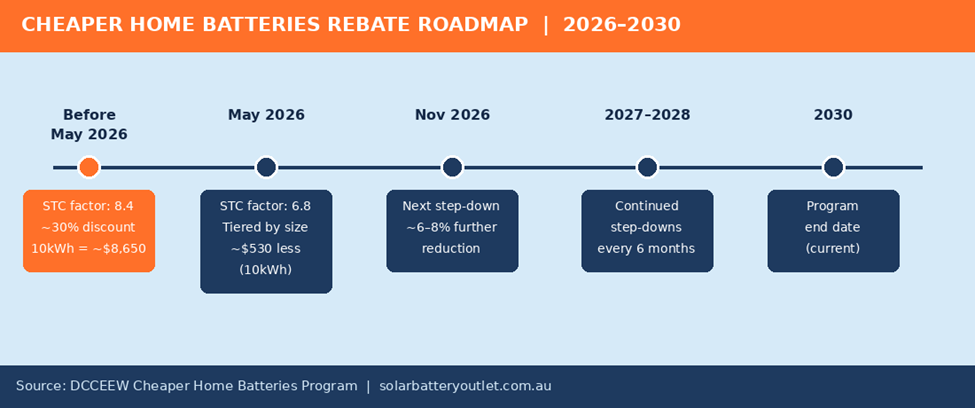
This is the factor most homeowners underestimate. The federal Cheaper Home Batteries Program is not ending — it runs to 2030, with the total program funding expanded to an estimated $7.2 billion. However, from 1 May 2026, the rebate structure changed in two important ways.
First, the STC factor dropped from 8.4 to 6.8. For a standard 10 kWh battery, that translates to approximately $530 less rebate. For batteries above 14 kWh, the new tiered structure means the reduction is considerably larger — between $1,000 and $1,800 or more, depending on size.
Second, and this is the part fewer people are talking about: from May 2026 onward, rebate values step down every six months rather than annually. That means the rebate is structurally programmed to shrink twice per year from this point forward.
The practical takeaway is clear: even if hardware costs fall 8% in the next 12 months, a homeowner who waits may find that the rebate reduction over the same period cancels out — or exceeds — those hardware savings.
The Numbers: What a NSW Homeowner Can Expect to Pay in 2026
Below is a realistic snapshot of what NSW homeowners are paying for installed battery systems in June 2026, post-rebate. These figures are drawn from current market data and exclude switchboard upgrades or additional backup wiring.
| Battery Size | Avg. Installed Cost | Cost Per kWh (installed) | Est. Payback Period |
| 5 kWh | $4,500 – $6,500 | $900 – $1,300/kWh | 7–11 years |
| 10 kWh | $8,000 – $10,000 | $664 – $900/kWh | 5–7 years |
| 13 kWh | $10,500 – $13,500 | $700 – $900/kWh | 5–7 years |
| 20 kWh | $14,700 – $18,000 | $700 – $850/kWh | 6–8 years |
The Decision Framework: Should You Buy Now or Wait?
Rather than giving a one-size-fits-all answer, the most useful thing this article can do is give you a structured way to assess your own situation. Work through the following checkpoints honestly.
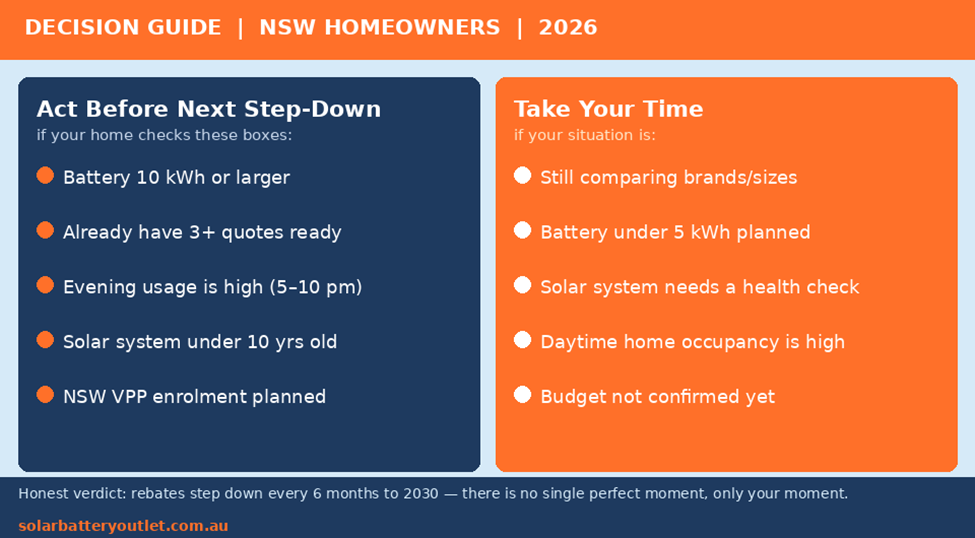
Act Before the Next Rebate Step-Down If:
- You have already obtained three or more written quotes and are ready to proceed.
- Your planned battery is 10 kWh or larger, where the tiered rebate reduction has the most financial impact.
- Your household uses the majority of its power in the evenings, after solar generation stops.
- Your existing solar system is under ten years old and generating reliably.
- You plan to enrol in a Virtual Power Plant (VPP) — NSW VPP incentives can add up to $1,500 on top of the standard rebate.
Take Your Time If:
- You are still researching brands, sizes, or installers and have not yet compared quotes.
- Your battery plan is under 5 kWh, where the hardware cost decline is likely to outpace the rebate reduction over the short term.
- Your solar system is more than ten years old and may need servicing or replacement before adding storage makes sense.
- Your daytime electricity usage is high — meaning you may already be consuming much of your solar output directly.
One important point worth emphasising: installers in NSW report that booking calendars filled rapidly ahead of the May 2026 rebate change. If you are considering a mid-2026 installation, getting onto a waiting list sooner rather than later is practical advice regardless of your timing decision.
What about solar battery NSW Markets?
For homeowners in south-western Sydney and areas like Liverpool, Bankstown, and Campbelltown, the same national pricing dynamics apply. However, there are a few local factors worth noting.
First, installation costs in Greater Sydney tend to be slightly higher than in regional NSW due to labour rates and parking/access considerations. This makes the upfront rebate value proportionally more significant for metro homeowners, since you are starting from a higher baseline cost.
Second, feed-in tariffs in the Ausgrid and Endeavour Energy network areas are now as low as 4–6 cents per kWh for excess solar exports. That gap between what you earn from exporting (4–6c) and what you pay to buy power back at night (30–35c) is exactly the economic case for solar battery Liverpool homeowners—and it is growing rather than shrinking.
If you are on a time-of-use tariff in NSW, a well-sized home battery storage system can shift almost all of your expensive peak consumption to free solar energy, making the payback calculation considerably more favorable than the headline figures suggest.
A Real-World Example: The Mathers Family, Penrith
To make the numbers concrete, consider a typical four-person household in western Sydney. They have a 6.6 kW solar system installed in 2021, pay approximately $2,400 per year in electricity bills despite having solar, and use most of their power between 5 pm and 10 pm.
Battery installed (10 kWh, mid-2026): The upfront cost is approximately $8,500 after rebate. Annual bill savings estimated at $1,100–$1,400 based on current Ausgrid tariff rates. Payback period: approximately 6–7 years. VPP enrolment could reduce payback to 5 years.
If they wait until 2027, Hardware cost savings of roughly $400–$600. Rebate reduction of approximately $400 (next step-down). Chinese VAT removal adds ~$300 to import costs. Net position: roughly similar or slightly worse out-of-pocket, plus 12 more months of high evening bills ($1,200+ missed savings).
The maths does not always favor waiting—especially once you factor in the electricity savings you forgo during the waiting period.
What the Experts Are Saying About Prices to 2030
CSIRO’s GenCost 2025–26 draft report is the most authoritative domestic source on battery cost trajectories. Its findings confirm that battery technologies continue to show significant double-digit cost reductions, while noting that large-scale solar has seen its first price rise in three years.
For residential storage specifically, CSIRO projects two-hour battery storage capital costs will reach $484 per kWh by 2030 under a current-policies scenario—down from $525 per kWh in 2025. In a faster-decarbonisation scenario, costs could fall to $358 per kWh by 2050.
BloombergNEF’s 2025 Energy Storage Outlook adds global context: average battery pack prices are expected to approach $80 per kWh at the pack level by 2026, roughly half of what they were in 2023. That said, pack-level costs do not translate directly to Australian installed residential prices, which include inverter hardware, installation labour, certifications, and grid connection charges.
What to Do Next
You have done the reading. Now it is time to do the numbers for your specific home.
The single most valuable step you can take right now is not reading another article — it is getting at least three written quotes from CEC-accredited NSW installers. A quote is free. It tells you exactly what you would pay, what battery size suits your usage, and whether your switchboard needs upgrading. That information is worth more than any general price forecast.
At Solar Battery Outlet, we work with NSW homeowners across greater Sydney and regional areas to assess their solar setup, right-size a battery, and navigate the Cheaper Home Batteries rebate process end to end. We do not pressure you to sign on the spot, and we will tell you honestly if the timing does not make sense for your household.
Frequently Asked Questions
Yes, but modestly. Hardware costs are projected to decline 8–12% year-on-year. However, the rebate step-downs and Chinese VAT changes partially offset those savings for Australian buyers. Small batteries (5–10 kWh) remain the sweet spot where hardware declines outpace rebate reductions.
As of June 2026, the average installed cost for a 10 kWh residential battery in NSW sits between $8,000 and $10,000 after the federal rebate. The exact figure depends on brand, installer, and whether any additional work (switchboard upgrade, backup wiring) is needed.
No. The Cheaper Home Batteries Program runs until 2030, backed by $7.2 billion in expanded funding. However, the rebate amount steps down every six months from May 2026. It does not end — but it does keep getting smaller, which means earlier installations attract a larger discount.
The most commonly recommended brands by NSW installers in 2026 are the Tesla Powerwall 3, Sungrow SBR, BYD Battery-Box, and Alpha ESS Smile-5. Each suits different budgets and system sizes. The best choice depends on your inverter compatibility, backup requirements, and long-term warranty support.
In that case, the financial return is lower than for households that shift a significant load to the evening. However, a battery can still provide value through VPP enrollment, blackout protection, and bill stability as grid electricity prices continue to rise. The honest answer: get a quote and review your usage profile with a qualified installer before deciding.
A Virtual Power Plant (VPP) connects your battery to a network of other home batteries, allowing the operator to dispatch small amounts of energy during grid demand peaks. In return, you receive bill credits or annual payments typically ranging from $200 to $600. In NSW, the government also offers a separate VPP incentive of up to $1,500 on eligible systems, which can reduce your payback period by 12–18 months.
