From 1 July 2026, something that once sounded like a marketing gimmick became a real, government-backed electricity offer: three hours of completely free power in the middle of every day. Under the new Solar Sharer Offer, eligible households in NSW, South East Queensland, and South Australia can now use electricity from 11am to 2pm at no cost, up to a daily cap.
This did not happen by accident. It happened because Australian households and businesses installed batteries faster than almost anyone predicted, and those batteries are now doing a job that used to belong to expensive gas power stations. For NSW homeowners who already have a battery, or who are weighing one up, this is one of the more significant shifts in how solar batteries pay for themselves that we have seen in years.
In this guide, we will unpack exactly what the Solar Sharer Offer means for NSW households, why batteries are now displacing gas at the evening peak, and how to build a simple framework around your own energy use so you get the most out of both the free window and your battery.
What Is the Solar Sharer Offer, Exactly?
The Solar Sharer Offer is a regulated electricity plan introduced by the Australian Government and administered by the Australian Energy Regulator (AER). It requires energy retailers with more than 1,000 customers in Default Market Offer areas, which includes NSW, to give eligible households at least three hours of free electricity every day, timed to the middle of the day when solar generation is at its highest.
For NSW and South East Queensland, the free window runs from 11am to 2pm. In South Australia, it runs from 12pm to 3pm. Households can access up to 24 kilowatt-hours of free electricity during that window each day, which the AER calibrated to roughly match a five-person household’s typical daily usage. You do not need rooftop solar panels to use it, and it is available to renters as well as homeowners, since it is an opt-in plan you request through your electricity retailer rather than a rebate tied to owning equipment.
It is worth being clear about what the offer does not do. Your entire bill does not become free, and you still pay your daily supply charge and for any electricity used outside the three-hour window. For most households without a way to shift or store energy, the practical saving comes down to whatever they can genuinely use, such as running the dishwasher, washing machine, or pool pump, during that specific window.
Why the Grid Can Suddenly Afford to Give Power Away
The Solar Sharer Offer only exists because the economics of the electricity grid have shifted underneath it. Rooftop and grid-scale batteries have been installed at a pace that has genuinely surprised energy regulators, and that build-out is doing double duty: soaking up surplus midday solar that used to go to waste, and then discharging that stored power during the evening demand peak that gas plants used to cover almost exclusively.
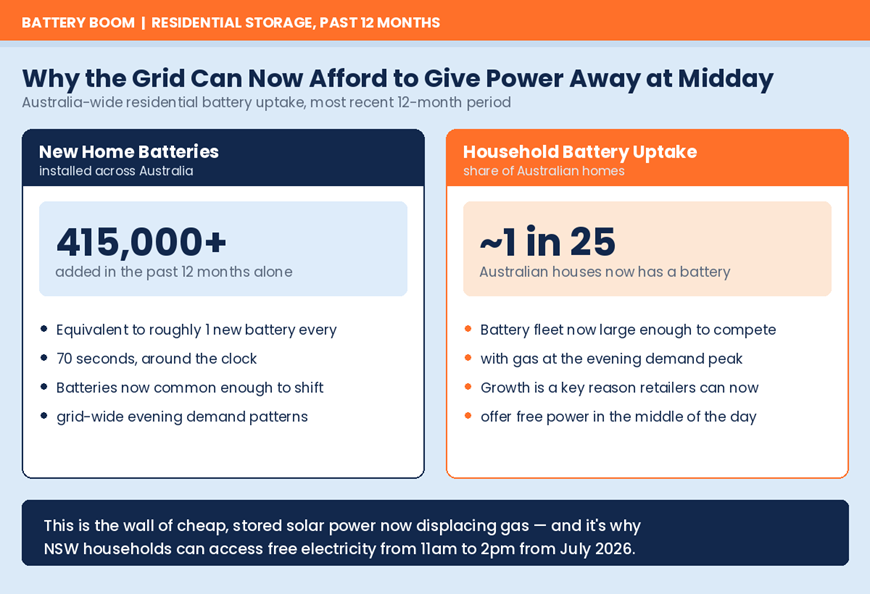
More than 415,000 residential batteries were added across Australia in the past year alone, or roughly one for every 25 houses in the country. That is a large enough fleet to genuinely change how the grid behaves at 6pm, which is traditionally the most expensive and gas-dependent hour of the day.
Clair Savage, who chairs the Australian Energy Regulator, has pointed to this directly as the reason wholesale prices have flattened out. “Batteries have been displacing more expensive gas and hydro in the evenings, and we’ve just seen flatter prices through the whole day,” she said, adding that the shift has translated into lower forward electricity contract prices. Tennant Reed, climate change and energy director at the Australian Industry Group, made a similar point about the evening peak specifically: “The role of gas used to be in the evening to meet the evening peak and that came at a cost, because gas is not a cheap fuel. But more and more every day, it is batteries that are surging into the market at 6 p.m.”
Why a Battery Changes the Value of the Free Window
Here is the part that matters most for anyone in NSW deciding whether a home battery is worth it in 2026: without a battery, you can only benefit from the Solar Sharer Offer in real time. If nobody is home between 11am and 2pm to run appliances, most of that free power simply goes unused.
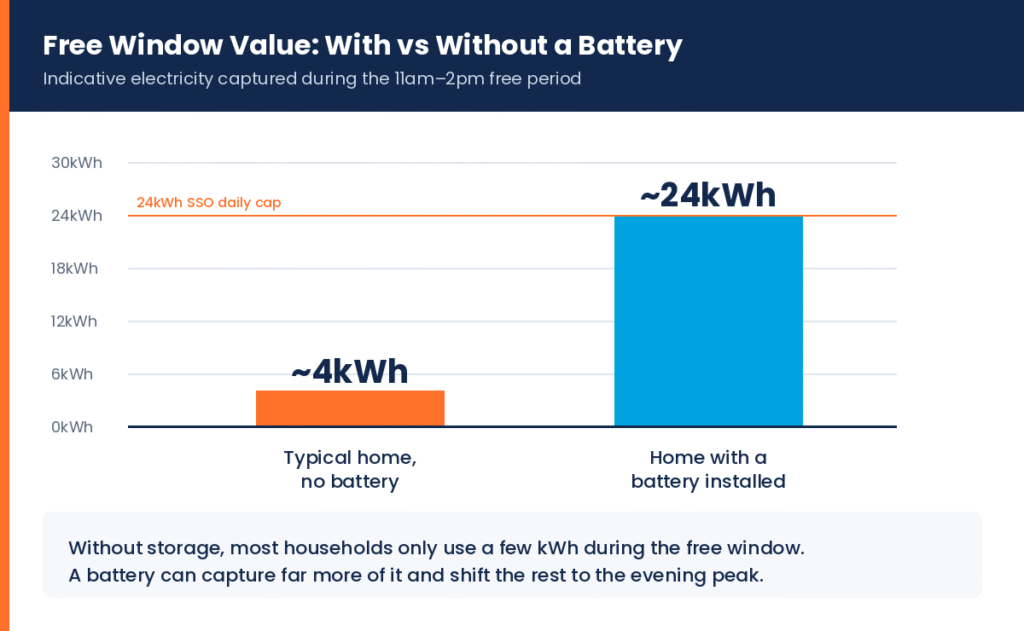
A household with a correctly sized battery can behave very differently. Instead of relying on someone being home to use appliances in real time, the battery can charge from the grid during the free window, capturing far more of the available 24 kilowatt-hour allowance, and then discharge that stored energy during the evening when electricity would otherwise cost the most. This is exactly the same load-shifting principle that is driving battery uptake at the grid level, just applied to a single household.
These figures are indicative only. Actual free-window capture and evening savings depend on your battery’s capacity, your retailer’s specific Solar Sharer Offer terms, your household’s usage pattern, and your existing tariff, so results will vary from home to home.
An Actionable Framework for NSW Households
Whether you already own a battery or are comparing options for the first time, use this five-step framework to make sure you are actually capturing the value of the free midday window rather than leaving it on the table.
- Confirm you have a smart meter. The Solar Sharer Offer requires one, since retailers need interval data to apply the free-power period accurately to your bill.
- Opt in through your retailer. The offer is not automatic, even if you are eligible. Contact your electricity retailer directly or compare offers via Energy Made Easy to opt in.
- Check your battery’s charge scheduling. Most modern inverters and battery management apps let you set a forced-charge window, so confirm yours is set to draw from the grid, not just solar, between 11am and 2pm.
- Size your evening discharge around real usage. Look at 30 days of your evening consumption data, typically 5pm to 9pm, and check your battery’s usable capacity can realistically cover it after a midday charge.
- Review your tariff structure annually. As more states introduce free-window offers and time-of-use pricing evolves, the most cost-effective charge-and-discharge pattern for your household may shift year to year.
| A note on choosing an installer Getting the charge-scheduling and battery sizing right is where a qualified installer earns their fee. As a solar battery installation company working across Liverpool, Bankstown, and Mudgee, we configure new systems to target the Solar Sharer Offer window as standard, and we can also reprogram an existing battery’s charge schedule during a routine service visit. |
Choosing the Right Battery for a Free-Window Strategy
Not every battery on the market is well suited to this new charge-midday, discharge-evening pattern. A battery that is too small will fill up quickly during the free window and have little left to offer for a full evening peak, while an oversized battery may add cost without meaningfully improving your outcome if your evening usage is modest.
If you are comparing the best solar batteries in Australia for this specific use case, prioritise usable capacity in the 10 to 13 kilowatt-hour range for an average NSW household, confirm the inverter supports scheduled grid-charging (not just solar-charging), and check the manufacturer’s cycle life, since a free-window strategy means more frequent daily cycling than a solar-only setup.
If you are in South West Sydney, a local solar battery Bankstown installer can walk through your actual smart meter data with you, rather than relying on rule-of-thumb sizing, and set the charge schedule up correctly from day one.
Frequently Asked Questions
No. The Solar Sharer Offer is available to households with or without rooftop solar, and to renters as well as homeowners. You need a smart meter and must opt in through your electricity retailer.
No. The free window only benefits you in real time unless you can shift usage into it. A battery lets you capture power during the free hours and use it later in the evening peak, which is when electricity is normally most expensive.
It is available across NSW as one of the Default Market Offer areas, alongside South East Queensland and South Australia. Other states and territories are expected to introduce similar offers from 2027, subject to further government decisions.
No. Only electricity used within the three-hour window, up to the 24 kilowatt-hour cap, is free. You still pay for electricity used outside that window and your daily supply charge.
Disclaimer
This article is general information only and does not constitute financial or energy market advice. Details of the Solar Sharer Offer, including free power windows, usage caps, and eligible regions, are based on Australian government and Australian Energy Regulator information available as of July 2026 and may change. Savings and consumption figures referencing third-party sources (including CleanTechnica and The Cool Down) are indicative estimates, not guaranteed outcomes, and actual results depend on your retailer’s terms, battery specifications, and household usage. Always seek personalised advice before making a purchasing decision.
| Want Your Battery Set Up for the Free Window? We help NSW households across Liverpool, Bankstown, and Mudgee choose, size, and correctly schedule a solar battery to make the most of the Solar Sharer Offer, whether you’re installing a new system or reconfiguring an existing one. Call us: 1800 000 777, or visit solarbatteryoutlet.com.au for a free assessment of your usage patterns and battery options. |