A practical, numbers-first guide for NSW homeowners weighing up a home battery in 2026

Every NSW homeowner researching solar batteries eventually runs into the same headline: “save up to $1,100 a year.” It sounds promising, but it also raises an obvious question — is that figure realistic for your home or just a marketing average? In 2026, with electricity prices climbing and battery rebates shifting, that question matters more than ever.

This guide breaks down exactly where the $1,100 figure comes from, how it changes depending on your battery size, household usage, and tariff plan, and what the real 10-year savings picture looks like once rebates, bill savings, and avoided peak charges are combined. We’ll also walk through a worked example using actual NSW electricity rates so you can sense-check the numbers against your own bill.

If you’re comparing options for solar batteries NSW wide, or specifically researching a solar battery Liverpool installers can supply and fit, the framework below applies regardless of postcode—only the inputs (your usage, your tariff, your roof) change.

Where Does the “$1,100 a Year” Figure Actually Come From?

The $1,100 number isn’t pulled from thin air, but it also isn’t a guarantee. It typically represents the combined effect of three separate savings streams working together over a full year:

  • Avoided peak import charges—using stored solar instead of grid power during the 3pm–9pm peak window, when NSW time-of-use rates often sit between 40 and 55 cents per kWh.
  • Higher solar self-consumption — instead of exporting excess solar for a low feed-in tariff, the battery stores it for later use, effectively converting a 5–8 cent export credit into a 30+ cent saving.
  • Reduced reliance on the grid during outages or price spikes — particularly relevant as wholesale prices become more volatile.

Independently, the New South Wales government’s home battery rebate explainer for the Cheaper Home Batteries Program confirms that NSW households can stack the federal rebate with the state’s VPP incentive, which is the second half of the savings equation alongside ongoing bill reductions.

For a household with average NSW consumption (around 14–16 kWh per day) and a 10kWh battery, the combined annual bill savings typically land between $950 and $1,200, depending on tariff structure and how much solar is already being self-consumed before the battery is installed.

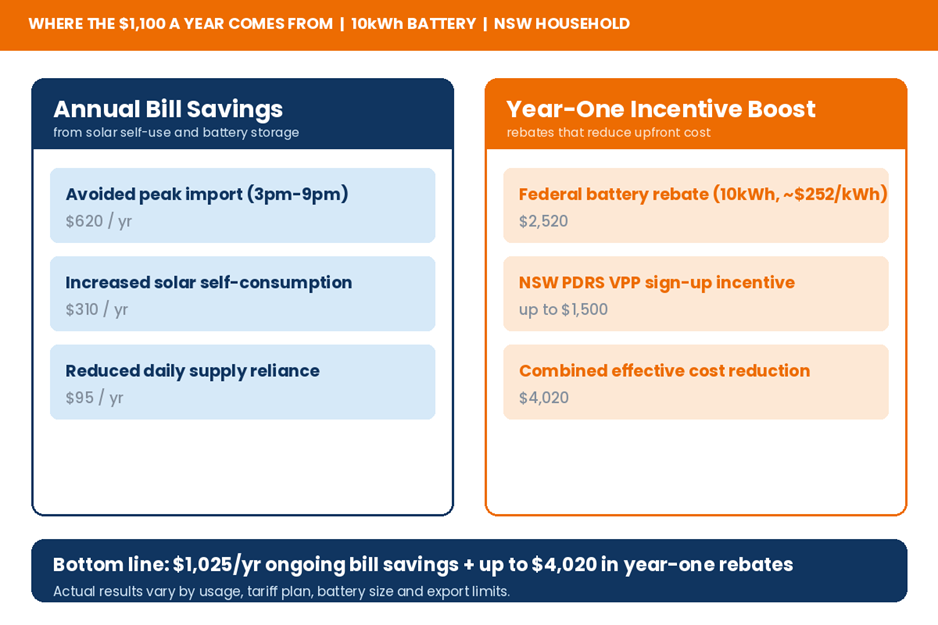
Breakdown of where annual battery savings and year-one incentives come from for a typical 10kWh NSW system

The 2026 Rebate Landscape: Why Timing Still Matters

From 1 May 2026, the federal Cheaper Home Batteries Program moved to a tiered structure. Batteries up to 14kWh continue to receive the full STC rate, currently around $252 to $272 per usable kWh, while capacity between 14kWh and 28kWh receives roughly 60% of that rate, and capacity beyond that drops further still. For most NSW homes, a battery in the 10–14kWh range remains the sweet spot for rebate value.

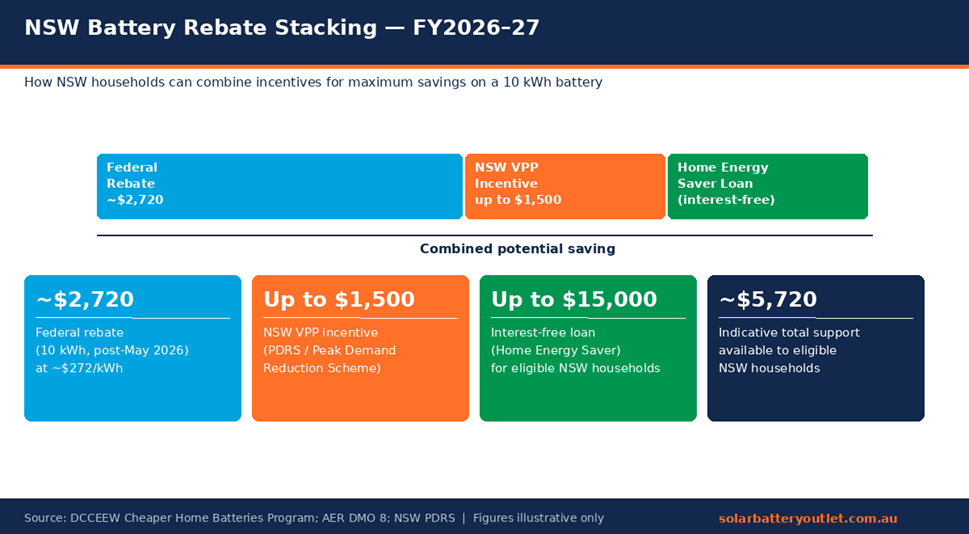
On top of the federal rebate, NSW homeowners can apply for the Peak Demand Reduction Scheme (PDRS) VPP incentive, worth up to $1,500 when a battery is connected to an approved virtual power plant. Combined, a 10kWh battery installed in 2026 can attract a federal rebate of roughly $2,520, plus the VPP incentive, for a total reduction in upfront cost approaching $4,000.

None of this changes the underlying running-cost savings discussed in this article — those depend on your usage and tariff, not the rebate. But the rebate does affect how quickly your system pays for itself, which is why timing your install before further STC step-downs (the next is scheduled for January 2027) can meaningfully shorten your payback period.

A Worked Example: 10kWh Battery, Average NSW Household

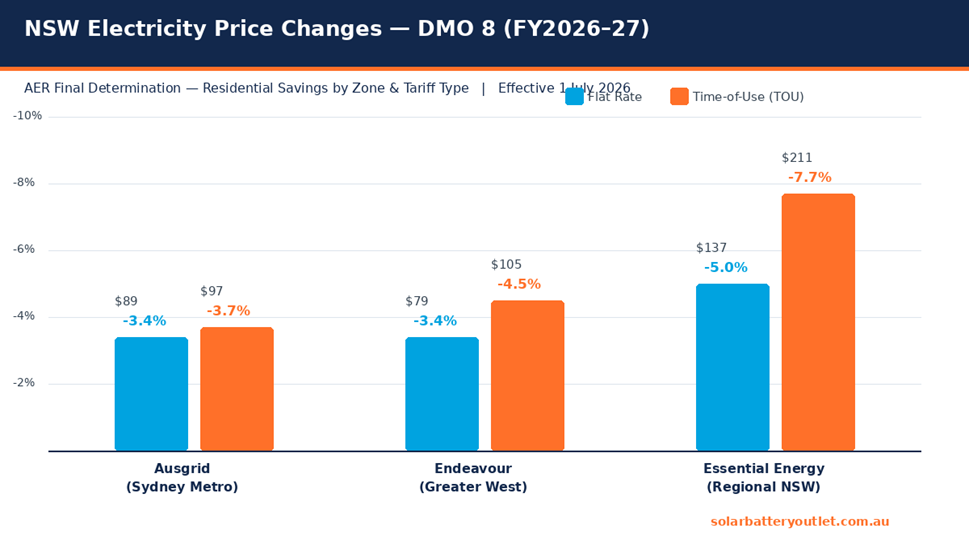
Let’s use a realistic household profile. According to NSW energy data, the average household electricity bill currently sits around $1,800 to $1,900 per year, with a typical usage rate of roughly 30 to 34 cents per kWh and many homes now on time-of-use tariffs where peak rates climb above 40 cents.

Consider a household with 6.6kW of rooftop solar and a 10kWh battery added in 2026. Before the battery, this home self-consumes roughly 35% of its solar generation and exports the rest at a low feed-in tariff. After the battery is installed, self-consumption typically rises to 70–80%, because the battery soaks up midday solar surplus and discharges it during the evening peak instead of drawing from the grid.

Running the numbers across a full year produces three savings categories that, added together, comfortably reach the $1,100 mark in homes with above-average evening usage, and sit closer to $850–950 for smaller households. The breakdown image above shows the typical split: roughly $620 from avoided peak imports, $310 from improved solar self-consumption, and $95 from reduced reliance on the daily supply charge during outages or low-generation days.

It’s worth being transparent here: these figures will not be identical for every home. A single-person household using 7–8 kWh per day will see proportionally smaller savings, while a larger family running air conditioning, an EV charger, and a pool pump during peak hours could exceed $1,300 annually.

The 10-Year Picture: When Does a Battery Actually Pay for Itself?

Annual savings are useful, but the real question most homeowners want answered is payback time. Using the $1,025/year average from our worked example, and assuming a net system cost (after rebates) of roughly $5,000 to $7,000 for a 10kWh battery added to existing solar, payback typically falls between 5 and 7 years. Most home batteries carry a 10-year warranty, meaning the system continues delivering savings well past the point it has paid for itself.

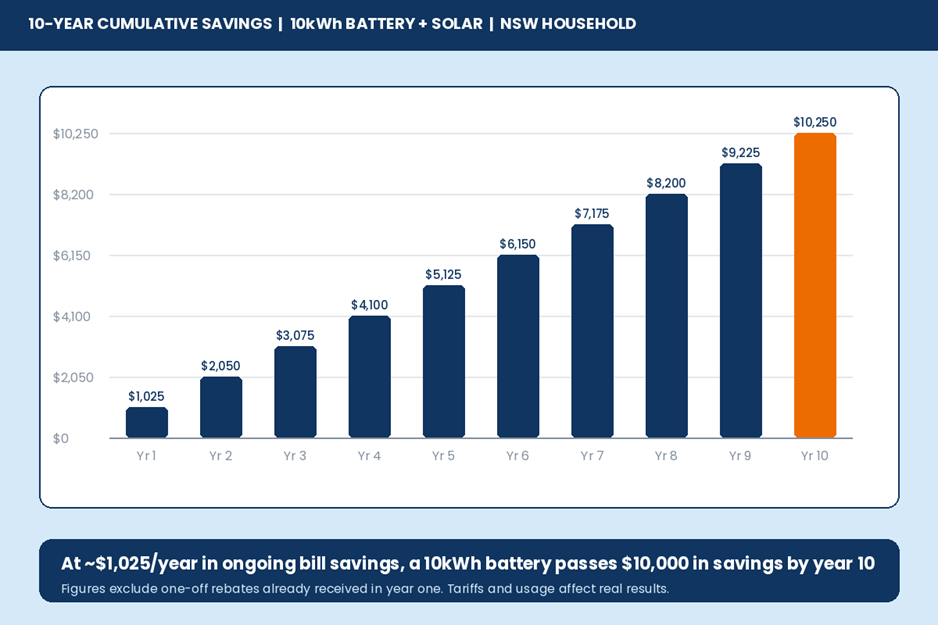
The chart below shows cumulative bill savings over a 10-year period at the $1,025/year rate, excluding the one-off rebate already banked in year one. By year 10, cumulative bill savings alone exceed $10,000 — and that’s before accounting for the likelihood that electricity prices, and therefore savings, will continue rising over that period.

Cumulative bill savings over 10 years for a 10kWh battery paired with rooftop solar in NSW

A Simple Framework to Estimate Your Own Savings

Rather than relying on a generic average, you can estimate your own potential savings in four steps. This framework mirrors the approach used by energy analysts when calculating real bill impact rather than theoretical kWh totals.

  1. Find your actual evening usage. Pull a recent bill and identify how much electricity you use between 3pm and 9pm — this is the window a battery primarily offsets.
  2. Check your time-of-use rate for that window. Multiply your average evening kWh usage by your peak rate (often 40–55c/kWh) to estimate your current peak spend.
  3. Estimate your battery’s usable discharge. A 10kWh battery typically delivers 8–9kWh of usable evening discharge per day after accounting for depth-of-discharge limits and standby losses.
  4. Multiply and annualise. Multiply your usable discharge by your peak rate, then by 365 days, to estimate annual peak-avoidance savings. Add your expected solar self-consumption uplift (usually $250–$400/year) for a total estimate.

This four-step approach consistently produces estimates within 10–15% of actual post-installation savings reported by NSW households, making it a far more reliable starting point than a flat headline figure.

Common Mistakes That Inflate or Deflate Battery Savings Estimates

  • Ignoring tariff structure. A flat-rate tariff produces very different savings to a time-of-use tariff, sometimes by a factor of two.
  • Assuming 100% battery efficiency. Real-world round-trip efficiency for most lithium batteries sits between 85% and 95%, which should be factored into any estimate.
  • Overlooking export tariff changes. Some NSW retailers now apply negative feed-in tariffs during solar-flush periods, which increases the relative value of storing solar rather than exporting it.
  • Comparing battery size to roof size, not usage. A larger battery only delivers proportionally larger savings if your evening usage is high enough to draw down that extra capacity each day.

Getting these details right is where working with an experienced, CEC-accredited installer makes a measurable difference — not just in installation quality, but in correctly sizing the system to your actual usage pattern rather than a generic recommendation.

Frequently Asked Questions
Is the $1,100 a year savings figure realistic for most NSW homes?

It’s realistic for households with above-average evening electricity use and a 10kWh or larger battery on a time-of-use tariff. Smaller households or those on flat tariffs may see figures closer to $700–$950 per year, while larger households with high peak-period consumption can exceed $1,100.

How is battery savings different from solar savings?

Solar savings come from generating your own electricity during the day. Battery savings come from storing that solar for use later, particularly during the evening peak when grid electricity is most expensive. The two work together, but a battery specifically targets the gap between cheap daytime solar and expensive evening grid power.

Does the rebate change reduce my ongoing savings?

No. The May 2026 changes to the Cheaper Home Batteries Program affect the upfront rebate amount, particularly for batteries over 14kWh, but they don’t change how much you save on your electricity bill each year. Ongoing savings depend entirely on your usage and tariff, not the rebate structure.

How long does a home battery take to pay for itself?

Based on current rebate levels and average NSW usage, most 10kWh batteries reach payback within 5 to 7 years, with a typical 10-year warranty meaning several years of savings continue after the system has paid for itself.

Do I need a specific tariff plan to benefit from a battery?

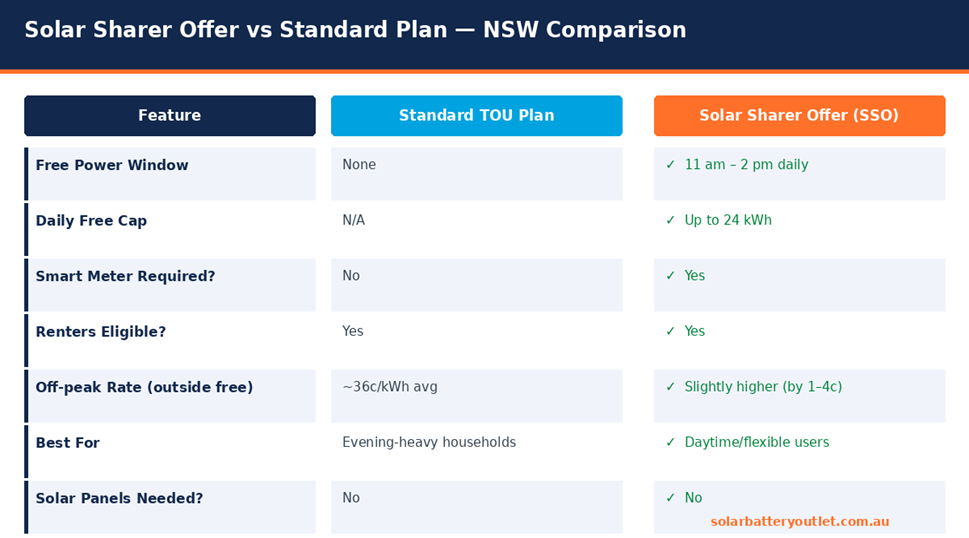
A time-of-use tariff generally maximises battery savings because it creates a larger gap between cheap off-peak rates and expensive peak rates. However, batteries still provide savings on flat tariffs through improved solar self-consumption, just at a slightly lower rate.

Get Your Personalised Savings Estimate

The numbers in this guide are based on average NSW usage patterns, but your actual savings depend on your roof, your bill, and how your household uses electricity. At Solar Battery Outlet, we use your real usage data to model expected savings before you commit to a system size — so you know what to expect, not just a headline figure.

Whether you’re comparing solar batteries NSW-wide or you’re specifically after a solar battery Liverpool homeowners can have installed quickly, our team can walk you through current rebate eligibility, VPP options, and a savings estimate based on your own electricity bill—not an industry average.

Data used in this from these links:

cheaper-home-batteries

eligibility-information

average-electricity-bill-nsw

If you have been following Australia’s home energy space in 2026, you have probably heard two things: the federal battery rebate changed on 1 May, and installation numbers have been breaking records. Both are true — and they are connected. This article pulls together what actually happened, what the numbers mean, and what they tell NSW homeowners right now.

At the centre of it all is the Australian Government’s $1 billion Household Energy Upgrades Fund (HEUF), which crossed a major milestone in the quarter to December 2025: more than 10,000 energy upgrades financed across over 4,100 Australian homes. But that milestone, significant as it is, has now been overtaken by an even bigger story in 2026 — the Cheaper Home Batteries Program (CHBP) surge that saw daily battery installations jump from 200 to over 1,500 per day.

Here is the full picture, with verified data from the Australian Government and the Clean Energy Regulator.

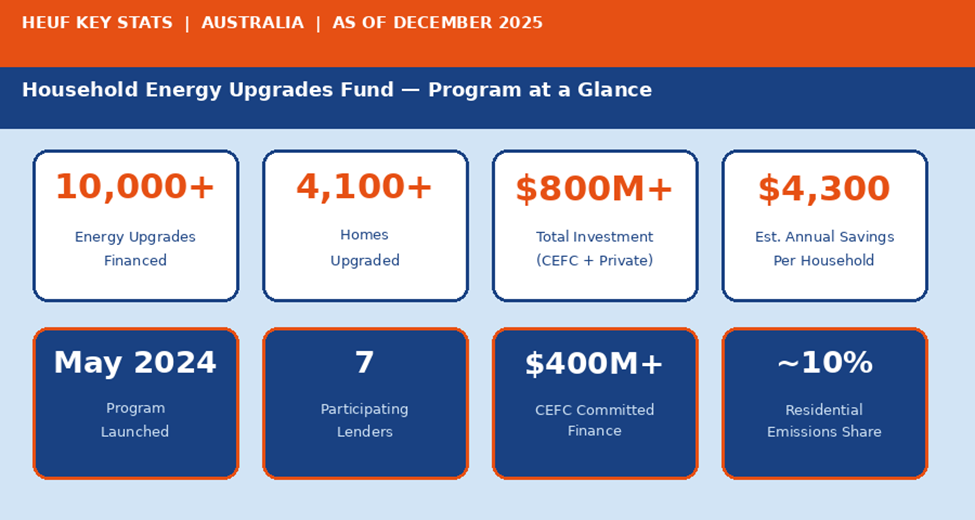
HEUF Key Program Statistics — as at December 2025

HEUF Key Program Statistics — as at December 2025 (Source: energy.gov.au)

What Is the Household Energy Upgrades Fund?

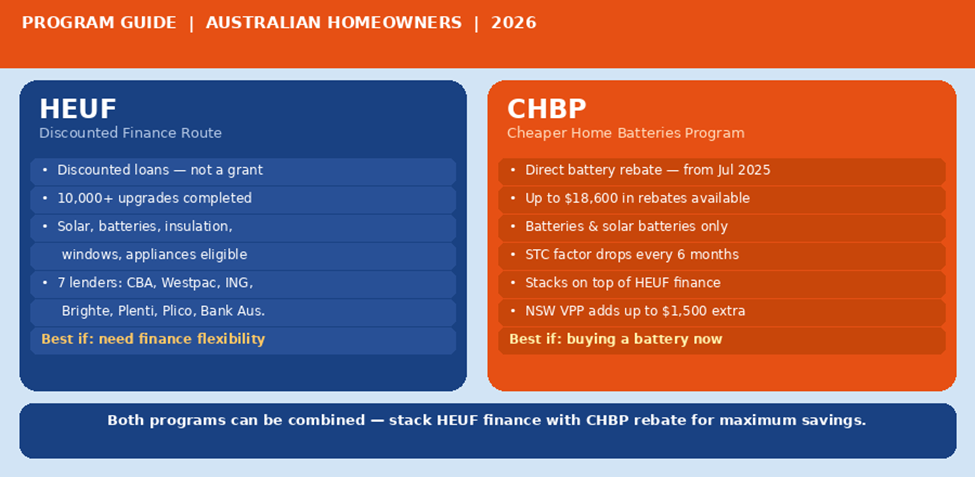
The HEUF is a $1 billion federal initiative delivered through the Clean Energy Finance Corporation (CEFC). It does not hand you cash directly — instead, it works with banks and lenders to offer discounted finance products so that upgrading your home becomes more affordable upfront. Think of it as the government subsidising your interest rate, not writing you a cheque.

Running since May 2024, the HEUF targets existing homes — many built before modern energy efficiency standards. The aim is to bring down the practical barrier of upfront cost so more households can access solar, batteries, insulation, and other upgrades that lower bills and reduce emissions.

The 10,000 Milestone — What the December 2025 Numbers Say

The HEUF reached 10,000 financed upgrades across more than 4,100 homes in the quarter to December 2025. Here is what the data behind that number reveals:

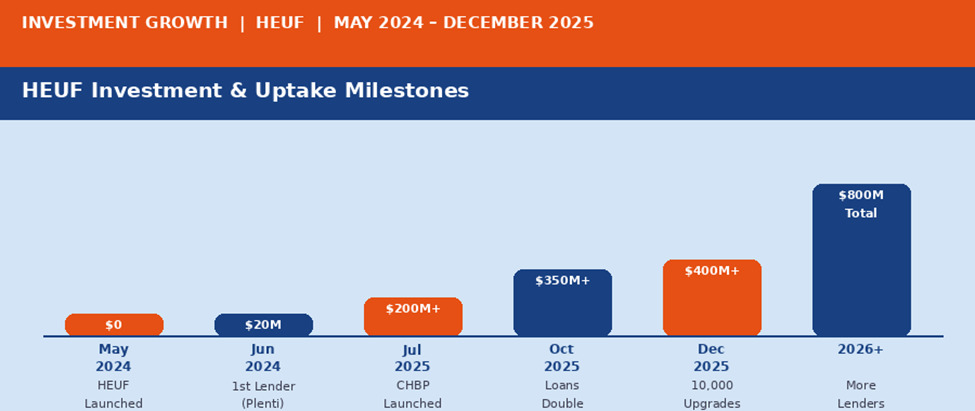
Loans Nearly Doubled in One Quarter

In the last quarter of 2025 alone, HEUF loan volumes almost doubled. This was not a gradual climb — it was a sharp acceleration driven directly by the July 2025 launch of the CHBP. When the battery rebate arrived, homeowners started bundling finance and rebate together, and uptake tripled across batteries, inverters and solar PV under the HEUF in the six months that followed.

Queensland and NSW Are Leading

Around 2,600 households in Queensland and NSW combined have accessed HEUF discounted finance — making these two states the most active in the country. If you are an NSW homeowner, you are in the heart of where this is happening.

$800 Million in Total Investment Committed

The CEFC has committed over $400 million through seven participating lenders. Those lenders have matched it with a further $400 million in private capital, bringing total committed investment to over $800 million. With more lender deals expected in 2026 and beyond, competition for your finance business is likely to increase — which is good for borrowers.

Batteries, Inverters and Solar Are the Top Choices

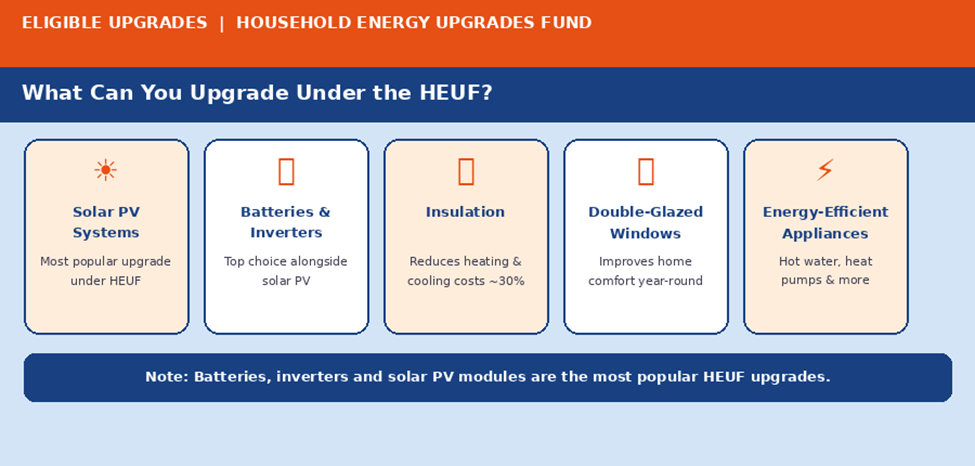
The most popular HEUF upgrades by a clear margin have been batteries, inverters and solar PV systems. This is consistent with broader market trends — solar and storage offer the most direct, measurable reduction in electricity bills, and they pair naturally with the CHBP rebate.

Eligible Upgrade Categories Under the HEUF

The 2026 Story: Australia’s Battery Boom in Numbers

The HEUF milestone is impressive. But to understand where Australia’s home energy market stands in May 2026, you need the full CHBP picture alongside it. The numbers are genuinely remarkable.

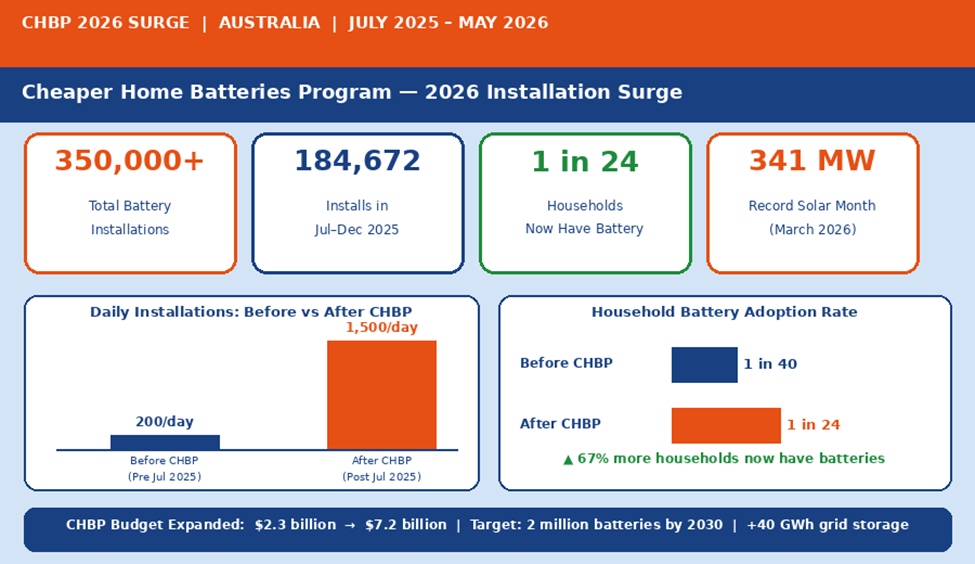
CHBP 2026 Installation Surge

350,000+ Batteries Installed in 10 Months

From July 2025 to May 2026, more than 350,000 home battery installations were completed under the CHBP. That is not a typo. To put it in context: in the entire year before the CHBP launched, Australia averaged around 200 battery installations per day. After the program started, that figure jumped to over 1,500 per day — a 7.5x increase.

184,672 Batteries in Just the Second Half of 2025

Federal Minister for Climate Change and Energy Chris Bowen confirmed that from 1 July to 31 December 2025, Australians installed 184,672 home batteries, adding 4.27 gigawatt-hours of storage capacity. The average battery size also doubled compared to 2024 — from 10–12 kWh to around 23 kWh — as households took advantage of the rebate structure to install larger systems.

From 1 in 40 to 1 in 24 Households

Before the CHBP launched, only 1 in 40 Australian households had a home battery. By May 2026, that figure had shifted to 1 in 24 — a 67% increase in household adoption in under a year. This is the fastest shift in home battery penetration Australia has ever recorded.

Record Solar Month: 341 MW in March 2026

Australia’s rooftop solar market hit an all-time record in March 2026, with 341 MW of small-scale solar capacity installed in a single month — a 19% jump from February. Industry analyst firm SunWiz noted the market was already 16% ahead of the same point in 2025, with battery demand pulling larger solar systems along with it. As of early 2026, Australia’s total rooftop solar capacity stands at 28.3 GW across approximately 4.3 million installations — making Australia the world leader in per capita rooftop solar.

★  2026 Data Snapshot — Verified Sources

How HEUF and CHBP Work Together

With both programs now running at scale, the most financially savvy move for an NSW homeowner is to use them in combination. Here is how they fit together:

HEUF vs. CHBP- Comparison

The HEUF provides the discounted loan to spread the cost over time. The CHBP reduces the purchase price of the battery upfront — around 30% off, delivered through your installer. On top of both, the NSW Peak Demand Reduction Scheme (PDRS) VPP incentive adds up to $1,500 for battery owners who connect to a Virtual Power Plant.

The three stacked together — HEUF finance + CHBP rebate + NSW VPP — represent the most comprehensive government support package for home batteries that has ever existed in NSW. The fact that CHBP uptake through HEUF tripled in the six months after July 2025 shows that homeowners have already figured this out.

What the Budget Expansion Means for You

On 13 December 2025, the Australian Government announced the CHBP budget would be expanded from the original estimate of $2.3 billion to $7.2 billion over four years. This is important for a few reasons:

  • The program is not going anywhere. It runs through to 2030 with massively increased funding.
  • More than 2 million Australians are expected to install a battery by 2030 — adding around 40 GWh of grid storage.
  • The expansion was triggered by uptake far exceeding forecasts, confirming the market is real and the demand is genuine.
  • New requirements from May 2026 mean all new CHBP battery installations must be VPP-capable — meaning the hardware is already set up to participate in grid programs like the NSW PDRS.

The Australian Energy Market Commission analysis found that increased home battery uptake could deliver a 3% reduction in energy bills annually across the entire energy system by smoothing out peak demand. In other words, your battery does not just save you money — it helps reduce costs for everyone connected to the grid.

HEUF Investment & Uptake Growth Timeline (May 2024 – December 2025)

What This Means for NSW Homeowners Right Now

Pulling the HEUF milestone and the 2026 CHBP data together, here is the practical picture for an NSW homeowner considering solar or batteries today:

The market has validated the technology

350,000+ installations in 10 months is not a niche movement. Batteries are now mainstream in Australian homes — 1 in 24 households have one. The installers, the products, and the programs are all mature. The early-adopter risk is gone.

Government support is substantial and funded to 2030

The CHBP has $7.2 billion behind it. The HEUF has $800 million in committed capital from seven lenders. The NSW VPP incentive is active. This is not a rebate program that might disappear — it is a funded, multi-year policy commitment with an accelerating trajectory.

The rebate declines over time — but not off a cliff

The most common misconception right now is that the rebate ‘ended’ on 1 May 2026. It did not. What changed is that the STC factor now steps down every six months rather than annually, and larger batteries above 14 kWh attract a tapered rate. The program continues to deliver around 30% off battery costs across a range of sizes. Every six months you delay, the rebate is slightly smaller — but it does not disappear overnight.

The combination of programs is where the real value lies

Treasury analysis found that full electrification — solar PV, battery, and EV — can save a typical Australian household around $4,300 per year. Even just adding a battery to an existing solar system can deliver meaningful bill reductions, particularly for households with high evening electricity usage. The HEUF + CHBP + NSW VPP combination makes this more accessible than it has ever been.

How to Access These Programs — Step by Step

  • Decide on your upgrade: for most NSW homeowners, this is solar + battery, or battery-only if you already have solar panels.
  • Get written quotes from at least three SAA-accredited installers — compare size, brand, installation date, and what rebates are shown on the quote.
  • Speak to a participating HEUF lender about discounted finance options: Brighte, Plenti, Plico, Commonwealth Bank, Westpac, ING, or Bank Australia.
  • Confirm the CHBP rebate appears as a dollar deduction on your written quote — not just mentioned verbally.
  • Ask your installer about the NSW VPP incentive and whether your battery will be enrolled in a Virtual Power Plant.
  • Confirm an actual installation date in writing — your rebate is determined by installation date, not contract signing date.

Frequently Asked Questions

Is the HEUF still open in 2026?

Yes. The HEUF is active with seven participating lenders and more expected to be announced in 2026. It is open to homeowners with or without a mortgage, rental property owners, and strata properties. High-value properties are excluded — speak to your lender for eligibility details.

Did the battery rebate end on 1 May 2026?

No. The CHBP continues until 2030 with a significantly expanded $7.2 billion budget. What changed on 1 May 2026 is the calculation method: the STC factor now steps down every six months instead of annually, and batteries above 14 kWh attract a tiered rate. The government states the around 30% discount is maintained across a range of battery sizes under the new structure.

How many batteries have been installed under the CHBP so far?

More than 350,000 installations were completed in the ten months from July 2025 to May 2026, according to PV Magazine Australia and CER public data. In the second half of 2025 alone, 184,672 batteries were installed, adding 4.27 GWh of storage capacity to the grid.

Can I still use HEUF finance and the CHBP rebate together?

Yes — and it is the recommended approach. The HEUF reduces your interest rate on the finance. The CHBP reduces the upfront purchase price. They are complementary programs. On top of both, the NSW PDRS VPP incentive adds up to $1,500. Your installer and lender can help you access all three.

What is the average battery size being installed in 2026?

The average has grown significantly. Before the CHBP launched, the average battery usable capacity was 10–12 kWh. In the second half of 2025, it jumped to around 23 kWh as households took advantage of the rebate structure to install larger systems. From May 2026, the tiered structure is designed to encourage right-sizing rather than over-sizing.

Data Sources

All data in this article is sourced from official Australian Government publications and verified industry sources:

1. energy.gov.au/news/household-energy-upgrades-fund-reaches-10000-installations

2. dcceew.gov.au/energy/programs/cheaper-home-batteries

3. pv-magazine-australia.com — 350,000 installations in 10 months under CHBP (May 2026)

4. minister.dcceew.gov.au — Joint media release: 10,000 home energy upgrades (April 2026)

5. cer.gov.au/batteries — Clean Energy Regulator CHBP postcode data to 31 March 2026

6. dailyenergynews.com.au — Record 341 MW solar month, March 2026

7. solarchoice.net.au — CHBP 1 May 2026 changes explained

8. solarquotes.com.au — Battery installation data H2 2025

About Solar Battery Outlet

A VPP-ready battery installation — now the non-negotiable baseline for 2026 federal rebate eligibility across Australia.

⚠  IMPORTANT POLICY CHANGE — 2026As of 2026, the federal Cheaper Home Batteries Program requires all eligible battery systems to be VPP-capable at the time of installation. Systems that cannot connect to a Virtual Power Plant are now excluded from rebates entirely — regardless of brand, capacity, or installer.

Here’s a question most installers aren’t asking before they hand you a quote: Is the battery they’re recommending actually eligible for the rebate?

Not every battery on the Australian market qualifies for the 2026 federal incentives. The reason isn’t price, brand reputation, or storage capacity. It comes down to one increasingly important technical requirement: VPP readiness.

If you’ve been researching the best solar batteries in Australia for your home, understanding this requirement could save you thousands — or spare you the costly shock of installing a system that doesn’t qualify for any government support at all.

What Is a VPP — and Why Does It Suddenly Matter?

VPP stands for Virtual Power Plant. It’s not a building or a physical location. It’s a network — your home battery, along with hundreds or thousands of other batteries across the grid, connected and coordinated by software.

When the electricity grid comes under pressure — say, on a hot summer evening in NSW when everyone cranks the air conditioning at once — the network operator draws on all those connected batteries simultaneously. Your battery exports a small amount of stored energy to help stabilise the grid. You get paid for it.

From the government’s perspective, this is exactly the outcome they want. Instead of building expensive new gas peaker plants to handle demand spikes, they’d rather pay homeowners to use their existing batteries as a distributed grid resource. It costs less, it’s cleaner, and it makes the grid more resilient during extreme weather.

So when the federal rebate program was restructured for 2026, VPP capability became a hard requirement — not a bonus feature. The policy logic is simple: if you want public money to help fund your battery, your battery needs to be able to give something back to the public grid.

“The cheapest battery isn’t the cheapest battery once you factor in the rebates you lose by buying it.”

What “VPP-Ready” Actually Means in Practice

VPP readiness isn’t a sticker a manufacturer slaps on a box. It’s a set of technical and software requirements that determine whether a battery can safely communicate with — and be remotely dispatched by — a certified VPP operator. For a battery to qualify under the 2026 federal guidelines, it needs to meet all of the following:

OCPP or AS4755 compliance — the inverter or battery management system must support the communication protocols used by Australian VPP operators.

Remote dispatch capability — must receive and act on charge/discharge instructions from a certified aggregator automatically, without manual homeowner input.

Smart meter compatibility — real-time two-way data exchange is required so the aggregator can see your battery’s state of charge at all times.

✓Listed on the CEC-approved product register — the Clean Energy Council list is the authoritative reference. Only listed products qualify for federal incentives.

Not an off-grid only system — batteries designed purely for off-grid use without grid-export capability do not qualify (except systems more than 1km from the grid).

The practical implication is significant. Many cheaper imported batteries — sold through generic online retailers or unaccredited installers — simply don’t meet these standards. They may store energy perfectly well, but they cannot participate in a VPP, and that now disqualifies them from rebate eligibility entirely.

The Financial Stakes: What You Lose Without VPP Eligibility

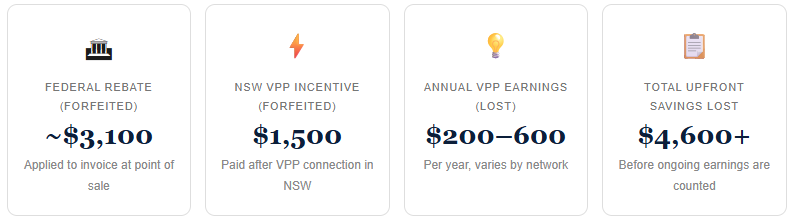
If you install a non-VPP-capable battery in 2026, here’s what you forfeit:

For a typical 10 kWh system, that’s over $4,600 in combined upfront incentives you simply don’t receive. On top of that, you miss out on annual VPP participation payments compounding over the battery’s life. When comparing two quotes side by side, this gap can easily make the “cheaper” non-VPP battery significantly more expensive over a 10-year horizon.

$4,600+That’s the combined value of federal rebates and the NSW VPP incentive available to eligible homeowners right now.Non-VPP batteries receive none of this. For anyone comparing the best solar battery options in NSW and across Australia, VPP eligibility isn’t a bonus — it’s the baseline requirement.

Which Batteries Are VPP-Ready in 2026?

The good news: all major reputable brands sold through accredited Australian installers meet the VPP-ready standard. The problem is grey-market imports and off-brand systems that occasionally get quoted as “budget alternatives.” Here’s how the leading options compare:

Battery SystemVPP-ReadyRebate EligibleNSW VPP IncentiveCapacity
BYD Battery-Box HVM Yes Yes Yes8.3–22.1 kWh
Tesla Powerwall 3 Yes Yes Yes13.5 kWh
Sungrow SBR / SBH Yes Yes Yes9.6–25.6 kWh
Enphase IQ Battery 5P Yes Yes Yes5–15 kWh
Generic imported batteries No No NoVaries
Off-grid only systems No No NoVaries

For anyone looking at solar battery in NSW specifically, all four mainstream systems also qualify for the NSW Peak Demand Reduction Scheme — the state-level incentive that stacks directly on top of the federal rebate.

How to Verify VPP Status Before You Sign

Don’t take a salesperson’s word for it. Here is the exact process to confirm a battery is VPP-eligible before committing:

Step 1:  Check the Clean Energy Council-approved product list

The CEC register at cleanenergycouncil.org.au is the authoritative source. If your quoted battery isn’t on it, the federal rebate cannot be claimed — full stop.

Step 2:  Ask directly: “Does this battery support VPP dispatch protocols?”

A confident, experienced installer answers without hesitation. Hedging or vague reassurances are a red flag — get written confirmation.

Step 3:  Verify your installer is SAA-accredited

Only SAA-accredited installers can legally process the federal rebate on your behalf. Check at saaustralia.com.au before signing anything.

Step 4:  Confirm the rebate appears as a line item on your quote

The federal rebate must appear as a specific dollar reduction on your invoice — not a verbal promise or small-print footnote.

Step 5:  Ask who handles the NSW VPP enrolment paperwork

Some installers skip VPP enrolment to reduce their compliance workload. A thorough installer includes it as standard — not as an optional add-on.

NSW homeowners currently have access to the most generous combined battery incentive stack in the state’s history — but only for VPP-capable systems.

Why VPP Requirements Are Only Getting Stricter

The 2026 VPP mandate didn’t arrive suddenly. It’s part of a sustained policy direction that started with the original Home Battery Scheme and has been progressively tightened each year. Australia’s grid managers — AEMO in particular — have identified distributed battery storage as a critical tool for grid stability as coal plants retire and renewable penetration increases.

For homeowners, the implication is clear: this requirement isn’t going away. Future iterations of the federal incentive program are likely to add further requirements around grid responsiveness, cycle ratings, and communication protocols. Batteries meeting the 2026 standard are well-positioned for whatever comes next. Systems that don’t meet it today are likely to become increasingly marginalised in terms of both incentive eligibility and resale value.

For homeowners in NSW: the combination of federal rebates and the NSW VPP incentive represents the most generous stack of battery support the state has ever seen. The window is narrowing — the federal rebate rate already dropped in May 2026 — but the incentive structure for VPP-ready systems remains strong through the rest of the year. Acting now with the right battery is still significantly better financially than waiting.

Frequently Asked Questions

Q: Does joining a VPP mean the operator controls my battery completely?

Partially — and only within agreed limits. VPP operators can dispatch your battery during grid stress events, but reputable agreements always include protections. Your battery won’t be drained below a minimum threshold (typically 20%), preserving backup capacity for outages. Most operators also let you set exclusion windows during your personal peak evening hours.

Q: Can I get the federal rebate if I choose not to actively join a VPP?

Yes — with an important distinction. The requirement is that the battery is capable of VPP connection, not that you must enrol. You can install a VPP-ready battery and claim the federal rebate without joining a VPP program. However, you’ll miss the separate NSW VPP incentive payment of up to $1,500, which does require actual enrolment.

Q: What if I already have an older battery that isn’t VPP-capable?

Existing systems installed under earlier rebate programs are not retroactively affected. The 2026 VPP requirement applies to new installations. If you’re upgrading or replacing an older system, the new battery must meet the current standard to qualify for rebates.

Q: How much can I realistically earn from VPP participation each year?

This varies by operator, grid event frequency in your area, and battery capacity. For a typical 10 kWh system enrolled in a NSW VPP, annual earnings of $200–$600 are a reasonable estimate. Some operators offer fixed quarterly credits; others pay per dispatch event based on energy exported.

Q: Does a solar battery NSW installation always include VPP enrolment automatically?

Not automatically. A thorough installer handles both the federal rebate processing and VPP enrolment as part of the standard package. Some skip enrolment to reduce compliance workload — always confirm explicitly that it’s included before signing your contract.

Bottom Line

If you’re comparing quotes and one comes in noticeably cheaper, the first question to ask is whether the battery is VPP-capable and listed on the CEC approved product register. A battery that saves $800 upfront but costs $4,600 in lost incentives isn’t a saving — it’s an expensive mistake that takes years to recover from.

For homeowners in NSW who want a solar battery that captures everything available in 2026 — federal rebate, NSW VPP incentive, and long-term participation payments — the path is clear: choose one of the four mainstream VPP-ready systems, use an SAA-accredited installer, and confirm both the rebate and VPP enrolment are included in the package before you sign.

As solar batteries grow in number across Australia, the grid value of interconnected VPP networks grows with them. The requirement isn’t a bureaucratic hurdle — it’s a genuine two-way exchange. You receive meaningful financial support. The grid gains resilience. That’s why this requirement is here to stay, and why the best solar batteries in Australia in 2026 are defined as much by grid compatibility as by storage capacity.

✅  Quick Summary for NSW Homeowners All four mainstream batteries — BYD Battery-Box HVM, Tesla Powerwall 3, Sungrow SBR/SBH, and Enphase IQ Battery 5P — are fully VPP-ready and eligible for both the federal rebate (~$3,100) and the NSW VPP incentive (up to $1,500). Combined upfront savings reach $4,600+ before ongoing annual VPP earnings. Non-VPP batteries qualify for neither.
Not Sure If You Are Ready? Talk to Us First. At Solar Battery Outlet, we handle the full process — federal rebate, NSW VPP incentive, SAA-accredited installation, and VPP enrolment — so you never leave money on the table.
Call us: 1800 000 777
About Solar Battery Outlet: We are a Liverpool-based solar battery installer, part of GWM Group Pty Ltd, servicing homes across South West Sydney, Bankstown, Campbelltown, and the greater NSW region. All installations are done by SAA-accredited electricians. We handle all rebate paperwork, so you do not have to.
php