From 1 July 2026, something that once sounded like a marketing gimmick became a real, government-backed electricity offer: three hours of completely free power in the middle of every day. Under the new Solar Sharer Offer, eligible households in NSW, South East Queensland, and South Australia can now use electricity from 11am to 2pm at no cost, up to a daily cap.

This did not happen by accident. It happened because Australian households and businesses installed batteries faster than almost anyone predicted, and those batteries are now doing a job that used to belong to expensive gas power stations. For NSW homeowners who already have a battery, or who are weighing one up, this is one of the more significant shifts in how solar batteries pay for themselves that we have seen in years.

In this guide, we will unpack exactly what the Solar Sharer Offer means for NSW households, why batteries are now displacing gas at the evening peak, and how to build a simple framework around your own energy use so you get the most out of both the free window and your battery.

What Is the Solar Sharer Offer, Exactly?

The Solar Sharer Offer is a regulated electricity plan introduced by the Australian Government and administered by the Australian Energy Regulator (AER). It requires energy retailers with more than 1,000 customers in Default Market Offer areas, which includes NSW, to give eligible households at least three hours of free electricity every day, timed to the middle of the day when solar generation is at its highest.

For NSW and South East Queensland, the free window runs from 11am to 2pm. In South Australia, it runs from 12pm to 3pm. Households can access up to 24 kilowatt-hours of free electricity during that window each day, which the AER calibrated to roughly match a five-person household’s typical daily usage. You do not need rooftop solar panels to use it, and it is available to renters as well as homeowners, since it is an opt-in plan you request through your electricity retailer rather than a rebate tied to owning equipment.

It is worth being clear about what the offer does not do. Your entire bill does not become free, and you still pay your daily supply charge and for any electricity used outside the three-hour window. For most households without a way to shift or store energy, the practical saving comes down to whatever they can genuinely use, such as running the dishwasher, washing machine, or pool pump, during that specific window.

Why the Grid Can Suddenly Afford to Give Power Away

The Solar Sharer Offer only exists because the economics of the electricity grid have shifted underneath it. Rooftop and grid-scale batteries have been installed at a pace that has genuinely surprised energy regulators, and that build-out is doing double duty: soaking up surplus midday solar that used to go to waste, and then discharging that stored power during the evening demand peak that gas plants used to cover almost exclusively.
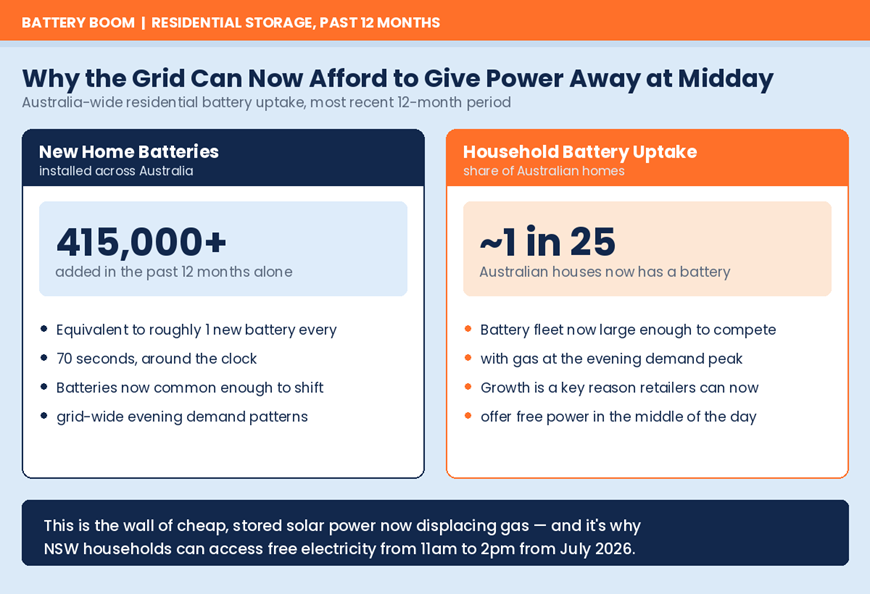
Two stat cards showing 415,000+ new home batteries added in the past 12 months and roughly 1 in 25 Australian homes now having a battery

More than 415,000 residential batteries were added across Australia in the past year alone, or roughly one for every 25 houses in the country. That is a large enough fleet to genuinely change how the grid behaves at 6pm, which is traditionally the most expensive and gas-dependent hour of the day.

Clair Savage, who chairs the Australian Energy Regulator, has pointed to this directly as the reason wholesale prices have flattened out. “Batteries have been displacing more expensive gas and hydro in the evenings, and we’ve just seen flatter prices through the whole day,” she said, adding that the shift has translated into lower forward electricity contract prices. Tennant Reed, climate change and energy director at the Australian Industry Group, made a similar point about the evening peak specifically: “The role of gas used to be in the evening to meet the evening peak and that came at a cost, because gas is not a cheap fuel. But more and more every day, it is batteries that are surging into the market at 6 p.m.”

Why a Battery Changes the Value of the Free Window

Here is the part that matters most for anyone in NSW deciding whether a home battery is worth it in 2026: without a battery, you can only benefit from the Solar Sharer Offer in real time. If nobody is home between 11am and 2pm to run appliances, most of that free power simply goes unused.
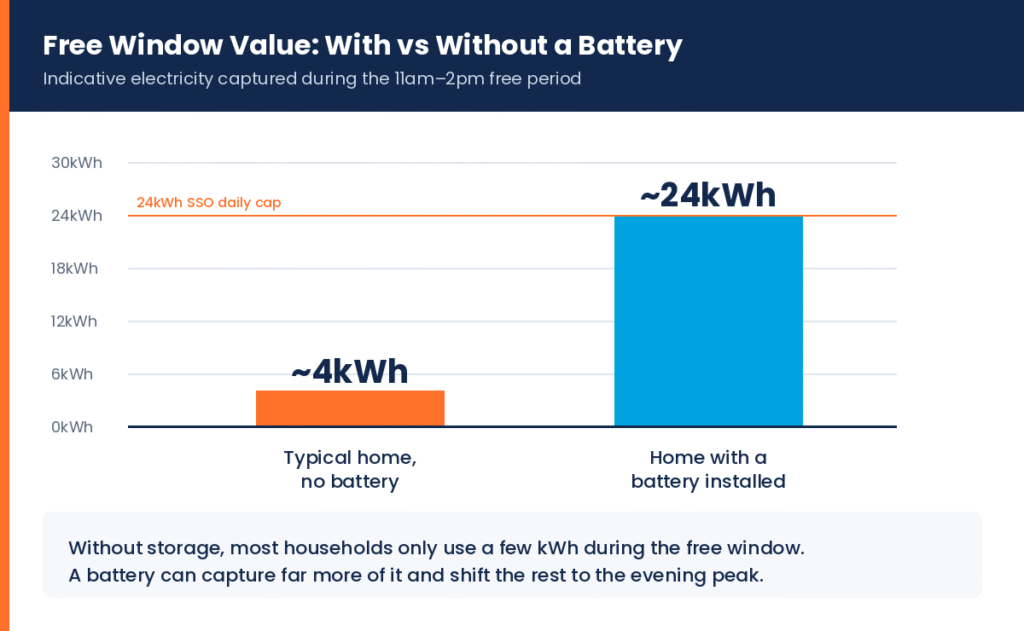
free window, with and without a battery

A household with a correctly sized battery can behave very differently. Instead of relying on someone being home to use appliances in real time, the battery can charge from the grid during the free window, capturing far more of the available 24 kilowatt-hour allowance, and then discharge that stored energy during the evening when electricity would otherwise cost the most. This is exactly the same load-shifting principle that is driving battery uptake at the grid level, just applied to a single household.

These figures are indicative only. Actual free-window capture and evening savings depend on your battery’s capacity, your retailer’s specific Solar Sharer Offer terms, your household’s usage pattern, and your existing tariff, so results will vary from home to home.

An Actionable Framework for NSW Households

Whether you already own a battery or are comparing options for the first time, use this five-step framework to make sure you are actually capturing the value of the free midday window rather than leaving it on the table.

  1. Confirm you have a smart meter. The Solar Sharer Offer requires one, since retailers need interval data to apply the free-power period accurately to your bill.
  2. Opt in through your retailer. The offer is not automatic, even if you are eligible. Contact your electricity retailer directly or compare offers via Energy Made Easy to opt in.
  3. Check your battery’s charge scheduling. Most modern inverters and battery management apps let you set a forced-charge window, so confirm yours is set to draw from the grid, not just solar, between 11am and 2pm.
  4. Size your evening discharge around real usage. Look at 30 days of your evening consumption data, typically 5pm to 9pm, and check your battery’s usable capacity can realistically cover it after a midday charge.
  5. Review your tariff structure annually. As more states introduce free-window offers and time-of-use pricing evolves, the most cost-effective charge-and-discharge pattern for your household may shift year to year.
A note on choosing an installer
Getting the charge-scheduling and battery sizing right is where a qualified installer earns their fee. As a solar battery installation company working across Liverpool, Bankstown, and Mudgee, we configure new systems to target the Solar Sharer Offer window as standard, and we can also reprogram an existing battery’s charge schedule during a routine service visit.

Choosing the Right Battery for a Free-Window Strategy

Not every battery on the market is well suited to this new charge-midday, discharge-evening pattern. A battery that is too small will fill up quickly during the free window and have little left to offer for a full evening peak, while an oversized battery may add cost without meaningfully improving your outcome if your evening usage is modest.

If you are comparing the best solar batteries in Australia for this specific use case, prioritise usable capacity in the 10 to 13 kilowatt-hour range for an average NSW household, confirm the inverter supports scheduled grid-charging (not just solar-charging), and check the manufacturer’s cycle life, since a free-window strategy means more frequent daily cycling than a solar-only setup.

If you are in South West Sydney, a local solar battery Bankstown installer can walk through your actual smart meter data with you, rather than relying on rule-of-thumb sizing, and set the charge schedule up correctly from day one.

Frequently Asked Questions
Do I need solar panels to get the Solar Sharer Offer?

No. The Solar Sharer Offer is available to households with or without rooftop solar, and to renters as well as homeowners. You need a smart meter and must opt in through your electricity retailer.

Does the Solar Sharer Offer make home batteries unnecessary?

No. The free window only benefits you in real time unless you can shift usage into it. A battery lets you capture power during the free hours and use it later in the evening peak, which is when electricity is normally most expensive.

Is the Solar Sharer Offer available everywhere in NSW?

It is available across NSW as one of the Default Market Offer areas, alongside South East Queensland and South Australia. Other states and territories are expected to introduce similar offers from 2027, subject to further government decisions.

Will my whole electricity bill be free during the Solar Sharer window?

No. Only electricity used within the three-hour window, up to the 24 kilowatt-hour cap, is free. You still pay for electricity used outside that window and your daily supply charge.

Disclaimer

This article is general information only and does not constitute financial or energy market advice. Details of the Solar Sharer Offer, including free power windows, usage caps, and eligible regions, are based on Australian government and Australian Energy Regulator information available as of July 2026 and may change. Savings and consumption figures referencing third-party sources (including CleanTechnica and The Cool Down) are indicative estimates, not guaranteed outcomes, and actual results depend on your retailer’s terms, battery specifications, and household usage. Always seek personalised advice before making a purchasing decision.

Want Your Battery Set Up for the Free Window?
We help NSW households across Liverpool, Bankstown, and Mudgee choose, size, and correctly schedule a solar battery to make the most of the Solar Sharer Offer, whether you’re installing a new system or reconfiguring an existing one. Call us: 1800 000 777, or visit solarbatteryoutlet.com.au for a free assessment of your usage patterns and battery options.

Two major electricity changes took effect for NSW households on 1 July 2026. First, the Australian Energy Regulator (AER) finalised its Default Market Offer (DMO) 8 determination. This reduced residential standing-offer electricity prices across all three NSW distribution zones.

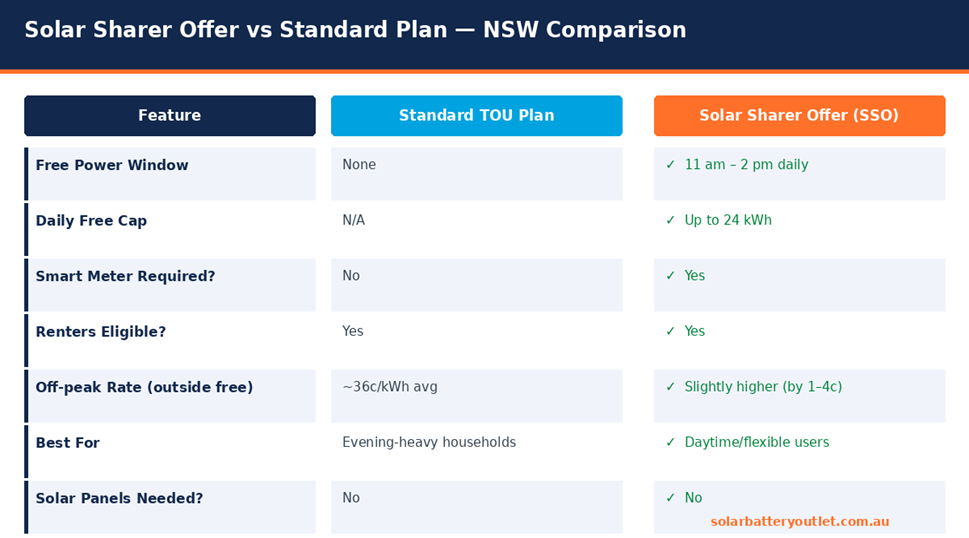
Second, every retailer in the DMO area must now offer the Solar Sharer Offer (SSO). This new opt-in plan gives households with smart meters three hours of free electricity every day from 11 am to 2 pm, with a daily limit of 24 kWh.

If you have solar panels, a home battery, or both, these changes could work together to significantly reduce your annual electricity bill. In addition, the federal Cheaper Home Batteries Program remains available through 2030, and its rebate continues to provide substantial savings after May 2026.

This article explains what these changes mean for NSW households. It also provides a practical framework to help you maximise savings during the 2026–27 financial year.

What Is the Solar Sharer Offer (SSO)?

The Solar Sharer Offer is a regulated, opt-in electricity plan introduced as part of the DMO 8 framework. Its core mechanic is straightforward: eligible households receive a three-hour window of free electricity — 11 am to 2 pm daily in NSW — capped at 24 kWh per day. That cap is well above the midday consumption of most households; the CSIRO estimates average five-person household daily use at around 20 kWh, meaning the cap is unlikely to be an issue for most families.

Importantly, you do not need rooftop solar to access the SSO. Renters are eligible, provided they have a smart meter installed. If you do not currently have a smart meter, contact your retailer—for most NSW households, smart meter installation is available at no upfront cost.

The SSO is designed to solve a structural challenge in the National Electricity Market. Australia now has more than 4.2 million rooftop solar systems, generating over 25 GW of daytime capacity. As a result, wholesale electricity prices often fall to zero or even become negative during the middle of the day. Instead of letting this excess solar energy go to waste, the SSO passes the cost savings directly to households that can shift their electricity use into the free energy window.

Solar Sharer Offer vs Standard TOU plan comparison

What Is the DMO 8 and How Much Can NSW Households Save?

The Default Market Offer (DMO) is the regulated benchmark price set by the AER each year. It acts as a safety net for the roughly 8% of NSW households — approximately 463,000 customers nationally — who remain on standing-offer electricity plans. It also functions as a comparison reference price that helps all electricity customers evaluate market offers.

The AER’s Final DMO 8 Determination, released 26 May 2026, confirmed residential price reductions across all three NSW distribution zones from 1 July 2026. The reductions were driven by lower wholesale electricity costs, reduced environmental scheme costs, and declining retail operating expenses.

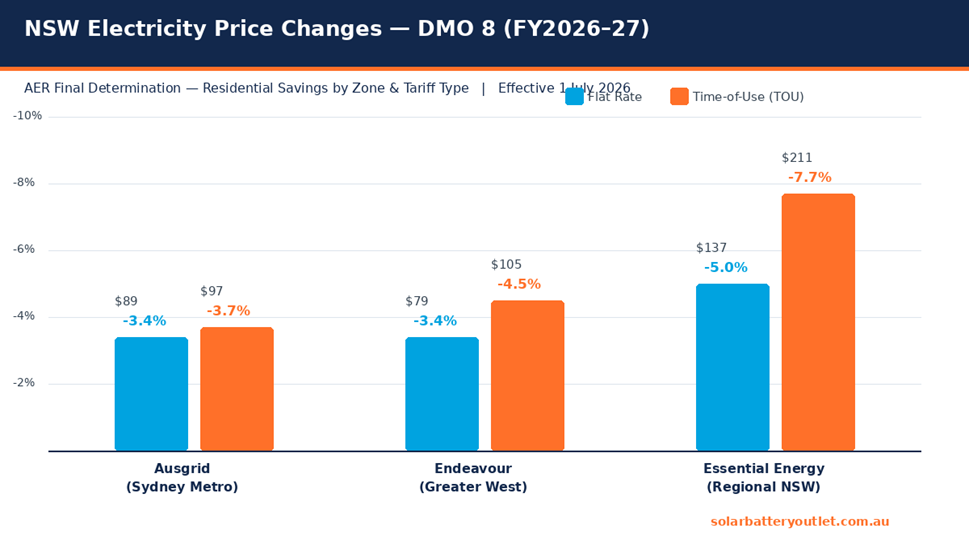
NSW DMO 8 electricity price reduction by zone 2026-27

NSW DMO 8 Residential Savings at a Glance

For the Ausgrid zone (Sydney Metro): flat-rate customers save -3.4% (up to $89/yr); TOU customers save -3.7% (up to $97/yr).

Endeavour Energy zone (Greater Western Sydney/Blue Mountains): flat-rate customers save -3.4% (up to $79/yr); TOU customers save -4.5% (up to $105/yr).

Essential Energy zone (Regional NSW): the largest savings—flat-rate customers save -5.0% (up to $137/yr); TOU customers save -7.7% (up to $211/yr). This zone benefits most from the correction of elevated wholesale costs that disproportionately affected regional NSW in 2022–24.

These savings apply to standing-offer customers. If you are on a competitive market offer—and you should be—you may already be paying up to 20% below the DMO. The DMO’s value is as a benchmark for comparing plans on the Australian Government’s free comparison tool, Energy Made Easy.

The Federal Cheaper Home Batteries Program—Still Active in FY2026–27

The Cheaper Home Batteries Program is a $7.2 billion federal initiative. It provides an upfront discount of approximately 30% on eligible home battery systems ranging from 5–100 kWh. The program is delivered through the Small-Scale Renewable Energy Scheme (SRES). The discount is applied at the point of sale, so there is no separate application process. There is also no means test, making the program available to all eligible households and businesses.

What changed on 1 May 2026: The STC factor dropped from 8.4 to 6.8 per kWh of usable capacity, and a new tiered structure was introduced for larger batteries. Specifically:

  • Tier 1 (0–14 kWh): Full STC rate — approximately $252–$272 per usable kWh in NSW (Zone 3)
  • Tier 2 (14–28 kWh): 60% of the full rate applies
  • Tier 3 (28–50 kWh): Only 15% of the full rate applies

For a standard 10 kWh battery, the current rebate is approximately $2,720 (post-May 2026, at ~$272/kWh). The rebate will step down again on 1 January 2027, so FY2026–27 represents the highest available value under the current schedule. The program runs through 2030.

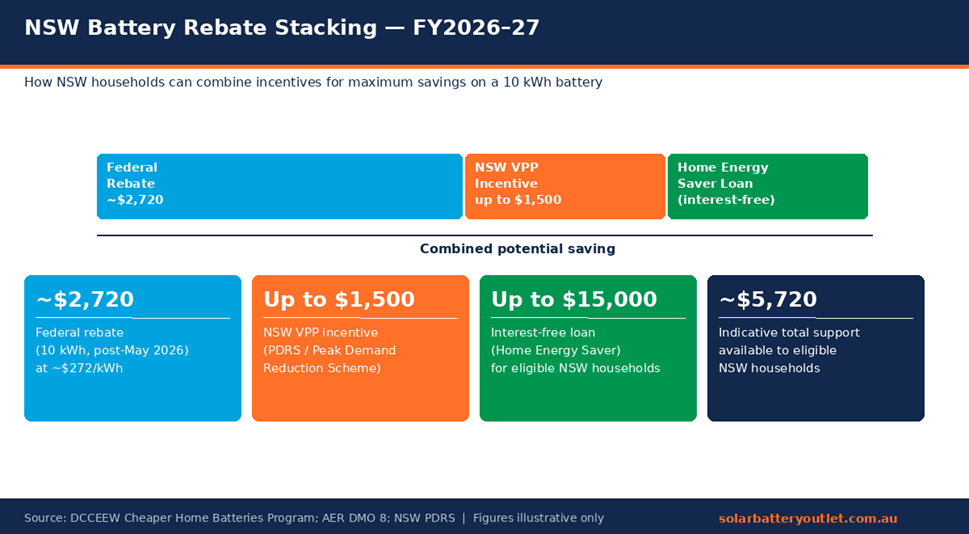
NSW Rebate Stacking — How to Maximise Your Battery Savings

NSW households can combine several incentives to maximise their savings. By stacking these incentives correctly, you can make one of the smartest financial decisions when investing in home battery storage.

Available NSW Incentive Stack

  • Federal Cheaper Home Batteries Program: ~$2,720 for a 10 kWh system (post-May 2026), applied as a point-of-sale discount by your accredited installer
  • NSW VPP Incentive (PDRS): Up to $1,500 for households who connect their battery to an approved Virtual Power Plant (VPP). Stackable with the federal rebate
  • NSW Home Energy Saver — Interest-Free Loan: Up to $15,000 for eligible households (income under $210,000/yr, repaid over 10 years). A targeted discount of up to $4,000 is available for lower-income households or concession-card holders

An eligible NSW household can access more than $5,720 in combined support by installing a 10 kWh battery, before factoring in any electricity bill savings. Eligibility conditions apply. Speak to an accredited installer or visit energy.gov.au for more details.

Which Strategy Suits Your Household? A Practical FY2026–27 Framework

Not every NSW household benefits from every option. The right strategy depends on your usage pattern, whether you have solar, and what tariff you are currently on. Here is a straightforward framework to guide your decision.

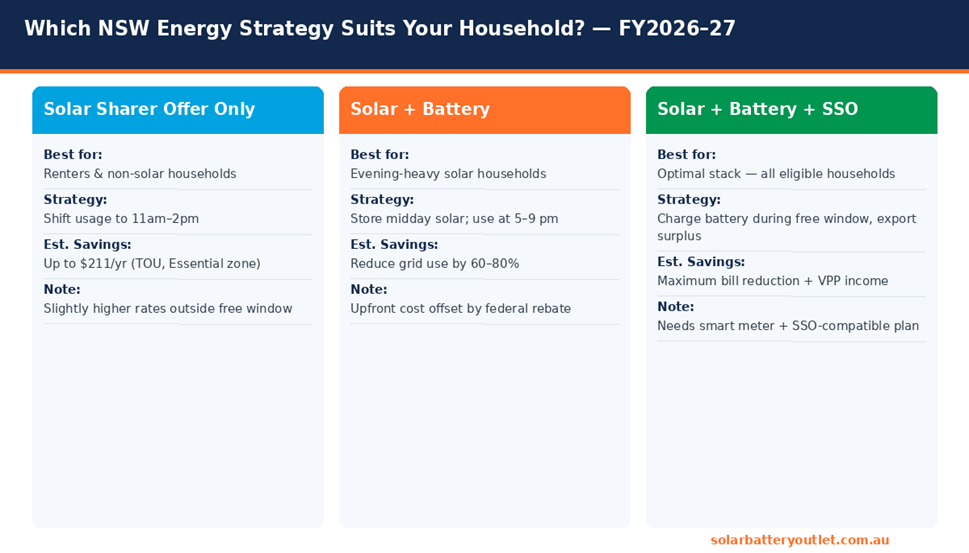
NSW energy plan decision framework Solar Sharer solar battery 2026

Strategy 1 — Solar Sharer Offer Only

Best for renters, apartment residents, or any household without solar panels who can shift appliance use to the 11 am–2 pm window. Running your dishwasher, washing machine, pool pump, or EV charger during the free window is where the savings are. On the Essential Energy TOU tariff, this strategy alone could save up to $211 per year.

Strategy 2 — Existing Solar + Battery

Best for households with an existing solar system that generates strong daytime output. A home battery stores surplus solar generated during the free window and discharges it during the 5–9 pm evening peak—when grid electricity typically costs 36 cents or more per kWh. Consequently, well-sized households can reduce grid dependency by 60–80%.

Strategy 3 — Solar + Battery + SSO (The Optimal Stack)

The most powerful combination for eligible households. During the 11 am–2 pm free window, the battery charges from the grid at zero cost. Any surplus solar is exported to the grid at feed-in tariff rates (currently 4–10 c/kWh across NSW retailers). In the evening, the battery discharges — avoiding peak rates. Joining a VPP adds a potential $1,500 incentive and ongoing grid participation revenue. This strategy delivers the maximum possible reduction in annual electricity bills.

A Real-World NSW Example — The Kumar Family in Parramatta

Consider a four-person household in Parramatta (Endeavour Energy zone) on a TOU standing offer, using 15 kWh per day with most usage in the evenings. Prior to FY2026–27, their annual electricity bill was approximately $2,328 (DMO 7 TOU reference price).

Under DMO 8, their standing-offer TOU price drops by -4.5%, saving approximately $105 per year automatically—without changing a thing.

By switching to the Solar Sharer Offer and shifting their dishwasher, washing machine, and air-conditioner pre-cool to the 11 am–2 pm window (about 3 kWh per day), they capture an additional estimated saving of $130–$180 per year.

They add a 10 kWh solar battery using the federal rebate (~$2,720 discount), reducing their out-of-pocket cost to approximately $5,000–$6,000 after the rebate. Their evening grid draw drops from roughly 9 kWh to 1–2 kWh per night. Annual electricity bill savings from the battery alone are estimated at $800–$1,200, suggesting a payback period of approximately 5–7 years under current tariffs.

This is a simplified illustrative example. Actual outcomes depend on household usage, system size, tariff structure, solar exposure, and other factors. See our contact page to get personalised advice for your home.

The Smart Meter Requirement — What NSW Households Need to Know

Access to the Solar Sharer Offer requires a smart meter. Smart meters record electricity usage at 30-minute intervals and transmit data to your retailer, enabling time-of-use billing. Without a smart meter, TOU plans — including the SSO — are not accessible.

The good news: for most NSW households, smart meter installation is available free of charge through your electricity retailer or distributor. Contact your retailer and ask specifically about smart meter installation ahead of the 1 July 2026 SSO launch. If you are with a retailer offering 10 or fewer customers, they may not be required to offer the SSO, but most major retailers are participating.

Frequently Asked Questions

Do I need rooftop solar to access the Solar Sharer Offer in NSW?

No. The Solar Sharer Offer is available to all NSW households in DMO-regulated zones with a smart meter, regardless of whether you have solar panels. Renters are also eligible.

Is the Solar Sharer Offer free electricity, or are there strings attached?

The SSO provides free electricity between 11 am and 2 pm, up to 24 kWh per day. However, the overall plan cost is calibrated to equal the DMO TOU reference price — meaning rates outside the free window are approximately 1–4 cents per kWh higher than a standard TOU plan. Households that can shift usage to the free window benefit; those who cannot may find a standard market offer more cost-effective.

Can I still claim the federal battery rebate in FY2026–27?

Yes. The Cheaper Home Batteries Program runs through 2030. Post-May 2026, the rebate is approximately $252–$272 per usable kWh for systems under 14 kWh (Zone 3 NSW). The next step-down is 1 January 2027, so the current half-year window offers the highest available rebate in FY2026–27.

Can I stack the federal battery rebate with NSW state incentives?

Yes. The federal Cheaper Home Batteries Program is stackable with the NSW VPP Incentive (up to $1,500) and the NSW Home Energy Saver interest-free loan (up to $15,000 for eligible households). Eligibility conditions apply.

What happens if I use more than 24 kWh during the Solar Sharer free window?

Usage above the 24 kWh daily cap during the free window is charged at the applicable ‘reasonable use rate’, as set out in your Energy Price Fact Sheet. For most households, 24 kWh far exceeds midday consumption, so hitting the cap is unlikely.

How do I compare Solar Sharer plans across retailers?

Use the Australian Government’s free, independent comparison tool at energymadeeasy.gov.au. From July 2026, retailers must list their Solar Sharer Offer plans on the site. Compare the off-peak rates, daily supply charges, and any feed-in tariffs included with the SSO.

Your FY2026–27 Energy Action Plan — 5 Steps
  • Step 1 — Check your smart meter status. Contact your retailer to confirm you have a smart meter, or arrange installation (free for most NSW households).
  • Step 2 — Map your usage pattern. Review your electricity bills from the last three months. If you can shift more than 20–30% of your electricity use to the 11 am–2 pm window, you will likely benefit from the Solar Sharer Offer.
  • Step 3 — Compare plans on Energy Made Easy. Use energymadeeasy.gov.au to compare your current plan against available Solar Sharer offers in your zone.
  • Step 4 — Get at least 3 battery quotes. If you are considering a battery, compare a minimum of three written quotes from accredited installers. Ask each installer to confirm the federal rebate amount, any VPP incentive, and your eligibility for the NSW Home Energy Saver loan.
  • Step 5 — Act before 1 January 2027. The federal battery rebate steps down again on 1 January 2027. If you are ready to proceed, the current second half of FY2026–27 offers the best available rebate under the post-May 2026 schedule.
Ready to Maximise Your NSW Energy Savings in FY2026–27?

Whether you want to understand how the Solar Sharer Offer works for your home, explore the federal battery rebate, or stack NSW incentives for maximum savings — our team is here to help.

Get a Free Quote from Solar Battery Outlet → or call us on 1800 000 777—serving NSW households across Sydney, Parramatta, Newcastle, Wollongong, and regional NSW.

Disclaimer: The figures, savings estimates, rebate amounts, and tariff reductions in this article are illustrative examples only and are not a guarantee of future savings or outcomes. Actual results vary depending on your location, usage pattern, tariff, solar system, battery size, and eligibility for government incentives. Information is accurate at the date of publication and is subject to change. Please seek personalised advice before switching plans or making a purchasing decision.

php