

If you are shopping for a solar battery in NSW, the most common question is also the most important one: what size do you actually need? Buying too small means your battery fills up early and you still pay peak rates for evening electricity. Buying too large means you spend thousands more upfront — and a portion of that battery capacity sits idle every day.
This guide breaks down the three most common residential battery sizes — 10 kWh, 13 kWh, and 20 kWh — and shows you exactly which one suits which household. We cover real costs, rebate entitlements, annual savings, and payback periods for NSW homeowners in 2026.
First, understand what battery capacity actually means.
Battery capacity is measured in kilowatt-hours (kWh). One kWh is roughly what a typical split-system air conditioner uses in 30 minutes, or what a fridge uses in about 7 hours. Therefore, a 10 kWh battery holds ten times that amount of stored energy.
However, the number on the box is not always the number you can use. Most batteries have a usable capacity of 90–100% of their rated storage — this is called the depth of discharge (DoD). For example, a BYD Battery-Box 10 kWh has 100% usable capacity, while some older models only allowed 80%.
When comparing quotes, always ask about usable capacity — not just the headline figure.
How Much Power Does a NSW Home Use Each Evening?
To size a battery correctly, you need to know how much electricity your household draws after sunset — typically from around 4 pm to 10 pm. This is the window when electricity costs the most in NSW, particularly if you are on a time-of-use tariff.
Here is how NSW households break down by daily evening usage:
- 1–2 person household: 7–12 kWh per day total, with roughly 5–8 kWh used after 4 pm
- 3–4 person household: 15–22 kWh per day total, with 8–14 kWh used after 4 pm
- 4–6 person household with EV or pool: 25 kWh+ per day, with 14–20 kWh after 4 pm
The goal is to match your battery’s usable capacity to your evening demand. A battery that runs out by 8 pm is undersized. A battery that still has 60% charge remaining at midnight is oversized for your situation.
Battery Size Comparison: 10 kWh vs 13 kWh vs 20 kWh
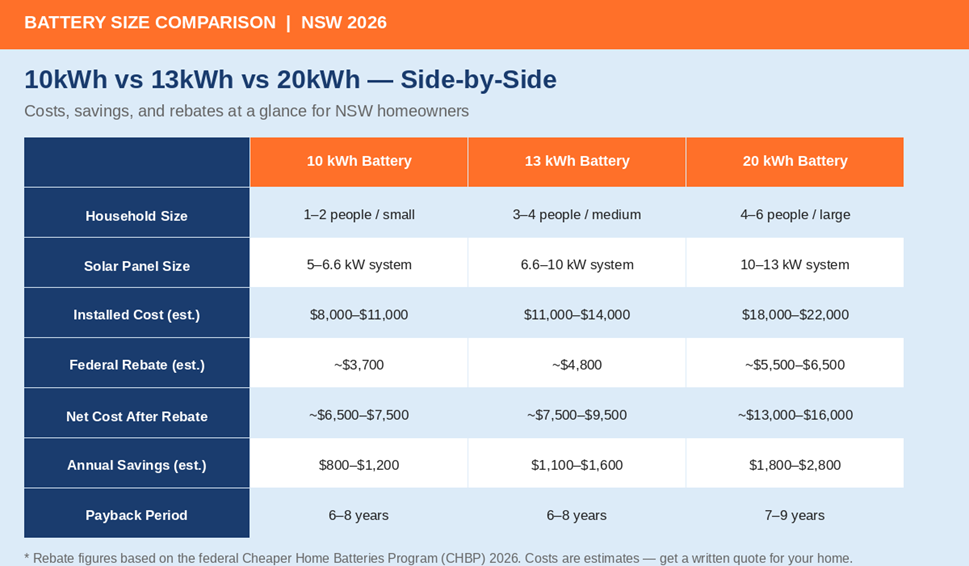
The table above summarises the key numbers. However, the figures are estimates based on typical NSW installations — your actual quote will depend on your solar system, switchboard condition, and installer. Always get three written quotes before committing.
For detailed information on government rules affecting your installation, the new 2026 installation requirements for NSW homeowners cover what has changed and what your installer must comply with.
The 10 kWh Battery: Who Is It Best For?
A 10 kWh battery is the entry-level option for most NSW homeowners — and for the right household, it is also the most cost-effective. At a net cost of roughly $6,500–$7,500 after the 2026 federal rebate, it delivers a solid payback without the larger upfront investment.
This size suits you well if:
- Your household has 1–2 people, or 3 people who are home and using power during the day
- Your total daily electricity use is under 15 kWh
- You already have a 5–6.6 kW solar system
- Your main goal is to reduce your evening electricity bill, not full energy independence
- You are on a standard tariff rather than a time-of-use plan with high peak rates
The 10 kWh category includes popular models such as the BYD Battery-Box 10 kWh and various Sungrow and Growatt options. These batteries are widely available, well-supported, and CEC-approved — which matters if you want to access the federal rebate and the NSW VPP incentive.
One important consideration: if you plan to add an electric vehicle within the next few years, a 10 kWh battery will likely feel undersized. Charging an EV overnight typically adds 8–15 kWh of demand on its own.
The 13 kWh Battery: The NSW Sweet Spot
For most NSW families, the 13–13.5 kWh range is the practical sweet spot. This is the size tier where the federal rebate provides the most benefit relative to capacity, where annual savings are substantial, and where the payback period remains manageable.
The Tesla Powerwall 3 (13.5 kWh) sits squarely in this category and remains the most popular single-unit residential battery in NSW. The BYD Battery-Box 13.8 kWh is a strong alternative, offering a slightly larger capacity at a competitive price point.
This size suits you well if:
- Your household has 3–4 people with typical appliance use
- Your daily electricity consumption is between 15–25 kWh
- You have a 6.6–10 kW solar system
- You run the dishwasher, washing machine, and AC during peak evening hours
- You want a comfortable energy buffer without a premium price
At a net cost of approximately $7,500–$9,500 after rebates, the 13 kWh option offers annual savings of $1,100–$1,600 for a typical NSW family — giving a payback period of around 6–8 years. That is a strong result by any measure.
It is also worth noting that the 13 kWh size tier falls within the most favourable portion of the federal Cheaper Home Batteries Program rebate structure. For specifics on which batteries qualify for the 2026 federal rebate in NSW, including eligible brands and models, check the full eligibility list.
Matching Battery Size to Your Household: A Quick Reference
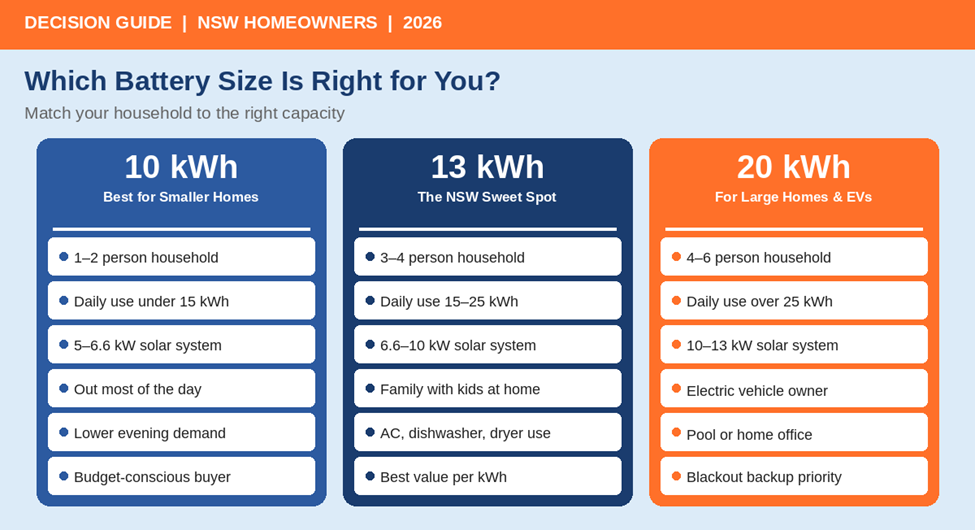
The decision guide above makes the size decision straightforward. Furthermore, keep in mind that the right battery size is not just about your current usage — it is about where your household is heading over the next 3–5 years.
If you are planning to switch to an electric vehicle, install an induction cooktop, or add more occupants to the house, factor that future demand into your decision now. Upgrading a battery system later involves additional labour and potential equipment costs.
The 20 kWh Battery: When Bigger Makes Sense
A 20 kWh battery is not for everyone — and that is by design. However, for a specific type of NSW homeowner, it is genuinely the right call rather than an oversized purchase.
This size suits you well if:
- Your household has 4–6 people with high appliance usage
- You own or plan to own an electric vehicle
- You have a pool, home office, or other high-draw equipment
- Blackout protection and energy independence are a priority
- You have a 10–13 kW solar system that generates surplus power daily
The 20 kWh tier typically requires either two battery units stacked together (for example, two BYD 10 kWh batteries) or a single large-format unit designed for residential or light commercial use. Installation costs are proportionally higher, and the switchboard may need upgrading depending on your home’s existing electrical capacity.
Moreover, from 1 May 2026, the federal rebate structure introduced tiered support — which means larger batteries above 14 kWh attract a smaller proportional subsidy than before. Consequently, the relative financial case for a 20 kWh battery is slightly less favourable than it was pre-May. That said, if your household genuinely needs the capacity, the payback still stacks up.
Payback Period: What to Expect From Each Size
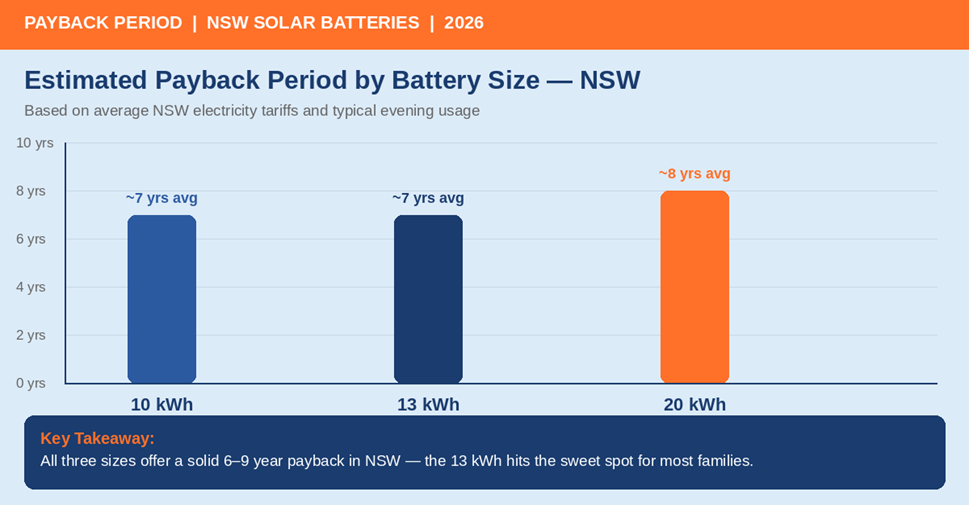
As the chart shows, all three sizes deliver a reasonable payback period in NSW — typically 6 to 9 years. The exact figure depends on your electricity tariff, your evening usage pattern, and whether you participate in the NSW Virtual Power Plant (VPP) incentive through the Peak Demand Reduction Scheme.
Importantly, VPP participation adds $300–$1,000+ in annual earnings on top of your bill savings. For solar batteries NSW-wide, that additional income can shave 1–2 years off the payback period. Ask your installer whether the battery they are recommending is VPP-compatible.
What Affects Your Battery’s Actual Performance in NSW?
Choosing the right size is only part of the equation. Even with the perfect capacity, your battery will underperform if the following factors are not in order.
Your solar system’s output
A battery only charges from excess solar production. If your panels are aged, shaded, or undersized, they will not generate enough surplus to fill the battery each day. Before adding storage, ask your installer to assess your current solar system’s performance. The
Before adding storage, ask your installer to assess your current solar system. The CER registration rules for NSW solar panel installers explain the credentials your installer must hold for the installation to qualify for rebates.
Your tariff type
On a flat tariff, a battery saves you the difference between what you would have paid for grid electricity and what it cost to generate solar. On a time-of-use tariff — which many NSW households are now on — the savings are larger, because you avoid paying 45–55 cents per kWh during peak evening hours. The higher your peak rate, the faster your battery pays back.
Installation quality
A properly installed battery on a compatible solar system outperforms a poorly installed one regardless of size. Wiring standards matter — the battery wiring standard in Australia sets out what a compliant installation must include. Make sure your installer follows AS/NZS 3000 and the relevant clean energy installer requirements.
Rebates Available in NSW in 2026: What You Can Stack
NSW homeowners in 2026 can access two separate incentives — and they stack together, which makes a significant difference to the net cost.
- Federal Cheaper Home Batteries Program (CHBP): Approximately $302–$372 per kWh of usable capacity, applied as an upfront discount at the point of installation. For a 10 kWh battery, this is roughly $3,100–$3,700. For a 13 kWh battery, roughly $4,200–$4,800.
- NSW Peak Demand Reduction Scheme (PDRS) VPP Incentive: Up to $1,500 when you connect your battery to an approved Virtual Power Plant. The exact amount depends on your battery size. You must use an Accredited Certificate Provider.
Combined, these two incentives can reduce your net cost by $4,000–$5,500 on a typical 10–13 kWh system. That is a meaningful contribution to payback, and it is available right now regardless of when you install — as long as you use a CEC-accredited installer and an eligible battery.
| Note for solar battery Bankstown and surrounding areas: Solar Battery Outlet services Bankstown, Liverpool, and Mudgee. All installations include full rebate paperwork handling — you do not need to lodge any claims yourself. Our SAA-accredited electricians manage the CHBP discount and PDRS VPP application end to end. |
Quick Checklist: Before You Choose a Battery Size
Before you sign anything, work through these five checks. They take 10 minutes and will save you from buying the wrong size.
- Check your last 12 months of electricity bills. Look at your total daily usage and identify how much you draw after 4 pm. Your retailer’s app or your smart meter data will show this.
- Find out what solar system you have. Note the total panel capacity (kW) and the inverter size. A 5 kW inverter may not support a 20 kWh battery without an upgrade.
- Ask whether your switchboard needs upgrading. Some older NSW homes need a switchboard upgrade before a battery can be safely added. This adds $500–$1,500 to the project cost and should appear on your written quote.
- Confirm the battery is CEC-approved and VPP-capable. Both are required to access the federal rebate and the NSW PDRS incentive, respectively.
- Get three written quotes. Size recommendations vary between installers. If one quote recommends a 10 kWh system and another recommends 20 kWh for the same home, ask both to justify the recommendation with your actual usage data.
| Not Sure Which Size Is Right for Your Home? Solar Battery Outlet offers free, no-obligation quotes for NSW homeowners across Liverpool, Bankstown, and Mudgee. We will review your electricity bills, assess your solar system, and give you an honest size recommendation — along with a written quote that shows the federal rebate deducted upfront. No pressure. No countdown timers. Just the right answer for your home. Call us: 1800 000 777 | Get a free quote at solarbatteryoutlet.com.au |
Frequently Asked Questions
It depends on your evening usage. A 10 kWh battery is sufficient for a 1–2 person household or a family that uses most of its power during the day. For a 3–4 person family running AC, the dishwasher, and the TV from 4 pm onwards, 10 kWh will often run out before midnight. In that case, 13 kWh is a safer choice.
Not entirely. The rebate is calculated per kWh of usable capacity — so a 13 kWh battery attracts a larger absolute rebate than a 10 kWh battery. However, the total installed cost of the 13 kWh system is also higher. The net cost difference between the two is typically $1,000–$2,500 after rebates.
Yes. Many NSW homeowners choose to install one 10 kWh or 13 kWh battery initially, then add a second unit later as demand grows. However, adding a second battery in a future installation involves additional labour costs compared to installing both at once. If you know your usage is high, installing the full capacity upfront is usually the better financial decision.
Your solar panels charge your battery. A 5 kW solar system in NSW typically generates 18–22 kWh on a good day. After powering daytime loads, it might produce 8–12 kWh of surplus available to charge a battery. Therefore, installing a 20 kWh battery on a 5 kW solar system means the battery will rarely be fully charged, which reduces your annual savings and stretches the payback period.
The PDRS VPP incentive applies to batteries connected to an approved Virtual Power Plant provider. The incentive value scales with battery size, with larger systems receiving up to $1,500. However, the battery must be VPP-capable (able to discharge to the grid on demand) — not all models support this. Ask your installer specifically about VPP compatibility before purchasing.
