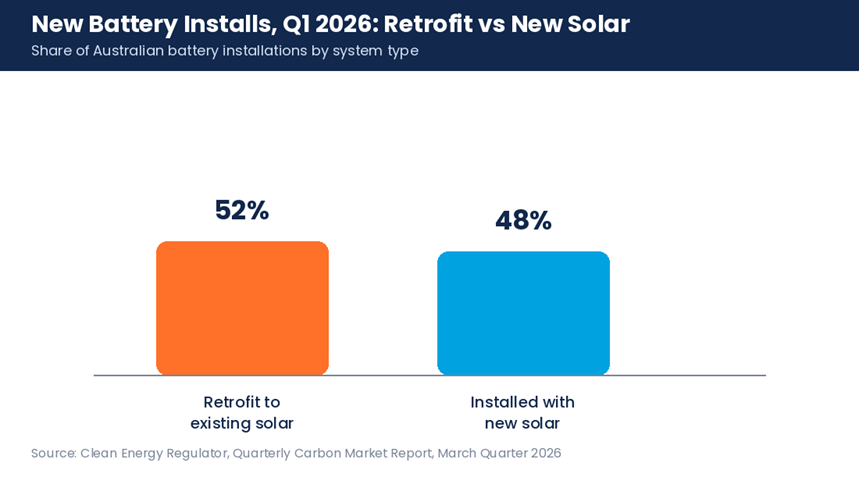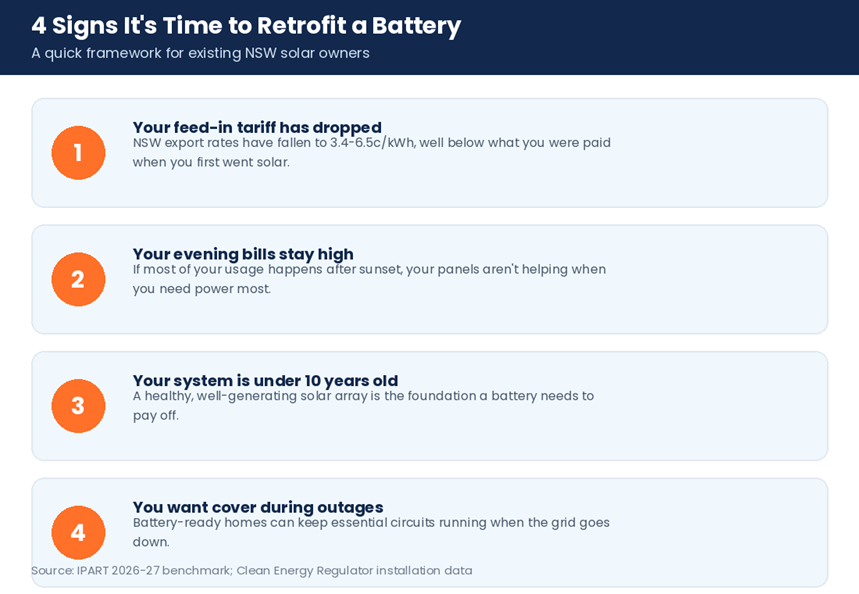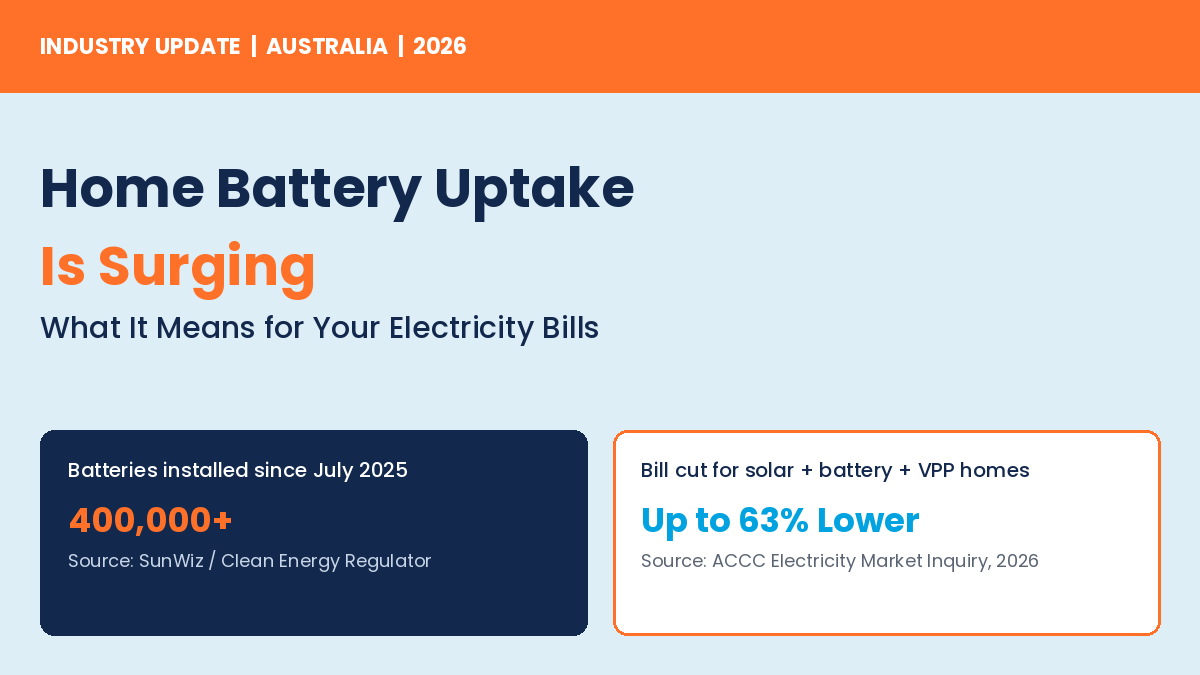
A practical, numbers-first guide for NSW homeowners weighing up a home battery in 2026

Every NSW homeowner researching solar batteries eventually runs into the same headline: “save up to $1,100 a year.” It sounds promising, but it also raises an obvious question — is that figure realistic for your home or just a marketing average? In 2026, with electricity prices climbing and battery rebates shifting, that question matters more than ever.

This guide breaks down exactly where the $1,100 figure comes from, how it changes depending on your battery size, household usage, and tariff plan, and what the real 10-year savings picture looks like once rebates, bill savings, and avoided peak charges are combined. We’ll also walk through a worked example using actual NSW electricity rates so you can sense-check the numbers against your own bill.

If you’re comparing options for solar batteries NSW wide, or specifically researching a solar battery Liverpool installers can supply and fit, the framework below applies regardless of postcode—only the inputs (your usage, your tariff, your roof) change.

Where Does the “$1,100 a Year” Figure Actually Come From?

The $1,100 number isn’t pulled from thin air, but it also isn’t a guarantee. It typically represents the combined effect of three separate savings streams working together over a full year:

  • Avoided peak import charges—using stored solar instead of grid power during the 3pm–9pm peak window, when NSW time-of-use rates often sit between 40 and 55 cents per kWh.
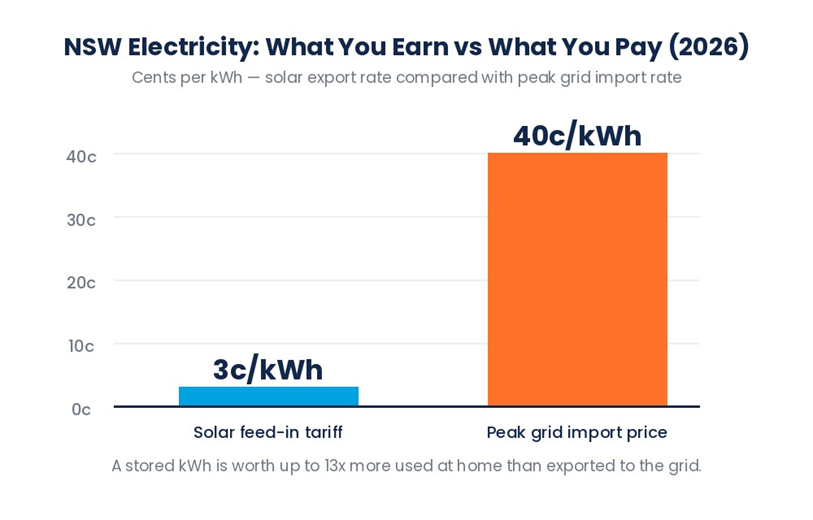
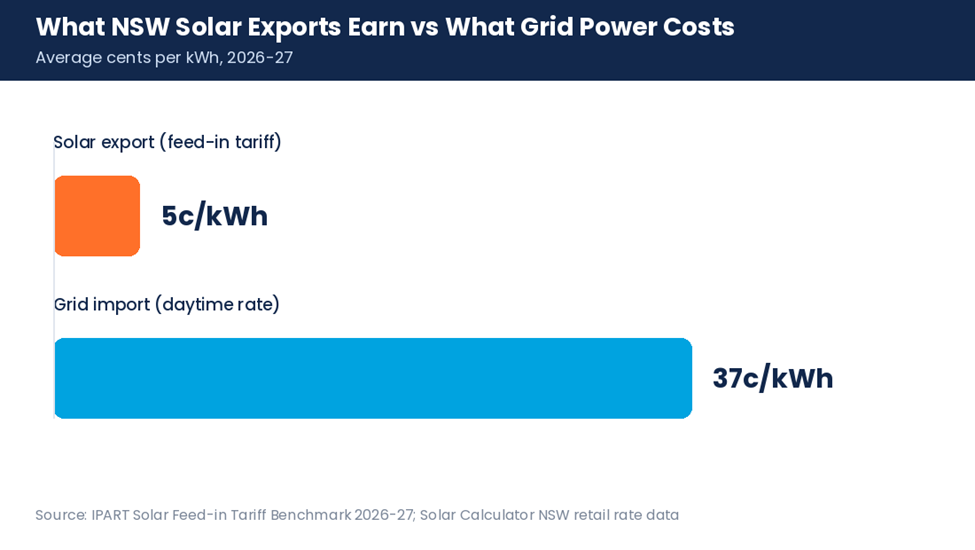
  • Higher solar self-consumption — instead of exporting excess solar for a low feed-in tariff, the battery stores it for later use, effectively converting a 5–8 cent export credit into a 30+ cent saving.
  • Reduced reliance on the grid during outages or price spikes — particularly relevant as wholesale prices become more volatile.

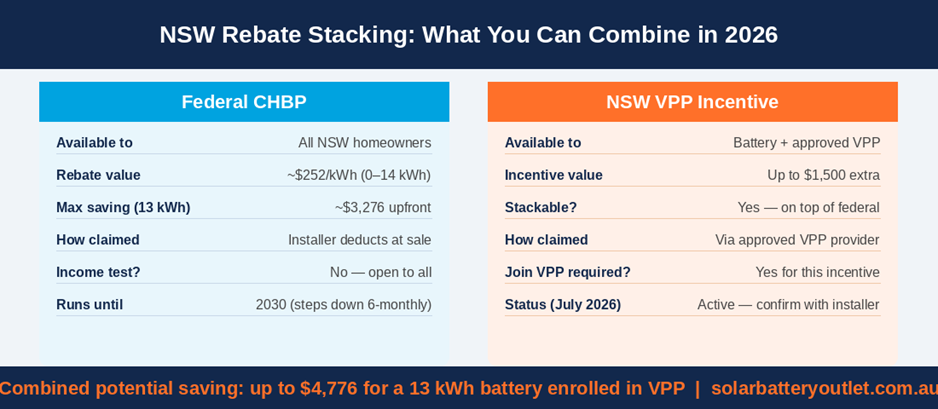
Independently, the New South Wales government’s home battery rebate explainer for the Cheaper Home Batteries Program confirms that NSW households can stack the federal rebate with the state’s VPP incentive, which is the second half of the savings equation alongside ongoing bill reductions.

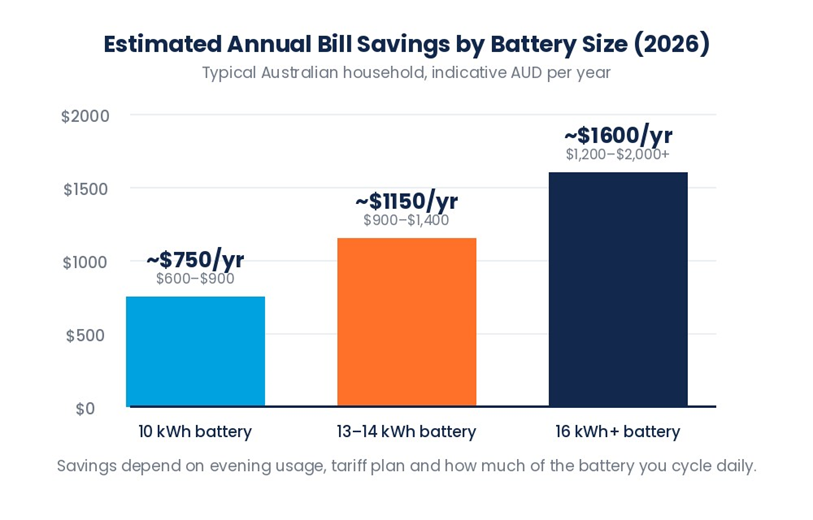
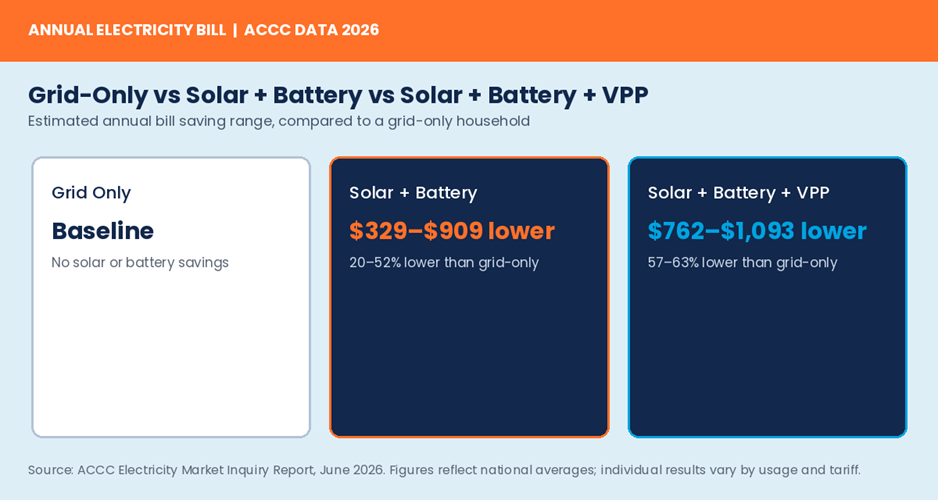
For a household with average NSW consumption (around 14–16 kWh per day) and a 10kWh battery, the combined annual bill savings typically land between $950 and $1,200, depending on tariff structure and how much solar is already being self-consumed before the battery is installed.

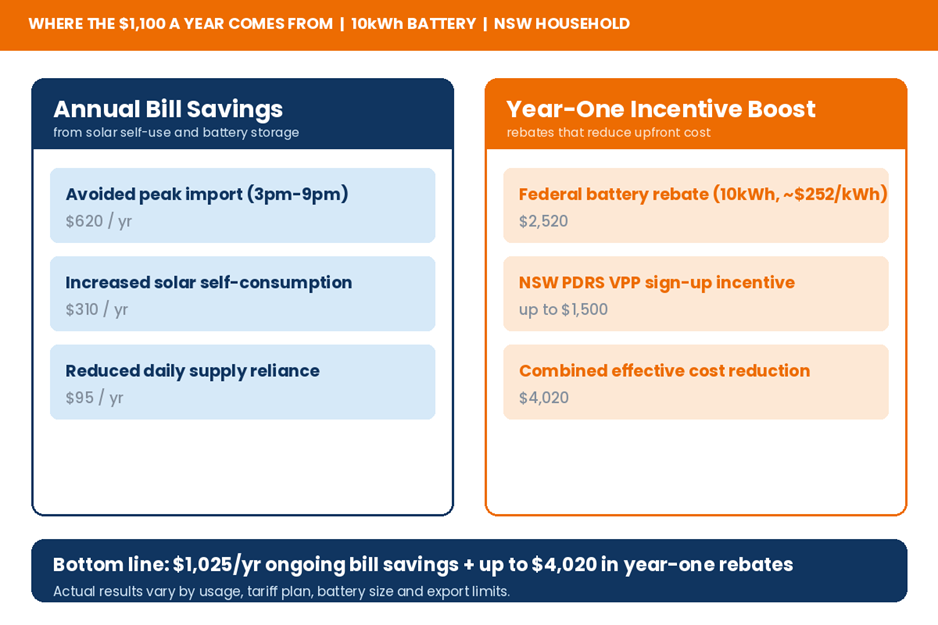
Breakdown of where annual battery savings and year-one incentives come from for a typical 10kWh NSW system

The 2026 Rebate Landscape: Why Timing Still Matters

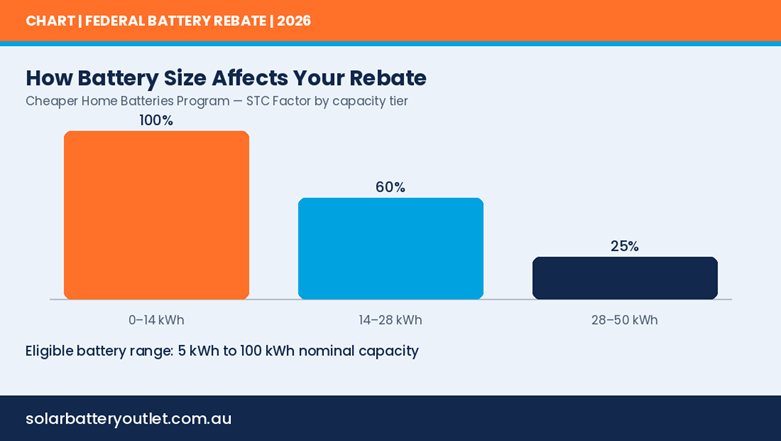
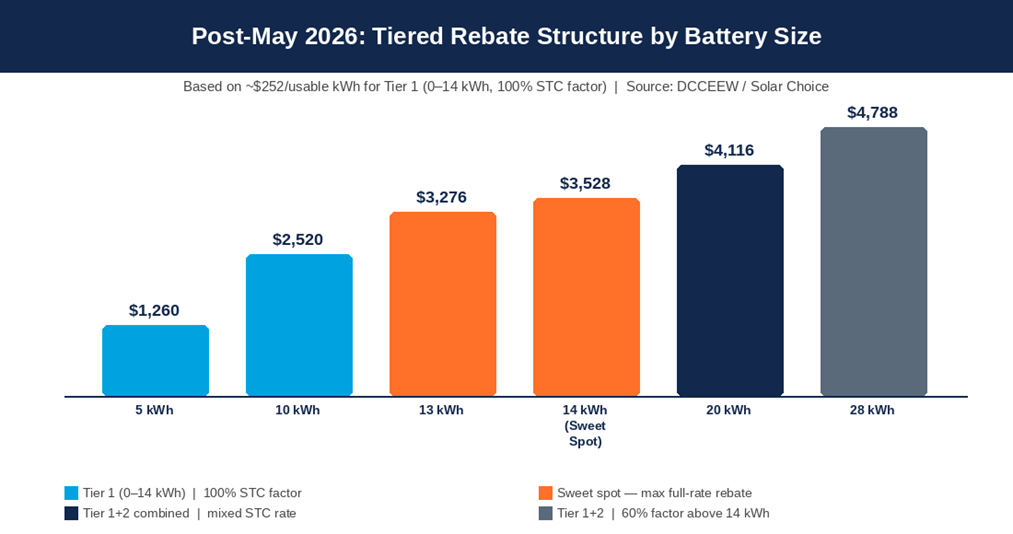
From 1 May 2026, the federal Cheaper Home Batteries Program moved to a tiered structure. Batteries up to 14kWh continue to receive the full STC rate, currently around $252 to $272 per usable kWh, while capacity between 14kWh and 28kWh receives roughly 60% of that rate, and capacity beyond that drops further still. For most NSW homes, a battery in the 10–14kWh range remains the sweet spot for rebate value.

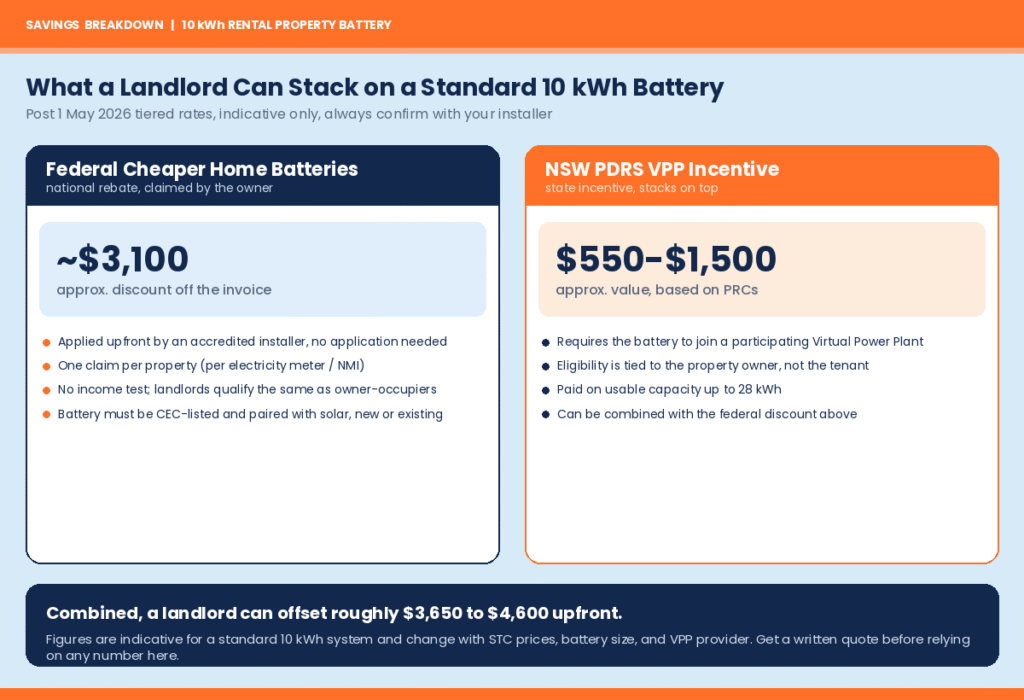
On top of the federal rebate, NSW homeowners can apply for the Peak Demand Reduction Scheme (PDRS) VPP incentive, worth up to $1,500 when a battery is connected to an approved virtual power plant. Combined, a 10kWh battery installed in 2026 can attract a federal rebate of roughly $2,520, plus the VPP incentive, for a total reduction in upfront cost approaching $4,000.

None of this changes the underlying running-cost savings discussed in this article — those depend on your usage and tariff, not the rebate. But the rebate does affect how quickly your system pays for itself, which is why timing your install before further STC step-downs (the next is scheduled for January 2027) can meaningfully shorten your payback period.

A Worked Example: 10kWh Battery, Average NSW Household

Let’s use a realistic household profile. According to NSW energy data, the average household electricity bill currently sits around $1,800 to $1,900 per year, with a typical usage rate of roughly 30 to 34 cents per kWh and many homes now on time-of-use tariffs where peak rates climb above 40 cents.

Consider a household with 6.6kW of rooftop solar and a 10kWh battery added in 2026. Before the battery, this home self-consumes roughly 35% of its solar generation and exports the rest at a low feed-in tariff. After the battery is installed, self-consumption typically rises to 70–80%, because the battery soaks up midday solar surplus and discharges it during the evening peak instead of drawing from the grid.

Running the numbers across a full year produces three savings categories that, added together, comfortably reach the $1,100 mark in homes with above-average evening usage, and sit closer to $850–950 for smaller households. The breakdown image above shows the typical split: roughly $620 from avoided peak imports, $310 from improved solar self-consumption, and $95 from reduced reliance on the daily supply charge during outages or low-generation days.

It’s worth being transparent here: these figures will not be identical for every home. A single-person household using 7–8 kWh per day will see proportionally smaller savings, while a larger family running air conditioning, an EV charger, and a pool pump during peak hours could exceed $1,300 annually.

The 10-Year Picture: When Does a Battery Actually Pay for Itself?

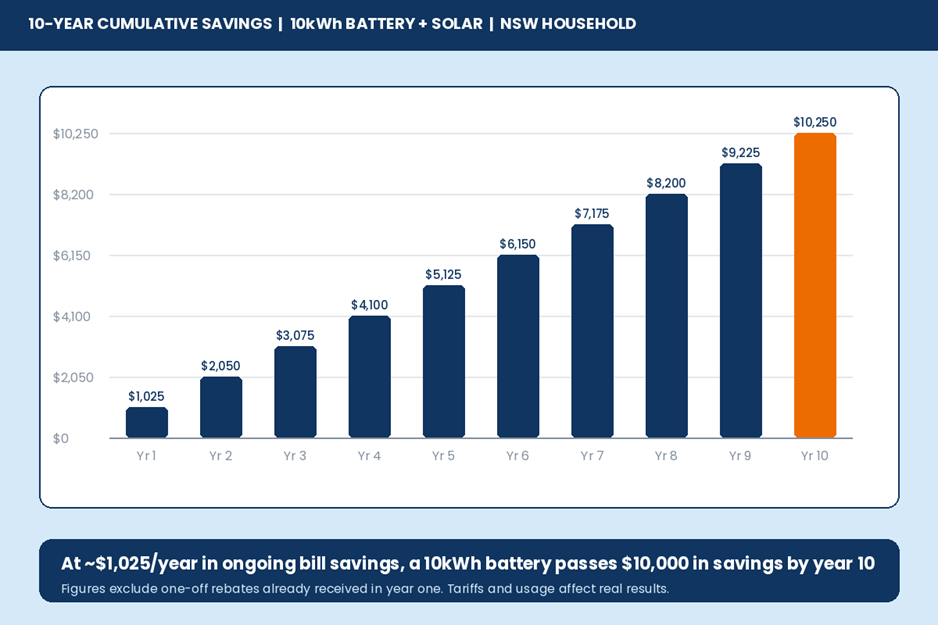
Annual savings are useful, but the real question most homeowners want answered is payback time. Using the $1,025/year average from our worked example, and assuming a net system cost (after rebates) of roughly $5,000 to $7,000 for a 10kWh battery added to existing solar, payback typically falls between 5 and 7 years. Most home batteries carry a 10-year warranty, meaning the system continues delivering savings well past the point it has paid for itself.

The chart below shows cumulative bill savings over a 10-year period at the $1,025/year rate, excluding the one-off rebate already banked in year one. By year 10, cumulative bill savings alone exceed $10,000 — and that’s before accounting for the likelihood that electricity prices, and therefore savings, will continue rising over that period.

Cumulative bill savings over 10 years for a 10kWh battery paired with rooftop solar in NSW

A Simple Framework to Estimate Your Own Savings

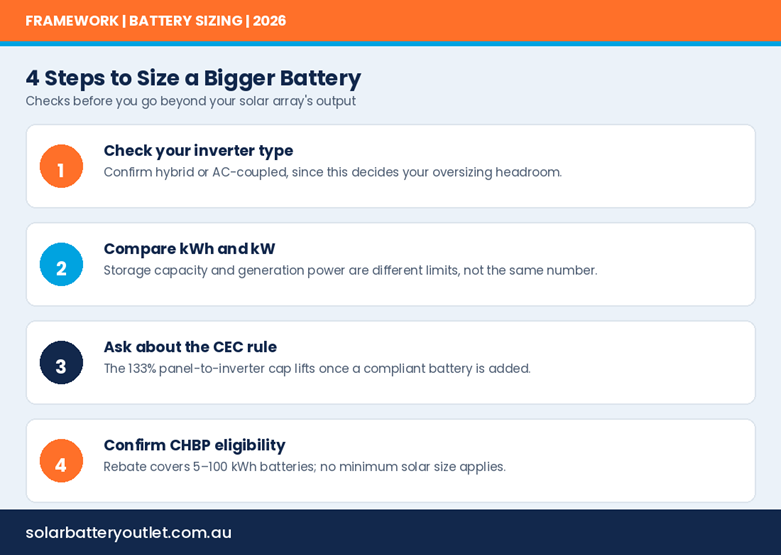
Rather than relying on a generic average, you can estimate your own potential savings in four steps. This framework mirrors the approach used by energy analysts when calculating real bill impact rather than theoretical kWh totals.

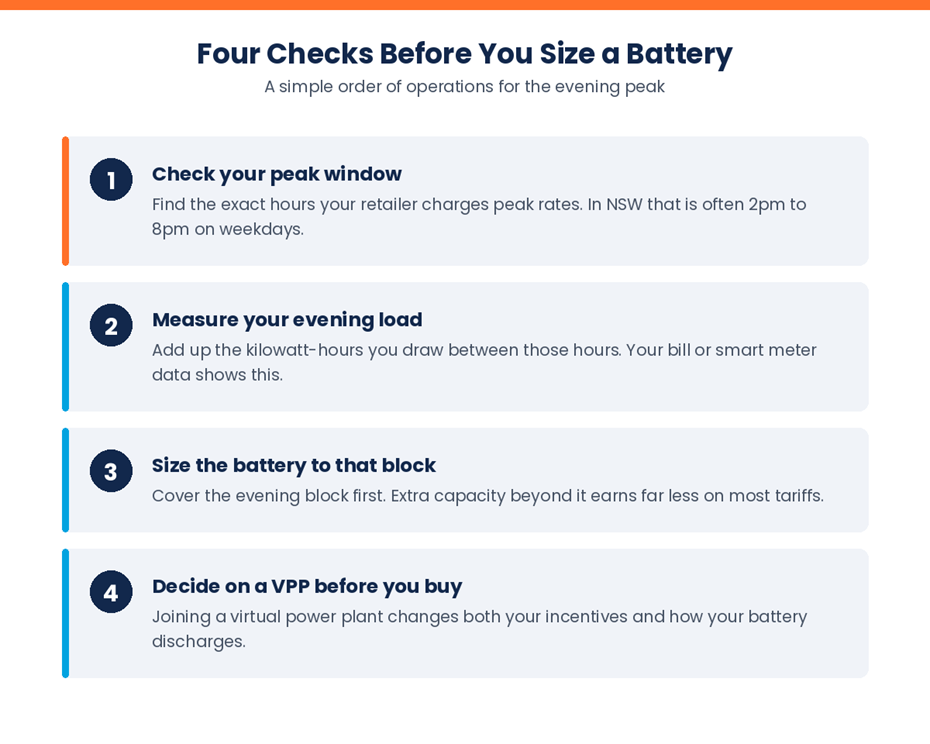
  1. Find your actual evening usage. Pull a recent bill and identify how much electricity you use between 3pm and 9pm — this is the window a battery primarily offsets.
  2. Check your time-of-use rate for that window. Multiply your average evening kWh usage by your peak rate (often 40–55c/kWh) to estimate your current peak spend.
  3. Estimate your battery’s usable discharge. A 10kWh battery typically delivers 8–9kWh of usable evening discharge per day after accounting for depth-of-discharge limits and standby losses.
  4. Multiply and annualise. Multiply your usable discharge by your peak rate, then by 365 days, to estimate annual peak-avoidance savings. Add your expected solar self-consumption uplift (usually $250–$400/year) for a total estimate.

This four-step approach consistently produces estimates within 10–15% of actual post-installation savings reported by NSW households, making it a far more reliable starting point than a flat headline figure.

Common Mistakes That Inflate or Deflate Battery Savings Estimates

  • Ignoring tariff structure. A flat-rate tariff produces very different savings to a time-of-use tariff, sometimes by a factor of two.
  • Assuming 100% battery efficiency. Real-world round-trip efficiency for most lithium batteries sits between 85% and 95%, which should be factored into any estimate.
  • Overlooking export tariff changes. Some NSW retailers now apply negative feed-in tariffs during solar-flush periods, which increases the relative value of storing solar rather than exporting it.
  • Comparing battery size to roof size, not usage. A larger battery only delivers proportionally larger savings if your evening usage is high enough to draw down that extra capacity each day.

Getting these details right is where working with an experienced, CEC-accredited installer makes a measurable difference — not just in installation quality, but in correctly sizing the system to your actual usage pattern rather than a generic recommendation.

Frequently Asked Questions
Is the $1,100 a year savings figure realistic for most NSW homes?

It’s realistic for households with above-average evening electricity use and a 10kWh or larger battery on a time-of-use tariff. Smaller households or those on flat tariffs may see figures closer to $700–$950 per year, while larger households with high peak-period consumption can exceed $1,100.

How is battery savings different from solar savings?

Solar savings come from generating your own electricity during the day. Battery savings come from storing that solar for use later, particularly during the evening peak when grid electricity is most expensive. The two work together, but a battery specifically targets the gap between cheap daytime solar and expensive evening grid power.

Does the rebate change reduce my ongoing savings?

No. The May 2026 changes to the Cheaper Home Batteries Program affect the upfront rebate amount, particularly for batteries over 14kWh, but they don’t change how much you save on your electricity bill each year. Ongoing savings depend entirely on your usage and tariff, not the rebate structure.

How long does a home battery take to pay for itself?

Based on current rebate levels and average NSW usage, most 10kWh batteries reach payback within 5 to 7 years, with a typical 10-year warranty meaning several years of savings continue after the system has paid for itself.

Do I need a specific tariff plan to benefit from a battery?

A time-of-use tariff generally maximises battery savings because it creates a larger gap between cheap off-peak rates and expensive peak rates. However, batteries still provide savings on flat tariffs through improved solar self-consumption, just at a slightly lower rate.

Get Your Personalised Savings Estimate

The numbers in this guide are based on average NSW usage patterns, but your actual savings depend on your roof, your bill, and how your household uses electricity. At Solar Battery Outlet, we use your real usage data to model expected savings before you commit to a system size — so you know what to expect, not just a headline figure.

Whether you’re comparing solar batteries NSW-wide or you’re specifically after a solar battery Liverpool homeowners can have installed quickly, our team can walk you through current rebate eligibility, VPP options, and a savings estimate based on your own electricity bill—not an industry average.

Data used in this from these links:

cheaper-home-batteries

eligibility-information

average-electricity-bill-nsw

If you are a NSW homeowner with solar panels, you have almost certainly asked this question: Should you install a battery now, or wait another year for prices to fall? It sounds like a simple cost-benefit decision. In reality, the answer involves several moving parts—hardware trends, government rebates, import costs, and your household’s own usage pattern.

This article cuts through the noise. It draws on data from CSIRO’s GenCost report. It also uses BloombergNEF’s 2025 Energy Storage Outlook and the Australian Government’s updated Cheaper Home Batteries Program. Together, these sources show where battery prices are heading. They also explain what that means for your timing decision.
Home battery storage costs 2026 Australia – decision guide for NSW homeowners

What Has Happened to Battery Prices So Far?

The short version is that prices have fallen dramatically over the past five years. According to BloombergNEF, lithium battery costs declined by more than 40% between 2020 and 2025 globally. In Australia specifically, CSIRO’s GenCost 2025–26 draft report confirmed residential battery storage costs dropped 11 to 16% in 2024–25 alone. Furthermore, an even steeper 40% drop was recorded from 2023 to 2024.

To put that into dollar terms: the average installed cost of a 10 kWh residential battery in Australia currently sits at around $8,650 after the federal rebate, compared to well over $12,000 just three years ago. For homeowners researching the best home batteries Australia has to offer, this downward trend is genuinely significant.

Solar battery price per kWh Australia 2021 to 2026 trend chart

So Will Costs Drop Further in 2026?

Yes — but the picture is more nuanced than a simple ‘wait and save more’ conclusion.

On the hardware side, the outlook is positive. BloombergNEF expects lithium battery pack prices to fall by 8–12% through late 2026. Expanding manufacturing capacity is a key reason. Increased use of lithium iron phosphate (LFP) batteries is also helping. Supply chains have become more stable since 2024. CSIRO projects battery storage costs of $484 per kWh by 2030. That is down from $525 per kWh in 2025.

However, two factors are pushing back against those hardware savings for Australian buyers in 2026.

Factor 1: The Chinese Export VAT Change

In April 2026, China reduced its VAT rebate on battery exports from 9% to 6%. That 3-percentage-point cut increases the cost of imported battery components by roughly 3%, and industry analysts expect it to flow through to Australian installed prices within one to two months. The same rebate is scheduled for complete removal in January 2027, which could add a further 6% at the import stage.

For small- to mid-size batteries (5–10 kWh), the projected decline in hardware costs should offset this. For larger systems above 14 kWh, the combination of tiered rebates and higher import costs means the net price direction is less favorable than the headline hardware trend suggests.

Factor 2: The Rebate Steps Down — And Keeps Stepping

This is the factor most homeowners underestimate. The federal Cheaper Home Batteries Program is not ending — it runs to 2030, with the total program funding expanded to an estimated $7.2 billion. However, from 1 May 2026, the rebate structure changed in two important ways.

First, the STC factor dropped from 8.4 to 6.8. For a standard 10 kWh battery, that translates to approximately $530 less rebate. For batteries above 14 kWh, the new tiered structure means the reduction is considerably larger — between $1,000 and $1,800 or more, depending on size.

Second, and this is the part fewer people are talking about: from May 2026 onward, rebate values step down every six months rather than annually. That means the rebate is structurally programmed to shrink twice per year from this point forward.

The practical takeaway is clear: even if hardware costs fall 8% in the next 12 months, a homeowner who waits may find that the rebate reduction over the same period cancels out — or exceeds — those hardware savings.

Should I buy a home battery now or wait – decision guide 2026

The Numbers: What a NSW Homeowner Can Expect to Pay in 2026

Below is a realistic snapshot of what NSW homeowners are paying for installed battery systems in June 2026, post-rebate. These figures are drawn from current market data and exclude switchboard upgrades or additional backup wiring.

The Decision Framework: Should You Buy Now or Wait?

Rather than giving a one-size-fits-all answer, the most useful thing this article can do is give you a structured way to assess your own situation. Work through the following checkpoints honestly.

Decision guide for NSW homeowners considering home battery storage in 2026

Act Before the Next Rebate Step-Down If:

  • You have already obtained three or more written quotes and are ready to proceed.
  • Your planned battery is 10 kWh or larger, where the tiered rebate reduction has the most financial impact.
  • Your household uses the majority of its power in the evenings, after solar generation stops.
  • Your existing solar system is under ten years old and generating reliably.
  • You plan to enrol in a Virtual Power Plant (VPP) — NSW VPP incentives can add up to $1,500 on top of the standard rebate.

Take Your Time If:

  • You are still researching brands, sizes, or installers and have not yet compared quotes.
  • Your battery plan is under 5 kWh, where the hardware cost decline is likely to outpace the rebate reduction over the short term.
  • Your solar system is more than ten years old and may need servicing or replacement before adding storage makes sense.
  • Your daytime electricity usage is high — meaning you may already be consuming much of your solar output directly.

One important point worth emphasising: installers in NSW report that booking calendars filled rapidly ahead of the May 2026 rebate change. If you are considering a mid-2026 installation, getting onto a waiting list sooner rather than later is practical advice regardless of your timing decision.
What about solar battery NSW Markets?

For homeowners in south-western Sydney and areas like Liverpool, Bankstown, and Campbelltown, the same national pricing dynamics apply. However, there are a few local factors worth noting.

First, installation costs in Greater Sydney tend to be slightly higher than in regional NSW due to labour rates and parking/access considerations. This makes the upfront rebate value proportionally more significant for metro homeowners, since you are starting from a higher baseline cost.

Second, feed-in tariffs in the Ausgrid and Endeavour Energy network areas are now as low as 4–6 cents per kWh for excess solar exports. That gap between what you earn from exporting (4–6c) and what you pay to buy power back at night (30–35c) is exactly the economic case for solar battery Liverpool homeowners—and it is growing rather than shrinking.

If you are on a time-of-use tariff in NSW, a well-sized home battery storage system can shift almost all of your expensive peak consumption to free solar energy, making the payback calculation considerably more favorable than the headline figures suggest.

A Real-World Example: The Mathers Family, Penrith

To make the numbers concrete, consider a typical four-person household in western Sydney. They have a 6.6 kW solar system installed in 2021, pay approximately $2,400 per year in electricity bills despite having solar, and use most of their power between 5 pm and 10 pm.

Battery installed (10 kWh, mid-2026): The upfront cost is approximately $8,500 after rebate. Annual bill savings estimated at $1,100–$1,400 based on current Ausgrid tariff rates. Payback period: approximately 6–7 years. VPP enrolment could reduce payback to 5 years.

If they wait until 2027, Hardware cost savings of roughly $400–$600. Rebate reduction of approximately $400 (next step-down). Chinese VAT removal adds ~$300 to import costs. Net position: roughly similar or slightly worse out-of-pocket, plus 12 more months of high evening bills ($1,200+ missed savings).

The maths does not always favor waiting—especially once you factor in the electricity savings you forgo during the waiting period.

What the Experts Are Saying About Prices to 2030

CSIRO’s GenCost 2025–26 draft report is the most authoritative domestic source on battery cost trajectories. Its findings confirm that battery technologies continue to show significant double-digit cost reductions, while noting that large-scale solar has seen its first price rise in three years.

For residential storage specifically, CSIRO projects two-hour battery storage capital costs will reach $484 per kWh by 2030 under a current-policies scenario—down from $525 per kWh in 2025. In a faster-decarbonisation scenario, costs could fall to $358 per kWh by 2050.

BloombergNEF’s 2025 Energy Storage Outlook adds global context: average battery pack prices are expected to approach $80 per kWh at the pack level by 2026, roughly half of what they were in 2023. That said, pack-level costs do not translate directly to Australian installed residential prices, which include inverter hardware, installation labour, certifications, and grid connection charges.

What to Do Next

You have done the reading. Now it is time to do the numbers for your specific home.

Will home battery storage costs continue to fall through 2026?

Yes, but modestly. Hardware costs are projected to decline 8–12% year-on-year. However, the rebate step-downs and Chinese VAT changes partially offset those savings for Australian buyers. Small batteries (5–10 kWh) remain the sweet spot where hardware declines outpace rebate reductions.

How much does a 10 kWh battery cost in NSW right now?

As of June 2026, the average installed cost for a 10 kWh residential battery in NSW sits between $8,000 and $10,000 after the federal rebate. The exact figure depends on brand, installer, and whether any additional work (switchboard upgrade, backup wiring) is needed.

Is the federal battery rebate ending soon?

No. The Cheaper Home Batteries Program runs until 2030, backed by $7.2 billion in expanded funding. However, the rebate amount steps down every six months from May 2026. It does not end — but it does keep getting smaller, which means earlier installations attract a larger discount.

What are the best home batteries Australia currently recommends?

The most commonly recommended brands by NSW installers in 2026 are the Tesla Powerwall 3, Sungrow SBR, BYD Battery-Box, and Alpha ESS Smile-5. Each suits different budgets and system sizes. The best choice depends on your inverter compatibility, backup requirements, and long-term warranty support.

Does a battery make sense if I already use most of my solar during the day?

In that case, the financial return is lower than for households that shift a significant load to the evening. However, a battery can still provide value through VPP enrollment, blackout protection, and bill stability as grid electricity prices continue to rise. The honest answer: get a quote and review your usage profile with a qualified installer before deciding.

What is a virtual power plant, and how does it affect payback?

A Virtual Power Plant (VPP) connects your battery to a network of other home batteries, allowing the operator to dispatch small amounts of energy during grid demand peaks. In return, you receive bill credits or annual payments typically ranging from $200 to $600. In NSW, the government also offers a separate VPP incentive of up to $1,500 on eligible systems, which can reduce your payback period by 12–18 months.

If you have been searching for a solar battery in NSW and wondering whether your shortlisted model actually qualifies for the federal rebate — you are not alone. The government’s Cheaper Home Batteries Program has attracted enormous interest since launching in July 2025, but the eligibility rules are specific, and not every battery on the market makes the cut.

This guide gives you a straight answer. It explains which batteries qualify, outlines the technical requirements, lists the approved brands, and shows how the 2026 tiered rebate structure affects your savings.

The 5 Rules That Determine Whether a Battery Qualifies

To be eligible for the federal rebate under the Cheaper Home Batteries Program, your battery and installation must meet five specific criteria. Miss any one of them and the rebate does not apply.

4 core requirements to quality for the federal battery rebate

1. The Battery Must Be on the CEC Approved Product List

The Clean Energy Council (CEC) maintains a list of approved battery products. If your battery is not on this list, it is simply not eligible — regardless of brand name, price, or capacity. The list is updated regularly and contains hundreds of models from dozens of manufacturers.

The major brands available in NSW — Tesla, BYD, Sungrow, Enphase, Growatt, AlphaESS, GoodWe, Sonnen, and SolarEdge — all have qualifying models on the list. But here is the important nuance: not every model from every brand is automatically listed. Some older variants, grey imports, or uncertified sub-models of otherwise approved brands may not qualify.

2. The Installer Must Hold Current SAA Accreditation

Since 2024, the accreditation body for solar installers in Australia changed from the Clean Energy Council to Solar Accreditation Australia (SAA). Your installer must hold a current, active SAA accreditation — not a historic CEC accreditation that predates the changeover.

You can verify an installer’s accreditation status directly at saaustralia.com.au. This check takes less than a minute and protects you from using an unqualified installer who cannot legally apply the rebate.

3. The Battery Must Be VPP-Capable

VPP stands for Virtual Power Plant. The federal government’s program requires that all eligible batteries are technically capable of participating in a VPP—meaning the battery’s hardware and firmware must support remote dispatch by a VPP operator.

You do not have to actually enrol in a VPP to claim the rebate. But the battery must be capable of it. This requirement rules out some older models and certain cheaper imported batteries that lack the communications hardware needed for VPP operation.

Every major brand installed by qualified NSW installers—Tesla Powerwall, BYD, Sungrow, Enphase, and Growatt—meets this requirement. Cheaper or unlisted brands may not.

4. The Battery Must Be Paired with a Solar PV System

This rule strictly requires you to connect your battery to a solar panel system to qualify for the federal rebate. You must either install the battery alongside a new solar system or retrofit it to an existing solar system already operating at the property.

However, off-grid properties are eligible for the federal rebate as long as the battery and solar pairing requirement is met. At the same time, off-grid systems cannot access the NSW VPP incentive, which requires grid connection by definition.

5. The Battery Must Have Between 5 kWh and 100 kWh Usable Capacity

The program covers batteries with a usable capacity of 5 kWh to 100 kWh. Batteries below 5 kWh do not qualify. Batteries above 100 kWh are eligible for installation under the program but receive no additional STC discount on capacity above 50 kWh.

For most NSW homeowners, the relevant range is 10–20 kWh. The tiered rebate structure introduced in May 2026 means the best rebate-per-dollar outcome sits in the 10–14 kWh range.

Which Battery Brands Are Approved in NSW?

Qualified NSW installers commonly install the following CEC-approved, VPP-capable battery brands. All of these qualify for the federal Cheaper Home Batteries Program and the NSW Peak Demand Reduction Scheme (VPP incentive).

Top Qualifying Batteries

Key Approved Brands — NSW 2026

Tesla Powerwall 3 (13.5 kWh) — The most popular choice in NSW. Fully CEC-listed, VPP-capable, and eligible for both the federal rebate and the NSW PDRS incentive. Estimated rebate: approximately $4,500 at the post-May 2026 STC rate.

BYD Battery-Box Premium HVS (5–22 kWh, modular) — A modular system allowing homeowners to start smaller and expand later. All HVS variants currently listed are CEC-approved. Estimated rebate: $1,700–$5,800 depending on configured capacity.

Sungrow SBR Series (9.6–25.6 kWh) — Often cited as the best value option in NSW for mid-range capacity. CEC-listed, fully VPP-capable, and widely available through SAA-accredited installers. Estimated rebate: $3,200–$5,800.

Enphase IQ Battery 5P (5 kWh, stackable) — An AC-coupled system that stacks in 5 kWh increments. Excellent for homes with older DC-coupled solar systems. Fully CEC-listed and VPP-capable. Estimated rebate: approximately $1,700 per unit.

Growatt ARK Series (5.12–30.72 kWh) — A competitively priced option with growing installer support across NSW. CEC-listed variants available. Estimated rebate: $1,700–$6,000 depending on configuration.

Other brands with CEC-approved models available in NSW include AlphaESS, GoodWe Lynx Home, Sonnen, SolarEdge Energy Bank, and Fronius. Your installer can confirm which specific variants are currently listed and available.

From 1 May 2026, the Cheaper Home Batteries Program introduced a tiered rebate structure. The STC rate from May to December 2026 is $272 per usable kWh of battery capacity — but this full rate only applies to the first 14 kWh.

Rebate Tiers

The Three Tiers Explained

  • Tier 1 (0–14 kWh): 100% of the STC rate — $272 per kWh. A 14 kWh battery earns approximately $3,808 in rebate.
  • Tier 2 (14–28 kWh): 60% of the STC rate — approximately $163 per kWh. An additional 14 kWh in this band earns approximately $2,282.
  • Tier 3 (28–50 kWh): 15% of the STC rate — approximately $41 per kWh. Minimal return for oversized systems.

For a standard 10–13.5 kWh battery (the most common size in NSW homes), the full Tier 1 rate applies, giving you the maximum rebate per kilowatt-hour of capacity installed.

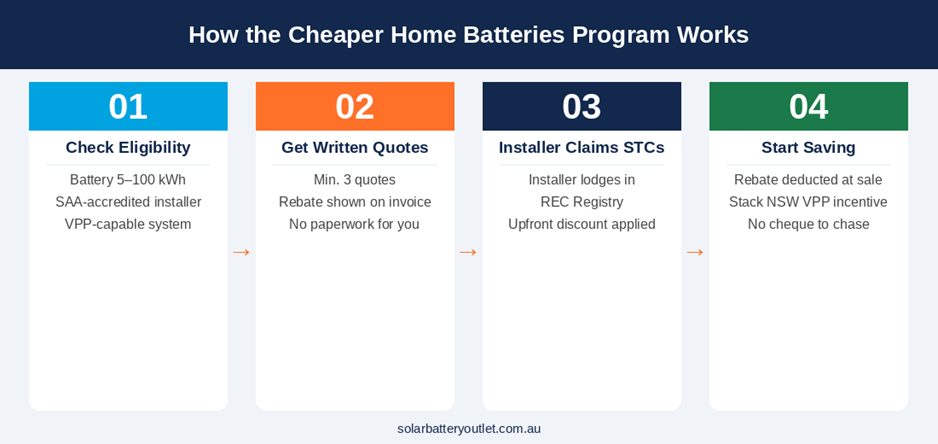
In addition to the federal rebate, NSW homeowners can also access the NSW Peak Demand Reduction Scheme (PDRS) — a VPP incentive worth up to $1,500 for connecting your battery to a registered Virtual Power Plant. These two rebates can be stacked for maximum savings.

Common Reasons a Battery Claim Is Rejected

The most common reasons homeowners find their rebate was not applied correctly or was rejected:

Battery Qualify for the 2026 NSW Federal Rebate
  • The battery brand or specific model was not on the CEC approved list at the time of installation.
  • The installer’s SAA accreditation had lapsed or they were never accredited — meaning the rebate cannot be claimed.
  • The battery was installed as a standalone system with no solar panels connected.
  • The property had previously claimed a battery STC rebate — one claim per address applies.
  • The battery’s capacity was below 5 kWh usable, making it ineligible under the program rules.
  • The installer quoted a “rebate” verbally but it was never applied as an STC deduction on the written invoice.

The simplest protection against all of these: check that your written quote clearly shows the rebate as a dollar deduction line item — not just a single “after-rebate price.” If it is not visible on paper, ask why before signing.

What About the NSW VPP Incentive — How Does It Stack?

The NSW Peak Demand Reduction Scheme (PDRS) is a separate state incentive that runs alongside the federal Cheaper Home Batteries Program. Furthermore, it rewards homeowners for connecting a new battery to a registered Virtual Power Plant operator, which allows the grid to draw on stored energy during peak periods.

The NSW VPP incentive is worth up to $1,500, paid through Peak Reduction Certificates (PRCs). Additionally, it is available to all NSW homeowners installing an eligible battery and can be combined with the federal rebate regardless of your installation timing — before or after 1 May 2026.

To access it, your installer registers your battery with a VPP operator and the local network operator (Ausgrid, for most of Sydney and NSW). You sign a VPP agreement, which covers the terms under which your battery can be remotely dispatched. Your installer handles all of this as part of the installation process.

Frequently Asked Questions

Can I claim the rebate if I already have solar but no battery?

Yes. Adding a battery to an existing solar system is one of the most common claim types. The federal rebate applies as long as your new battery meets the eligibility requirements and an SAA-accredited installer installs it. The installer will retrofit the battery to your existing system and connect it accordingly.

Does the rebate apply if I am renting the property?

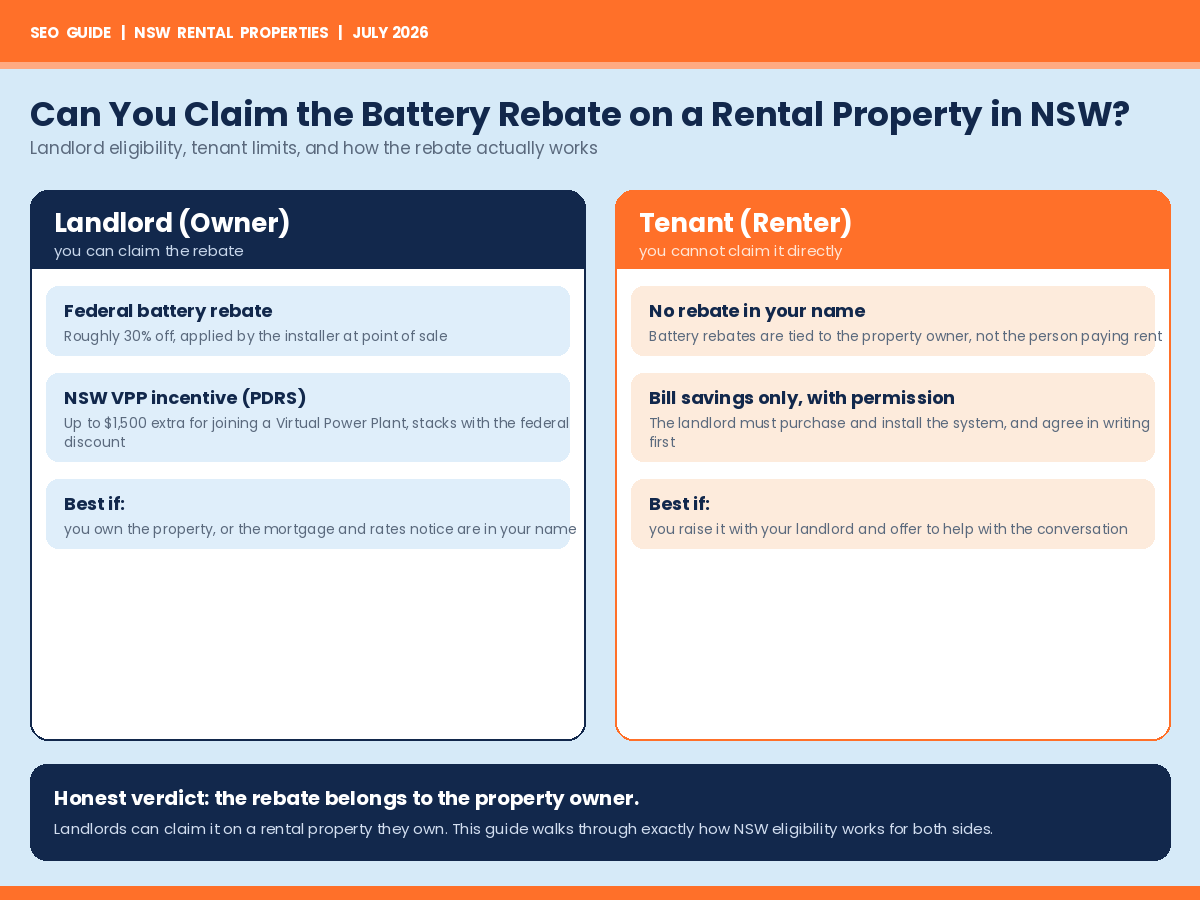
The federal Cheaper Home Batteries Program does not have an income test or homeowner restriction. Landlords, owner-occupiers, small businesses, and community organisations can all qualify. For renters looking to install a battery, the decision rests with the property owner — but the rebate would be available to them if they choose to proceed.

What happens if I want to install two batteries?

One rebate claim applies per property address. If you install a second battery at the same address, it is not eligible for a fresh STC rebate. However, if you install a modular system like BYD or Enphase that supports expansion, the installer can configure the initial setup to maximise your eligible capacity within the rebate tiers.

How do I verify that my installer is SAA-accredited?

Visit saaustralia.com.au and search the installer’s name or accreditation number. Verification takes less than 60 seconds and protects you from working with an uncertified installer. Any legitimate installer will give you their SAA number without hesitation.

Is there a deadline to claim the rebate?

The program runs until 2030. There is no single cut-off date, but the rebate value decreases over time. The STC factor reduces every six months, meaning the discount is slightly smaller in each subsequent period. The highest rebate available within the post-May 2026 period applies from May through December 2026.

Check If Your Battery Qualifies — Free Quote for NSW Homeowners

At Solar Battery Outlet, we install CEC-approved batteries across Liverpool, Bankstown, and Mudgee. SAA-accredited electricians complete all installations, and we handle all rebate paperwork on your behalf.

If you are unsure whether your shortlisted battery qualifies or want a written quote that clearly shows the rebate deduction, get in touch. We will look at your existing solar system, your electricity usage, and your budget—and give you an honest answer on whether a battery makes financial sense before you commit to anything.

Data Sources & References

The information in this article is drawn from the following sources:

  • Australian Government Clean Energy Regulator (CER) — Cheaper Home Batteries Program guidelines and STC rate tables
  • Clean Energy Council (CEC) — Approved battery product list (accessed May 2026)
  • Solar Accreditation Australia (SAA) — Installer accreditation database: saaustralia.com.au
  • NSW Department of Climate Change, Energy, the Environment and Water — Peak Demand Reduction Scheme (PDRS) guidelines
  • Tesla Australia — Powerwall 3 Cheaper Home Batteries Program eligibility page (tesla.com/en_au/support/energy/powerwall)
  • Solar Choice — Federal Solar Battery Rebate 2026 guide (solarchoice.net.au)
  • Solar Scorecard — Battery Rebates Australia 2026 (solarscorecard.com.au)
  • PSC Energy — Ultimate Guide to Australia Solar and Battery Rebates 2026 (pscenergy.com.au)
  • Solar Battery Outlet — Federal Battery Rebate NSW 2026 guide (solarbatteryoutlet.com.au)

Rebate estimates in this article are based on the post-May 2026 STC rate of $272 per usable kWh. Actual rebate amounts vary based on battery capacity, STC market price at time of installation, and installer calculations. Always confirm figures with your SAA-accredited installer before signing a contract.

If you have been shopping for a solar battery since the 1 May 2026 rebate changes came into effect, you have probably noticed the rebate figures on your quotes look different. That is not a mistake, and it is not the installer padding their margin. The federal Cheaper Home Batteries Program restructured how it calculates upfront discounts from 1 May — and for the first time, the rebate is not the same for every battery size. It now depends on how large your system is.

This article breaks down exactly what changed, what the new slab structure looks like in plain terms, and — most usefully — what that means in dollars for every common battery size installed in NSW right now. 

If you are buying a standard 10 kWh or 13.5 kWh battery, the rebate is still very meaningful — roughly $2,520 to $3,402 upfront. The tiered structure does not cut your savings at all for batteries 14 kWh or under. If you are considering larger batteries for solar, such as 20 kWh, 27 kWh, or above, the new structure does reduce the per-kWh rebate on the extra capacity, and that is where the real numbers start to diverge.

First: What Actually Changed on 1 May 2026?

The federal battery rebate — delivered through the Small-scale Renewable Energy Scheme (SRES) as Small-scale Technology Certificates (STCs) — has been running since 1 July 2025 under the Cheaper Home Batteries Program. It is the same mechanism used for rooftop solar for over 15 years: STCs are created at installation, sold to liable entities (large electricity retailers), and passed back to you as an upfront discount off the cost of the battery. You do not apply, there is no waiting for a cheque, and there is no income test.

From 1 May 2026, two significant changes took effect simultaneously:

  • Change 1: The STC factor dropped from 8.4 to 6.8 — a reduction of about 19%. This applies to every eligible battery, regardless of size.
  • Change 2: The government introduced a new tiered (tapered) structure, so the STC factor no longer applies equally across the full capacity of larger batteries. Instead, different battery capacity bands now receive different percentages of the 6.8 factor.

Energy Minister Chris Bowen announced both changes in December 2025, and the Clean Energy Regulator confirmed them in March 2026. The stated purpose is to keep the program’s $7.2 billion budget sustainable through to its 2030 end date, while aligning rebate levels with the continued fall in battery hardware costs.

Here is the tiered structure as confirmed by the Clean Energy Regulator. This is the structure that applies from 1 May 2026:

New Tiered STC Structure

Using the new STC factor of 6.8 and an average STC market price of approximately $37 to $40 (after typical admin fees), here is what the rebate looks like across the batteries most commonly installed in NSW homes:

Real Dollar Rebate by Battery Size

Note on figures: Estimates use STC price of $38. Your actual quote may vary depending on your installer’s STC handling fee, your location zone, and the exact usable capacity of your chosen battery model. Always ask your installer to show the rebate as a line-item deduction on your written quote.

The STC Schedule: How the Rebate Continues to Fall

This is the part most people miss when they assume the 1 May change is a one-off event. It is not. From May 2026, the STC factor now reduces every six months rather than every twelve months as it previously did. That is twice the rate of reduction previously planned.

STC Factor Schedule to 2030

What this means practically is that every six months you delay an installation, the available rebate shrinks a little more. However, the gap is not enormous for a standard 10 to 14 kWh battery in any single period — usually around $300 to $500. Over time, though, those differences begin to compound. As a result, a homeowner who installs in late 2027 instead of mid-2026 could receive over $2,000 less in total rebate value for a standard battery, and significantly less for larger systems.

The rebate is not ending — it is shrinking, slowly but twice as fast as before. The program continues to 2030 with government backing and a $7.2 billion budget. The principle is simple: the earlier you install, the higher your STC factor, and the bigger your upfront saving. This is not a sales pressure tactic — it is the program’s designed-in incentive to act sooner rather than later.

How the NSW VPP Incentive Still Stacks on Top

One aspect of the rebate picture that often gets lost in the noise about May changes is the NSW Peak Demand Reduction Scheme (PDRS) — commonly called the NSW VPP incentive. This is a completely separate, state-level incentive worth up to $1,500 for connecting your battery to a Virtual Power Plant.

The key facts NSW homeowners need to know:

  • The NSW VPP incentive is not affected by the 1 May 2026 federal STC changes at all. It runs under a different program entirely.
  • You can claim both the federal STC rebate and the NSW PDRS incentive on the same installation — they stack together.
  • To qualify for the NSW incentive, your battery must be VPP-capable (able to participate in demand response), though actual participation is voluntary.
  • Most modern batteries — Tesla Powerwall 3, BYD HVM, Sungrow SBR, Growatt, Sigenergy — are VPP-capable. Ask your installer to confirm.

Adding the $1,500 NSW incentive to the federal rebate means a 10 kWh battery installation in NSW could see total upfront savings of around $4,020 post-May. Even after the rebate reduction, many homeowners are still investing in what they consider the best solar battery NSW solutions to reduce long-term electricity costs and improve energy independence.

Does a Battery Still Make Financial Sense Post-May?

The honest answer for most NSW homeowners is yes. The rebate reduction changes the numbers, but does not change the fundamental financial case for battery storage.

A solar battery delivers its main financial return not through the rebate itself, but through the savings it generates every single day. It stores cheap solar energy and releases it during peak evening hours when grid electricity in NSW costs 30 to 35 cents per kWh. The STC changes do not affect those savings at all. A household can still save $1,400 per year on electricity bills regardless of when the rebate rate was set.

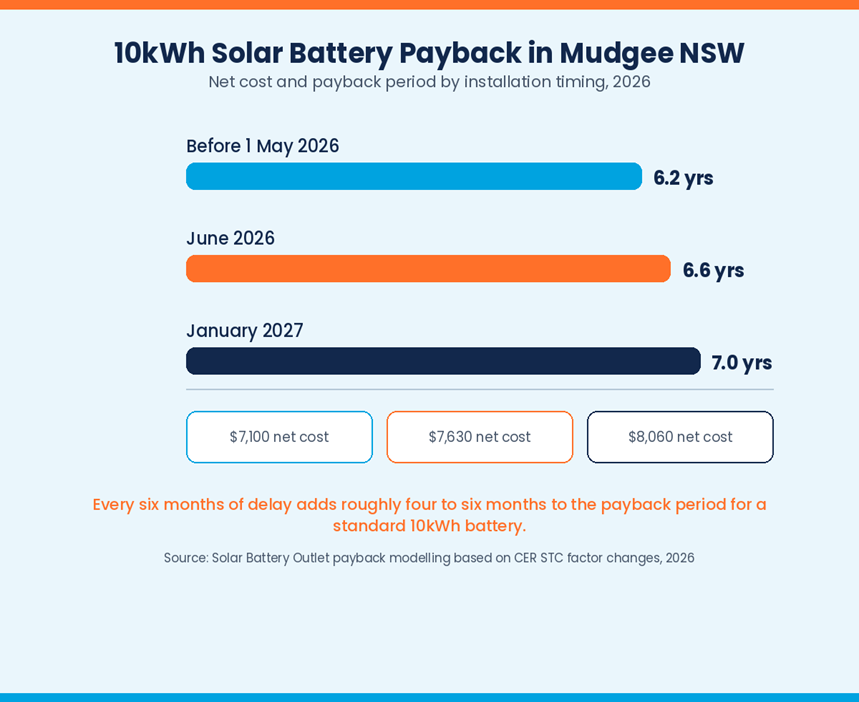
The rebate change affects your upfront cost and, therefore, your payback period. Here is how that looks for a standard 10 kWh battery in NSW:

Assumed gross install cost of $10,500 for a 10 kWh system. Annual bill saving of ~$1,150/year (based on typical 30c/kWh evening usage in NSW). Figures are indicative — get a written quote for your specific home and usage profile.

The clear takeaway: the payback period is lengthening as the rebate reduces. But it remains well within the typical 10-year battery warranty period even at 2027 rates. The battery still makes financial sense for most NSW homeowners — the urgency is relative, not absolute, unless you are planning a system above 14 kWh where the tiered cut is sharper.

Popular NSW Battery Models and Their New Rebate

Here is a quick guide to the most popular battery models installed across Liverpool, Bankstown, and Mudgee, and what the new tiered structure means for each:

Sizing tip: If you are considering a battery slightly above 14 kWh, ask your installer whether a 14 kWh system can still meet your energy needs. Once you move above the Tier 1 threshold, the cost of additional capacity rises more sharply because the rebate only covers 60% of that extra capacity. However, you should not reduce your battery size purely to qualify for the threshold — instead, use it as an opportunity to discuss the most cost-effective option with your installer.

What to Check Before Signing Any Quote

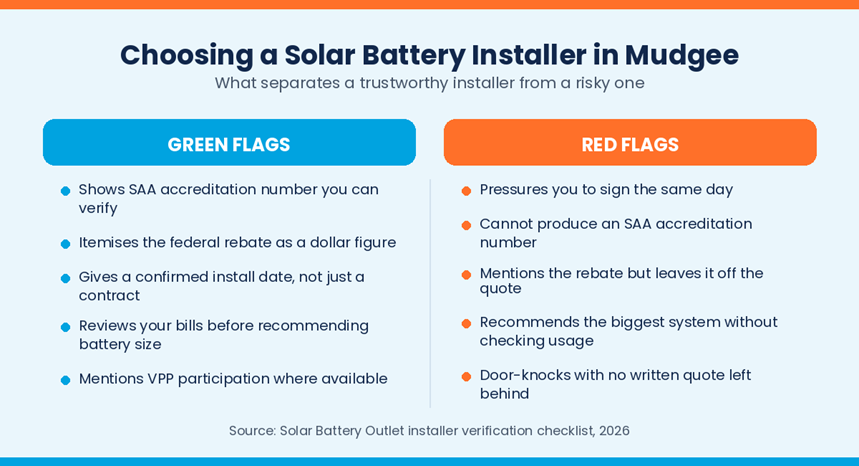
Whether you book now or wait a few more months, the requirements for a quality installation experience remain the same. Before signing any agreement, every NSW homeowner should verify the following:

  • The rebate is shown as a dollar deduction on your written quote — not mentioned verbally and absent from the paperwork.
  • Your installer is accredited with Solar Accreditation Australia (SAA). Verify their SAA number yourself at saaustralia.com.au — it takes 30 seconds.
  • Make sure your chosen battery model appears on the Clean Energy Council (CEC) approved product list. If the CEC does not list the battery, installers cannot create STCs, which means the rebate will not apply.
  • The quote should clearly specify the actual installation date, not just the contract signing date. Your installation date determines and locks in your STC factor—not the date you sign the agreement
  • The installer asked about your electricity bills and solar setup before recommending a battery size. Good installer size for your home.
  • You are not being pressured to sign on the day. Reputable installers provide a written quote to take home and compare.
Important note on the CEC-approved product list: The Clean Energy Council periodically removes older or non-compliant battery models. Always confirm the specific model and firmware version of your battery is currently listed. Some older Powerwall 2 units and certain grey-import models have been removed. Solar Battery Outlet installs only currently CEC-listed batteries.

Frequently Asked Questions

Is the battery rebate still worth claiming after May 2026?

Yes, for most homeowners. A 10 to 14 kWh system still attracts $2,500 to $3,500 in upfront savings in NSW when you combine the federal STC discount and the state VPP incentive. The financial case depends on your electricity usage pattern, not just the rebate level — a good installer will model this for your specific home.

Should I deliberately size my battery to exactly 14 kWh to maximise the rebate?

It is worth discussing with your installer. If your energy usage can genuinely be met by 14 kWh, choosing a battery system at the Tier 1 ceiling allows you to maximise the rebate for every dollar spent on battery capacity. However, do not shrink a system purely to chase the threshold — the long-term bill savings from appropriate additional storage often outweigh the marginal rebate difference depending on your tariff and usage.

Can I still claim the NSW VPP incentive after May 2026?

Yes. The NSW Peak Demand Reduction Scheme is a separate state program and is completely unaffected by the federal STC changes. You can stack both incentives on the same installation, provided your battery is VPP-capable — which most current-generation residential batteries are.

The rebate runs to 2030 — why not just wait?

Because the STC factor reduces every six months from May 2026 onwards. Every period you delay, the available upfront discount shrinks a little further. The battery’s annual bill saving does not increase to compensate. The rebate is a one-time upfront benefit — the earlier you access it, the lower your net cost and the shorter your payback period.

Does Solar Battery Outlet handle all the rebate paperwork?

Yes. Solar Battery Outlet manages the full STC creation and lodgement process on your behalf through the Clean Energy Regulator’s REC Registry. You do not apply for anything separately. The rebate appears as a line-item deduction on your invoice — the post-rebate price is simply what you pay.

The tiered structure makes accurate quoting more important than ever — the rebate you receive depends on your exact battery size, your location zone, and the current STC market price. We calculate your specific rebate upfront, show it clearly as a line item on your written quote, and size the battery for your home, not for maximum paperwork.

Solar Battery Outlet serves homeowners across Liverpool, Bankstown, Mudgee, and surrounding NSW regions. All installations are carried out by SAA-accredited electricians. We handle every step from quote to grid connection to rebate lodgement.

Or visit solarbatteryoutlet.com.au — fill in the 60-second eligibility form.
https://survey.solarbatteryoutlet.com.au/offer

Data Sources & References

As of May 2026, we verified all dollar figures, STC factors, and tier structures in this article using the following primary and secondary sources:

#SourceArticle / PageDomain
1Clean Energy Regulator (CER)Battery rebates are changing 1 May 2026cer.gov.au
2CHOICE AustraliaSolar home battery rebate: The big changes coming 1 Maychoice.com.au
3Energy MattersHow Much Will Batteries Cost When the Federal Battery Rebate Reduces From 1 May 2026?energymatters.com.au
4Battery IQ AustraliaFederal Battery Rebate 2026 — Complete Guidebatteryiq.com.au
5Solar ChoiceChanges To Cheaper Home Batteries Program | Coming 1 May 2026solarchoice.net.au
6Solar MarketFederal Solar Battery Rebate Changes — May 2026 Updatesolarmarket.com.au
7Solar Score CardBattery Rebates Australia 2026: The Complete Federal + State Stack Guidesolarscorecard.com.au
8Why SolarBattery Rebate Changes May 2026: New Tiered STC Structure Explainedwhysolar.com.au
9Solar Battery GroupTime is Ticking on Bigger Rebates for Batteries Over 14 kWhsolarbatterygroup.com.au
10Opera Solar (NSW)New Solar Battery Rebate 2026: The May 1st Drop & NSW Guideoperasolar.com.au

Note on figures: All rebate estimates use an STC price of $37 to $38 per certificate, reflecting typical market prices net of standard admin fees. The Clean Energy Regulator publishes current STC spot prices at cer.gov.au. Actual installer quotes may vary. This article does not constitute financial advice.

If you have been following Australia’s home energy space in 2026, you have probably heard two things: the federal battery rebate changed on 1 May, and installation numbers have been breaking records. Both are true — and they are connected. This article pulls together what actually happened, what the numbers mean, and what they tell NSW homeowners right now.

At the centre of it all is the Australian Government’s $1 billion Household Energy Upgrades Fund (HEUF), which crossed a major milestone in the quarter to December 2025: more than 10,000 energy upgrades financed across over 4,100 Australian homes. But that milestone, significant as it is, has now been overtaken by an even bigger story in 2026 — the Cheaper Home Batteries Program (CHBP) surge that saw daily battery installations jump from 200 to over 1,500 per day.

Here is the full picture, with verified data from the Australian Government and the Clean Energy Regulator.

HEUF Key Program Statistics — as at December 2025

HEUF Key Program Statistics — as at December 2025 (Source: energy.gov.au)

What Is the Household Energy Upgrades Fund?

The HEUF is a $1 billion federal initiative delivered through the Clean Energy Finance Corporation (CEFC). It does not hand you cash directly — instead, it works with banks and lenders to offer discounted finance products so that upgrading your home becomes more affordable upfront. Think of it as the government subsidising your interest rate, not writing you a cheque.

Running since May 2024, the HEUF targets existing homes — many built before modern energy efficiency standards. The aim is to bring down the practical barrier of upfront cost so more households can access solar, batteries, insulation, and other upgrades that lower bills and reduce emissions.

The 10,000 Milestone — What the December 2025 Numbers Say

The HEUF reached 10,000 financed upgrades across more than 4,100 homes in the quarter to December 2025. Here is what the data behind that number reveals:

Loans Nearly Doubled in One Quarter

In the last quarter of 2025 alone, HEUF loan volumes almost doubled. This was not a gradual climb — it was a sharp acceleration driven directly by the July 2025 launch of the CHBP. When the battery rebate arrived, homeowners started bundling finance and rebate together, and uptake tripled across batteries, inverters and solar PV under the HEUF in the six months that followed.

Queensland and NSW Are Leading

Around 2,600 households in Queensland and NSW combined have accessed HEUF discounted finance — making these two states the most active in the country. If you are an NSW homeowner, you are in the heart of where this is happening.

$800 Million in Total Investment Committed

The CEFC has committed over $400 million through seven participating lenders. Those lenders have matched it with a further $400 million in private capital, bringing total committed investment to over $800 million. With more lender deals expected in 2026 and beyond, competition for your finance business is likely to increase — which is good for borrowers.

Batteries, Inverters and Solar Are the Top Choices

The most popular HEUF upgrades by a clear margin have been batteries, inverters and solar PV systems. This is consistent with broader market trends — solar and storage offer the most direct, measurable reduction in electricity bills, and they pair naturally with the CHBP rebate.

Eligible Upgrade Categories Under the HEUF

The 2026 Story: Australia’s Battery Boom in Numbers

The HEUF milestone is impressive. But to understand where Australia’s home energy market stands in May 2026, you need the full CHBP picture alongside it. The numbers are genuinely remarkable.

CHBP 2026 Installation Surge

350,000+ Batteries Installed in 10 Months

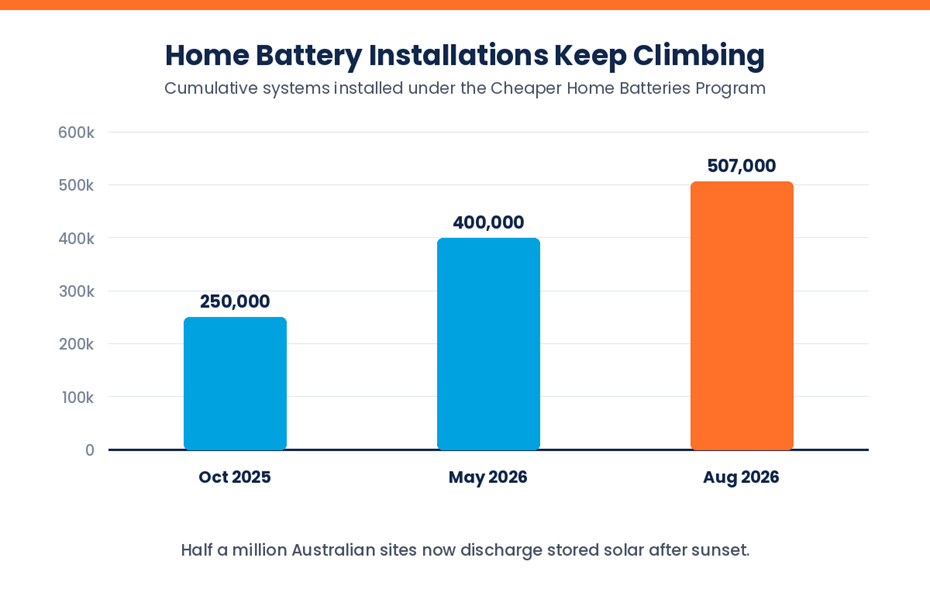
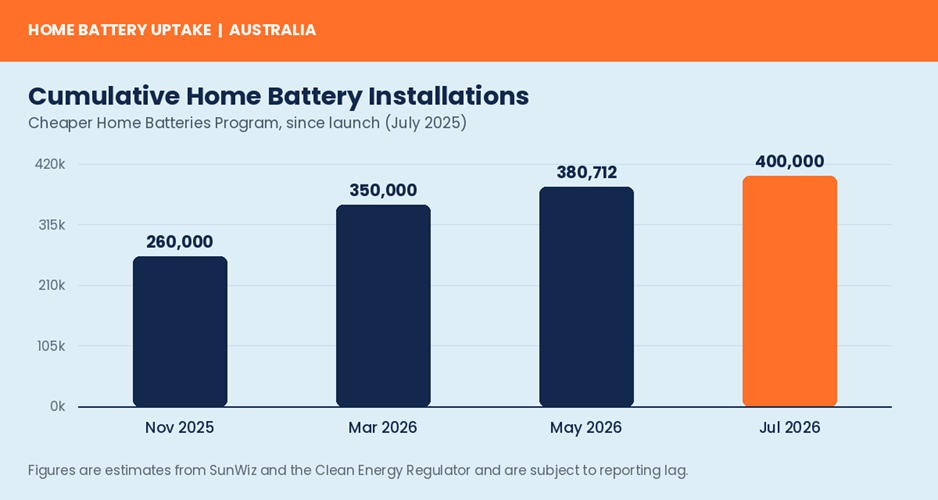
From July 2025 to May 2026, more than 350,000 home battery installations were completed under the CHBP. That is not a typo. To put it in context: in the entire year before the CHBP launched, Australia averaged around 200 battery installations per day. After the program started, that figure jumped to over 1,500 per day — a 7.5x increase.

184,672 Batteries in Just the Second Half of 2025

Federal Minister for Climate Change and Energy Chris Bowen confirmed that from 1 July to 31 December 2025, Australians installed 184,672 home batteries, adding 4.27 gigawatt-hours of storage capacity. The average battery size also doubled compared to 2024 — from 10–12 kWh to around 23 kWh — as households took advantage of the rebate structure to install larger systems.

From 1 in 40 to 1 in 24 Households

Before the CHBP launched, only 1 in 40 Australian households had a home battery. By May 2026, that figure had shifted to 1 in 24 — a 67% increase in household adoption in under a year. This is the fastest shift in home battery penetration Australia has ever recorded.

Record Solar Month: 341 MW in March 2026

Australia’s rooftop solar market hit an all-time record in March 2026, with 341 MW of small-scale solar capacity installed in a single month — a 19% jump from February. Industry analyst firm SunWiz noted the market was already 16% ahead of the same point in 2025, with battery demand pulling larger solar systems along with it. As of early 2026, Australia’s total rooftop solar capacity stands at 28.3 GW across approximately 4.3 million installations — making Australia the world leader in per capita rooftop solar.

★  2026 Data Snapshot — Verified Sources

How HEUF and CHBP Work Together

With both programs now running at scale, the most financially savvy move for an NSW homeowner is to use them in combination. Here is how they fit together:

HEUF vs. CHBP- Comparison

The HEUF provides the discounted loan to spread the cost over time. The CHBP reduces the purchase price of the battery upfront — around 30% off, delivered through your installer. On top of both, the NSW Peak Demand Reduction Scheme (PDRS) VPP incentive adds up to $1,500 for battery owners who connect to a Virtual Power Plant.

The three stacked together — HEUF finance + CHBP rebate + NSW VPP — represent the most comprehensive government support package for home batteries that has ever existed in NSW. The fact that CHBP uptake through HEUF tripled in the six months after July 2025 shows that homeowners have already figured this out.

What the Budget Expansion Means for You

On 13 December 2025, the Australian Government announced the CHBP budget would be expanded from the original estimate of $2.3 billion to $7.2 billion over four years. This is important for a few reasons:

  • The program is not going anywhere. It runs through to 2030 with massively increased funding.
  • More than 2 million Australians are expected to install a battery by 2030 — adding around 40 GWh of grid storage.
  • The expansion was triggered by uptake far exceeding forecasts, confirming the market is real and the demand is genuine.
  • New requirements from May 2026 mean all new CHBP battery installations must be VPP-capable — meaning the hardware is already set up to participate in grid programs like the NSW PDRS.

The Australian Energy Market Commission analysis found that increased home battery uptake could deliver a 3% reduction in energy bills annually across the entire energy system by smoothing out peak demand. In other words, your battery does not just save you money — it helps reduce costs for everyone connected to the grid.

HEUF Investment & Uptake Growth Timeline (May 2024 – December 2025)

What This Means for NSW Homeowners Right Now

Pulling the HEUF milestone and the 2026 CHBP data together, here is the practical picture for an NSW homeowner considering solar or batteries today:

The market has validated the technology

350,000+ installations in 10 months is not a niche movement. Batteries are now mainstream in Australian homes — 1 in 24 households have one. The installers, the products, and the programs are all mature. The early-adopter risk is gone.

Government support is substantial and funded to 2030

The CHBP has $7.2 billion behind it. The HEUF has $800 million in committed capital from seven lenders. The NSW VPP incentive is active. This is not a rebate program that might disappear — it is a funded, multi-year policy commitment with an accelerating trajectory.

The rebate declines over time — but not off a cliff

The most common misconception right now is that the rebate ‘ended’ on 1 May 2026. It did not. What changed is that the STC factor now steps down every six months rather than annually, and larger batteries above 14 kWh attract a tapered rate. The program continues to deliver around 30% off battery costs across a range of sizes. Every six months you delay, the rebate is slightly smaller — but it does not disappear overnight.

The combination of programs is where the real value lies

Treasury analysis found that full electrification — solar PV, battery, and EV — can save a typical Australian household around $4,300 per year. Even just adding a battery to an existing solar system can deliver meaningful bill reductions, particularly for households with high evening electricity usage. The HEUF + CHBP + NSW VPP combination makes this more accessible than it has ever been.

How to Access These Programs — Step by Step

  • Decide on your upgrade: for most NSW homeowners, this is solar + battery, or battery-only if you already have solar panels.
  • Get written quotes from at least three SAA-accredited installers — compare size, brand, installation date, and what rebates are shown on the quote.
  • Speak to a participating HEUF lender about discounted finance options: Brighte, Plenti, Plico, Commonwealth Bank, Westpac, ING, or Bank Australia.
  • Confirm the CHBP rebate appears as a dollar deduction on your written quote — not just mentioned verbally.
  • Ask your installer about the NSW VPP incentive and whether your battery will be enrolled in a Virtual Power Plant.
  • Confirm an actual installation date in writing — your rebate is determined by installation date, not contract signing date.

Frequently Asked Questions

Is the HEUF still open in 2026?

Yes. The HEUF is active with seven participating lenders and more expected to be announced in 2026. It is open to homeowners with or without a mortgage, rental property owners, and strata properties. High-value properties are excluded — speak to your lender for eligibility details.

Did the battery rebate end on 1 May 2026?

No. The CHBP continues until 2030 with a significantly expanded $7.2 billion budget. What changed on 1 May 2026 is the calculation method: the STC factor now steps down every six months instead of annually, and batteries above 14 kWh attract a tiered rate. The government states the around 30% discount is maintained across a range of battery sizes under the new structure.

How many batteries have been installed under the CHBP so far?

More than 350,000 installations were completed in the ten months from July 2025 to May 2026, according to PV Magazine Australia and CER public data. In the second half of 2025 alone, 184,672 batteries were installed, adding 4.27 GWh of storage capacity to the grid.

Can I still use HEUF finance and the CHBP rebate together?

Yes — and it is the recommended approach. The HEUF reduces your interest rate on the finance. The CHBP reduces the upfront purchase price. They are complementary programs. On top of both, the NSW PDRS VPP incentive adds up to $1,500. Your installer and lender can help you access all three.

What is the average battery size being installed in 2026?

The average has grown significantly. Before the CHBP launched, the average battery usable capacity was 10–12 kWh. In the second half of 2025, it jumped to around 23 kWh as households took advantage of the rebate structure to install larger systems. From May 2026, the tiered structure is designed to encourage right-sizing rather than over-sizing.

Data Sources

All data in this article is sourced from official Australian Government publications and verified industry sources:

1. energy.gov.au/news/household-energy-upgrades-fund-reaches-10000-installations

2. dcceew.gov.au/energy/programs/cheaper-home-batteries

3. pv-magazine-australia.com — 350,000 installations in 10 months under CHBP (May 2026)

4. minister.dcceew.gov.au — Joint media release: 10,000 home energy upgrades (April 2026)

5. cer.gov.au/batteries — Clean Energy Regulator CHBP postcode data to 31 March 2026

6. dailyenergynews.com.au — Record 341 MW solar month, March 2026

7. solarchoice.net.au — CHBP 1 May 2026 changes explained

8. solarquotes.com.au — Battery installation data H2 2025

About Solar Battery Outlet

A VPP-ready battery installation — now the non-negotiable baseline for 2026 federal rebate eligibility across Australia.

⚠  IMPORTANT POLICY CHANGE — 2026As of 2026, the federal Cheaper Home Batteries Program requires all eligible battery systems to be VPP-capable at the time of installation. Systems that cannot connect to a Virtual Power Plant are now excluded from rebates entirely — regardless of brand, capacity, or installer.

Here’s a question most installers aren’t asking before they hand you a quote: Is the battery they’re recommending actually eligible for the rebate?

Not every battery on the Australian market qualifies for the 2026 federal incentives. The reason isn’t price, brand reputation, or storage capacity. It comes down to one increasingly important technical requirement: VPP readiness.

If you’ve been researching the best solar batteries in Australia for your home, understanding this requirement could save you thousands — or spare you the costly shock of installing a system that doesn’t qualify for any government support at all.

What Is a VPP — and Why Does It Suddenly Matter?

VPP stands for Virtual Power Plant. It’s not a building or a physical location. It’s a network — your home battery, along with hundreds or thousands of other batteries across the grid, connected and coordinated by software.

When the electricity grid comes under pressure — say, on a hot summer evening in NSW when everyone cranks the air conditioning at once — the network operator draws on all those connected batteries simultaneously. Your battery exports a small amount of stored energy to help stabilise the grid. You get paid for it.

From the government’s perspective, this is exactly the outcome they want. Instead of building expensive new gas peaker plants to handle demand spikes, they’d rather pay homeowners to use their existing batteries as a distributed grid resource. It costs less, it’s cleaner, and it makes the grid more resilient during extreme weather.

So when the federal rebate program was restructured for 2026, VPP capability became a hard requirement — not a bonus feature. The policy logic is simple: if you want public money to help fund your battery, your battery needs to be able to give something back to the public grid.

“The cheapest battery isn’t the cheapest battery once you factor in the rebates you lose by buying it.”

What “VPP-Ready” Actually Means in Practice

VPP readiness isn’t a sticker a manufacturer slaps on a box. It’s a set of technical and software requirements that determine whether a battery can safely communicate with — and be remotely dispatched by — a certified VPP operator. For a battery to qualify under the 2026 federal guidelines, it needs to meet all of the following:

OCPP or AS4755 compliance — the inverter or battery management system must support the communication protocols used by Australian VPP operators.

Remote dispatch capability — must receive and act on charge/discharge instructions from a certified aggregator automatically, without manual homeowner input.

Smart meter compatibility — real-time two-way data exchange is required so the aggregator can see your battery’s state of charge at all times.

✓Listed on the CEC-approved product register — the Clean Energy Council list is the authoritative reference. Only listed products qualify for federal incentives.

Not an off-grid only system — batteries designed purely for off-grid use without grid-export capability do not qualify (except systems more than 1km from the grid).

The practical implication is significant. Many cheaper imported batteries — sold through generic online retailers or unaccredited installers — simply don’t meet these standards. They may store energy perfectly well, but they cannot participate in a VPP, and that now disqualifies them from rebate eligibility entirely.

The Financial Stakes: What You Lose Without VPP Eligibility

If you install a non-VPP-capable battery in 2026, here’s what you forfeit:

For a typical 10 kWh system, that’s over $4,600 in combined upfront incentives you simply don’t receive. On top of that, you miss out on annual VPP participation payments compounding over the battery’s life. When comparing two quotes side by side, this gap can easily make the “cheaper” non-VPP battery significantly more expensive over a 10-year horizon.

$4,600+That’s the combined value of federal rebates and the NSW VPP incentive available to eligible homeowners right now.Non-VPP batteries receive none of this. For anyone comparing the best solar battery options in NSW and across Australia, VPP eligibility isn’t a bonus — it’s the baseline requirement.

Which Batteries Are VPP-Ready in 2026?

The good news: all major reputable brands sold through accredited Australian installers meet the VPP-ready standard. The problem is grey-market imports and off-brand systems that occasionally get quoted as “budget alternatives.” Here’s how the leading options compare:

Battery SystemVPP-ReadyRebate EligibleNSW VPP IncentiveCapacity
BYD Battery-Box HVM Yes Yes Yes8.3–22.1 kWh
Tesla Powerwall 3 Yes Yes Yes13.5 kWh
Sungrow SBR / SBH Yes Yes Yes9.6–25.6 kWh
Enphase IQ Battery 5P Yes Yes Yes5–15 kWh
Generic imported batteries No No NoVaries
Off-grid only systems No No NoVaries

For anyone looking at solar battery in NSW specifically, all four mainstream systems also qualify for the NSW Peak Demand Reduction Scheme — the state-level incentive that stacks directly on top of the federal rebate.

How to Verify VPP Status Before You Sign

Don’t take a salesperson’s word for it. Here is the exact process to confirm a battery is VPP-eligible before committing:

Step 1:  Check the Clean Energy Council-approved product list

The CEC register at cleanenergycouncil.org.au is the authoritative source. If your quoted battery isn’t on it, the federal rebate cannot be claimed — full stop.

Step 2:  Ask directly: “Does this battery support VPP dispatch protocols?”

A confident, experienced installer answers without hesitation. Hedging or vague reassurances are a red flag — get written confirmation.

Step 3:  Verify your installer is SAA-accredited

Only SAA-accredited installers can legally process the federal rebate on your behalf. Check at saaustralia.com.au before signing anything.

Step 4:  Confirm the rebate appears as a line item on your quote

The federal rebate must appear as a specific dollar reduction on your invoice — not a verbal promise or small-print footnote.

Step 5:  Ask who handles the NSW VPP enrolment paperwork

Some installers skip VPP enrolment to reduce their compliance workload. A thorough installer includes it as standard — not as an optional add-on.

NSW homeowners currently have access to the most generous combined battery incentive stack in the state’s history — but only for VPP-capable systems.

Why VPP Requirements Are Only Getting Stricter

The 2026 VPP mandate didn’t arrive suddenly. It’s part of a sustained policy direction that started with the original Home Battery Scheme and has been progressively tightened each year. Australia’s grid managers — AEMO in particular — have identified distributed battery storage as a critical tool for grid stability as coal plants retire and renewable penetration increases.

For homeowners, the implication is clear: this requirement isn’t going away. Future iterations of the federal incentive program are likely to add further requirements around grid responsiveness, cycle ratings, and communication protocols. Batteries meeting the 2026 standard are well-positioned for whatever comes next. Systems that don’t meet it today are likely to become increasingly marginalised in terms of both incentive eligibility and resale value.

For homeowners in NSW: the combination of federal rebates and the NSW VPP incentive represents the most generous stack of battery support the state has ever seen. The window is narrowing — the federal rebate rate already dropped in May 2026 — but the incentive structure for VPP-ready systems remains strong through the rest of the year. Acting now with the right battery is still significantly better financially than waiting.

Frequently Asked Questions

Q: Does joining a VPP mean the operator controls my battery completely?

Partially — and only within agreed limits. VPP operators can dispatch your battery during grid stress events, but reputable agreements always include protections. Your battery won’t be drained below a minimum threshold (typically 20%), preserving backup capacity for outages. Most operators also let you set exclusion windows during your personal peak evening hours.

Q: Can I get the federal rebate if I choose not to actively join a VPP?

Yes — with an important distinction. The requirement is that the battery is capable of VPP connection, not that you must enrol. You can install a VPP-ready battery and claim the federal rebate without joining a VPP program. However, you’ll miss the separate NSW VPP incentive payment of up to $1,500, which does require actual enrolment.

Q: What if I already have an older battery that isn’t VPP-capable?

Existing systems installed under earlier rebate programs are not retroactively affected. The 2026 VPP requirement applies to new installations. If you’re upgrading or replacing an older system, the new battery must meet the current standard to qualify for rebates.

Q: How much can I realistically earn from VPP participation each year?

This varies by operator, grid event frequency in your area, and battery capacity. For a typical 10 kWh system enrolled in a NSW VPP, annual earnings of $200–$600 are a reasonable estimate. Some operators offer fixed quarterly credits; others pay per dispatch event based on energy exported.

Q: Does a solar battery NSW installation always include VPP enrolment automatically?

Not automatically. A thorough installer handles both the federal rebate processing and VPP enrolment as part of the standard package. Some skip enrolment to reduce compliance workload — always confirm explicitly that it’s included before signing your contract.

Bottom Line

If you’re comparing quotes and one comes in noticeably cheaper, the first question to ask is whether the battery is VPP-capable and listed on the CEC approved product register. A battery that saves $800 upfront but costs $4,600 in lost incentives isn’t a saving — it’s an expensive mistake that takes years to recover from.

For homeowners in NSW who want a solar battery that captures everything available in 2026 — federal rebate, NSW VPP incentive, and long-term participation payments — the path is clear: choose one of the four mainstream VPP-ready systems, use an SAA-accredited installer, and confirm both the rebate and VPP enrolment are included in the package before you sign.

As solar batteries grow in number across Australia, the grid value of interconnected VPP networks grows with them. The requirement isn’t a bureaucratic hurdle — it’s a genuine two-way exchange. You receive meaningful financial support. The grid gains resilience. That’s why this requirement is here to stay, and why the best solar batteries in Australia in 2026 are defined as much by grid compatibility as by storage capacity.

✅  Quick Summary for NSW Homeowners All four mainstream batteries — BYD Battery-Box HVM, Tesla Powerwall 3, Sungrow SBR/SBH, and Enphase IQ Battery 5P — are fully VPP-ready and eligible for both the federal rebate (~$3,100) and the NSW VPP incentive (up to $1,500). Combined upfront savings reach $4,600+ before ongoing annual VPP earnings. Non-VPP batteries qualify for neither.
Not Sure If You Are Ready? Talk to Us First. At Solar Battery Outlet, we handle the full process — federal rebate, NSW VPP incentive, SAA-accredited installation, and VPP enrolment — so you never leave money on the table.
Call us: 1800 000 777
About Solar Battery Outlet: We are a Liverpool-based solar battery installer, part of GWM Group Pty Ltd, servicing homes across South West Sydney, Bankstown, Campbelltown, and the greater NSW region. All installations are done by SAA-accredited electricians. We handle all rebate paperwork, so you do not have to.
php