Type “solar battery rebate NSW” into Google and you get the same explainer a hundred times over: what the Cheaper Home Batteries Program is, what STCs are, and a vague “up to 30% off” headline. None of that tells you what you will actually pay in Liverpool, Bankstown, or Mudgee.
Your rebate is not one number that applies Australia-wide. It is a stack—a federal certificate value, a state VPP incentive, and, in theory, a local council contribution—and each layer depends on where your meter sits, not only which battery you buy. This guide walks through that stack for each of our three service areas and lands you on a real dollar range for your suburb, instead of another generic scheme summary.
What Actually Determines Your Rebate Amount
Three factors determine your rebate: your solar zone rating, your battery’s usable capacity, and the STC price on your installation date.
Under the Clean Energy Regulator’s postcode zone map, Liverpool, Bankstown, and Mudgee are all in Zone 3. This is the same rating used for much of Sydney, Adelaide, and Perth. That matters because some installers suggest regional customers receive a “country loading.” For batteries, however, postcode does not change the federal rebate. The calculation is based on usable battery capacity.
Since 1 May 2026, battery size has become more important. The scheme provides the full STC factor of 6.8 STCs per usable kWh for the first 14 kWh. A reduced rate applies to the next 14 kWh. Capacity above that receives much less support. A typical 10–13.5 kWh battery falls entirely within the highest tier. Larger 20 kWh systems may receive less value for capacity above 14 kWh.
The STC price also changes daily on the open market. Installers commonly use approximately $37 per certificate, while the Clean Energy Regulator’s Clearing House benchmark may be slightly higher.
Local councils do not currently offer direct cash rebates for home batteries in Liverpool, Canterbury-Bankstown or Mudgee. Council support usually involves development guidance or general sustainability advice. If your quote includes a “council rebate”, ask the installer to identify the exact program.
| Straight from the regulator and the minister Federal Energy Minister Chris Bowen has described uptake of the battery scheme as “a program of success and strength”, pointing to enthusiasm for the rebate as the reason for the May 2026 changes. |
Liverpool — Your 2026 Rebate Number
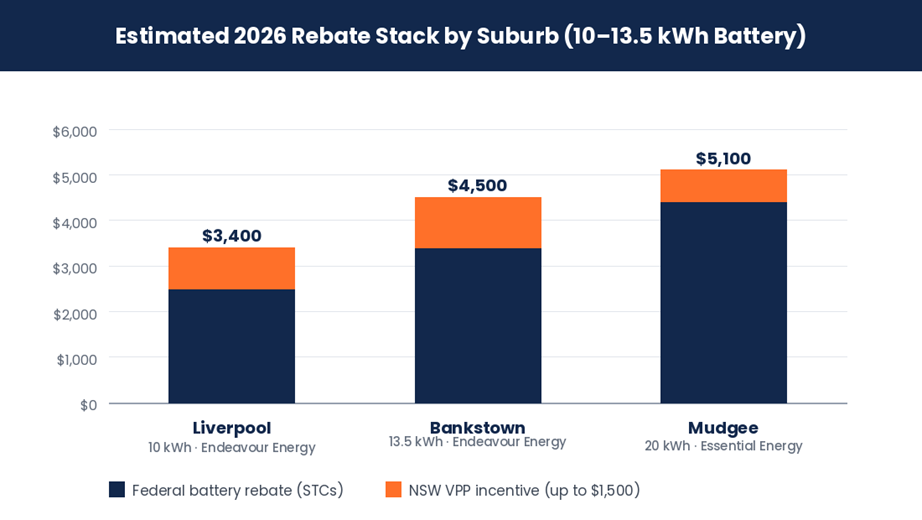
Liverpool sits in the Endeavour Energy network area, and most homes here run a 6.6–10 kW solar system paired with a mid-sized battery. For a typical 10 kWh battery installed in the second half of 2026:
- Federal battery discount only: around $2,500 (10 kWh × 6.8 STCs × approximately $37 per STC)
- NSW Peak Demand Reduction Scheme incentive: Eligible households who connect an approved battery to an approved Virtual Power Plant (VPP) may receive an additional incentive, subject to current scheme rules and eligibility requirements.
- Total available incentives will depend on battery size, STC values, VPP eligibility and current program settings.
Based on an assumed STC value of approximately $37. STC values can change over time and your quote will show the actual discount available to your installation.
That figure assumes solar is already installed and a standard-sized battery is being added. If solar and battery are going in together, the panel component is calculated separately using the Zone 3 rating and adds its own STC value on top. Liverpool households with evening-heavy usage — working families out during the day, home from around 5pm—tend to see the strongest return from this stack, since the battery discharges stored solar exactly when grid electricity is most expensive.
Bankstown — Your 2026 Rebate Number
Also within Endeavour Energy territory, Bankstown mirrors Liverpool’s zone rating and network loss factor, but homes here more often step up to a 13.5 kWh battery — the size of a Tesla Powerwall 3 — to cover larger households or dual-occupancy properties. Running the same method on a 13.5 kWh system:
- Federal battery discount only: around $3,400 (13.5 kWh × 6.8 STCs × approximately $37 per STC)
- With the NSW Peak Demand Reduction Scheme incentive (if you connect an eligible battery to an approved Virtual Power Plant): additional incentives may be available, subject to current scheme rules and eligibility requirements.
- Total available incentives will depend on battery size, STC values, VPP eligibility and current program settings.
Based on an assumed STC value of approximately $37. STC values can change over time and your quote will show the actual discount available to your installation.
If a solar battery Bankstown installation is what you’re comparing quotes for, this is the number to hold your installer to. A good Bankstown quote shows the STC deduction as a line item on the invoice, not a verbal estimate, and it names which VPP provider the state incentive is coming through, since not every retailer offers the same terms.
Mudgee — Your 2026 Rebate Number
Mudgee sits on the Essential Energy network—regional NSW’s distributor—rather than Endeavour Energy, but the network loss factor used in the incentive calculation is identical to Bankstown’s and Liverpool’s. Where Mudgee genuinely differs is system size and VPP access. Larger rural blocks and bigger roofs mean 20 kWh batteries are common, and fewer retailers currently run VPP plans on the Essential Energy network, so the state incentive can be smaller, or occasionally unavailable.
- Federal battery discount only: around $4,400 (20 kWh battery using the applicable tiered rebate calculation and assumed STC value).
- NSW Peak Demand Reduction Scheme incentive: Eligible households who connect an approved battery to an approved Virtual Power Plant (VPP) may be able to receive an additional incentive, subject to current scheme rules and eligibility requirements.
- Total available incentives will depend on battery size, STC values, VPP eligibility and current program settings.
Based on an assumed STC value of approximately $37. STC values can change over time, and your quote will show the actual discount available to your installation.
Before budgeting on the VPP figure, ask the installer to confirm — by name — which retailer will run the VPP contract in Mudgee. “Should be available” is not the same as confirmed.
Common Reasons People Get Quoted the Wrong Number
Four mistakes account for almost every inflated or understated rebate quote we see:
1. Contract date versus installation date. The rebate locks in on the day the battery is commissioned, not the day the contract is signed. A quote based on the STC factor in the contract month is only accurate if installation happens in that same window.
2. Nameplate capacity instead of usable capacity. STCs are calculated on usable kWh, typically 90–95% of the battery’s nameplate size. A 13.5 kWh nameplate battery might carry a rebate calculated on closer to 12.8 kWh.
3. Ignoring the tiered structure. Anyone quoting a flat per-kWh rate on a battery over 14 kWh is either rounding generously or working from a spreadsheet that has not been updated since April 2026.
4. Assuming VPP participation is automatic. The NSW incentive only applies once a VPP retailer contract is actually signed — it is not bundled into every battery purchase by default.
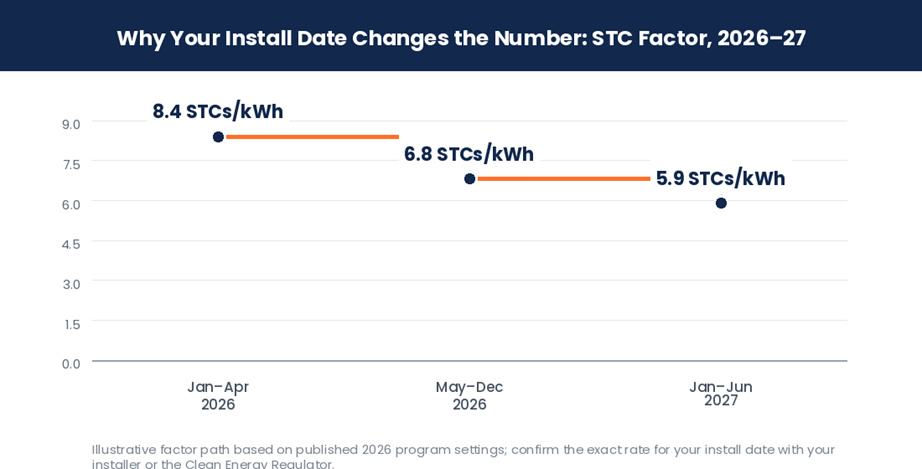
Because the STC factor changes twice a year now, instead of once, a quote that felt accurate in March can already be stale by August. This is one reason the Clean Energy Regulator has started pushing back publicly on overly optimistic installation timelines. The regulator’s executive general manager, Carl Binning, warned that “deceptive or misleading behaviour will not be tolerated”, and urged installers to keep quotes tied to realistic scheduling.
How to Verify Your Quote Already Has the Rebate Applied
Before signing anything, run the written quote through this five-point check:
1. Is the STC discount shown as a dollar figure on the invoice? It should reduce the total price directly, not appear as a separate rebate to be claimed later.
2. Does the quote state the battery’s usable capacity, not just its nameplate size? The rebate is calculated on usable kWh.
3. Is the installer SAA-accredited, and can they show the number? Only accredited installs are eligible for the federal rebate.
4. Is the VPP incentive named to a specific retailer, with an approximate payment window? “Up to $1,500” with no provider attached is a placeholder, not a quote.
5. Does the quote reference an installation date, not just a contract date? If installation slips into the next STC period, the rebate amount changes — and that should be flagged before signing, not after.
Any reputable solar battery installation company will walk a customer through these five points without being asked. If an installer will not put the numbers in writing, treat that as a warning sign.
Frequently Asked Questions
No, this is not the case for most installations. The installer or retailer usually handles both incentives. This includes the federal STC discount and the NSW VPP incentive. They create the certificates and pass the value on as a point-of-sale discount. Homeowners can technically create and trade STCs directly through the REC Registry. However, very few choose this option. It is mainly suitable for homeowners who are comfortable navigating the registry themselves.
Generally, no. The rebate follows the STC factor and scheme rules in effect when the system was installed and commissioned. Systems installed before the scheme existed cannot claim the rebate retroactively. Eligibility also requires an approved product and an accredited installer. One exception is adding new battery capacity. The added capacity can generate STCs if it is at least 5 kWh and stays within the scheme’s cap.
The rebate is tied to the equipment and property connection, not home ownership. A landlord can install a battery at a rental property and claim it. Tenants generally cannot claim the rebate directly. Renters interested in a battery should discuss the option with their landlord.
A Note on Accuracy
This article is general information only and does not take into account personal circumstances, electricity usage, or property details. Rebate values, STC prices, and NSW incentive amounts are estimates based on publicly available program settings as of July 2026, and can change without notice, including reductions to the STC factor every six months. Nothing here constitutes financial, legal or tax advice.
Always seek personalised advice before making a purchasing decision. For the confirmed rebate value on a specific installation, request a written, itemised quote from an SAA-accredited installer.
| Want Your Exact Number, Not an Estimate? We put together the real, written-down rebate stack for every home we assess across Liverpool, Bankstown and Mudgee — federal STCs, NSW VPP incentive and usable capacity, itemised before anyone signs anything. Call us: 1800 000 777 Or visit solarbatteryoutlet.com.au and fill in the 60-second eligibility form. |
