
Selling your home doesn’t mean losing the value of your solar investment. Understanding what happens to your solar battery when you sell your house can protect real value. It can also prevent last-minute contract disputes.
A battery raises questions a standard property sale doesn’t. Is it a fixture, or can you remove it? What happens to your VPP contract? Does the warranty transfer to the new owner? This guide answers each question for NSW homeowners in 2026, from contract wording through to buyer due diligence.
Is Your Solar Battery a Fixture or Something You Can Take?
Under NSW property law, anything permanently attached to a house usually becomes part of the land. Conveyancers call this a fixture. Solar panels are treated this way, and a wall-mounted or garage-fixed battery generally follows the same principle.
That means your battery normally passes to the buyer automatically, unless the contract says otherwise. According to Bartier Perry’s guidance on solar panels in a contract of sale, vendors should list every doubtful item clearly. Each item should be listed either as an inclusion or an exclusion to avoid disputes after settlement.
If you plan to take the battery with you, list it as an exclusion before you exchange contracts. If you’re leaving it behind, list it as an inclusion for clarity. Ambiguity causes disputes, not the battery itself. Talk to your conveyancer early, since a battery is a far more expensive asset than panels alone.
How Much Value Does a Solar Battery Add at Sale?
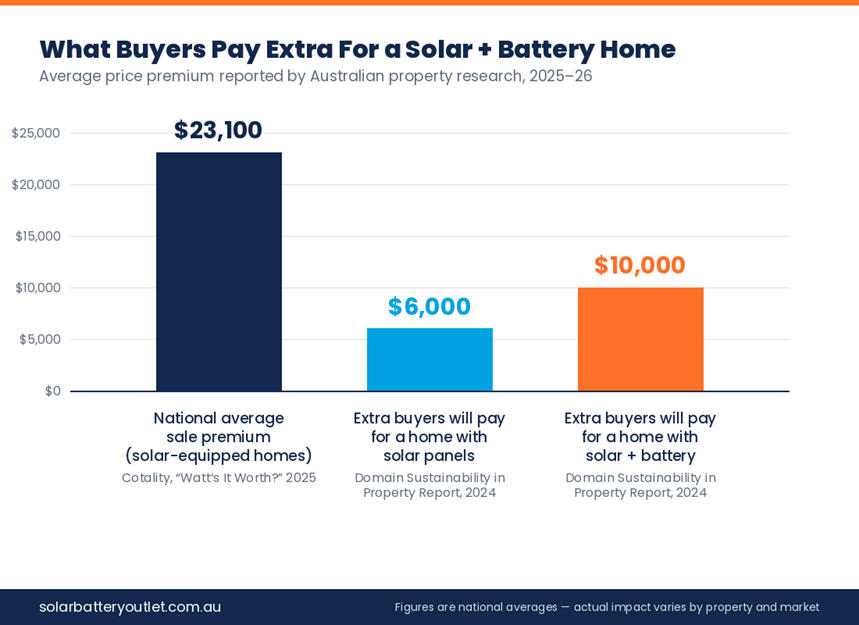
A solar battery isn’t just a fixture question. It’s also a value question. National data shows solar-equipped homes sell for an average 2.7% premium, worth around $23,100, according to Cotality’s 2025 property research.
Battery storage appears to lift this further. Domain’s Sustainability in Property Report found many buyers will pay $6,000 more for solar alone. Close to 60% said they’d pay at least $10,000 more for a home with both solar and a battery.
This buyer appetite reflects a bigger shift. Australia is moving through what many call a turning point for solar adoption. Buyers increasingly expect energy resilience as standard, not as a bonus. Presenting your battery’s specifications and savings history can help justify a stronger asking price.
Sort Out Your VPP Contract Before You List
Many NSW batteries are enrolled in a Virtual Power Plant (VPP), earning bill credits for exported power. This contract sits with you, the account holder, not automatically with the property.
Before listing your home, check three things. Does your VPP contract end automatically when you move? Can it transfer to the new owner? Are there exit fees for leaving early?
Some providers allow a straightforward transfer. Others require the buyer to sign a fresh agreement. Either way, tell your real estate agent about the VPP arrangement early. It should be disclosed during the sale, not discovered afterward.
Transferring Warranties and Handing Over Documentation
A well-documented battery reassures buyers and protects your sale price. Before settlement, gather your compliance certificate, product warranty, and your SAA-accredited installer’s details.
Most battery manufacturers offer warranties of 10 years or longer. Many are transferable to a new owner, but some require formal notification within a set period after the sale. Check your warranty terms, and notify the manufacturer if needed.
Handing over your monitoring app login, or transferring the account, also matters. It lets new owners track performance from day one. A simple folder of documents costs nothing and can make your listing far more attractive to informed buyers.
Selling a House With a Financed or Leased Battery
Some batteries are financed or leased rather than owned outright. If you still owe money on the system, settlement usually requires paying out the remaining balance. This works much like clearing a car loan before a sale.
Leased batteries are more complex. The finance company, not you, may own the equipment. Selling the house doesn’t automatically transfer a lease. Buyers may need to take over repayments, or you may need to pay out the lease before settlement.
Speak to your financier or a solar battery company early if this applies to you. Sorting the paperwork before you list avoids delays at exchange or settlement.
Do You Need to Disclose Rebates and Incentives?
If your battery was installed under a government incentive, honesty matters. Under the Cheaper Home Batteries Program, retailers must confirm the system is for permanent, ongoing use.
Selling your house with the battery still installed generally doesn’t breach this condition. The equipment stays in permanent use; only the owner changes. Problems can arise if you remove the battery to take it with you, since this may affect the rebate’s standing.
Under Australian Consumer Law, you must not mislead a buyer about rebates, warranties, or system condition. If unsure how a rebate interacts with your sale, check with the Clean Energy Regulator or your conveyancer.
A Quick Checklist for Sellers
- Confirm whether the battery is included or excluded in the contract of sale
- Review your VPP contract for transfer or exit conditions
- Gather compliance certificates, warranties, and installer details
- Pay out or transfer any battery finance or lease
- Brief your real estate agent on the system’s specifications and savings
- Notify your battery’s manufacturer or retailer of the change of ownership
What Buyers Should Check Before Making an Offer
Buyers benefit from due diligence too. Before making an offer, ask whether the battery is included in the sale price. Request the compliance certificate and the remaining warranty period.
Check whether a VPP contract is attached, and read its terms rather than assuming it transfers automatically. Ask for recent performance or savings data if the seller has it available.
A well-documented, SAA-approved battery is a genuine asset. An undocumented one is a question mark. A few questions before exchange can save confusion after settlement.
Frequently Asked Questions
Generally, yes. A battery fixed to the property is treated as a fixture under NSW law. It passes to the buyer unless the contract of sale excludes it.
Yes, but you must list it as an exclusion in the contract of sale before exchange. Removal must be done by a licensed electrician, and taking the battery may affect the rebate you received — check with the Clean Energy Regulator first. Removing it without disclosure can lead to a dispute or a compensation claim.
Selling a house with the battery still installed generally doesn’t affect a rebate like the Cheaper Home Batteries Program. The system stays in permanent use, and removing the battery may be treated differently.
It depends on the provider. Some VPP contracts transfer to the new owner, while others end automatically or require a new agreement. Always check the contract terms before listing.
It can. National research shows solar-equipped homes sell for a measurable premium. Many buyers also report they would pay more for a home with both solar and a battery.
A solar battery can be one of the most attractive features on your listing, if it’s handled correctly. Sort your VPP contract, gather your documentation, and disclose your rebate history before you list. Buyers respond well to transparency, and it protects you from disputes after settlement.
If you’re planning a sale in Liverpool, Bankstown, or Mudgee, our team can help. We can walk you through your battery’s transferability and next steps. Contact Solar Battery Outlet today for tailored advice before you list.
Disclaimer
This article provides general information about solar batteries and property sales in NSW as of 2026. It is not personal financial, energy, or legal advice. Rules around fixtures, rebates, and VPP contracts can vary by contract, provider, and individual circumstances. Confirm rebate and warranty conditions with the relevant provider, and consult a licensed conveyancer for contract advice. Always seek personalised advice before making a purchasing decision.
