A VPP-ready battery installation — now the non-negotiable baseline for 2026 federal rebate eligibility across Australia.
| ⚠ IMPORTANT POLICY CHANGE — 2026As of 2026, the federal Cheaper Home Batteries Program requires all eligible battery systems to be VPP-capable at the time of installation. Systems that cannot connect to a Virtual Power Plant are now excluded from rebates entirely — regardless of brand, capacity, or installer. |
Here’s a question worth asking before you accept a quote before they hand you a quote: Is the battery they’re recommending actually eligible for the rebate?
Not every battery on the Australian market qualifies for the 2026 federal incentives. The reason isn’t price, brand reputation, or storage capacity. It comes down to one increasingly important technical requirement: VPP readiness.
If you’ve been researching home batteries for your home, understanding this requirement could save you thousands — or spare you the costly shock of installing a system that doesn’t qualify for any government support at all.
What Is a VPP — and Why Does It Suddenly Matter?
VPP stands for Virtual Power Plant. It’s not a building or a physical location. It’s a network — your home battery, along with hundreds or thousands of other batteries across the grid, connected and coordinated by software.
When the electricity grid comes under pressure — say, on a hot summer evening in NSW when everyone cranks the air conditioning at once — the network operator draws on all those connected batteries simultaneously. Your battery exports a small amount of stored energy to help stabilise the grid. You get paid for it.
From the government’s perspective, this is exactly the outcome they want. Instead of building expensive new gas peaker plants to handle demand spikes, they’d rather pay homeowners to use their existing batteries as a distributed grid resource. It costs less, it’s cleaner, and it makes the grid more resilient during extreme weather.
So when the federal rebate program was restructured for 2026, VPP capability became a hard requirement — not a bonus feature. The policy logic is simple: if you want public money to help fund your battery, your battery needs to be able to give something back to the public grid.
“The cheapest battery isn’t the cheapest battery once you factor in the rebates you lose by buying it.”
What “VPP-Ready” Actually Means in Practice
VPP readiness isn’t a sticker a manufacturer slaps on a box. It’s a set of technical and software requirements that determine whether a battery can safely communicate with — and be remotely dispatched by — a certified VPP operator. For a battery to qualify under the 2026 federal guidelines, it needs to meet all of the following:
✓OCPP or AS4755 compliance — the inverter or battery management system must support the communication protocols used by Australian VPP operators.
✓Remote dispatch capability — must receive and act on charge/discharge instructions from a certified aggregator automatically, without manual homeowner input.
✓Smart meter compatibility — real-time two-way data exchange is required so the aggregator can see your battery’s state of charge at all times.
✓Listed on the CEC-approved product register — the Clean Energy Council list is the authoritative reference. Only listed products qualify for federal incentives.
✗Not an off-grid only system — batteries designed purely for off-grid use without grid-export capability do not qualify (except systems more than 1km from the grid).
The practical implication is significant. Many cheaper imported batteries — sold through generic online retailers or unaccredited installers — simply don’t meet these standards. They may store energy perfectly well, but they cannot participate in a VPP, and that now disqualifies them from rebate eligibility entirely.
The Financial Stakes: What You Lose Without VPP Eligibility
If you install a non-VPP-capable battery in 2026, here’s what you forfeit:
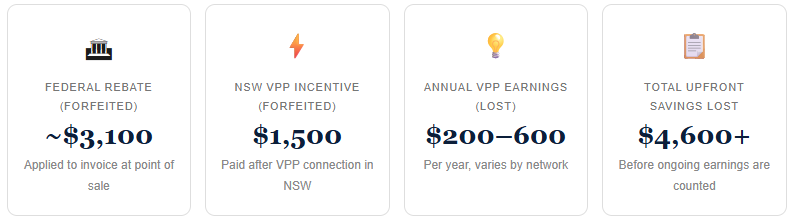
For a typical 10 kWh system, that’s over $4,600 in combined upfront incentives you simply don’t receive. On top of that, you miss out on annual VPP participation payments compounding over the battery’s life. When comparing two quotes side by side, this gap can easily make the “cheaper” non-VPP battery significantly more expensive over a 10-year horizon.
| $4,600+ | That’s the combined value of federal rebates and the NSW VPP incentive available to eligible homeowners right now.Non-VPP batteries receive none of this. For anyone comparing the best solar battery options in NSW and across Australia, VPP eligibility isn’t a bonus — it’s the baseline requirement. |
Which Batteries Are VPP-Ready in 2026?
The good news: all major reputable brands sold through accredited Australian installers meet the VPP-ready standard. The problem is grey-market imports and off-brand systems that occasionally get quoted as “budget alternatives.” Here’s how the leading options compare:
| Battery System | VPP-Ready | Rebate Eligible | NSW VPP Incentive | Capacity |
|---|---|---|---|---|
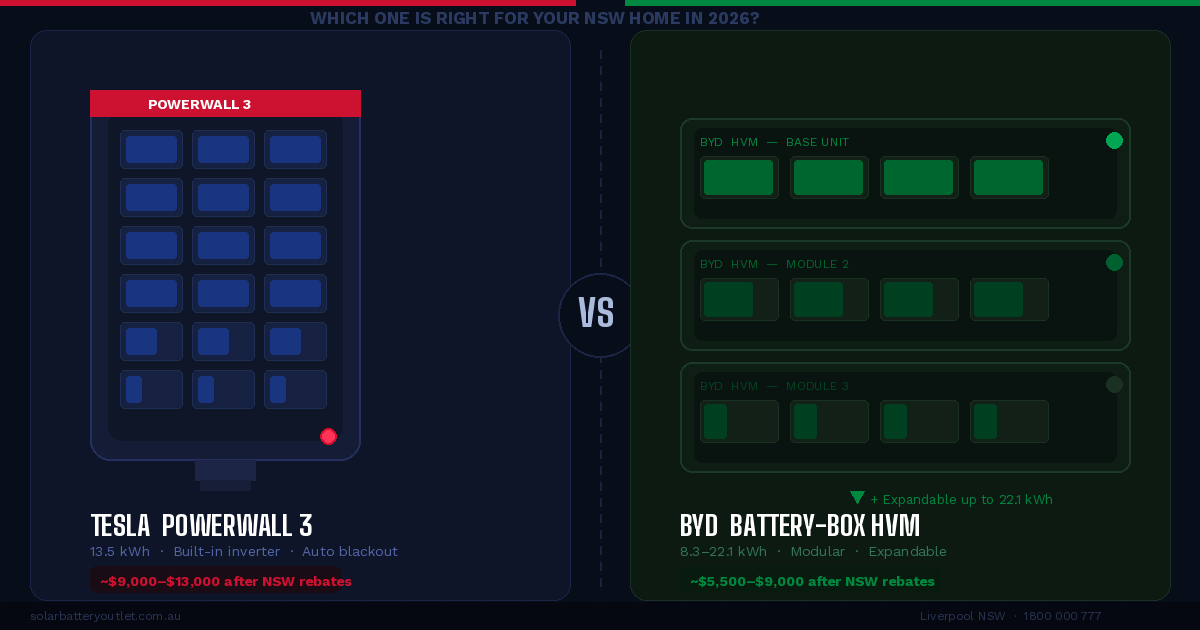
| BYD Battery-Box HVM | ✓ Yes | ✓ Yes | ✓ Yes | 8.3–22.1 kWh |
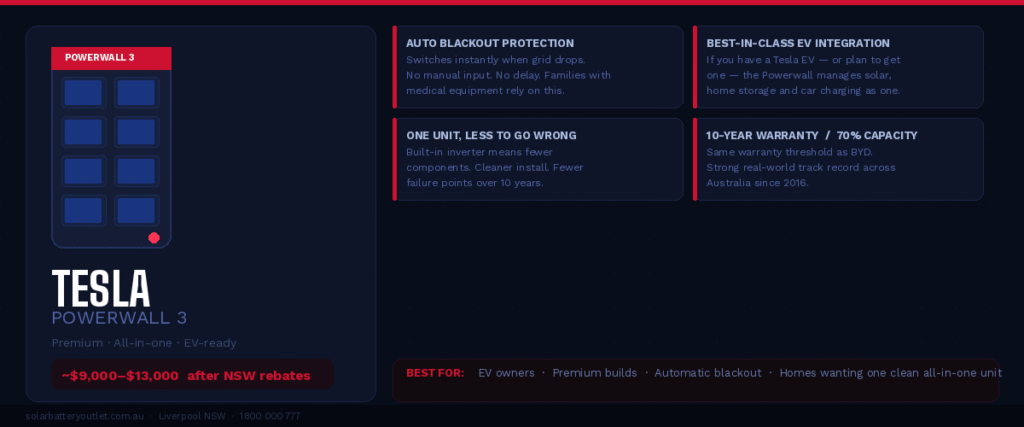
| Tesla Powerwall 3 | ✓ Yes | ✓ Yes | ✓ Yes | 13.5 kWh |
| Sungrow SBR / SBH | ✓ Yes | ✓ Yes | ✓ Yes | 9.6–25.6 kWh |
| Enphase IQ Battery 5P | ✓ Yes | ✓ Yes | ✓ Yes | 5–15 kWh |
| Other batteries | ✗ No | ✗ No | ✗ No | Varies |
| Off-grid only systems | ✗ No | ✗ No | ✗ No | Varies |
For anyone looking at solar battery in NSW specifically, all four mainstream systems also qualify for the NSW Peak Demand Reduction Scheme — the state-level incentive that stacks directly on top of the federal rebate.
How to Verify VPP Status Before You Sign
Don’t take a salesperson’s word for it. Here is the exact process to confirm a battery is VPP-eligible before committing:
Step 1: Check the Clean Energy Council-approved product list
The CEC register at cleanenergycouncil.org.au is the authoritative source. If your quoted battery isn’t on it, the federal rebate cannot be claimed — full stop.
Step 2: Ask directly: “Does this battery support VPP dispatch protocols?”
A confident, experienced installer answers without hesitation. Hedging or vague reassurances are a red flag — get written confirmation.
Step 3: Verify your installer is SAA-accredited
Only SAA-accredited installers can legally process the federal rebate on your behalf. Check at saaustralia.com.au before signing anything.
Step 4: Confirm the rebate appears as a line item on your quote
The federal rebate must appear as a specific dollar reduction on your invoice — not a verbal promise or small-print footnote.
Step 5: Ask who handles the NSW VPP enrolment paperwork
Some installers skip VPP enrolment to reduce their compliance workload. A thorough installer includes it as standard — not as an optional add-on.
NSW homeowners currently have access to the most generous combined battery incentive stack in the state’s history — but only for VPP-capable systems.
Why VPP Requirements Are Only Getting Stricter
The 2026 VPP mandate didn’t arrive suddenly. It’s part of a sustained policy direction that started with the original Home Battery Scheme and has been progressively tightened each year. Australia’s grid managers — AEMO in particular — have identified distributed battery storage as a critical tool for grid stability as coal plants retire and renewable penetration increases.
For homeowners, the implication is clear: this requirement isn’t going away. Future iterations of the federal incentive program are likely to add further requirements around grid responsiveness, cycle ratings, and communication protocols. Batteries meeting the 2026 standard are well-positioned for whatever comes next. Systems that don’t meet it today are likely to become increasingly marginalised in terms of both incentive eligibility and resale value.
| For homeowners in NSW: the combination of federal rebates and the NSW VPP incentive represents the most generous stack of battery support the state has ever seen. The window is narrowing — the federal rebate rate already dropped in May 2026 — but the incentive structure for VPP-ready systems remains strong through the rest of the year. Acting now with the right battery is still significantly better financially than waiting. |
Frequently Asked Questions
Q: Does joining a VPP mean the operator controls my battery completely?
Partially — and only within agreed limits. VPP operators can dispatch your battery during grid stress events. Many VPP agreements let you set a minimum charge level. Check the terms — VPP events can lower your stored charge, which may affect backup if your system is set up for it. Most operators also let you set exclusion windows during your personal peak evening hours.
Q: Can I get the federal rebate if I choose not to actively join a VPP?
Yes — with an important distinction. The requirement is that the battery is capable of VPP connection, not that you must enrol. You can install a VPP-ready battery and claim the federal rebate without joining a VPP program. However, you’ll miss the separate NSW VPP incentive payment of up to $1,500, which does require actual enrolment.
Q: What if I already have an older battery that isn’t VPP-capable?
Existing systems installed under earlier rebate programs are not retroactively affected. The 2026 VPP requirement applies to new installations. If you’re upgrading or replacing an older system, the new battery must meet the current standard to qualify for rebates.
Q: How much can I realistically earn from VPP participation each year?
This varies by operator, grid event frequency in your area, and battery capacity. For a typical 10 kWh system enrolled in a NSW VPP, annual earnings of $200–$600 are a reasonable estimate. Some operators offer fixed quarterly credits; others pay per dispatch event based on energy exported.
Q: Does a solar battery NSW installation always include VPP enrolment automatically?
Not automatically. A thorough installer handles both the federal rebate processing and VPP enrolment as part of the standard package. Some skip enrolment to reduce compliance workload — always confirm explicitly that it’s included before signing your contract.
Bottom Line
If you’re comparing quotes and one comes in noticeably cheaper, the first question to ask is whether the battery is VPP-capable and listed on the CEC approved product register. A battery that saves $800 upfront but costs $4,600 in lost incentives isn’t a saving — it’s an expensive mistake that takes years to recover from.
For homeowners in NSW who want a solar battery that captures everything available in 2026 — federal rebate, NSW VPP incentive, and long-term participation payments — the path is clear: choose one of the four mainstream VPP-ready systems, use an SAA-accredited installer, and confirm both the rebate and VPP enrolment are included in the package before you sign.
As solar batteries grow in number across Australia, the grid value of interconnected VPP networks grows with them. The requirement isn’t a bureaucratic hurdle — it’s a genuine two-way exchange. You receive meaningful financial support. The grid gains resilience. That’s why this requirement is here to stay, and why grid compatibility matters as much as storage capacity.
| ✅ Quick Summary for NSW Homeowners All four mainstream batteries — BYD Battery-Box HVM, Tesla Powerwall 3, Sungrow SBR/SBH, and Enphase IQ Battery 5P — are fully VPP-ready and eligible for both the federal rebate (~$3,100) and the NSW VPP incentive (up to $1,500). Combined upfront savings reach $4,600+ before ongoing annual VPP earnings. Non-VPP batteries qualify for neither. |
| Not Sure If You Are Ready? Talk to Us First. At Solar Battery Outlet, we handle the full process — federal rebate, NSW VPP incentive, SAA-accredited installation, and VPP enrolment — so you never leave money on the table. Call us: 1800 000 777 |
| About Solar Battery Outlet: We are a Liverpool-based solar battery installer, part of GWM Group Pty Ltd, servicing homes across South West Sydney, Bankstown, Campbelltown, and the greater NSW region. All installations are done by SAA-accredited electricians. We handle all rebate paperwork, so you do not have to. |