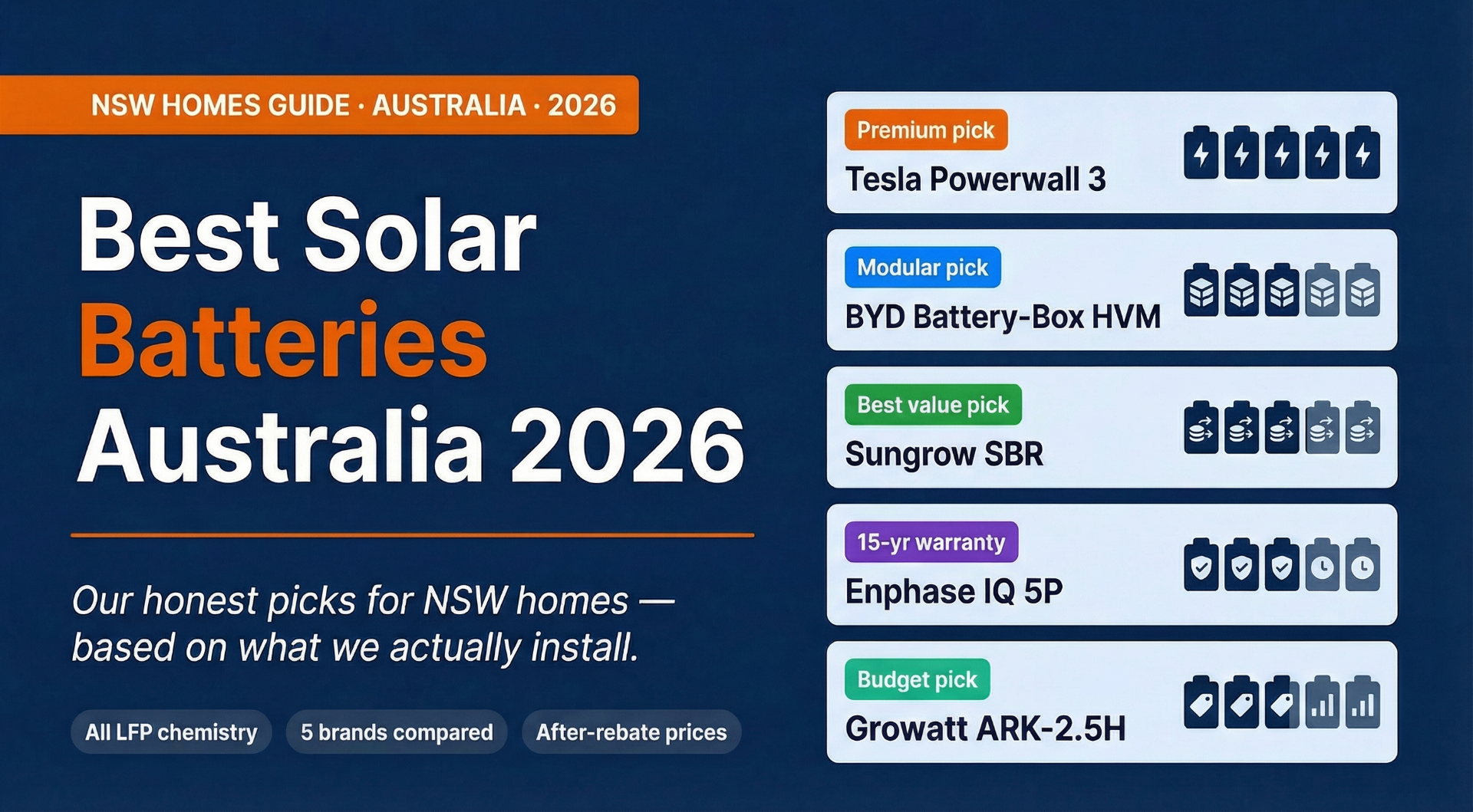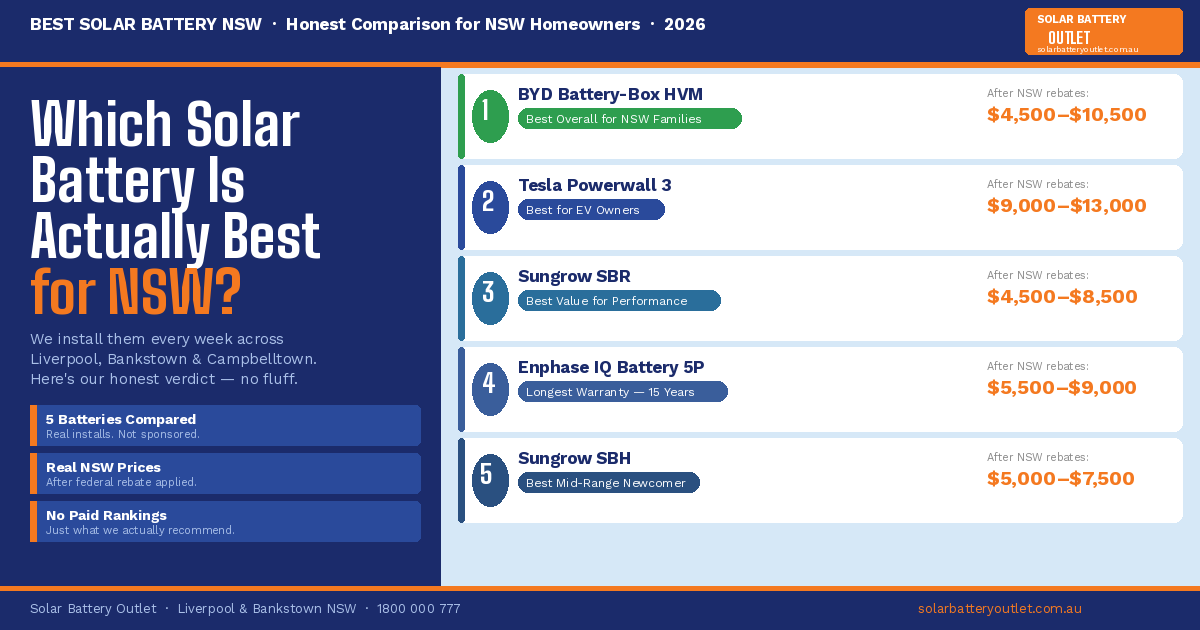
Best Solar Battery NSW 2026: What We Actually Recommend After Installing Hundreds of Them

Here’s the honest truth about “best solar battery” lists you find online.

Most of them are written by people who’ve never installed a battery in their life. They copy spec sheets, rank by storage capacity, and slap an affiliate link at the bottom. The brand that pays the most commission usually wins.

We do this differently.

Our team installs solar batteries every week across Liverpool, Bankstown, Campbelltown and South West Sydney. We see which batteries perform quietly for years. We see which ones throw error codes at 2am. We see which brands actually show up when something goes wrong under warranty — and which ones leave homeowners waiting months for a response.

This guide is based on that experience. Not sponsored rankings. Not manufacturer spec sheets. Just what we’ve genuinely seen work well in NSW homes in 2026 — and what the right choice looks like depending on your situation.


Before we get into it: The federal battery rebate rate drops after 1 May 2026. Every battery on this list qualifies for it. For a 10 kWh system, installing before May saves around $530 compared to waiting. All prices in this guide are shown after the current rebate rate. See exactly how the rebate works here.


First — What Makes a Battery “Best” in NSW Specifically?

This matters because NSW has specific conditions that affect which battery suits your home.

Heat. Western Sydney summers are brutal. Batteries sitting in garages or on west-facing walls in Bankstown, Liverpool and Campbelltown experience higher ambient temperatures than coastal suburbs. Heat degrades batteries faster. Battery chemistry and thermal management matter more here than they do in Melbourne or Adelaide.

Ausgrid network requirements. Most of NSW — including all of South West Sydney — runs on the Ausgrid network. Ausgrid has specific requirements around how batteries connect and register. Not every battery brand’s firmware plays nicely with every network. An experienced local installer knows which combinations work cleanly.

VPP eligibility. The NSW Peak Demand Reduction Scheme pays you up to $1,500 for connecting your battery to a Virtual Power Plant. Not all batteries are VPP-capable under the scheme. Every battery we recommend below qualifies — but it’s worth knowing this is a NSW-specific filter that rules out some cheaper imported options.

Storm season backup. South West Sydney gets hit hard in summer storms. Blackout protection isn’t just a nice feature here — for a lot of families it’s the whole point. How reliably a battery switches to backup mode when the grid drops is a real performance question, not a marketing checkbox.

With that context, here’s what we actually recommend.

The Best Solar Batteries for NSW Homes in 2026
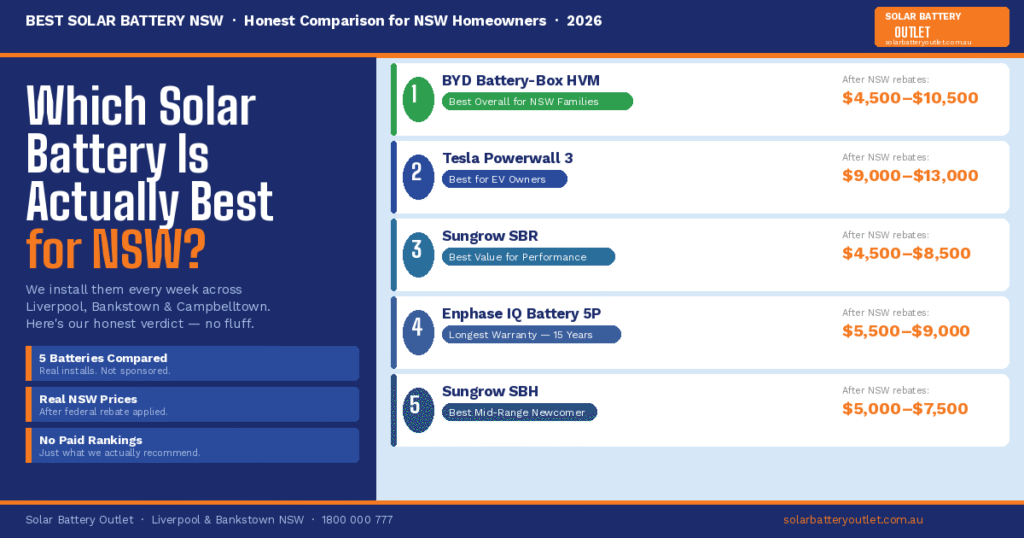
best solar battery NSW comparison

1. BYD Battery-Box HVM — Best Overall for NSW Families

Best for: Most NSW homeowners. Families wanting flexibility. Anyone planning an EV in the next few years.

If we had to recommend one battery to the average NSW family in 2026 — this is it. Not because it’s the flashiest. Because it’s the most sensible combination of performance, price, flexibility and warranty we’ve seen at this price point.

BYD is the world’s largest battery manufacturer. They make batteries for everything from home storage to electric buses to grid-scale projects. That manufacturing scale shows up in consistent quality and genuinely responsive warranty support in Australia.

The modularity is the standout. You start at 8.3 kWh and add modules later up to 22.1 kWh. If you’re not sure how much storage you need right now — or if an EV is coming in the next couple of years — this lets you start with what makes sense today and grow without replacing anything.

The 10-year warranty covers 70% capacity retention. That’s the higher threshold among mid-range options and it means in year 10, your battery should still hold more than two-thirds of its original capacity.

Real numbers for NSW after rebates:

  • 8.3 kWh: approximately $4,500–$6,500 installed
  • 10 kWh: approximately $5,500–$8,000 installed
  • 13.8 kWh: approximately $7,500–$10,500 installed

Watch out for: Needs a compatible hybrid inverter. If you have an older string inverter, confirm compatibility before accepting a quote. This is the most common issue we see with BYD retrofits.

2. Tesla Powerwall 3 — Best Premium Option and Best for EV Owners

Best for: EV owners. Families who want automatic blackout protection. Homes wanting a single all-in-one unit.

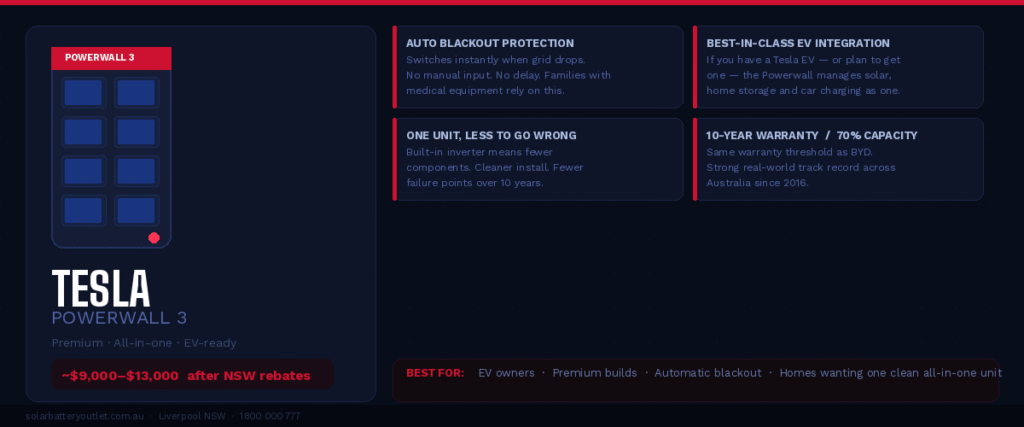
The Powerwall 3 earns its reputation. It’s a single 13.5 kWh unit with a built-in inverter — everything in one box, fewer components, cleaner installation, fewer failure points over 10 years.

The blackout protection is the best we’ve seen in a residential battery. When the grid drops, the Powerwall switches automatically. No manual input, no delay, no noticing it happened. For families with medical equipment or just anyone who’s been through one too many summer blackouts in South West Sydney, this matters.

The EV integration is genuinely useful if you’re in the Tesla ecosystem. The Powerwall manages solar generation, home storage and car charging as one system through the Tesla app — deciding when to charge the car from solar versus battery versus grid based on your usage patterns and time-of-use pricing. No other battery on this list matches that level of integration.

Real numbers for NSW after rebates:

  • 13.5 kWh: approximately $9,000–$13,000 installed

Watch out for: Fixed capacity — you can’t expand it modularly. If your storage needs grow significantly, you add a second unit. Also the most expensive option on this list. If you’re not in the Tesla EV ecosystem, you’re paying a premium for features you may not fully use.

For a full head-to-head between Powerwall 3 and BYD, we’ve written a detailed Tesla Powerwall 3 vs BYD Battery-Box comparison specifically for NSW homeowners.

3. Sungrow SBR — Best Value for Performance

Best for: Value-focused buyers. Homes already running a Sungrow inverter. Households wanting larger storage without Tesla’s price tag.

Sungrow is the world’s largest solar inverter manufacturer. Their SBR battery range is built on the same engineering heritage — and it shows. The cycle rating on the SBR is among the best in this price bracket, rated at around 6,000 cycles. Over a 10-year period, that’s solid.

It scales from 9.6 kWh up to 25.6 kWh, which makes it a strong option for larger homes or households with higher evening usage. If you’ve already got a Sungrow inverter from a previous solar install — which is common across South West Sydney — the SBR is usually the cleanest and most cost-effective battery to add. No inverter replacement needed.

The 10-year warranty covers 60% capacity retention — slightly lower than BYD and Tesla’s 70% threshold, but at this price point the trade-off is reasonable for most households.

Real numbers for NSW after rebates:

  • 9.6 kWh: approximately $4,500–$7,000 installed
  • 12.8 kWh: approximately $6,000–$8,500 installed

Watch out for: Works best with Sungrow inverters. AC-coupling to other brands is possible but adds cost and complexity. Confirm your inverter compatibility before getting a quote.

4. Enphase IQ Battery 5P — Best for Long-Term Peace of Mind

Best for: Long-term homeowners who want the longest warranty available. Retrofits onto any existing inverter. Fire-safety conscious buyers.

The Enphase IQ Battery 5P is the only battery available in Australia right now with a 15-year warranty. Everything else on this list is 10 years. If you’re planning to stay in your home for 15 years and you want certainty over that entire window, that warranty alone is a significant differentiator.

It’s fully AC-coupled, which means it connects to almost any existing solar inverter without replacing anything. If your current setup is a few years old and you want to add a battery with the least disruption, Enphase is often the cleanest retrofit technically.

Fire safety credentials are worth mentioning given how hot South West Sydney gets. The IQ 5P carries UL 9540 and UL 9540A certification — the highest fire safety standard available for residential batteries. For homes in bushfire-adjacent areas west of Sydney, this isn’t a small thing.

Real numbers for NSW after rebates:

  • 10 kWh setup: approximately $5,500–$9,000 installed

Watch out for: Higher cost per kWh than BYD or Sungrow. Each module is a separate physical unit — you can’t stack them, they sit side by side. For tight spaces this can be a consideration.

5. Sungrow SBH — Best Mid-Range Newcomer Worth Watching

Best for: Mid-range buyers wanting newer technology. Homes with Sungrow inverters wanting an upgrade path.

The SBH is Sungrow’s newer residential battery range and it’s been getting strong reviews from installers across NSW. Better thermal management than the SBR, slightly cleaner firmware, and good compatibility with Sungrow’s latest hybrid inverters.

We’ve been installing it for a few months now and the early feedback from customers has been solid. It’s not as proven in the long-term as BYD or Tesla simply because it hasn’t been around as long — but the engineering behind it is strong and Sungrow’s local support in Australia is responsive.

Real numbers for NSW after rebates:

  • 9.6 kWh: approximately $5,000–$7,500 installed

Watch out for: Shorter Australian track record than BYD and Tesla. Ask your installer specifically about local warranty support before committing.

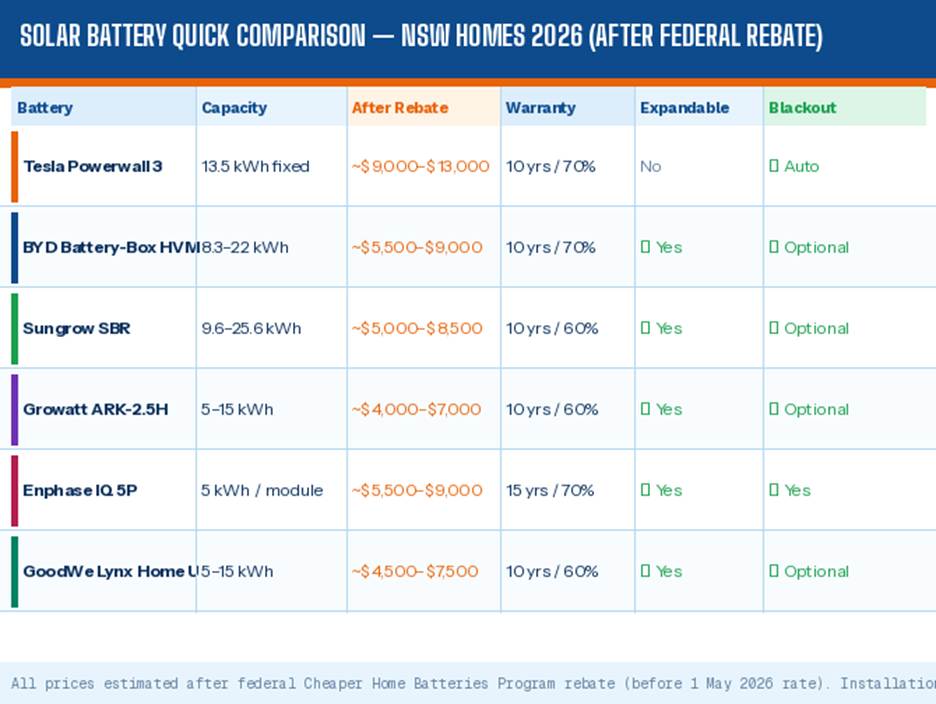
Quick Comparison — All Five Side by Side

BatteryCapacityExpandableWarrantyAfter NSW RebatesBest For
BYD Battery-Box HVM8.3–22.1 kWhYes10yr / 70%$4,500–$10,500Most NSW families
Tesla Powerwall 313.5 kWhNo (add unit)10yr / 70%$9,000–$13,000EV owners, premium
Sungrow SBR9.6–25.6 kWhYes10yr / 60%$4,500–$8,500Value, Sungrow homes
Enphase IQ 5P5–15 kWhYes15yr / 70%$5,500–$9,000Long-term owners
Sungrow SBH9.6–19.2 kWhYes10yr / 70%$5,000–$7,500Mid-range upgrade

How to Choose the Right One for Your NSW Home
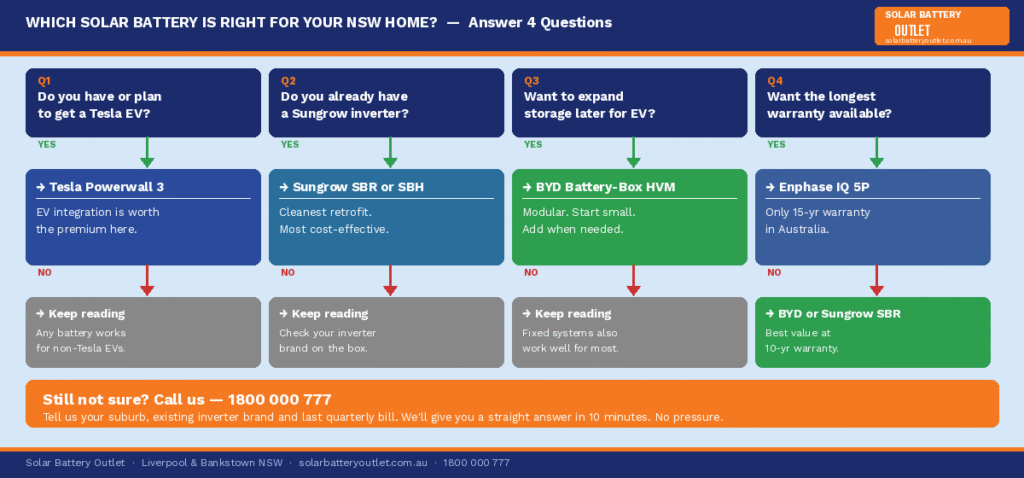
how to choose best solar battery NSW 2026 guide

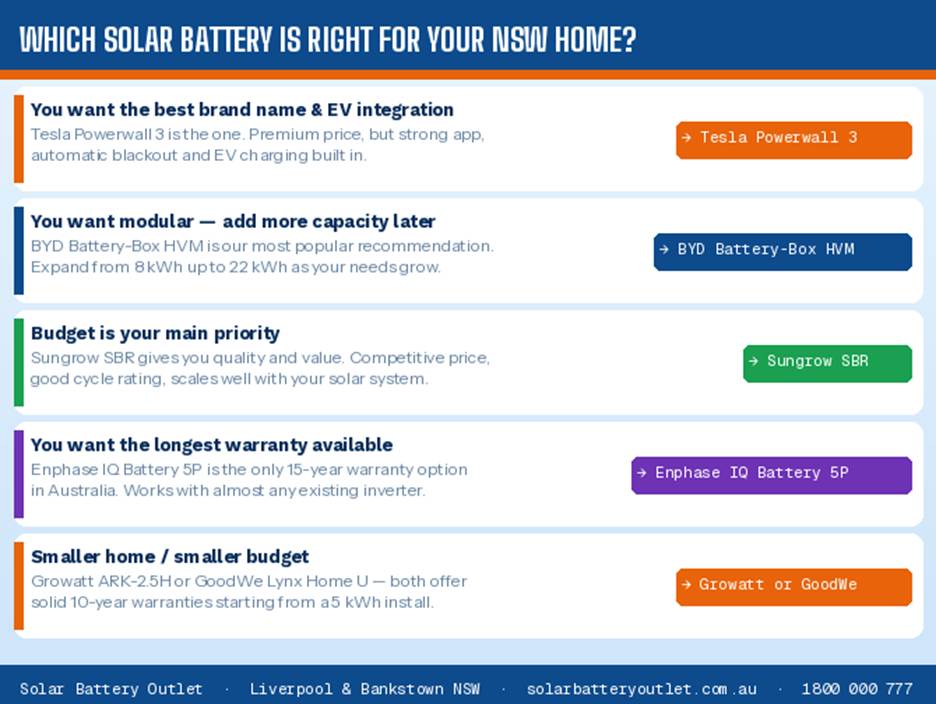
Stop looking at the spec table and ask yourself these four questions instead. They’ll narrow it down faster than any comparison chart.

Do you have or plan to get a Tesla EV? Yes → Powerwall 3. The integration is genuinely worth the premium in this case.

Do you already have a Sungrow inverter? Yes → Sungrow SBR or SBH. Cleanest retrofit, most cost-effective.

Do you want to expand storage later — especially for an EV? Yes → BYD Battery-Box HVM. Start where you need to and add modules.

Do you want the longest warranty and simplest retrofit onto any existing system? Yes → Enphase IQ Battery 5P.

Is value your main driver and you want solid performance without the premium? Sungrow SBR or BYD depending on your inverter.

If you’ve answered those questions and you’re still not sure — that’s what a no-obligation quote call is for. Any reputable installer, including us, should be able to look at your existing setup and give you a straight recommendation in 10 minutes.

What the NSW Rebates Look Like for Each Battery

Every battery on this list qualifies for both the federal Cheaper Home Batteries Program and the NSW VPP incentive. Here’s how that stacks for a typical 10 kWh install:

  • Federal rebate: ~$3,100 off upfront (applied directly on your invoice by your installer)
  • NSW VPP incentive: up to $1,500 paid to you after installation for connecting to a Virtual Power Plant

Combined: up to $4,600 in savings before your first electricity bill reduction kicks in.

The federal rate drops after 1 May 2026. For anything over 14 kWh — like the Powerwall 3 — the drop is more significant because of the new tiered structure. For standard 10 kWh batteries, it’s around $530 less if you wait past May. Not a cliff, but real money.

For the exact numbers on what changes and when, our Solar Battery Rebate Drops 1 May 2026 guide has the full breakdown.

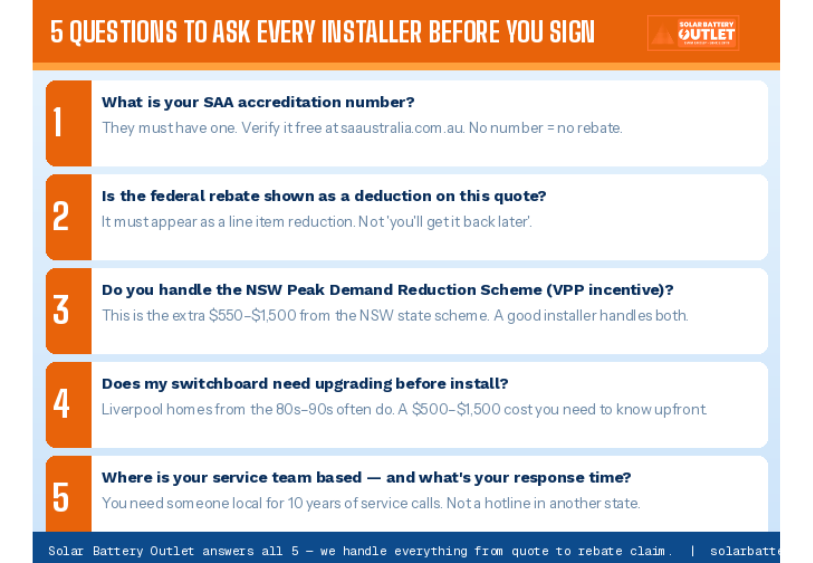
What to Ask Any Installer Before You Sign

A few things we see trip people up when getting quotes for any of these batteries across NSW:

The cheapest quote is not always the best value. A BYD installed with the wrong inverter or poor cable management will give you more headaches than a Sungrow installed properly at a higher price.

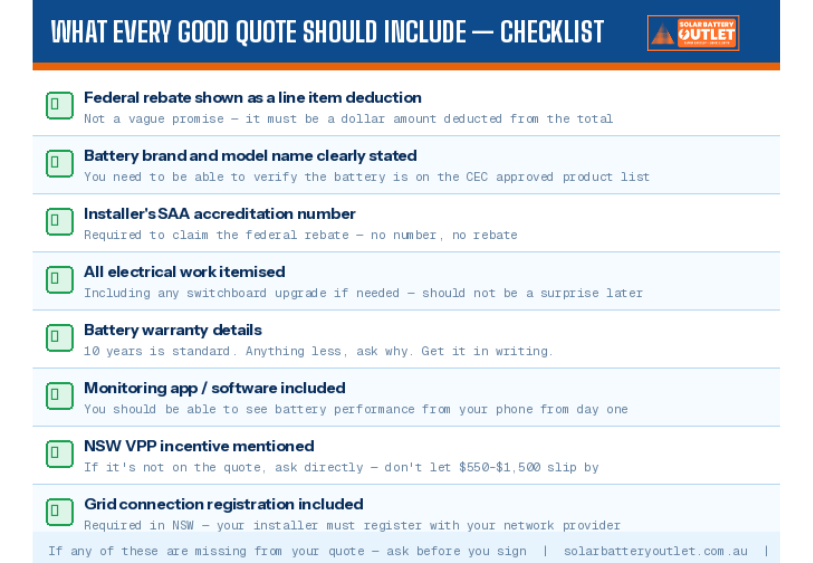
Make sure the federal rebate shows as a line item on the quote — not a verbal promise. You should be able to see exactly how much the rebate is reducing your invoice.

Ask specifically: does this installation include blackout protection? Not all system designs include automatic backup even when the battery supports it.

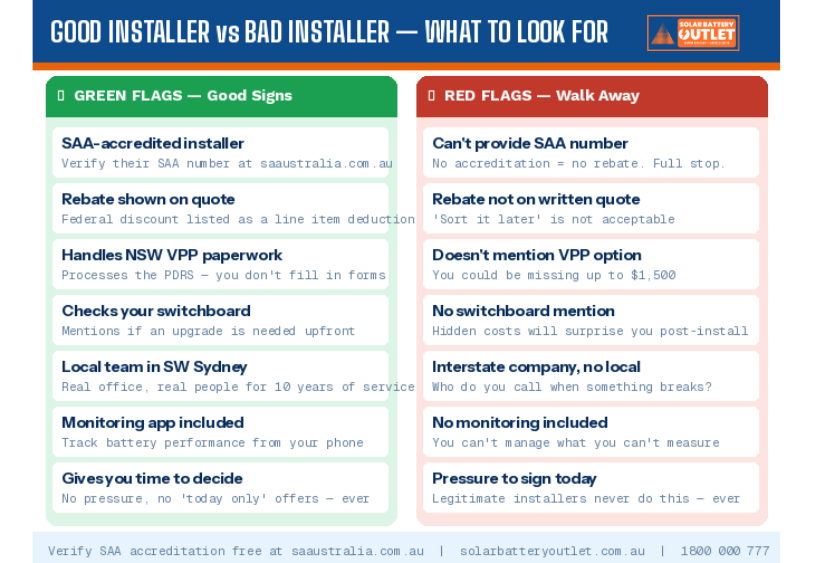
Confirm the installer is SAA-accredited before signing anything. Verify at saaustralia.com.au — takes 30 seconds. Without SAA accreditation your installer cannot process the federal rebate.

Ask who handles the NSW VPP paperwork. Some installers skip this step because it’s extra compliance work. A good installer processes both rebates as standard.

For everything else to check — including the questions that catch installers out — our Solar Battery Installer Liverpool NSW guide covers what to look for and what to avoid.


Frequently Asked Questions

Is the BYD Battery-Box actually as good as Tesla?

For most NSW families — yes. Tesla wins on automatic blackout switching and EV integration. BYD wins on price, flexibility and the ability to expand. If you’re not in the Tesla ecosystem, BYD gives you equivalent quality at a lower cost. That’s why it’s our most installed battery across Liverpool, Bankstown and Campbelltown.

Which battery lasts longest in Australian heat?

All five batteries on this list use LFP chemistry, which handles heat better than older lithium-ion. Enphase has the longest warranty at 15 years. In terms of real-world longevity in hot Western Sydney conditions, BYD and Sungrow have the largest local install base and the longest track record in Australian conditions. For more on what actually affects lifespan, see our How Long Does a Solar Battery Last in Australia guide.

Can I get a solar battery without existing solar panels?

No — the federal rebate requires existing or simultaneously installed solar panels. A battery alone doesn’t qualify. If you don’t have panels yet, a combined solar and battery install is actually good timing and the rebate applies to the battery portion. For the full eligibility checklist, see our Federal Battery Rebate NSW 2026 guide.

What size battery do I actually need for a NSW home?

For most families in South West Sydney using power mainly in evenings, 10 kWh covers the majority of overnight usage comfortably. If you have an EV or high usage, 13–15 kWh makes more sense. A good installer will look at your last 3 electricity bills and size it properly rather than just recommending the biggest option. Our Solar Battery Cost Sydney 2026 guide breaks down sizing and cost together.

Are solar batteries worth it in NSW right now?

For most homeowners with existing solar and evening-heavy usage — yes. The combination of low feed-in tariffs, high evening rates and the current rebate makes the numbers work better than they have at any point in the last five years. For an honest payback analysis, our Are Solar Batteries Worth It in Australia guide covers the full case.


Want a straight recommendation for your home? Tell us your suburb, your existing inverter brand, and your last quarterly bill — and we’ll tell you exactly which battery makes sense and what it’ll cost after rebates.

Call 1800 000 777 or fill in our 60-second form at solarbatteryoutlet.com.au We’re based in Liverpool and Bankstown. No pressure, no pushy sales.
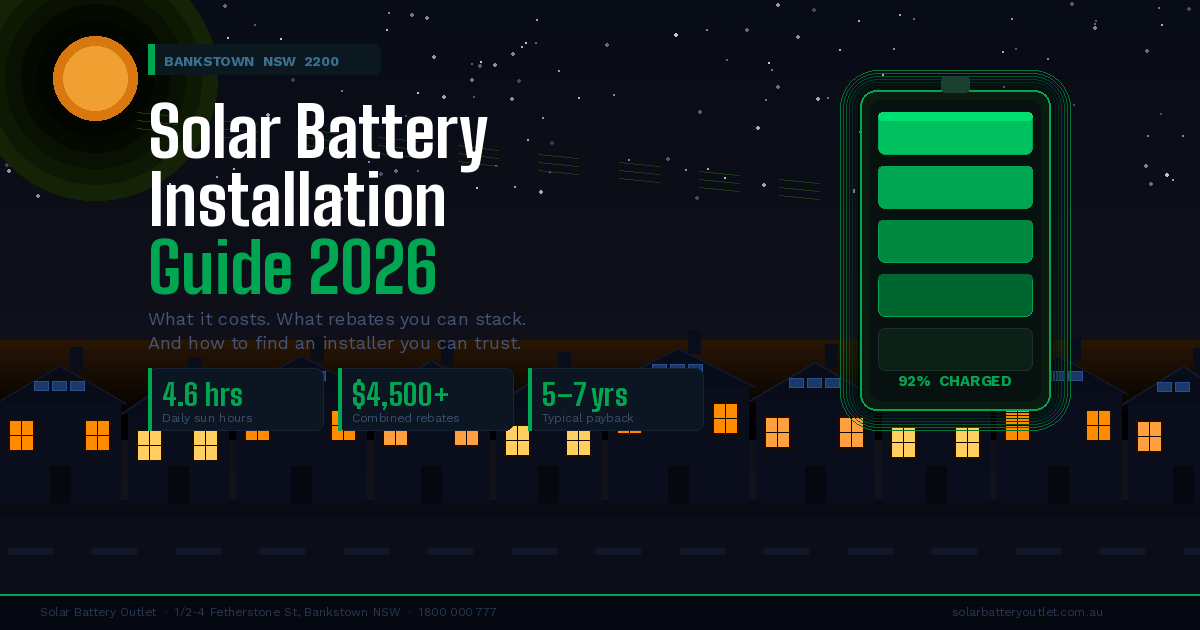
You’ve probably noticed something interesting happening in Bankstown lately.

In February 2026, Ausgrid switched on a brand new 10 MW community battery right here in the suburb — one of the largest they’ve ever built. That’s not a coincidence. It’s a signal. Battery storage in Bankstown is no longer something early adopters do. It’s something the energy industry is betting serious money on, right in your backyard.

And homeowners are paying attention. Enquiries from Bankstown and Canterbury-Bankstown area have jumped significantly over the past few months — not because of marketing, but because the maths has changed. Feed-in tariffs are low, evening electricity rates are high, and the government rebate makes the upfront cost a lot more manageable than most people expect.

We’re based at Fetherstone Street in Bankstown. We install solar batteries across this area every week. This guide is written specifically for Bankstown homeowners — the real numbers, the actual rebates available right now, and the questions you should be asking any installer before you hand over a dollar.


One thing to flag before we start: The federal battery rebate rate drops after 1 May 2026. For a 10 kWh battery, installing before that date saves around $530 compared to installing in June. It’s not a massive cliff — but it’s real money. If you’re already leaning toward a battery, sooner is better than later. Full breakdown of what changes on 1 May here.


Why Bankstown Homeowners Are Enquiring About Batteries Right Now

It’s worth understanding the context, because it explains why the timing matters.

Bankstown gets around 4.6 peak sun hours per day on average. That’s solid — it means a typical rooftop solar system here generates strong output, especially through spring and autumn. The problem is, most of that generation happens between 10am and 3pm. And most families in Bankstown aren’t home during those hours.

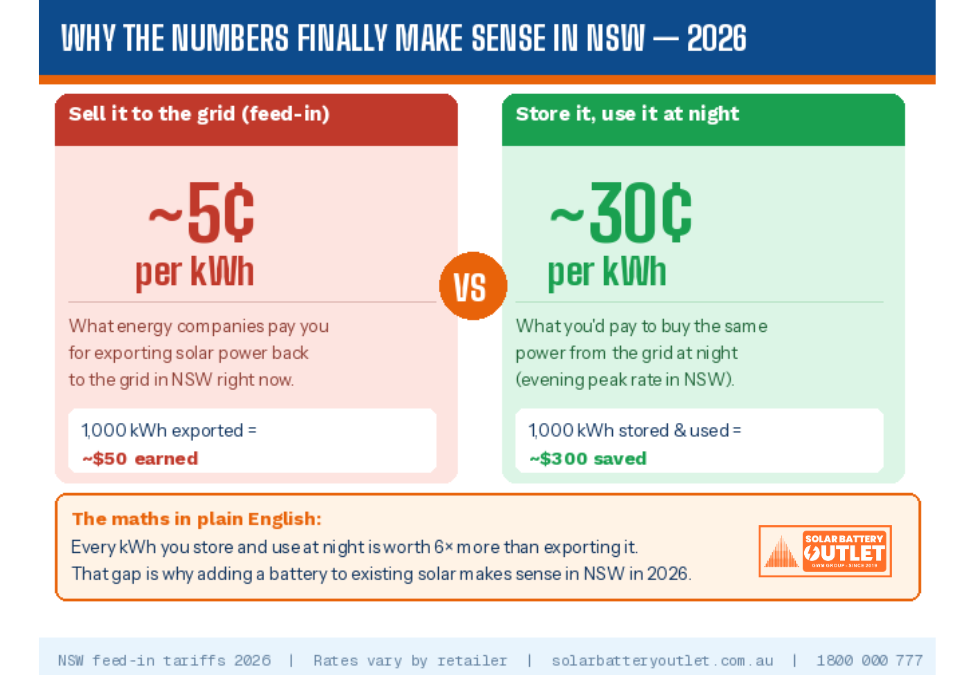
So what happens? Your solar panels generate power, you export it to the grid for around 5 to 8 cents per kWh, and then you buy it back at night for close to 30 cents. You’re essentially selling something cheap and buying it back expensive. A battery fixes that. It holds what your panels generate and saves it for when you actually need it — evenings, mornings, weekends.

On top of that, Bankstown sits in an area of Canterbury-Bankstown where summer storm outages are a genuine issue. A battery with backup capability means when the grid goes down, your home keeps running. Lights, fridge, phone charging — all of it.

The rebate is the third piece. A 10 kWh battery that cost $14,000 a few years ago is now closer to $7,000 to $9,000 after the federal discount. That changes the payback calculation significantly.

What a Solar Battery Actually Costs in Bankstown in 2026

Let’s not beat around the bush. Here are the real numbers after rebates:

Battery SizeFederal RebateNSW VPP IncentiveYour Cost After Both
5 kWh system~$1,550Up to $550~$4,500–$6,000
10 kWh system~$3,100Up to $1,100~$7,000–$9,000
13–15 kWh system~$3,700–$4,500Up to $1,500~$9,500–$13,000

These are estimates — your actual quote will depend on your existing solar system, your switchboard, and which battery brand you go with. Bankstown homes, particularly older ones built in the 1980s and 1990s, sometimes need a switchboard upgrade before a battery can be safely connected. That adds $500 to $1,500 to the job. Any installer worth their salt will tell you upfront if that applies to your property — before you’ve committed to anything.

For the full cost breakdown including what drives the price up or down, our Solar Battery Cost Sydney 2026 guide has the detail.

The Two Rebates Bankstown Homeowners Can Stack Right Now

This is where people get confused online, so let’s make it simple.

1. Federal Cheaper Home Batteries Program

This is the big one — roughly 30% off your battery upfront. Your SAA-accredited installer applies it straight off your invoice. You don’t apply separately, you don’t wait for a cheque. It just comes off the price. For a 10 kWh system, that’s around $3,100 in savings right there.

2. NSW Peak Demand Reduction Scheme (VPP Incentive)

This is a separate NSW government payment of up to $1,500 for connecting your battery to a Virtual Power Plant. Your battery stays in your home — nothing physical changes. It’s a software connection that lets your battery join a network that helps stabilise the grid during peak times. In return, the government pays you.

The good news — you can claim both. They stack. A Bankstown homeowner installing a 10 kWh battery could save over $4,500 combined before the first electricity bill saving even kicks in.

For the step-by-step on how to claim both rebates without touching any paperwork yourself, our Federal Battery Rebate NSW 2026 guide walks through exactly what happens.

Is a Solar Battery Actually Worth It for Your Bankstown Home?

Honest answer — it depends on your situation. Here’s a quick way to think about it.

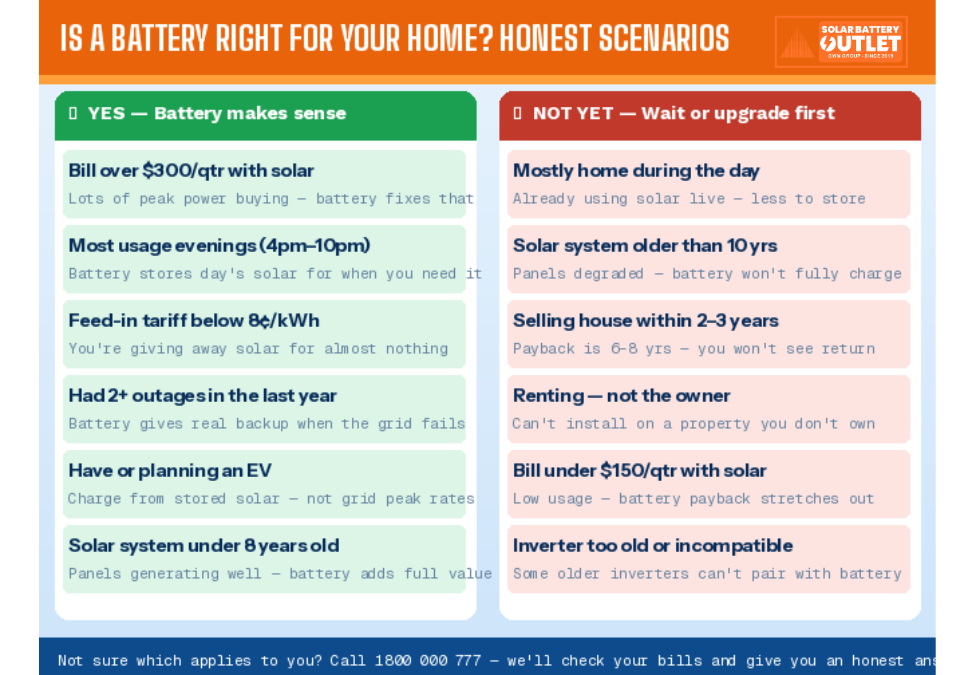
A battery makes strong financial sense if:

  • Your quarterly electricity bill is still above $250 even with existing solar panels on your roof
  • You’re mostly home in the evenings — after solar has stopped generating
  • Your current feed-in tariff is below 10 cents per kWh (most Bankstown homes are on 5 to 8 cents right now)
  • You’ve had two or more power outages in the past year and want backup capability
  • You have or plan to get an electric vehicle

A battery probably isn’t the right move yet if:

  • You’re renting — you’d need the landlord to agree and that’s a different conversation
  • Your existing solar system is more than 10 years old and generating poorly — sort that first
  • You’re planning to sell the house within 2 to 3 years — payback periods run 5 to 8 years for most Bankstown households
  • You work from home and use most of your solar power during the day already

If you’re genuinely unsure, a good installer should be able to look at your last 3 electricity bills and give you a straight answer on whether the numbers work for your home. We do this at no charge for Bankstown homeowners. If the numbers don’t stack up, we’ll tell you.

For a deeper look at the financial case, our Is Adding a Battery to Existing Solar Worth It in 2026 guide has the honest payback analysis.

What to Look for in a Bankstown Solar Battery Installer

The quality of your installation matters more than the brand of battery you choose. A good battery installed badly will give you problems. A solid mid-range battery installed properly will run quietly for 10 years. Here’s what to check.

SAA Accreditation — Non-Negotiable

The old CEC accreditation has been replaced by SAA (Solar Accreditation Australia) for battery installations. If your installer isn’t SAA-accredited, you cannot claim the federal rebate. Full stop. Before you accept any quote, verify their accreditation at saaustralia.com.au. Takes about 30 seconds.

Do They Handle Both Rebates?

Some installers apply the federal rebate but skip the NSW VPP incentive because it involves extra compliance paperwork. Ask directly: “Do you process the NSW Peak Demand Reduction Scheme incentive?” If they look blank — that’s a flag. A good installer handles both.

Get Three Written Quotes

Prices vary significantly in Bankstown — sometimes by $2,000 to $3,000 for the same system. Make sure each quote shows the federal rebate as a clear line item, includes all electrical work, and specifies the battery warranty period. Ten years should be the minimum from any quality brand.

Local Presence Matters

A battery needs to work for 10 years. If something goes wrong in year 4, who do you call? An installer based in Bankstown or South West Sydney is a very different service experience from an interstate company with no local team. Ask where their technicians are based.

Which Battery Brands Work Best in Bankstown?

We install several brands across Bankstown, Mudgee and Liverpool. Here’s an honest look at what we recommend most often and why.

BYD Battery-Box HVM — This is our most recommended option for the average Bankstown family. It’s modular, meaning you can start with 8.3 kWh and add storage later. Strong value, 10-year warranty with 70% capacity retention. Works well with a wide range of existing inverters — which matters in an area with lots of older solar systems.

Tesla Powerwall 3 — The premium option. Best automatic blackout protection available, excellent for EV owners, and the cleanest single-unit installation. Costs more but earns it. We wrote a full comparison of Tesla Powerwall 3 vs BYD Battery-Box if you’re deciding between the two.

Sungrow SBR — Best value for performance. If your Bankstown home already has a Sungrow inverter, this is often the most cost-effective and technically compatible upgrade. Strong cycle rating at a price point that makes sense.

For the full comparison across all six brands we stock, see our Best Solar Batteries Australia 2026 guide.

What Actually Happens on Installation Day in Bankstown

People always ask how disruptive it is. For a standard Bankstown home, installation takes 4 to 6 hours from arrival to sign-off. Here’s what that day looks like:

The installer arrives and checks your switchboard and existing solar system — that’s usually the first 30 minutes. The battery is mounted, typically in the garage, laundry, or on an external wall. Electrical connections are made and the system is tested. The installer registers the system with Ausgrid (your local network provider here in Bankstown) — this is required in NSW. You’re shown how to monitor everything from your phone. Then they leave.

Your house looks exactly the same. Except now you have a battery.

One thing worth knowing — the Ausgrid network registration sometimes takes a few days to fully process. During that window your battery runs in backup-only mode. That’s completely normal. Nothing is wrong.

Frequently Asked Questions from Bankstown Homeowners

Do I need existing solar panels to get the rebate?

Yes. The federal Cheaper Home Batteries Program requires you to have rooftop solar — either existing or installed at the same time as the battery. If you don’t have solar yet, you can install both together and the rebate still applies to the battery portion. For how long batteries last once you’ve installed, see our How Long Does a Solar Battery Last in Australia guide.

Will my battery keep the power on during a blackout?

Only if backup mode is included in the system design — which it isn’t automatically on all setups. Always confirm blackout protection is included when you’re getting quotes. Tesla Powerwall 3 does this automatically. Other batteries need to be configured for it.

What’s the payback period for a Bankstown home?

For most Bankstown households we work with, payback sits between 5 and 7 years depending on battery size, electricity usage, and whether you join a VPP. With Ausgrid’s local grid seeing higher peak demand in summer, Bankstown homes with batteries that participate in VPPs often see strong returns on that $1,500 incentive payment.

Can I add more storage later if my needs change?

Some batteries are modular and let you add capacity — BYD Battery-Box is the main one we recommend for this. Others are fixed. If you think your energy needs might grow — especially if an EV is in the picture — ask specifically about modular options when comparing quotes.

What if I already claimed an older NSW rebate?

The old NSW Empowering Homes program ended 30 June 2025. If you previously claimed that, you may still be able to access the NSW VPP incentive separately depending on your battery’s specifications. Worth asking an installer to check.


Want a Quote for Your Bankstown Home?

We’re based locally at 1/2-4 Fetherstone Street, Bankstown. Our team services all of Liverpool-Bankstown and Mudgee. We check your eligibility for both the federal rebate and NSW VPP incentive — no obligation, no pressure.

Call 1800 000 777

or fill in our 60-second eligibility form at solarbatteryoutlet.com.au

Here’s a question we get asked almost every week at our Liverpool office.

Someone’s done their research, they’ve got a couple of quotes in hand, and they’ve narrowed it down to two batteries — Tesla Powerwall 3 or BYD Battery-Box. And then they ring us and ask: “Mate, which one should I actually go with?”

The honest answer is — it depends. But not in a wishy-washy way. There are genuinely specific situations where one beats the other, and we’re going to walk through exactly that here.

We install both of these batteries every week across Liverpool, Bankstown, Campbelltown and South West Sydney. This comparison is based on what we actually see on the job — not spec sheets from a manufacturer’s website.


Quick heads up on timing: The federal battery rebate rate drops after 1 May 2026. If you’re seriously comparing these two batteries right now, getting your quote locked in before that date means more money in your pocket — regardless of which one you choose. More on the rebate deadline here.


The Quick Side-by-Side

Before we get into the detail, here’s where they sit head to head:

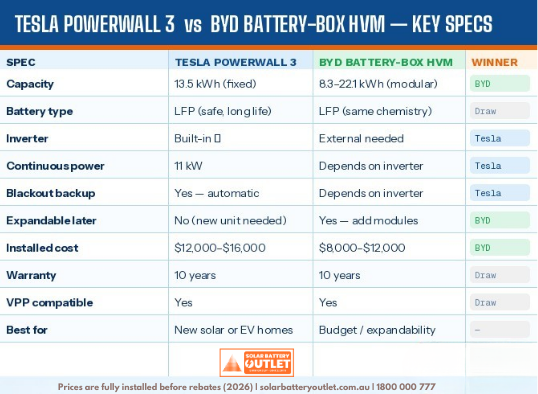
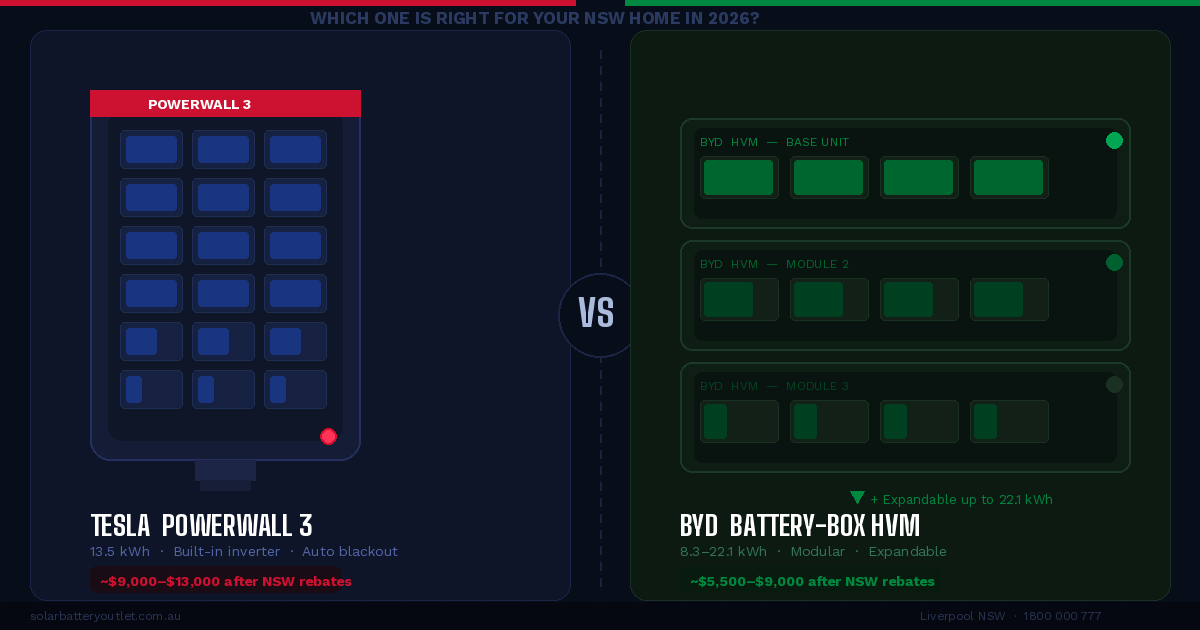
Comparison InTesla Powerwall 3BYD Battery-Box HVM
Capacity13.5 kWh (fixed)8.3 kWh – 22.1 kWh (modular)
ChemistryLFPLFP
Inverter includedYes — built inNo — needs separate inverter
Blackout protectionAutomaticAvailable (confirm with installer)
ExpandableNo (add second unit)Yes — add modules
Warranty10 years / 70% capacity10 years / 70% capacity
EV integrationExcellent (Tesla app)Good
Approx. cost after rebates (NSW)$9,000 – $13,000 installed$5,500 – $9,000 installed

Both use LFP chemistry — the safer, longer-lasting standard for home batteries in Australia. Both carry a solid 10-year warranty. On paper they look similar. In real life, the differences matter quite a bit.

What the Tesla Powerwall 3 Does Really Well

The Powerwall 3 is the most complete single-unit home battery available in Australia right now. Everything — the battery, the inverter, and the backup switching — is built into one box. That means fewer components, a cleaner installation, and fewer things that can go wrong over 10 years.

The blackout protection is genuinely impressive. When the grid goes down, the Powerwall switches over automatically. Most homeowners don’t even notice it happened. For families with someone who relies on medical equipment, or just anyone who’s sick of sitting in the dark during a South West Sydney storm, that seamless switchover matters.

The EV integration is also in a league of its own. If you have a Tesla vehicle — or you’re planning to get one — the Powerwall and the car talk to each other through the Tesla app. It decides when to charge the car from solar, when to pull from the battery, and when to use the grid based on time-of-use pricing. That level of automation is genuinely useful, not just a marketing gimmick.

Where it falls short:

The Powerwall 3 is fixed at 13.5 kWh. You can’t expand it — if you need more storage down the track, you add a second unit. That’s fine for most households, but if you’re not sure how your energy needs might grow, it’s worth thinking about.

It’s also the more expensive option. After the federal rebate, you’re generally looking at $9,000 to $13,000 installed in NSW. That’s not outrageous for what you’re getting — but it’s real money.

What the BYD Battery-Box Does Really Well

BYD is the largest battery manufacturer in the world. That’s not a marketing line — they produce batteries for everything from home storage to electric buses. The Battery-Box HVM is built on that same manufacturing foundation, and it shows in the consistency.

The biggest advantage of BYD over Tesla for a lot of NSW families is the modularity. You can start at 8.3 kWh and add modules up to 22.1 kWh as your needs change. Planning to get an EV next year? Just add a module. Energy usage going up as the kids get older? Add a module. You’re not locked into a fixed decision made in 2026.

It also tends to come in at a lower price point — $5,500 to $9,000 after rebates for a comparable setup. For households where the Powerwall’s premium price is a stretch, BYD gives you quality storage without compromising on warranty or safety.

Compatibility is another plus. BYD works with a wide range of inverters, which makes it a cleaner retrofit option if you already have an existing solar system. You’re less likely to need an inverter replacement alongside it.

Where it falls short:

BYD doesn’t include a built-in inverter — you need a separate compatible hybrid inverter. This adds to the installation complexity slightly, and if you don’t already have a compatible inverter, it adds to the cost. Always confirm inverter compatibility before you accept a quote.

The app and the EV integration, while solid, doesn’t match Tesla’s seamless experience if you’re in the Tesla ecosystem.

Who Should Get the Tesla Powerwall 3?

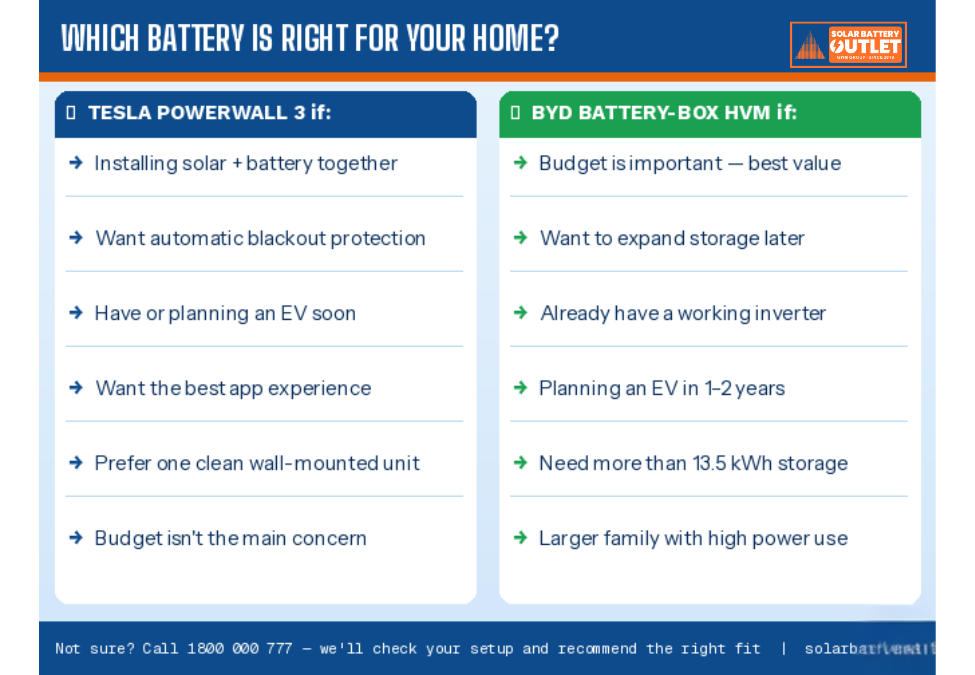
Get the Powerwall 3 if:

  • You already have a Tesla EV, or you’re buying one in the next 12 months
  • You want the best automatic blackout protection available — no fiddling, no manual switching
  • You want the cleanest single-unit installation with the fewest components
  • Budget isn’t your primary concern and you want the premium option
  • You have a larger home and 13.5 kWh fits your storage needs well

Who Should Get the BYD Battery-Box?

Get the BYD if:

  • You want flexibility to expand storage later — especially if an EV is on the horizon but not confirmed yet
  • You’re working with a tighter budget but don’t want to compromise on quality or warranty
  • Your existing solar system already has a BYD-compatible inverter
  • You’re looking at larger storage above 13.5 kWh — BYD scales better at the bigger end
  • You want strong value from a globally proven manufacturer without paying Tesla’s premium

What About the Rebate — Does It Affect the Choice?

Both batteries qualify for the federal Cheaper Home Batteries Program rebate, so you get the same percentage discount regardless of which one you choose.

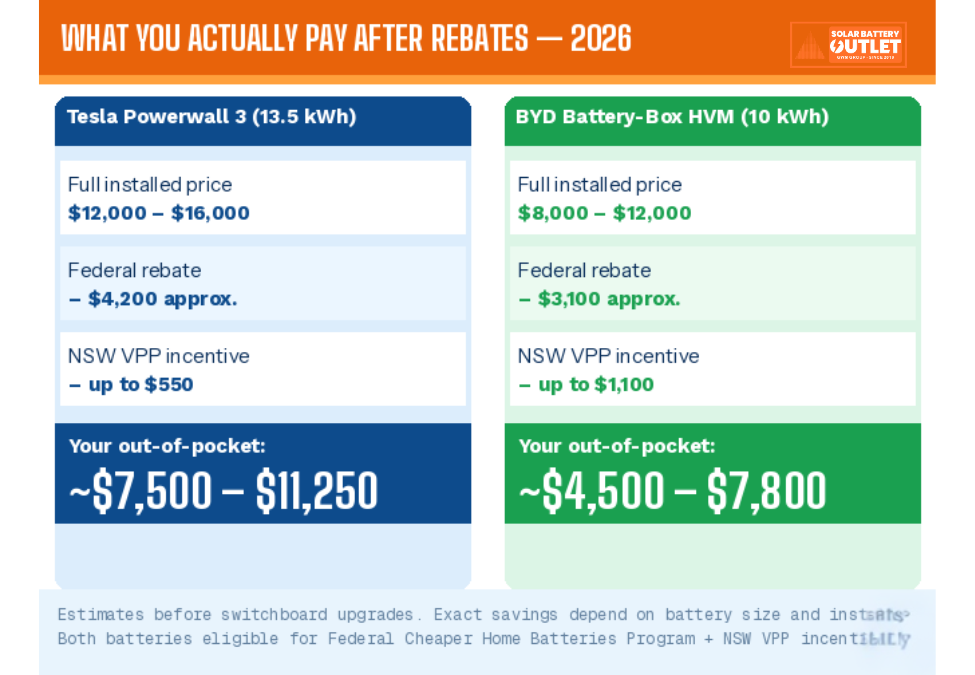
For the Powerwall 3 at 13.5 kWh, the rebate works out to around $3,600–$4,200 off the upfront cost before 1 May 2026. For a 10 kWh BYD setup, it’s around $2,800–$3,100 off.

On top of that, both qualify for the NSW VPP incentive — up to $1,500 extra for connecting to a Virtual Power Plant. That stacks with the federal rebate. So before your first electricity bill saving even kicks in, you could be $4,000 to $5,500 better off than the sticker price.

For the full breakdown on how the rebate works and what you actually need to do to claim it, read our Federal Battery Rebate NSW 2026 guide here.

The Price Gap — Is It Worth It?

This is the real question most people are sitting with.

The Powerwall 3 typically costs $2,000 to $4,000 more than a comparable BYD setup after rebates. Whether that’s worth it comes down to one main thing: the Tesla ecosystem.

If you’re an EV owner or planning to be one — that gap narrows fast. The energy management you get from pairing a Powerwall with a Tesla vehicle saves a meaningful amount in optimised charging over time, and that’s before you factor in the convenience of managing everything from one app.

If you’re not in the Tesla ecosystem and you just want reliable, expandable home battery storage with a strong warranty — BYD closes that gap completely. You’re not giving up quality. You’re just not paying for features you won’t use.

We’ve helped hundreds of families in Liverpool and South West Sydney work through exactly this decision. Most EV owners land on Powerwall. Most everyone else lands on BYD. That’s a genuine pattern, not a sales pitch.

A Note on Installation

Both batteries need to be installed by an SAA-accredited installer. This is not optional — if your installer isn’t SAA-accredited, you won’t qualify for the federal rebate. Full stop.

You can verify any installer’s accreditation at saaustralia.com.au before signing anything.

For what to look for (and what to avoid) when choosing an installer in the Liverpool area, our Solar Battery Liverpool NSW guide covers that in detail.

Frequently Asked Questions

Which lasts longer — Tesla Powerwall 3 or BYD Battery-Box?

Both carry a 10-year warranty with 70% capacity retention — so on paper they’re equal. Real-world lifespan for both is typically 10 to 15 years. For a deeper look at what actually affects battery lifespan in Australian conditions, see our How Long Does a Solar Battery Last in Australia guide.

Can I add more storage to the Tesla Powerwall 3?

Not in the traditional sense. You can add a second Powerwall 3 unit, which gives you 27 kWh total. It’s not modular like BYD — you’re adding a complete second unit rather than a storage module. For most households, one Powerwall 3 at 13.5 kWh is enough.

Does BYD work with any solar inverter?

Not any — but it works with a wide range. It’s compatible with most hybrid inverters from Sungrow, Fronius, SolarEdge and others. Your installer should confirm compatibility before quoting. If you already have solar and you’re not sure what inverter you have, check the brand name on the grey box near your switchboard.

Which battery is better for blackouts?

Tesla Powerwall 3 wins here. It switches to backup mode automatically with no manual input needed. BYD can handle blackouts too, but you need to confirm with your installer that backup mode is included in the system design — it’s not automatic on all setups.

Is either battery worth it if I’m adding to existing solar?

Yes — both are strong options for retrofitting onto an existing solar system. Whether adding a battery makes financial sense for your specific situation is a separate question worth working through. Our Is Adding a Battery to Existing Solar Worth It guide has the honest numbers on that.


Ready to get a quote for Liverpool or South West Sydney?

We install both Tesla Powerwall 3 and BYD Battery-Box HVM. We’ll tell you honestly which one suits your home — and we handle all the rebate paperwork so you don’t have to.

Call 1800 000 777

or fill in our 60-second form at solarbatteryoutlet.com.au


How Much More Does a Solar Battery Cost After 1 May 2026?

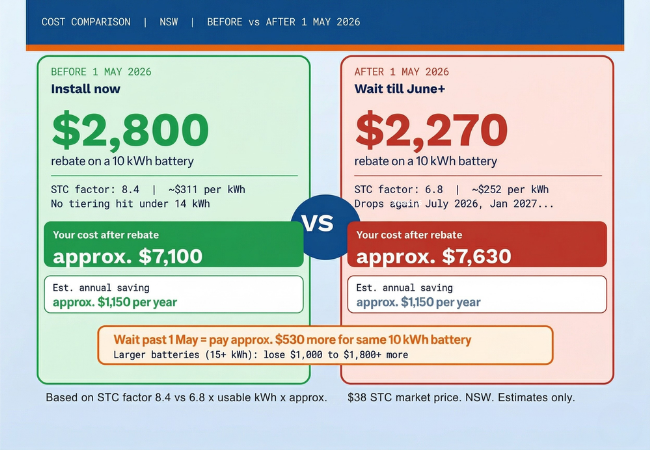
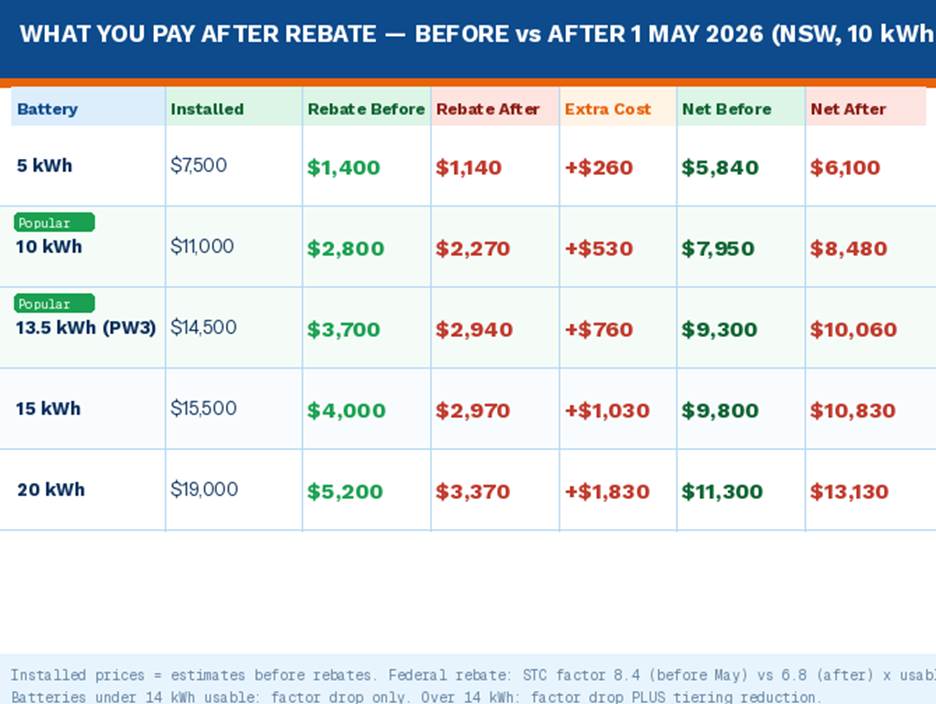
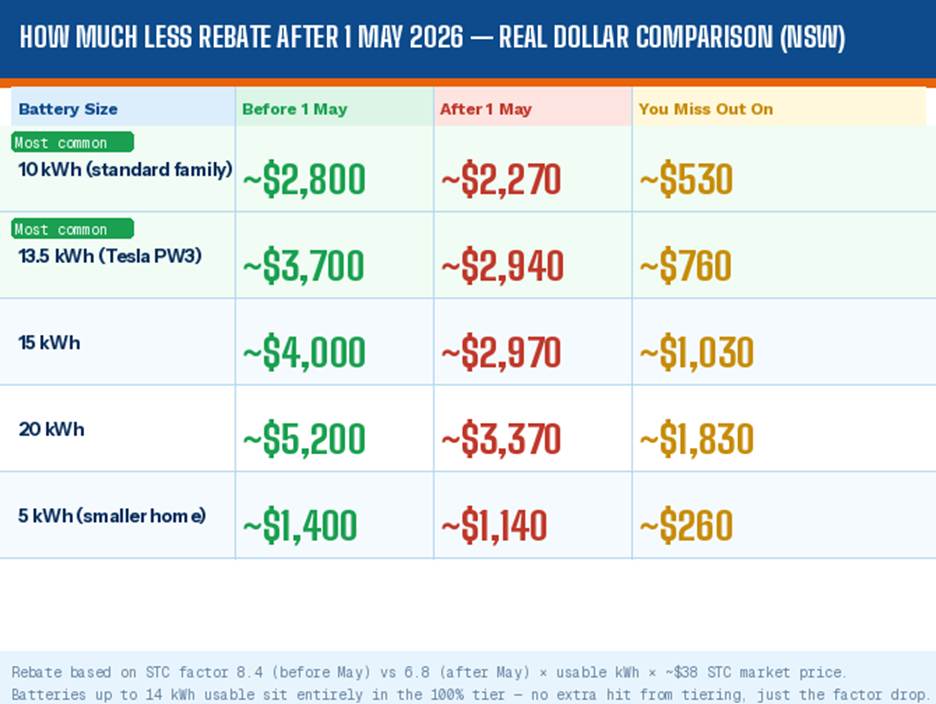
Short answer: for a standard 10 kWh battery, about $530 more. For a 13.5 kWh system like the Tesla Powerwall 3, about $760 more. For anything above 15 kWh, the gap widens significantly — $1,000 to over $1,800.

Here is exactly how those numbers work, why they are what they are, and what it actually means for your decision.

Why is the rebate dropping on 1 May? The federal Cheaper Home Batteries Program has been wildly popular since launching in July 2025 — installations jumped from about 200 per day to over 1,500 per day. The government expanded funding from $2.3 billion to $7.2 billion to keep the program running to 2030, but adjusted the rate downward to keep it sustainable. The rebate was always designed to reduce as battery prices fall over time.

The Full Cost Comparison — Every Common Battery Size

A few things worth noting from this table:

  • The ‘extra cost’ column is the difference in rebate between installing before and after 1 May 2026. It is not what the battery costs in total — it is what you lose in rebate value.
  • For batteries under 14 kWh usable capacity, the only hit is the STC factor dropping from 8.4 to 6.8. No tiering penalty applies.
  • For batteries over 14 kWh, there is a double hit — the factor drop AND the new tiered structure that applies reduced STC rates to capacity above 14 kWh. That is why the 20 kWh column jumps to $1,830 extra.
  • The annual saving from the battery itself does not change — that is determined by your electricity tariff and usage. The difference is purely in how much you pay upfront.

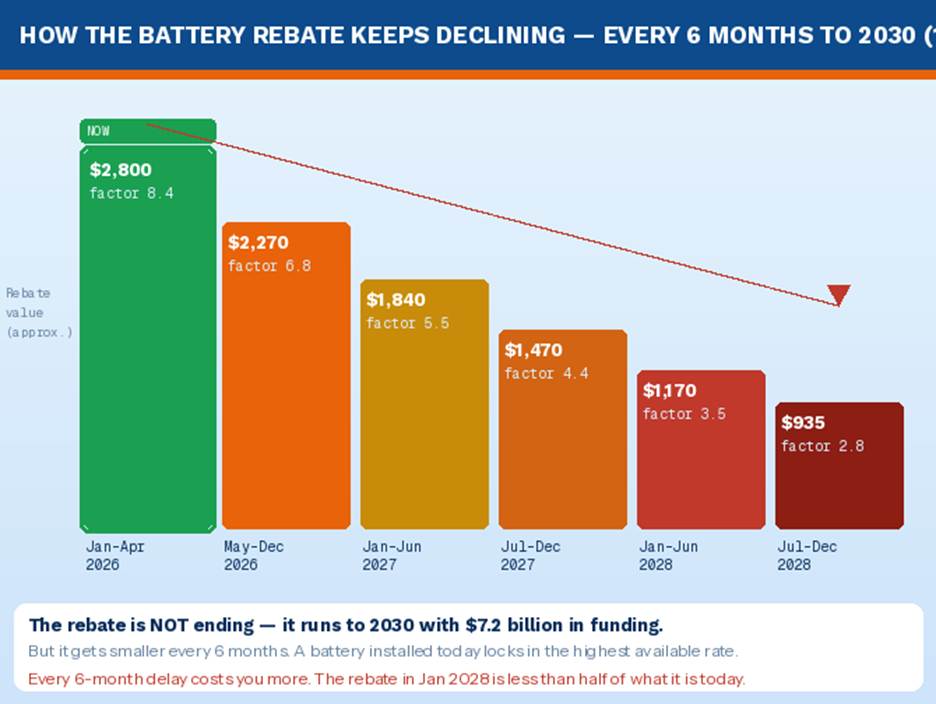
The Rebate Keeps Declining — Not Just in May

This is the part most people do not realise. The 1 May change is not a one-off. From May 2026, the STC factor steps down every six months. By January 2028, a 10 kWh battery that gets you $2,800 today will only get you around $1,170 in rebate — less than half.

The rebate does not disappear. The program runs to 2030 and has $7.2 billion behind it. But it is designed to wind down gradually as battery prices fall. Every six months you wait, the rebate is a little smaller.

The honest take on timing: If you are seriously considering a battery, the best time to install has always been before the next step-down. That is not a scare tactic — it is just how the scheme was designed. Whether that means acting before 1 May 2026 or before January 2027 depends on your situation. What it does mean is that waiting years to install will cost you significantly more than waiting months.

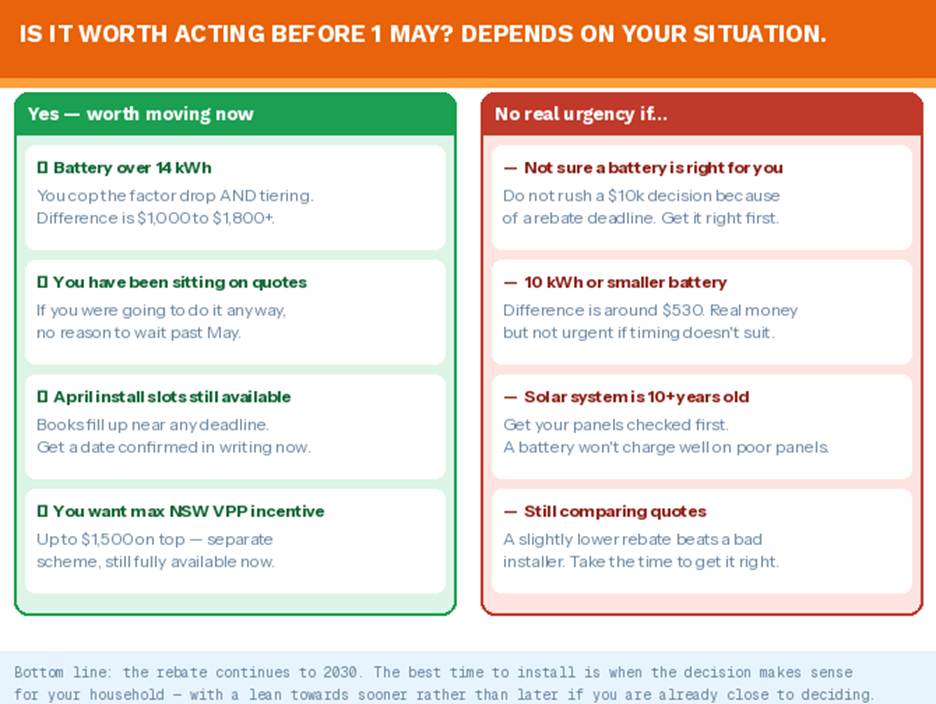
So Is the Extra Cost Worth Rushing For?

Whether $530 to $760 more is worth acting on before 1 May depends entirely on where you are in your decision. Let us be straight about it.

Worth moving now if…

  • You are considering a battery over 14 kWh — the tiering adds a second hit on top of the factor drop, so the cost difference is more substantial
  • You have already compared quotes and were getting around to booking — there is no good reason to delay past May
  • Your installer has April slots available — books do fill closer to any deadline, and the last thing you want is a rushed job
  • You want to claim the NSW VPP incentive alongside — up to $1,500 on top of the federal rebate, and fully available right now

No real rush if…

  • You are not yet sure a battery is right for your home — do not let a rebate deadline push you into a $10,000 decision you are not ready to make
  • You are still comparing quotes and need more time — a $530 saving means nothing if you end up with the wrong installer
  • Your solar system is old and needs checking first — a battery will not perform well on a degraded solar system
  • Your household does not yet use much power in the evenings — sort that question first before committing to storage

The bottom line is this: the rebate is real, the decline is real, and for most NSW families considering a battery, there is no compelling reason to wait past May if you are already close to deciding. But it should not be the thing that makes the decision for you.

What the Maths Actually Looks Like on Payback

Some people hear $530 and think that changes their payback calculation dramatically. It does not — at least not at the 10 kWh level. Here is a quick comparison:

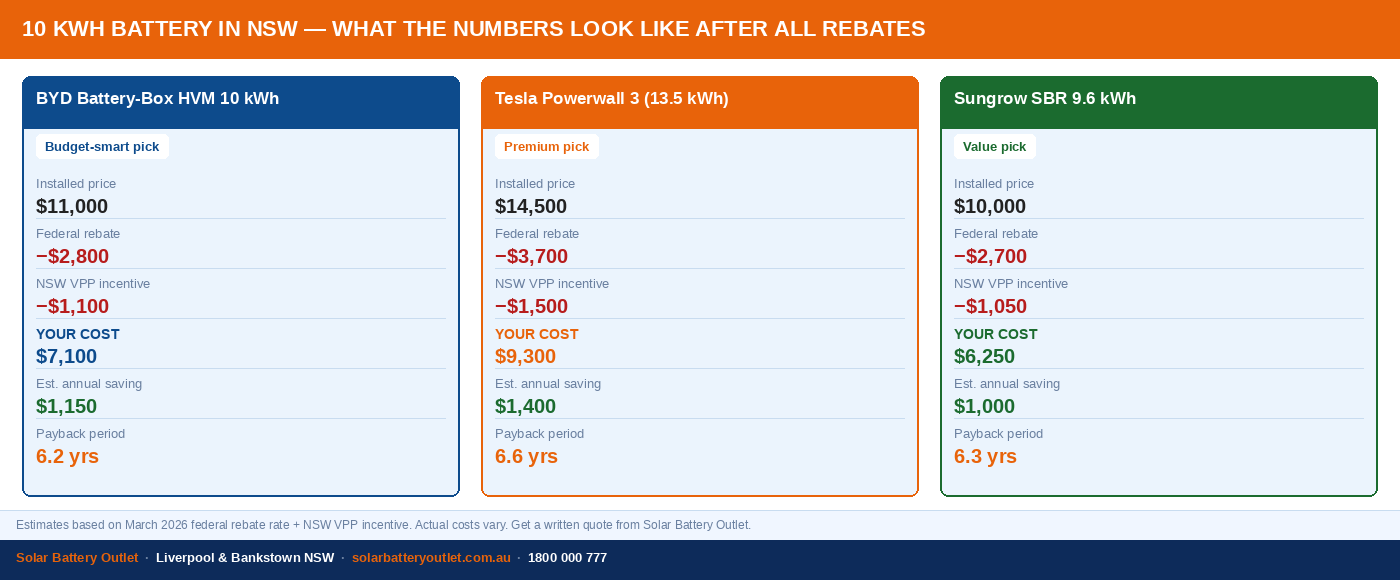
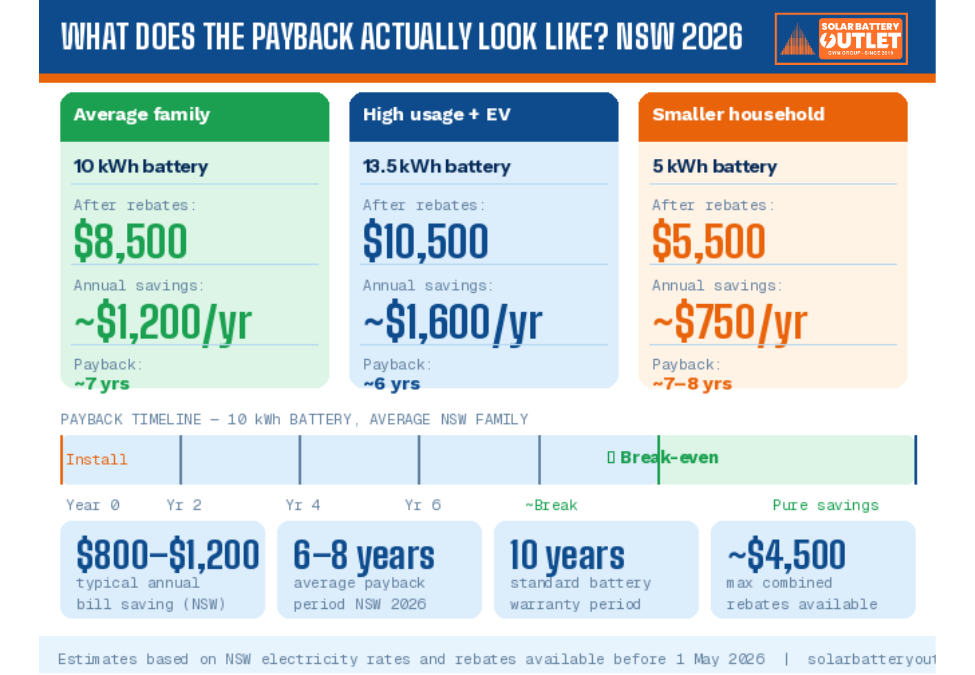
Payback comparison — 10 kWh battery, NSW family: Install before May 2026: Net cost ~$7,100 | Annual saving ~$1,150 | Payback ~6.2 years Install after May 2026: Net cost ~$7,630 | Annual saving ~$1,150 | Payback ~6.6 years Difference: 5 months on the payback period. Meaningful — but not dramatic for a 10+ year battery.

For a 20 kWh battery the gap is larger — about 18 months difference in payback. If you are planning a big system and the timing works, acting before May genuinely makes financial sense.

Frequently Asked Questions

Does the NSW VPP incentive also drop on 1 May?

No. The NSW Peak Demand Reduction Scheme is a separate state incentive — up to $1,500 for connecting your battery to a Virtual Power Plant. It is not affected by the 1 May federal changes. You can still stack both incentives.

If I sign a contract before 1 May, do I get the old rate?

No — and this is important. Your rebate is determined by the date the battery is physically installed and registered, not the date you sign. An installer who tells you to ‘sign now to lock in the rate’ without giving you an actual installation date before 1 May is not being straight with you. Get the confirmed install date in writing.

What if battery prices fall after May to make up the difference?

Possibly over time, but not on 2 May. Battery hardware prices have been falling slowly and gradually over years. The government rebate is designed to step down as those prices fall — the idea is that your net cost stays roughly similar over time. Whether that plays out exactly depends on market conditions, exchange rates and supply chains. No one can tell you with certainty what battery prices will do in June 2026.

Is it worth installing a bigger battery before May just to maximise the rebate?

Probably not. The tiering structure after May is specifically designed to reduce the incentive for oversizing. But even before May, you should size your battery for what your household actually needs — not to maximise certificate count. A battery that is too large for your solar and usage pattern will not charge fully most days, which wastes money and stresses the battery. Any good installer will tell you the same thing.

Want the Numbers for Your Specific Home?
Every home is a bit different — your bill, your solar size, your tariff and your evening usage all affect the real payback numbers. We are based in Liverpool and Bankstown and do a free no-obligation quote for NSW homeowners. We will show you the exact rebate you qualify for, both federal and NSW VPP, and the honest payback estimate for your situation.
Call us: 1800 000 777
Or visit solarbatteryoutlet.com.au — 60-second eligibility form, no sales call if you do not want one.
About Solar Battery Outlet We are a Liverpool-based solar battery installer, part of GWM Group Pty Ltd, servicing homes across South West Sydney, Bankstown, Campbelltown, and the greater NSW region. All installations are done by SAA-accredited electricians. We handle all rebate paperwork so you do not have to.

The Solar Battery Rebate Is Dropping on 1 May 2026 — Here Is What It Actually Means for NSW Homeowners

You have probably seen the ads. Maybe someone has knocked on your door. The message is always the same: the battery rebate is ending, act now, limited time, call today.

The rebate is not ending. That part is wrong.

But something IS changing on 1 May 2026, and it is worth understanding properly — because depending on the size of battery you are considering, it could mean anywhere from $260 to well over $1,800 less in your pocket if you install after that date.

This guide explains exactly what is changing, who it affects most, who barely notices, and what you should actually do about it — without the panic and without the pushy sales pitch.

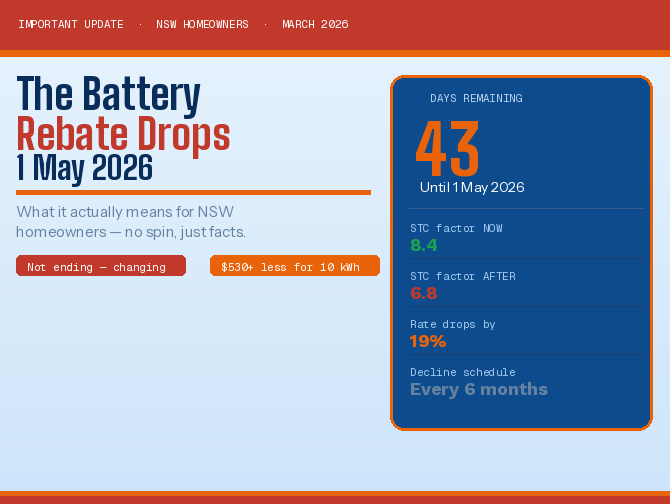
The short version: The federal rebate (called the Cheaper Home Batteries Program) continues until 2030. On 1 May 2026, the rate used to calculate the rebate drops. For a standard 10 kWh battery, that means roughly $530 less in rebate. For bigger systems over 14 kWh, the hit is larger due to a new tiered structure. The rebate continues after May — it just keeps getting a little smaller every six months.

How the Rebate Actually Works — Plain English

The federal battery rebate is delivered through something called Small-scale Technology Certificates — STCs. You do not need to understand the detail, but knowing the basics helps make sense of what is changing.

When you install a battery, your SAA-accredited installer creates a number of STCs based on your battery’s usable capacity. Those certificates have a market value — currently around $38 each. Your installer sells them and passes the savings directly to you as a discount on your invoice. You never see a government form. You never chase a cashback. It comes straight off the price.

The number of STCs your battery earns is calculated using a multiplier called the STC factor. Right now, that factor sits at 8.4. On 1 May 2026, it drops to 6.8. That is a 19% reduction. Smaller factor = fewer certificates = less money off your bill.

The Dollars — Before and After

These numbers are based on the STC factor dropping from 8.4 to 6.8, using a current STC market price of around $38 per certificate. The STC price does fluctuate slightly, so your actual rebate will vary — but the direction is clear.

For the most common battery size — 10 kWh — the difference is around $530. That is real money, but it is not the thousands some ads would have you believe. Be sceptical of anyone quoting you dramatic figures without showing you the maths.

Where the change does bite harder is on bigger batteries — anything above 14 kWh. That brings in the tiered structure.

The New Tiered Structure — Who It Hits Most

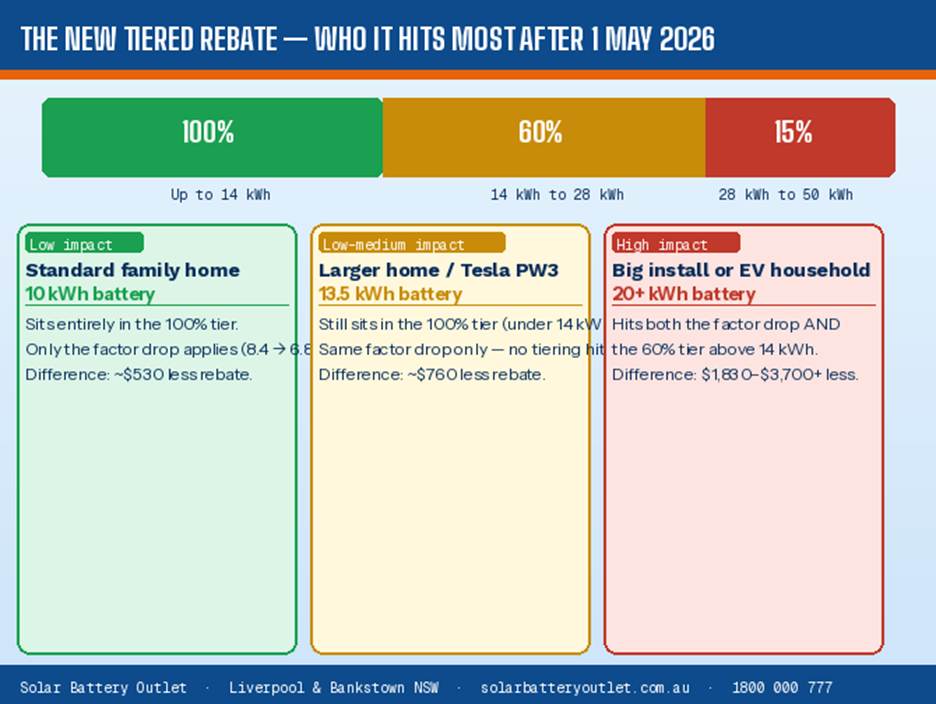
From 1 May 2026, there is also a new tiered rebate structure for larger batteries. This is separate from the factor drop and only affects systems above 14 kWh.

  • First 14 kWh of usable capacity: full STC factor applies — 100%
  • Between 14 and 28 kWh usable: STC factor applies at 60% — reduced support
  • Between 28 and 50 kWh usable: STC factor applies at just 15% — minimal support

The thing most people miss: if you are buying a standard 10 kWh or 13.5 kWh battery — which covers roughly 80% of residential installs in Australia — the tiering does not touch you at all. Your entire battery sits within the 100% tier. The only difference you feel is the factor drop from 8.4 to 6.8.

The tiering really bites for bigger systems — 20 kWh setups, whole-home installs, or anyone planning a large EV-charging-capable battery. If that is you, the maths on timing is pretty clear.

Why is the government doing this? Federal Energy Minister Chris Bowen called it ‘a victim of its own success.’ The program launched in July 2025 and immediately went off. Installations jumped from about 200 per day to over 1,500 per day. The original $2.3 billion budget was on track to run out well ahead of schedule. The government has now added $4.9 billion to keep the program going until 2030 — but adjusted the rate to make it more sustainable. The rebate is not going away. It is just being calibrated.

So — Is There Actually Any Rush?

Depends on your situation. Here is an honest breakdown.

You should probably get moving if…

  • You are considering a battery over 14 kWh — the tiering adds a meaningful extra hit on top of the factor drop
  • You have been sitting on quotes for a while and were going to get around to it — now is a sensible time to act
  • You want to lock in the current NSW VPP incentive rate as well — that is up to $1,500 on top of the federal rebate, and separate to all of this
  • Your installer is already booked out — April books tend to fill up as the deadline approaches

There is no real urgency if…

  • You are not yet sure a battery is right for your home — do not rush into a $10,000 decision because of a deadline
  • You are planning a 10 kWh or smaller battery and $530 is not the deciding factor in your budget
  • Your solar system is over 10 years old and needs checking first — get that sorted before adding a battery
  • You are comparing quotes and still need time — a slightly smaller rebate is better than the wrong installer

The rebate continues after 1 May. It does not fall off a cliff. It drops again in July 2026, then January 2027, and so on until 2030. The program was always designed to wind down gradually as battery prices fall. The best time to install is whenever the decision makes sense for your household — with a lean towards sooner rather than later.

What to Do Before 1 May — A Sensible Order

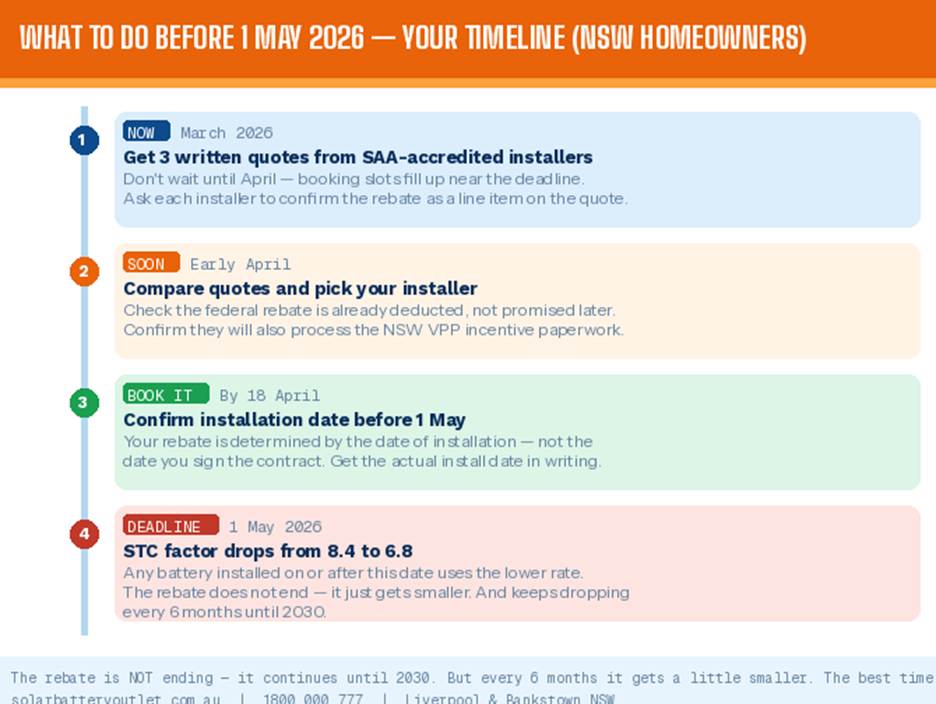
  • Get 3 written quotes from SAA-accredited installers now — not in late April when everyone else is scrambling
  • Ask each installer to confirm the rebate as a line item on the quote, not a verbal promise
  • Check they are also processing the NSW VPP incentive — up to $1,500 on top, and a separate step most homeowners miss
  • Confirm your actual installation date in writing — your rebate is calculated on the date the battery is physically installed, not the date you sign the contract
  • Verify SAA accreditation before accepting any quote at saaustralia.com.au
One thing to watch out for near any deadline: Some installers will use the 1 May date as a high-pressure sales tactic — door knockers especially. A legitimate installer will show you the maths, give you time to compare, and never pressure you to sign on the spot. If anyone refuses to put things in writing or pushes you for a same-day decision, walk away.

Frequently Asked Questions

Is the solar battery rebate ending in 2026?

No. The federal Cheaper Home Batteries Program continues until 2030. The rate used to calculate the rebate is being reduced from 1 May 2026, and will step down again every six months. The rebate gets smaller over time — it does not disappear.

Does the 1 May change affect the NSW VPP incentive as well?

No. The NSW Peak Demand Reduction Scheme incentive — worth up to $1,500 for connecting your battery to a Virtual Power Plant — is a separate state scheme and is not affected by the 1 May federal changes. You can still stack both.

My installer said I need to sign by a certain date to get the old rate. Is that true?

Partially. Your rebate is determined by the date the battery is physically installed and registered — not the date you sign a contract. Some installers do lock in installation slots in advance and will commit to booking you in before May. That is legitimate. What is not legitimate is pressure to hand over money based on a contract date alone. Get the actual installation date confirmed in writing.

What if I cannot get an installation slot before 1 May?

The rebate still applies after 1 May — just at a lower rate. A battery installed in June 2026 will receive around $530 less rebate than one installed in April (for a 10 kWh system). That is meaningful but not catastrophic. If the wait gets you a better installer or a better price, it can still be the right call.

Will battery prices drop after May to offset the rebate reduction?

Possibly over time, but not immediately on 2 May. Battery hardware prices in Australia have been gradually falling over several years. The federal rebate was designed to step down as prices fall, keeping the net cost relatively steady for homeowners. Whether that actually plays out depends on exchange rates, supply chains, and demand — which no one can predict reliably.

Want a Quote Before 1 May? We Are Based in Liverpool and Bankstown.
Our installation calendar for April is filling up. If you want to lock in the current rebate rate, now is a good time to get a written quote. No obligation, no pressure — just the numbers for your home. We handle both the federal rebate and NSW VPP incentive paperwork. You do not need to do a thing except say yes.
Call us: 1800 000 777
Or visit solarbatteryoutlet.com.au and fill in the 60-second eligibility form.
About Solar Battery Outlet We are a Liverpool-based solar battery installer, part of GWM Group Pty Ltd, servicing homes across South West Sydney, Bankstown, Campbelltown, and the greater NSW region. All installations are done by SAA-accredited electricians. We handle all rebate paperwork so you do not have to.

Best Solar Batteries Australia 2026: Our Top Picks for NSW Homes

There are over 30 solar battery brands available in Australia right now. Most of them will tell you they are the best. A few of them actually are.

We install solar batteries every week across Liverpool, Bankstown, Campbelltown and South West Sydney. We see which ones perform well, which ones give customers headaches, and which ones represent genuinely good value after rebates. This guide is based on that real-world experience — not sponsored rankings.

We have narrowed it down to six batteries that we are confident recommending to NSW homeowners in 2026. Here is how they compare, what each one is best for, and the real numbers after the federal rebate.

One thing before we start: Every battery on this list uses LFP (Lithium Iron Phosphate) chemistry. This is now the standard for quality home batteries in Australia — safer, longer-lived, and more heat-stable than older lithium-ion chemistries. If anyone quotes you a non-LFP battery for home storage in 2026, ask why.

The Quick Comparison — All Six Batteries Side by Side

A few things to note about this table before we go deeper:

  • All prices shown are after the federal Cheaper Home Batteries Program rebate (before 1 May 2026 rate of $311/kWh usable). NSW VPP incentive is additional.
  • Blackout protection is available on most batteries but is not automatic on all of them — you need to confirm with your installer that backup mode is included in the system design.
  • Expandable means you can add more battery modules later without replacing the whole system. This matters if you are planning to get an EV or expect your energy needs to grow.

The Real Numbers for NSW Homes — After All Rebates

These numbers assume a NSW homeowner claiming both the federal rebate and the NSW VPP incentive. The annual saving estimate is based on NSW peak electricity rates (~32 cents per kWh) versus the typical feed-in tariff (~6 cents), cycling a 9–10 kWh battery about 300 days per year.

Your actual numbers will vary depending on your tariff plan, how much power you use in the evenings, and whether you are connecting an EV. The point of this table is to show the relative value of each option — not to give you an exact quote.

The rebate deadline is real: The federal rebate rate drops after 1 May 2026. For a 10 kWh battery, installing before that date saves an extra $530 compared to installing in June 2026. It is not a trick — it is how the STC scheme works. Your installer applies the rebate directly on your invoice.

Each Battery — What We Actually Think

Tesla Powerwall 3 — Best for Premium Homes and EV Owners

The Tesla Powerwall 3 is the most recognised name in home batteries and it earns that recognition. It is a single 13.5 kWh unit with a built-in inverter, which simplifies installation and reduces the number of components that can fail over time.

What sets the Powerwall 3 apart in 2026 is its EV integration. If you have a Tesla vehicle — or are planning to get one — the Powerwall manages solar charging, home storage and car charging as one system through the Tesla app. That level of integration is not matched by any other battery on this list.

The blackout protection is also the best available — it switches automatically when the grid goes down, with no manual intervention. For families with medical equipment, young children, or just a strong preference for reliability, this matters.

  • Best for: EV owners, premium builds, households wanting best-in-class backup
  • Watch out for: Fixed capacity — you cannot expand it. If your needs grow significantly, you add a second unit
  • After rebates (NSW): Approximately $9,000–$13,000 installed for the 13.5 kWh system

BYD Battery-Box HVM — Our Most Recommended All-Rounder

BYD is one of the largest battery manufacturers in the world. Their Battery-Box HVM range is the battery we recommend most often to average NSW families — and for good reason.

It is modular. You can start with 8.3 kWh and expand up to 22.1 kWh by adding modules. If you are not sure how much storage you need right now, or if you expect to add an EV in a couple of years, this flexibility is genuinely valuable. You are not locked in.

The 10-year warranty covers 70% capacity retention, which is the better warranty threshold among the mid-range options. Installation is straightforward and it works with a wide range of inverters, which means it is a good retrofit option if you already have a solar system.

  • Best for: Families wanting flexibility to expand, good all-round performance, strong value
  • Watch out for: Needs a compatible hybrid inverter — confirm compatibility before quoting
  • After rebates (NSW): Approximately $5,500–$9,000 installed depending on module count

Sungrow SBR — Best Value for Performance

Sungrow is the world’s largest solar inverter manufacturer and their SBR battery range has benefited from that engineering heritage. The SBR delivers one of the best cycle ratings in this price range — rated at around 6,000 cycles — and scales from 9.6 kWh up to 25.6 kWh.

If your main priority is getting the most battery for your dollar without sacrificing quality, the Sungrow SBR is the one to look at closely. The 10-year warranty carries a 60% capacity threshold rather than 70%, which is slightly lower than BYD and Tesla — but at this price point, that trade-off makes sense for most households.

It pairs naturally with Sungrow’s inverter range, which many NSW homes already have installed. If you have a Sungrow inverter, this is often the most cost-effective and technically compatible upgrade.

  • Best for: Value-focused buyers, homes with existing Sungrow inverters, larger storage needs
  • Watch out for: Works best with Sungrow inverters. AC-coupling to other brands is possible but adds cost
  • After rebates (NSW): Approximately $5,000–$8,500 installed

Enphase IQ Battery 5P — The 15-Year Warranty Option

The Enphase IQ Battery 5P stands apart from everything else on this list for one reason: it is the only battery available in Australia with a 15-year warranty. For homeowners who want certainty beyond the standard 10-year window, that is a genuine differentiator.

It is also fully AC-coupled, which means it works with almost any existing solar inverter. If your current setup is a few years old and you want to add a battery without replacing anything else, Enphase is often the cleanest option technically.

The modular design means you can add units as needed. Each 5 kWh module can be installed independently, which is useful if you want to start small and grow. Fire safety credentials are also notable — the IQ 5P carries UL 9540 and UL 9540A fire safety certification, which is the highest standard available.

  • Best for: Long-term homeowners wanting 15-year coverage, retrofits onto any existing inverter, fire-safety conscious buyers
  • Watch out for: Higher cost per kWh than BYD or Sungrow. Physical stacking is not possible — separate units side by side
  • After rebates (NSW): Approximately $5,500–$9,000 for a 10 kWh setup

Growatt ARK-2.5H — Solid Budget Option

Growatt has grown quickly in Australia and their ARK-2.5H battery is worth considering if budget is the primary concern and you still want a quality system with a proper warranty.

The ARK-2.5H is modular starting from 5 kWh and scales up to 15 kWh. It pairs well with Growatt’s own inverter range. The 10-year warranty covers 60% capacity — the same as Sungrow — and the price point often makes it the most accessible entry into home battery storage.

It is a newer product in Australia compared to BYD and Tesla, which means the long-term real-world track record is shorter. That is not a reason to avoid it, but it is worth knowing.

  • Best for: Tighter budgets, smaller households, homes already using Growatt inverters
  • Watch out for: Shorter Australian track record than BYD or Tesla. Ask your installer about local warranty support
  • After rebates (NSW): Approximately $4,000–$7,000 installed

GoodWe Lynx Home U — Reliable Mid-Range Pick

GoodWe is a solid mid-range option that does not get as much attention as Tesla or BYD but consistently performs well in Australian conditions. The Lynx Home U works with GoodWe’s hybrid inverter range and delivers dependable performance for households that want a straightforward, no-fuss system.

Like Sungrow and Growatt, the 10-year warranty covers 60% capacity retention. Pricing is competitive and GoodWe has good local support in Australia — something worth checking for any brand you buy.

  • Best for: GoodWe inverter owners, households wanting a reliable mid-range option
  • Watch out for: Works best paired with GoodWe inverters — confirm compatibility
  • After rebates (NSW): Approximately $4,500–$7,500 installed

Which One Is Right for Your Home?

The honest answer is that the right battery depends more on your situation than on any feature comparison table. Here are the questions that actually drive the decision:

  • Do you already have a solar inverter? If yes — check which batteries are compatible before anything else. Retrofitting a compatible battery is cheaper and simpler than replacing your inverter.
  • Do you have or plan to get an EV? If yes — Tesla Powerwall 3 or a larger modular system like BYD is worth the premium for the integrated charging management.
  • Is budget your main driver? Sungrow SBR or Growatt ARK give you solid performance at the best price point. Do not let anyone pressure you into spending more than you need to.
  • Do you want maximum peace of mind over 15 years? Enphase IQ Battery 5P is the only option with a 15-year warranty in Australia right now.
  • Do you want to start small and expand later? BYD Battery-Box HVM or Sungrow SBR both allow modular expansion. Start with what you need today.
A note on brands we do not stock: There are other brands available in Australia — Alpha ESS and Sigenergy get mentioned often. We do not install them ourselves, so we are not going to pretend we can give you a fair comparison. Our recommendation is always to ask any installer specifically why they recommend what they recommend — and to get at least three quotes.

What to Watch Out For When Getting Quotes

A few things we see regularly that are worth knowing before you start talking to installers:

  • The cheapest quote is not always the best value — a low-cost battery with an incompatible inverter or poor installation will cost you more in the long run
  • Make sure the federal rebate is shown as a line item on the quote — not promised verbally or ‘applied later’
  • Ask specifically about blackout protection — not all system designs include it by default even when the battery supports it
  • Check if the installer will handle the NSW VPP incentive paperwork, not just the federal rebate
  • Verify SAA accreditation at saaustralia.com.au before accepting any quote

Frequently Asked Questions

Which battery has the best warranty in Australia in 2026?

Enphase IQ Battery 5P offers the longest warranty at 15 years with 70% capacity retention. For 10-year warranties, Tesla Powerwall 3 and BYD Battery-Box HVM both guarantee 70% capacity at end of warranty — slightly better than the 60% threshold offered by Sungrow, Growatt and GoodWe.

Can I use any battery with my existing solar system?

Not necessarily. DC-coupled batteries generally need to be matched to a compatible hybrid inverter. AC-coupled batteries like Enphase IQ Battery 5P work with almost any existing system, which makes them a popular choice for retrofits. Always confirm compatibility with your installer before committing.

Does it matter which brand I choose if the installation is good?

Installation quality matters a lot — a poorly installed premium battery will underperform a well-installed mid-range one. But brand does matter for warranty support, firmware updates, and the quality of the battery management system over time. The brands on this list all have real Australian presence and established warranty processes.

Are these batteries safe to have in the house?

LFP batteries have a very strong safety record in residential installations in Australia. They do not suffer from the thermal runaway issues associated with older lithium-ion chemistries. All the batteries on this list meet Australian safety standards. Your installer will position the battery in a compliant location as part of the installation.

Get a Quote for Any of These Batteries — Solar Battery Outlet
We stock and install Tesla Powerwall 3, BYD Battery-Box HVM, Sungrow SBR, Growatt ARK-2.5H, Enphase IQ Battery 5P and GoodWe Lynx Home U across Liverpool, Bankstown, Campbelltown and South West Sydney. We handle all rebate paperwork — federal and NSW VPP incentive.
Call us: 1800 000 777
Or visit: solarbatteryoutlet.com.au
About Solar Battery Outlet We are a Liverpool-based solar battery installer, part of GWM Group Pty Ltd, servicing homes across South West Sydney, Bankstown, Campbelltown, and the greater NSW region. All installations are done by SAA-accredited electricians. We handle all rebate paperwork so you do not have to.

Solar Energy | Australia | Updated March 2026

How Long Does a Solar Battery Last in Australia? (Real Answers)

When you spend $8,000-$14,000 on a solar battery, the lifespan question is completely reasonable. You want to know if it will still be doing its job in year 8. Year 10. Maybe beyond.

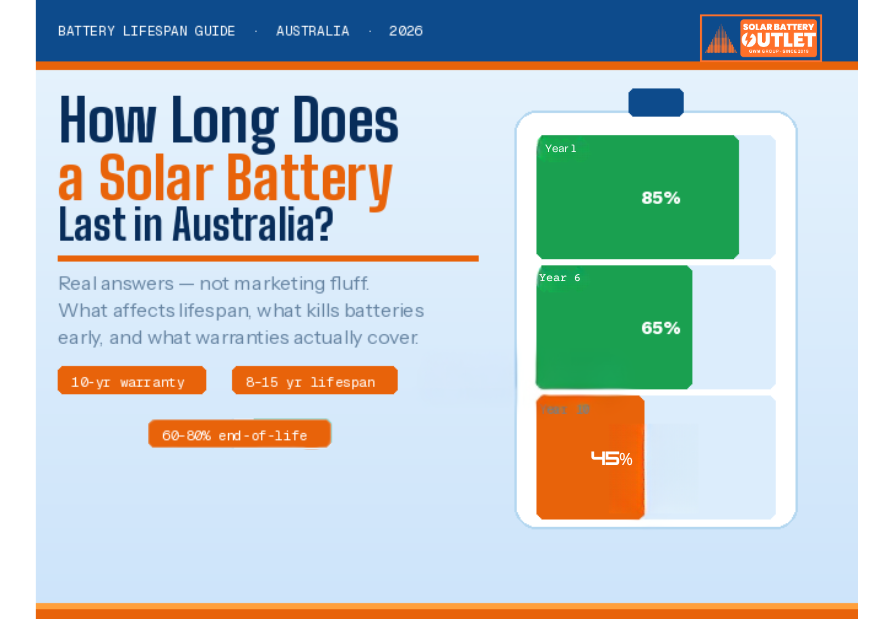
The honest answer: most quality solar batteries installed in Australia today will last between 10 and 15 years in real-world conditions. The 10-year warranty you see on most brands is not just marketing — it is a legally binding capacity guarantee. But there is a lot of nuance between ‘lasts 10 years’ and ‘performs well for 10 years.’

This guide covers what actually determines how long a battery lasts, what affects performance over time, what your warranty really covers (and what it does not), and the questions to ask before you buy.

Quick answer for busy homeowners: A quality LFP solar battery installed correctly in Australia will typically retain 70-80% of its original capacity after 10 years. That means if you install a 10 kWh battery today, expect it to deliver 7-8 kWh in year 10. Most warranties guarantee at least 60-70% capacity at the end of the warranty period. After that, the battery continues working — just with gradually reduced storage.

The Short Version: Battery Chemistry Is the Starting Point

Almost every quality solar battery sold in Australia in 2026 uses LFP chemistry — Lithium Iron Phosphate. This matters because LFP is fundamentally more stable, safer, and longer-lived than older lithium-ion chemistries.

LFP batteries do not overheat and fail in the same ways older chemistries did. They handle more charge cycles without as much degradation. And they do not carry the same fire risk that made earlier batteries concerning for home installation.

If a salesperson is talking to you about a non-LFP battery for home storage in 2026, ask why. The answer should be very specific.

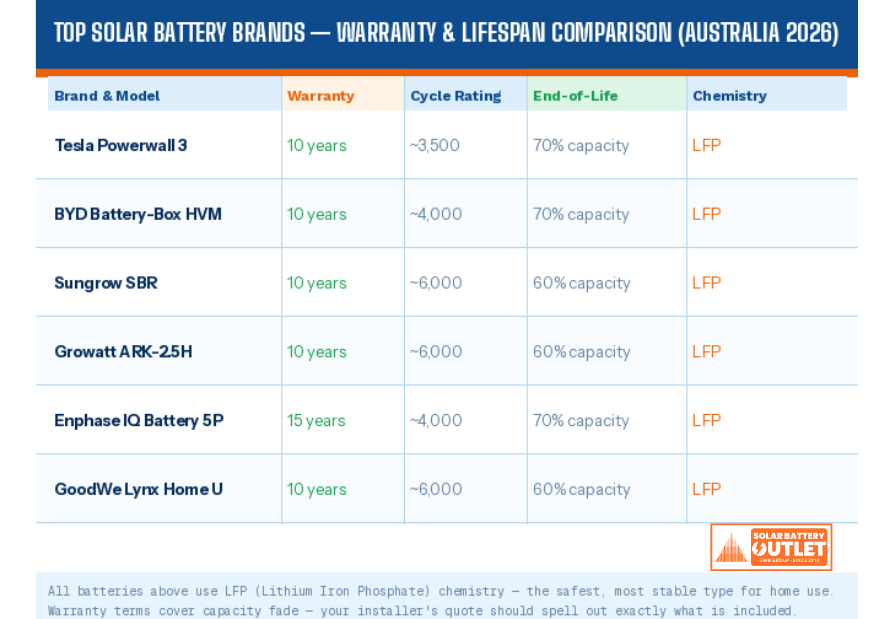
top solar battery brands

What the Numbers Actually Mean

When a battery manufacturer says ‘4,000 cycles at 80% depth of discharge’, here is how to read that:

  • 4,000 cycles means 4,000 full charge/discharge cycles before capacity falls to the warranted threshold
  • One cycle per day = roughly 11 years of daily use before hitting that threshold
  • 80% depth of discharge means they tested by draining 80% of capacity each cycle
  • Real-world usage is typically less aggressive — real-world lifespan is often longer than the cycle rating implies

The Enphase IQ Battery 5P is notable for offering a 15-year warranty — the longest available in Australia right now. That is a genuine differentiator if long-term peace of mind is your priority. The trade-off is higher upfront cost compared to 10-year options.

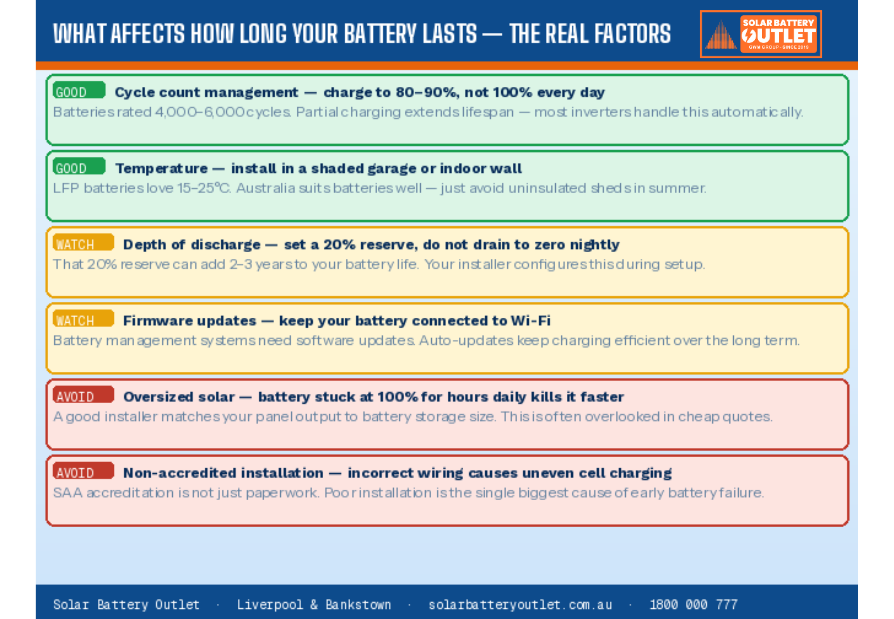
Six Things That Actually Determine How Long Your Battery Lasts

1. How You Charge It — Partial vs Full Cycles

This is the single biggest factor most homeowners do not know about. Charging your battery to 100% every single day and draining it to 0% every night is the fastest way to reduce its lifespan — the battery equivalent of redlining your car engine daily.

Most good inverters have a setting to cap charging at 80-90% and keep a reserve of 10-20% at the bottom. Your installer should configure this during setup. If they do not mention it, ask them to.

Practical tip: Ask your installer what depth of discharge and charge ceiling they recommend for your specific battery and inverter combination. This one conversation could add years to your battery’s life.

2. Temperature — Where You Install It Matters

LFP batteries perform best between 15 and 25 degrees Celsius. Australia’s climate is actually well-suited to battery storage — most of the country stays comfortably within that range for most of the year.

The issue is installation location. A battery bolted to an uninsulated shed wall in Penrith or Bankstown in January, facing west, can hit 45 degrees on a hot afternoon. That repeated heat stress accelerates capacity fade significantly.

  • Best locations: internal garage wall, laundry, shaded external wall under an eave
  • Avoid: uninsulated sheds, west-facing external walls in direct afternoon sun, under roof spaces with no ventilation
  • In QLD and SA especially: ask your installer about thermal management for your specific install location

3. Depth of Discharge — The Reserve Setting

Every battery has a ‘depth of discharge’ setting — how far down it depletes before stopping. Running at 100% depth of discharge every day will measurably shorten lifespan compared to running at 80%.

Most installer setups include a default reserve of 10-20%. That is not dead capacity — that is protection for the battery cells. Think of it like keeping your car fuel above the ‘E’ instead of running it dry every time.

4. Firmware and Software Updates

Solar batteries have battery management systems (BMS) — software that controls how the battery charges, discharges, and protects itself. That software receives updates, just like your phone.

Missing firmware updates can mean your battery is not charging as efficiently as it should, or is not applying the cell-balancing algorithms that protect long-term health. Most brands push updates automatically via your home Wi-Fi. Keep your battery app connected and check occasionally that it is running current firmware.

5. Solar Panel Sizing — Do Not Go Too Big

Counterintuitively, a solar system that is much larger than your battery can shorten the battery’s life. If your panels generate far more than the battery can absorb, the battery reaches 100% early in the day and then sits there for hours — stressing the cells over time.

A well-designed system matches panel output to battery storage capacity. This is something a competent installer considers during system design. If you are retrofitting a battery to an existing large solar system, ask specifically whether the panel output is appropriate for the battery you are choosing.

6. Quality of Installation

Incorrect wiring — including improper cell connections, wrong inverter configuration, or poor earthing — causes uneven charging across battery cells. This accelerates capacity fade and in worse cases causes premature failure.

This is the practical reason SAA (Solar Accreditation Australia) accreditation matters for battery installation. It is not bureaucracy — it is the technical standard that prevents installation errors that shorten lifespan. You can verify any installer’s accreditation at saaustralia.com.au before accepting a quote.

What Your Warranty Actually Covers

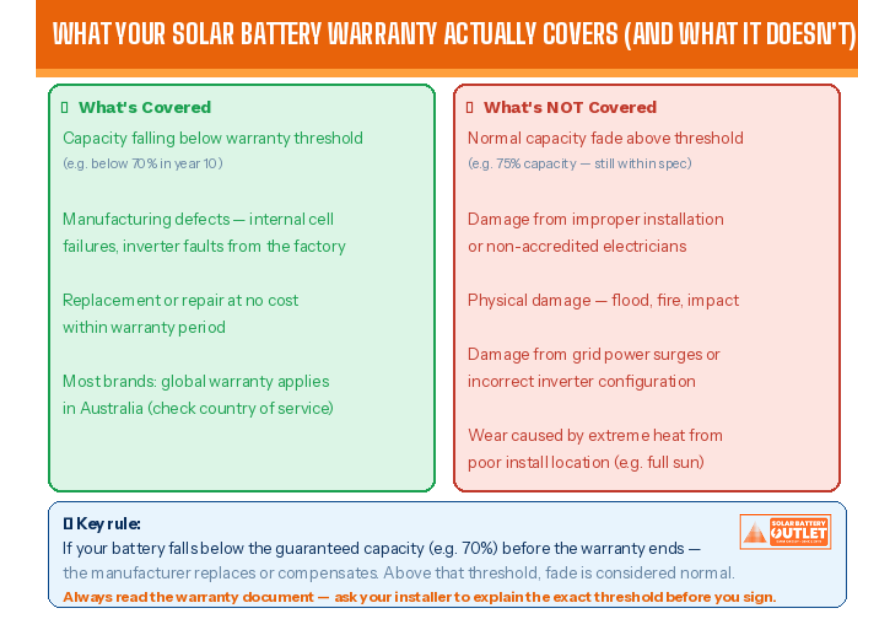
what your solar battery actually coversery warranty

Capacity Warranty vs Product Warranty

Capacity warranty — the more important one — guarantees that your battery will retain a minimum percentage of its original storage capacity for a set number of years. Common thresholds are 60% or 70% of original capacity at the end of year 10.

Product warranty — covers manufacturing defects, component failures, and premature failure. This is standard and typically runs 10 years for most brands.

If your battery falls below the guaranteed capacity threshold before the warranty ends, the manufacturer is obligated to replace it or compensate you. If it stays above that threshold — even at 72% capacity in year 9 — that is within spec and not a warranty claim.

The Question to Ask Before You Sign

Ask: “What is the exact capacity threshold in the warranty, and at what year?”

Some brands warrant 70% at year 10. Others warrant 60% at year 10. A battery that retains 70% of 10 kWh is giving you 7 kWh in year 10. A 60% threshold battery might only deliver 6 kWh. For most households — especially with growing EV use — that difference matters.

What happens after the warranty period? The battery keeps working — it just continues degrading gradually without the manufacturer’s capacity guarantee. Most quality LFP batteries continue functioning well beyond their warranty period. A 10 kWh battery at 65% capacity in year 12 is still delivering 6.5 kWh — still useful, just less than day one.

How to Get the Most Life Out of Your Battery — Practical Tips

  • Ask your installer to configure the charge ceiling at 80-90% and a 10-20% reserve at the bottom
  • Keep your battery monitoring app installed and check firmware update notifications
  • Choose an install location that stays under 35 degrees in summer — shaded garage or indoor wall
  • If your solar system is over 10 kW, confirm with your installer that battery sizing is appropriate
  • Do not skip maintenance checks — most brands recommend a system check at year 5
  • If you notice the battery depleting faster than usual, check the monitoring app for error codes before calling a technician

Frequently Asked Questions

Can I replace the battery cells when they degrade, rather than the whole unit?

For most residential batteries, no — they are sealed units. BYD Battery-Box is modular, meaning you can add capacity or swap modules, but individual cell replacement is not a standard consumer option. When a battery reaches end-of-life, the whole unit is replaced or recycled.

Does the battery still work during a blackout as it gets older?

Yes — backup capability is not directly related to capacity degradation. A battery at 70% capacity still provides blackout protection, just for a shorter duration than when new. If your 10 kWh battery is at 7 kWh capacity in year 10, it will keep your essentials running for about 70% of the time it originally could.

What happens to the battery at the end of its life?

LFP batteries are recyclable. Australia’s battery recycling infrastructure has improved significantly — most installers and manufacturers have take-back or recycling programs. Ask about this when getting quotes. Reputable installers will have a clear answer.

Is a 15-year warranty worth paying extra for?

It depends on your situation. If you are planning to stay in your home for 15+ years and want certainty, the Enphase IQ Battery 5P’s 15-year warranty is a genuine differentiator. If your planning horizon is 10 years, or you expect to upgrade technology at the 10-year mark anyway, the standard 10-year options deliver very strong value.

Do batteries degrade faster in hot climates like Queensland or South Australia?

They can — if the install location is poor. The solution is not to avoid batteries in hot climates; it is to install them correctly. SA homeowners actually have some of the strongest battery economics in the country thanks to high electricity prices, despite the warm climate.

Want a Quote for a Solar Battery in Sydney or South West NSW?
We are based in Liverpool and Bankstown, servicing all of South West Sydney and beyond. Our team will recommend the right battery size for your home and handle all rebate paperwork — federal and NSW VPP incentive.
Call us: 1800 000 777
Or visit: solarbatteryoutlet.com.au
About Solar Battery Outlet We are a Liverpool-based solar battery installer, part of GWM Group Pty Ltd, servicing homes across South West Sydney, Bankstown, Campbelltown, and the greater NSW region. All installations are done by SAA-accredited electricians. We handle all rebate paperwork so you do not have to.

Solar Battery Guide | NSW | Updated March 2026

Is Adding a Battery to Existing Solar Worth It in 2026? (NSW Analysis)

You already have solar panels. Good. They’ve been doing their job — generating power during the day, cutting your bills, and for a while there, earning you a decent feed-in tariff.

But here’s what’s changed. The money you get for sending power back to the grid has dropped to almost nothing. Most NSW households are now getting 5 to 8 cents per kilowatt-hour — while buying power at night for 30 cents or more. You’re giving away solar energy for almost nothing, then paying full price to run your house after dark.

That gap — and the government rebate that now makes batteries roughly 30% cheaper upfront — is why the question of adding a battery to existing solar has shifted from ‘probably not yet’ to ‘this actually makes sense for a lot of homes’.

This guide is for NSW homeowners who already have solar and want an honest look at whether a battery is worth it in 2026. No fluff, no sales pitch. Just the numbers and the honest answer.

The Short Answer For most NSW households who use power mainly in the evenings, have a feed-in tariff below 8¢/kWh, and get electricity bills above $300/quarter despite having solar — yes, adding a battery in 2026 is worth it. The combination of low feed-in tariffs, rising grid electricity prices, and the current government rebate makes the payback period shorter than it has ever been.

Why the Numbers Finally Make Sense in NSW

For years, solar batteries were the answer to a question the maths hadn’t quite justified yet. The panels paid for themselves easily, but the batteries were expensive and the payback stretched beyond the warranty period.

Two things changed that:

  • Feed-in tariffs collapsed. Where NSW households were once earning 15–20¢ per kWh for exported solar, most are now on 5–8¢. Some retailers are offering as little as 3¢. The incentive to send power to the grid has almost disappeared.
  • The federal rebate arrived. From July 2025, the Cheaper Home Batteries Program cut roughly 30% off the upfront cost of an eligible battery — applied directly to your invoice. That one change shortened payback periods by years.

The core reason a battery makes sense in NSW: every kWh you store is worth 6× more than every kWh you export

The maths is this simple: right now in NSW, every kilowatt-hour of solar you export earns you roughly 5 cents. Every kilowatt-hour you store in a battery and use at night saves you roughly 30 cents. That’s a 6-to-1 difference in value.

A household that exports 4,000 kWh per year earns about $200 from the grid. That same 4,000 kWh stored and used at night saves roughly $1,200 off the electricity bill. Same solar energy. Very different outcome.

Is a Battery Actually Worth It for Your Home?

The honest answer depends entirely on your usage patterns, your existing solar system, and your electricity bills. Here’s a plain breakdown:

When a battery makes sense for your NSW home — and when it’s better to wait

The situations where it makes the most sense

  • Your electricity bill is still over $300 per quarter despite having solar. This tells us you’re drawing a lot of power from the grid — usually in the evenings. A battery captures your daytime solar and uses it to power those evening hours instead of buying grid power at peak rates.
  • Most of your household usage happens between 4pm and 10pm. Families with kids home from school, people finishing work in the evening — this is the most common pattern in Liverpool and South West Sydney. It’s also the most expensive time to use grid power. A battery flips that.
  • Your feed-in tariff is below 8 cents per kWh. If you’re getting 5–8¢ for every kWh you export, you’re effectively gifting your solar energy to the grid for a fraction of its real value. Storing it instead is the financially smarter move.
  • You have an electric vehicle, or you’re planning to get one. Charging an EV overnight from the grid at peak rates costs significantly more than charging it from stored solar. If an EV is on your radar in the next year or two, a battery starts paying back even faster.
  • You’ve experienced power outages. South West Sydney gets more grid outages than people realise, especially in summer storms. A battery with backup capability keeps your lights, fridge, and essentials running when the grid goes down.

The situations where it’s better to wait

  • Your solar system is older than 10 years. Panels degrade over time — typically losing around 0.5% output per year. A system that’s 10-plus years old might be generating 30–40% less than it did when new. Adding a battery to a weak solar system means the battery may rarely fully charge. In this case, a full solar and battery upgrade together often makes more financial sense.
  • You’re mostly home during the day. If you work from home and run appliances through the day, you’re already using your solar as it generates. There’s less surplus to store — and a battery adds less value than it would for a household that’s out all day.
  • You’re planning to sell within 2–3 years. Battery payback periods in NSW currently sit at 6–8 years. If you’re selling before you see the return, the investment benefits the next owner more than you. It may add some value to the property, but not dollar for dollar.
  • Your inverter is very old or incompatible. Some older inverters — particularly those more than 8–10 years old — can’t integrate with a modern battery. Ask an installer to check your existing inverter before you commit to anything. You may need an inverter upgrade, which adds cost.

What the Rebates Actually Mean for Your Out-of-Pocket Cost

The cost conversation changed significantly when the federal Cheaper Home Batteries Program launched. Here’s what’s currently available for NSW homeowners:

  • Federal Cheaper Home Batteries Program: Roughly 30% off the upfront installed cost of an eligible battery. Applied directly to your invoice — you don’t apply for it separately. For a 10 kWh system that’s around $3,100 off automatically.
  • NSW VPP Incentive (Peak Demand Reduction Scheme): Up to $1,500 for connecting your battery to a Virtual Power Plant. A VPP just means your battery joins a software network that helps stabilise the grid at peak times. Your battery stays in your home. Most homeowners are comfortable with it, and you can claim this on top of the federal rebate.
Important: Rebate Rate Drops After 1 May 2026 The federal rebate is currently at $311 per usable kWh of battery capacity. From 1 May 2026, this drops to $252 per usable kWh — and will decrease again every 6 months after that. If you’re seriously considering a battery this year, getting your installation done before May 2026 locks in the higher rate. For a 10 kWh battery, the difference is around $600.

What Does the Payback Actually Look Like?

This is the question that matters most. Here’s an honest picture for three common NSW household types:

Estimated payback scenarios for NSW households adding a battery to existing solar in 2026

A few important notes on those numbers:

  • These figures assume NSW electricity rates of around 30¢/kWh at peak times, which is consistent with what most Liverpool and South West Sydney households are currently paying
  • Annual savings can increase over time as electricity prices rise — which they have done consistently in NSW
  • Joining a VPP adds modest ongoing payments or bill credits on top of the bill savings shown above
  • The payback clock starts from installation day — not from when you first get interest in buying

Does Your Existing Solar System Work With a Battery?

This is a practical question many homeowners skip, and it matters. Not every existing solar setup is battery-ready without changes.

  • Inverter compatibility: Battery-ready hybrid inverters are now standard in new installs, but older systems often have a basic string inverter that can’t directly interface with a battery. You may need an AC-coupled battery (which works alongside your existing inverter) or an inverter replacement. A good installer will tell you which applies before you sign.
  • Solar system size: Most batteries work best when paired with at least 6.6 kW of solar panels. If your existing system is smaller — say 3–4 kW — it may not generate enough surplus to charge a 10 kWh battery fully each day. A battery sized to match your actual solar output is worth discussing with your installer.
  • System age and output: Ask your installer to check your current generation data before recommending a battery size. If your panels are performing well, great. If output has degraded significantly, a smaller battery — or a full system upgrade — may be the smarter path.
What to Ask Your Installer Before You Commit Before agreeing to anything, ask your installer three questions specific to your existing system: (1) Is my current inverter compatible with the battery you’re recommending? (2) Is my solar system generating enough to fully charge a battery most days? (3) Does my switchboard need upgrading before installation? Any reputable installer will check all three before quoting — not after you’ve signed.

The Right Battery Size for an Existing Solar Home

Bigger isn’t always better. The right battery size depends on how much solar surplus you generate and how much power you use after dark.

A rough guide for NSW homes adding a battery to existing solar:

  • 5 kWh battery: Good for smaller households with lower evening usage. Lower upfront cost, shorter payback. Less useful if you have high power loads after dark or an EV.
  • 10 kWh battery: The sweet spot for most average NSW families. Covers typical evening usage, charges reasonably from a standard 6.6 kW solar system, and qualifies for good rebate value.
  • 13–15 kWh battery: Worth considering if you have high evening usage, an EV, or you want stronger blackout protection. Make sure your solar system is large enough to charge it reliably.

The most common mistake we see is homeowners buying the largest battery available because it feels like better value. A battery that doesn’t fully charge every day because your solar system can’t fill it is not giving you the return the numbers suggest.

Frequently Asked Questions

Can I add a battery if I already claimed the old NSW battery rebate?

The old NSW Empowering Homes program ended on 30 June 2025. If you claimed that previously, you may still be eligible for the current NSW VPP Incentive — provided your battery meets the technical requirements for VPP participation. Ask an installer to check your existing setup.

Do I need to switch electricity retailers to get a battery?

Not necessarily, but some VPP providers do require you to use their energy retail partner to join the VPP incentive. This is worth understanding before signing up — some VPP offers are genuinely good value, others are less clear. Ask your installer to explain the full terms of any VPP they recommend.

Will a battery work during a blackout?

Only if it’s installed with blackout protection capability enabled — and not all battery and inverter combinations support this by default. When getting quotes, always ask specifically: ‘Does this installation include automatic blackout protection?’ and confirm it’s included in the system design, not an optional extra.

How long does the installation take on an existing solar home?

For a home with a compatible inverter and a switchboard that’s already up to standard, a battery installation typically takes 4 to 6 hours. If a switchboard upgrade is needed or the inverter needs replacing, it may take a full day. Your installer should give you a clear time estimate when they quote.

What happens to my feed-in tariff when I add a battery?

Your feed-in tariff stays the same. Adding a battery doesn’t change your contract with your energy retailer. What changes is how much you export — because instead of sending surplus solar to the grid for 5¢, you’re storing it for use at night instead. You’ll likely export less, which is the whole point.

Want to Know If a Battery Makes Sense for Your Specific Home?
We’re a Liverpool-based installer servicing all of South West Sydney. We’ll check your existing solar system, your bills, and your inverter compatibility before recommending anything. No obligation, no pressure.

Call us: 1800 000 777

Or fill in our 60-second eligibility check at solarbatteryoutlet.com.au
About Solar Battery Outlet We’re a Liverpool-based solar battery installer, part of GWM Group Pty Ltd, servicing homes across South West Sydney, Bankstown, Campbelltown, Mudgee, and the greater NSW region. All installations by SAA-accredited electricians. We handle federal rebate and NSW VPP incentive paperwork so you don’t have to.

Getting a solar battery quote is the easy part. Getting the right installer — one who actually knows what they’re doing, handles all the rebate paperwork, and will still be around in three years when you have a question — that’s the part most people underestimate.

And in Liverpool and South West Sydney right now, the quality of installers varies enormously. The government rebate has brought a lot of new companies into the market — some excellent, some not. Knowing who to trust before you sign anything could save you thousands.

This guide covers the exact things to check, the green flags that tell you an installer knows their stuff, the red flags that should make you walk away, and the five questions every Liverpool homeowner should ask before handing over a deposit.

Why the Installer Matters More Than the Brand Most homeowners spend hours researching battery brands — Tesla vs BYD vs Sungrow — and about ten minutes checking the installer. That’s the wrong way around. A good battery installed poorly will underperform for its entire 10-year life. A great installer who knows your suburb, handles your rebate paperwork, and is still taking calls in year five is worth far more than the brand name on the wall.

The One Non-Negotiable: SAA Accreditation

This is not optional. Any installer doing a battery installation in NSW must be accredited by Solar Accreditation Australia (SAA). This replaced the old CEC (Clean Energy Council) accreditation system from mid-2024.

Here’s why it matters directly to you: if your installer is not SAA-accredited, you cannot claim the federal Cheaper Home Batteries rebate. That’s up to $4,200 off a Powerwall or $3,100 off a BYD system — gone, just because you didn’t check a number.

You can verify any installer’s accreditation free of charge at saaustralia.com.au. It takes about 30 seconds. Do it before you agree to anything.

Important: CEC vs SAA — What Changed From 30 May 2024, the Clean Energy Council (CEC) handed over all accreditation to Solar Accreditation Australia (SAA). Any installer who was CEC-accredited should now hold an SAA accreditation number. If an installer gives you a CEC number and claims it’s still valid, that’s a red flag — ask for their SAA number specifically.

Green Flags vs Red Flags — What to Look For

Here’s a plain-English guide to what separates a good installer from one you should avoid:

Green flags that show a trustworthy installer vs red flags that mean walk away — Liverpool NSW 2026

A few of those red flags are worth expanding on:

  • ‘We’ll sort the rebate later’ is never acceptable. The federal rebate must be shown as a line item deduction on your written quote. If an installer says they’ll ‘process it afterwards’ or ‘you’ll get it as cashback’, that’s either incompetence or dishonesty. Either way, get a different quote.
  • Door-to-door solar sales are still common in Liverpool. We hear from customers regularly who were pressured into signing at the door. A legitimate installer will always give you time to compare quotes. If anyone tells you a deal expires today — hang up or close the door.
  • Interstate companies with no local team are a real risk. Your battery needs to work for 10 years. If your installer is based in Brisbane or Melbourne and has no service team in South West Sydney, who do you call when something goes wrong in year four? Always ask where the service technicians are physically based.

5 Questions to Ask Every Installer Before You Sign

These questions take two minutes to ask. The answers will tell you everything you need to know about whether an installer is worth trusting:

The 5 questions every Liverpool homeowner should ask before signing a solar battery quote

Question 1: What is your SAA accreditation number?

A confident, reputable installer will give you this number without hesitation. Take it, write it down, and verify it at saaustralia.com.au before you go any further. If they can’t give you a number or become evasive — stop right there.

Question 2: Is the federal rebate shown as a deduction on this quote?

It must appear as a clear dollar deduction on the written quote — not a verbal promise, not ‘we’ll sort it at invoice stage’. The rebate should read something like: ‘Federal Cheaper Home Batteries discount: – $3,100’. If it’s not there, ask them to redo the quote.

Question 3: Do you process the NSW VPP incentive (PDRS)?

This is the NSW state incentive of $550 to $1,500 for connecting your battery to a Virtual Power Plant. Some installers skip this because it involves extra compliance steps. If they look confused when you ask — or say they don’t handle it — that’s money you’re leaving on the table. Find an installer who does both.

Question 4: Does my switchboard need upgrading?

Liverpool homes built in the 1980s and 1990s often have older switchboards that can’t safely handle a battery installation. A switchboard upgrade typically costs $500 to $1,500. A good installer will check this during the site assessment and tell you upfront. An installer who doesn’t raise this at all — and then hits you with an extra charge after you’ve signed — is one to avoid.

Question 5: Where is your service team based?

Ask specifically: ‘Where are your technicians physically based? What is your typical response time for a service call in Liverpool?’ A company with a local South West Sydney team can have someone at your door within a day or two. A company whose nearest team is in another state might take weeks — or worse, subcontract to someone unfamiliar with your system.

What Every Good Quote Should Include

Once you’ve asked your questions and you’re ready to compare written quotes, here’s exactly what should be on every page:

Full checklist of what a trustworthy solar battery quote must include — Liverpool NSW 2026

The most commonly missing items we see on Liverpool quotes are:

  • The NSW VPP incentive. Many quotes show the federal rebate but not the NSW state incentive. If it’s missing, ask explicitly — don’t assume they’ll add it later.
  • Switchboard work. If a switchboard upgrade is needed, it must be on the quote before you sign — not added as a surprise on installation day.
  • Grid connection registration. This is a legal requirement in NSW. Your installer must register the system with your network provider (e.g. Ausgrid or Endeavour Energy). If it’s not mentioned, ask who handles it.

How Many Quotes Should You Get?

Three is the right number. Not two, not five — three. Here’s why:

  • One quote gives you no reference point — you have nothing to compare it against
  • Two quotes and you might still pick the wrong one based on a coin flip
  • Three quotes gives you a genuine picture of what the market looks like in Liverpool right now
  • Beyond three, you’re spending time comparing minor differences and creating decision fatigue

When you compare quotes, always compare the after-rebate price — not the sticker price. And make sure all three quotes are for the same battery model and capacity, otherwise you’re comparing apples with oranges.

A Note on Cheap Quotes

The cheapest quote in Liverpool is rarely the best value. Here’s what cheap quotes often hide:

  • A lower-grade battery brand not on the CEC approved product list
  • Missing switchboard work that will be charged separately on the day
  • No monitoring software included — you’ll pay for it later
  • An interstate company with no local service team
  • The NSW VPP incentive not processed — saving them admin, costing you money

A difference of $500–$800 on a quote from a fully accredited local company with a solid service team is almost always worth it over a decade of battery ownership.

Frequently Asked Questions

How do I verify an installer’s SAA accreditation?

Go to saaustralia.com.au and use the accreditation status check tool. Enter the installer’s name or their SAA number. It’s free and takes about 30 seconds. If their name doesn’t appear or their accreditation has lapsed — do not proceed.

Can I use any installer or does it have to be someone specific?

You can use any SAA-accredited installer — you’re not locked to one company. What matters is that whoever does your installation is SAA-accredited at the time of installation. The installer then processes the rebate paperwork with the Clean Energy Regulator on your behalf.

What if something goes wrong after installation?

Your battery and inverter come with manufacturer warranties (typically 10 years). For installation workmanship, your installer is responsible. This is exactly why a local company with a real team in South West Sydney matters — you need someone you can actually reach. Always ask about the installer’s own warranty on their workmanship before signing.

Is it okay to get quotes from companies I find online vs local?

Online quotes and comparison sites are fine as a starting point. But always confirm the company has actual installers and service technicians based in Liverpool or South West Sydney — not just a national call centre. Ask directly: ‘Who will physically do my installation and where are they based?’

Get a Quote from a Liverpool-Based, SAA-Accredited Installer

We’re based locally in Liverpool and service all of South West Sydney. SAA-accredited electricians. We handle the federal rebate and NSW VPP incentive paperwork — and we’ll always tell you if your switchboard needs upgrading before you sign.

Call us: 1800 000 777

Or fill in our 60-second eligibility form at solarbatteryoutlet.com.au
About Solar Battery Outlet We’re a Liverpool-based solar battery installer, part of GWM Group Pty Ltd, servicing homes across South West Sydney, Bankstown, Campbelltown, Mudgee, and the greater NSW region. All installations by SAA-accredited electricians. We handle all rebate paperwork — federal and NSW — so you don’t have to.

Solar Battery Comparison | Sydney NSW | Updated March 2026

Tesla Powerwall 3 vs BYD Battery: Which Is Better for Sydney Homes in 2026?

If you’ve gotten past the ‘should I get a battery?’ question and now you’re comparing brands, you’ve probably landed on these two names. Tesla Powerwall. BYD Battery-Box. They come up in every online comparison, and half the time those comparisons leave you more confused than when you started.

So here’s a straight answer, written for NSW homeowners — not for people who enjoy reading spec sheets.

Short version: both are excellent batteries. The differences are real, but they’re not dramatic. Which one is right for you comes down to your budget, your existing solar setup, and what you actually want the battery to do.

Let’s go through it properly.

What Both Batteries Have in Common Before we compare them, it helps to know what they share. Both Tesla Powerwall 3 and BYD Battery-Box HVM use LFP (lithium iron phosphate) chemistry — which means they’re safe, long-lasting, and thermally stable in Australian heat. Both carry 10-year warranties. Both are on the CEC approved product list and eligible for the federal Cheaper Home Batteries rebate and the NSW VPP incentive. Neither is a bad choice. The question is which one fits your situation better.

Quick Specs Side by Side

Let’s get the technical stuff out of the way first. Here’s how they compare on the key numbers:

Tesla Powerwall 3 vs BYD Battery-Box HVM — full specs comparison including winner per category

A few things worth explaining from that table:

  • The built-in inverter is Tesla’s biggest practical advantage. Most batteries need a separate ‘hybrid’ inverter to work. Tesla has one built in. If you’re installing from scratch or your old inverter is due for replacement anyway, this saves you $1,500–$2,500 right away.
  • BYD’s modularity is its biggest practical advantage. You can start with a 10 kWh system and add more modules later without replacing the whole battery. Tesla requires a whole new unit if you want to expand beyond 13.5 kWh.
  • ‘Blackout backup’ depends on your setup. Tesla handles this automatically — if the grid goes down, it switches instantly. BYD can do it too, but only if paired with the right inverter. Ask your installer to confirm before buying.

What Does Each Battery Actually Cost in 2026?

This is what most people really want to know. Here’s the honest pricing picture after rebates are applied:

What you actually pay after the federal rebate and NSW VPP incentive — Tesla vs BYD 2026

The BYD comes in meaningfully cheaper — typically $2,000–$4,000 less out of pocket than Tesla after rebates. For a lot of Liverpool and South West Sydney families, that gap matters.

The Tesla commands a premium because of the integrated inverter, the polished app, and the brand name. If you’re doing a fresh solar + battery install or your old inverter needs replacing, that premium shrinks significantly — because you’d have to buy an inverter for BYD anyway.

Bottom line: if budget is your main concern, BYD wins clearly. If you’re doing a full system install and want one product to do everything, Tesla’s price gap narrows fast.

The 1 May 2026 Rebate Deadline — Applies to Both The federal Cheaper Home Batteries rebate rate drops from 1 May 2026. This applies equally to Tesla and BYD. Getting your installation confirmed before that date locks in the current (higher) rebate regardless of which brand you choose. If you’re reading this in March or April 2026, now is the time to get your quotes sorted.

Which One Should You Actually Buy?

Honest answer: it depends on your situation. Here’s our plain-English guide:

Decision guide — choose Tesla Powerwall 3 or BYD Battery-Box based on your actual situation

Choose Tesla Powerwall 3 if:

  • You’re installing solar panels and a battery together (the integrated inverter saves real money)
  • You want true automatic blackout protection — Tesla switches seamlessly, no configuration needed
  • You have an EV or plan to get one — Tesla’s app handles smart EV charging really well
  • You want the cleanest, most user-friendly app experience for monitoring your energy
  • Your existing inverter is old and needs replacing anyway — factor that cost in
  • Design matters to you — the Powerwall is wall-mounted and genuinely looks good

Choose BYD Battery-Box HVM if:

  • Budget is your priority — BYD is typically $2,000–$4,000 cheaper after rebates
  • You want to expand your storage capacity later as your needs grow (e.g. when you get an EV)
  • You already have a compatible hybrid inverter (Fronius, Sungrow, GoodWe, etc.) working fine
  • You’re a larger family or run a home office and need more than 13.5 kWh of storage
  • You want a proven, reliable system without paying for the Tesla brand premium
  • Your installer is more experienced with BYD — installation quality matters more than brand

What About Other Brands?

Tesla and BYD get most of the attention, but they’re not the only strong options available in NSW. If you’re getting quotes, it’s worth asking about:

  • Sungrow SBR: The best value per kWh on the market right now. Requires a Sungrow hybrid inverter, so it’s most cost-effective if you’re doing a combined solar + battery install. Excellent reliability.
  • Growatt ARK: Newer to the Australian market but growing fast. Good tech at a competitive price point. Worth considering for smaller homes or tighter budgets.
  • Enphase: The premium modular option — each panel gets its own microinverter and battery module. More expensive, but the most resilient system design. Good for shaded roofs.

We install all of these. The ‘best’ brand for your home really does depend on what inverter you already have, your storage needs, and your budget. A good installer will go through this with you honestly — not just push the brand with the highest margin.

Questions to Ask Before You Decide

Before you lock in any brand, ask your installer these questions:

  • “What inverter do I currently have — and is it compatible with this battery?” If you have a working hybrid inverter, BYD might pair perfectly at lower cost. If you don’t, Tesla’s all-in-one is worth considering.
  • “Does this battery support automatic blackout switching?” Tesla yes. BYD depends on inverter — confirm this explicitly before buying.
  • “Is this battery modular? Can I add capacity later?” BYD yes. Tesla requires a second unit. Important if you’re planning an EV in the next 2–3 years.
  • “What’s the net cost after the federal rebate and NSW VPP incentive?” Always compare after-rebate prices. The sticker price gap between Tesla and BYD is bigger than the real gap after rebates.

Frequently Asked Questions

Can I retrofit either battery to my existing solar system?

Yes — both can be added to an existing system. Tesla is AC-coupled, meaning it connects directly without needing a new inverter. BYD is DC-coupled, which means it needs a compatible hybrid inverter. If you already have a compatible inverter, BYD is a great retrofit option. If you don’t, you’ll need to factor in the inverter cost.

Which battery has better blackout protection?

Tesla Powerwall 3 handles blackouts automatically — the switch happens within milliseconds and most people don’t even notice the grid went down. BYD can provide blackout protection too, but it depends entirely on the inverter it’s paired with. If blackout backup is important to you, confirm this in writing before you sign any quote.

Is BYD a reliable brand?

Absolutely. BYD (Build Your Dreams) is one of the largest battery manufacturers in the world — they also make EV batteries for Toyota, Ford, and their own electric cars. Their battery tech is mature, widely tested, and the Battery-Box has a strong track record in Australia. The 10-year warranty is solid and backed by their Australian office.

What if I want more than 13.5 kWh of storage?

BYD is the better choice here. You can expand a BYD system by adding modules — either at installation or later. Tesla Powerwall 3 is fixed at 13.5 kWh per unit. You can install a second Powerwall to get 27 kWh, but that’s a much bigger upfront investment.

Which brand holds its value better if I sell my house?

Tesla has stronger brand recognition with buyers, which may add slightly more perceived value to a property listing. That said, any quality battery brand adds value — the bigger factor is the age of the system and remaining warranty at point of sale.

Not Sure Which Battery Is Right for Your Home?
We install both Tesla and BYD across Liverpool, Bankstown, Campbelltown, and South West Sydney. We’ll check your existing setup, compare the real after-rebate costs, and recommend the battery that gives you the best return — not the one with the highest margin.
Call us: 1800 000 777
Or fill in our 60-second eligibility form at solarbatteryoutlet.com.au
About Solar Battery Outlet We’re a Liverpool-based solar battery installer, part of GWM Group Pty Ltd, servicing homes across South West Sydney, Bankstown, Campbelltown, Mudgee, and the greater NSW region. All installations by SAA-accredited electricians. We handle all rebate paperwork — federal and NSW — so you don’t have to.