
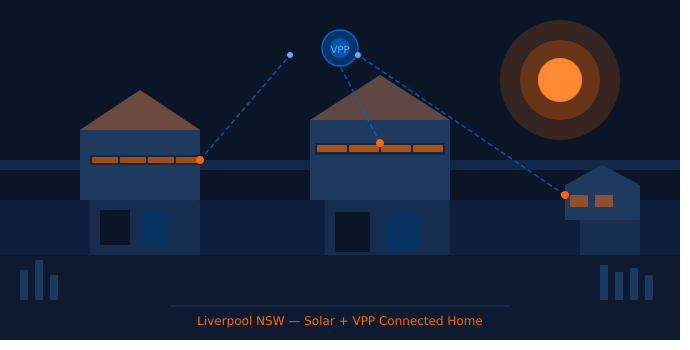
Liverpool NSW home with rooftop solar panels

Most Liverpool homeowners looking at solar batteries in 2026 know about the federal rebate. What most don’t realise is that the NSW State Bonus comes with a condition: your battery must be connected to a Virtual Power Plant. No VPP, no bonus. This article explains what that means for your money, your control, and your privacy.

The Rebate That Has Strings Attached

For a typical Liverpool household installing a 10 kWh system, the NSW VPP incentive may be available if the battery is connected to an eligible Virtual Power Plant and the applicable program requirements are met. The amount available will depend on the battery, the VPP provider and current scheme rules, and should be confirmed in your quote.

But here is what catches most people off guard: non-VPP batteries do not qualify for the NSW Battery Incentive. Participation in the Peak Demand Reduction Scheme requires VPP-capable hardware with active communications enabled. 

What Is a Virtual Power Plant?
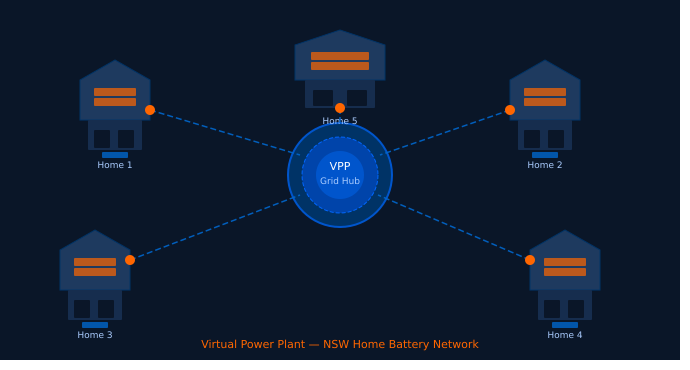
Virtual Power Plant

A Virtual Power Plant is a group of home batteries connected through the internet. The batteries don’t have extra wires or special hardware — they stay right where they are in your home. A VPP works by linking these batteries together through software, allowing them to all respond to energy demand simultaneously. When the grid comes under pressure — such as during a heatwave — the VPP can draw a small amount of stored power from the network to help stabilise it. 

The bidirectional data exchange between the individual batteries and the VPP enables not just control commands but also real-time data on capacity utilisation, feed-in levels, consumption data, and storage charge levels. 

The NSW State Bonus: What the 2026 Scheme Actually Looks Like
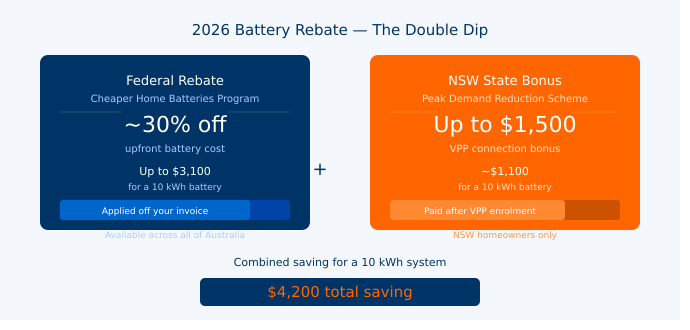
Battery Debate- Double Dip

From 1 July 2025, the NSW Government introduced the Virtual Power Plant (VPP) Incentive, replacing the previous battery installation rebate which ended on 30 June 2025. The Federal Government pays for the physical hardware — the tank — while the NSW Government pays for the grid flexibility — the tap. By allowing a VPP to occasionally draw from your battery during peak demand, you receive an additional incentive of up to A$1,500. 

Battery SizeFederal RebateNSW VPP IncentiveTotal Saving
5 kWh~$1,550~$550~$2,100
10 kWh~$3,100~$1,100~$4,200
13.5 kWh~$3,720~$1,350~$5,070
15 kWh~$4,200~$1,500~$5,700


The Privacy Question Most Installers Don’t Raise
 Privacy / Data Shield

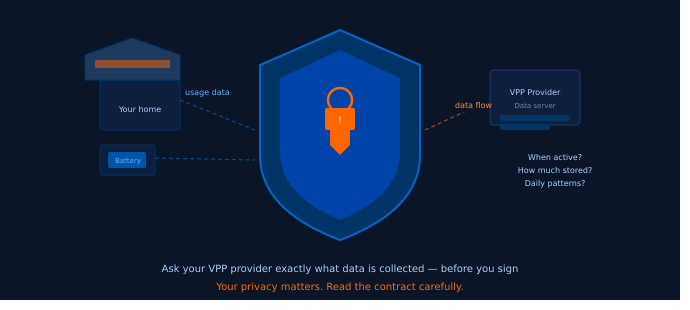
VPP operators can see which assets are producing energy, which are consuming energy, and which have energy stored. The biggest practical trade-off of joining a VPP is giving that operator visibility over your home devices.

As VPPs require collecting and sharing large amounts of data, there are genuine concerns about data privacy and the potential misuse of consumer information.

Ongoing efforts to improve cybersecurity measures for VPPs are underway, but it remains a risk worth considering. Experts recommend asking your VPP provider directly about what data they collect and what security measures they use to protect it.

“You’re in Control” — What That Actually Means

If you want the NSW State Bonus, VPP enrolment is a requirement, not a suggestion. Given that NSW residential electricity prices rose by up to 9.7% from July 2025, according to the Australian Energy Regulator, and have continued rising a further 4.3% over the past six months, EnergyPlans, that is real money for most Liverpool households.

The Hardware Requirement That Locks It In
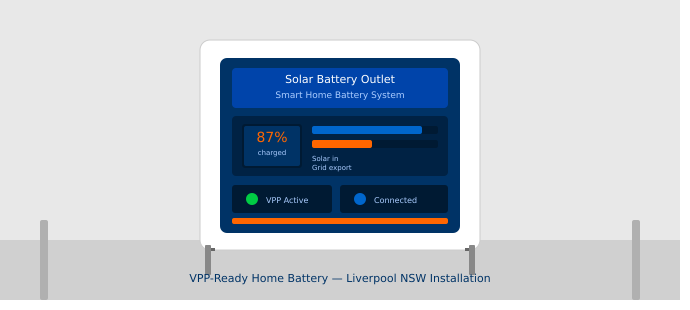
Battery Installation Unit

VPP readiness requires the system to be internet-connectable and capable of responding to remote signals at all times. 

If a system is installed in self-consumption only mode without VPP capability enabled, the NSW Battery Incentive is invalid. 

The Grid Stability Case — It’s a Real Argument

Connecting more batteries across NSW to Virtual Power Plants is a core part of the state’s plan to reduce NSW emissions by 70% by 2035 and achieve net zero by 2050. NSW Government

Australians installed 85,000 home battery units in the first half of 2025 alone — a 191% increase on the same period the year prior. That momentum accelerated further with 183,245 batteries installed in the second half of 2025 after the Cheaper Home Batteries Program launched. 

The Numbers Liverpool Residents Should Know

  • More than 236,000 batteries have been installed nationally since the Cheaper Home Batteries Program launched in July 2025.
  • NSW recorded 4,782 new residential battery installations in the first half of 2025 alone — the highest of any Australian state. 
  • Battery adoption in Australia sits at just 15% of households despite solar penetration reaching 43%. 
  • NSW residential electricity prices rose up to 9.7% from July 2025, making the financial case for battery storage stronger than ever.

What Liverpool Homeowners Should Do Before Signing

  1. Ask your installer which VPP provider they work with — then read that provider’s privacy policy before signing.
  2. Confirm the contract terms around dispatch events and minimum charge reserve settings.
  3. Verify your installer is SAA-accredited at saaustralia.com.au before accepting any quote.
  4. Ask directly: “Do you process the NSW Peak Demand Reduction Scheme incentive?” — not all installers bother because it involves extra compliance steps. 
  5. Compare VPP providers — you are not obligated to use the one your installer recommends.

FAQs

Q: Is VPP participation mandatory to get the NSW State Bonus?

Yes. Batteries running in self-consumption only mode are not eligible for the PDRS incentive worth up to $1,500.

Q: Does joining a VPP mean I lose control of my home battery?

Not entirely — but you do share access. How often the operator can use your battery depends on the VPP — check the agreement. You set a minimum charge reserve through your app.

Q: What happens to my personal data when I join a VPP?

Your provider gains real-time visibility of your energy patterns. Each provider has their own privacy policy — read it before enrolling.

Q: Can Liverpool homeowners combine both rebates?

Yes. Federal rebate (~30% off upfront) plus NSW VPP incentive (up to $1,500) can be stacked. The federal rate steps down after 1 May 2026 — the NSW incentive is not affected.

📞 Not Sure Where to Start? We’ll Walk You Through It — Free

At Solar Battery Outlet, we handle the full process — federal rebate, NSW VPP incentive, SAA-accredited installation, and VPP enrolment — so you never leave money on the table.

✅ We’ll show the federal rebate and NSW VPP incentive you’re eligible for on your written quote✅ NSW VPP incentive processed on your behalf ✅ Servicing Liverpool, Bankstown, South West Sydney and beyond ✅ No obligation. No pushy sales. Just straight answers.
📲 Call Us Free: 1800 000 777

Get a Free Quote Online →

Most NSW homeowners buying a solar battery in 2026 know about the federal rebate. They’ve seen the ads, they’ve had the conversations with installers, they know roughly what to expect off the invoice.

What a lot of them don’t know — until someone tells them — is that there’s a second payment available on top of that. From the NSW government. Up to $1,500. And you can stack it with the federal rebate.

It’s called the NSW VPP incentive. It comes through the Peak Demand Reduction Scheme. And the reason most people miss it is simple — their installer either doesn’t bother processing it because it takes extra paperwork, or they mention it once in passing and the homeowner forgets to follow up.

This guide explains exactly what a VPP is in plain English, how much the incentive is actually worth for your battery size, what you need to qualify, and the step-by-step process to make sure you actually receive it. Because eligible homeowners may be missing out on a NSW VPP incentive if they do not check their eligibility and compare available VPP offers.

Quick note on timing: The federal battery rebate rate drops after 1 May 2026. The NSW VPP incentive is completely separate and is NOT affected by that change — you can still claim the full amount after May. But if you’re installing before May anyway, you capture both the higher federal rate AND the full VPP payment. More on the federal rebate deadline here.

What Is a VPP?

Virtual Power Plant sounds complicated. It’s actually a straightforward concept.

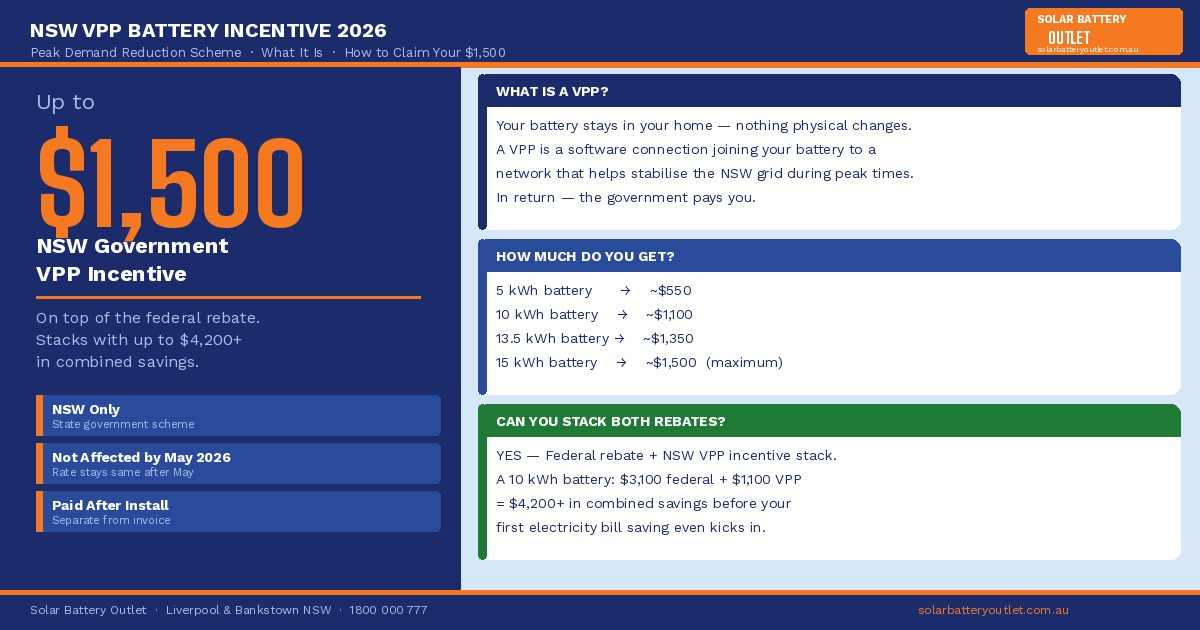
Your battery sits in your garage or on your wall. That doesn’t change. The hardware stays exactly where it is. What a VPP does is connect your battery — through software — to a network of thousands of other home batteries across NSW.

During peak demand periods, usually hot summer afternoons when everyone is running air conditioning at once, the grid comes under pressure. The VPP operator can draw a small amount of stored power from the network of batteries to help stabilise it. In practice, your battery might contribute a small discharge during these events — you probably won’t even notice.

In return for making your battery available to the network, the NSW government pays you. That’s the VPP incentive. It’s not charity — it’s a genuine payment for a service your battery is providing to the grid.

You stay in control. You can set minimum charge reserves so your battery never drops below a level you’re comfortable with. You’re not handing over your battery to a stranger. You’re joining a coordinated network with clear rules about how and when it can be accessed.

How Much Is the NSW VPP Incentive Worth?

The amount available through the NSW VPP incentive depends on factors including the battery’s eligible capacity, the VPP provider and the terms of the VPP arrangement. The amount is not a single fixed payment that applies to every battery.

Eligible customers should compare VPP providers and review the incentive, payment structure, battery access conditions, and other contract terms before choosing a provider. The provider will check eligibility and confirm the incentive available for the specific battery and arrangement.

For a full breakdown of what these rebates mean for your out-of-pocket cost, our Solar Battery Cost Sydney 2026 guide has the complete numbers.

Who Qualifies for the NSW VPP Incentive

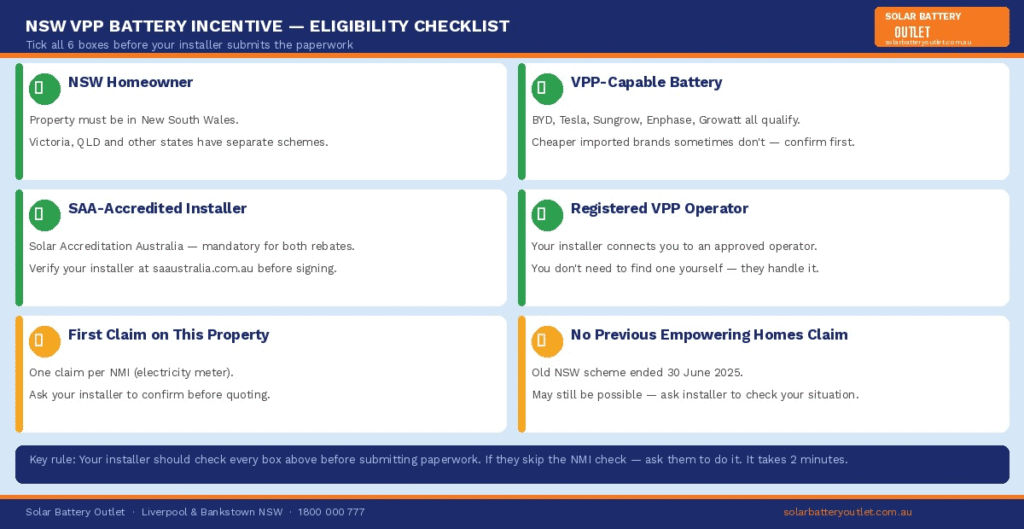
NSW VPP incentive eligibility checklist 2026

Not every battery installation qualifies. Here’s the exact checklist:

You must be a NSW household or small business that meets the eligibility requirements for the NSW VPP incentive. The Peak Demand Reduction Scheme is a NSW state program. Properties in Victoria, Queensland or other states don’t qualify — those states have their own separate schemes.

Your battery must be VPP-capable. This means the battery’s firmware and hardware support remote dispatch by a VPP operator. Your battery must meet the applicable NSW VPP incentive requirements and be compatible with the VPP provider you choose. Battery eligibility can vary by model and provider, so confirm compatibility before signing a contract. Your installer should confirm this before quoting.

You need to use a VPP provider that offers the NSW Government incentive. Compare available providers and their contract conditions, then confirm that your battery is eligible with the provider you choose.

The battery must be installed by an SAA-accredited installer. Same requirement as the federal rebate. If your installer isn’t SAA-accredited, you can’t access either scheme. Verify at saaustralia.com.au before signing anything.

One claim per property. The incentive is tied to your property’s electricity meter (NMI). If a previous owner already claimed it, you can’t claim again on the same address. A good installer checks this upfront.

You must not have previously claimed the old NSW Empowering Homes battery rebate on this property. If the old scheme was claimed, the VPP incentive may still be accessible separately depending on your battery specifications — worth asking your installer to check your specific situation.

The Federal Rebate vs The NSW VPP Incentive — What’s the Difference

People often confuse these two. They’re completely separate schemes run by different governments. Here’s the clearest way to think about them:

Federal Cheaper Home Batteries Program:

    • Run by the Australian federal government

    • Gives you roughly 30% off the upfront cost of an eligible battery

    • Applied directly off your invoice by your installer — you never see the money, it just reduces what you pay

    • Rate drops after 1 May 2026 and steps down every six months until 2030

    • Available across all of Australia

NSW Peak Demand Reduction Scheme (VPP Incentive):

    • Run by the NSW state government

    • Pays you up to $1,500 as a separate payment after installation

    • Paid out after your battery is connected to a VPP and registered with the scheme

    • Not affected by the 1 May federal changes — rate stays the same

    • Only available in NSW

The key point: you can claim both. They are designed to stack. A typical NSW homeowner installing a 10 kWh battery captures around $3,100 from the federal scheme and around $1,100 from the NSW VPP scheme — over $4,200 in combined savings before a single electricity bill reduction kicks in.

Our Federal Battery Rebate NSW 2026 guide walks you through the federal rebate step by step and explains exactly who qualifies and how it’s applied.

How to Claim the NSW VPP Incentive — Step by Step

Good news: most of this happens automatically when you use a good installer. Here’s the process so you know what to expect and what to ask.

Step 1 — Choose an SAA-accredited installer who processes both rebates.

This is the most important step. Not all installers bother with the VPP incentive because it involves extra compliance and registration steps. Before you accept any quote, ask directly: “Do you process the NSW Peak Demand Reduction Scheme incentive?” If they hesitate or look confused — find a different installer.

Step 2 — Choose a VPP-capable battery.

Your installer will confirm this. Every battery we recommend — BYD, Tesla Powerwall 3, Sungrow SBR, Enphase IQ 5P — qualifies. The installer will specify a registered VPP operator at the time of installation. You sign a VPP agreement, which covers how your battery can be dispatched and sets your minimum reserve levels.

Step 3 — Installation day.

Your battery is installed and connected. The installer registers the system with Ausgrid (your local network operator across most of NSW) and with the VPP operator. Both registrations are handled by your installer — not you.

Step 4 — VPP incentive payment.

After installation and registration are confirmed, the NSW incentive payment is processed. This typically takes a few weeks and comes through as a payment separate from your installation invoice. Your installer should give you a clear timeline on when to expect it.

Step 5 — You’re done.

Your battery runs normally. You keep full visibility of your charge levels through your battery’s app. The VPP operator can access your battery during peak events — but you set the floor on how low it can go.

Will Being in a VPP Affect My Battery Performance?

This is the question we get asked most often once people understand what a VPP is. The honest answer is — minimally, and usually in your favour.

VPP dispatch events typically happen a handful of times per year during extreme peak demand. Each event might draw 1 to 2 kWh from your battery. In practice, your battery recharges from solar the next day and you’re back to normal.

Some VPP arrangements also pay you ongoing payments or bill credits each time your battery is dispatched — on top of the upfront $1,500 incentive. This varies by VPP operator, so ask your installer which operator they use and what the ongoing earning structure looks like.

The one thing to confirm is your minimum reserve setting. If you want blackout protection — and you should, given South West Sydney’s storm season — make sure your VPP agreement lets you set a minimum charge reserve to keep enough backup power available. A good installer configures this during setup.

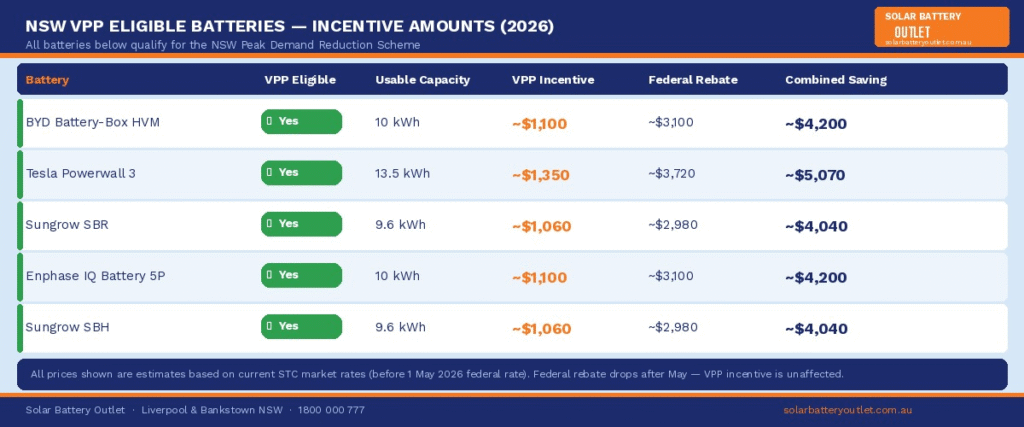
Which Batteries Qualify for the NSW VPP Incentive in 2026

NSW VPP eligible batteries 2026 comparison

Every battery we stock and install qualifies. Here’s the confirmed list:

Battery VPP Eligible Usable Capacity Approx. VPP Incentive
BYD Battery-Box HVM 10 kWh ✅ Yes 10 kWh ~$1,100
Tesla Powerwall 3 ✅ Yes 13.5 kWh ~$1,350
Sungrow SBR 9.6 kWh ✅ Yes 9.6 kWh ~$1,060
Enphase IQ Battery 5P (10 kWh) ✅ Yes 10 kWh ~$1,100
Sungrow SBH 9.6 kWh ✅ Yes 9.6 kWh ~$1,060

For a full comparison of these batteries including prices and performance, our Best Solar Battery NSW 2026 guide has everything side by side.

What About VPP Ongoing Earnings — Is It Worth Staying In?

The $1,500 upfront incentive is the main headline. But some VPP programs also pay you on an ongoing basis each time your battery contributes to a grid event.

The exact amount varies by operator and by how active your battery is in dispatch events. Some VPP providers may offer ongoing payments or bill credits in addition to any applicable incentive. The amount and payment structure vary between providers, so compare the terms before joining. It’s not life-changing money on its own — but it’s passive income from a battery you already own.

The key question to ask your installer is: which VPP operator are we being connected to, and what’s the ongoing payment structure after the upfront incentive is paid?

Some operators give you bill credits. Some pay direct. Some offer a hybrid arrangement. It’s worth understanding before you sign the VPP agreement — not because any of them are bad, but because you want to know what you’re getting.

Frequently Asked Questions

Does the NSW VPP incentive drop after 1 May 2026 like the federal rebate?

No. The federal rebate rate drops on 1 May 2026 — the NSW VPP incentive is completely separate and is not affected by that date. You can claim the full VPP incentive amount whether you install before or after May. The only reason to rush for May is the federal rebate component.

Can I claim the VPP incentive if I already have a battery installed?

Generally no — the NSW Peak Demand Reduction Scheme incentive is designed for new battery installations. If you have an existing battery that’s already registered with a VPP, you may have already received it or been ineligible depending on when it was installed. Worth asking your installer to check your specific situation.

What if I don’t want to join a VPP?

You can still claim the federal rebate without joining a VPP — the two are separate. You simply won’t receive the $1,500 NSW incentive. For most homeowners the VPP agreement is a straightforward arrangement and the $1,500 is well worth it. But it’s your choice.

How long does the VPP incentive payment take to arrive?

Typically 2 to 6 weeks after your installation is registered and confirmed. Your installer handles the registration — ask them for a specific timeline at the time of installation so you know what to expect.

Will the VPP drain my battery during a blackout?

No. VPP dispatch only operates when the grid is running — not during a blackout. If the grid goes down, your battery automatically switches to backup mode and the VPP connection is inactive. Your stored power is yours during an outage.

Does joining a VPP affect my battery warranty?

VPP participation should be checked against the battery manufacturer’s warranty terms. Before joining, confirm that the specific VPP arrangement and operating conditions are permitted under your battery and inverter warranties. The VPP dispatch events are within the normal operating parameters of the battery. Confirm this with your installer and check your battery’s warranty documentation to be sure.

Want us to handle both rebates for your NSW home?

Where eligible, we can assist NSW customers with the Australian Government’s Cheaper Home Batteries Program and the NSW VPP incentive as part of the installation process. Eligibility and incentive amounts depend on the applicable program requirements and VPP provider terms.

Call 1800 000 777 or fill in our 60-second form at solarbatteryoutlet.com.au

php