You’ve probably noticed something interesting happening in Bankstown lately.

In February 2026, Ausgrid switched on a brand new 10 MW community battery right here in the suburb — one of the largest they’ve ever built. That’s not a coincidence. It’s a signal. Battery storage in Bankstown is no longer something early adopters do. It’s something the energy industry is betting serious money on, right in your backyard.

And homeowners are paying attention. Enquiries from Bankstown and Canterbury-Bankstown area have jumped significantly over the past few months — not because of marketing, but because the maths has changed. Feed-in tariffs are low, evening electricity rates are high, and the government rebate makes the upfront cost a lot more manageable than most people expect.

We’re based at Fetherstone Street in Bankstown. We install solar batteries across this area every week. This guide is written specifically for Bankstown homeowners — the real numbers, the actual rebates available right now, and the questions you should be asking any installer before you hand over a dollar.


One thing to flag before we start: The federal battery rebate rate drops after 1 May 2026. For a 10 kWh battery, installing before that date saves around $530 compared to installing in June. It’s not a massive cliff — but it’s real money. If you’re already leaning toward a battery, sooner is better than later. Full breakdown of what changes on 1 May here.


Why Bankstown Homeowners Are Enquiring About Batteries Right Now

It’s worth understanding the context, because it explains why the timing matters.

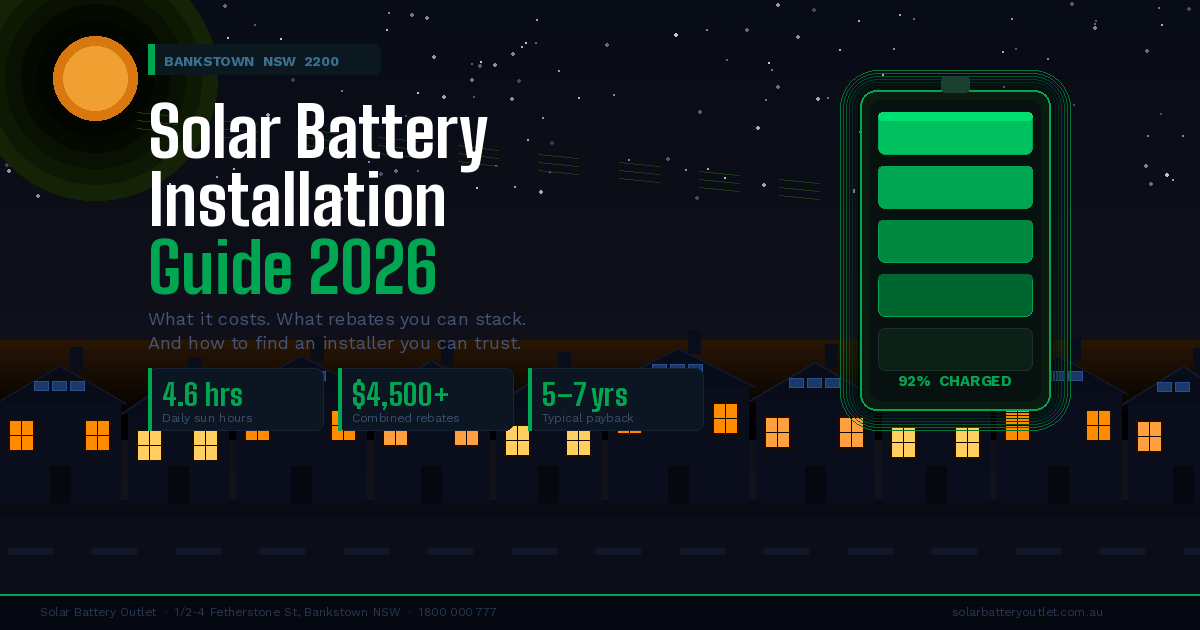
Bankstown gets around 4.6 peak sun hours per day on average. That’s solid — it means a typical rooftop solar system here generates strong output, especially through spring and autumn. The problem is, most of that generation happens between 10am and 3pm. And most families in Bankstown aren’t home during those hours.

So what happens? Your solar panels generate power, you export it to the grid for around 5 to 8 cents per kWh, and then you buy it back at night for close to 30 cents. You’re essentially selling something cheap and buying it back expensive. A battery fixes that. It holds what your panels generate and saves it for when you actually need it — evenings, mornings, weekends.

On top of that, Bankstown sits in an area of Canterbury-Bankstown where summer storm outages are a genuine issue. A battery with backup capability means when the grid goes down, your home keeps running. Lights, fridge, phone charging — all of it.

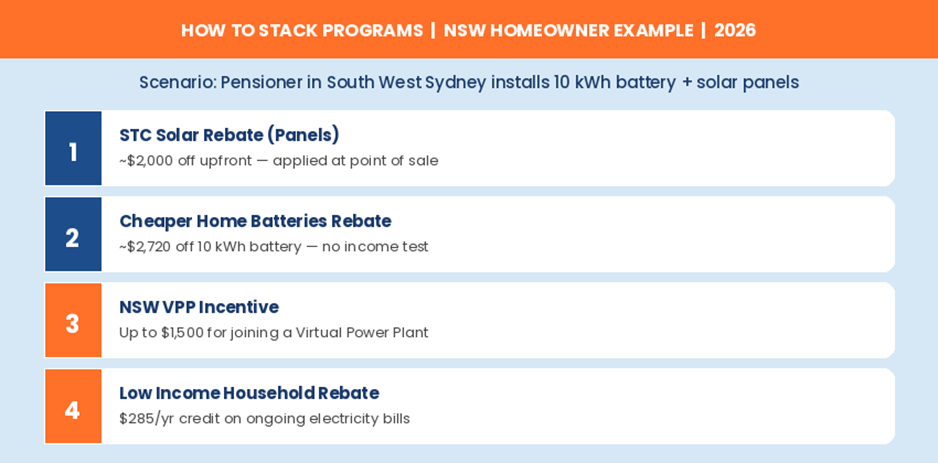
The rebate is the third piece. A 10 kWh battery that cost $14,000 a few years ago is now closer to $7,000 to $9,000 after the federal discount. That changes the payback calculation significantly.

What a Solar Battery Actually Costs in Bankstown in 2026

Let’s not beat around the bush. Here are the real numbers after rebates:

Battery SizeFederal RebateNSW VPP IncentiveYour Cost After Both
5 kWh system~$1,550Up to $550~$4,500–$6,000
10 kWh system~$3,100Up to $1,100~$7,000–$9,000
13–15 kWh system~$3,700–$4,500Up to $1,500~$9,500–$13,000

These are estimates — your actual quote will depend on your existing solar system, your switchboard, and which battery brand you go with. Bankstown homes, particularly older ones built in the 1980s and 1990s, sometimes need a switchboard upgrade before a battery can be safely connected. That adds $500 to $1,500 to the job. Any installer worth their salt will tell you upfront if that applies to your property — before you’ve committed to anything.

For the full cost breakdown including what drives the price up or down, our Solar Battery Cost Sydney 2026 guide has the detail.

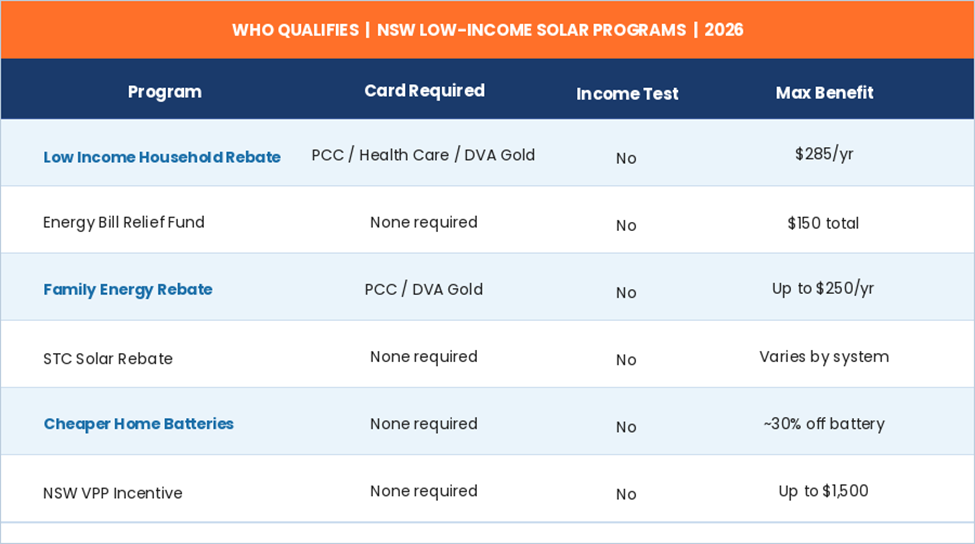
The Two Rebates Bankstown Homeowners Can Stack Right Now

This is where people get confused online, so let’s make it simple.

1. Federal Cheaper Home Batteries Program

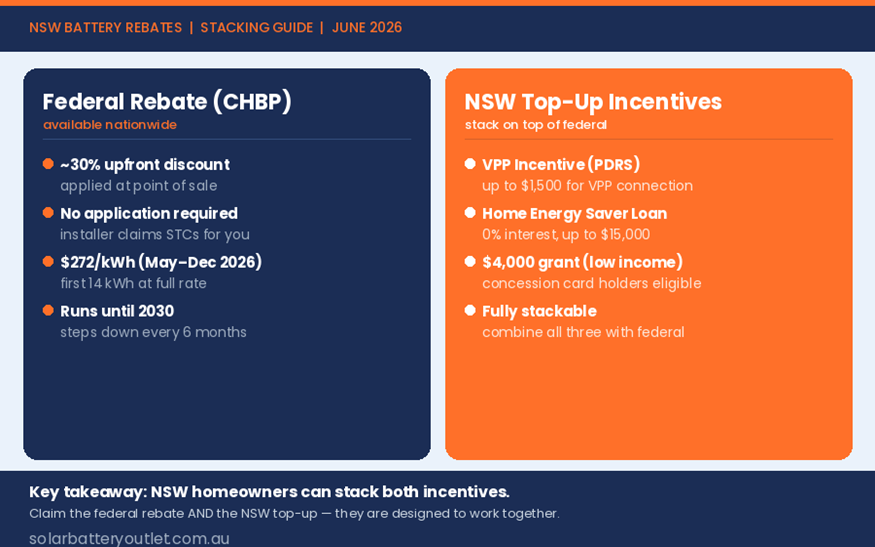
This is the big one — roughly 30% off your battery upfront. Your SAA-accredited installer applies it straight off your invoice. You don’t apply separately, you don’t wait for a cheque. It just comes off the price. For a 10 kWh system, that’s around $3,100 in savings right there.

2. NSW Peak Demand Reduction Scheme (VPP Incentive)

This is a separate NSW government payment of up to $1,500 for connecting your battery to a Virtual Power Plant. Your battery stays in your home — nothing physical changes. It’s a software connection that lets your battery join a network that helps stabilise the grid during peak times. In return, the government pays you.

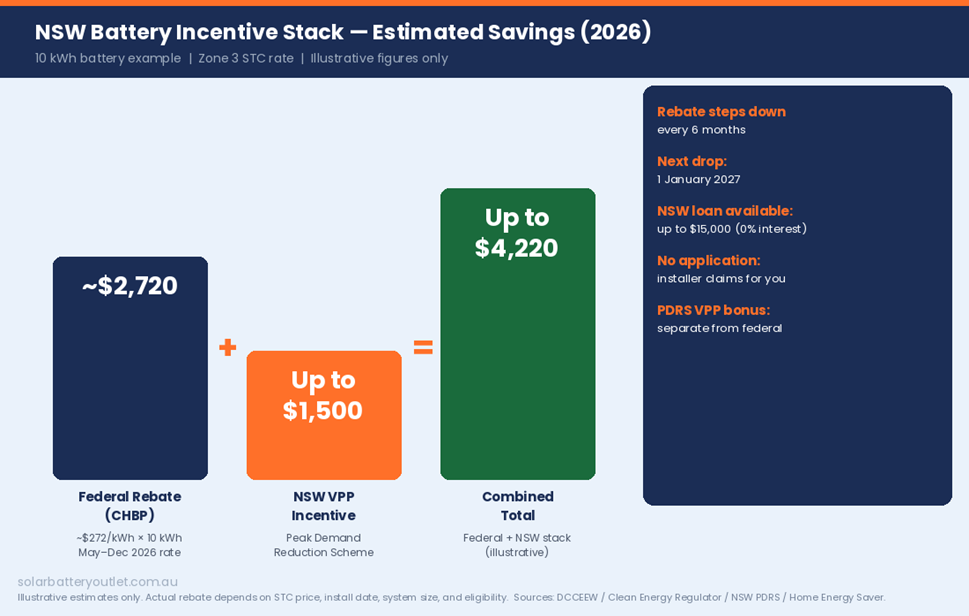
The good news — you can claim both. They stack. A Bankstown homeowner installing a 10 kWh battery could save over $4,500 combined before the first electricity bill saving even kicks in.

For the step-by-step on how to claim both rebates without touching any paperwork yourself, our Federal Battery Rebate NSW 2026 guide walks through exactly what happens.

Is a Solar Battery Actually Worth It for Your Bankstown Home?

Honest answer — it depends on your situation. Here’s a quick way to think about it.

A battery makes strong financial sense if:

  • Your quarterly electricity bill is still above $250 even with existing solar panels on your roof
  • You’re mostly home in the evenings — after solar has stopped generating
  • Your current feed-in tariff is below 10 cents per kWh (most Bankstown homes are on 5 to 8 cents right now)
  • You’ve had two or more power outages in the past year and want backup capability
  • You have or plan to get an electric vehicle

A battery probably isn’t the right move yet if:

  • You’re renting — you’d need the landlord to agree and that’s a different conversation
  • Your existing solar system is more than 10 years old and generating poorly — sort that first
  • You’re planning to sell the house within 2 to 3 years — payback periods run 5 to 8 years for most Bankstown households
  • You work from home and use most of your solar power during the day already

If you’re genuinely unsure, a good installer should be able to look at your last 3 electricity bills and give you a straight answer on whether the numbers work for your home. We do this at no charge for Bankstown homeowners. If the numbers don’t stack up, we’ll tell you.

For a deeper look at the financial case, our Is Adding a Battery to Existing Solar Worth It in 2026 guide has the honest payback analysis.

What to Look for in a Bankstown Solar Battery Installer

The quality of your installation matters more than the brand of battery you choose. A good battery installed badly will give you problems. A solid mid-range battery installed properly will run quietly for 10 years. Here’s what to check.

SAA Accreditation — Non-Negotiable

The old CEC accreditation has been replaced by SAA (Solar Accreditation Australia) for battery installations. If your installer isn’t SAA-accredited, you cannot claim the federal rebate. Full stop. Before you accept any quote, verify their accreditation at saaustralia.com.au. Takes about 30 seconds.

Do They Handle Both Rebates?

Some installers apply the federal rebate but skip the NSW VPP incentive because it involves extra compliance paperwork. Ask directly: “Do you process the NSW Peak Demand Reduction Scheme incentive?” If they look blank — that’s a flag. A good installer handles both.

Get Three Written Quotes

Prices vary significantly in Bankstown — sometimes by $2,000 to $3,000 for the same system. Make sure each quote shows the federal rebate as a clear line item, includes all electrical work, and specifies the battery warranty period. Ten years should be the minimum from any quality brand.

Local Presence Matters

A battery needs to work for 10 years. If something goes wrong in year 4, who do you call? An installer based in Bankstown or South West Sydney is a very different service experience from an interstate company with no local team. Ask where their technicians are based.

Which Battery Brands Work Best in Bankstown?

We install several brands across Bankstown, Mudgee and Liverpool. Here’s an honest look at what we recommend most often and why.

BYD Battery-Box HVM — This is our most recommended option for the average Bankstown family. It’s modular, meaning you can start with 8.3 kWh and add storage later. Strong value, 10-year warranty with 70% capacity retention. Works well with a wide range of existing inverters — which matters in an area with lots of older solar systems.

Tesla Powerwall 3 — The premium option. Best automatic blackout protection available, excellent for EV owners, and the cleanest single-unit installation. Costs more but earns it. We wrote a full comparison of Tesla Powerwall 3 vs BYD Battery-Box if you’re deciding between the two.

Sungrow SBR — Best value for performance. If your Bankstown home already has a Sungrow inverter, this is often the most cost-effective and technically compatible upgrade. Strong cycle rating at a price point that makes sense.

For the full comparison across all six brands we stock, see our Best Solar Batteries Australia 2026 guide.

What Actually Happens on Installation Day in Bankstown

People always ask how disruptive it is. For a standard Bankstown home, installation takes 4 to 6 hours from arrival to sign-off. Here’s what that day looks like:

The installer arrives and checks your switchboard and existing solar system — that’s usually the first 30 minutes. The battery is mounted, typically in the garage, laundry, or on an external wall. Electrical connections are made and the system is tested. The installer registers the system with Ausgrid (your local network provider here in Bankstown) — this is required in NSW. You’re shown how to monitor everything from your phone. Then they leave.

Your house looks exactly the same. Except now you have a battery.

One thing worth knowing — the Ausgrid network registration sometimes takes a few days to fully process. During that window your battery runs in backup-only mode. That’s completely normal. Nothing is wrong.

Frequently Asked Questions from Bankstown Homeowners

Do I need existing solar panels to get the rebate?

Yes. The federal Cheaper Home Batteries Program requires you to have rooftop solar — either existing or installed at the same time as the battery. If you don’t have solar yet, you can install both together and the rebate still applies to the battery portion. For how long batteries last once you’ve installed, see our How Long Does a Solar Battery Last in Australia guide.

Will my battery keep the power on during a blackout?

Only if backup mode is included in the system design — which it isn’t automatically on all setups. Always confirm blackout protection is included when you’re getting quotes. Tesla Powerwall 3 does this automatically. Other batteries need to be configured for it.

What’s the payback period for a Bankstown home?

For most Bankstown households we work with, payback sits between 5 and 7 years depending on battery size, electricity usage, and whether you join a VPP. With Ausgrid’s local grid seeing higher peak demand in summer, Bankstown homes with batteries that participate in VPPs often see strong returns on that $1,500 incentive payment.

Can I add more storage later if my needs change?

Some batteries are modular and let you add capacity — BYD Battery-Box is the main one we recommend for this. Others are fixed. If you think your energy needs might grow — especially if an EV is in the picture — ask specifically about modular options when comparing quotes.

What if I already claimed an older NSW rebate?

The old NSW Empowering Homes program ended 30 June 2025. If you previously claimed that, you may still be able to access the NSW VPP incentive separately depending on your battery’s specifications. Worth asking an installer to check.


Want a Quote for Your Bankstown Home?

We’re based locally at 1/2-4 Fetherstone Street, Bankstown. Our team services all of Liverpool-Bankstown and Mudgee. We check your eligibility for both the federal rebate and NSW VPP incentive — no obligation, no pressure.

Call 1800 000 777

or fill in our 60-second eligibility form at solarbatteryoutlet.com.au

Solar Battery Rebates | NSW | Updated March 2026

Federal Battery Rebate NSW 2026: Who Qualifies and How to Claim It

Go and search ‘battery rebate NSW’ and within about 30 seconds you’ll want to close the tab. One site says you can get $7,000 off. Another says the NSW rebate ended. A third talks about STCs, VPPs, and PRCs like you’re supposed to already know what those mean.

You’re not confused because you’re missing something. You’re confused because the information online is a mess.

So let’s cut through it. This is a plain-English guide to the two rebates NSW homeowners can actually access in 2026, who qualifies for each, how much you can realistically save, and the exact steps to claim them — without needing to call a government hotline.

We service homeowners across Liverpool, South West Sydney, Bankstown, and Mudgee, and these are the same questions we get asked every single week. Here are the straight answers.

The Short Version (Read This First) There are two rebates NSW homeowners can stack in 2026. First: the Federal Cheaper Home Batteries Program — around 30% off the cost of your battery, applied directly at point of sale. Second: the NSW VPP Incentive — up to $1,500 for connecting your battery to a Virtual Power Plant. Combined on a 10 kWh battery, that’s over $4,000 in savings before a single bill comes in. The federal rate drops after 1 May 2026 — more on that below.

What Is the Federal Battery Rebate?

The federal government launched the Cheaper Home Batteries Program in July 2025. The idea is simple: Australia has 4.2 million homes with rooftop solar but only a fraction have batteries. The program gives homeowners a roughly 30% discount on the cost of installing an eligible battery.

The discount works through something called Small-scale Technology Certificates (STCs). Don’t worry too much about what those are — the practical effect is that your installer deducts the rebate amount straight off your invoice. You never pay the full sticker price.

For a standard 10 kWh battery, that’s roughly $3,100 off the upfront cost. For a 13–15 kWh system, it’s closer to $3,700–$4,500.

The program runs until 2030, but the discount rate decreases over time. The highest rate is right now — before 1 May 2026.

Who Actually Qualifies — The Full Checklist

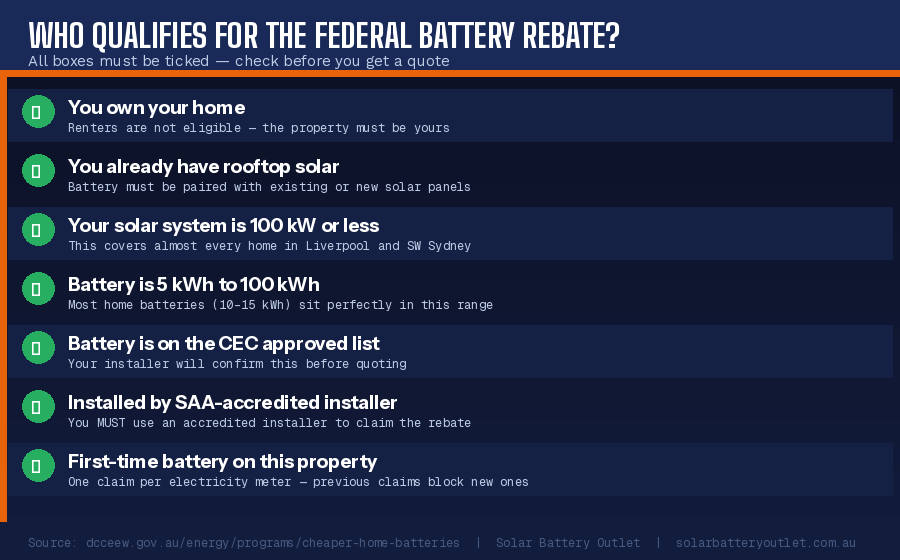
This is where a lot of homeowners get caught out. The rebate isn’t available to everyone. Here’s the exact eligibility list:

Full eligibility checklist for the Federal Cheaper Home Batteries Program 2026 — tick all boxes before requesting quotes

A few of those are worth unpacking:

  • You need existing solar. The battery must be paired with rooftop solar panels — new or existing. A battery without solar attached is not eligible. If you don’t have solar yet, you can install both together and the rebate still applies to the battery portion.
  • The installer must be SAA-accredited. This is Solar Accreditation Australia — the body that replaced the old CEC accreditation system for battery installations. If your installer isn’t accredited, you cannot claim the rebate. Always ask for their accreditation number before signing anything.
  • One claim per property. The rebate is tied to your electricity meter (NMI). If a previous owner already claimed a battery rebate on that address, you’re locked out. A good installer will check this before quoting.
  • The battery must be on the CEC approved product list. Most major brands (Tesla, BYD, Sungrow, Growatt, Sigenergy) are approved. Your installer should confirm this before recommending any brand.

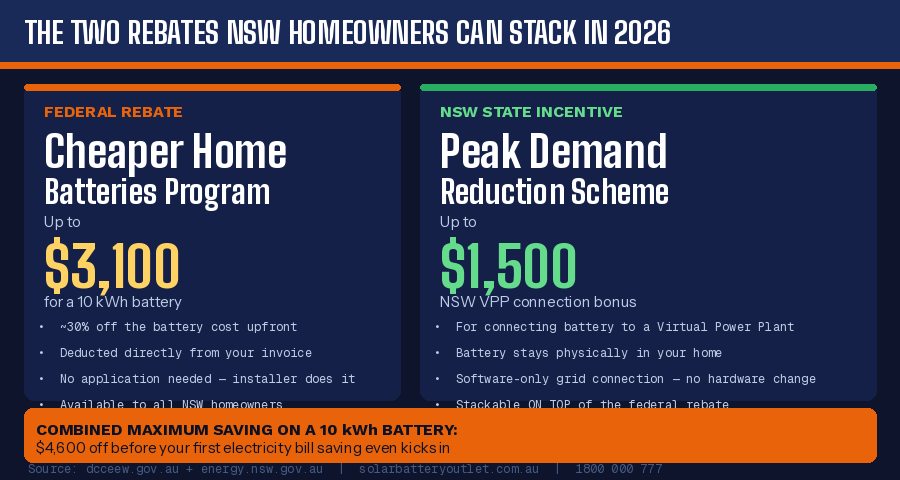
The Two Rebates You Can Stack — Federal + NSW

Here’s where Liverpool homeowners are ahead of the game — NSW offers an additional incentive on top of the federal one. Most people only find out about the second rebate by accident, or not at all.

The two rebates NSW homeowners can combine in 2026 — federal program plus the NSW VPP incentive

The NSW Peak Demand Reduction Scheme (PDRS) pays you for connecting your battery to a Virtual Power Plant (VPP). Here’s what a VPP actually is in plain terms:

Your battery stays physically in your home. Nothing changes about the hardware. A VPP is a software connection that lets your battery join a network of thousands of other batteries across NSW. During peak demand periods — like hot summer afternoons — the operator can draw a small amount of power from the network to help stabilise the grid. In return, you get paid.

The VPP incentive payment is up to $1,500 for most standard home batteries. You receive this as a payment after installation, separate from the federal rebate.

Can You Claim Both? Yes — and you should. The federal discount and the NSW VPP incentive stack on top of each other. They are completely separate schemes. On a 10 kWh battery, combining both could save you over $4,600 before your first electricity bill saving even kicks in. The only catch: some VPP operators take a small fee for managing the connection. Ask your installer to clarify what the net payment will be after any operator fees.

How Much Will You Actually Save? Real Numbers

Let’s put real figures on a typical Liverpool home scenario. Assume you’re installing a 10 kWh battery alongside an existing solar system.

  • Battery cost before rebates: ~$11,000–$12,000 fully installed (varies by brand and your switchboard setup)
  • Federal Cheaper Home Batteries rebate: ~$3,100 deducted upfront from your invoice
  • NSW VPP incentive: ~$1,000–$1,100 paid after installation (for a 10 kWh system)
  • Your actual out-of-pocket cost: ~$7,000–$8,000 depending on brand and any switchboard work needed
  • Estimated annual electricity savings: $1,800–$2,300 per year for a typical Liverpool household using power in the evenings
  • Estimated payback period: 5–7 years, shortening as electricity prices continue to rise

That payback period is based on current electricity prices. NSW tariffs have been increasing roughly 10–15% per year. Every time your electricity rate goes up, your battery saves you more — which means the payback period gets shorter, not longer.

The 1 May 2026 Deadline — Why It Actually Matters

You’ve probably seen installers and comparison sites mentioning this date. Here’s what’s actually happening, without the hype.

The federal rebate is calculated using STCs. From 1 May 2026, the government is changing two things:

  • The STC rate drops faster: Before May, the rate decreases annually. From May onwards, it drops every six months. That means each six-month delay costs you a bit more.
  • Larger batteries get tapered rebates: Systems over 14 kWh will see a lower rebate per kWh on the capacity above that threshold. For a typical 10 kWh battery, nothing changes. For a 15 kWh system, you lose some of the rebate on the extra 1 kWh above 14 kWh.

If you’re looking at a battery under 14 kWh — which is most Liverpool homes — the May deadline is relevant but not dramatic. You’ll save a modest amount by acting before May. If you’re looking at a larger 15 kWh+ system, acting before May is more meaningful.

What we tell customers honestly: if you’re genuinely ready to buy, now is the best time. If you’re still not sure, it’s better to take another few weeks and get it right than to rush into a $10,000 decision.

What Changed with the Old NSW Empowering Homes Program? If you’ve been Googling for a while, you might have seen references to the old NSW Empowering Homes Program — interest-free loans of up to $14,000 for solar battery installs. That program ended on 30 June 2025 and is no longer available. It’s been replaced by the federal rebate + NSW VPP incentive combination described in this guide. Any website still advertising the Empowering Homes loan is out of date.

How to Claim the Rebate — Step by Step

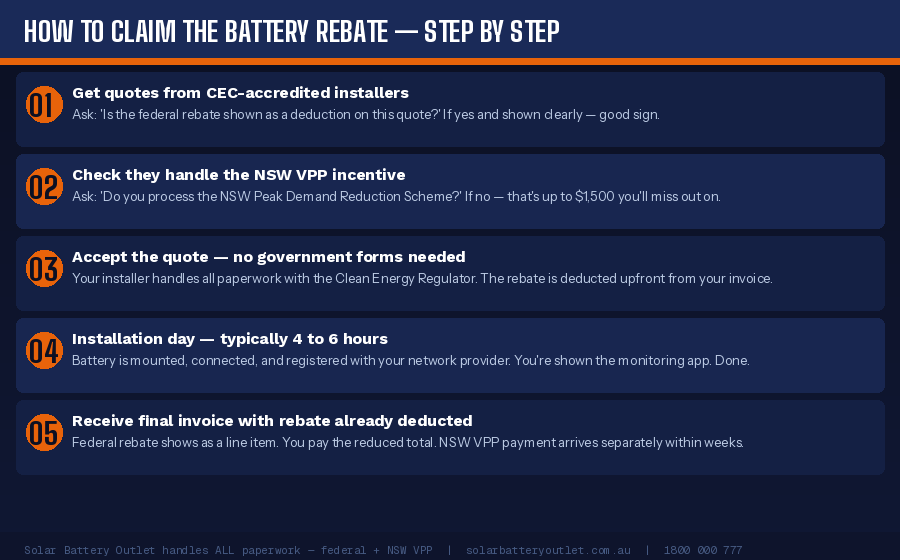
The good news: you don’t have to navigate any government portals or fill in complex forms. Here’s exactly how it works:

How to claim the federal battery rebate and NSW VPP incentive — your installer handles the heavy lifting

The most important thing to understand is that your accredited installer does almost all of the work. Your job is to:

  • Get at least two quotes from SAA-accredited installers
  • Confirm the federal rebate is shown as a deduction on the quote (not a cashback after)
  • Confirm they will also process the NSW VPP incentive paperwork
  • Accept the quote and book the install
  • That’s it — you pay the reduced invoice amount and receive the VPP payment within weeks

Questions to Ask Every Installer Before You Sign

Not all installers are equal. Some offer the federal rebate but skip the NSW VPP incentive because it requires extra compliance steps. Here are the four questions that separate good installers from average ones:

  • “Is the federal rebate shown as a line item deduction on this quote?” It should be clearly deducted on the invoice — not a vague mention that you’ll get money back later.
  • “Do you process the NSW Peak Demand Reduction Scheme incentive?” If they look confused or say they don’t handle it, find another installer. That’s your $1,500.
  • “Is there any switchboard upgrade needed for my property?” Liverpool homes from the 80s and 90s often need a switchboard upgrade ($500–$1,500). A good installer tells you upfront.
  • “Where is your service team based and what’s your response time?” An installer with no local team in South West Sydney is a risk for the next 10 years of service calls.

Common Mistakes NSW Homeowners Make

We see these regularly. Avoid them:

  • Assuming the cheapest quote includes everything. Some quotes look cheap because they exclude switchboard work, inverter upgrades, or monitoring setup. Read the detail.
  • Signing on the same day as a door knock. We’ve had customers tell us they signed at the door, paid a deposit, and only later discovered the company had no local team and no way to contact them after installation. Never sign on the spot.
  • Not asking about VPP eligibility. Some battery models are not VPP-capable. If you want the NSW incentive, confirm your battery choice supports VPP before buying.
  • Waiting for the ‘perfect time’ to buy. Electricity prices go up. Battery prices don’t drop dramatically year-on-year anymore. The best time to install was a year ago. The second best time is before 1 May 2026.

Frequently Asked Questions

Does the rebate apply if I don’t have solar yet?

The federal rebate requires the battery to be paired with solar panels — either existing or being installed at the same time. If you’re installing solar and a battery together in 2026, the rebate applies to the battery component. It’s actually a great time to do a combined install.

Can I claim the rebate on a second property?

Yes — each property has its own electricity meter (NMI) and can make one claim. So if you own a rental property that also has solar, it could qualify independently. The property must meet all the same eligibility criteria.

Is the rebate income-tested?

No. The federal Cheaper Home Batteries Program is not means-tested. It doesn’t matter how much you earn — eligibility is based on your property and installation, not your income.

What if I claimed the old NSW Empowering Homes loan?

The old program ended on 30 June 2025. If you claimed that loan, you may still be able to access the NSW VPP incentive (PDRS) separately, as long as your battery is VPP-capable. It’s worth asking an installer to check your specific situation.

How long does the rebate take to appear?

The federal discount is applied upfront — you’ll see it as a deduction on your final invoice on installation day. The NSW VPP incentive payment comes separately and usually takes a few weeks after your battery is registered with an approved VPP operator.

What if my installer doesn’t process the VPP incentive?

Find a different installer. Processing the NSW VPP paperwork is part of the job for any competent, fully accredited installer in NSW. If they’re not doing it, they’re either inexperienced or cutting corners.

Want Us to Check Your Eligibility for Both Rebates? We’re based in Liverpool and service all of South West Sydney. We handle the federal rebate and NSW VPP incentive paperwork — you don’t have to do anything except choose your battery. Call us: 1800 000 777 Or fill in our 60-second eligibility form at solarbatteryoutlet.com.au
About Solar Battery Outlet We’re a Liverpool-based solar battery installer, part of GWM Group Pty Ltd, servicing homes across South West Sydney, Bankstown, Campbelltown, Mudgee, and the greater NSW region. All installations by SAA-accredited electricians. We handle all rebate paperwork — federal and NSW — so you don’t have to.