If you live in a house in NSW, adding a solar battery is now a fairly well-worn path: get quotes, check your usage, claim the rebate, and get it installed. If you live in an apartment, the path has looked very different—until recently, it barely existed at all.
That is changing quickly. The NSW Solar for Apartment Residents (SoAR) grant now supports apartment buildings. New state battery rebate categories also support shared systems. Strata law reforms make sustainability upgrades easier to approve. Together, these changes give apartments and strata buildings across Sydney and regional NSW a realistic path to shared solar battery storage.
This guide walks through exactly what has changed, what a shared battery system actually looks like in an apartment building, what it costs, and the framework your strata committee can use to move from “we should look into this” to an approved, installed system.
Why Apartment Batteries Were Stuck Until Now
For years, manufacturers designed home batteries around a single meter and a single roof. This model works for detached houses but not for buildings with dozens of separate electricity accounts sharing one roof. Strata schemes also had to navigate common property rules, and many buildings required unanimous or 75% owner approval before owners could install shared solar, let alone a battery.
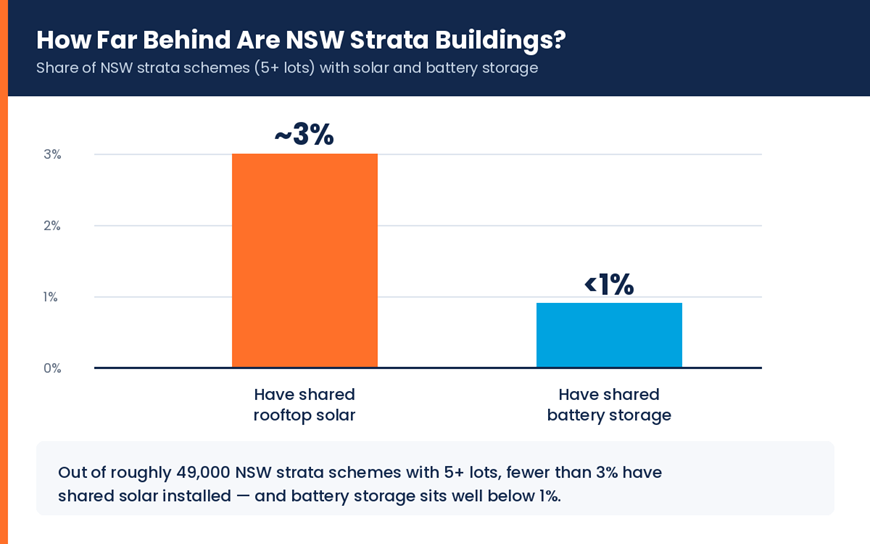
The numbers show how far apartments have fallen behind. Solar Choice researched approximately 49,000 NSW strata schemes with five or more lots. Fewer than 3% have shared rooftop solar installed. Battery storage penetration remains below 1%.
Jeff Sykes is Solar Choice’s CEO. He describes strata buildings as one of Australia’s last untapped frontiers for rooftop solar. He says the barriers have never been technical. Instead, they involve ownership, decision-making, and fair benefit-sharing among residents.
Three things have shifted that picture in 2026: government funding aimed specifically at strata buildings, a battery rebate category built for shared systems, and a lower voting threshold that makes approval realistic.
What’s Actually Changed for NSW Strata in 2026
1. The Solar for Apartment Residents (SoAR) grant
The NSW Government’s Solar for Apartment Residents grant funds up to 50% of the cost of a shared rooftop solar system, capped at $150,000 per building. It is open to owners corporations and strata managing agents rather than individual lot owners, and applications must be authorised by a sustainability infrastructure resolution passed at a general meeting.
2. A battery rebate built for shared systems
Previously, the federal Cheaper Home Batteries Program assumed one battery per household — which effectively locked apartments out. From September 2026, the NSW Peak Demand Reduction Scheme introduced a new category that allows an entire apartment building to share one large battery, with certificates calculated per apartment up to a 5 kWh cap per dwelling. This can stack on top of the federal rebate, meaningfully improving the payback case for a building-wide system rather than requiring each resident to install their own.
3. Strata voting reform
Getting 75% of owners to agree on anything is difficult. Recent NSW reforms dropped the threshold for sustainability infrastructure proposals — including solar and battery installations on common property — to a simple 50% majority of those voting, and strata committees can no longer block rooftop solar purely based on how it looks, except in heritage-listed buildings. This single change has removed the biggest practical obstacle for many committees.
How a Shared Apartment Battery Actually Works
Unlike a single-home installation, an apartment battery system needs a way to distribute stored solar energy fairly across multiple electricity accounts. There are a few established approaches used across NSW buildings today:
- Solar-sharing hardware: technology such as Allume’s SolShare allows one rooftop solar array, paired with a shared battery, to distribute stored energy across up to 30 apartments through the existing switchboard, with each resident metered individually.
- Embedded networks: the building operates its own private electricity network, purchasing bulk power and reselling it to residents, which can include a shared battery as part of the network’s supply.
- Common-property battery: a battery sized to offset shared services like lifts, lighting, and car park power, funded and owned via the owners corporation rather than distributed to individual lots.
Mio Dart, Head of Operations at Allume Energy, said the company designed its newest hardware generation specifically to close this gap for residents. Dart explained that the company redesigned SolShare 2 with batteries in mind, allowing apartment residents to access battery storage in ways that were previously unavailable. The technology now enables multi-unit buildings to share both solar power and battery storage, rather than relying solely on solar sharing.
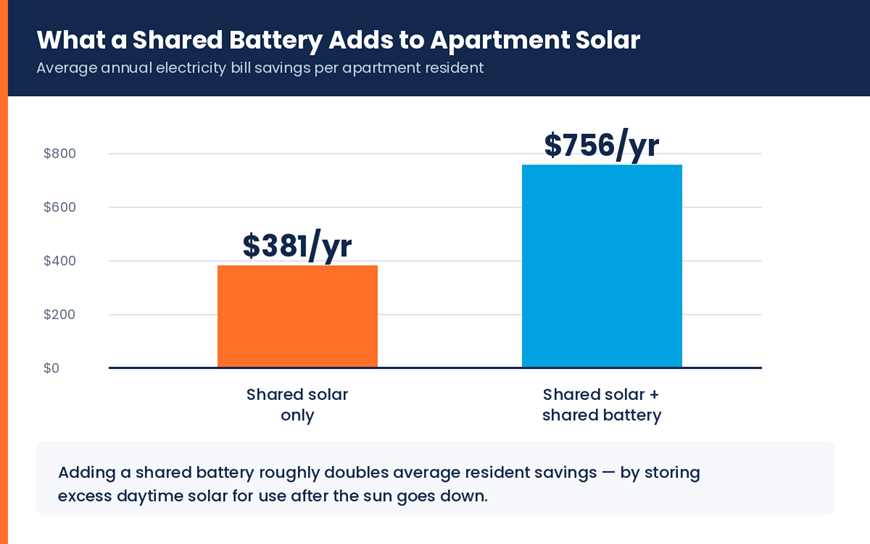
Allume’s own performance data illustrates the difference storage makes: shared solar alone has delivered average annual savings of around $381 per resident, while pairing that solar with a shared battery has lifted average savings to around $756 per year in early deployments. These figures depend heavily on building consumption, solar output, battery size, and each resident’s electricity tariff, so actual results vary from one strata scheme to another.
What It Costs — and the Actionable Framework for Your Strata Committee
A shared battery system for an apartment building is a bigger project than a single home installation, and the cost depends heavily on building size, battery capacity, and whether solar already exists on the roof. As a working framework, strata committees weighing this up should work through five steps in order:
- Check your existing solar. If your building already has rooftop solar under a previous SoAR-funded project, a shared battery add-on is usually far more cost-effective than starting from scratch.
- Get an energy usage assessment. A reputable installer should review 12 months of common-area and, where available, individual unit consumption before recommending a battery size — not just quote off the roof area.
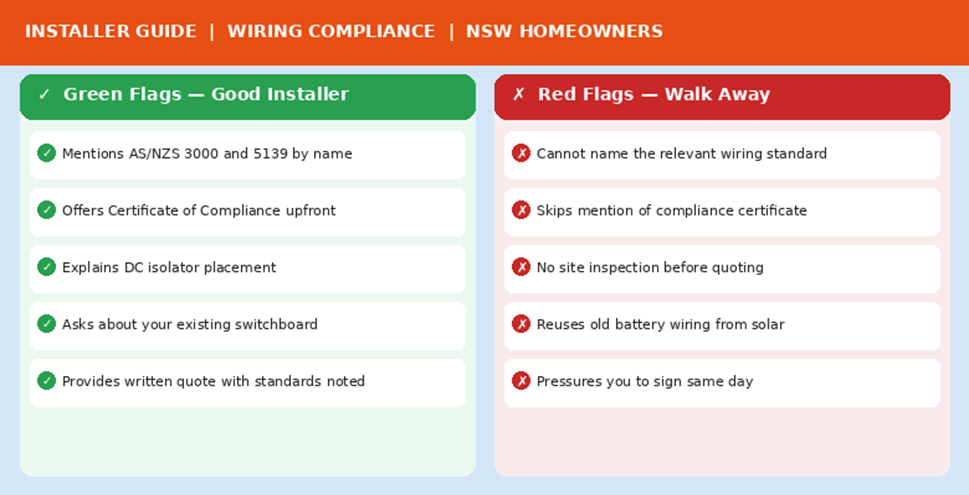
- Compare at least two quotes from SAA- and NETCC-accredited installers, as SoAR applications require, and confirm that both the federal Cheaper Home Batteries rebate and the NSW PDRS shared-battery category appear as dollar deductions on the written quotes.
- Pass a sustainability infrastructure resolution at a general meeting. Under the current rules this needs only a 50% majority of those voting, with no quorum requirement.
- Confirm the benefit-sharing model in writing before signing so every lot owner understands how the body corporate will distribute the savings—whether proportionately to unit entitlements, through individual metering via solar-sharing hardware, or as deductions from body corporate levies.
| A note on installers and accreditation Whether you’re comparing quotes for a detached home or an entire strata scheme, always confirm your installer’s SAA accreditation number and check it directly at saaustralia.com.au. As a solar battery installation company working across Liverpool, Bankstown, and Mudgee, we handle the rebate paperwork and strata documentation requirements as part of every quote, so committees are not left chasing forms. |
Choosing the Right Approach for Your Building
Not every strata scheme needs the same solution. A smaller block of 6–10 units with a straightforward switchboard may suit a solar-sharing hardware approach with a moderate shared battery, while a larger complex running lifts, shared lighting, and basement car parking may get more value from a common-property battery sized around those services. Buildings already on an embedded network have a third option again, since the battery can sit inside the network’s existing billing structure.
This is also where it pays to talk to a team that has done the comparison work already. Whether you’re weighing up the best solar batteries in Australia for a single dwelling or scoping a shared system for a 40-lot strata scheme, the right battery size and configuration should always follow an honest look at usage data — not the other way around.
If your building is in South West Sydney, a solar battery installer working across Bankstown and neighbouring suburbs can visit the site, review the switchboard capacity, and map out which of the three approaches above suits your roof, your metering setup, and your owners corporation’s appetite for the project.
Frequently Asked Questions
No. For shared building systems, the application must come through the owners’ corporation or an authorised strata managing agent — individual lot owners cannot apply for the SoAR grant or the shared-battery PDRS category on their own. Raising it at the next strata meeting is the correct first step, not calling an installer directly.
No, but it helps the economy. A building with no existing solar can still apply for a combined solar-plus-battery project, though buildings that already have SoAR-funded solar typically see a faster payback when adding storage, since the panels are already paying for themselves.
This depends on the system. Solar-sharing hardware like SolShare meters and credits each apartment individually. A common-property battery offsetting shared services typically reduces the whole building’s electricity costs, thereby lowering strata levies in proportion to unit entitlements rather than crediting individual units directly.
There is no single answer — the number of lots, existing solar capacity, and the amount of power residents use after solar generation stops each day determine the required battery size. Under the NSW shared-battery rebate category, the scheme caps certificates at 5 kWh per apartment, providing a rough starting point. However, property owners should review 12 months of usage data before committing to a system to determine the appropriate size.
Disclaimer
This article is general information only and does not constitute financial, legal, or strata governance advice. Rebate amounts, eligibility criteria, and voting thresholds referenced above are based on NSW Government and industry information available as of July 2026 and are subject to change without notice. Strata committees should obtain independent advice specific to their scheme, by-laws, and building configuration before passing any resolution or entering a contract. Savings figures cited from third-party sources (including Allume Energy and Solar Choice) are averages based on specific deployments and are not guaranteed outcomes for every building. Always seek personalised advice before making a purchasing decision.
| Ready to Bring Battery Storage to Your Building? We help NSW strata committees and apartment owners across Liverpool, Bankstown, and Mudgee assess shared solar and battery options, compare accredited installer quotes, and handle the SoAR and PDRS rebate paperwork from start to finish. Call us: 1800 000 777 Or visit solarbatteryoutlet.com.au to start with a free strata eligibility assessment. |