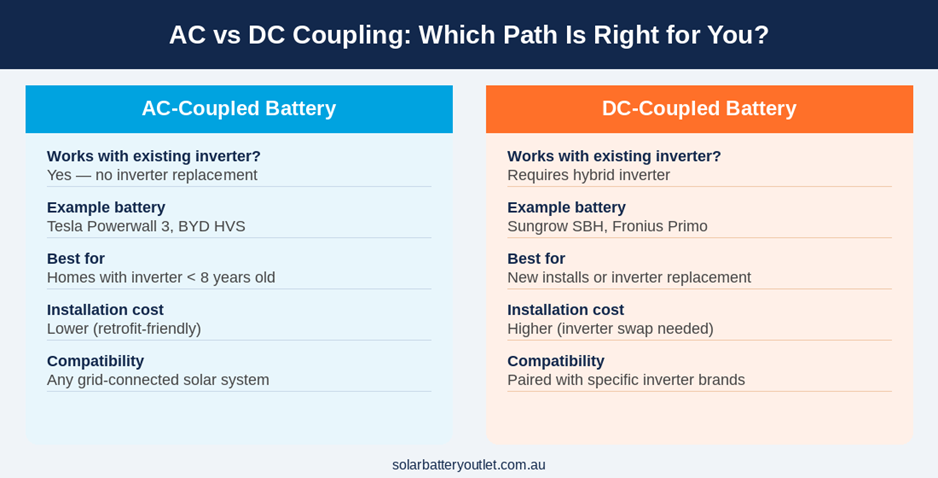

If you have been shopping for a solar battery since the 1 May 2026 rebate changes came into effect, you have probably noticed the rebate figures on your quotes look different. That is not a mistake, and it is not the installer padding their margin. The federal Cheaper Home Batteries Program restructured how it calculates upfront discounts from 1 May — and for the first time, the rebate is not the same for every battery size. It now depends on how large your system is.

This article breaks down exactly what changed, what the new slab structure looks like in plain terms, and — most usefully — what that means in dollars for every common battery size installed in NSW right now. 

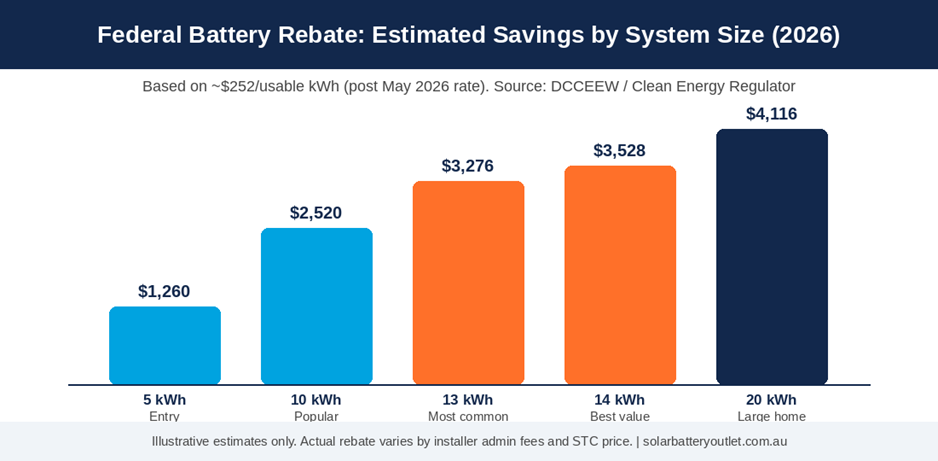
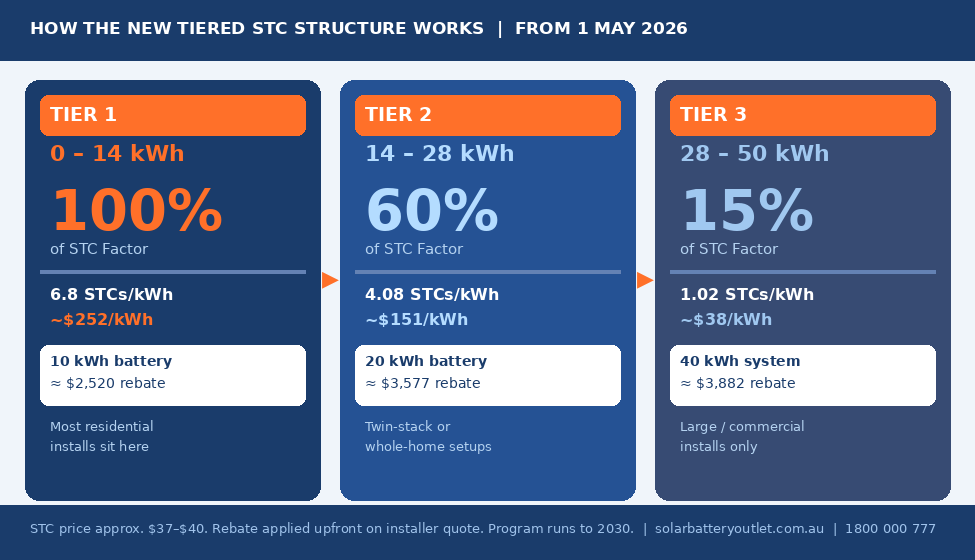
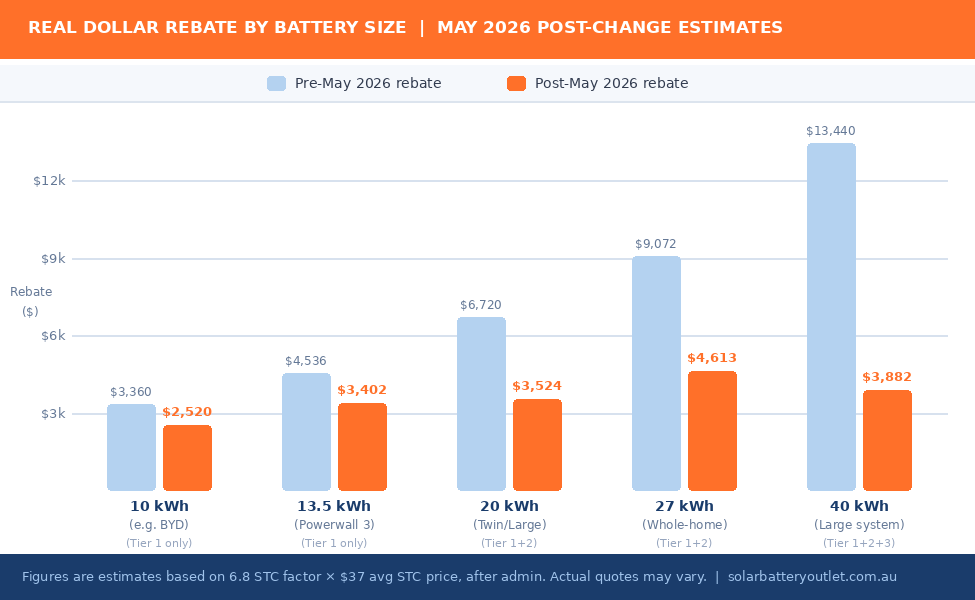
If you are buying a standard 10 kWh or 13.5 kWh battery, the rebate is still very meaningful — roughly $2,520 to $3,402 upfront. The tiered structure does not cut your savings at all for batteries 14 kWh or under. If you are considering larger batteries for solar, such as 20 kWh, 27 kWh, or above, the new structure does reduce the per-kWh rebate on the extra capacity, and that is where the real numbers start to diverge.

First: What Actually Changed on 1 May 2026?

The federal battery rebate — delivered through the Small-scale Renewable Energy Scheme (SRES) as Small-scale Technology Certificates (STCs) — has been running since 1 July 2025 under the Cheaper Home Batteries Program. It is the same mechanism used for rooftop solar for over 15 years: STCs are created at installation, sold to liable entities (large electricity retailers), and passed back to you as an upfront discount off the cost of the battery. You do not apply, there is no waiting for a cheque, and there is no income test.

From 1 May 2026, two significant changes took effect simultaneously:

  • Change 1: The STC factor dropped from 8.4 to 6.8 — a reduction of about 19%. This applies to every eligible battery, regardless of size.
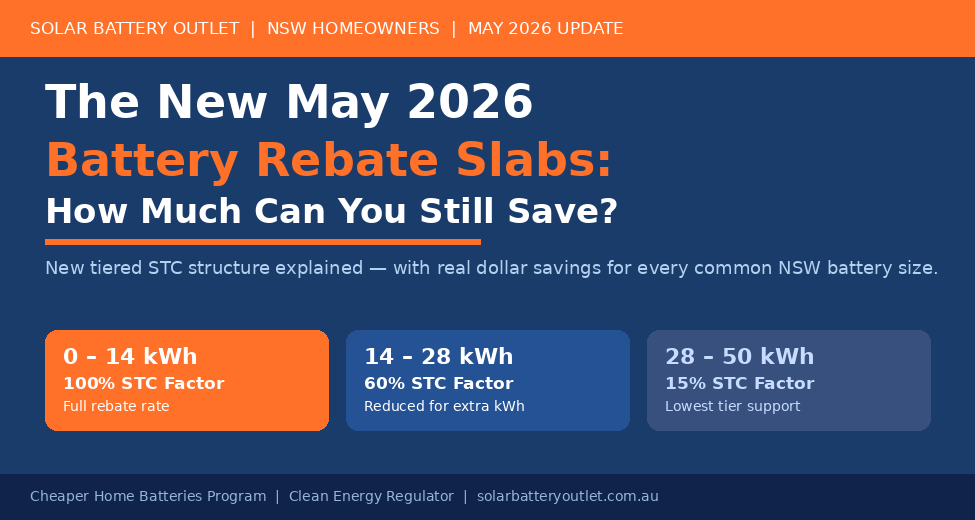
  • Change 2: The government introduced a new tiered (tapered) structure, so the STC factor no longer applies equally across the full capacity of larger batteries. Instead, different battery capacity bands now receive different percentages of the 6.8 factor.

Energy Minister Chris Bowen announced both changes in December 2025, and the Clean Energy Regulator confirmed them in March 2026. The stated purpose is to keep the program’s $7.2 billion budget sustainable through to its 2030 end date, while aligning rebate levels with the continued fall in battery hardware costs.

Here is the tiered structure as confirmed by the Clean Energy Regulator. This is the structure that applies from 1 May 2026:

New Tiered STC Structure

Using the new STC factor of 6.8 and an average STC market price of approximately $37 to $40 (after typical admin fees), here is what the rebate looks like across the batteries most commonly installed in NSW homes:

Real Dollar Rebate by Battery Size

Note on figures: Estimates use STC price of $38. Your actual quote may vary depending on your installer’s STC handling fee, your location zone, and the exact usable capacity of your chosen battery model. Always ask your installer to show the rebate as a line-item deduction on your written quote.

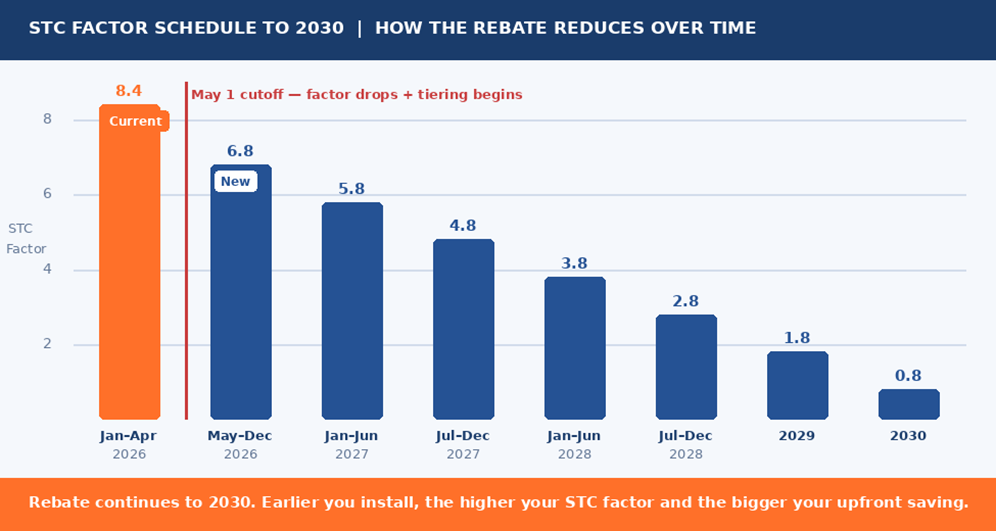
The STC Schedule: How the Rebate Continues to Fall

This is the part most people miss when they assume the 1 May change is a one-off event. It is not. From May 2026, the STC factor now reduces every six months rather than every twelve months as it previously did. That is twice the rate of reduction previously planned.

STC Factor Schedule to 2030

What this means practically is that every six months you delay an installation, the available rebate shrinks a little more. However, the gap is not enormous for a standard 10 to 14 kWh battery in any single period — usually around $300 to $500. Over time, though, those differences begin to compound. As a result, a homeowner who installs in late 2027 instead of mid-2026 could receive over $2,000 less in total rebate value for a standard battery, and significantly less for larger systems.

The rebate is not ending — it is shrinking, slowly but twice as fast as before. The program continues to 2030 with government backing and a $7.2 billion budget. The principle is simple: the earlier you install, the higher your STC factor, and the bigger your upfront saving. This is not a sales pressure tactic — it is the program’s designed-in incentive to act sooner rather than later.

How the NSW VPP Incentive Still Stacks on Top

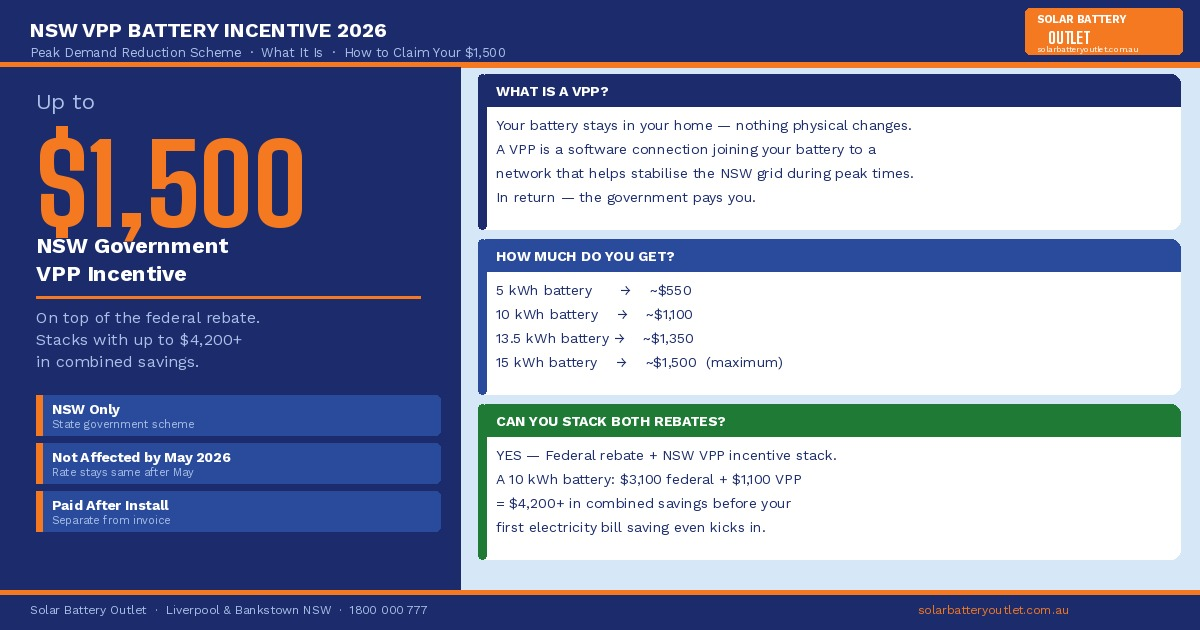
One aspect of the rebate picture that often gets lost in the noise about May changes is the NSW Peak Demand Reduction Scheme (PDRS) — commonly called the NSW VPP incentive. This is a completely separate, state-level incentive worth up to $1,500 for connecting your battery to a Virtual Power Plant.

The key facts NSW homeowners need to know:

  • The NSW VPP incentive is not affected by the 1 May 2026 federal STC changes at all. It runs under a different program entirely.
  • You can claim both the federal STC rebate and the NSW PDRS incentive on the same installation — they stack together.
  • To qualify for the NSW incentive, your battery must be VPP-capable (able to participate in demand response), though actual participation is voluntary.
  • Most modern batteries — Tesla Powerwall 3, BYD HVM, Sungrow SBR, Growatt, Sigenergy — are VPP-capable. Ask your installer to confirm.

Adding the $1,500 NSW incentive to the federal rebate means a 10 kWh battery installation in NSW could see total upfront savings of around $4,020 post-May. Even after the rebate reduction, many homeowners are still investing in what they consider the best solar battery NSW solutions to reduce long-term electricity costs and improve energy independence.

Does a Battery Still Make Financial Sense Post-May?

The honest answer for most NSW homeowners is yes. The rebate reduction changes the numbers, but does not change the fundamental financial case for battery storage.

A solar battery delivers its main financial return not through the rebate itself, but through the savings it generates every single day. It stores cheap solar energy and releases it during peak evening hours when grid electricity in NSW costs 30 to 35 cents per kWh. The STC changes do not affect those savings at all. A household can still save $1,400 per year on electricity bills regardless of when the rebate rate was set.

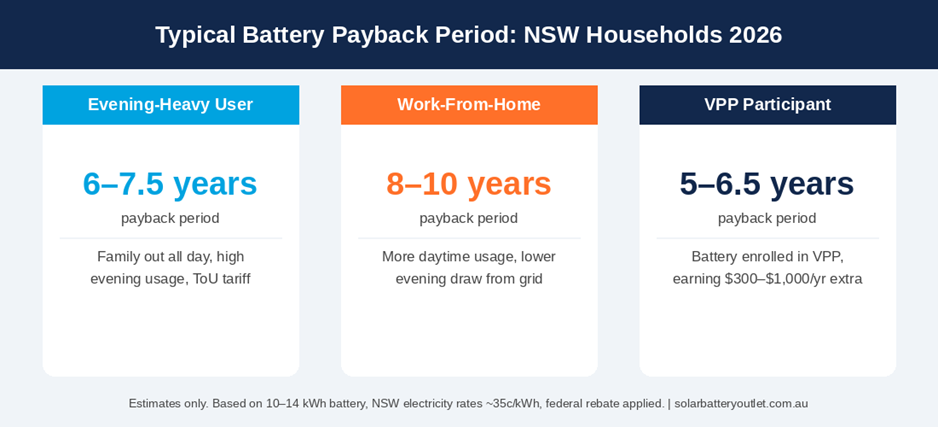
The rebate change affects your upfront cost and, therefore, your payback period. Here is how that looks for a standard 10 kWh battery in NSW:

Assumed gross install cost of $10,500 for a 10 kWh system. Annual bill saving of ~$1,150/year (based on typical 30c/kWh evening usage in NSW). Figures are indicative — get a written quote for your specific home and usage profile.

The clear takeaway: the payback period is lengthening as the rebate reduces. But it remains well within the typical 10-year battery warranty period even at 2027 rates. The battery still makes financial sense for most NSW homeowners — the urgency is relative, not absolute, unless you are planning a system above 14 kWh where the tiered cut is sharper.

Popular NSW Battery Models and Their New Rebate

Here is a quick guide to the most popular battery models installed across Liverpool, Bankstown, and Mudgee, and what the new tiered structure means for each:

Sizing tip: If you are considering a battery slightly above 14 kWh, ask your installer whether a 14 kWh system can still meet your energy needs. Once you move above the Tier 1 threshold, the cost of additional capacity rises more sharply because the rebate only covers 60% of that extra capacity. However, you should not reduce your battery size purely to qualify for the threshold — instead, use it as an opportunity to discuss the most cost-effective option with your installer.

What to Check Before Signing Any Quote

Whether you book now or wait a few more months, the requirements for a quality installation experience remain the same. Before signing any agreement, every NSW homeowner should verify the following:

  • The rebate is shown as a dollar deduction on your written quote — not mentioned verbally and absent from the paperwork.
  • Your installer is accredited with Solar Accreditation Australia (SAA). Verify their SAA number yourself at saaustralia.com.au — it takes 30 seconds.
  • Make sure your chosen battery model appears on the Clean Energy Council (CEC) approved product list. If the CEC does not list the battery, installers cannot create STCs, which means the rebate will not apply.
  • The quote should clearly specify the actual installation date, not just the contract signing date. Your installation date determines and locks in your STC factor—not the date you sign the agreement
  • The installer asked about your electricity bills and solar setup before recommending a battery size. Good installer size for your home.
  • You are not being pressured to sign on the day. Reputable installers provide a written quote to take home and compare.
Important note on the CEC-approved product list: The Clean Energy Council periodically removes older or non-compliant battery models. Always confirm the specific model and firmware version of your battery is currently listed. Some older Powerwall 2 units and certain grey-import models have been removed. Solar Battery Outlet installs only currently CEC-listed batteries.

Frequently Asked Questions

Is the battery rebate still worth claiming after May 2026?

Yes, for most homeowners. A 10 to 14 kWh system still attracts $2,500 to $3,500 in upfront savings in NSW when you combine the federal STC discount and the state VPP incentive. The financial case depends on your electricity usage pattern, not just the rebate level — a good installer will model this for your specific home.

Should I deliberately size my battery to exactly 14 kWh to maximise the rebate?

It is worth discussing with your installer. If your energy usage can genuinely be met by 14 kWh, choosing a battery system at the Tier 1 ceiling allows you to maximise the rebate for every dollar spent on battery capacity. However, do not shrink a system purely to chase the threshold — the long-term bill savings from appropriate additional storage often outweigh the marginal rebate difference depending on your tariff and usage.

Can I still claim the NSW VPP incentive after May 2026?

Yes. The NSW Peak Demand Reduction Scheme is a separate state program and is completely unaffected by the federal STC changes. You can stack both incentives on the same installation, provided your battery is VPP-capable — which most current-generation residential batteries are.

The rebate runs to 2030 — why not just wait?

Because the STC factor reduces every six months from May 2026 onwards. Every period you delay, the available upfront discount shrinks a little further. The battery’s annual bill saving does not increase to compensate. The rebate is a one-time upfront benefit — the earlier you access it, the lower your net cost and the shorter your payback period.

Does Solar Battery Outlet handle all the rebate paperwork?

Yes. Solar Battery Outlet manages the full STC creation and lodgement process on your behalf through the Clean Energy Regulator’s REC Registry. You do not apply for anything separately. The rebate appears as a line-item deduction on your invoice — the post-rebate price is simply what you pay.

The tiered structure makes accurate quoting more important than ever — the rebate you receive depends on your exact battery size, your location zone, and the current STC market price. We calculate your specific rebate upfront, show it clearly as a line item on your written quote, and size the battery for your home, not for maximum paperwork.

Solar Battery Outlet serves homeowners across Liverpool, Bankstown, Mudgee, and surrounding NSW regions. All installations are carried out by SAA-accredited electricians. We handle every step from quote to grid connection to rebate lodgement.

Or visit solarbatteryoutlet.com.au — fill in the 60-second eligibility form.
https://survey.solarbatteryoutlet.com.au/offer

Data Sources & References

As of May 2026, we verified all dollar figures, STC factors, and tier structures in this article using the following primary and secondary sources:

#SourceArticle / PageDomain
1Clean Energy Regulator (CER)Battery rebates are changing 1 May 2026cer.gov.au
2CHOICE AustraliaSolar home battery rebate: The big changes coming 1 Maychoice.com.au
3Energy MattersHow Much Will Batteries Cost When the Federal Battery Rebate Reduces From 1 May 2026?energymatters.com.au
4Battery IQ AustraliaFederal Battery Rebate 2026 — Complete Guidebatteryiq.com.au
5Solar ChoiceChanges To Cheaper Home Batteries Program | Coming 1 May 2026solarchoice.net.au
6Solar MarketFederal Solar Battery Rebate Changes — May 2026 Updatesolarmarket.com.au
7Solar Score CardBattery Rebates Australia 2026: The Complete Federal + State Stack Guidesolarscorecard.com.au
8Why SolarBattery Rebate Changes May 2026: New Tiered STC Structure Explainedwhysolar.com.au
9Solar Battery GroupTime is Ticking on Bigger Rebates for Batteries Over 14 kWhsolarbatterygroup.com.au
10Opera Solar (NSW)New Solar Battery Rebate 2026: The May 1st Drop & NSW Guideoperasolar.com.au

Note on figures: All rebate estimates use an STC price of $37 to $38 per certificate, reflecting typical market prices net of standard admin fees. The Clean Energy Regulator publishes current STC spot prices at cer.gov.au. Actual installer quotes may vary. This article does not constitute financial advice.

Most NSW homeowners buying a solar battery in 2026 know about the federal rebate. They’ve seen the ads, they’ve had the conversations with installers, they know roughly what to expect off the invoice.

What a lot of them don’t know — until someone tells them — is that there’s a second payment available on top of that. From the NSW government. Up to $1,500. And you can stack it with the federal rebate.

It’s called the NSW VPP incentive. It comes through the Peak Demand Reduction Scheme. And the reason most people miss it is simple — their installer either doesn’t bother processing it because it takes extra paperwork, or they mention it once in passing and the homeowner forgets to follow up.

This guide explains exactly what a VPP is in plain English, how much the incentive is actually worth for your battery size, what you need to qualify, and the step-by-step process to make sure you actually receive it. Because a lot of NSW homeowners are leaving $1,500 on the table without realising it.

Quick note on timing: The federal battery rebate rate drops after 1 May 2026. The NSW VPP incentive is completely separate and is NOT affected by that change — you can still claim the full amount after May. But if you’re installing before May anyway, you capture both the higher federal rate AND the full VPP payment. More on the federal rebate deadline here.

What Is a VPP?

Virtual Power Plant sounds complicated. It’s actually a straightforward concept.

Your battery sits in your garage or on your wall. That doesn’t change. The hardware stays exactly where it is. What a VPP does is connect your battery — through software — to a network of thousands of other home batteries across NSW.

During peak demand periods, usually hot summer afternoons when everyone is running air conditioning at once, the grid comes under pressure. The VPP operator can draw a small amount of stored power from the network of batteries to help stabilise it. In practice, your battery might contribute a small discharge during these events — you probably won’t even notice.

In return for making your battery available to the network, the NSW government pays you. That’s the VPP incentive. It’s not charity — it’s a genuine payment for a service your battery is providing to the grid.

You stay in control. You can set minimum charge reserves so your battery never drops below a level you’re comfortable with. You’re not handing over your battery to a stranger. You’re joining a coordinated network with clear rules about how and when it can be accessed.

How Much Is the NSW VPP Incentive Worth?

The NSW Peak Demand Reduction Scheme pays a point-of-sale incentive based on your battery’s usable capacity. Here’s what that looks like in real numbers:

Battery SizeVPP IncentiveFederal Rebate (before May)Combined Saving
5 kWh~$550~$1,550~$2,100
10 kWh~$1,100~$3,100~$4,200
13.5 kWh~$1,350~$3,720~$5,070
15 kWh~$1,500~$4,200~$5,700

The $1,500 is the cap — you hit that around 13 to 15 kWh of usable capacity. Most standard 10 kWh batteries land around $1,100 in VPP incentive.

These are estimates — the exact amount depends on your battery’s certified usable capacity as registered with the scheme. Your installer will confirm the exact figure for your specific battery model before installation.

For a full breakdown of what these rebates mean for your out-of-pocket cost, our Solar Battery Cost Sydney 2026 guide has the complete numbers.

Who Qualifies for the NSW VPP Incentive

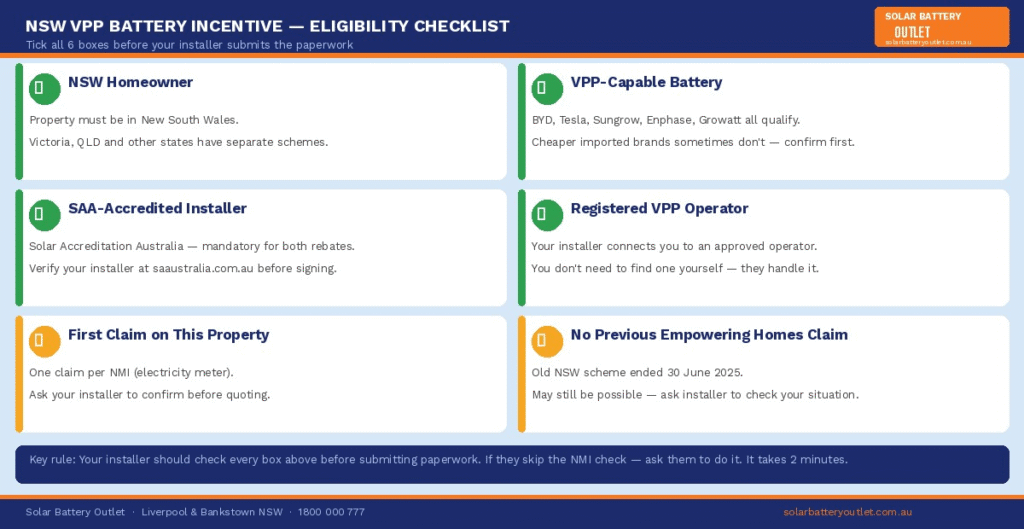
NSW VPP incentive eligibility checklist 2026

Not every battery installation qualifies. Here’s the exact checklist:

You must be a NSW homeowner. The Peak Demand Reduction Scheme is a NSW state program. Properties in Victoria, Queensland or other states don’t qualify — those states have their own separate schemes.

Your battery must be VPP-capable. This means the battery’s firmware and hardware support remote dispatch by a VPP operator. Every major brand we install — BYD, Tesla, Sungrow, Enphase, Growatt — qualifies. Cheaper imported brands sometimes don’t. Your installer should confirm this before quoting.

Your battery must be connected to a registered VPP operator. There are several approved VPP operators in NSW — your installer will connect you to one as part of the installation process. You don’t need to go find one yourself.

The battery must be installed by an SAA-accredited installer. Same requirement as the federal rebate. If your installer isn’t SAA-accredited, you can’t access either scheme. Verify at saaustralia.com.au before signing anything.

One claim per property. The incentive is tied to your property’s electricity meter (NMI). If a previous owner already claimed it, you can’t claim again on the same address. A good installer checks this upfront.

You must not have previously claimed the old NSW Empowering Homes battery rebate on this property. If the old scheme was claimed, the VPP incentive may still be accessible separately depending on your battery specifications — worth asking your installer to check your specific situation.

The Federal Rebate vs The NSW VPP Incentive — What’s the Difference

People often confuse these two. They’re completely separate schemes run by different governments. Here’s the clearest way to think about them:

Federal Cheaper Home Batteries Program:

  • Run by the Australian federal government
  • Gives you roughly 30% off the upfront cost of an eligible battery
  • Applied directly off your invoice by your installer — you never see the money, it just reduces what you pay
  • Rate drops after 1 May 2026 and steps down every six months until 2030
  • Available across all of Australia

NSW Peak Demand Reduction Scheme (VPP Incentive):

  • Run by the NSW state government
  • Pays you up to $1,500 as a separate payment after installation
  • Paid out after your battery is connected to a VPP and registered with the scheme
  • Not affected by the 1 May federal changes — rate stays the same
  • Only available in NSW

The key point: you can claim both. They are designed to stack. A typical NSW homeowner installing a 10 kWh battery captures around $3,100 from the federal scheme and around $1,100 from the NSW VPP scheme — over $4,200 in combined savings before a single electricity bill reduction kicks in.

Our Federal Battery Rebate NSW 2026 guide walks you through the federal rebate step by step and explains exactly who qualifies and how it’s applied.

How to Claim the NSW VPP Incentive — Step by Step

Good news: most of this happens automatically when you use a good installer. Here’s the process so you know what to expect and what to ask.

Step 1 — Choose an SAA-accredited installer who processes both rebates.

This is the most important step. Not all installers bother with the VPP incentive because it involves extra compliance and registration steps. Before you accept any quote, ask directly: “Do you process the NSW Peak Demand Reduction Scheme incentive?” If they hesitate or look confused — find a different installer.

Step 2 — Choose a VPP-capable battery.

Your installer will confirm this. Every battery we recommend — BYD, Tesla Powerwall 3, Sungrow SBR, Enphase IQ 5P — qualifies. The installer will specify a registered VPP operator at the time of installation. You sign a VPP agreement, which covers how your battery can be dispatched and sets your minimum reserve levels.

Step 3 — Installation day.

Your battery is installed and connected. The installer registers the system with Ausgrid (your local network operator across most of NSW) and with the VPP operator. Both registrations are handled by your installer — not you.

Step 4 — VPP incentive payment.

After installation and registration are confirmed, the NSW incentive payment is processed. This typically takes a few weeks and comes through as a payment separate from your installation invoice. Your installer should give you a clear timeline on when to expect it.

Step 5 — You’re done.

Your battery runs normally. You keep full visibility of your charge levels through your battery’s app. The VPP operator can access your battery during peak events — but you set the floor on how low it can go.

Will Being in a VPP Affect My Battery Performance?

This is the question we get asked most often once people understand what a VPP is. The honest answer is — minimally, and usually in your favour.

VPP dispatch events typically happen a handful of times per year during extreme peak demand. Each event might draw 1 to 2 kWh from your battery. In practice, your battery recharges from solar the next day and you’re back to normal.

Some VPP arrangements also pay you ongoing payments or bill credits each time your battery is dispatched — on top of the upfront $1,500 incentive. This varies by VPP operator, so ask your installer which operator they use and what the ongoing earning structure looks like.

The one thing to confirm is your minimum reserve setting. If you want blackout protection — and you should, given South West Sydney’s storm season — make sure your VPP agreement lets you set a minimum charge reserve to keep enough backup power available. A good installer configures this during setup.

Which Batteries Qualify for the NSW VPP Incentive in 2026

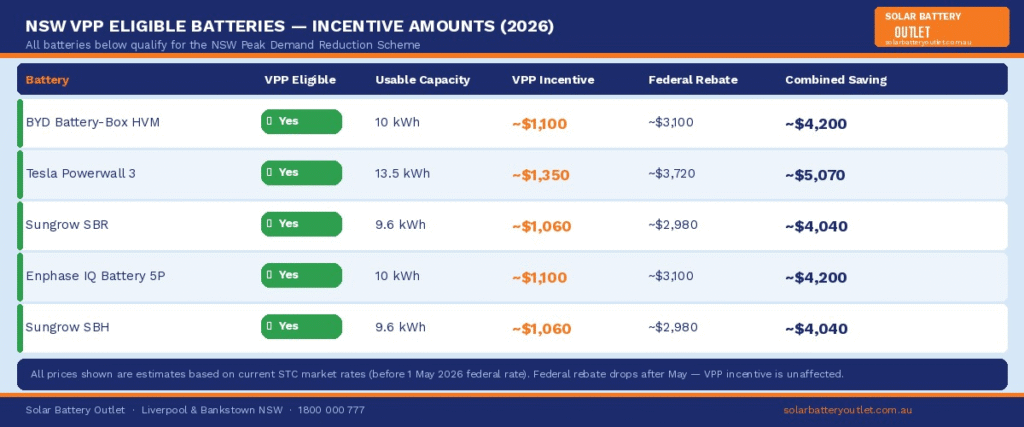
NSW VPP eligible batteries 2026 comparison

Every battery we stock and install qualifies. Here’s the confirmed list:

BatteryVPP EligibleUsable CapacityApprox. VPP Incentive
BYD Battery-Box HVM 10 kWh✅ Yes10 kWh~$1,100
Tesla Powerwall 3✅ Yes13.5 kWh~$1,350
Sungrow SBR 9.6 kWh✅ Yes9.6 kWh~$1,060
Enphase IQ Battery 5P (10 kWh)✅ Yes10 kWh~$1,100
Sungrow SBH 9.6 kWh✅ Yes9.6 kWh~$1,060

For a full comparison of these batteries including prices and performance, our Best Solar Battery NSW 2026 guide has everything side by side.

What About VPP Ongoing Earnings — Is It Worth Staying In?

The $1,500 upfront incentive is the main headline. But some VPP programs also pay you on an ongoing basis each time your battery contributes to a grid event.

The exact amount varies by operator and by how active your battery is in dispatch events. Some households earn an extra $50 to $200 per year through ongoing VPP participation. It’s not life-changing money on its own — but it’s passive income from a battery you already own.

The key question to ask your installer is: which VPP operator are we being connected to, and what’s the ongoing payment structure after the upfront incentive is paid?

Some operators give you bill credits. Some pay direct. Some offer a hybrid arrangement. It’s worth understanding before you sign the VPP agreement — not because any of them are bad, but because you want to know what you’re getting.

Frequently Asked Questions

Does the NSW VPP incentive drop after 1 May 2026 like the federal rebate?

No. The federal rebate rate drops on 1 May 2026 — the NSW VPP incentive is completely separate and is not affected by that date. You can claim the full VPP incentive amount whether you install before or after May. The only reason to rush for May is the federal rebate component.

Can I claim the VPP incentive if I already have a battery installed?

Generally no — the NSW Peak Demand Reduction Scheme incentive is designed for new battery installations. If you have an existing battery that’s already registered with a VPP, you may have already received it or been ineligible depending on when it was installed. Worth asking your installer to check your specific situation.

What if I don’t want to join a VPP?

You can still claim the federal rebate without joining a VPP — the two are separate. You simply won’t receive the $1,500 NSW incentive. For most homeowners the VPP agreement is a straightforward arrangement and the $1,500 is well worth it. But it’s your choice.

How long does the VPP incentive payment take to arrive?

Typically 2 to 6 weeks after your installation is registered and confirmed. Your installer handles the registration — ask them for a specific timeline at the time of installation so you know what to expect.

Will the VPP drain my battery during a blackout?

No. VPP dispatch only operates when the grid is running — not during a blackout. If the grid goes down, your battery automatically switches to backup mode and the VPP connection is inactive. Your stored power is yours during an outage.

Does joining a VPP affect my battery warranty?

It shouldn’t if you’re using an approved VPP operator and your battery is installed correctly. The VPP dispatch events are within the normal operating parameters of the battery. Confirm this with your installer and check your battery’s warranty documentation to be sure.

Want us to handle both rebates for your NSW home?

We process the federal Cheaper Home Batteries rebate AND the NSW VPP incentive as standard on every installation. You don’t chase paperwork. We handle it.

Call 1800 000 777 or fill in our 60-second form at solarbatteryoutlet.com.au

If you are reading this, you have probably already seen the ads. The countdown timers. The ‘act now before it is too late’ messaging that has been all over social media since the government announced the 1 May rebate change.

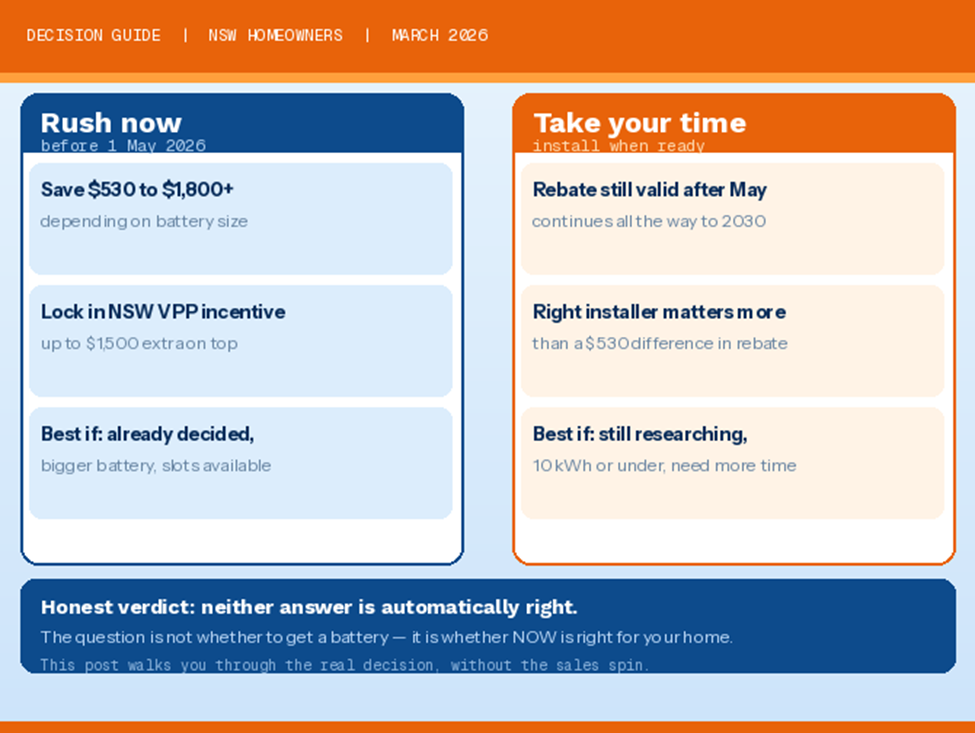
Here is the honest answer: it depends on your situation. And anyone who tells you otherwise — without knowing anything about your home, your electricity usage, your solar system, or your budget — is trying to sell you something.

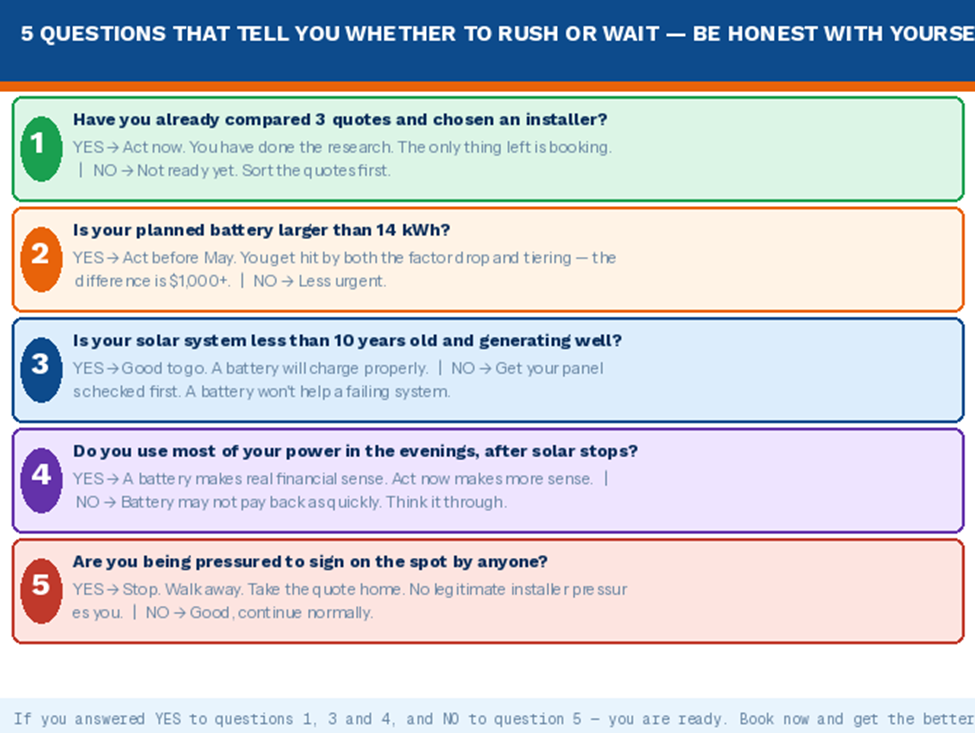
This guide gives you five straightforward questions to work through. Answer them honestly and you will know exactly whether you should be moving quickly or taking your time.

First — what is actually happening on 1 May 2026? The federal battery rebate is not ending. It runs until 2030. What is changing is the rate used to calculate the rebate — the STC factor drops from 8.4 to 6.8. For a standard 10 kWh battery, that means roughly $530 less rebate. For larger batteries above 14 kWh, the hit is bigger due to a new tiered structure. The rebate continues after May — it just keeps getting a little smaller every six months.

Five Questions That Tell You Whether to Rush or Wait

Five Questions That Tell You Whether to Rush or Wait

Work through these in order. Be straight with yourself.

Question 1: Have you already compared at least 3 written quotes?

This is the most important question. If the answer is no, you are not ready to book — and rushing into a booking without comparing quotes is the most expensive mistake you can make with solar batteries.

A difference of $530 in rebate savings means nothing if you end up with the wrong installer, the wrong battery size, or a quote that has not accounted for a switchboard upgrade you need. Get your three quotes first. Then make the timing decision.

If yes: you have done the work. There is no good reason to delay past 1 May if you are already ready to book.

If no: start there. Get the quotes. Then come back to the timing question.

Question 2: Is your planned battery larger than 14 kWh?

From 1 May 2026, there is a new tiered rebate structure that reduces support for batteries above 14 kWh of usable capacity. If you are planning a 20 kWh system, a whole-home setup, or anything that pushes above that threshold, the cost difference between installing before and after May is not $530 — it is $1,000 to $1,800 or more.

At that level the maths on timing is pretty clear, assuming you are already ready to go.

If yes: this is a meaningful saving. Worth acting before May if your other questions check out.

If no: the factor drop alone gives you a $530 difference. Real money, but not urgent.

Question 3: Is your solar system less than 10 years old and generating well?

A battery will not help you much if your solar panels are degraded and not generating properly. Before adding storage, it is worth knowing how your existing system is performing.

If your system is over 10 years old, get a quick health check from a solar technician before booking a battery. Adding a $10,000 battery to a solar system that generates poorly is throwing money at the wrong problem.

If yes: your system should charge a battery well. Good to proceed.

If no: sort the solar first. The battery can wait.

Question 4: Do you use most of your power in the evenings, after solar stops generating?

This is the core question about whether a battery will actually save you meaningful money. A battery stores the solar power your panels generate during the day and releases it at night when electricity is expensive — typically 30 cents or more per kWh in NSW.

If you work from home, are retired, or are home all day, you might already be using a lot of your solar output directly. A battery will help less in that case than for a family that is out all day and runs the dishwasher, oven and TV from 5pm onwards.

If yes: a battery is likely to give you a solid return. The timing decision becomes more financially meaningful.

If no: take the time to understand your usage pattern before committing. A free quote assessment from a good installer will look at your bills and advise you properly.

Question 5: Is anyone pressuring you to sign on the spot?

This one is a bit different. It is not about your home — it is about protecting yourself from a common tactic that spikes around any rebate deadline.

Door knockers. Cold callers. ‘Limited spots available.’ ‘Sign today to guarantee your rate.’ These are not legitimate sales techniques — they are pressure tactics that solar regulators in NSW have repeatedly warned about.

A legitimate installer will: give you a written quote, leave it with you to compare, answer questions honestly, and respect your timeline.

If you are being pressured: stop. Take the quote home. Call the installer back in your own time. If they will not give you a written quote to take away, that is your answer.

What the Payback Numbers Actually Look Like

Comparison of NSW solar battery

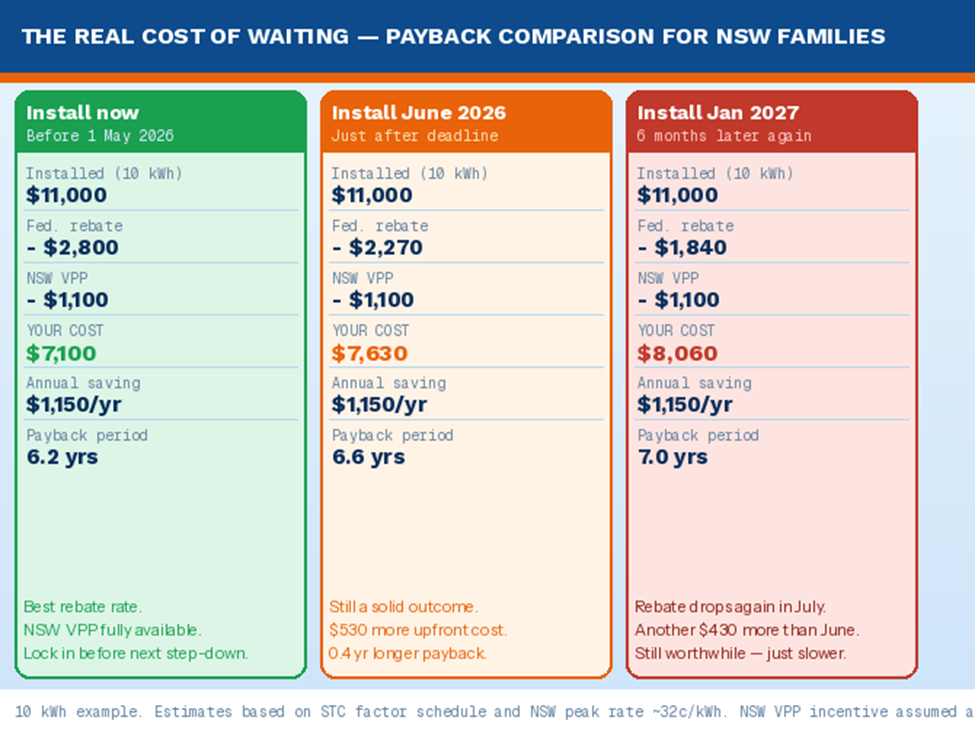
The payback comparison puts the timing decision in perspective. For a 10 kWh battery in NSW:

  • Install before 1 May 2026: net cost around $7,100, payback around 6.2 years
  • Install June 2026: net cost around $7,630, payback around 6.6 years — half a year longer
  • Install January 2027: net cost around $8,060, payback around 7.0 years — a full year longer than today

The annual saving from the battery itself does not change — that is determined by how much electricity you use at night and what your tariff is. The only difference is in the upfront cost, which affects how long until you break even.

The takeaway: every six months you delay adds roughly four to six months to your payback period. Over years, that compounds. But for a 10 kWh battery, the difference between installing in April 2026 and June 2026 is about half a year on payback — meaningful but not dramatic.

The one scenario where timing really matters: If you are planning a larger battery — 15 kWh, 20 kWh, or anything above 14 kWh — the 1 May change hits harder because of the tiered structure on top of the factor drop. A 20 kWh system loses over $1,800 in rebate after May. At that level, if you are already ready to go, the case for acting before May is genuinely strong.

Before You Book Anything — Know What to Look For

Green flags/Red flags Installer

Whether you are booking before May or later, the quality of your installer matters more than any rebate timing. Here is what separates a good installer from a poor one.

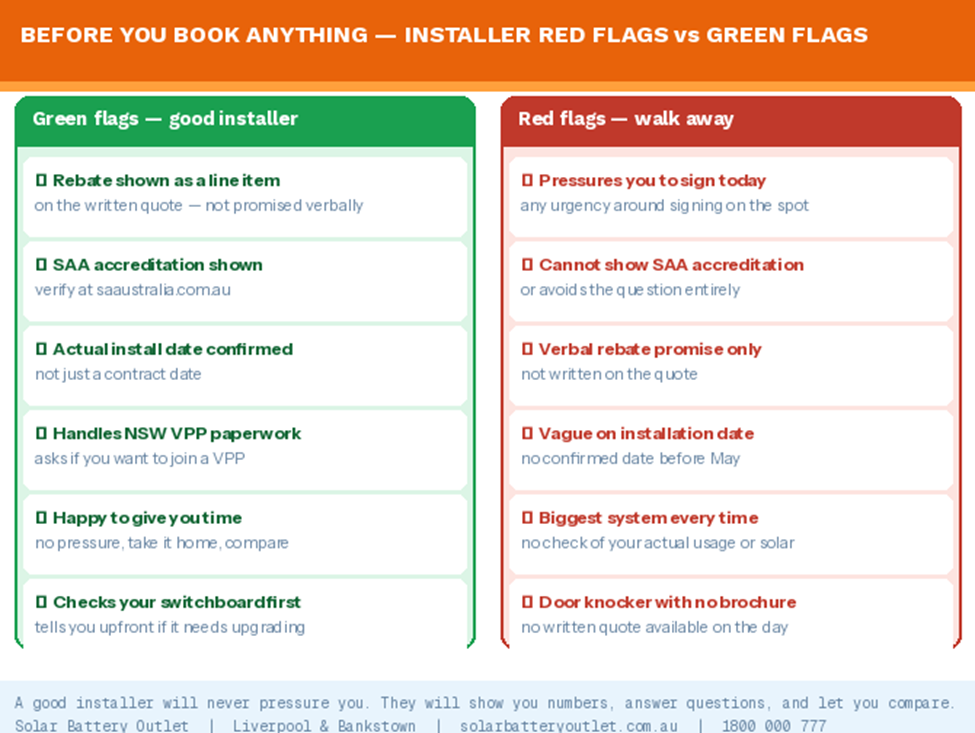
Green flags — signs of a good installer

  • The federal rebate appears as a dollar deduction on the written quote — not a verbal promise
  • They can show you their SAA accreditation number — verify it yourself at saaustralia.com.au
  • They give you an actual confirmed installation date, not just a contract signing date
  • They ask about your electricity usage and solar system before recommending a battery size
  • They mention the NSW VPP incentive and ask if you want to participate
  • They are happy for you to take the quote home and compare it

Red flags — walk away

  • Any pressure to sign on the same day — ‘this price is only available today’
  • Cannot produce an SAA accreditation number or avoids the question
  • Rebate mentioned verbally but not shown on the written quote
  • No confirmed installation date before 1 May — just a contract date
  • Recommends the biggest possible system without looking at your bills or usage
  • Door knocker with no leave-behind quote — nothing in writing on the day

So — Should You Rush?

Here is the straight answer:

Rush if: you have compared quotes, chosen an installer, your solar is in good shape, you use power in the evenings, and you are planning a battery over 14 kWh. In that case, there is no good reason to wait past May.

Take your time if: you are still researching, not sure a battery is right for you, have an older solar system that needs checking, or are being pressured by anyone. A $530 difference in rebate is not worth making a rushed decision on a $10,000 purchase.

Either way: the rebate continues to 2030. Batteries still make financial sense after May. The decision should be driven by your readiness — not by a deadline.

One last thing worth saying plainly: We install solar batteries for a living. It would be easy for us to tell you to rush, book now, do not wait. But the homeowners who get the best outcome from a battery are the ones who made the decision properly — not the ones who were panicked into it. If you are not ready, take more time. We will still be here in June.

Frequently Asked Questions

If I wait until June, will I still qualify for the NSW VPP incentive?

Yes. The NSW Peak Demand Reduction Scheme — up to $1,500 for connecting to a Virtual Power Plant — is a separate state incentive and is not affected by the 1 May federal changes. You can claim both rebates regardless of when you install.

Can I lock in the current rebate rate by signing a contract now, even if installation is after May?

No. Your rebate is determined by the date the battery is physically installed and commissioned — not the date you sign a contract. Any installer who tells you otherwise is not being straight with you. Get the actual installation date confirmed in writing before May if you want the current rate.

I am not sure if my electricity usage justifies a battery. How do I find out?

Ask any reputable installer to look at your last 12 months of electricity bills. A good installer will tell you honestly whether a battery makes financial sense for your home before recommending one. Be cautious of anyone who recommends a battery without looking at your bills first.

Are there any battery brands I should avoid buying near a deadline?

The brand is less important than the installer. Near any deadline, some less reputable operators push cheap or uncertified batteries because margins are easier to hide. Stick to established brands — Tesla Powerwall, BYD, Sungrow, Enphase, Growatt — and make sure the battery is SAA product-listed. Ask your installer to show you the product listing if you are unsure.

Not Sure If You Are Ready? Talk to Us First. We do free no-obligation quotes for NSW homeowners across Liverpool, Bankstown, and Mudgee. We will look at your bills, check your solar setup, and tell you honestly whether a battery makes sense — and whether timing matters for your situation. No countdown timer. No pressure. Just the numbers. Call us: 1800 000 777 Or visit solarbatteryoutlet.com.au — fill in the 60-second eligibility form and we will be in touch.
About Solar Battery Outlet: We are a Liverpool-based solar battery installer, part of GWM Group Pty Ltd, servicing homes across Bankstown and Mudgee. All installations are done by SAA-accredited electricians. We handle all rebate paperwork, so you do not have to.