When homeowners think about solar battery safety, they usually think about fire risk from the battery itself — a legitimate concern and one that good brands like BYD and Sungrow take seriously. But there is a second risk that almost nobody talks about: the wiring behind the wall.

Across New South Wales, a significant number of solar battery installations are wired incorrectly. Not badly — incorrectly. There is a specific Australian Standard that governs how batteries must be wired into your home, and many homeowners have no idea it exists, let alone whether their own installer followed it.

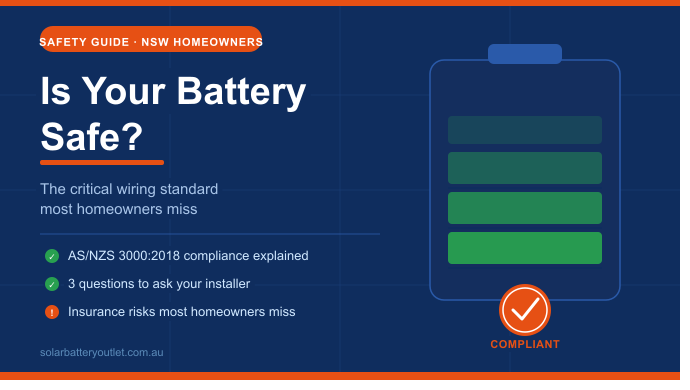
This article explains what the standard is, what it requires, and the three questions you should ask any installer before you sign anything.
Battery Safety Guide

The Standard You Have Never Heard Of: AS/NZS 3000:2018

Australian electrical installations — including solar battery storage systems — are governed by AS/NZS 3000:2018, commonly known as the Wiring Rules. Every licensed electrician in NSW is legally required to follow it. The problem is not that the standard does not exist. The problem is that nobody tells homeowners about it, which means nobody thinks to check.

In 2019, the standard was updated with a companion document specifically for battery energy storage systems: AS/NZS 5139:2019. Together, these two documents set out exactly how a battery must be wired — from the cable sizing, to the isolator placement, to the earthing arrangement — to be considered safe and compliant.

Why Most Homeowners Miss It

The solar and battery industry in NSW has grown rapidly. With that growth has come pressure on installers to move quickly, keep costs low, and compete on price. In that environment, some corners get cut — and wiring compliance is one of the first places shortcuts appear.

Here is what non-compliant wiring typically looks like in practice:

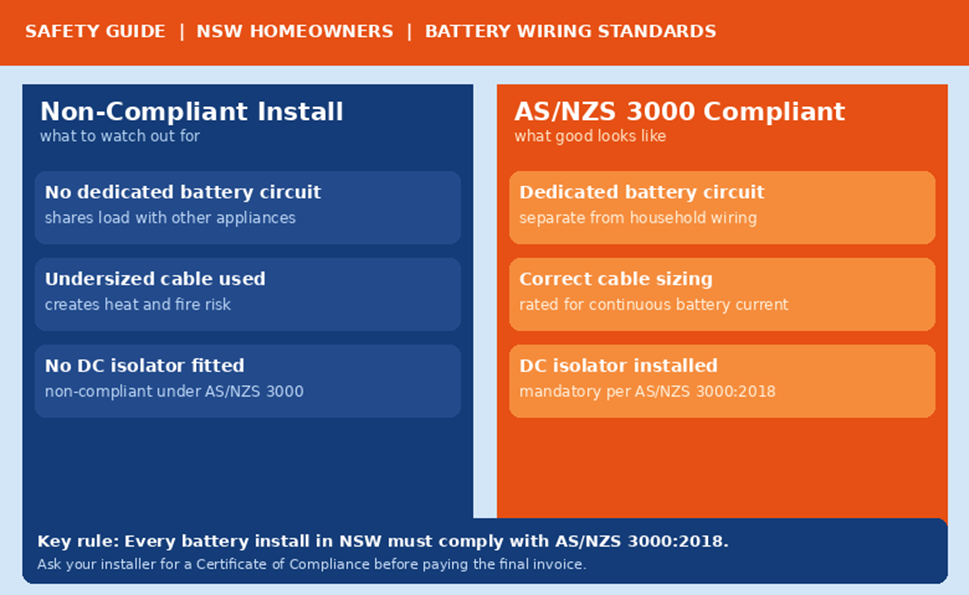
  • The installation connects the battery to an existing circuit that already serves other loads, instead of using a dedicated run
  • The cable used is undersized for the continuous discharge current of the battery — creating heat at the cable over time
  • The DC isolator is missing, poorly placed, or not rated for the battery’s voltage and current
  • No Certificate of Compliance is issued after the install — meaning there is no official record that the work meets the standard

None of these shortcuts are visible once the wall is closed. You would not know. Your installer might not even acknowledge the issue. But your insurer might — particularly if something goes wrong.

The Insurance Problem Nobody Warns You About

Home insurance policies in Australia typically contain a clause that voids coverage for damage caused by non-compliant electrical work. If your battery is wired incorrectly and causes a fire or electrical fault, your insurer can — and in some cases will — refuse to pay.

This is not about fearmongering. The vast majority of battery installations are done correctly. But a ‘mostly fine’ installation rate is not the same as a ‘yours is definitely fine’ guarantee. Given that a compliant install and a non-compliant install often look identical from the outside, the only way to know is to ask the right questions before you sign.
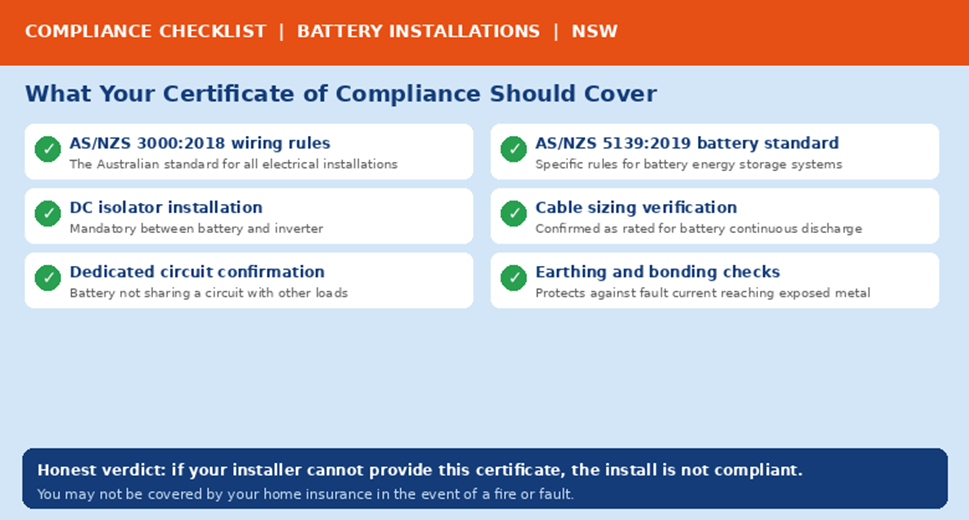
Compliance Checklist

The Three Questions to Ask Any Installer

You do not need to become an electrician to protect yourself. These three questions will quickly tell you whether an installer knows their obligations — and whether they are willing to meet them.

Question 1: Which wiring standard governs battery installations in NSW?

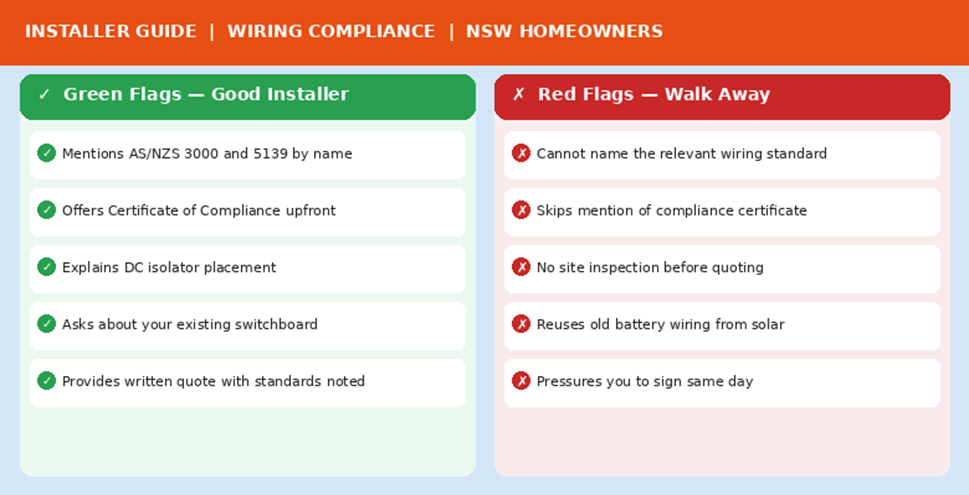
The correct answer is AS/NZS 3000:2018 (the Wiring Rules) and AS/NZS 5139:2019 (the battery-specific standard). An installer who cannot name either document — or who looks uncertain — is a red flag. This is not obscure knowledge. It is the legal foundation of their work.

Every licensed installer in NSW should hold current accreditation. You can verify your installer’s accreditation here before you agree to anything — it takes less than a minute and gives you immediate peace of mind.

Question 2: Will you provide a Certificate of Compliance after installation?

This certificate, sometimes called a Certificate of Compliance for Electrical Work (CCEW), is issued by a licensed electrician to confirm that the installation meets the required standard. It is not optional. If an installer says they do not usually provide one, or that you can request it separately, be cautious. It should be offered as standard.

Question 3: Will the battery have its own dedicated circuit?

A compliant battery installation requires a dedicated circuit — not a circuit shared with other appliances or with your existing solar setup. If the answer is vague or the installer suggests they will reuse existing wiring, that is a flag worth exploring further before proceeding.
Solar Installer Guide

A Note on NSW VPP Incentives and Compliance

If you plan to participate in a Virtual Power Plant (VPP) to access the NSW VPP battery incentive — which can add up to $1,500 on top of the federal rebate — you must ensure your battery installation passes a network assessment before enrollment.

That assessment includes a review of how the system is wired. If your installation doesn’t meet AS/NZS 3000 or 5139 standards, it won’t pass the network check. A simple wiring shortcut could end up costing you the entire incentive If you want to understand more about how the VPP incentive works in NSW, this guide to the NSW VPP battery incentive explains the full requirements and eligibility process.

What a Compliant Installation Includes

To be clear about what you should expect from a professional battery installation in NSW. Here is what the standards require:

  • A dedicated battery circuit, separate from all other household wiring
  • AC and DC cables sized correctly for the battery’s continuous discharge current
  • A DC isolator installed between the battery and inverter, rated for the system voltage
  • Correct earthing and bonding in line with AS/NZS 3000:2018
  • Battery location meeting the clearance and ventilation requirements of AS/NZS 5139:2019
  • A Certificate of Compliance issued by the licensed electrician who performed the work

None of this is expensive or time-consuming when done from the start. The problem only arises when an installer tries to save time by skipping steps — and the homeowner does not know what to ask.

The Honest Bottom Line

Solar batteries are safe when installed correctly. The Australian standards exist precisely because someone — or many someones — worked out what ‘correctly’ looks like in detail. They are not bureaucratic box-ticking. They are the engineering consensus on what a battery installation needs to look like to be reliably safe over its working life.

The single most effective thing you can do as a homeowner is ask the three questions above before you sign. A good installer will answer them clearly and confidently. A poor installer will not.

Ask anyway. The answer will tell you everything you need to know.

You’ve probably noticed something interesting happening in Bankstown lately.

In February 2026, Ausgrid switched on a brand new 10 MW community battery right here in the suburb — one of the largest they’ve ever built. That’s not a coincidence. It’s a signal. Battery storage in Bankstown is no longer something early adopters do. It’s something the energy industry is betting serious money on, right in your backyard.

And homeowners are paying attention. Enquiries from Bankstown and Canterbury-Bankstown area have jumped significantly over the past few months — not because of marketing, but because the maths has changed. Feed-in tariffs are low, evening electricity rates are high, and the government rebate makes the upfront cost a lot more manageable than most people expect.

We’re based at Fetherstone Street in Bankstown. We install solar batteries across this area every week. This guide is written specifically for Bankstown homeowners — the real numbers, the actual rebates available right now, and the questions you should be asking any installer before you hand over a dollar.


One thing to flag before we start: The federal battery rebate rate drops after 1 May 2026. For a 10 kWh battery, installing before that date saves around $530 compared to installing in June. It’s not a massive cliff — but it’s real money. If you’re already leaning toward a battery, sooner is better than later. Full breakdown of what changes on 1 May here.


Why Bankstown Homeowners Are Enquiring About Batteries Right Now

It’s worth understanding the context, because it explains why the timing matters.

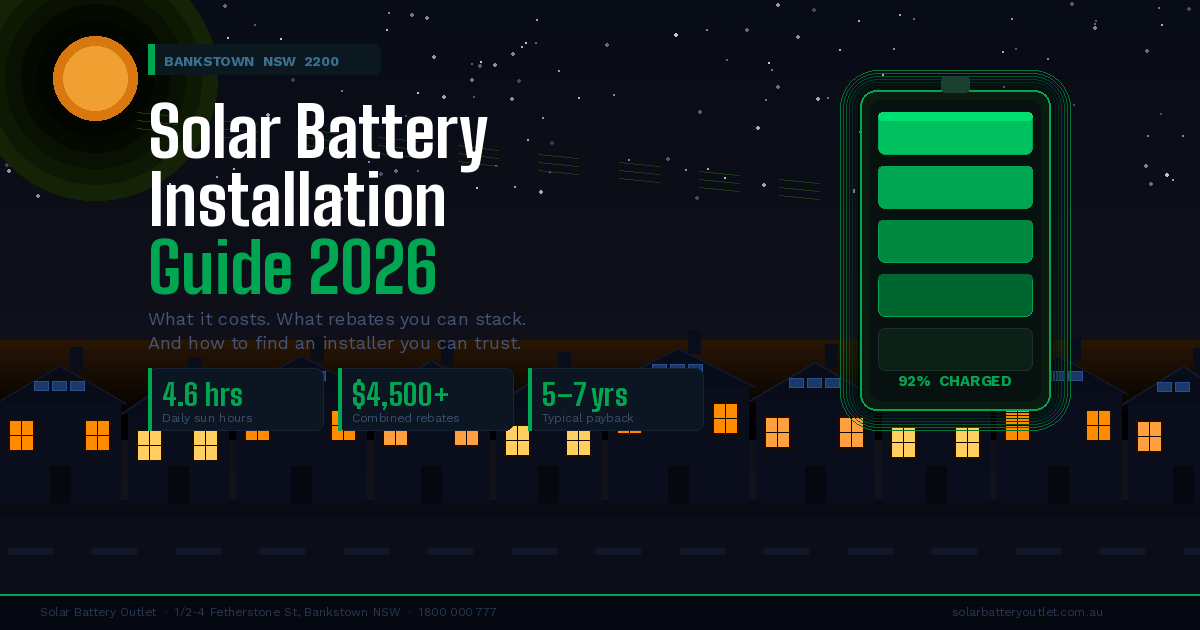
Bankstown gets around 4.6 peak sun hours per day on average. That’s solid — it means a typical rooftop solar system here generates strong output, especially through spring and autumn. The problem is, most of that generation happens between 10am and 3pm. And most families in Bankstown aren’t home during those hours.

So what happens? Your solar panels generate power, you export it to the grid for around 5 to 8 cents per kWh, and then you buy it back at night for close to 30 cents. You’re essentially selling something cheap and buying it back expensive. A battery fixes that. It holds what your panels generate and saves it for when you actually need it — evenings, mornings, weekends.

On top of that, Bankstown sits in an area of Canterbury-Bankstown where summer storm outages are a genuine issue. A battery with backup capability means when the grid goes down, your home keeps running. Lights, fridge, phone charging — all of it.

The rebate is the third piece. A 10 kWh battery that cost $14,000 a few years ago is now closer to $7,000 to $9,000 after the federal discount. That changes the payback calculation significantly.

What a Solar Battery Actually Costs in Bankstown in 2026

Let’s not beat around the bush. Here are the real numbers after rebates:

Battery SizeFederal RebateNSW VPP IncentiveYour Cost After Both
5 kWh system~$1,550Up to $550~$4,500–$6,000
10 kWh system~$3,100Up to $1,100~$7,000–$9,000
13–15 kWh system~$3,700–$4,500Up to $1,500~$9,500–$13,000

These are estimates — your actual quote will depend on your existing solar system, your switchboard, and which battery brand you go with. Bankstown homes, particularly older ones built in the 1980s and 1990s, sometimes need a switchboard upgrade before a battery can be safely connected. That adds $500 to $1,500 to the job. Any installer worth their salt will tell you upfront if that applies to your property — before you’ve committed to anything.

For the full cost breakdown including what drives the price up or down, our Solar Battery Cost Sydney 2026 guide has the detail.

The Two Rebates Bankstown Homeowners Can Stack Right Now

This is where people get confused online, so let’s make it simple.

1. Federal Cheaper Home Batteries Program

This is the big one — roughly 30% off your battery upfront. Your SAA-accredited installer applies it straight off your invoice. You don’t apply separately, you don’t wait for a cheque. It just comes off the price. For a 10 kWh system, that’s around $3,100 in savings right there.

2. NSW Peak Demand Reduction Scheme (VPP Incentive)

This is a separate NSW government payment of up to $1,500 for connecting your battery to a Virtual Power Plant. Your battery stays in your home — nothing physical changes. It’s a software connection that lets your battery join a network that helps stabilise the grid during peak times. In return, the government pays you.

The good news — you can claim both. They stack. A Bankstown homeowner installing a 10 kWh battery could save over $4,500 combined before the first electricity bill saving even kicks in.

For the step-by-step on how to claim both rebates without touching any paperwork yourself, our Federal Battery Rebate NSW 2026 guide walks through exactly what happens.

Is a Solar Battery Actually Worth It for Your Bankstown Home?

Honest answer — it depends on your situation. Here’s a quick way to think about it.

A battery makes strong financial sense if:

  • Your quarterly electricity bill is still above $250 even with existing solar panels on your roof
  • You’re mostly home in the evenings — after solar has stopped generating
  • Your current feed-in tariff is below 10 cents per kWh (most Bankstown homes are on 5 to 8 cents right now)
  • You’ve had two or more power outages in the past year and want backup capability
  • You have or plan to get an electric vehicle

A battery probably isn’t the right move yet if:

  • You’re renting — you’d need the landlord to agree and that’s a different conversation
  • Your existing solar system is more than 10 years old and generating poorly — sort that first
  • You’re planning to sell the house within 2 to 3 years — payback periods run 5 to 8 years for most Bankstown households
  • You work from home and use most of your solar power during the day already

If you’re genuinely unsure, a good installer should be able to look at your last 3 electricity bills and give you a straight answer on whether the numbers work for your home. We do this at no charge for Bankstown homeowners. If the numbers don’t stack up, we’ll tell you.

For a deeper look at the financial case, our Is Adding a Battery to Existing Solar Worth It in 2026 guide has the honest payback analysis.

What to Look for in a Bankstown Solar Battery Installer

The quality of your installation matters more than the brand of battery you choose. A good battery installed badly will give you problems. A solid mid-range battery installed properly will run quietly for 10 years. Here’s what to check.

SAA Accreditation — Non-Negotiable

The old CEC accreditation has been replaced by SAA (Solar Accreditation Australia) for battery installations. If your installer isn’t SAA-accredited, you cannot claim the federal rebate. Full stop. Before you accept any quote, verify their accreditation at saaustralia.com.au. Takes about 30 seconds.

Do They Handle Both Rebates?

Some installers apply the federal rebate but skip the NSW VPP incentive because it involves extra compliance paperwork. Ask directly: “Do you process the NSW Peak Demand Reduction Scheme incentive?” If they look blank — that’s a flag. A good installer handles both.

Get Three Written Quotes

Prices vary significantly in Bankstown — sometimes by $2,000 to $3,000 for the same system. Make sure each quote shows the federal rebate as a clear line item, includes all electrical work, and specifies the battery warranty period. Ten years should be the minimum from any quality brand.

Local Presence Matters

A battery needs to work for 10 years. If something goes wrong in year 4, who do you call? An installer based in Bankstown or South West Sydney is a very different service experience from an interstate company with no local team. Ask where their technicians are based.

Which Battery Brands Work Best in Bankstown?

We install several brands across Bankstown, Mudgee and Liverpool. Here’s an honest look at what we recommend most often and why.

BYD Battery-Box HVM — This is our most recommended option for the average Bankstown family. It’s modular, meaning you can start with 8.3 kWh and add storage later. Strong value, 10-year warranty with 70% capacity retention. Works well with a wide range of existing inverters — which matters in an area with lots of older solar systems.

Tesla Powerwall 3 — The premium option. Best automatic blackout protection available, excellent for EV owners, and the cleanest single-unit installation. Costs more but earns it. We wrote a full comparison of Tesla Powerwall 3 vs BYD Battery-Box if you’re deciding between the two.

Sungrow SBR — Best value for performance. If your Bankstown home already has a Sungrow inverter, this is often the most cost-effective and technically compatible upgrade. Strong cycle rating at a price point that makes sense.

For the full comparison across all six brands we stock, see our Best Solar Batteries Australia 2026 guide.

What Actually Happens on Installation Day in Bankstown

People always ask how disruptive it is. For a standard Bankstown home, installation takes 4 to 6 hours from arrival to sign-off. Here’s what that day looks like:

The installer arrives and checks your switchboard and existing solar system — that’s usually the first 30 minutes. The battery is mounted, typically in the garage, laundry, or on an external wall. Electrical connections are made and the system is tested. The installer registers the system with Ausgrid (your local network provider here in Bankstown) — this is required in NSW. You’re shown how to monitor everything from your phone. Then they leave.

Your house looks exactly the same. Except now you have a battery.

One thing worth knowing — the Ausgrid network registration sometimes takes a few days to fully process. During that window your battery runs in backup-only mode. That’s completely normal. Nothing is wrong.

Frequently Asked Questions from Bankstown Homeowners

Do I need existing solar panels to get the rebate?

Yes. The federal Cheaper Home Batteries Program requires you to have rooftop solar — either existing or installed at the same time as the battery. If you don’t have solar yet, you can install both together and the rebate still applies to the battery portion. For how long batteries last once you’ve installed, see our How Long Does a Solar Battery Last in Australia guide.

Will my battery keep the power on during a blackout?

Only if backup mode is included in the system design — which it isn’t automatically on all setups. Always confirm blackout protection is included when you’re getting quotes. Tesla Powerwall 3 does this automatically. Other batteries need to be configured for it.

What’s the payback period for a Bankstown home?

For most Bankstown households we work with, payback sits between 5 and 7 years depending on battery size, electricity usage, and whether you join a VPP. With Ausgrid’s local grid seeing higher peak demand in summer, Bankstown homes with batteries that participate in VPPs often see strong returns on that $1,500 incentive payment.

Can I add more storage later if my needs change?

Some batteries are modular and let you add capacity — BYD Battery-Box is the main one we recommend for this. Others are fixed. If you think your energy needs might grow — especially if an EV is in the picture — ask specifically about modular options when comparing quotes.

What if I already claimed an older NSW rebate?

The old NSW Empowering Homes program ended 30 June 2025. If you previously claimed that, you may still be able to access the NSW VPP incentive separately depending on your battery’s specifications. Worth asking an installer to check.


Want a Quote for Your Bankstown Home?

We’re based locally at 1/2-4 Fetherstone Street, Bankstown. Our team services all of Liverpool-Bankstown and Mudgee. We check your eligibility for both the federal rebate and NSW VPP incentive — no obligation, no pressure.

Call 1800 000 777

or fill in our 60-second eligibility form at solarbatteryoutlet.com.au