If you have been searching for a solar battery in NSW and wondering whether your shortlisted model actually qualifies for the federal rebate — you are not alone. The government’s Cheaper Home Batteries Program has attracted enormous interest since launching in July 2025, but the eligibility rules are specific, and not every battery on the market makes the cut.

This guide gives you a straight answer. It explains which batteries qualify, outlines the technical requirements, lists the approved brands, and shows how the 2026 tiered rebate structure affects your savings.

The 5 Rules That Determine Whether a Battery Qualifies

To be eligible for the federal rebate under the Cheaper Home Batteries Program, your battery and installation must meet five specific criteria. Miss any one of them and the rebate does not apply.
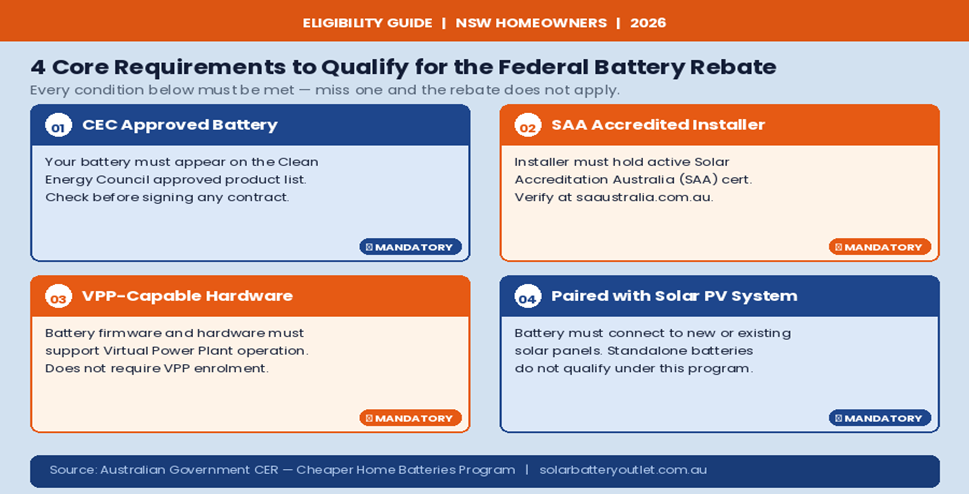
4 core requirements to quality for the federal battery rebate

1. The Battery Must Be on the CEC Approved Product List

The Clean Energy Council (CEC) maintains a list of approved battery products. If your battery is not on this list, it is simply not eligible — regardless of brand name, price, or capacity. The list is updated regularly and contains hundreds of models from dozens of manufacturers.

The major brands available in NSW — Tesla, BYD, Sungrow, Enphase, Growatt, AlphaESS, GoodWe, Sonnen, and SolarEdge — all have qualifying models on the list. But here is the important nuance: not every model from every brand is automatically listed. Some older variants, grey imports, or uncertified sub-models of otherwise approved brands may not qualify.

2. The Installer Must Hold Current SAA Accreditation

Since 2024, the accreditation body for solar installers in Australia changed from the Clean Energy Council to Solar Accreditation Australia (SAA). Your installer must hold a current, active SAA accreditation — not a historic CEC accreditation that predates the changeover.

You can verify an installer’s accreditation status directly at saaustralia.com.au. This check takes less than a minute and protects you from using an unqualified installer who cannot legally apply the rebate.

3. The Battery Must Be VPP-Capable

VPP stands for Virtual Power Plant. The federal government’s program requires that all eligible batteries are technically capable of participating in a VPP—meaning the battery’s hardware and firmware must support remote dispatch by a VPP operator.

You do not have to actually enrol in a VPP to claim the rebate. But the battery must be capable of it. This requirement rules out some older models and certain cheaper imported batteries that lack the communications hardware needed for VPP operation.

Every major brand installed by qualified NSW installers—Tesla Powerwall, BYD, Sungrow, Enphase, and Growatt—meets this requirement. Cheaper or unlisted brands may not.

4. The Battery Must Be Paired with a Solar PV System

This rule strictly requires you to connect your battery to a solar panel system to qualify for the federal rebate. You must either install the battery alongside a new solar system or retrofit it to an existing solar system already operating at the property.

However, off-grid properties are eligible for the federal rebate as long as the battery and solar pairing requirement is met. At the same time, off-grid systems cannot access the NSW VPP incentive, which requires grid connection by definition.

5. The Battery Must Have Between 5 kWh and 100 kWh Usable Capacity

The program covers batteries with a usable capacity of 5 kWh to 100 kWh. Batteries below 5 kWh do not qualify. Batteries above 100 kWh are eligible for installation under the program but receive no additional STC discount on capacity above 50 kWh.

For most NSW homeowners, the relevant range is 10–20 kWh. The tiered rebate structure introduced in May 2026 means the best rebate-per-dollar outcome sits in the 10–14 kWh range.

Which Battery Brands Are Approved in NSW?

Qualified NSW installers commonly install the following CEC-approved, VPP-capable battery brands. All of these qualify for the federal Cheaper Home Batteries Program and the NSW Peak Demand Reduction Scheme (VPP incentive).

Top Qualifying Batteries

Key Approved Brands — NSW 2026

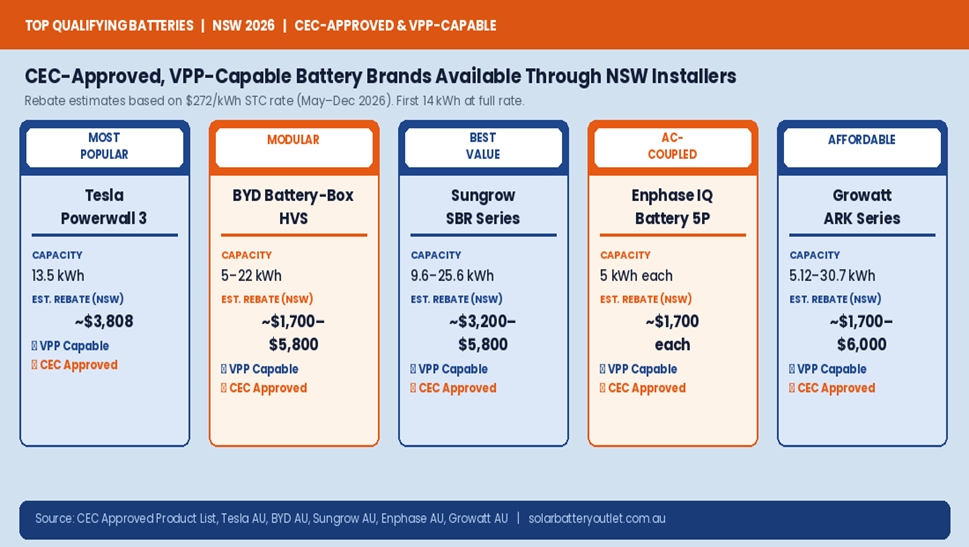
Tesla Powerwall 3 (13.5 kWh) — The most popular choice in NSW. Fully CEC-listed, VPP-capable, and eligible for both the federal rebate and the NSW PDRS incentive. Estimated rebate: approximately $4,500 at the post-May 2026 STC rate.

BYD Battery-Box Premium HVS (5–22 kWh, modular) — A modular system allowing homeowners to start smaller and expand later. All HVS variants currently listed are CEC-approved. Estimated rebate: $1,700–$5,800 depending on configured capacity.

Sungrow SBR Series (9.6–25.6 kWh) — Often cited as the best value option in NSW for mid-range capacity. CEC-listed, fully VPP-capable, and widely available through SAA-accredited installers. Estimated rebate: $3,200–$5,800.

Enphase IQ Battery 5P (5 kWh, stackable) — An AC-coupled system that stacks in 5 kWh increments. Excellent for homes with older DC-coupled solar systems. Fully CEC-listed and VPP-capable. Estimated rebate: approximately $1,700 per unit.

Growatt ARK Series (5.12–30.72 kWh) — A competitively priced option with growing installer support across NSW. CEC-listed variants available. Estimated rebate: $1,700–$6,000 depending on configuration.

Other brands with CEC-approved models available in NSW include AlphaESS, GoodWe Lynx Home, Sonnen, SolarEdge Energy Bank, and Fronius. Your installer can confirm which specific variants are currently listed and available.

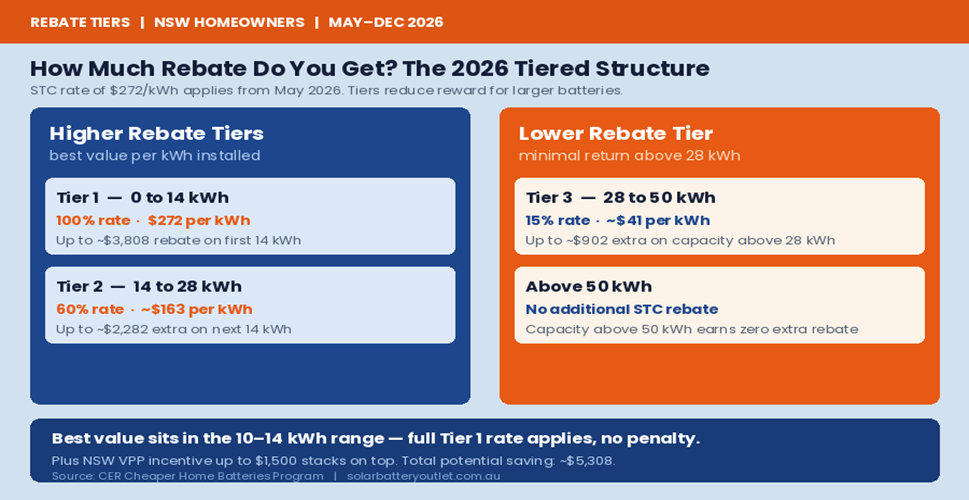
From 1 May 2026, the Cheaper Home Batteries Program introduced a tiered rebate structure. The STC rate from May to December 2026 is $272 per usable kWh of battery capacity — but this full rate only applies to the first 14 kWh.

Rebate Tiers

The Three Tiers Explained

  • Tier 1 (0–14 kWh): 100% of the STC rate — $272 per kWh. A 14 kWh battery earns approximately $3,808 in rebate.
  • Tier 2 (14–28 kWh): 60% of the STC rate — approximately $163 per kWh. An additional 14 kWh in this band earns approximately $2,282.
  • Tier 3 (28–50 kWh): 15% of the STC rate — approximately $41 per kWh. Minimal return for oversized systems.

For a standard 10–13.5 kWh battery (the most common size in NSW homes), the full Tier 1 rate applies, giving you the maximum rebate per kilowatt-hour of capacity installed.

In addition to the federal rebate, NSW homeowners can also access the NSW Peak Demand Reduction Scheme (PDRS) — a VPP incentive worth up to $1,500 for connecting your battery to a registered Virtual Power Plant. These two rebates can be stacked for maximum savings.

Common Reasons a Battery Claim Is Rejected

The most common reasons homeowners find their rebate was not applied correctly or was rejected:
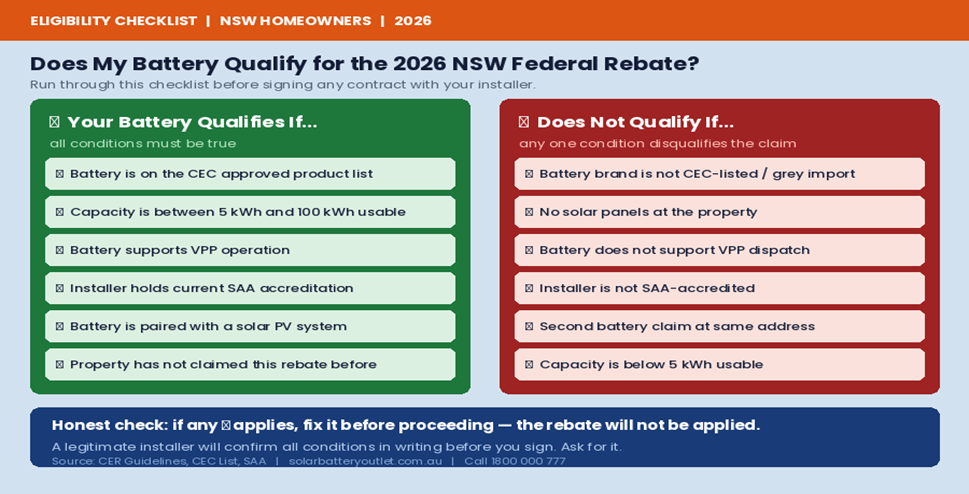
Battery Qualify for the 2026 NSW Federal Rebate
  • The battery brand or specific model was not on the CEC approved list at the time of installation.
  • The installer’s SAA accreditation had lapsed or they were never accredited — meaning the rebate cannot be claimed.
  • The battery was installed as a standalone system with no solar panels connected.
  • The property had previously claimed a battery STC rebate — one claim per address applies.
  • The battery’s capacity was below 5 kWh usable, making it ineligible under the program rules.
  • The installer quoted a “rebate” verbally but it was never applied as an STC deduction on the written invoice.

The simplest protection against all of these: check that your written quote clearly shows the rebate as a dollar deduction line item — not just a single “after-rebate price.” If it is not visible on paper, ask why before signing.

What About the NSW VPP Incentive — How Does It Stack?

The NSW Peak Demand Reduction Scheme (PDRS) is a separate state incentive that runs alongside the federal Cheaper Home Batteries Program. Furthermore, it rewards homeowners for connecting a new battery to a registered Virtual Power Plant operator, which allows the grid to draw on stored energy during peak periods.

The NSW VPP incentive is worth up to $1,500, paid through Peak Reduction Certificates (PRCs). Additionally, it is available to all NSW homeowners installing an eligible battery and can be combined with the federal rebate regardless of your installation timing — before or after 1 May 2026.

To access it, your installer registers your battery with a VPP operator and the local network operator (Ausgrid, for most of Sydney and NSW). You sign a VPP agreement, which covers the terms under which your battery can be remotely dispatched. Your installer handles all of this as part of the installation process.

Frequently Asked Questions

Can I claim the rebate if I already have solar but no battery?

Yes. Adding a battery to an existing solar system is one of the most common claim types. The federal rebate applies as long as your new battery meets the eligibility requirements and an SAA-accredited installer installs it. The installer will retrofit the battery to your existing system and connect it accordingly.

Does the rebate apply if I am renting the property?

The federal Cheaper Home Batteries Program does not have an income test or homeowner restriction. Landlords, owner-occupiers, small businesses, and community organisations can all qualify. For renters looking to install a battery, the decision rests with the property owner — but the rebate would be available to them if they choose to proceed.

What happens if I want to install two batteries?

One rebate claim applies per property address. If you install a second battery at the same address, it is not eligible for a fresh STC rebate. However, if you install a modular system like BYD or Enphase that supports expansion, the installer can configure the initial setup to maximise your eligible capacity within the rebate tiers.

How do I verify that my installer is SAA-accredited?

Visit saaustralia.com.au and search the installer’s name or accreditation number. Verification takes less than 60 seconds and protects you from working with an uncertified installer. Any legitimate installer will give you their SAA number without hesitation.

Is there a deadline to claim the rebate?

The program runs until 2030. There is no single cut-off date, but the rebate value decreases over time. The STC factor reduces every six months, meaning the discount is slightly smaller in each subsequent period. The highest rebate available within the post-May 2026 period applies from May through December 2026.

Check If Your Battery Qualifies — Free Quote for NSW Homeowners

At Solar Battery Outlet, we install CEC-approved batteries across Liverpool, Bankstown, and Mudgee. SAA-accredited electricians complete all installations, and we handle all rebate paperwork on your behalf.

If you are unsure whether your shortlisted battery qualifies or want a written quote that clearly shows the rebate deduction, get in touch. We will look at your existing solar system, your electricity usage, and your budget—and give you an honest answer on whether a battery makes financial sense before you commit to anything.

Data Sources & References

The information in this article is drawn from the following sources:

  • Australian Government Clean Energy Regulator (CER) — Cheaper Home Batteries Program guidelines and STC rate tables
  • Clean Energy Council (CEC) — Approved battery product list (accessed May 2026)
  • Solar Accreditation Australia (SAA) — Installer accreditation database: saaustralia.com.au
  • NSW Department of Climate Change, Energy, the Environment and Water — Peak Demand Reduction Scheme (PDRS) guidelines
  • Tesla Australia — Powerwall 3 Cheaper Home Batteries Program eligibility page (tesla.com/en_au/support/energy/powerwall)
  • Solar Choice — Federal Solar Battery Rebate 2026 guide (solarchoice.net.au)
  • Solar Scorecard — Battery Rebates Australia 2026 (solarscorecard.com.au)
  • PSC Energy — Ultimate Guide to Australia Solar and Battery Rebates 2026 (pscenergy.com.au)
  • Solar Battery Outlet — Federal Battery Rebate NSW 2026 guide (solarbatteryoutlet.com.au)

Rebate estimates in this article are based on the post-May 2026 STC rate of $272 per usable kWh. Actual rebate amounts vary based on battery capacity, STC market price at time of installation, and installer calculations. Always confirm figures with your SAA-accredited installer before signing a contract.
A VPP-ready battery installation — now the non-negotiable baseline for 2026 federal rebate eligibility across Australia.

⚠  IMPORTANT POLICY CHANGE — 2026As of 2026, the federal Cheaper Home Batteries Program requires all eligible battery systems to be VPP-capable at the time of installation. Systems that cannot connect to a Virtual Power Plant are now excluded from rebates entirely — regardless of brand, capacity, or installer.

Here’s a question most installers aren’t asking before they hand you a quote: Is the battery they’re recommending actually eligible for the rebate?

Not every battery on the Australian market qualifies for the 2026 federal incentives. The reason isn’t price, brand reputation, or storage capacity. It comes down to one increasingly important technical requirement: VPP readiness.

If you’ve been researching the best solar batteries in Australia for your home, understanding this requirement could save you thousands — or spare you the costly shock of installing a system that doesn’t qualify for any government support at all.

home batteries into one coordinated grid resource

What Is a VPP — and Why Does It Suddenly Matter?

VPP stands for Virtual Power Plant. It’s not a building or a physical location. It’s a network — your home battery, along with hundreds or thousands of other batteries across the grid, connected and coordinated by software.

When the electricity grid comes under pressure — say, on a hot summer evening in NSW when everyone cranks the air conditioning at once — the network operator draws on all those connected batteries simultaneously. Your battery exports a small amount of stored energy to help stabilise the grid. You get paid for it.

From the government’s perspective, this is exactly the outcome they want. Instead of building expensive new gas peaker plants to handle demand spikes, they’d rather pay homeowners to use their existing batteries as a distributed grid resource. It costs less, it’s cleaner, and it makes the grid more resilient during extreme weather.

So when the federal rebate program was restructured for 2026, VPP capability became a hard requirement — not a bonus feature. The policy logic is simple: if you want public money to help fund your battery, your battery needs to be able to give something back to the public grid.

“The cheapest battery isn’t the cheapest battery once you factor in the rebates you lose by buying it.”

What “VPP-Ready” Actually Means in Practice

VPP readiness isn’t a sticker a manufacturer slaps on a box. It’s a set of technical and software requirements that determine whether a battery can safely communicate with — and be remotely dispatched by — a certified VPP operator. For a battery to qualify under the 2026 federal guidelines, it needs to meet all of the following:

OCPP or AS4755 compliance — the inverter or battery management system must support the communication protocols used by Australian VPP operators.

Remote dispatch capability — must receive and act on charge/discharge instructions from a certified aggregator automatically, without manual homeowner input.

Smart meter compatibility — real-time two-way data exchange is required so the aggregator can see your battery’s state of charge at all times.

✓Listed on the CEC-approved product register — the Clean Energy Council list is the authoritative reference. Only listed products qualify for federal incentives.

Not an off-grid only system — batteries designed purely for off-grid use without grid-export capability do not qualify (except systems more than 1km from the grid).

The practical implication is significant. Many cheaper imported batteries — sold through generic online retailers or unaccredited installers — simply don’t meet these standards. They may store energy perfectly well, but they cannot participate in a VPP, and that now disqualifies them from rebate eligibility entirely.

The Financial Stakes: What You Lose Without VPP Eligibility

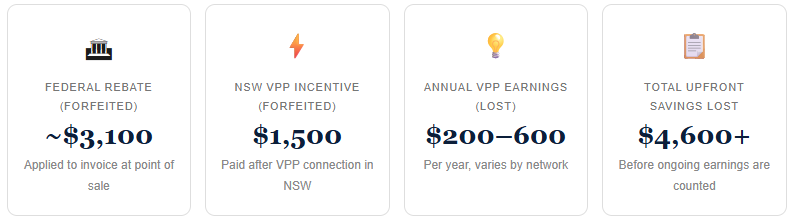
If you install a non-VPP-capable battery in 2026, here’s what you forfeit:

For a typical 10 kWh system, that’s over $4,600 in combined upfront incentives you simply don’t receive. On top of that, you miss out on annual VPP participation payments compounding over the battery’s life. When comparing two quotes side by side, this gap can easily make the “cheaper” non-VPP battery significantly more expensive over a 10-year horizon.

$4,600+That’s the combined value of federal rebates and the NSW VPP incentive available to eligible homeowners right now.Non-VPP batteries receive none of this. For anyone comparing the best solar battery options in NSW and across Australia, VPP eligibility isn’t a bonus — it’s the baseline requirement.

Which Batteries Are VPP-Ready in 2026?

The good news: all major reputable brands sold through accredited Australian installers meet the VPP-ready standard. The problem is grey-market imports and off-brand systems that occasionally get quoted as “budget alternatives.” Here’s how the leading options compare:

Battery SystemVPP-ReadyRebate EligibleNSW VPP IncentiveCapacity
BYD Battery-Box HVM Yes Yes Yes8.3–22.1 kWh
Tesla Powerwall 3 Yes Yes Yes13.5 kWh
Sungrow SBR / SBH Yes Yes Yes9.6–25.6 kWh
Enphase IQ Battery 5P Yes Yes Yes5–15 kWh
Generic imported batteries No No NoVaries
Off-grid only systems No No NoVaries

For anyone looking at solar battery in NSW specifically, all four mainstream systems also qualify for the NSW Peak Demand Reduction Scheme — the state-level incentive that stacks directly on top of the federal rebate.

How to Verify VPP Status Before You Sign

Don’t take a salesperson’s word for it. Here is the exact process to confirm a battery is VPP-eligible before committing:

Step 1:  Check the Clean Energy Council-approved product list

The CEC register at cleanenergycouncil.org.au is the authoritative source. If your quoted battery isn’t on it, the federal rebate cannot be claimed — full stop.

Step 2:  Ask directly: “Does this battery support VPP dispatch protocols?”

A confident, experienced installer answers without hesitation. Hedging or vague reassurances are a red flag — get written confirmation.

Step 3:  Verify your installer is SAA-accredited

Only SAA-accredited installers can legally process the federal rebate on your behalf. Check at saaustralia.com.au before signing anything.

Step 4:  Confirm the rebate appears as a line item on your quote

The federal rebate must appear as a specific dollar reduction on your invoice — not a verbal promise or small-print footnote.

Step 5:  Ask who handles the NSW VPP enrolment paperwork

Some installers skip VPP enrolment to reduce their compliance workload. A thorough installer includes it as standard — not as an optional add-on.

NSW homeowners

NSW homeowners currently have access to the most generous combined battery incentive stack in the state’s history — but only for VPP-capable systems.

Why VPP Requirements Are Only Getting Stricter

The 2026 VPP mandate didn’t arrive suddenly. It’s part of a sustained policy direction that started with the original Home Battery Scheme and has been progressively tightened each year. Australia’s grid managers — AEMO in particular — have identified distributed battery storage as a critical tool for grid stability as coal plants retire and renewable penetration increases.

For homeowners, the implication is clear: this requirement isn’t going away. Future iterations of the federal incentive program are likely to add further requirements around grid responsiveness, cycle ratings, and communication protocols. Batteries meeting the 2026 standard are well-positioned for whatever comes next. Systems that don’t meet it today are likely to become increasingly marginalised in terms of both incentive eligibility and resale value.

For homeowners in NSW: the combination of federal rebates and the NSW VPP incentive represents the most generous stack of battery support the state has ever seen. The window is narrowing — the federal rebate rate already dropped in May 2026 — but the incentive structure for VPP-ready systems remains strong through the rest of the year. Acting now with the right battery is still significantly better financially than waiting.

Frequently Asked Questions

Q: Does joining a VPP mean the operator controls my battery completely?

Partially — and only within agreed limits. VPP operators can dispatch your battery during grid stress events, but reputable agreements always include protections. Your battery won’t be drained below a minimum threshold (typically 20%), preserving backup capacity for outages. Most operators also let you set exclusion windows during your personal peak evening hours.

Q: Can I get the federal rebate if I choose not to actively join a VPP?

Yes — with an important distinction. The requirement is that the battery is capable of VPP connection, not that you must enrol. You can install a VPP-ready battery and claim the federal rebate without joining a VPP program. However, you’ll miss the separate NSW VPP incentive payment of up to $1,500, which does require actual enrolment.

Q: What if I already have an older battery that isn’t VPP-capable?

Existing systems installed under earlier rebate programs are not retroactively affected. The 2026 VPP requirement applies to new installations. If you’re upgrading or replacing an older system, the new battery must meet the current standard to qualify for rebates.

Q: How much can I realistically earn from VPP participation each year?

This varies by operator, grid event frequency in your area, and battery capacity. For a typical 10 kWh system enrolled in a NSW VPP, annual earnings of $200–$600 are a reasonable estimate. Some operators offer fixed quarterly credits; others pay per dispatch event based on energy exported.

Q: Does a solar battery NSW installation always include VPP enrolment automatically?

Not automatically. A thorough installer handles both the federal rebate processing and VPP enrolment as part of the standard package. Some skip enrolment to reduce compliance workload — always confirm explicitly that it’s included before signing your contract.

Bottom Line

If you’re comparing quotes and one comes in noticeably cheaper, the first question to ask is whether the battery is VPP-capable and listed on the CEC approved product register. A battery that saves $800 upfront but costs $4,600 in lost incentives isn’t a saving — it’s an expensive mistake that takes years to recover from.

For homeowners in NSW who want a solar battery that captures everything available in 2026 — federal rebate, NSW VPP incentive, and long-term participation payments — the path is clear: choose one of the four mainstream VPP-ready systems, use an SAA-accredited installer, and confirm both the rebate and VPP enrolment are included in the package before you sign.

As solar batteries grow in number across Australia, the grid value of interconnected VPP networks grows with them. The requirement isn’t a bureaucratic hurdle — it’s a genuine two-way exchange. You receive meaningful financial support. The grid gains resilience. That’s why this requirement is here to stay, and why the best solar batteries in Australia in 2026 are defined as much by grid compatibility as by storage capacity.

✅  Quick Summary for NSW Homeowners All four mainstream batteries — BYD Battery-Box HVM, Tesla Powerwall 3, Sungrow SBR/SBH, and Enphase IQ Battery 5P — are fully VPP-ready and eligible for both the federal rebate (~$3,100) and the NSW VPP incentive (up to $1,500). Combined upfront savings reach $4,600+ before ongoing annual VPP earnings. Non-VPP batteries qualify for neither.
Not Sure If You Are Ready? Talk to Us First. At Solar Battery Outlet, we handle the full process — federal rebate, NSW VPP incentive, SAA-accredited installation, and VPP enrolment — so you never leave money on the table.
Call us: 1800 000 777
About Solar Battery Outlet: We are a Liverpool-based solar battery installer, part of GWM Group Pty Ltd, servicing homes across South West Sydney, Bankstown, Campbelltown, and the greater NSW region. All installations are done by SAA-accredited electricians. We handle all rebate paperwork, so you do not have to.

Best Solar Battery NSW 2026: What We Actually Recommend After Installing Hundreds of Them

Here’s the honest truth about “best solar battery” lists you find online.

Most of them are written by people who’ve never installed a battery in their life. They copy spec sheets, rank by storage capacity, and slap an affiliate link at the bottom. The brand that pays the most commission usually wins.

We do this differently.

Our team installs solar batteries every week across Liverpool, Bankstown, Campbelltown and South West Sydney. We see which batteries perform quietly for years. We see which ones throw error codes at 2am. We see which brands actually show up when something goes wrong under warranty — and which ones leave homeowners waiting months for a response.

This guide is based on that experience. Not sponsored rankings. Not manufacturer spec sheets. Just what we’ve genuinely seen work well in NSW homes in 2026 — and what the right choice looks like depending on your situation.


Before we get into it: The federal battery rebate rate drops after 1 May 2026. Every battery on this list qualifies for it. For a 10 kWh system, installing before May saves around $530 compared to waiting. All prices in this guide are shown after the current rebate rate. See exactly how the rebate works here.


First — What Makes a Battery “Best” in NSW Specifically?

This matters because NSW has specific conditions that affect which battery suits your home.

Heat. Western Sydney summers are brutal. Batteries sitting in garages or on west-facing walls in Bankstown, Liverpool and Campbelltown experience higher ambient temperatures than coastal suburbs. Heat degrades batteries faster. Battery chemistry and thermal management matter more here than they do in Melbourne or Adelaide.

Ausgrid network requirements. Most of NSW — including all of South West Sydney — runs on the Ausgrid network. Ausgrid has specific requirements around how batteries connect and register. Not every battery brand’s firmware plays nicely with every network. An experienced local installer knows which combinations work cleanly.

VPP eligibility. The NSW Peak Demand Reduction Scheme pays you up to $1,500 for connecting your battery to a Virtual Power Plant. Not all batteries are VPP-capable under the scheme. Every battery we recommend below qualifies — but it’s worth knowing this is a NSW-specific filter that rules out some cheaper imported options.

Storm season backup. South West Sydney gets hit hard in summer storms. Blackout protection isn’t just a nice feature here — for a lot of families it’s the whole point. How reliably a battery switches to backup mode when the grid drops is a real performance question, not a marketing checkbox.

With that context, here’s what we actually recommend.

The Best Solar Batteries for NSW Homes in 2026

best solar battery NSW comparison

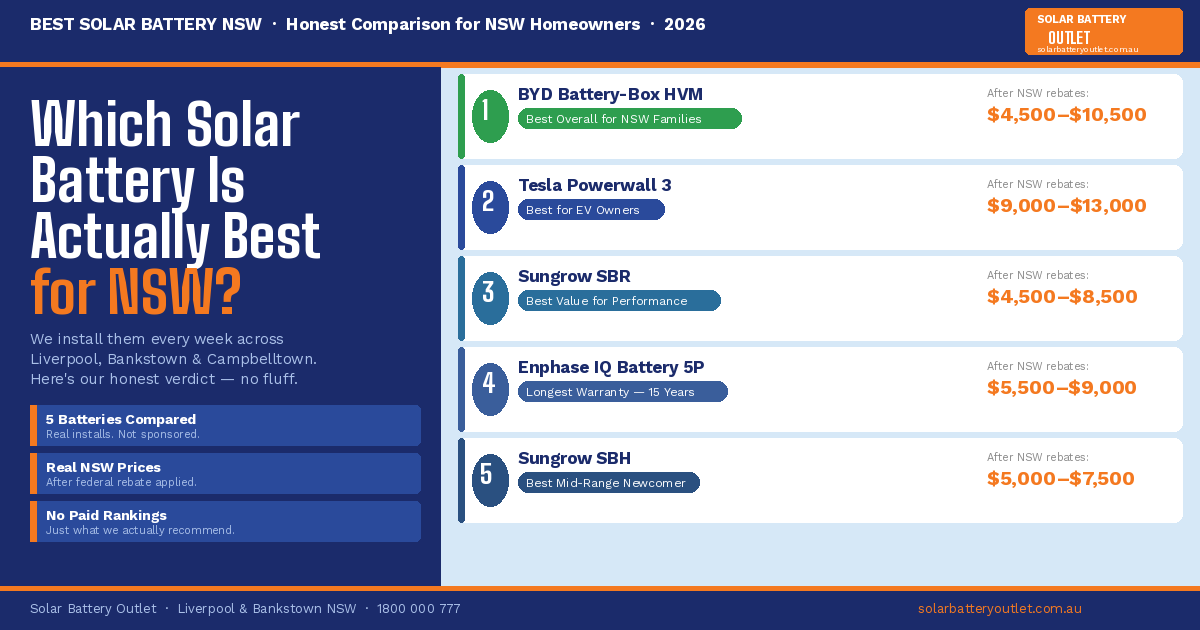
1. BYD Battery-Box HVM — Best Overall for NSW Families

Best for: Most NSW homeowners. Families wanting flexibility. Anyone planning an EV in the next few years.

If we had to recommend one battery to the average NSW family in 2026 — this is it. Not because it’s the flashiest. Because it’s the most sensible combination of performance, price, flexibility and warranty we’ve seen at this price point.

BYD is the world’s largest battery manufacturer. They make batteries for everything from home storage to electric buses to grid-scale projects. That manufacturing scale shows up in consistent quality and genuinely responsive warranty support in Australia.

The modularity is the standout. You start at 8.3 kWh and add modules later up to 22.1 kWh. If you’re not sure how much storage you need right now — or if an EV is coming in the next couple of years — this lets you start with what makes sense today and grow without replacing anything.

The 10-year warranty covers 70% capacity retention. That’s the higher threshold among mid-range options and it means in year 10, your battery should still hold more than two-thirds of its original capacity.

Real numbers for NSW after rebates:

  • 8.3 kWh: approximately $4,500–$6,500 installed
  • 10 kWh: approximately $5,500–$8,000 installed
  • 13.8 kWh: approximately $7,500–$10,500 installed

Watch out for: Needs a compatible hybrid inverter. If you have an older string inverter, confirm compatibility before accepting a quote. This is the most common issue we see with BYD retrofits.

2. Tesla Powerwall 3 — Best Premium Option and Best for EV Owners

Best for: EV owners. Families who want automatic blackout protection. Homes wanting a single all-in-one unit.

The Powerwall 3 earns its reputation. It’s a single 13.5 kWh unit with a built-in inverter — everything in one box, fewer components, cleaner installation, fewer failure points over 10 years.

The blackout protection is the best we’ve seen in a residential battery. When the grid drops, the Powerwall switches automatically. No manual input, no delay, no noticing it happened. For families with medical equipment or just anyone who’s been through one too many summer blackouts in South West Sydney, this matters.

The EV integration is genuinely useful if you’re in the Tesla ecosystem. The Powerwall manages solar generation, home storage and car charging as one system through the Tesla app — deciding when to charge the car from solar versus battery versus grid based on your usage patterns and time-of-use pricing. No other battery on this list matches that level of integration.

Real numbers for NSW after rebates:

  • 13.5 kWh: approximately $9,000–$13,000 installed

Watch out for: Fixed capacity — you can’t expand it modularly. If your storage needs grow significantly, you add a second unit. Also the most expensive option on this list. If you’re not in the Tesla EV ecosystem, you’re paying a premium for features you may not fully use.

For a full head-to-head between Powerwall 3 and BYD, we’ve written a detailed Tesla Powerwall 3 vs BYD Battery-Box comparison specifically for NSW homeowners.

3. Sungrow SBR — Best Value for Performance

Best for: Value-focused buyers. Homes already running a Sungrow inverter. Households wanting larger storage without Tesla’s price tag.

Sungrow is the world’s largest solar inverter manufacturer. Their SBR battery range is built on the same engineering heritage — and it shows. The cycle rating on the SBR is among the best in this price bracket, rated at around 6,000 cycles. Over a 10-year period, that’s solid.

It scales from 9.6 kWh up to 25.6 kWh, which makes it a strong option for larger homes or households with higher evening usage. If you’ve already got a Sungrow inverter from a previous solar install — which is common across South West Sydney — the SBR is usually the cleanest and most cost-effective battery to add. No inverter replacement needed.

The 10-year warranty covers 60% capacity retention — slightly lower than BYD and Tesla’s 70% threshold, but at this price point the trade-off is reasonable for most households.

Real numbers for NSW after rebates:

  • 9.6 kWh: approximately $4,500–$7,000 installed
  • 12.8 kWh: approximately $6,000–$8,500 installed

Watch out for: Works best with Sungrow inverters. AC-coupling to other brands is possible but adds cost and complexity. Confirm your inverter compatibility before getting a quote.

4. Enphase IQ Battery 5P — Best for Long-Term Peace of Mind

Best for: Long-term homeowners who want the longest warranty available. Retrofits onto any existing inverter. Fire-safety conscious buyers.

The Enphase IQ Battery 5P is the only battery available in Australia right now with a 15-year warranty. Everything else on this list is 10 years. If you’re planning to stay in your home for 15 years and you want certainty over that entire window, that warranty alone is a significant differentiator.

It’s fully AC-coupled, which means it connects to almost any existing solar inverter without replacing anything. If your current setup is a few years old and you want to add a battery with the least disruption, Enphase is often the cleanest retrofit technically.

Fire safety credentials are worth mentioning given how hot South West Sydney gets. The IQ 5P carries UL 9540 and UL 9540A certification — the highest fire safety standard available for residential batteries. For homes in bushfire-adjacent areas west of Sydney, this isn’t a small thing.

Real numbers for NSW after rebates:

  • 10 kWh setup: approximately $5,500–$9,000 installed

Watch out for: Higher cost per kWh than BYD or Sungrow. Each module is a separate physical unit — you can’t stack them, they sit side by side. For tight spaces this can be a consideration.

5. Sungrow SBH — Best Mid-Range Newcomer Worth Watching

Best for: Mid-range buyers wanting newer technology. Homes with Sungrow inverters wanting an upgrade path.

The SBH is Sungrow’s newer residential battery range and it’s been getting strong reviews from installers across NSW. Better thermal management than the SBR, slightly cleaner firmware, and good compatibility with Sungrow’s latest hybrid inverters.

We’ve been installing it for a few months now and the early feedback from customers has been solid. It’s not as proven in the long-term as BYD or Tesla simply because it hasn’t been around as long — but the engineering behind it is strong and Sungrow’s local support in Australia is responsive.

Real numbers for NSW after rebates:

  • 9.6 kWh: approximately $5,000–$7,500 installed

Watch out for: Shorter Australian track record than BYD and Tesla. Ask your installer specifically about local warranty support before committing.

Quick Comparison — All Five Side by Side

BatteryCapacityExpandableWarrantyAfter NSW RebatesBest For
BYD Battery-Box HVM8.3–22.1 kWhYes10yr / 70%$4,500–$10,500Most NSW families
Tesla Powerwall 313.5 kWhNo (add unit)10yr / 70%$9,000–$13,000EV owners, premium
Sungrow SBR9.6–25.6 kWhYes10yr / 60%$4,500–$8,500Value, Sungrow homes
Enphase IQ 5P5–15 kWhYes15yr / 70%$5,500–$9,000Long-term owners
Sungrow SBH9.6–19.2 kWhYes10yr / 70%$5,000–$7,500Mid-range upgrade

How to Choose the Right One for Your NSW Home

how to choose best solar battery NSW 2026 guide

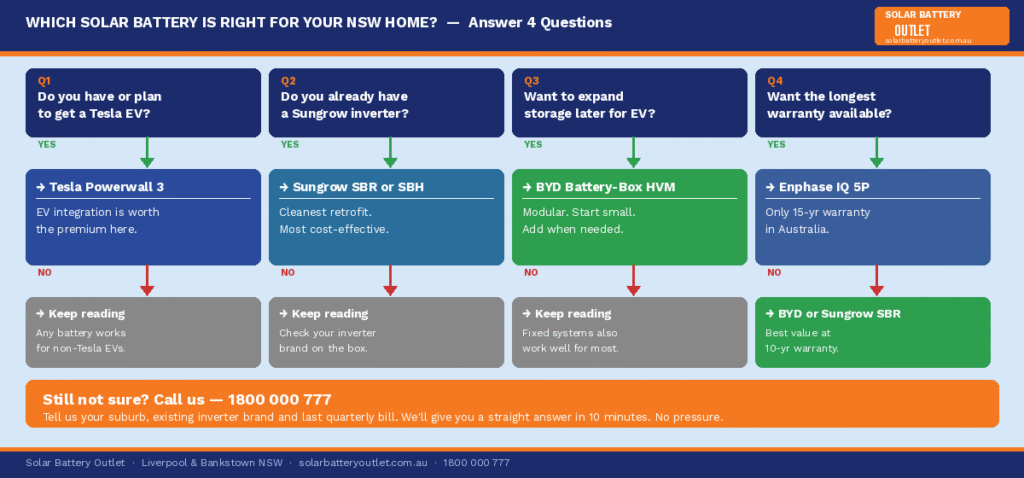
Stop looking at the spec table and ask yourself these four questions instead. They’ll narrow it down faster than any comparison chart.

Do you have or plan to get a Tesla EV? Yes → Powerwall 3. The integration is genuinely worth the premium in this case.

Do you already have a Sungrow inverter? Yes → Sungrow SBR or SBH. Cleanest retrofit, most cost-effective.

Do you want to expand storage later — especially for an EV? Yes → BYD Battery-Box HVM. Start where you need to and add modules.

Do you want the longest warranty and simplest retrofit onto any existing system? Yes → Enphase IQ Battery 5P.

Is value your main driver and you want solid performance without the premium? Sungrow SBR or BYD depending on your inverter.

If you’ve answered those questions and you’re still not sure — that’s what a no-obligation quote call is for. Any reputable installer, including us, should be able to look at your existing setup and give you a straight recommendation in 10 minutes.

What the NSW Rebates Look Like for Each Battery

Every battery on this list qualifies for both the federal Cheaper Home Batteries Program and the NSW VPP incentive. Here’s how that stacks for a typical 10 kWh install:

  • Federal rebate: ~$3,100 off upfront (applied directly on your invoice by your installer)
  • NSW VPP incentive: up to $1,500 paid to you after installation for connecting to a Virtual Power Plant

Combined: up to $4,600 in savings before your first electricity bill reduction kicks in.

The federal rate drops after 1 May 2026. For anything over 14 kWh — like the Powerwall 3 — the drop is more significant because of the new tiered structure. For standard 10 kWh batteries, it’s around $530 less if you wait past May. Not a cliff, but real money.

For the exact numbers on what changes and when, our Solar Battery Rebate Drops 1 May 2026 guide has the full breakdown.

What to Ask Any Installer Before You Sign

A few things we see trip people up when getting quotes for any of these batteries across NSW:

The cheapest quote is not always the best value. A BYD installed with the wrong inverter or poor cable management will give you more headaches than a Sungrow installed properly at a higher price.

Make sure the federal rebate shows as a line item on the quote — not a verbal promise. You should be able to see exactly how much the rebate is reducing your invoice.

Ask specifically: does this installation include blackout protection? Not all system designs include automatic backup even when the battery supports it.

Confirm the installer is SAA-accredited before signing anything. Verify at saaustralia.com.au — takes 30 seconds. Without SAA accreditation your installer cannot process the federal rebate.

Ask who handles the NSW VPP paperwork. Some installers skip this step because it’s extra compliance work. A good installer processes both rebates as standard.

For everything else to check — including the questions that catch installers out — our Solar Battery Installer Liverpool NSW guide covers what to look for and what to avoid.


Frequently Asked Questions

Is the BYD Battery-Box actually as good as Tesla?

For most NSW families — yes. Tesla wins on automatic blackout switching and EV integration. BYD wins on price, flexibility and the ability to expand. If you’re not in the Tesla ecosystem, BYD gives you equivalent quality at a lower cost. That’s why it’s our most installed battery across Liverpool, Bankstown and Campbelltown.

Which battery lasts longest in Australian heat?

All five batteries on this list use LFP chemistry, which handles heat better than older lithium-ion. Enphase has the longest warranty at 15 years. In terms of real-world longevity in hot Western Sydney conditions, BYD and Sungrow have the largest local install base and the longest track record in Australian conditions. For more on what actually affects lifespan, see our How Long Does a Solar Battery Last in Australia guide.

Can I get a solar battery without existing solar panels?

No — the federal rebate requires existing or simultaneously installed solar panels. A battery alone doesn’t qualify. If you don’t have panels yet, a combined solar and battery install is actually good timing and the rebate applies to the battery portion. For the full eligibility checklist, see our Federal Battery Rebate NSW 2026 guide.

What size battery do I actually need for a NSW home?

For most families in South West Sydney using power mainly in evenings, 10 kWh covers the majority of overnight usage comfortably. If you have an EV or high usage, 13–15 kWh makes more sense. A good installer will look at your last 3 electricity bills and size it properly rather than just recommending the biggest option. Our Solar Battery Cost Sydney 2026 guide breaks down sizing and cost together.

Are solar batteries worth it in NSW right now?

For most homeowners with existing solar and evening-heavy usage — yes. The combination of low feed-in tariffs, high evening rates and the current rebate makes the numbers work better than they have at any point in the last five years. For an honest payback analysis, our Are Solar Batteries Worth It in Australia guide covers the full case.


Want a straight recommendation for your home? Tell us your suburb, your existing inverter brand, and your last quarterly bill — and we’ll tell you exactly which battery makes sense and what it’ll cost after rebates.

Call 1800 000 777 or fill in our 60-second form at solarbatteryoutlet.com.au We’re based in Liverpool and Bankstown. No pressure, no pushy sales.