Australia’s home battery boom shows no sign of slowing in 2026. The federal Cheaper Home Batteries Program has pulled thousands of new households into the market, and that surge has attracted its fair share of installers who talk a big game but skip the fine print on compliance.

Before you let anyone touch your switchboard, you need one simple confirmation: is this person actually an SAA-accredited solar battery installer, or are they relying on an outdated “CEC-accredited” claim that no longer applies? Getting this wrong doesn’t just risk a shoddy install; it can cost you your rebate entirely.

This guide breaks down exactly what SAA accreditation means, walks through a four-step framework you can use in five minutes, and flags the warning signs that separate a genuine professional from a risky sales pitch.

What Does “SAA-Accredited” Actually Mean?

Solar Accreditation Australia (SAA) is the national body responsible for accrediting the individuals who design and install rooftop solar and battery systems. The Clean Energy Regulator appointed SAA to run this scheme, so accreditation isn’t a marketing badge; it’s a government-recognised qualification tied directly to your eligibility for small-scale technology certificates (STCs) and state rebates.

Accreditation isn’t one-size-fits-all, either. An installer can hold separate endorsements for Grid-Connected Photovoltaic systems, grid-connected battery storage, and stand-alone power systems, plus a design-only, install-only, or combined design-and-install status. Consequently, an electrician accredited to install solar panels isn’t automatically qualified to install a battery. You need to confirm the specific battery storage endorsement, not just a general solar accreditation.

To hold accreditation, an installer must also carry an unrestricted electrical licence, current public liability insurance, and a working-at-heights certificate, and they must complete at least 100 continuing professional development points every 12 months to keep their status current.

Why “CEC Accredited” Isn’t the Full Story Anymore

For 16 years, the Clean Energy Council administered installer accreditation, and plenty of homeowners still search for a “CEC-accredited installer” out of habit. However, the CER transferred this function to SAA, with the changeover formally completing on 29 May 2024. Since that date, installers must hold current SAA accreditation to claim STCs; a lapsed or historical CEC number no longer qualifies a system for the rebate.

This matters because some installers still reference their old CEC credentials on websites and brochures that haven’t been refreshed. That isn’t necessarily dishonest, but it does mean you shouldn’t take a printed CEC logo at face value. Instead, ask directly whether the installer has transitioned to SAA and request their current accreditation number.

The Clean Energy Council hasn’t disappeared, though. It still maintains the approved product lists for panels, inverters, and batteries, and it continues offering CPD-eligible training that SAA recognises. So you’ll likely see both organisations mentioned in a compliant quote: SAA for the installer’s personal accreditation, and CEC for the equipment’s approval status.

The 4-Step SAA Verification Framework

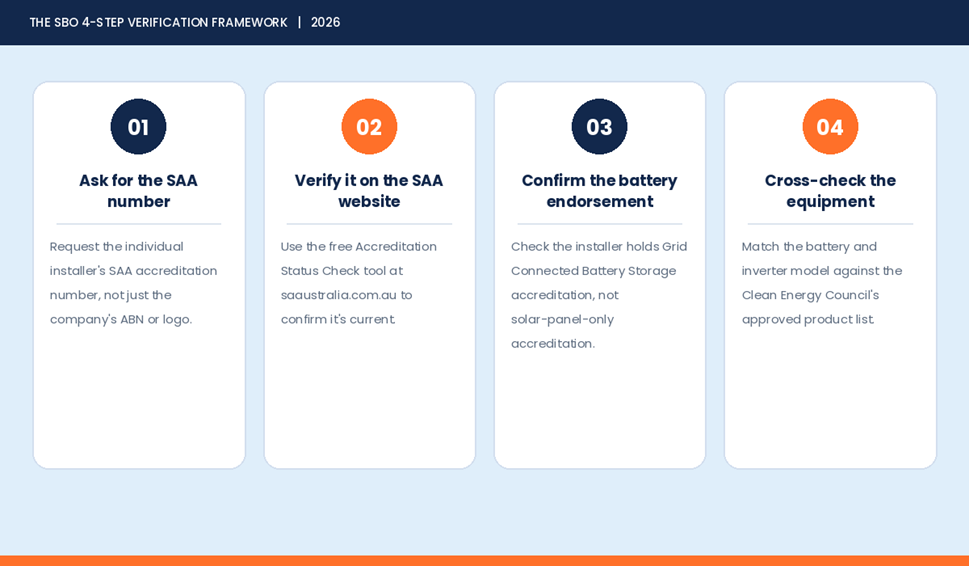
You don’t need to be a compliance expert to run this check; it takes about five minutes once you have the right details in hand.

First, ask for the installer’s full name and SAA accreditation number before you sign anything. A properly accredited installer provides this without hesitation. Second, head to the SAA website and use the free Accreditation Status Check tool to confirm the number is current and active. Third, confirm the accreditation specifically covers Grid Connected Battery Storage, since a solar-only endorsement doesn’t extend to batteries. Fourth, cross-check the exact battery and inverter model against the Clean Energy Council’s approved product list, because using an unapproved product voids STC eligibility even with a fully accredited installer.

Run through these four checks with every quote you receive, and keep a screenshot of the verification result for your records. If a retailer sub-contracts the physical install, apply the same checklist to the sub-contractor, not just the salesperson who wrote your quote.
Green Flags vs Red Flags When Vetting an Installer

Genuine SAA-accredited installers tend to behave in consistent, reassuring ways throughout the sales process. They share their accreditation number immediately, their number checks out live on SAA’s database, and they confirm their battery storage endorsement without prompting. They also hold a current electrical license for your state and quote equipment that already appears on the CEC’s approved list.

By contrast, a few behaviours should make you pause and ask more questions. Hesitation or vague answers when you request an accreditation number is one of the clearest warning signs, since a compliant installer has nothing to hide. Similarly, be cautious of quotes that only mention a company name or an old CEC reference, because the individual performing the on-site work is what actually determines your rebate eligibility, not the business logo on the invoice.

High-pressure tactics deserve extra scrutiny too. If someone pushes you to sign before you’ve had a chance to verify their details, that urgency is often designed to bypass exactly the checks outlined in this guide.
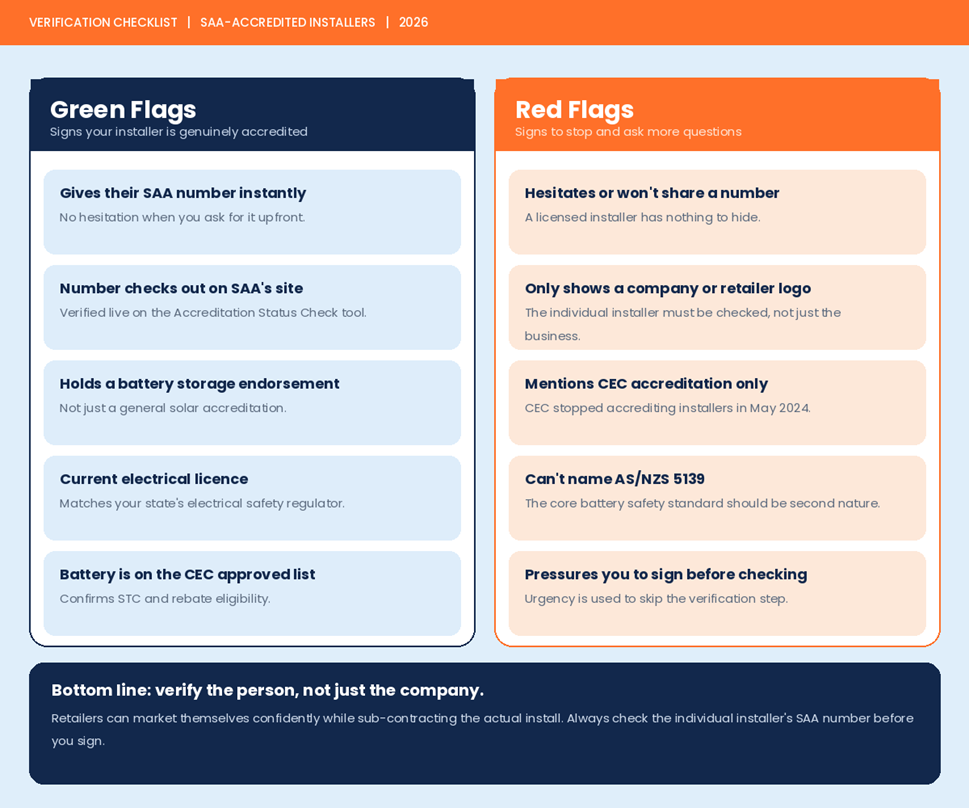
Green flags vs red flags when vetting a solar battery installer

Why Accreditation Checks Protect Your Rebate and Your Home

Skipping this verification step carries consequences well beyond an awkward conversation. Under the Renewable Energy (Electricity) Amendment (Cheaper Home Batteries Program) Regulations 2025, installers must supply a written compliance statement confirming they met accreditation, design, and on-site attendance requirements, and they must supply geotagged, timestamped photos matching serial numbers in the REC Registry. Without a genuinely accredited installer, none of that documentation stands up, and your rebate claim can be rejected outright.

Safety matters just as much as paperwork. Australian Standard AS/NZS 5139 governs where a battery can sit relative to windows, doorways, and habitable rooms, alongside cabling and fire-rated backing requirements. An installer who can’t confidently explain how your proposed battery location complies with AS/NZS 5139 likely hasn’t had the training to install it safely in the first place.

Ultimately, accreditation checking protects three things at once: your government rebate, your product warranty (many manufacturers void warranties if installation wasn’t performed by an accredited professional), and the physical safety of everyone living in your home.

A Local Example: Vetting a Solar Battery Installer in Liverpool, NSW

Demand for solar battery Liverpool households has climbed sharply as the Cheaper Home Batteries Program made storage more affordable across South-West Sydney. That growth has brought more installers into the area, which is good for competition but makes the verification habit even more important locally.

When you’re comparing quotes from installers servicing Liverpool, Bankstown, or Mudgee, treat the accreditation check as step one, not an afterthought once you’ve picked a favourite. A reputable, best solar battery installer in the region will happily walk you through their SAA number, their battery storage endorsement, and the approved product list for the exact system they’re proposing.

At Solar Battery Outlet, our SAA-accredited professionals carry out every installation, and we gladly provide our accreditation details upfront so you can verify them before committing to anything.

Verify These Details Yourself

You don’t have to take our word for it. Check accreditation status and program rules directly with the official sources below.

Solar Accreditation Australia – Accreditation Status Check

Clean Energy Regulator – Solar Battery Installers and Designers

Frequently Asked Questions

Is SAA the same as CEC accreditation?

No. Solar Accreditation Australia (SAA) took over the installer and designer accreditation function from the Clean Energy Council, with the transition completing on 29 May 2024. The CEC still manages approved product lists, but installer accreditation now sits entirely with SAA.

How do I find my installer’s SAA number?

Ask your installer directly for their full name and accreditation number, then confirm it using the free Accreditation Status Check tool on the SAA website. Never rely solely on a number printed on a business card or invoice without checking it online.

Does my battery need separate accreditation from my solar panels?

Yes. Installers hold distinct accreditation classes for grid-connected solar, battery storage, and stand-alone power systems. A solar-panel accreditation alone doesn’t qualify someone to install a battery, so confirm the battery storage endorsement specifically.

What happens if my installer isn’t SAA-accredited?

Your system won’t be eligible for Small-scale technology certificates or related rebates, and you may also void your battery’s manufacturer’s warranty. Non-accredited installs can also fail to meet AS/NZS 5139 safety requirements.

Should I check the retailer or the individual installer?

Both, but the individual matters most for compliance. A retailer’s accreditation doesn’t automatically extend to every subcontractor it uses, so always verify the specific person attending your site.

Ready to Work With an Accredited Team?

Solar Battery Outlet’s installers are SAA-accredited and happy to share their credentials before you commit to anything. Get a free, obligation-free quote and a straight answer on accreditation, approved equipment, and rebate eligibility for your home.

Disclaimer

This article provides general information about solar battery installer accreditation in Australia and does not constitute personalised financial, legal, or technical advice. Accreditation rules, rebate values, and eligibility criteria under the Cheaper Home Batteries Program and the Small-scale Renewable Energy Scheme can change, so always confirm current requirements directly with Solar Accreditation Australia, the Clean Energy Regulator, or a licensed professional before signing a contract. Solar Battery Outlet makes no guarantee regarding rebate approval, as eligibility is ultimately determined by the relevant government body.
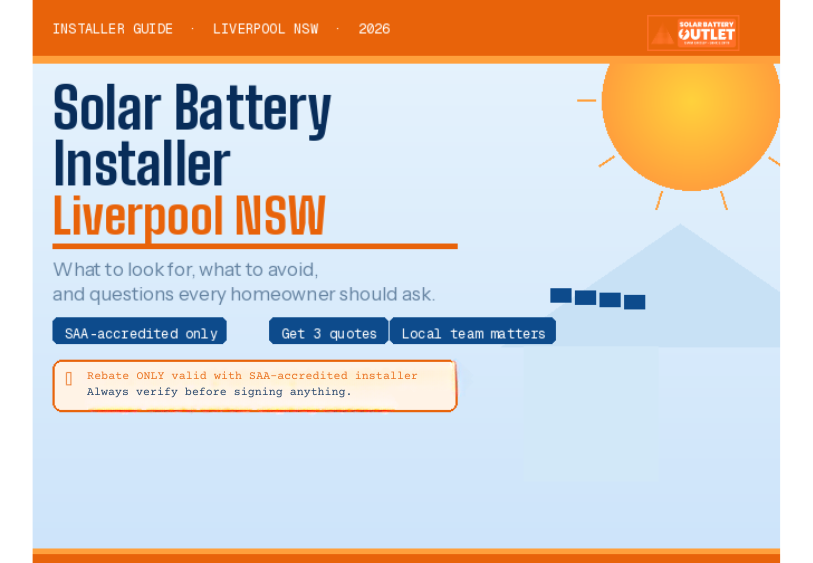
Getting a solar battery quote is the easy part. Getting the right installer — one who actually knows what they’re doing, handles all the rebate paperwork, and will still be around in three years when you have a question — that’s the part most people underestimate.

And in Liverpool and South West Sydney right now, the quality of installers varies enormously. The government rebate has brought a lot of new companies into the market — some excellent, some not. Knowing who to trust before you sign anything could save you thousands.

This guide covers the exact things to check, the green flags that tell you an installer knows their stuff, the red flags that should make you walk away, and the five questions every Liverpool homeowner should ask before handing over a deposit.

Why the Installer Matters More Than the Brand Most homeowners spend hours researching battery brands — Tesla vs BYD vs Sungrow — and about ten minutes checking the installer. That’s the wrong way around. A good battery installed poorly will underperform for its entire 10-year life. A great installer who knows your suburb, handles your rebate paperwork, and is still taking calls in year five is worth far more than the brand name on the wall.

The One Non-Negotiable: SAA Accreditation

This is not optional. Any installer doing a battery installation in NSW must be accredited by Solar Accreditation Australia (SAA). This replaced the old CEC (Clean Energy Council) accreditation system from mid-2024.

Here’s why it matters directly to you: if your installer is not SAA-accredited, you cannot claim the federal Cheaper Home Batteries rebate. That’s up to $4,200 off a Powerwall or $3,100 off a BYD system — gone, just because you didn’t check a number.

You can verify any installer’s accreditation free of charge at saaustralia.com.au. It takes about 30 seconds. Do it before you agree to anything.

Important: CEC vs SAA — What Changed From 30 May 2024, the Clean Energy Council (CEC) handed over all accreditation to Solar Accreditation Australia (SAA). Any installer who was CEC-accredited should now hold an SAA accreditation number. If an installer gives you a CEC number and claims it’s still valid, that’s a red flag — ask for their SAA number specifically.

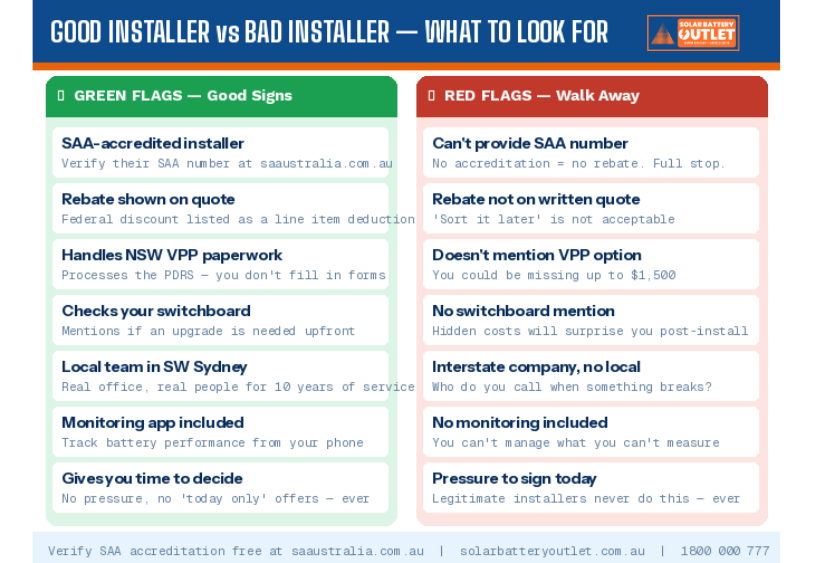
Green Flags vs Red Flags — What to Look For

Here’s a plain-English guide to what separates a good installer from one you should avoid:

Green flags that show a trustworthy installer vs red flags that mean walk away — Liverpool NSW 2026

A few of those red flags are worth expanding on:

  • ‘We’ll sort the rebate later’ is never acceptable. The federal rebate must be shown as a line item deduction on your written quote. If an installer says they’ll ‘process it afterwards’ or ‘you’ll get it as cashback’, that’s either incompetence or dishonesty. Either way, get a different quote.
  • Door-to-door solar sales are still common in Liverpool. We hear from customers regularly who were pressured into signing at the door. A legitimate installer will always give you time to compare quotes. If anyone tells you a deal expires today — hang up or close the door.
  • Interstate companies with no local team are a real risk. Your battery needs to work for 10 years. If your installer is based in Brisbane or Melbourne and has no service team in South West Sydney, who do you call when something goes wrong in year four? Always ask where the service technicians are physically based.

5 Questions to Ask Every Installer Before You Sign

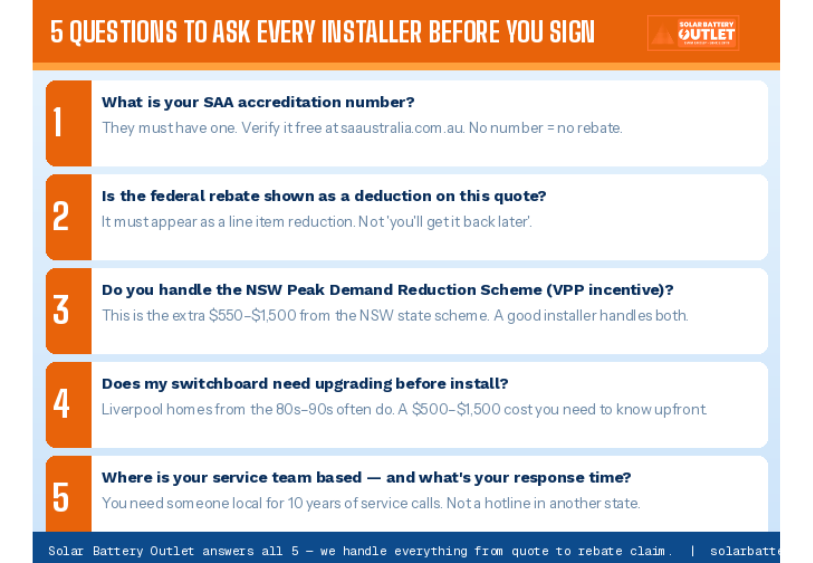
These questions take two minutes to ask. The answers will tell you everything you need to know about whether an installer is worth trusting:

The 5 questions every Liverpool homeowner should ask before signing a solar battery quote

Question 1: What is your SAA accreditation number?

A confident, reputable installer will give you this number without hesitation. Take it, write it down, and verify it at saaustralia.com.au before you go any further. If they can’t give you a number or become evasive — stop right there.

Question 2: Is the federal rebate shown as a deduction on this quote?

It must appear as a clear dollar deduction on the written quote — not a verbal promise, not ‘we’ll sort it at invoice stage’. The rebate should read something like: ‘Federal Cheaper Home Batteries discount: – $3,100’. If it’s not there, ask them to redo the quote.

Question 3: Do you process the NSW VPP incentive (PDRS)?

This is the NSW state incentive of $550 to $1,500 for connecting your battery to a Virtual Power Plant. Some installers skip this because it involves extra compliance steps. If they look confused when you ask — or say they don’t handle it — that’s money you’re leaving on the table. Find an installer who does both.

Question 4: Does my switchboard need upgrading?

Liverpool homes built in the 1980s and 1990s often have older switchboards that can’t safely handle a battery installation. A switchboard upgrade typically costs $500 to $1,500. A good installer will check this during the site assessment and tell you upfront. An installer who doesn’t raise this at all — and then hits you with an extra charge after you’ve signed — is one to avoid.

Question 5: Where is your service team based?

Ask specifically: ‘Where are your technicians physically based? What is your typical response time for a service call in Liverpool?’ A company with a local South West Sydney team can have someone at your door within a day or two. A company whose nearest team is in another state might take weeks — or worse, subcontract to someone unfamiliar with your system.

What Every Good Quote Should Include

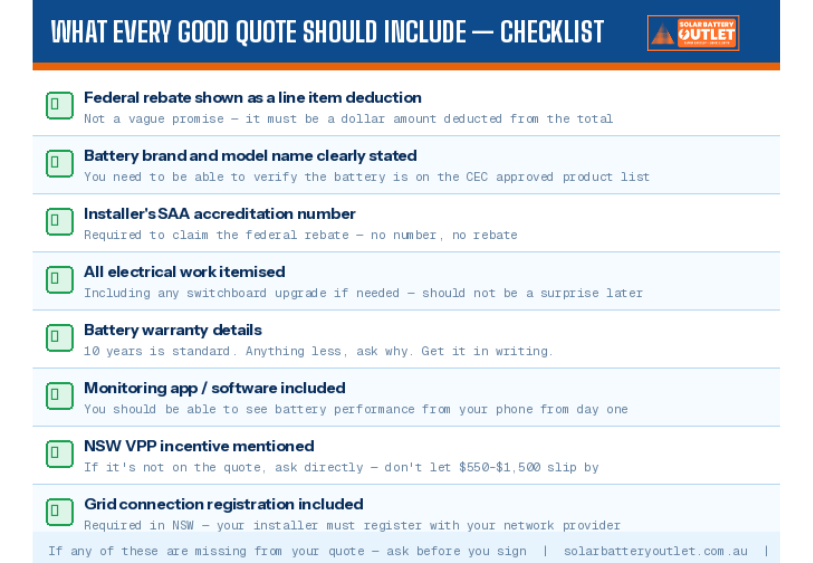
Once you’ve asked your questions and you’re ready to compare written quotes, here’s exactly what should be on every page:

Full checklist of what a trustworthy solar battery quote must include — Liverpool NSW 2026

The most commonly missing items we see on Liverpool quotes are:

  • The NSW VPP incentive. Many quotes show the federal rebate but not the NSW state incentive. If it’s missing, ask explicitly — don’t assume they’ll add it later.
  • Switchboard work. If a switchboard upgrade is needed, it must be on the quote before you sign — not added as a surprise on installation day.
  • Grid connection registration. This is a legal requirement in NSW. Your installer must register the system with your network provider (e.g. Ausgrid or Endeavour Energy). If it’s not mentioned, ask who handles it.

How Many Quotes Should You Get?

Three is the right number. Not two, not five — three. Here’s why:

  • One quote gives you no reference point — you have nothing to compare it against
  • Two quotes and you might still pick the wrong one based on a coin flip
  • Three quotes gives you a genuine picture of what the market looks like in Liverpool right now
  • Beyond three, you’re spending time comparing minor differences and creating decision fatigue

When you compare quotes, always compare the after-rebate price — not the sticker price. And make sure all three quotes are for the same battery model and capacity, otherwise you’re comparing apples with oranges.

A Note on Cheap Quotes

The cheapest quote in Liverpool is rarely the best value. Here’s what cheap quotes often hide:

  • A lower-grade battery brand not on the CEC approved product list
  • Missing switchboard work that will be charged separately on the day
  • No monitoring software included — you’ll pay for it later
  • An interstate company with no local service team
  • The NSW VPP incentive not processed — saving them admin, costing you money

A difference of $500–$800 on a quote from a fully accredited local company with a solid service team is almost always worth it over a decade of battery ownership.

Frequently Asked Questions

How do I verify an installer’s SAA accreditation?

Go to saaustralia.com.au and use the accreditation status check tool. Enter the installer’s name or their SAA number. It’s free and takes about 30 seconds. If their name doesn’t appear or their accreditation has lapsed — do not proceed.

Can I use any installer or does it have to be someone specific?

You can use any SAA-accredited installer — you’re not locked to one company. What matters is that whoever does your installation is SAA-accredited at the time of installation. The installer then processes the rebate paperwork with the Clean Energy Regulator on your behalf.

What if something goes wrong after installation?

Your battery and inverter come with manufacturer warranties (typically 10 years). For installation workmanship, your installer is responsible. This is exactly why a local company with a real team in South West Sydney matters — you need someone you can actually reach. Always ask about the installer’s own warranty on their workmanship before signing.

Is it okay to get quotes from companies I find online vs local?

Online quotes and comparison sites are fine as a starting point. But always confirm the company has actual installers and service technicians based in Liverpool or South West Sydney — not just a national call centre. Ask directly: ‘Who will physically do my installation and where are they based?’

Get a Quote from a Liverpool-Based, SAA-Accredited Installer

We’re based locally in Liverpool and service all of South West Sydney. SAA-accredited electricians. We handle the federal rebate and NSW VPP incentive paperwork — and we’ll always tell you if your switchboard needs upgrading before you sign.

Call us: 1800 000 777

Or fill in our 60-second eligibility form at solarbatteryoutlet.com.au
About Solar Battery Outlet We’re a Liverpool-based solar battery installer, part of GWM Group Pty Ltd, servicing homes across South West Sydney, Bankstown, Campbelltown, Mudgee, and the greater NSW region. All installations by SAA-accredited electricians. We handle all rebate paperwork — federal and NSW — so you don’t have to.
php