Australia has more rooftop solar than almost any country on earth. Yet for years, most of that solar power went straight to the grid—at a feed-in tariff of just 4 to 7 cents per kWh. The Cheaper Home Batteries Program changes that equation entirely. Since July 2025, eligible NSW homeowners can access an upfront discount on the cost of a home battery, based on its usable size and the current STC rate—with no paperwork, no income test, and no wait for a rebate check.
This guide explains exactly how the program works, who qualifies, what the rebate is worth right now, and how to stack it with the NSW VPP incentive. If you’ve been considering storage but felt unsure about the costs, read this first.
What Is the Cheaper Home Batteries Program?
The Cheaper Home Batteries Program is the Australian government’s initiative to cut the cost of home battery storage. It runs under the Small-scale Renewable Energy Scheme (SRES)—the same mechanism that has discounted rooftop solar for over a decade.
In December 2025, the government expanded total funding from $2.3 billion to $7.2 billion. That expansion supports more than two million battery installations by 2030, delivering around 40 gigawatt hours of additional storage capacity nationally. The program is not means-tested. Every eligible NSW household — regardless of income — can access the discount.
| Key Program Facts at a Glance Launch date: 1 July 2025 | Program end: 2030 | Total funding: $7.2 billion Discount level: ~30% upfront Eligible systems: 5–100 kWh nominal capacity How it works: The installer deducts the STC value from your quote — you simply pay less, upfront |
How Does the Rebate Actually Work?
The discount reaches you through Small-scale Technology Certificates (STCs). Your accredited installer creates and trades these certificates on your behalf. Then they deduct the STC value directly from your invoice. You never lodge a claim or chase a payment.
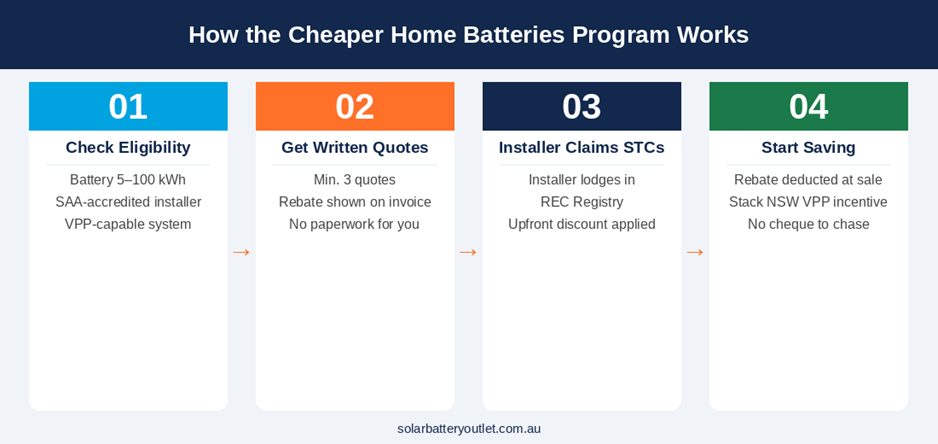
Because your installer handles everything, the process is straightforward. However, one step is critical on your end: always confirm the rebate is shown as a line item on your written quote. A legitimate quote will list the STC value separately and deduct it clearly from the gross price.
What Changed on 1 May 2026?
Two significant changes came into effect on 1 May 2026. Both affect how much the rebate is worth. Consequently, understanding these changes helps you make a better-informed decision about timing.
Change 1: The STC factor reduced from 8.4 to 6.8. This lowered the per-kWh rebate value from approximately $311 to approximately $252 for most standard batteries. The government adjusted this to reflect falling battery hardware prices. Furthermore, the factor will now step down every six months (in January and July) rather than annually.
Change 2: The rebate now uses a tiered structure based on battery size. Previously, every eligible kWh received the same discount rate. Now, the STC factor tapers based on how much storage you install:
- 0 to 14 kWh — 100% STC factor (full rebate rate)
- 14 to 28 kWh — 60% STC factor (reduced rate)
- 28 to 50 kWh — 15% STC factor (significantly reduced)
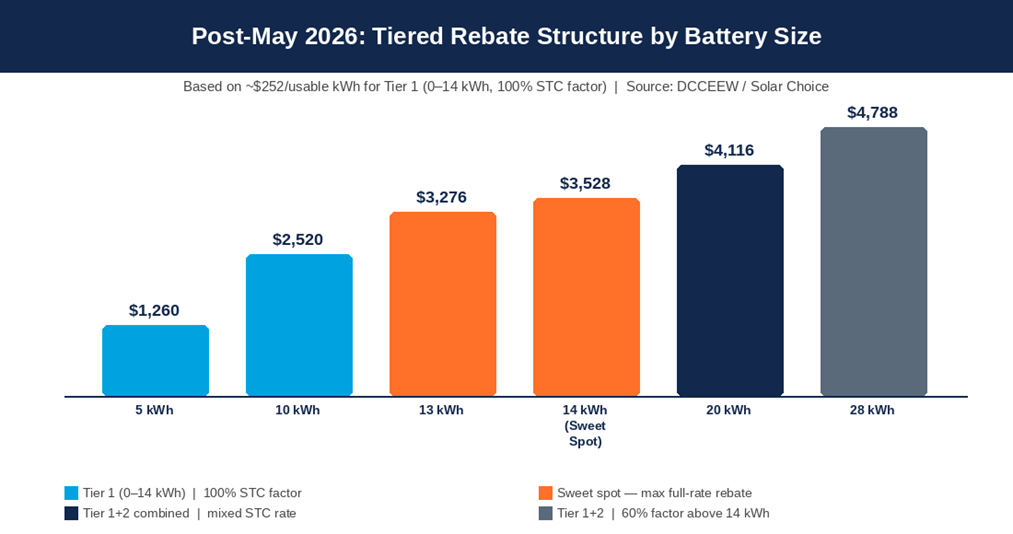
This tiered approach means 14 kWh is now the sweet spot for NSW homeowners. At that size, the full STC factor applies to every kWh. Beyond that, each additional kWh earns a smaller discount. In practical terms, a 13 kWh battery currently attracts a rebate of approximately $3,276 — making it one of the strongest value propositions in the market.
Who Qualifies for the Cheaper Home Batteries Program in NSW?
Eligibility is broader than many NSW homeowners realise. Therefore, it’s worth checking whether you qualify even if your property situation seems unusual.
You are eligible if:
- Your property has a separate electricity meter (NMI)
- Your battery system is between 5 kWh and 100 kWh in nominal capacity
- Your installer is accredited by Solar Accreditation Australia (SAA)
- Your system is VPP-capable at the time of installation (joining a VPP is optional)
- Your battery appears on the SAA approved products list
Importantly, you can also qualify if:
- You don’t yet have solar panels—the program supports standalone battery installations
- You are a landlord — the rebate is available per eligible property, each with its own NMI
- You own a small business or community organisation with an eligible premises
| What ‘VPP-Capable’ Actually Means. VPP-capable means your battery has the technical ability to connect to a Virtual Power Plant. It does NOT mean you are required to join one. You retain full control over whether you participate in a VPP program. |
How NSW Homeowners Can Stack the Rebate
This is where NSW homeowners have a real advantage over other states. The federal Cheaper Home Batteries Program can stack with the NSW VPP incentive—meaning you can access two sources of financial support from a single battery installation.
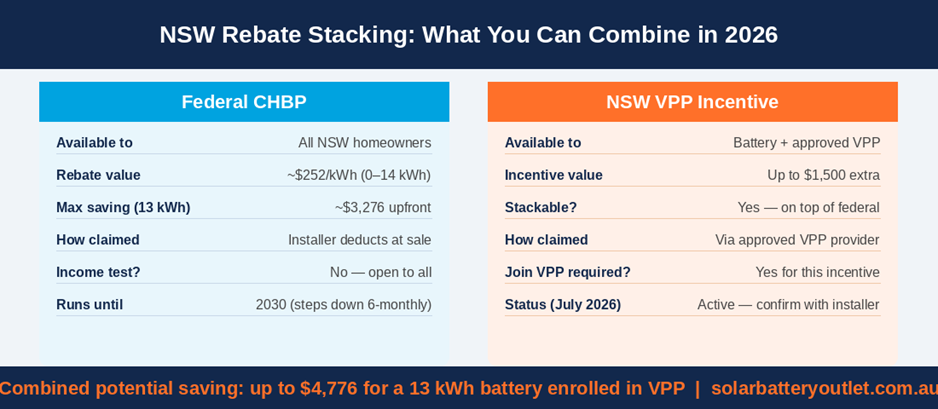
From 1 July 2025, the NSW Government increased the VPP incentive to up to $1,500 for households that connect their battery to an approved Virtual Power Plant. The exact amount depends on your battery size. Notably, this stacks cleanly on top of the federal rebate.
For a 13 kWh battery, the combined saving could therefore reach approximately $4,776—before you account for any ongoing electricity bill reductions from self-consumption. Homeowners looking at solar panel Liverpool, Bankstown, and surrounding suburbs should ask their installer specifically about VPP-approved providers in their area, since not all brands qualify.
How Much Will a Battery Actually Save You in NSW?
The rebate reduces your upfront cost. However, your ongoing savings depend on how you use the battery. Consider a typical NSW family with a 6.6 kW solar system that currently exports most of their midday generation at 5 cents per kWh.
After adding a 13 kWh battery — with the federal rebate reducing the net cost to roughly $7,000–$8,500 installed — they start storing that midday solar for evening use instead. At a grid price of 35 cents per kWh, and giving up about 5 cents of feed-in credit, storing 10 kWh on a sunny day saves about $3. Over a year, allowing for cloudy and winter days, that may be roughly $800–$1,000. A VPP may add more, depending on the plan [add source]. Payback depends on your price, usage and tariff.
If you want help sizing a battery correctly for your usage, a good installer—whether you’re in western Sydney or anywhere else across NSW—will review three months of electricity bills before recommending a size. Bigger is not always better under the new tiered structure.
What to Watch Out for When Getting Quotes
The surge in battery installations has unfortunately attracted some poor-quality operators. Moreover, the ACCC and NSW Fair Trading have issued warnings about high-pressure solar battery sales tactics. Here is what to look out for.
- The rebate should appear as a separate line item on every written quote. If it doesn’t, ask for it explicitly.
- Installers must be accredited by Solar Accreditation Australia. Ask for their SAA number before you proceed.
- Door-to-door and cold-call pressure to sign on the same day is a red flag. Under Australian Consumer Law, you have the right to a 10-business-day cooling-off period for unsolicited contracts.
- Get at least three written quotes before committing. Price differences of $2,000 or more for the same battery are common in the NSW market.
- Confirm the battery model appears on the SAA-approved products list before signing. An ineligible product means no rebate.
| Your Consumer Rights Under the ACL All battery sales in Australia carry automatic consumer guarantees under the Australian Consumer Law, regardless of the warranty a retailer provides. If a product fails to meet these guarantees, you are entitled to a repair, replacement, or refund. The ACCC and NSW Fair Trading jointly enforce these protections. |
Frequently Asked Questions
Yes. The program supports both new installations and batteries added to existing solar systems. This is one of the most frequently misunderstood aspects of the scheme.
No. The Cheaper Home Batteries Program has no income or means test. Every eligible NSW household can access the discount regardless of income level.
The government expanded funding to $7.2 billion in December 2025 specifically to avoid the program running out early. At current installation rates, the program is expected to remain funded through to 2030. However, the per-kWh value steps down every six months, so earlier installation delivers a higher discount.
Yes. Your battery must be VPP-capable, but you are not required to actually join a virtual power plant to receive the federal rebate. Joining a VPP is optional — though it unlocks the additional NSW VPP incentive of up to $1,500.
There is no suburb-specific rebate. However, the federal program applies equally across all of NSW. Homeowners looking for solar battery options in Bankstown or across the greater western Sydney region can access the same federal CHBP discount as the rest of the state. The NSW VPP incentive is also available statewide.
| Ready to Claim Your 2026 Battery Rebate? Solar Battery Outlet installs eligible batteries across Liverpool, Bankstown, Mudgee and surrounding areas. We handle the STC paperwork for you, show the rebate clearly on your written quote, and assess your existing solar system before recommending a size. The rebate steps down every six months, so we’ll show you the current amount on your written quote.. Get a Free Quote Today → solarbatteryoutlet.com.au/contact/ | 1800 000 777 |
Disclaimer: The rebate values, savings estimates, battery sizes, STC factors, and electricity prices in this article are illustrative only and not a guarantee of future performance. Actual outcomes vary by location, usage, tariff, battery configuration, and eligibility. Program details are subject to change. Please seek personalised advice from a qualified installer before purchasing.
