

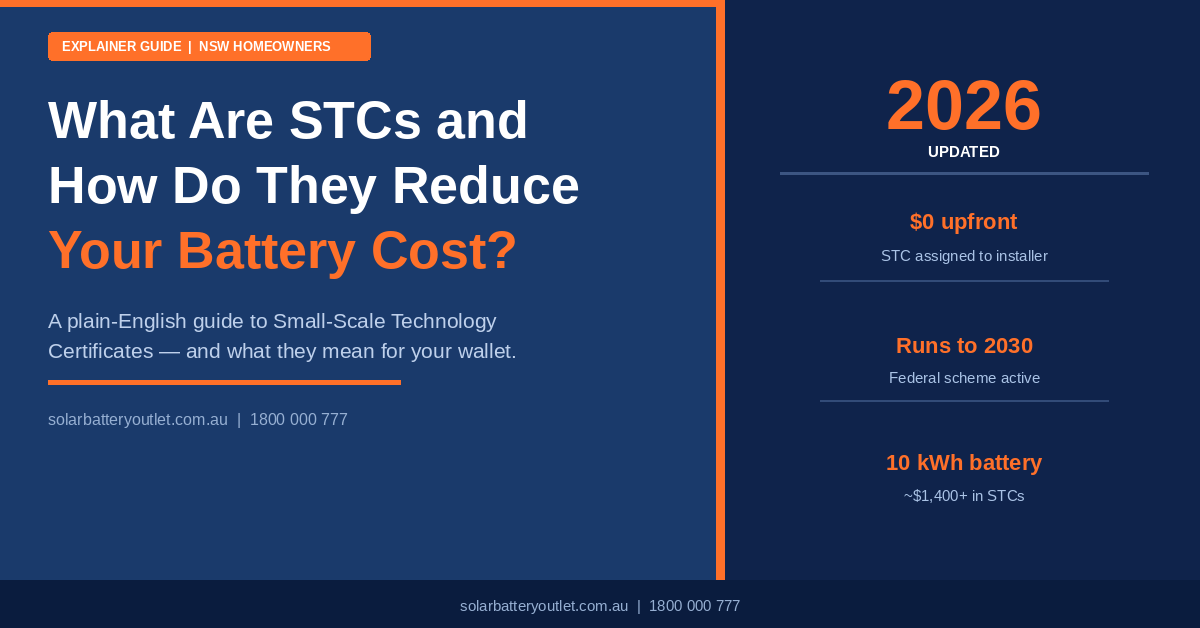
If you have received a quote for a solar battery recently, you may have noticed a line called the ‘federal rebate’ or ‘government rebate’ reducing the total price. That is not marketing spin. It is a real, government-backed mechanism called the Small-Scale Technology Certificate scheme — and in 2026, it is one of the most valuable financial tools available to NSW homeowners installing a battery.
This article explains, in plain English, exactly what STCs are, how they are calculated, what they are worth in 2026, and — most importantly — how they end up saving you money before you ever hand over a cent.
In plain English: STCs are government certificates created when you install an eligible battery. You assign them to your installer, who sells them — and that sale is deducted from your invoice as an upfront discount.
You never touch the certificates yourself. Your installer does the work. You just pay less.
What Are STCs, Really?
STC stands for Small-Scale Technology Certificate. You will also hear them called ‘the solar rebate’, ‘the federal rebate’, or simply ‘the government discount’. Technically, they are none of those things — but they function exactly like one.
STCs are part of Australia’s Renewable Energy Target, administered under the Small-scale Renewable Energy Scheme (SRES). The scheme has existed since 2011, originally to make rooftop solar more affordable. From 1 July 2025, it was expanded under the federal Cheaper Home Batteries Program to also cover eligible home battery systems.
When you install an eligible battery, your installation generates a set number of certificates. Those certificates have a dollar value. You assign your right to those certificates to your accredited installer. The installer sells them, and the proceeds are passed back to you as a deduction on your quote. The end result is a lower price on the day you pay.
How Are STCs Calculated for a Battery?
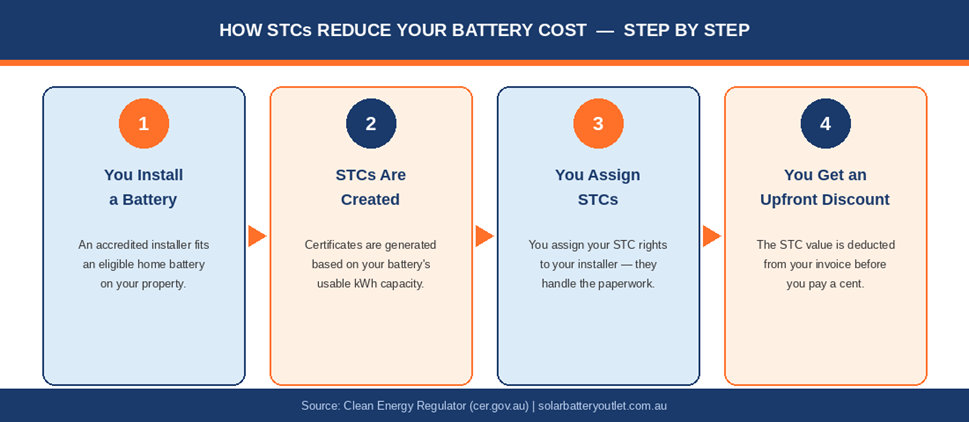
The number of STCs your installation generates depends on two things: the usable capacity of your battery in kilowatt-hours (kWh), and the STC factor that applies on the date of installation.
The STC Factor
The STC factor is a multiplier set by the government. It determines how many certificates are created per kWh of usable battery capacity. It is designed to step down over time as battery costs fall — the idea being that the rebate reflects how much financial help is needed, not a fixed handout.
From 1 July 2025 (scheme launch) to 30 April 2026: STC Factor = 8.4 per kWh
From 1 May 2026 onward: STC Factor = 6.8 per kWh (for batteries up to 14 kWh)
The factor continues declining every six months until the scheme ends in 2030.
The formula is straightforward:
Number of STCs = Usable kWh × STC Factor (rounded down to the nearest whole certificate)
The Tiered Structure for Larger Batteries
From 1 May 2026, a tiered STC factor applies for batteries above 14 kWh of usable capacity. This is how it works:
- 0 to 14 kWh (inclusive): STC Factor applied at 100%
- Every kWh above 14 kWh up to 28 kWh (inclusive): STC Factor applied at 60%
- Every kWh above 28 kWh up to 50 kWh (inclusive): STC Factor applied at 15%
- No STCs are created for any capacity above 50 kWh usable
This tiering means a 20 kWh battery does not simply get twice the STCs of a 10 kWh battery — it gets 14 kWh worth at full factor, then 6 kWh at 60% of factor. The total is still significant, but it is worth understanding the structure before assuming proportional savings.
What Is Each STC Worth?
The value of each individual STC fluctuates with the open market. The government purchases STCs from the STC Clearing House at a fixed administrative price, which provides a floor. In practice, STCs for batteries have traded close to the clearing house price.
As of mid-2026, each STC is worth approximately $28 to $30. Your installer will give you the exact amount when they prepare your written quote, as they deal with the certificates directly on your behalf.
How Much Will STCs Actually Save You?
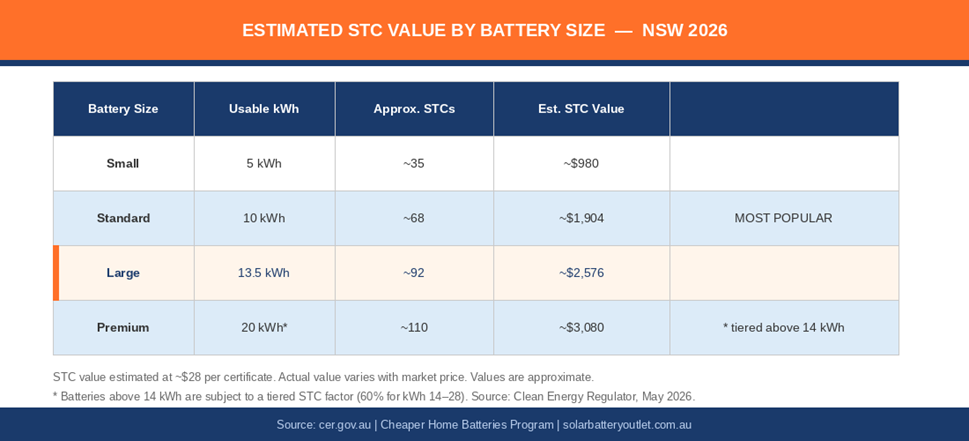
To put the numbers in perspective, a standard 10 kWh home battery installed in NSW after May 2026 generates approximately 68 STCs (10 × 6.8 = 68). At roughly $28 each, that is around $1,904 in certificate value — deducted from your invoice before you pay.
For a larger 13.5 kWh system, the saving rises to around $2,576 at the same rate. These are not small numbers. They represent a meaningful reduction off the total installed cost of a battery that might otherwise sit at $10,000 to $14,000 before any incentives.
How Does the STC Saving Actually Show Up on Your Quote?
This is where things get practical. When you receive a written quote from an accredited installer, the STC value should appear as a separate line item — a deduction from the gross price. The quote should show you:
- Gross cost of the battery and installation
- STC deduction (shown as a dollar amount, not a vague ‘rebate’)
- Net cost — what you actually pay
| Important: If an installer mentions the rebate verbally but it does not appear as a line item on the written quote — that is a red flag. A legitimate installer will always show the STC deduction clearly in writing. You are assigning your STC rights to them. You deserve to see exactly what those rights are worth. |
The reason it works this way is that you are technically transferring your legal right to create and trade those certificates to your installer. They do the paperwork through the Clean Energy Regulator’s REC Registry. They handle the compliance requirements — including the photo documentation requirements introduced in early 2026. In return, they pass the value back to you upfront, rather than making you wait for a government reimbursement.
If you want to understand the compliance requirements your installer must meet, our guide on new government rules for solar battery installations in 2026 covers this in detail.
Does the STC Scheme Apply to All Batteries?
No. Not all batteries qualify. To generate STCs, a battery system must meet the eligibility criteria under the Cheaper Home Batteries Program. The key requirements are:
- The battery must be installed and commissioned by an accredited installer
- The battery must appear on the Clean Energy Council’s approved products list
- The usable capacity must not exceed 50 kWh
- The installation must comply with all relevant Australian Standards
- The installer must register the installation with the Clean Energy Regulator
If any of these conditions are not met — for example, if the installer is not properly accredited or the battery model is not on the approved list — no STCs are generated and no discount applies. This is another reason why installer quality matters as much as product quality.
How Does the STC Factor Change Over Time?
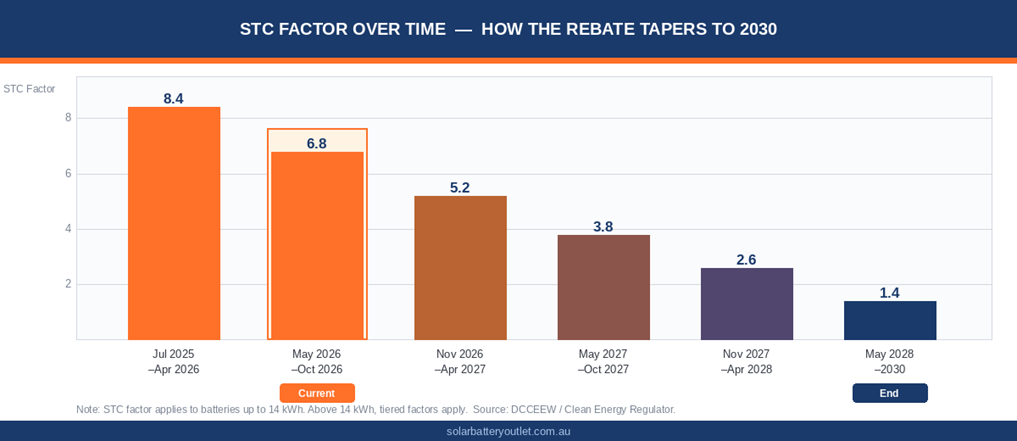
The STC factor for batteries reduces every six months under a schedule set by the government. The principle is simple: as battery costs fall over time, the government support tapers proportionally. The scheme is designed to wind down by 2030.
What this means for homeowners is that the longer you wait, the lower the STC value on your installation. Each six-month period that passes reduces the certificates available — and therefore the upfront saving on your battery cost.
The scheme is not ending abruptly. It is tapering gradually. But that taper is real money. Homeowners installing solar batteries NSW-wide in 2026 are still accessing a significant incentive — one that will be noticeably smaller by 2028.
Can You Stack STCs With Other Incentives?
Yes — and this is where the full picture becomes compelling. STCs are a federal scheme. They sit alongside, not instead of, state-level incentives that NSW homeowners can also access.
- NSW Peak Demand Reduction Scheme (PDRS): Up to $1,500 for connecting your battery to a Virtual Power Plant (VPP)
- VPP monthly payments: Ongoing income from your battery participating in grid support programs
- Time-of-use tariff savings: Storing cheap solar energy and using it during peak tariff periods
| Stacking example: 10 kWh battery installed in NSW, June 2026. |
| STC deduction off invoice: ~$1,904 |
| NSW PDRS incentive (if VPP-connected): up to $1,500 |
| Combined upfront benefit: up to ~$3,400 |
| That is before any ongoing savings on your electricity bills. |
Do You Need to Do Anything to Claim STCs?
In most cases, NO. The standard process is:
- Your installer confirms you are eligible and includes the STC deduction in the written quote.
- You sign the assignment agreement — typically a single form included with your contract.
- The installer completes the installation, takes the required compliance photos, and submits the STC application to the Clean Energy Regulator.
- The certificates are registered and sold. You have already received the value as a discount on your invoice.
You can also choose to create and trade STCs yourself through the REC Registry — but the vast majority of homeowners choose to assign them to their installer for simplicity.
For more on what the Clean Energy Regulator now requires at installation — including photo documentation — see our article on CER registration rules for NSW solar panel installers.
Frequently Asked Questions
No. STCs are a federal mechanism, separate from any state programs. In NSW, state incentives like the Peak Demand Reduction Scheme are additional to STCs, not a replacement. You can claim both if you are eligible for both.
Yes. Since 1 July 2025, STCs apply to eligible standalone battery installations — you do not need to be installing solar panels at the same time. This is a significant change from the earlier scheme.
Yes. Adding a battery to an existing solar system qualifies for its own STC entitlement under the Cheaper Home Batteries Program. The battery STCs are calculated independently of any STCs that were claimed when you originally installed your solar panels.
Yes — indirectly. Your installation must comply with AS/NZS 5139 and related Australian Standards. Non-compliant wiring can mean the installation fails CER registration, which means no STCs. This is another reason to choose an accredited installer who knows the current standards.
The Cheaper Home Batteries Program’s STC component runs until 2030. The factor tapers every six months, so the longer you wait, the smaller the saving — but the scheme does not switch off overnight.
| Want to Know Exactly What STCs You Qualify For? We calculate the exact STC value for your battery — and show it as a clear dollar deduction on your written quote. No hidden rebate promises. No verbal commitments. Just a transparent quote. Solar Battery Outlet — Liverpool, Bankstown & Mudgee NSW Call: 1800 000 777 | Get a free quote: survey.solarbatteryoutlet.com.au/offer All installations by SAA-accredited electricians. Rebate paperwork handled for you. |