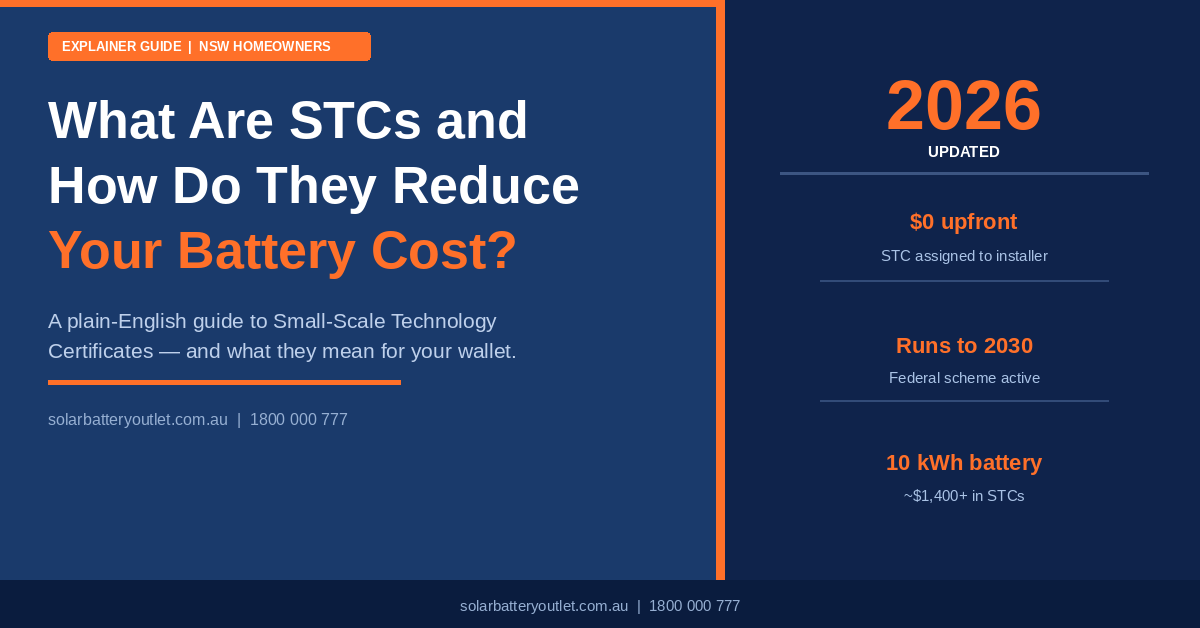
If you have received a quote for a solar battery recently, you may have noticed a line called the ‘federal rebate’ or ‘government rebate’ reducing the total price. That is not marketing spin. It is a real, government-backed mechanism called the Small-Scale Technology Certificate scheme — and in 2026, it is one of the most valuable financial tools available to NSW homeowners installing a battery.

This article explains, in plain English, exactly what STCs are, how they are calculated, what they are worth in 2026, and — most importantly — how they end up saving you money before you ever hand over a cent.

In plain English: STCs are government certificates created when you install an eligible battery. You assign them to your installer, who sells them — and that sale is deducted from your invoice as an upfront discount.

You never touch the certificates yourself. Your installer does the work. You just pay less.

What Are STCs, Really?

STC stands for Small-Scale Technology Certificate. You will also hear them called ‘the solar rebate’, ‘the federal rebate’, or simply ‘the government discount’. Technically, they are none of those things — but they function exactly like one.

STCs are part of Australia’s Renewable Energy Target, administered under the Small-scale Renewable Energy Scheme (SRES). The scheme has existed since 2011, originally to make rooftop solar more affordable. From 1 July 2025, it was expanded under the federal Cheaper Home Batteries Program to also cover eligible home battery systems.

When you install an eligible battery, your installation generates a set number of certificates. Those certificates have a dollar value. You assign your right to those certificates to your accredited installer. The installer sells them, and the proceeds are passed back to you as a deduction on your quote. The end result is a lower price on the day you pay.

How Are STCs Calculated for a Battery?
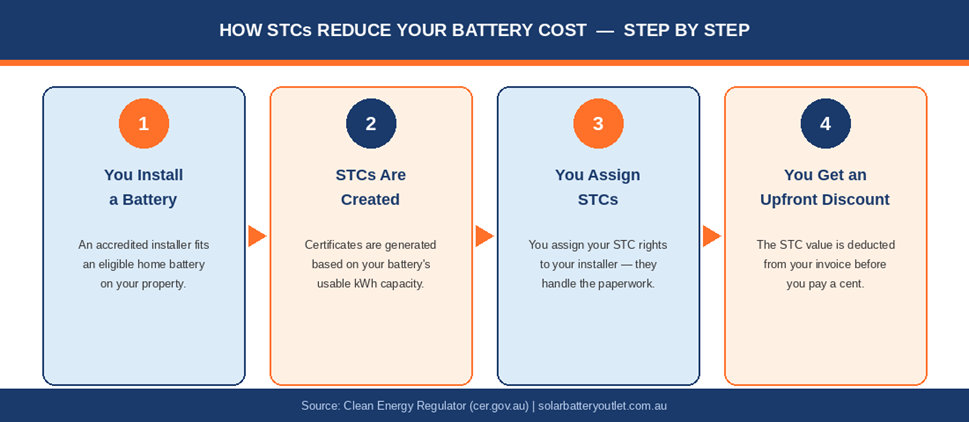
How STCs reduce your solar battery cost

The number of STCs your installation generates depends on two things: the usable capacity of your battery in kilowatt-hours (kWh), and the STC factor that applies on the date of installation.

The STC Factor

The STC factor is a multiplier set by the government. It determines how many certificates are created per kWh of usable battery capacity. It is designed to step down over time as battery costs fall — the idea being that the rebate reflects how much financial help is needed, not a fixed handout.

The formula is straightforward:

Number of STCs = Usable kWh × STC Factor (rounded down to the nearest whole certificate)

From 1 May 2026, a tiered STC factor applies for batteries above 14 kWh of usable capacity. This is how it works:

This tiering means a 20 kWh battery does not simply get twice the STCs of a 10 kWh battery — it gets 14 kWh worth at full factor, then 6 kWh at 60% of factor. The total is still significant, but it is worth understanding the structure before assuming proportional savings.

What Is Each STC Worth?

The value of each individual STC fluctuates with the open market. The government purchases STCs from the STC Clearing House at a fixed administrative price, which provides a floor. In practice, STCs for batteries have traded close to the clearing house price.

As of mid-2026, each STC is worth approximately $28 to $30. Your installer will give you the exact amount when they prepare your written quote, as they deal with the certificates directly on your behalf.

How Much Will STCs Actually Save You?
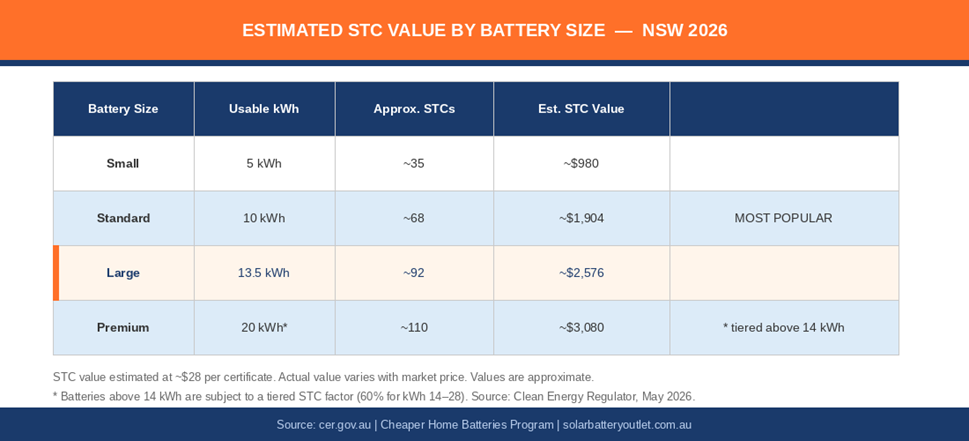
Estimated STC value by battery size NSW 2026- Comparison

To put the numbers in perspective, a standard 10 kWh home battery installed in NSW after May 2026 generates approximately 68 STCs (10 × 6.8 = 68). At roughly $28 each, that is around $1,904 in certificate value — deducted from your invoice before you pay.

For a larger 13.5 kWh system, the saving rises to around $2,576 at the same rate. These are not small numbers. They represent a meaningful reduction off the total installed cost of a battery that might otherwise sit at $10,000 to $14,000 before any incentives.

How Does the STC Saving Actually Show Up on Your Quote?

This is where things get practical. When you receive a written quote from an accredited installer, the STC value should appear as a separate line item — a deduction from the gross price. The quote should show you:

  • Gross cost of the battery and installation
  • STC deduction (shown as a dollar amount, not a vague ‘rebate’)
  • Net cost — what you actually pay

The reason it works this way is that you are technically transferring your legal right to create and trade those certificates to your installer. They do the paperwork through the Clean Energy Regulator’s REC Registry. They handle the compliance requirements — including the photo documentation requirements introduced in early 2026. In return, they pass the value back to you upfront, rather than making you wait for a government reimbursement.

If you want to understand the compliance requirements your installer must meet, our guide on new government rules for solar battery installations in 2026 covers this in detail.

Does the STC Scheme Apply to All Batteries?

No. Not all batteries qualify. To generate STCs, a battery system must meet the eligibility criteria under the Cheaper Home Batteries Program. The key requirements are:

  • The battery must be installed and commissioned by an accredited installer
  • The battery must appear on the Clean Energy Council’s approved products list
  • The usable capacity must not exceed 50 kWh
  • The installation must comply with all relevant Australian Standards
  • The installer must register the installation with the Clean Energy Regulator

If any of these conditions are not met — for example, if the installer is not properly accredited or the battery model is not on the approved list — no STCs are generated and no discount applies. This is another reason why installer quality matters as much as product quality.

How Does the STC Factor Change Over Time?
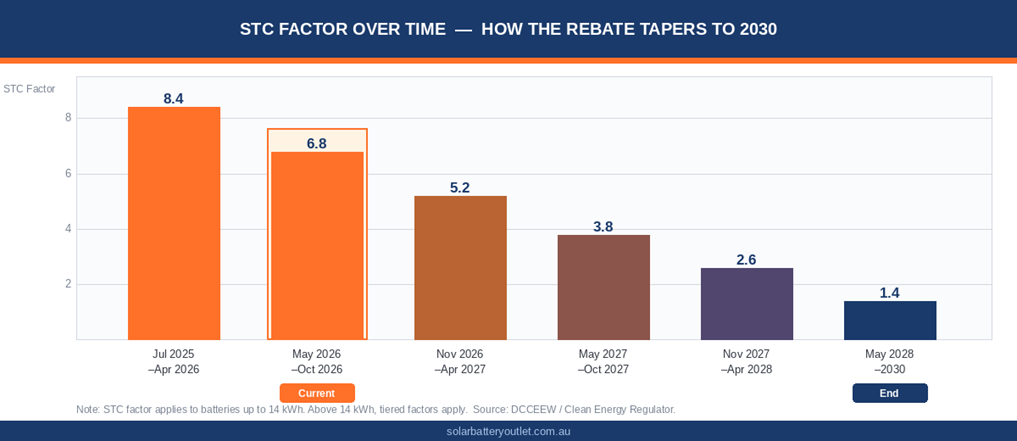
STC factor decline timeline 2025 to 2030 — bar chart showing how the solar battery rebate tapers over time in Australia

The STC factor for batteries reduces every six months under a schedule set by the government. The principle is simple: as battery costs fall over time, the government support tapers proportionally. The scheme is designed to wind down by 2030.

What this means for homeowners is that the longer you wait, the lower the STC value on your installation. Each six-month period that passes reduces the certificates available — and therefore the upfront saving on your battery cost.

The scheme is not ending abruptly. It is tapering gradually. But that taper is real money. Homeowners installing solar batteries NSW-wide in 2026 are still accessing a significant incentive — one that will be noticeably smaller by 2028.

Can You Stack STCs With Other Incentives?

Yes — and this is where the full picture becomes compelling. STCs are a federal scheme. They sit alongside, not instead of, state-level incentives that NSW homeowners can also access.

  • NSW Peak Demand Reduction Scheme (PDRS): Up to $1,500 for connecting your battery to a Virtual Power Plant (VPP)
  • VPP monthly payments: Ongoing income from your battery participating in grid support programs
  • Time-of-use tariff savings: Storing cheap solar energy and using it during peak tariff periods
Stacking example: 10 kWh battery installed in NSW, June 2026.
STC deduction off invoice: ~$1,904
NSW PDRS incentive (if VPP-connected): up to $1,500
Combined upfront benefit: up to ~$3,400
That is before any ongoing savings on your electricity bills.

Do You Need to Do Anything to Claim STCs?

In most cases, NO. The standard process is:

  1. Your installer confirms you are eligible and includes the STC deduction in the written quote.
  2. You sign the assignment agreement — typically a single form included with your contract.
  3. The installer completes the installation, takes the required compliance photos, and submits the STC application to the Clean Energy Regulator.
  4. The certificates are registered and sold. You have already received the value as a discount on your invoice.

You can also choose to create and trade STCs yourself through the REC Registry — but the vast majority of homeowners choose to assign them to their installer for simplicity.

For more on what the Clean Energy Regulator now requires at installation — including photo documentation — see our article on CER registration rules for NSW solar panel installers.

Frequently Asked Questions
Are STCs the same as the NSW state battery rebate?

No. STCs are a federal mechanism, separate from any state programs. In NSW, state incentives like the Peak Demand Reduction Scheme are additional to STCs, not a replacement. You can claim both if you are eligible for both.

Do STCs apply to battery-only installations (no solar panels)?

Yes. Since 1 July 2025, STCs apply to eligible standalone battery installations — you do not need to be installing solar panels at the same time. This is a significant change from the earlier scheme.

What happens if I already have solar panels — do I still get STCs for adding a battery?

Yes. Adding a battery to an existing solar system qualifies for its own STC entitlement under the Cheaper Home Batteries Program. The battery STCs are calculated independently of any STCs that were claimed when you originally installed your solar panels.

Does the wiring standard affect whether my installation qualifies?

Yes — indirectly. Your installation must comply with AS/NZS 5139 and related Australian Standards. Non-compliant wiring can mean the installation fails CER registration, which means no STCs. This is another reason to choose an accredited installer who knows the current standards.

When does the STC scheme end?

The Cheaper Home Batteries Program’s STC component runs until 2030. The factor tapers every six months, so the longer you wait, the smaller the saving — but the scheme does not switch off overnight.

If you have had solar panels on your roof for five years or more, there is a good chance your system is quietly working against you — and you do not realise it.

Not because something has broken. Not because your panels have failed. But because the economics of solar have shifted dramatically since you first installed, and your older system was never designed for the world you are living in today.

Feed-in tariffs have collapsed. Electricity prices have risen. Battery storage has become genuinely affordable. And a federal rebate that runs until 2030 means the cost barrier to adding storage has never been lower.

The question is no longer whether a battery is a good idea in theory. The question is whether your specific system is showing you the signs that now is the right time to act.

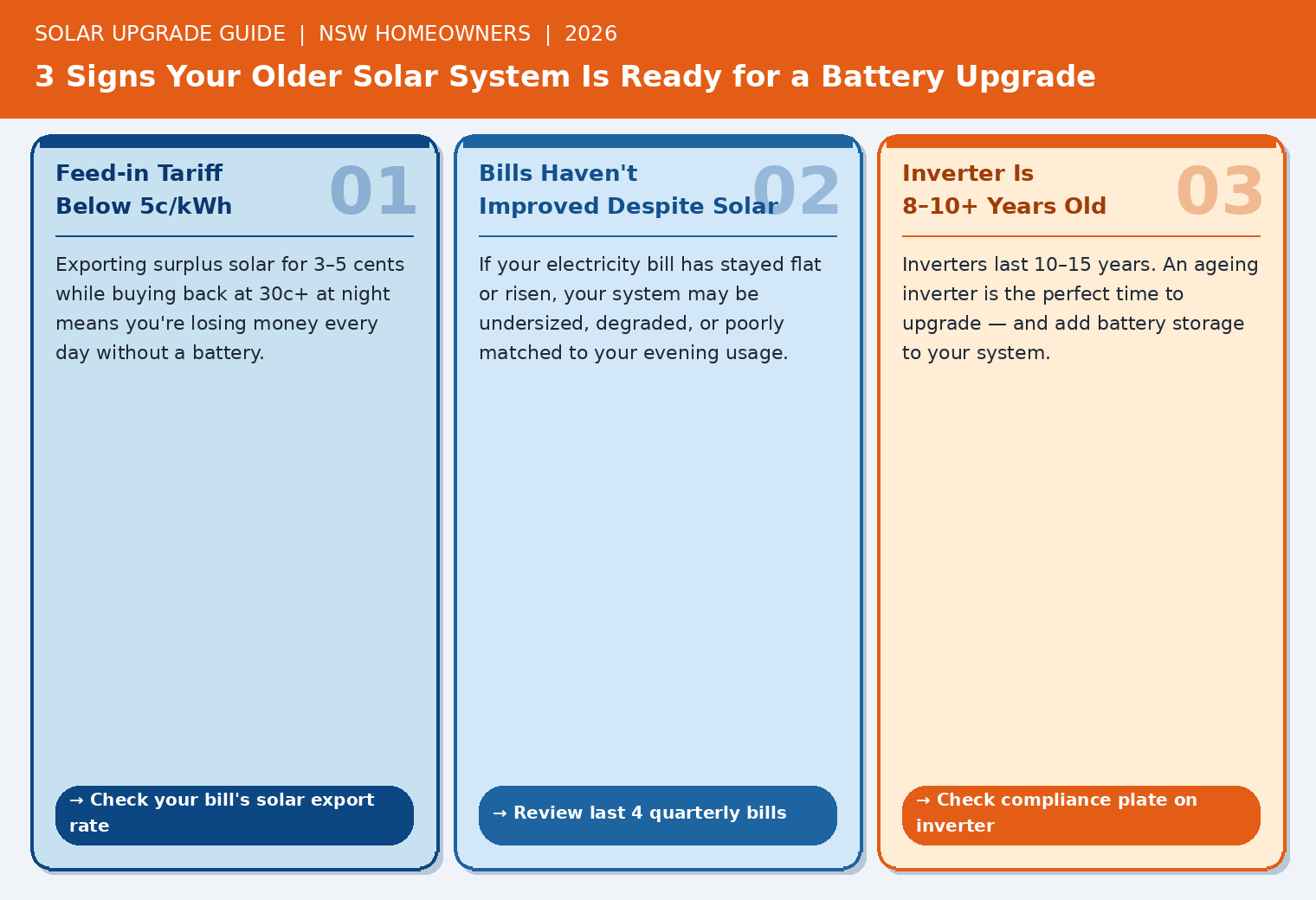
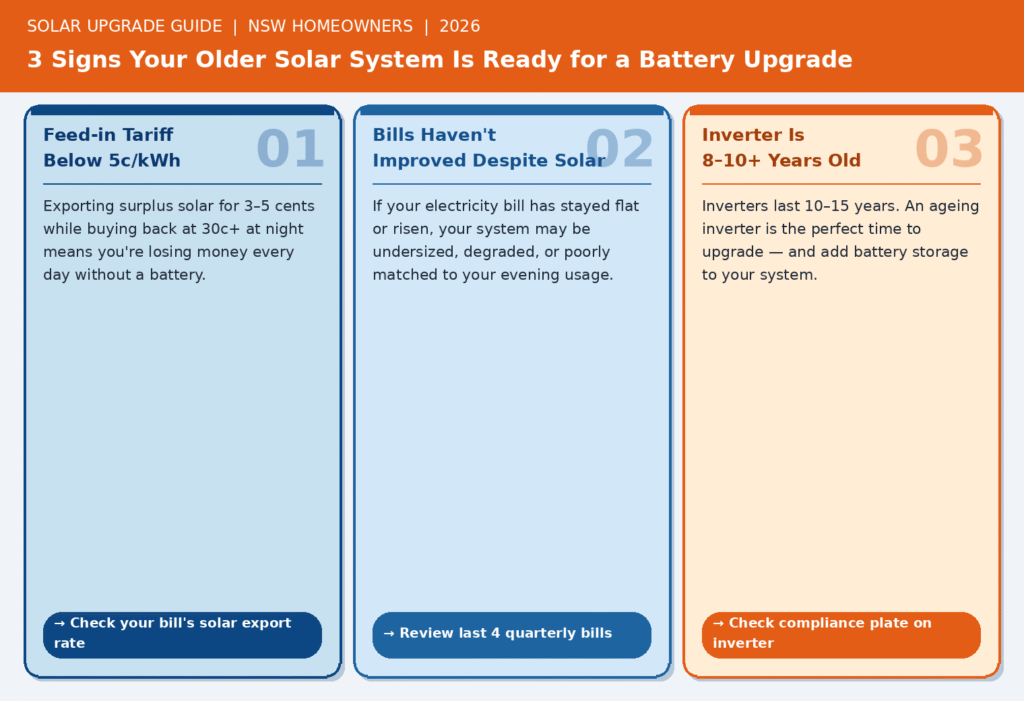
This guide walks you through three clear signs that it is time to upgrade solar system components for a 2026 battery integration — and exactly what to do if your current setup is showing its age.

What is the 2026 federal battery rebate? Australia’s Small-scale Technology Certificate (STC) scheme applies to battery installations. In 2026, homeowners can claim rebates of up to $1,800+ on eligible battery systems depending on size. The rebate continues until 2030 but decreases slightly every six months. NSW homeowners may also access the Virtual Power Plant (VPP) incentive on top of this.
signs your older solar system is ready for battery upgrade

Sign #1: Your Feed-in Tariff Has Dropped Below 5 Cents per kWh

This is the single most powerful indicator that a battery upgrade has crossed the line from ‘nice to have’ to ‘financially obvious.’

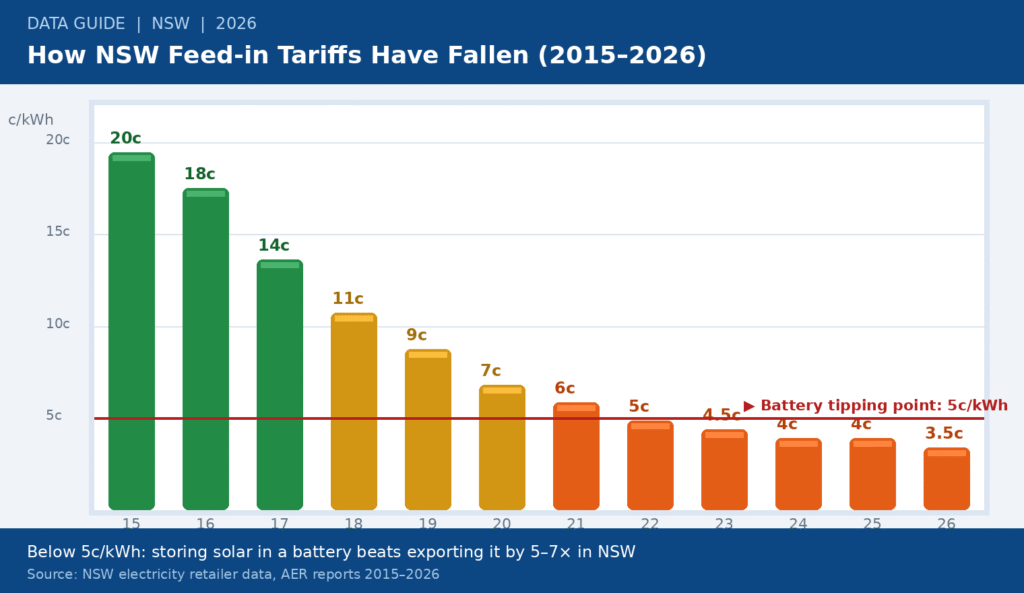
When solar panels were first widely installed across NSW in the late 2010s, feed-in tariffs — the rate your electricity retailer pays for surplus solar you export to the grid — were genuinely generous. Some homeowners locked in rates of 18 to 20 cents per kilowatt hour.

Those days are over. The typical feed-in tariff in NSW in 2026 sits between 3.5 and 5 cents per kWh for most retailers. Meanwhile, the cost of electricity you buy from the grid — particularly during peak evening hours — sits at 30 to 40 cents per kWh for most households.

The maths that changes everything

Here is what that gap means in practice. Every unit of solar energy you generate during the day has two possible destinations. It either gets used directly in your home (saving you the full 30–40 cents per kWh you would have paid), or it gets exported to the grid for 3.5 to 5 cents.

A battery changes that second option. Instead of exporting surplus energy for 4 cents and buying it back at night for 32 cents, you store it and use it yourself — capturing the full retail rate instead of the tiny export rate.

For a typical NSW household generating 20–25 kWh of solar per day and exporting half of that, the difference between a home with a battery and a home without one can be $800 to $1,400 per year in electricity savings.

How NSW Feed-in Tariffs Have Fallen

How to check your current feed-in tariff

Your current feed-in tariff is shown on every electricity bill. Look for a line that says ‘solar export,’ ‘solar feed-in,’ or ‘STC credit.’ The rate per kWh is listed next to it.

If that number is below 5 cents, your system is leaving money on the table every single day the sun shines. A battery captures it instead.

If that number is below 4 cents — which is increasingly common with standard retailer rates — the case for a battery is as clear as it gets.

The 5c threshold is not arbitrary. At feed-in rates below 5c/kWh, the value of self-consuming stored solar energy rather than exporting it is so large that a quality battery system typically reaches payback in 6–8 years in NSW — well within the battery’s 10–15 year operational lifespan.

Sign #2: Your Electricity Bills Have Not Improved Despite Having Solar

Solar panels were supposed to slash your electricity costs. If they are not doing that — if your bills have stayed roughly the same or even crept up over recent years — there are really only a few explanations.

Your household energy usage may have increased over time. Meanwhile, your solar panels could be generating less due to natural degradation. Changes in your tariff structure might also mean higher costs when solar isn’t producing — or it could be a mix of all three.

A battery does not fix panel degradation on its own — if your panels are genuinely underperforming, that needs to be assessed separately. But in the majority of cases where bills are not improving, the real issue is a mismatch between when solar generates and when households actually use power.

The solar-usage timing mismatch

Solar panels generate power from roughly 8 am to 5 pm in most of NSW, with peak output between 10 am and 2 pm on clear days. But the majority of household electricity usage — appliances, cooking, entertainment, charging — happens in the evening, particularly from 5 pm to 10 pm.

Without a battery, that evening’s usage is entirely powered by the grid. You are importing electricity at peak rates, even though your panels may have been generating more than your household needed just a few hours earlier.

A battery bridges that gap. It stores the surplus your panels generate during the day — the power that would otherwise be exported for 4 cents — and releases it into your home in the evening when the grid rate is highest.

For households with a strong daytime-to-evening usage mismatch, adding a battery to an existing solar system can reduce evening grid imports by 60 to 90 per cent on sunny days.

What your bill should tell you

  • If your solar export credits are high but your total bill is still elevated, you are generating well but using grid power in the evenings. A battery solves this directly.
  • If your generation has dropped noticeably over recent years, request a performance report from your installer or a solar technician — panel degradation or shading may be the root cause.
  • If your usage has grown significantly (new appliances, EV charging, kids at home), your original system was sized for a smaller household. A battery plus a potential panel upgrade may both be warranted.
Quick bill test: look at your last four quarterly bills. If your solar credits have not grown meaningfully even as the system ages, or if your ‘amount payable after solar’ figure is still above $200 per quarter, your system is not working optimally for your usage pattern. A battery assessment is the logical next step.

Sign #3: Your Solar Inverter Is Over 8 to 10 Years Old

This is the sign that most homeowners miss — because it looks like a maintenance issue rather than an opportunity.

Your solar inverter converts the direct current from your panels into usable alternating current for your home. It is also the most failure-prone component in a solar system. Typically, it has an operational lifespan of 10 to 15 years.

If your system is approaching or past the 8-year mark, your inverter is entering the period where replacement becomes increasingly likely. And an inverter replacement is the single best time to also upgrade your system with battery storage.

Why the inverter moment matters for batteries

Adding a battery to an older solar system often requires an inverter upgrade anyway. Many batteries installed on older systems require a hybrid inverter — a device that manages both solar generation and battery storage simultaneously.

If you are facing an inverter replacement regardless, the cost difference between a standard solar inverter and a hybrid inverter that supports batteries is typically $800 to $1,500. That is a small premium when you consider that it opens the door to battery storage for the full remaining life of your solar system.

Homeowners who replace an ageing inverter without upgrading to a battery-compatible hybrid inverter may face issues later. When they eventually add a battery, they often need another inverter upgrade. This can lead to paying for a second replacement within a few years.

How to check your inverter’s age and status

  • The installation date is on the compliance plate on the inverter itself — usually on the side or back of the unit.
  • Check whether your installer is still trading and whether the inverter brand is still supported with warranty parts in Australia.
  • If your inverter has been showing error codes, dropping offline occasionally, or producing noticeably less power than it used to, these are early warning signs of end-of-life.
  • Ask a solar technician to run a performance comparison between your current generation and the system’s designed output — a gap of more than 15 per cent warrants investigation.
The inverter upgrade window is finite. Once your inverter fails completely, you are under pressure to replace it quickly — which means less time to research, compare quotes, and make the right decision about battery integration. Acting proactively while your system is still running gives you the time to do it properly.
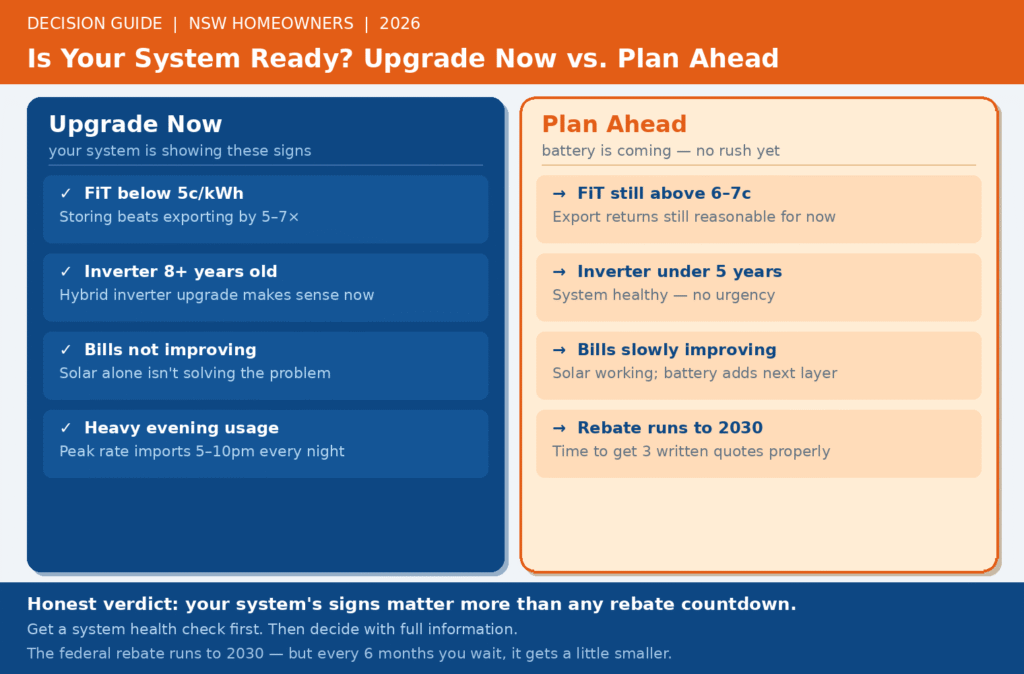
Upgrade solar now vs. plan ahead

What to Do If Your System Is Showing These Signs

If one or more of these signs applies to your home, the next step is fairly straightforward. Just make sure it’s done properly so you get the right outcome.

Step 1: Get a system health check before committing to anything

Before you book a battery installation, it’s important to get an independent assessment of your current solar system’s performance. A reputable solar installer will review your electricity bills and check your panel and inverter data. They’ll then honestly advise whether your system is ready for a battery or if additional upgrades are needed first.

This step protects you from adding a $10,000 battery to a system that is underperforming and will not charge it properly.

Step 2: Get three written quotes and compare them properly

The battery market in NSW is competitive. Prices, battery brands, installation quality, and warranty terms vary significantly between installers. Getting three written quotes — not verbal estimates, not online calculators, but actual documented quotes with itemised costs — is the only way to know whether you are getting a fair deal.

Look for quotes that clearly show the federal rebate as a dollar deduction and include a confirmed installation date, not just a contract signing date. Make sure the quote specifies the battery brand, model, usable capacity, and warranty terms. It should also mention any required switchboard or inverter upgrades.

Step 3: Ask about the NSW Virtual Power Plant incentive

NSW homeowners who install an eligible battery can access the VPP incentive — up to $1,500 additional rebate for agreeing to allow your battery to support grid stability during demand peaks. Most homeowners who participate see minimal impact on their own energy use while collecting a meaningful additional payment.

Not all installers mention this. Ask specifically.

Step 4: Understand the 2026 rebate timeline

The federal battery rebate decreases slightly every six months under the STC scheme. The current factor change in 2026 means a 10 kWh battery costs roughly $530 more after each factor drop, with larger batteries facing steeper reductions.

The rebate continues until 2030 — so there is no cliff edge where everything disappears. But every six months you wait adds cost. For households already showing these signs, acting in 2026 helps you secure the strongest available rebate. It also means you can start saving on energy costs sooner.

Honest verdict: the signs in your system matter more than any rebate countdown. A battery on a degraded or poorly-matched system will underperform no matter how good the rebate was. Get the system assessment first. Then make the timing decision with full information.

Frequently Asked Questions

My solar system is 6 years old. Is that too young to upgrade?

Not at all. Age alone is not the trigger — the signs are. If your feed-in tariff has dropped below 5 cents and your evening bills are still significant, a battery makes financial sense regardless of system age. The inverter consideration is more relevant for systems over 8 years old.

Can I add any battery to my existing solar system?

Most modern battery systems are compatible with most solar inverters, but compatibility does vary. AC-coupled batteries (like the Powerwall) can attach to virtually any existing system. DC-coupled batteries require a hybrid inverter. Your installer should assess which approach suits your system during a proper quote. Avoid any installer who skips this step.

What size battery do I actually need?

The right battery size depends on how much surplus solar energy you’re exporting and how much electricity you use in the evening. For most NSW households with a 6.6 kW solar system, a 10 kWh battery usually covers the majority of evening usage. Larger households or those with EVs may need a bigger system, typically in the 13–20 kWh range. It’s important not to rely only on general estimates. A good installer will size the battery based on your actual energy usage and bills.

Will a battery work during a blackout?

It depends on the battery system. Many batteries include backup functionality that allows them to power your home during a grid outage — but this is not universal and must be specified at the time of installation. If blackout protection matters to you, confirm it is included before signing any contract.

How long until a battery pays itself back in NSW?

For a typical NSW household installing a 10 kWh battery in 2026 with the current federal rebate, the payback period is usually around 6 to 7.5 years. This can vary based on usage patterns, tariff structure, and whether VPP participation is included. Most batteries come with a 10-year warranty. In practice, they typically operate for 12 to 15 years.

The Bottom Line for NSW Homeowners in 2026

Your solar panels were a smart investment when you installed them. But the market they were installed into has changed almost completely. Feed-in tariffs have fallen to near-irrelevance. Electricity prices have risen sharply. And battery storage — once an expensive luxury — is now a practical, cost-effective addition for any system showing the signs above.

The three signs are worth checking against your own situation right now: a feed-in tariff below 5 cents, electricity bills that have not improved despite having solar, and an inverter approaching or past 8 to 10 years old.

If any one of those applies to your home, the conversation about a battery upgrade is not a ‘maybe someday’ discussion. It is a 2026 discussion — and the federal rebate makes 2026 one of the better years to have it.

The next step is simple: request a system health check and get three written quotes. That combination — a real assessment of your system followed by genuine quote comparison — is the only way to make sure the upgrade delivers what it promises.

About Solar Battery Outlet: We are a Liverpool-based solar battery installer, part of GWM Group Pty Ltd, servicing homes across Bankstown and Mudgee. SAA-accredited electricians do all installations. We handle all rebate paperwork, so you do not have to.
Call us: 1800 000 777 or Get a free quote for your solar system battery upgrade

php