From 1 July 2026, something that once sounded like a marketing gimmick became a real, government-backed electricity offer: three hours of completely free power in the middle of every day. Under the new Solar Sharer Offer, eligible households in NSW, South East Queensland, and South Australia can now use electricity from 11am to 2pm at no cost, up to a daily cap.

This did not happen by accident. It happened because Australian households and businesses installed batteries faster than almost anyone predicted, and those batteries are now doing a job that used to belong to expensive gas power stations. For NSW homeowners who already have a battery, or who are weighing one up, this is one of the more significant shifts in how solar batteries pay for themselves that we have seen in years.

In this guide, we will unpack exactly what the Solar Sharer Offer means for NSW households, why batteries are now displacing gas at the evening peak, and how to build a simple framework around your own energy use so you get the most out of both the free window and your battery.

What Is the Solar Sharer Offer, Exactly?

The Solar Sharer Offer is a regulated electricity plan introduced by the Australian Government and administered by the Australian Energy Regulator (AER). It requires energy retailers with more than 1,000 customers in Default Market Offer areas, which includes NSW, to give eligible households at least three hours of free electricity every day, timed to the middle of the day when solar generation is at its highest.

For NSW and South East Queensland, the free window runs from 11am to 2pm. In South Australia, it runs from 12pm to 3pm. Households can access up to 24 kilowatt-hours of free electricity during that window each day, which the AER calibrated to roughly match a five-person household’s typical daily usage. You do not need rooftop solar panels to use it, and it is available to renters as well as homeowners, since it is an opt-in plan you request through your electricity retailer rather than a rebate tied to owning equipment.

It is worth being clear about what the offer does not do. Your entire bill does not become free, and you still pay your daily supply charge and for any electricity used outside the three-hour window. For most households without a way to shift or store energy, the practical saving comes down to whatever they can genuinely use, such as running the dishwasher, washing machine, or pool pump, during that specific window.

Why the Grid Can Suddenly Afford to Give Power Away

The Solar Sharer Offer only exists because the economics of the electricity grid have shifted underneath it. Rooftop and grid-scale batteries have been installed at a pace that has genuinely surprised energy regulators, and that build-out is doing double duty: soaking up surplus midday solar that used to go to waste, and then discharging that stored power during the evening demand peak that gas plants used to cover almost exclusively.

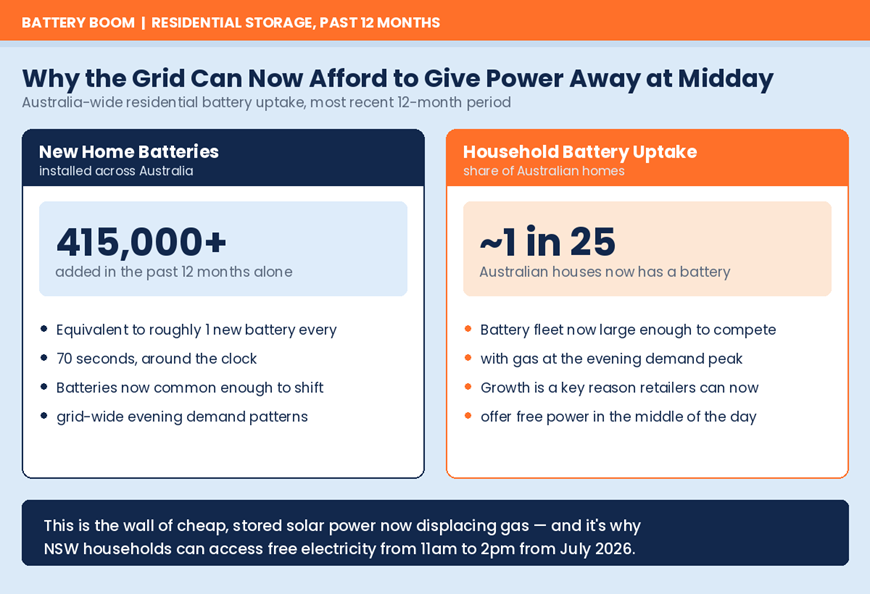
Two stat cards showing 415,000+ new home batteries added in the past 12 months and roughly 1 in 25 Australian homes now having a battery

More than 415,000 residential batteries were added across Australia in the past year alone, or roughly one for every 25 houses in the country. That is a large enough fleet to genuinely change how the grid behaves at 6pm, which is traditionally the most expensive and gas-dependent hour of the day.

Clair Savage, who chairs the Australian Energy Regulator, has pointed to this directly as the reason wholesale prices have flattened out. “Batteries have been displacing more expensive gas and hydro in the evenings, and we’ve just seen flatter prices through the whole day,” she said, adding that the shift has translated into lower forward electricity contract prices. Tennant Reed, climate change and energy director at the Australian Industry Group, made a similar point about the evening peak specifically: “The role of gas used to be in the evening to meet the evening peak and that came at a cost, because gas is not a cheap fuel. But more and more every day, it is batteries that are surging into the market at 6 p.m.”

Why a Battery Changes the Value of the Free Window

Here is the part that matters most for anyone in NSW deciding whether a home battery is worth it in 2026: without a battery, you can only benefit from the Solar Sharer Offer in real time. If nobody is home between 11am and 2pm to run appliances, most of that free power simply goes unused.

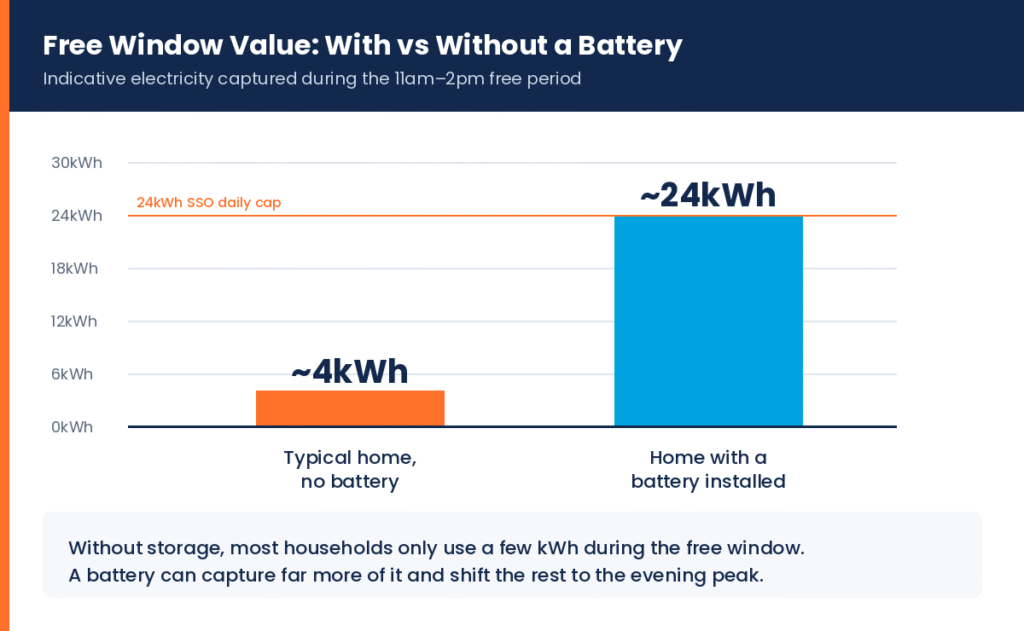
free window, with and without a battery

A household with a correctly sized battery can behave very differently. Instead of relying on someone being home to use appliances in real time, the battery can charge from the grid during the free window, capturing far more of the available 24 kilowatt-hour allowance, and then discharge that stored energy during the evening when electricity would otherwise cost the most. This is exactly the same load-shifting principle that is driving battery uptake at the grid level, just applied to a single household.

These figures are indicative only. Actual free-window capture and evening savings depend on your battery’s capacity, your retailer’s specific Solar Sharer Offer terms, your household’s usage pattern, and your existing tariff, so results will vary from home to home.

An Actionable Framework for NSW Households

Whether you already own a battery or are comparing options for the first time, use this five-step framework to make sure you are actually capturing the value of the free midday window rather than leaving it on the table.

  1. Confirm you have a smart meter. The Solar Sharer Offer requires one, since retailers need interval data to apply the free-power period accurately to your bill.
  2. Opt in through your retailer. The offer is not automatic, even if you are eligible. Contact your electricity retailer directly or compare offers via Energy Made Easy to opt in.
  3. Check your battery’s charge scheduling. Most modern inverters and battery management apps let you set a forced-charge window, so confirm yours is set to draw from the grid, not just solar, between 11am and 2pm.
  4. Size your evening discharge around real usage. Look at 30 days of your evening consumption data, typically 5pm to 9pm, and check your battery’s usable capacity can realistically cover it after a midday charge.
  5. Review your tariff structure annually. As more states introduce free-window offers and time-of-use pricing evolves, the most cost-effective charge-and-discharge pattern for your household may shift year to year.
A note on choosing an installer
Getting the charge-scheduling and battery sizing right is where a qualified installer earns their fee. As a solar battery installation company working across Liverpool, Bankstown, and Mudgee, we configure new systems to target the Solar Sharer Offer window as standard, and we can also reprogram an existing battery’s charge schedule during a routine service visit.

Choosing the Right Battery for a Free-Window Strategy

Not every battery on the market is well suited to this new charge-midday, discharge-evening pattern. A battery that is too small will fill up quickly during the free window and have little left to offer for a full evening peak, while an oversized battery may add cost without meaningfully improving your outcome if your evening usage is modest.

If you are comparing the best solar batteries in Australia for this specific use case, prioritise usable capacity in the 10 to 13 kilowatt-hour range for an average NSW household, confirm the inverter supports scheduled grid-charging (not just solar-charging), and check the manufacturer’s cycle life, since a free-window strategy means more frequent daily cycling than a solar-only setup.

If you are in South West Sydney, a local solar battery Bankstown installer can walk through your actual smart meter data with you, rather than relying on rule-of-thumb sizing, and set the charge schedule up correctly from day one.

Frequently Asked Questions
Do I need solar panels to get the Solar Sharer Offer?

No. The Solar Sharer Offer is available to households with or without rooftop solar, and to renters as well as homeowners. You need a smart meter and must opt in through your electricity retailer.

Does the Solar Sharer Offer make home batteries unnecessary?

No. The free window only benefits you in real time unless you can shift usage into it. A battery lets you capture power during the free hours and use it later in the evening peak, which is when electricity is normally most expensive.

Is the Solar Sharer Offer available everywhere in NSW?

It is available across NSW as one of the Default Market Offer areas, alongside South East Queensland and South Australia. Other states and territories are expected to introduce similar offers from 2027, subject to further government decisions.

Will my whole electricity bill be free during the Solar Sharer window?

No. Only electricity used within the three-hour window, up to the 24 kilowatt-hour cap, is free. You still pay for electricity used outside that window and your daily supply charge.

Disclaimer

This article is general information only and does not constitute financial or energy market advice. Details of the Solar Sharer Offer, including free power windows, usage caps, and eligible regions, are based on Australian government and Australian Energy Regulator information available as of July 2026 and may change. Savings and consumption figures referencing third-party sources (including CleanTechnica and The Cool Down) are indicative estimates, not guaranteed outcomes, and actual results depend on your retailer’s terms, battery specifications, and household usage. Always seek personalised advice before making a purchasing decision.

Want Your Battery Set Up for the Free Window?
We help NSW households across Liverpool, Bankstown, and Mudgee choose, size, and correctly schedule a solar battery to make the most of the Solar Sharer Offer, whether you’re installing a new system or reconfiguring an existing one. Call us: 1800 000 777, or visit solarbatteryoutlet.com.au for a free assessment of your usage patterns and battery options.

If you live in a house in NSW, adding a solar battery is now a fairly well-worn path: get quotes, check your usage, claim the rebate, and get it installed. If you live in an apartment, the path has looked very different—until recently, it barely existed at all.

That is changing quickly. The NSW Solar for Apartment Residents (SoAR) grant now supports apartment buildings. New state battery rebate categories also support shared systems. Strata law reforms make sustainability upgrades easier to approve. Together, these changes give apartments and strata buildings across Sydney and regional NSW a realistic path to shared solar battery storage.

This guide walks through exactly what has changed, what a shared battery system actually looks like in an apartment building, what it costs, and the framework your strata committee can use to move from “we should look into this” to an approved, installed system.

Why Apartment Batteries Were Stuck Until Now

For years, manufacturers designed home batteries around a single meter and a single roof. This model works for detached houses but not for buildings with dozens of separate electricity accounts sharing one roof. Strata schemes also had to navigate common property rules, and many buildings required unanimous or 75% owner approval before owners could install shared solar, let alone a battery.

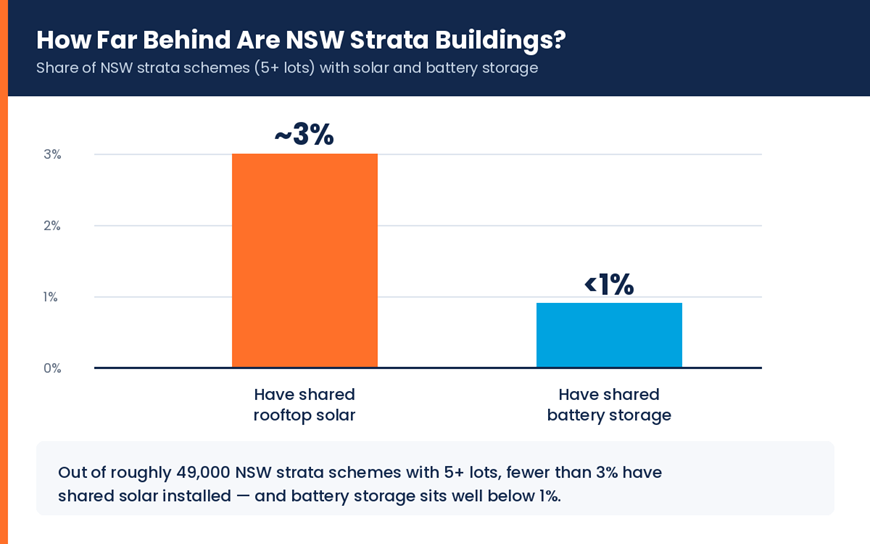
The numbers show how far apartments have fallen behind. Solar Choice researched approximately 49,000 NSW strata schemes with five or more lots. Fewer than 3% have shared rooftop solar installed. Battery storage penetration remains below 1%.

Jeff Sykes is Solar Choice’s CEO. He describes strata buildings as one of Australia’s last untapped frontiers for rooftop solar. He says the barriers have never been technical. Instead, they involve ownership, decision-making, and fair benefit-sharing among residents.

3% of NSW strata schemes have shared solar and under 1% have shared battery storage

Three things have shifted that picture in 2026: government funding aimed specifically at strata buildings, a battery rebate category built for shared systems, and a lower voting threshold that makes approval realistic.

What’s Actually Changed for NSW Strata in 2026

1. The Solar for Apartment Residents (SoAR) grant

The NSW Government’s Solar for Apartment Residents grant funds up to 50% of the cost of a shared rooftop solar system, capped at $150,000 per building. It is open to owners corporations and strata managing agents rather than individual lot owners, and applications must be authorised by a sustainability infrastructure resolution passed at a general meeting.

2. A battery rebate built for shared systems

Previously, the federal Cheaper Home Batteries Program assumed one battery per household — which effectively locked apartments out. From September 2026, the NSW Peak Demand Reduction Scheme introduced a new category that allows an entire apartment building to share one large battery, with certificates calculated per apartment up to a 5 kWh cap per dwelling. This can stack on top of the federal rebate, meaningfully improving the payback case for a building-wide system rather than requiring each resident to install their own.

3. Strata voting reform

Getting 75% of owners to agree on anything is difficult. Recent NSW reforms dropped the threshold for sustainability infrastructure proposals — including solar and battery installations on common property — to a simple 50% majority of those voting, and strata committees can no longer block rooftop solar purely based on how it looks, except in heritage-listed buildings. This single change has removed the biggest practical obstacle for many committees.

How a Shared Apartment Battery Actually Works

Unlike a single-home installation, an apartment battery system needs a way to distribute stored solar energy fairly across multiple electricity accounts. There are a few established approaches used across NSW buildings today:

  • Solar-sharing hardware: technology such as Allume’s SolShare allows one rooftop solar array, paired with a shared battery, to distribute stored energy across up to 30 apartments through the existing switchboard, with each resident metered individually.
  • Embedded networks: the building operates its own private electricity network, purchasing bulk power and reselling it to residents, which can include a shared battery as part of the network’s supply.
  • Common-property battery: a battery sized to offset shared services like lifts, lighting, and car park power, funded and owned via the owners corporation rather than distributed to individual lots.

Mio Dart, Head of Operations at Allume Energy, said the company designed its newest hardware generation specifically to close this gap for residents. Dart explained that the company redesigned SolShare 2 with batteries in mind, allowing apartment residents to access battery storage in ways that were previously unavailable. The technology now enables multi-unit buildings to share both solar power and battery storage, rather than relying solely on solar sharing.

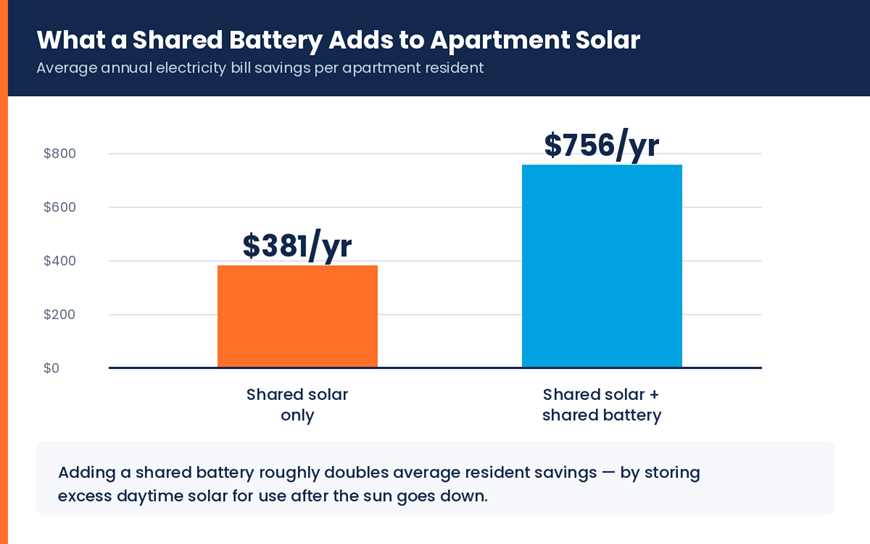
$381 average annual savings from shared solar only to $756 with shared solar plus battery storage

Allume’s own performance data illustrates the difference storage makes: shared solar alone has delivered average annual savings of around $381 per resident, while pairing that solar with a shared battery has lifted average savings to around $756 per year in early deployments. These figures depend heavily on building consumption, solar output, battery size, and each resident’s electricity tariff, so actual results vary from one strata scheme to another.

What It Costs — and the Actionable Framework for Your Strata Committee

A shared battery system for an apartment building is a bigger project than a single home installation, and the cost depends heavily on building size, battery capacity, and whether solar already exists on the roof. As a working framework, strata committees weighing this up should work through five steps in order:

  1. Check your existing solar. If your building already has rooftop solar under a previous SoAR-funded project, a shared battery add-on is usually far more cost-effective than starting from scratch.
  2. Get an energy usage assessment. A reputable installer should review 12 months of common-area and, where available, individual unit consumption before recommending a battery size — not just quote off the roof area.
  3. Compare at least two quotes from SAA- and NETCC-accredited installers, as SoAR applications require, and confirm that both the federal Cheaper Home Batteries rebate and the NSW PDRS shared-battery category appear as dollar deductions on the written quotes.
  4. Pass a sustainability infrastructure resolution at a general meeting. Under the current rules this needs only a 50% majority of those voting, with no quorum requirement.
  5. Confirm the benefit-sharing model in writing before signing so every lot owner understands how the body corporate will distribute the savings—whether proportionately to unit entitlements, through individual metering via solar-sharing hardware, or as deductions from body corporate levies.

Choosing the Right Approach for Your Building

Not every strata scheme needs the same solution. A smaller block of 6–10 units with a straightforward switchboard may suit a solar-sharing hardware approach with a moderate shared battery, while a larger complex running lifts, shared lighting, and basement car parking may get more value from a common-property battery sized around those services. Buildings already on an embedded network have a third option again, since the battery can sit inside the network’s existing billing structure.

This is also where it pays to talk to a team that has done the comparison work already. Whether you’re weighing up the best solar batteries in Australia for a single dwelling or scoping a shared system for a 40-lot strata scheme, the right battery size and configuration should always follow an honest look at usage data — not the other way around.

If your building is in South West Sydney, a solar battery installer working across Bankstown and neighbouring suburbs can visit the site, review the switchboard capacity, and map out which of the three approaches above suits your roof, your metering setup, and your owners corporation’s appetite for the project.

Frequently Asked Questions

Can individual apartment owners apply for the NSW battery rebate themselves?

No. For shared building systems, the application must come through the owners’ corporation or an authorised strata managing agent — individual lot owners cannot apply for the SoAR grant or the shared-battery PDRS category on their own. Raising it at the next strata meeting is the correct first step, not calling an installer directly.

Does my building need existing solar before we can add a shared battery?

No, but it helps the economy. A building with no existing solar can still apply for a combined solar-plus-battery project, though buildings that already have SoAR-funded solar typically see a faster payback when adding storage, since the panels are already paying for themselves.

How is the savings from a shared battery divided between residents?

This depends on the system. Solar-sharing hardware like SolShare meters and credits each apartment individually. A common-property battery offsetting shared services typically reduces the whole building’s electricity costs, thereby lowering strata levies in proportion to unit entitlements rather than crediting individual units directly.

What size battery does a typical apartment building need?

There is no single answer — the number of lots, existing solar capacity, and the amount of power residents use after solar generation stops each day determine the required battery size. Under the NSW shared-battery rebate category, the scheme caps certificates at 5 kWh per apartment, providing a rough starting point. However, property owners should review 12 months of usage data before committing to a system to determine the appropriate size.

Disclaimer

This article is general information only and does not constitute financial, legal, or strata governance advice. Rebate amounts, eligibility criteria, and voting thresholds referenced above are based on NSW Government and industry information available as of July 2026 and are subject to change without notice. Strata committees should obtain independent advice specific to their scheme, by-laws, and building configuration before passing any resolution or entering a contract. Savings figures cited from third-party sources (including Allume Energy and Solar Choice) are averages based on specific deployments and are not guaranteed outcomes for every building. Always seek personalised advice before making a purchasing decision.

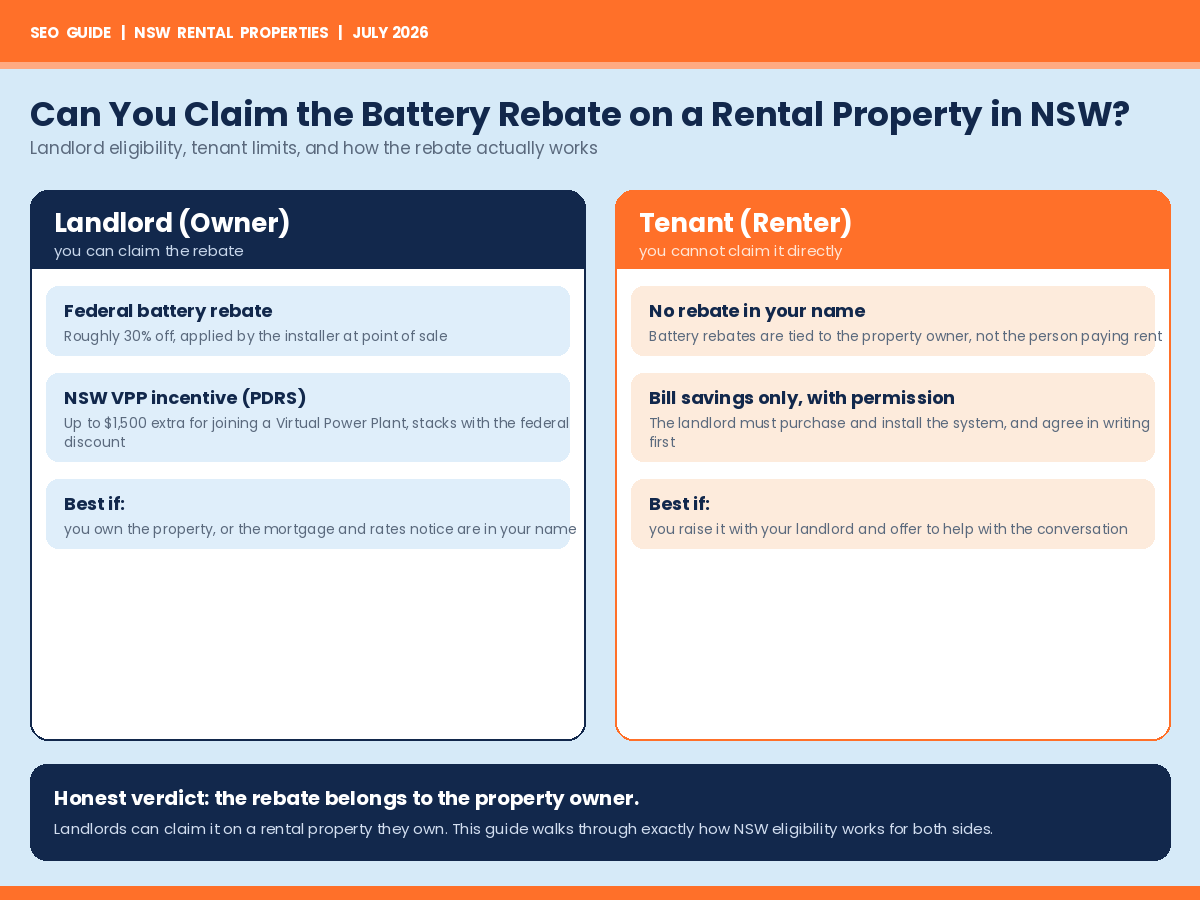
If you own a rental property in NSW, you are probably wondering whether the battery rebate on a rental property in NSW is even worth chasing, or whether it only applies to owner-occupiers. The short answer is that the rebate belongs to whoever owns and pays for the battery, not to whoever pays the electricity bill. That means landlords are eligible. Tenants, on their own, are not.

This guide walks through exactly who can claim, what it is worth on a typical rental in 2026, and how to avoid the mistakes that get landlord applications knocked back.

Quick Answer: Who Actually Owns the Rebate

Yes, landlords can claim the solar battery installation rebate on a rental property they own in NSW. Eligibility for both the federal Cheaper Home Batteries Program and NSW’s own incentives is tied to property ownership and to whoever purchases the system, not to who lives there or pays the power bill. A tenant cannot apply for the rebate in their own name, even if they are the one covering the electricity account.

There is a practical nuance worth flagging early. Renters can sometimes access the savings indirectly, but only with the landlord’s written agreement, because the landlord is the one signing the contract with the installer and the one whose name goes on the compliance paperwork.

The Federal Cheaper Home Batteries Program on a Rental Property

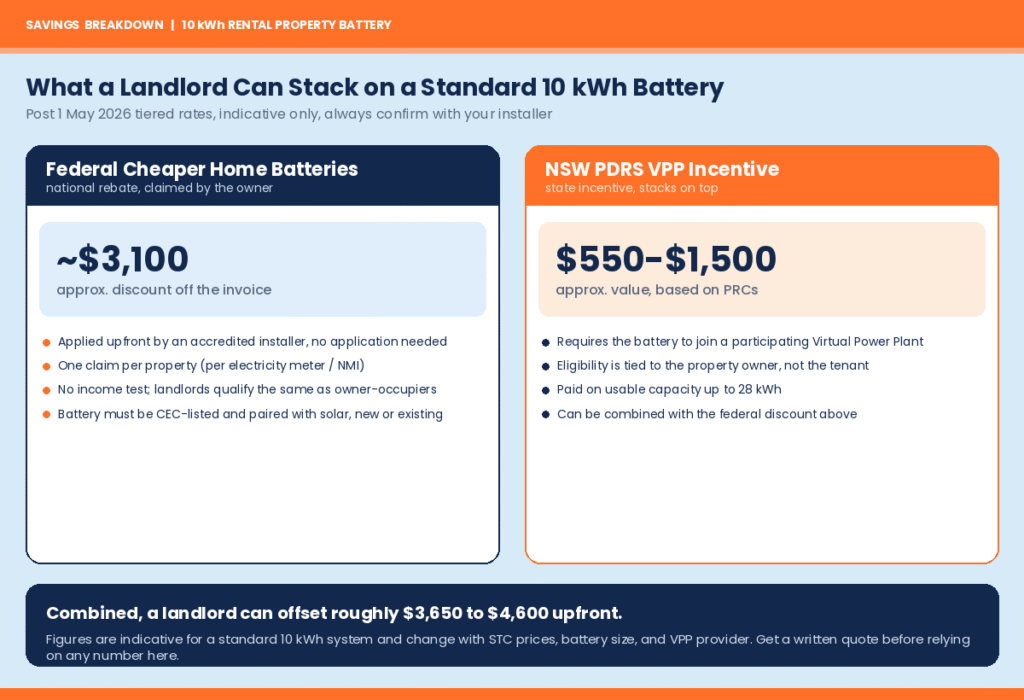
The national scheme, run through the Small-scale Renewable Energy Scheme, gives an upfront discount worth roughly 30% of the installed cost. There is no income test, and landlords qualify on exactly the same terms as a homeowner living in the property. Investors with several rental properties can even claim once per address, provided each property has its own electricity meter, or NMI.

A few conditions apply specifically to rental situations:

  • The person who purchases the system, generally the landlord, is the one who benefits from the discount, since the invoice and compliance certificate are issued in their name.
  • The battery must be new, listed on the Clean Energy Council’s approved product list, and installed by an installer accredited by Solar Accreditation Australia.
  • Grid-connected systems must be capable of joining a Virtual Power Plant, though actually joining one is optional for the federal rebate.
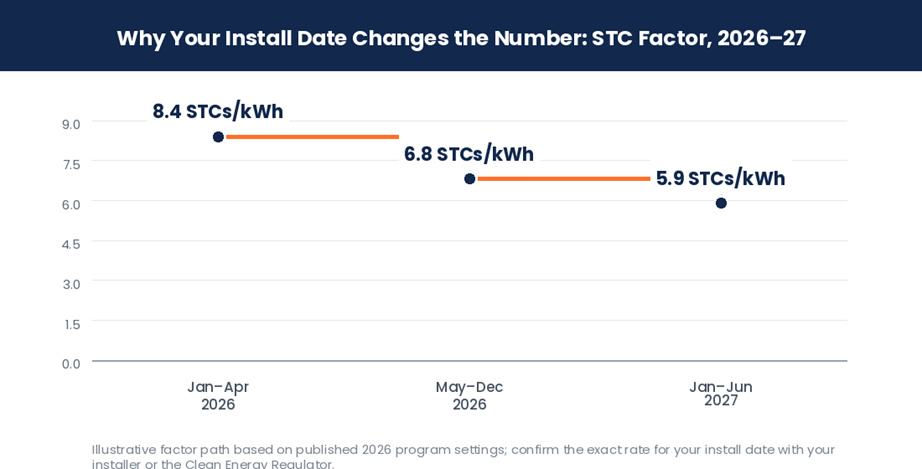
  • From 1 May 2026, the rebate is tiered: the full rate applies to the first 14 kWh of usable capacity, a reduced rate to the next 14 kWh, and a much smaller rate above that, up to a 50 kWh cap.

On a standard 10 to 13 kWh system, most rental properties still sit comfortably in the full-rate tier, so the reduction from May mostly affects larger commercial-style installs rather than typical suburban homes.

NSW State Incentives: PDRS VPP Incentive and the Home Energy Saver Program

On top of the federal discount, NSW runs the Peak Demand Reduction Scheme, which pays a one-off incentive worth roughly $550 to $1,500 for connecting an eligible battery to a Virtual Power Plant. As with the federal rebate, eligibility sits with the property owner. If a tenant wants their landlord’s battery connected to a VPP, the landlord still needs to be the one signing the VPP agreement.

NSW also launched the Home Energy Saver Program on 17 June 2026, offering zero-interest loans of up to $15,000 for eligible upgrades, including batteries. Importantly, this loan is open to landlords as well as owner-occupiers, which is unusual compared to some earlier state schemes that excluded investment properties entirely. A separate discount for lower-income households is expected to open later in 2026, and renters will be able to access that discount stream only with written landlord permission.

Can a Renter Claim Anything Themselves?

Not directly. Every current NSW and federal program requires the applicant to be the property owner or the person who purchased the system. A renter cannot lodge a claim in their own name, even for a battery they are paying to run.

Emerging policy has made battery ownership more interesting. Advocacy groups want renters and apartment residents to install plug-in balcony batteries without landlord approval. They support reforms similar to those already underway in parts of Europe. NSW has not finalized this framework yet. Renters should discuss battery installation with their landlord instead of applying independently.

Why It Is Worth Raising With Your Landlord Anyway

More than 30% of Australian households currently rent, according to analysis referenced in recent reporting on solar standards for rentals, and that share keeps growing. Yet very few rental properties carry solar or battery storage, largely because of what economists call the split incentive: the landlord pays the upfront cost, while the tenant captures the ongoing bill savings.

Uptake nationally is still accelerating despite that gap. As of early June 2026, the federal government reported more than 420,000 Cheaper Home Batteries installed, representing over 12 gigawatt-hours of usable storage capacity, according to independent coverage of the official announcement. Landlords who act now are still installing well ahead of the curve compared to the broader rental market.

Finn Peacock, a Chartered Electrical Engineer and founder of SolarQuotes.com.au, has pointed out that tenants are often willing to pay more rent for a solar-equipped property, citing research commissioned by Origin Energy in which roughly two-thirds of renters said they would pay at least $5 more a week for a home with solar, and over half said they would pay $10 or more. Actual market data cited in the same piece put the real average premium at around $19 a week for solar-equipped rentals.

Solar advocacy group Solar Citizens has separately described renters as one of the groups missing out most on rooftop solar and storage savings, and has called for a national target for solar uptake across rental housing. For a landlord, the combination of federal and state incentives, a rental premium tenants appear willing to pay, and a stronger sale price down the track makes the split incentive far less of a barrier than it used to be.

Step-by-Step: How a NSW Landlord Claims the Rebate

  • Confirm ownership documents. You will need a recent rates notice or title document showing you as the registered owner of the rental property.
  • Get at least two quotes from a Clean Energy Council-accredited solar battery installation company, including one in your local area, whether that is Liverpool, Parramatta, or regional NSW.
  • Confirm the battery model appears on the CEC approved products list before signing anything.
  • Ask your installer to apply the federal Small-scale Technology Certificate discount directly off the invoice, so you never have to claim it separately.
  • Ask whether the system will be VPP-capable, and separately, whether you want to opt into a VPP for the additional NSW PDRS payment.
  • Keep the electrical compliance certificate on file. This is the document that confirms the system was installed and triggers the rebate.
  • If your tenant is covering electricity costs, consider a short written note confirming who benefits from any bill savings, to avoid disputes later.

Common Mistakes That Get Rental Claims Rejected

A handful of avoidable errors account for most rejected or delayed rental property claims:

  • Applying with a tenant’s name on any part of the paperwork instead of the owner’s.
  • Using a second-hand or relocated battery, which is not eligible under the federal program.
  • Skipping the CEC approved products list check, only to find out after installation that the specific model is not eligible.
  • Assuming the rebate applies automatically. It only applies once an accredited installer completes the paperwork and issues a compliance certificate.
  • Not checking whether the property already has a NMI-linked rebate claim from a previous owner or installation at that address.

Choosing the Right Installer for a Rental Property

Because the rebate, the VPP agreement, and the compliance certificate all run through your installer, the choice of solar battery installation company matters more on a rental than on an owner-occupied home. Look for CEC accreditation, a track record with investment properties specifically, and clear documentation you can hand to your property manager. Independent comparisons of the best solar batteries in Australia is a useful starting point before you request quotes, since battery choice affects both your rebate tier and your long-term running costs.

Frequently Asked Questions

Can a landlord claim the battery rebate on an investment property in NSW?

Yes. Landlords are eligible for the same federal and state battery incentives as owner-occupiers, provided they purchase and install the system and meet the standard eligibility criteria.

Can a tenant apply for the battery rebate themselves?

No. Every current program requires that the applicant be the property owner or the purchaser of the system. A tenant would need the landlord’s agreement and involvement to access any rebate.

Does the NSW battery rebate apply to strata or apartment rentals?

The owners’ corporation or strata manager generally claims shared battery systems in apartment buildings, not an individual tenant or unit owner acting alone.

How much can a landlord save on a typical rental battery installation?

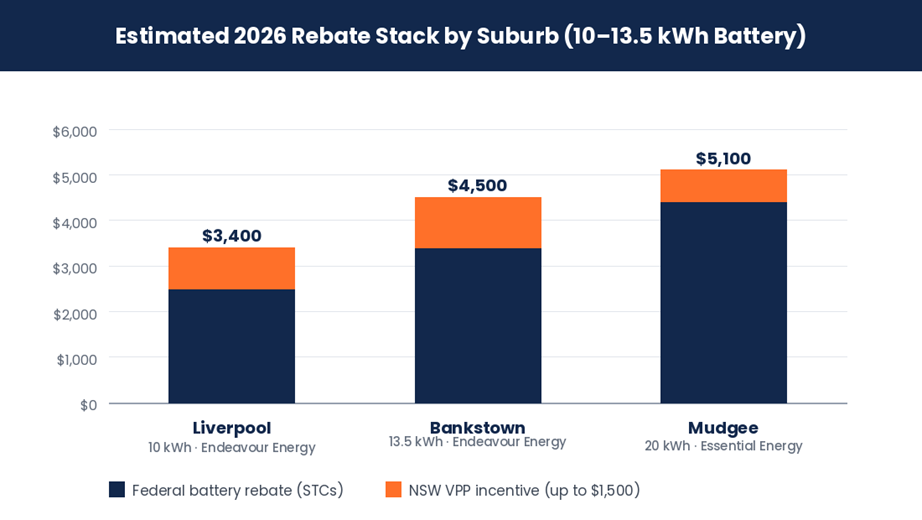
On a standard 10 kWh system, the federal discount is typically worth around $3,100, with a further $550 to $1,500 available through the NSW PDRS incentive if the battery joins a Virtual Power Plant.

Does installing a battery increase what a landlord can charge in rent?

There is no guaranteed rent increase, but research cited by industry sources suggests many tenants are willing to pay a premium for a solar and battery-equipped rental, and the improvement can lift the property’s resale value over time.

Ready to Check Your Rental Property’s Eligibility?

Solar Battery Outlet works with landlords across NSW to confirm eligibility, compare CEC-approved battery options, and handle the paperwork for both the federal rebate and the NSW PDRS incentive. Get in touch for a free, no-obligation quote and find out exactly what your rental property qualifies for before the next rebate step-down.

Disclaimer

This article provides general information about NSW and federal battery rebate eligibility as at the date of publication and is not personal financial, legal, or tax advice. Rebate values, eligibility rules, and program funding change regularly and may differ by installer, battery size, and VPP provider. Landlords and tenants should confirm current eligibility and figures directly with Solar Battery Outlet or an accredited installer before making a purchasing decision.

php