Every solar battery wears out eventually. That is normal, not a fault. But most homeowners install a battery and never ask what happens next.

This guide explains exactly that. You will learn how long a home battery lasts and the warning signs of decline. You will also learn your realistic options once it stops performing well. We also cover how battery recycling works in Australia. As a result, you can plan ahead instead of being caught off guard in ten years’ time.

How Long Does a Home Solar Battery Actually Last?

Most residential batteries installed in Australia today use lithium iron phosphate (LFP) cells. This chemistry is stable, and it generally outlasts older lithium-ion types.

In practice, a home battery typically performs well for 10 to 15 years. That is usually somewhere between 6,000 and 10,000 full charge cycles, whichever limit arrives first.

Manufacturers back this with a warranty, usually running for 10 years. However, a warranty does not promise perfect performance forever. Instead, it guarantees a minimum capacity by a set date. Most brands guarantee at least 70% of original capacity at the 10-year mark. Some premium brands go further, promising 80% capacity or offering 12 to 15-year cover.

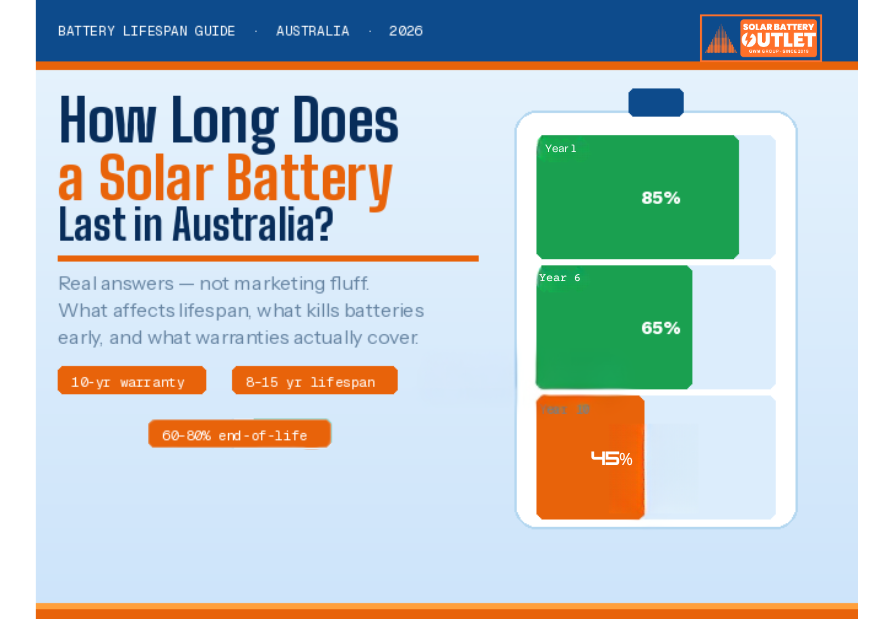
That gap between “still working” and “still under warranty” matters. A battery often keeps charging well past its warranty period. Even so, it stores slightly less energy every year. The chart below shows a typical LFP degradation curve against a common 10-year warranty floor.
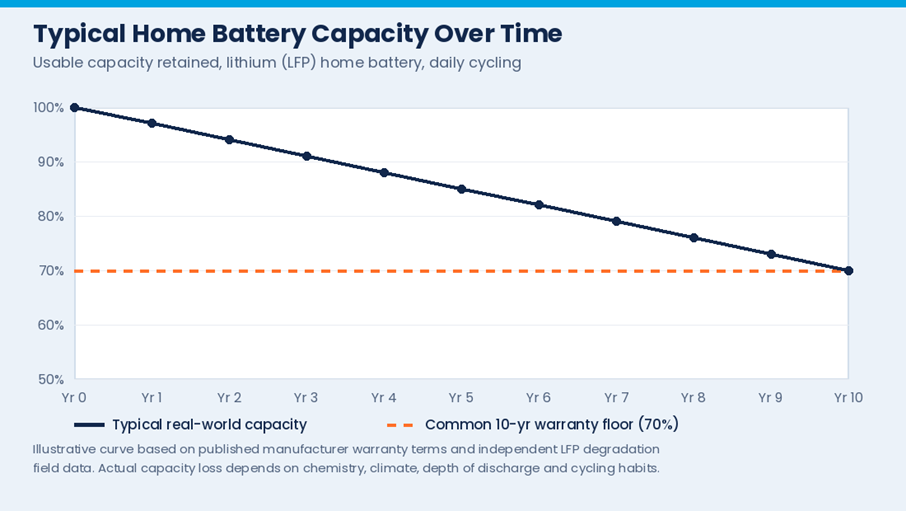
typical home battery capacity retention over 10 years compared with a common warranty floor

Understanding this curve helps you plan a realistic replacement timeline, rather than guessing.

Signs Your Solar Battery Is Nearing End of Life

A battery rarely fails without warning. Instead, it usually shows gradual signs first:

  • Shorter backup time — it empties faster than before, even with the same usage.
  • Slower charging — it takes longer to reach full charge from solar.
  • App or portal alerts — many systems flag reduced capacity or cell imbalance automatically.
  • Physical changes — swelling, unusual heat, or a burning smell.
  • Frequent inverter errors — an ageing battery management system throws more fault codes.

If you notice any physical warning sign, switch the battery off immediately. Then call your installer or the manufacturer straight away. This is a safety matter, not routine ageing.

For the more common gradual signs, check your battery’s app first. Most systems display remaining capacity as a percentage of the original rating. A steady decline is expected. A sudden drop, however, usually points to a fault worth investigating sooner rather than later.

What Actually Happens Inside the Battery as It Ages

Lithium batteries degrade through normal chemistry, not sudden breakdown. Every charge and discharge cycle causes tiny, permanent changes inside the cells. Heat, deep discharges, and constant full charging all speed this process up slightly.

This is why installers usually recommend keeping a battery between roughly 20% and 90% charge day-to-day, where practical. It also explains why batteries in a shaded, cool spot often outlast those on a hot garage wall.

None of this means your battery will suddenly stop working. Degradation is gradual and predictable, not a cliff edge. Most homeowners simply notice a slightly shorter evening of coverage each year, long before real replacement is needed.

Your Options When a Battery Reaches End of Life

Once a battery drops to a genuinely unhelpful capacity, you generally have three paths forward.
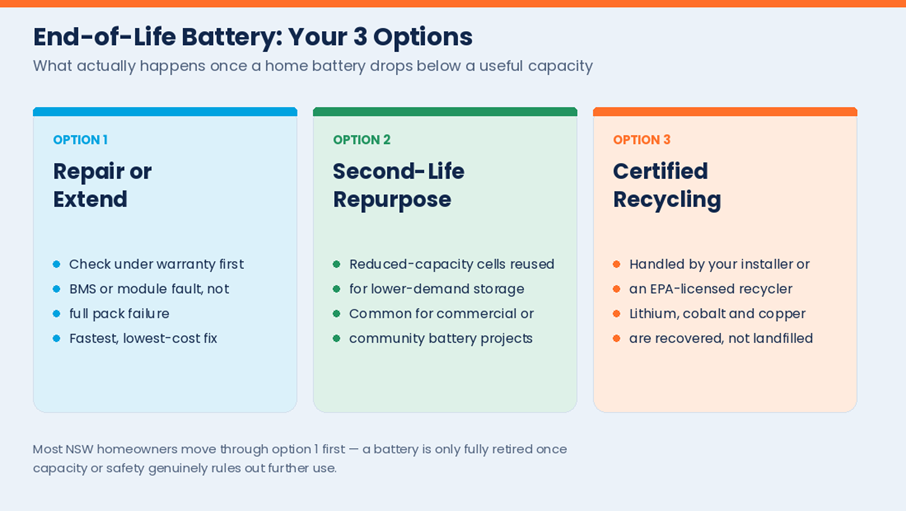
Three options for an end-of-life solar battery: repair or extend, second-life repurpose, or certified recycling

First, repair or extend. If the fault sits in the battery management system or a single module, a repair can restore normal performance. This is always worth checking, particularly while the battery remains under warranty.

Second, second-life repurposing. A battery that no longer suits daily home cycling can sometimes serve a lower-demand role, such as backup-only storage. Several Australian projects are already trialling repurposed cells for community and commercial storage.

Third, certified recycling. When a battery is genuinely finished, recycling recovers valuable materials such as lithium, cobalt, and copper for reuse. This is the appropriate option once a battery is damaged, unsafe, or beyond a useful capacity.

A trustworthy installer will walk you through all three options honestly. It will not jump straight to a full replacement quote.

How Solar Battery Recycling Works in Australia

Home battery recycling differs from recycling everyday household batteries. B-cycle, Australia’s national battery stewardship scheme, handles small batteries from remotes, torches, and power tools. However, B-cycle drop-off points do not accept home energy storage batteries. These units are too large, and they need specialist handling.

Instead, a home battery should go back through your installer, the manufacturer’s take-back program, or a licensed lithium battery recycler. These facilities are accredited to safely dismantle and process large lithium batteries.

Never place a home battery in general waste or a household recycling bin. Damaged or swollen lithium cells are a genuine fire risk. They must be stored and transported under strict safety guidelines.

The good news is that lithium batteries are highly recyclable. Materials such as lithium, cobalt, nickel, and copper can be recovered and reused in new batteries. This reduces the need for fresh mining. Government-backed programs continue expanding accredited recycling pathways as more home batteries reach end of life. For more detail on what the scheme accepts, see the Australian Government’s overview of household battery recycling.

What This Means for Your Warranty and Rebate Paperwork

Keep your original battery documentation. This includes the installation certificate, warranty terms, and any rebate paperwork from schemes such as the federal battery rebate. If your battery develops a fault within its warranty period, this paperwork speeds up any claim considerably.

It also matters when you sell your home. Buyers and conveyancers increasingly ask about remaining battery warranty and expected lifespan, much like they ask about solar panel age. Keeping records organised now saves confusion later.

Planning Ahead: Budgeting for Battery Replacement

A solar battery is a long-term asset, not a one-off purchase. Consequently, it is worth budgeting for eventual replacement, much like a hot water system or roof.

Battery prices and technology continue to shift quickly. Our guide on solar batteries in Australia in 2026 and why this is a turning point covers those trends.

Setting aside a small amount each year, or reviewing your battery’s health annually, avoids financial surprises later. A well-maintained battery usually serves its full warranty period comfortably, and often longer.

Talk to a Trusted Solar Battery Company Before You Decide

If your battery is showing signs of ageing, do not guess. A qualified solar battery company can test its actual remaining capacity, check warranty status, and explain your realistic options honestly.

We are a Liverpool-based solar battery installer, part of GWM Group, servicing homes across Liverpool, Bankstown, and Mudgee. Our SAA-accredited team can assess your existing battery, advise on repair versus replacement, and manage recycling paperwork if needed.

Call us on 1800 000 777, or visit solarbatteryoutlet.com.au to book a free, no-obligation battery health check. No pressure, no countdown timers — just honest advice about your system.

Frequently Asked Questions

How long do solar batteries last in Australia?

Most lithium (LFP) home batteries last 10 to 15 years. They are typically backed by a manufacturer warranty of around 10 years, guaranteeing a minimum capacity, often 70%.

Can I put my old solar battery in a B-cycle bin?

No. B-cycle only accepts small household batteries. Home energy storage batteries must go through your installer, the manufacturer, or a licensed lithium battery recycler.

Does a battery warranty cover normal capacity loss?

Yes, up to a point. Warranties guarantee a minimum capacity, commonly 70%, by a set year. Capacity loss above that threshold is expected and is not treated as a defect.

What happens to the materials inside an old solar battery?

Certified recyclers recover lithium, cobalt, nickel, and copper for reuse in new batteries. This reduces landfill risk and lowers demand for new mining.

Should I repair, repurpose, or replace an ageing battery?

It depends on the cause. A faulty module can often be repaired. A battery with reduced but stable capacity may suit second-life use. Full replacement suits batteries that are damaged, unsafe, or below a useful capacity.

Disclaimer

This article provides general information about solar battery lifespan, warranty terms, degradation, and recycling in Australia. It does not constitute financial, legal, or technical advice. Battery lifespan, warranty terms, and capacity retention vary by brand, model, installation conditions, and usage pattern. Figures referenced are illustrative industry benchmarks, not guarantees for any specific product. Always check your own product documentation for exact terms. Recycling requirements and accepted battery types may also vary by state and provider.
Solar Energy | Australia | Updated March 2026

How Long Does a Solar Battery Last in Australia? (Real Answers)

When you spend $8,000-$14,000 on a solar battery, the lifespan question is completely reasonable. You want to know if it will still be doing its job in year 8. Year 10. Maybe beyond.

The honest answer: most quality solar batteries installed in Australia today will last between 10 and 15 years in real-world conditions. The 10-year warranty you see on most brands is not just marketing — it is a legally binding capacity guarantee. But there is a lot of nuance between ‘lasts 10 years’ and ‘performs well for 10 years.’

This guide covers what actually determines how long a battery lasts, what affects performance over time, what your warranty really covers (and what it does not), and the questions to ask before you buy.

Quick answer for busy homeowners: A quality LFP solar battery installed correctly in Australia will typically retain 70-80% of its original capacity after 10 years. That means if you install a 10 kWh battery today, expect it to deliver 7-8 kWh in year 10. Most warranties guarantee at least 60-70% capacity at the end of the warranty period. After that, the battery continues working — just with gradually reduced storage.

The Short Version: Battery Chemistry Is the Starting Point

Almost every quality solar battery sold in Australia in 2026 uses LFP chemistry — Lithium Iron Phosphate. This matters because LFP is fundamentally more stable, safer, and longer-lived than older lithium-ion chemistries.

LFP batteries do not overheat and fail in the same ways older chemistries did. They handle more charge cycles without as much degradation. And they do not carry the same fire risk that made earlier batteries concerning for home installation.

If a salesperson is talking to you about a non-LFP battery for home storage in 2026, ask why. The answer should be very specific.

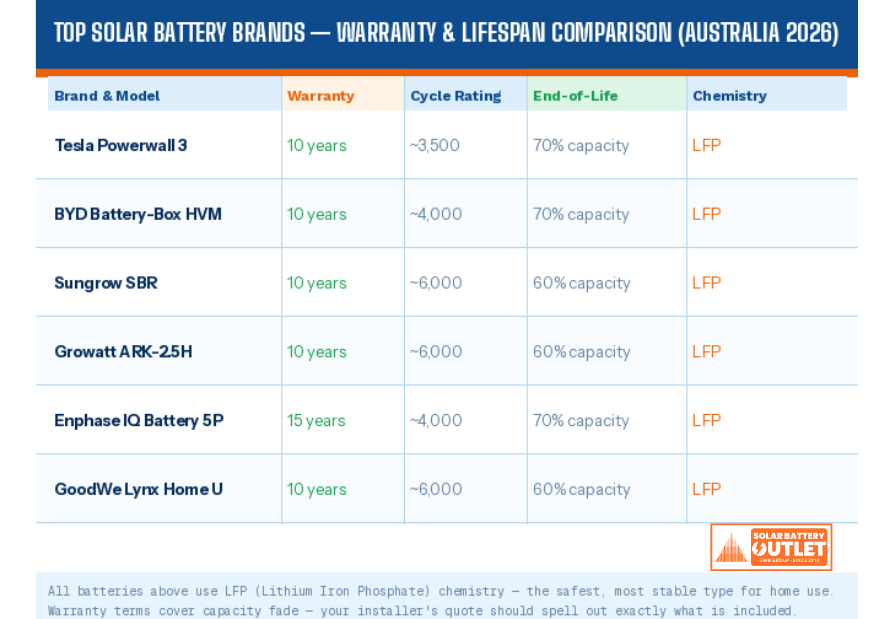
top solar battery brands

What the Numbers Actually Mean

When a battery manufacturer says ‘4,000 cycles at 80% depth of discharge’, here is how to read that:

  • 4,000 cycles means 4,000 full charge/discharge cycles before capacity falls to the warranted threshold
  • One cycle per day = roughly 11 years of daily use before hitting that threshold
  • 80% depth of discharge means they tested by draining 80% of capacity each cycle
  • Real-world usage is typically less aggressive — real-world lifespan is often longer than the cycle rating implies

The Enphase IQ Battery 5P is notable for offering a 15-year warranty — the longest available in Australia right now. That is a genuine differentiator if long-term peace of mind is your priority. The trade-off is higher upfront cost compared to 10-year options.

Six Things That Actually Determine How Long Your Battery Lasts

1. How You Charge It — Partial vs Full Cycles

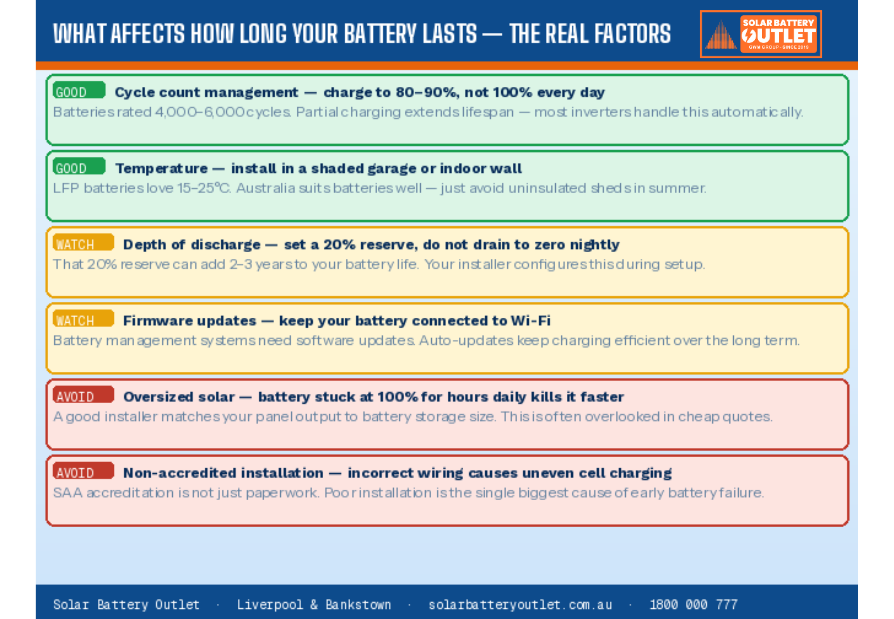
This is the single biggest factor most homeowners do not know about. Charging your battery to 100% every single day and draining it to 0% every night is the fastest way to reduce its lifespan — the battery equivalent of redlining your car engine daily.

Most good inverters have a setting to cap charging at 80-90% and keep a reserve of 10-20% at the bottom. Your installer should configure this during setup. If they do not mention it, ask them to.

Practical tip: Ask your installer what depth of discharge and charge ceiling they recommend for your specific battery and inverter combination. This one conversation could add years to your battery’s life.

2. Temperature — Where You Install It Matters

LFP batteries perform best between 15 and 25 degrees Celsius. Australia’s climate is actually well-suited to battery storage — most of the country stays comfortably within that range for most of the year.

The issue is installation location. A battery bolted to an uninsulated shed wall in Penrith or Bankstown in January, facing west, can hit 45 degrees on a hot afternoon. That repeated heat stress accelerates capacity fade significantly.

  • Best locations: internal garage wall, laundry, shaded external wall under an eave
  • Avoid: uninsulated sheds, west-facing external walls in direct afternoon sun, under roof spaces with no ventilation
  • In QLD and SA especially: ask your installer about thermal management for your specific install location

3. Depth of Discharge — The Reserve Setting

Every battery has a ‘depth of discharge’ setting — how far down it depletes before stopping. Running at 100% depth of discharge every day will measurably shorten lifespan compared to running at 80%.

Most installer setups include a default reserve of 10-20%. That is not dead capacity — that is protection for the battery cells. Think of it like keeping your car fuel above the ‘E’ instead of running it dry every time.

4. Firmware and Software Updates

Solar batteries have battery management systems (BMS) — software that controls how the battery charges, discharges, and protects itself. That software receives updates, just like your phone.

Missing firmware updates can mean your battery is not charging as efficiently as it should, or is not applying the cell-balancing algorithms that protect long-term health. Most brands push updates automatically via your home Wi-Fi. Keep your battery app connected and check occasionally that it is running current firmware.

5. Solar Panel Sizing — Do Not Go Too Big

Counterintuitively, a solar system that is much larger than your battery can shorten the battery’s life. If your panels generate far more than the battery can absorb, the battery reaches 100% early in the day and then sits there for hours — stressing the cells over time.

A well-designed system matches panel output to battery storage capacity. This is something a competent installer considers during system design. If you are retrofitting a battery to an existing large solar system, ask specifically whether the panel output is appropriate for the battery you are choosing.

6. Quality of Installation

Incorrect wiring — including improper cell connections, wrong inverter configuration, or poor earthing — causes uneven charging across battery cells. This accelerates capacity fade and in worse cases causes premature failure.

This is the practical reason SAA (Solar Accreditation Australia) accreditation matters for battery installation. It is not bureaucracy — it is the technical standard that prevents installation errors that shorten lifespan. You can verify any installer’s accreditation at saaustralia.com.au before accepting a quote.

What Your Warranty Actually Covers

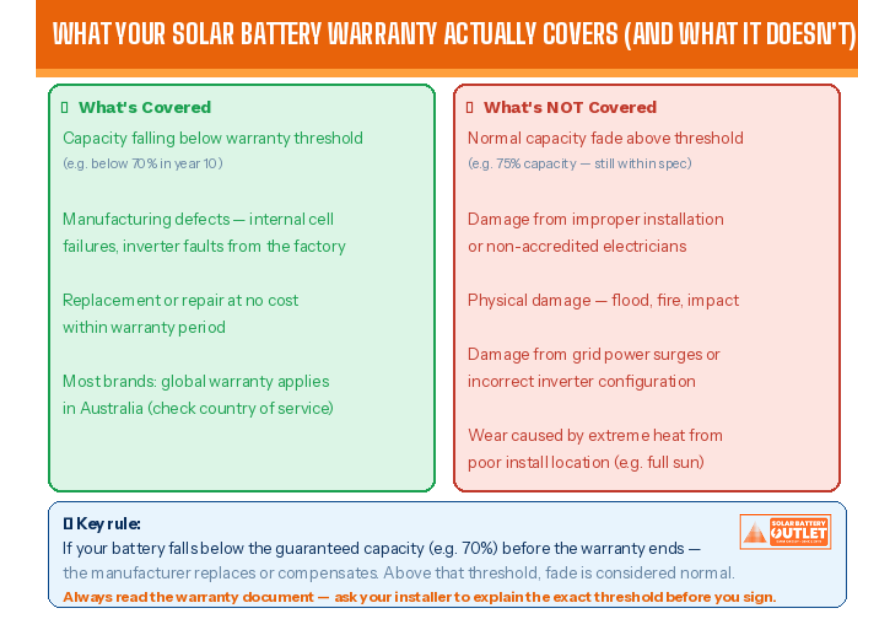
what your solar battery actually coversery warranty

Capacity Warranty vs Product Warranty

Capacity warranty — the more important one — guarantees that your battery will retain a minimum percentage of its original storage capacity for a set number of years. Common thresholds are 60% or 70% of original capacity at the end of year 10.

Product warranty — covers manufacturing defects, component failures, and premature failure. This is standard and typically runs 10 years for most brands.

If your battery falls below the guaranteed capacity threshold before the warranty ends, the manufacturer is obligated to replace it or compensate you. If it stays above that threshold — even at 72% capacity in year 9 — that is within spec and not a warranty claim.

The Question to Ask Before You Sign

Ask: “What is the exact capacity threshold in the warranty, and at what year?”

Some brands warrant 70% at year 10. Others warrant 60% at year 10. A battery that retains 70% of 10 kWh is giving you 7 kWh in year 10. A 60% threshold battery might only deliver 6 kWh. For most households — especially with growing EV use — that difference matters.

What happens after the warranty period? The battery keeps working — it just continues degrading gradually without the manufacturer’s capacity guarantee. Most quality LFP batteries continue functioning well beyond their warranty period. A 10 kWh battery at 65% capacity in year 12 is still delivering 6.5 kWh — still useful, just less than day one.

How to Get the Most Life Out of Your Battery — Practical Tips

  • Ask your installer to configure the charge ceiling at 80-90% and a 10-20% reserve at the bottom
  • Keep your battery monitoring app installed and check firmware update notifications
  • Choose an install location that stays under 35 degrees in summer — shaded garage or indoor wall
  • If your solar system is over 10 kW, confirm with your installer that battery sizing is appropriate
  • Do not skip maintenance checks — most brands recommend a system check at year 5
  • If you notice the battery depleting faster than usual, check the monitoring app for error codes before calling a technician

Frequently Asked Questions

Can I replace the battery cells when they degrade, rather than the whole unit?

For most residential batteries, no — they are sealed units. BYD Battery-Box is modular, meaning you can add capacity or swap modules, but individual cell replacement is not a standard consumer option. When a battery reaches end-of-life, the whole unit is replaced or recycled.

Does the battery still work during a blackout as it gets older?

Yes — backup capability is not directly related to capacity degradation. A battery at 70% capacity still provides blackout protection, just for a shorter duration than when new. If your 10 kWh battery is at 7 kWh capacity in year 10, it will keep your essentials running for about 70% of the time it originally could.

What happens to the battery at the end of its life?

LFP batteries are recyclable. Australia’s battery recycling infrastructure has improved significantly — most installers and manufacturers have take-back or recycling programs. Ask about this when getting quotes. Reputable installers will have a clear answer.

Is a 15-year warranty worth paying extra for?

It depends on your situation. If you are planning to stay in your home for 15+ years and want certainty, the Enphase IQ Battery 5P’s 15-year warranty is a genuine differentiator. If your planning horizon is 10 years, or you expect to upgrade technology at the 10-year mark anyway, the standard 10-year options deliver very strong value.

Do batteries degrade faster in hot climates like Queensland or South Australia?

They can — if the install location is poor. The solution is not to avoid batteries in hot climates; it is to install them correctly. SA homeowners actually have some of the strongest battery economics in the country thanks to high electricity prices, despite the warm climate.

Want a Quote for a Solar Battery in Sydney or South West NSW?
We are based in Liverpool and Bankstown, servicing all of South West Sydney and beyond. Our team will recommend the right battery size for your home and handle all rebate paperwork — federal and NSW VPP incentive.
Call us: 1800 000 777
Or visit: solarbatteryoutlet.com.au
About Solar Battery Outlet We are a Liverpool-based solar battery installer, part of GWM Group Pty Ltd, servicing homes across South West Sydney, Bankstown, Campbelltown, and the greater NSW region. All installations are done by SAA-accredited electricians. We handle all rebate paperwork so you do not have to.
php