LFP vs NMC batteries is one of the most common questions Australian homeowners ask before buying storage. Both are lithium-ion chemistries. However, they differ in lifespan, heat tolerance, size and weight.

Quick answer: lithium iron phosphate (LFP) batteries typically offer a longer cycle life and a wider thermal safety margin. Nickel manganese cobalt (NMC) batteries pack more energy into less space. Because a wall-mounted home battery has no weight limit, many current home batteries use LFP.

What Are LFP and NMC Batteries?

LFP stands for lithium iron phosphate. NMC stands for nickel manganese cobalt. Each name describes the cathode, the part of the cell that stores lithium ions. That single material choice shapes how a battery ages, heats and performs.

LFP cells use iron and phosphate, and they contain no cobalt. NMC cells blend nickel, manganese and cobalt. This blend stores more energy per kilogram.

Both chemistries belong to the lithium-ion family. Both also rely on a battery management system (BMS). The BMS monitors voltage, current and temperature, so each cell stays inside its limits.

Real products show the shift. Tesla’s Powerwall 2 used NMC cells, while the Powerwall 3 uses LFP. Similarly, many current home batteries sold in Australia use LFP. Always confirm the cell chemistry on the product datasheet.

LFP vs NMC Batteries: Key Differences at a Glance

  • Cathode: LFP uses iron phosphate. NMC uses nickel, manganese and cobalt.
  • Energy density: NMC typically stores about 150–250 Wh/kg. LFP typically stores about 90–160 Wh/kg.
  • Cycle life: LFP cells commonly list 3,000–6,000 cycles. NMC cells commonly list 1,000–2,500.
  • Thermal stability: LFP typically reaches its critical self-heating point at a higher temperature.
  • Cost: LFP uses cheaper raw materials, so it often costs less to make.
  • Typical use: LFP suits stationary home storage. NMC suits space-limited or weight-limited products.

The energy density gap explains why many electric vehicles still use NMC. A home battery faces no such weight limit. Therefore, the NMC density advantage matters less on a garage wall.

These figures are typical cell-level ranges. Individual products differ, so check the manufacturer’s datasheet and warranty.

Which Lasts Longer: LFP or NMC Batteries?

Cycle life counts full charge and discharge cycles before capacity drops to a set level. Most published comparisons show LFP lasting longer. LFP cells commonly list 3,000 to 6,000 cycles, while NMC cells commonly list 1,000 to 2,500.

comparing typical cycle life of LFP batteries (3,000–6,000 cycles) and NMC batteries

A home battery typically completes about one cycle a day. In theory, 3,000 cycles equals roughly eight years of daily use, and 6,000 cycles equals roughly 16 years. Real results depend on temperature, usage and settings.

However, your warranty sets the guaranteed terms, not cell-level ranges. Many warranties combine a time limit, such as 10 years, with a throughput limit measured in MWh. Read both limits. Also learn what  battery end of life looks like for your system.

Which Is Safer: LFP or NMC Batteries?

Safety starts with thermal runaway. Thermal runaway is a chain reaction in which an overheating cell heats its neighbours. Laboratory tests consistently show that LFP cells react later and at higher temperatures than NMC cells.

One peer-reviewed study of commercial cells found that LFP cells reacted more slowly and at significantly higher temperatures. In a separate overcharge study, every NMC-type cell caught fire or exploded. The LFP cell only released smoke.

Critical Self-Heating Temperature

These results describe single cells under abuse, not finished home systems. Still, a higher temperature margin can give the BMS more time to respond.

Chemistry alone does not decide safety, though. SolarQuotes founder Finn Peacock stresses that a well-installed battery from a major manufacturer is safe. He also warns about cheap batteries with weak control software and inexperienced installers.

Australian rules reinforce this. Rebate-eligible batteries must meet AS/NZS 5139:2019 and appear on the Clean Energy Council (CEC) approved list. Solar Accreditation Australia (SAA) accredited installers must complete the work. If you search for the best solar battery installer, look for SAA accreditation, not only a low price. Then review the key battery safety features in each quote.

How Do Heat and Cold Affect LFP and NMC Batteries?

Australian summers push battery enclosures hard. Heat speeds up ageing in both chemistries. LFP typically tolerates warm conditions with a wider safety margin, yet it still ages faster when it runs hot.

Therefore, location matters as much as chemistry. Choose a shaded, ventilated spot that follows the manufacturer’s clearances. For more detail, read how heat affects battery performance.

Cold weather poses a different challenge. Lithium-ion cells slow down in low temperatures, and LFP typically shows this more strongly. Frosty winters in places like Mudgee make low-temperature charging limits worth checking. Ask your installer for the manufacturer’s operating temperature range.

Does Battery Chemistry Change Your Rebate?

No. The Cheaper Home Batteries Program does not set a chemistry requirement. Instead, the Clean Energy Regulator ties eligibility to size, standards, CEC approval, virtual power plant (VPP) capability and installer accreditation.

Eligible batteries range from 5 kWh to 100 kWh in nominal capacity. The discount applies to the first 50 kWh of usable capacity. Usable capacity is the energy a household can actually draw from the battery.

The STC factor sits at 6.8 from May to December 2026. It falls to 5.7 on 1 January 2027. In addition, support tapers by size. The first 14 kWh earns the full factor. The next 14 kWh earns 60%, and the final 22 kWh earns 15%.

Your actual discount depends on eligibility, battery size, STC pricing and installation date. Ask your installer how the next step-down affects your quote.

How to Choose Between LFP and NMC Batteries

Use four steps to compare quotes. Start with space and weight, then check your climate. Next, compare warranty terms. Finally, confirm compliance. When you assess any solar battery company, ask for the cell chemistry in writing.

4 Steps to Choose Between LFP and NMC

You can also review popular batteries in Australia to compare current models side by side. For most stationary installs, LFP gives a strong balance of lifespan and thermal margin. NMC still suits tight spaces and existing systems.

FAQs About LFP vs NMC Batteries

Is LFP better than NMC for home batteries?

For most stationary home systems, LFP is the more common choice. It typically offers longer cycle life and a higher thermal margin. NMC still suits tight spaces. Software and installation quality matter too.

Is an LFP battery safer than an NMC battery?

Lab tests show LFP cells typically react later and at higher temperatures. However, no chemistry is risk-free. Safety also depends on the BMS, product approval and installation quality.

How long does an LFP battery last?

LFP cells commonly list 3,000 to 6,000 cycles. With daily cycling, that suggests roughly 8 to 16 years in theory. Your warranty sets the guaranteed terms.

Do NMC batteries still make sense in Australia?

Yes, in some cases. NMC suits space-limited installs, and many NMC systems already operate in Australian homes. Owners do not need to replace a working battery because of its chemistry.

Does the federal battery rebate favour LFP?

No. The program sets no chemistry requirement. It applies to eligible batteries, based on usable capacity and the current STC factor.

How do I find out which chemistry a battery uses?

Check the product datasheet, then ask your installer to confirm the cell chemistry in writing.

Talk to Our Team About LFP vs NMC Batteries

Chemistry is only one part of a good battery decision. As a solar battery company serving Liverpool, Bankstown and Mudgee, we explain the cell chemistry in any quote. We also compare it against your daily usage, roof and site conditions.

Ready to compare options? Contact the Solar Battery Outlet team to discuss a home battery for your property. Whether you are searching for the best solar battery installer or comparing quotes, bring your latest bill.

Disclaimer

This article provides general information about LFP and NMC home battery chemistries. Figures are typical cell-level ranges, and individual products, warranties and test results differ. Laboratory results do not predict how a complete, installed system performs.

Rebate settings, STC factors and eligibility rules change over time, so check the Clean Energy Regulator for current details. This article is not a quote, a guarantee of savings, or electrical or financial advice. Eligibility, pricing and outcomes depend on your property and circumstances.

Always seek personalised advice before making a purchasing decision.
Solar Energy | Australia | Updated March 2026

How Long Does a Solar Battery Last in Australia? (Real Answers)

When you spend $8,000-$14,000 on a solar battery, the lifespan question is completely reasonable. You want to know if it will still be doing its job in year 8. Year 10. Maybe beyond.

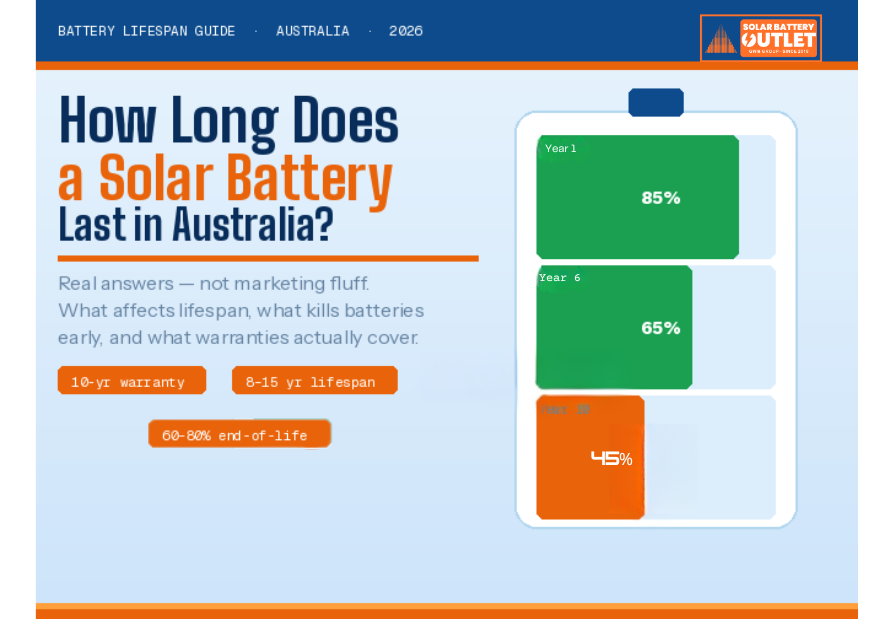
The honest answer: most quality solar batteries installed in Australia today will last between 10 and 15 years in real-world conditions. The 10-year warranty you see on most brands is not just marketing — it is a legally binding capacity guarantee. But there is a lot of nuance between ‘lasts 10 years’ and ‘performs well for 10 years.’

This guide covers what actually determines how long a battery lasts, what affects performance over time, what your warranty really covers (and what it does not), and the questions to ask before you buy.

Quick answer for busy homeowners: A quality LFP solar battery installed correctly in Australia will typically retain 70-80% of its original capacity after 10 years. That means if you install a 10 kWh battery today, expect it to deliver 7-8 kWh in year 10. Most warranties guarantee at least 60-70% capacity at the end of the warranty period. After that, the battery continues working — just with gradually reduced storage.

The Short Version: Battery Chemistry Is the Starting Point

Almost every quality solar battery sold in Australia in 2026 uses LFP chemistry — Lithium Iron Phosphate. This matters because LFP is fundamentally more stable, safer, and longer-lived than older lithium-ion chemistries.

LFP batteries do not overheat and fail in the same ways older chemistries did. They handle more charge cycles without as much degradation. They have a lower fire risk than some older chemistries, though no battery is risk-free.

If a salesperson is talking to you about a non-LFP battery for home storage in 2026, ask why. The answer should be very specific.

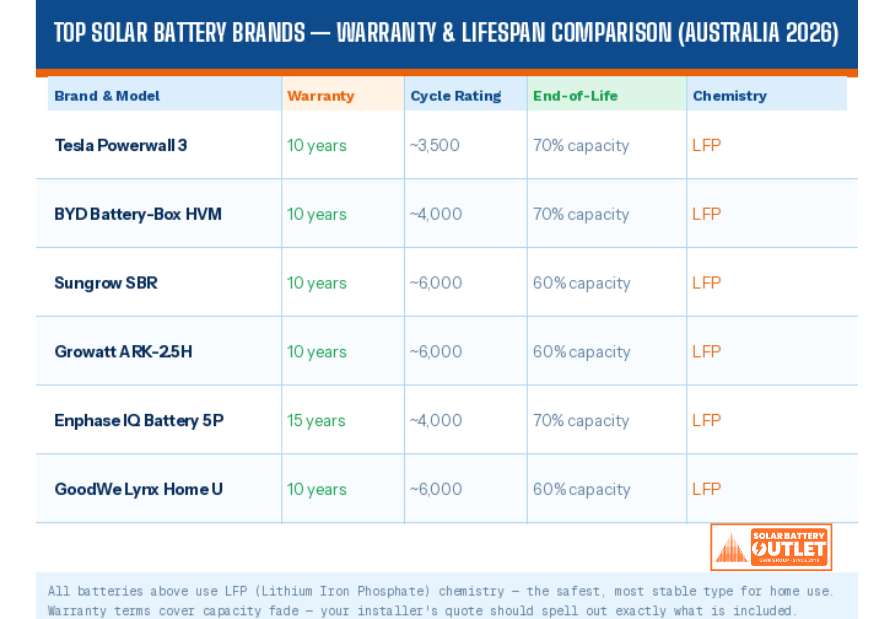
top solar battery brands

What the Numbers Actually Mean

When a battery manufacturer says ‘4,000 cycles at 80% depth of discharge’, here is how to read that:

  • 4,000 cycles means 4,000 full charge/discharge cycles before capacity falls to the warranted threshold
  • One cycle per day = roughly 11 years of daily use before hitting that threshold
  • 80% depth of discharge means they tested by draining 80% of capacity each cycle
  • Real-world usage is typically less aggressive — real-world lifespan is often longer than the cycle rating implies

The Enphase IQ Battery 5P is notable for offering a 15-year warranty — the longest available in Australia right now. That is a genuine differentiator if long-term peace of mind is your priority. The trade-off is higher upfront cost compared to 10-year options.

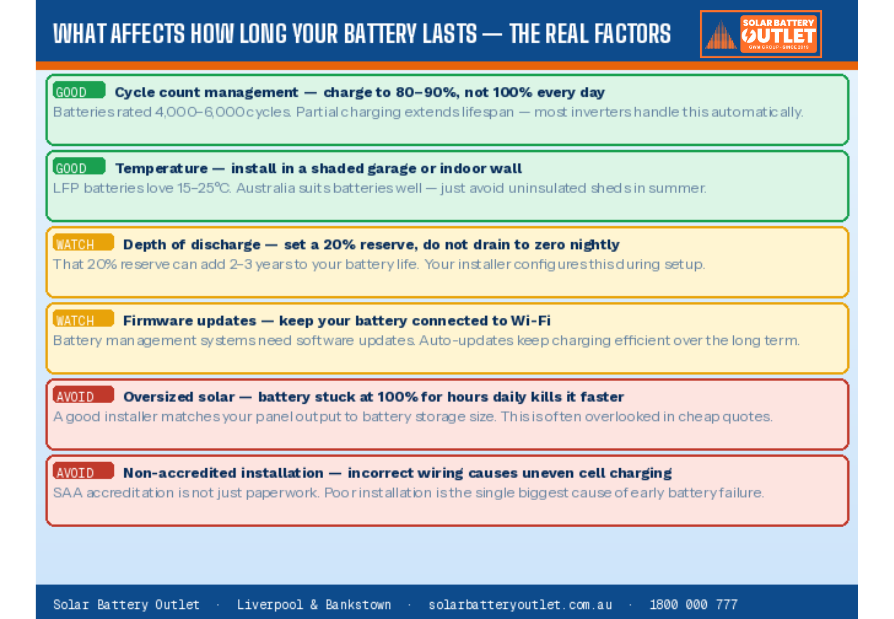
Six Things That Actually Determine How Long Your Battery Lasts

1. How You Charge It — Partial vs Full Cycles

This is the single biggest factor most homeowners do not know about. Charging your battery to 100% every single day and draining it to 0% every night is the fastest way to reduce its lifespan — the battery equivalent of redlining your car engine daily.

Most good inverters have a setting to cap charging at 80-90% and keep a reserve of 10-20% at the bottom. Your installer should configure this during setup. If they do not mention it, ask them to.

Practical tip: Ask your installer what depth of discharge and charge ceiling they recommend for your specific battery and inverter combination. This one conversation could add years to your battery’s life.

2. Temperature — Where You Install It Matters

LFP batteries perform best between 15 and 25 degrees Celsius, but battery location matters more than climate — a shaded, ventilated spot keeps the battery closer to its ideal range.

The issue is installation location. A battery bolted to an uninsulated shed wall in Penrith or Bankstown in January, facing west, can hit 45 degrees on a hot afternoon. That repeated heat stress accelerates capacity fade significantly.

  • Best locations: internal garage wall, laundry, shaded external wall under an eave
  • Avoid: uninsulated sheds, west-facing external walls in direct afternoon sun, under roof spaces with no ventilation
  • In QLD and SA especially: ask your installer about thermal management for your specific install location

3. Depth of Discharge — The Reserve Setting

Every battery has a ‘depth of discharge’ setting — how far down it depletes before stopping. Running at 100% depth of discharge every day will measurably shorten lifespan compared to running at 80%.

Most installer setups include a default reserve of 10-20%. That is not dead capacity — that is protection for the battery cells. Think of it like keeping your car fuel above the ‘E’ instead of running it dry every time.

4. Firmware and Software Updates

Solar batteries have battery management systems (BMS) — software that controls how the battery charges, discharges, and protects itself. That software receives updates, just like your phone.

Missing firmware updates can mean your battery is not charging as efficiently as it should, or is not applying the cell-balancing algorithms that protect long-term health. Most brands push updates automatically via your home Wi-Fi. Keep your battery app connected and check occasionally that it is running current firmware.

5. Solar Panel Sizing — Do Not Go Too Big

Counterintuitively, a solar system that is much larger than your battery can shorten the battery’s life. If your panels generate far more than the battery can absorb, the battery reaches 100% early in the day and then sits there for hours — stressing the cells over time.

A well-designed system matches panel output to battery storage capacity. This is something a competent installer considers during system design. If you are retrofitting a battery to an existing large solar system, ask specifically whether the panel output is appropriate for the battery you are choosing.

6. Quality of Installation

Incorrect wiring — including improper cell connections, wrong inverter configuration, or poor earthing — causes uneven charging across battery cells. This accelerates capacity fade and in worse cases causes premature failure.

This is the practical reason SAA (Solar Accreditation Australia) accreditation matters for battery installation. It is not bureaucracy — it is the technical standard that prevents installation errors that shorten lifespan. You can verify any installer’s accreditation at saaustralia.com.au before accepting a quote.

What Your Warranty Actually Covers

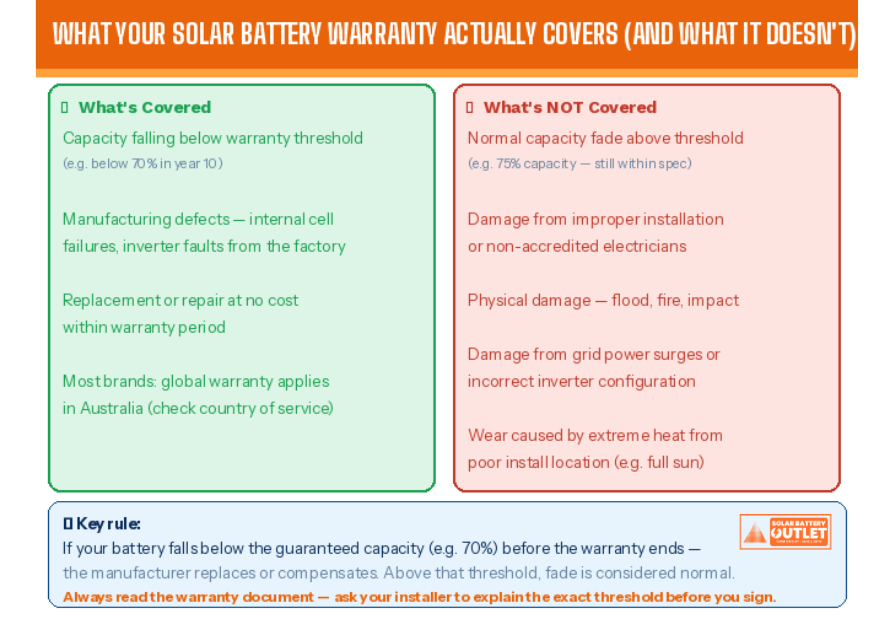
what your solar battery actually coversery warranty

Capacity Warranty vs Product Warranty

Capacity warranty — the more important one — guarantees that your battery will retain a minimum percentage of its original storage capacity for a set number of years. Common thresholds are 60% or 70% of original capacity at the end of year 10.

Product warranty — covers manufacturing defects, component failures, and premature failure. This is standard and typically runs 10 years for most brands.

If your battery falls below the guaranteed capacity threshold before the warranty ends, the manufacturer is obligated to replace it or compensate you. If it stays above that threshold — even at 72% capacity in year 9 — that is within spec and not a warranty claim.

The Question to Ask Before You Sign

Ask: “What is the exact capacity threshold in the warranty, and at what year?”

Some brands warrant 70% at year 10. Others warrant 60% at year 10. A battery that retains 70% of 10 kWh is giving you 7 kWh in year 10. A 60% threshold battery might only deliver 6 kWh. For most households — especially with growing EV use — that difference matters.

What happens after the warranty period? The battery keeps working — it just continues degrading gradually without the manufacturer’s capacity guarantee. Most quality LFP batteries continue functioning well beyond their warranty period. A 10 kWh battery at 65% capacity in year 12 is still delivering 6.5 kWh — still useful, just less than day one.

How to Get the Most Life Out of Your Battery — Practical Tips

  • Ask your installer to configure the charge ceiling at 80-90% and a 10-20% reserve at the bottom
  • Keep your battery monitoring app installed and check firmware update notifications
  • Choose an install location that stays under 35 degrees in summer — shaded garage or indoor wall
  • If your solar system is over 10 kW, confirm with your installer that battery sizing is appropriate
  • Do not skip maintenance checks — most brands recommend a system check at year 5
  • If you notice the battery depleting faster than usual, check the monitoring app for error codes before calling a technician

Frequently Asked Questions

Can I replace the battery cells when they degrade, rather than the whole unit?

For most residential batteries, no — they are sealed units. BYD Battery-Box is modular, meaning you can add capacity or swap modules, but individual cell replacement is not a standard consumer option. When a battery reaches end-of-life, the whole unit is replaced or recycled.

Does the battery still work during a blackout as it gets older?

If your system is set up for backup, yes — an older battery still provides backup, just for a shorter time. Not every battery setup provides backup, just for a shorter duration than when new. If your 10 kWh battery is at 7 kWh capacity in year 10, it will keep your essentials running for about 70% of the time it originally could.

What happens to the battery at the end of its life?

LFP batteries are recyclable. Australia’s battery recycling infrastructure has improved significantly — most installers and manufacturers have take-back or recycling programs. Ask about this when getting quotes. Reputable installers will have a clear answer.

Is a 15-year warranty worth paying extra for?

It depends on your situation. If you are planning to stay in your home for 15+ years and want certainty, the Enphase IQ Battery 5P’s 15-year warranty is a genuine differentiator. If your planning horizon is 10 years, or you expect to upgrade technology at the 10-year mark anyway, the standard 10-year options deliver very strong value.

Do batteries degrade faster in hot climates like Queensland or South Australia?

They can — if the install location is poor. The solution is not to avoid batteries in hot climates; it is to install them correctly. SA homeowners actually have some of the strongest battery economics in the country thanks to high electricity prices, despite the warm climate.

Want a Quote for a Solar Battery in Sydney or South West NSW?
We are based in Liverpool and Bankstown, servicing all of South West Sydney and beyond. Our team will recommend the right battery size for your home and handle all rebate paperwork — federal and NSW VPP incentive.
Call us: 1800 000 777
Or visit: solarbatteryoutlet.com.au
About Solar Battery Outlet We are a Liverpool-based solar battery installer, part of GWM Group Pty Ltd, servicing homes across South West Sydney, Bankstown, Campbelltown, and the greater NSW region. All installations are done by SAA-accredited electricians. We handle all rebate paperwork so you do not have to.