

Australian summers push home batteries to their limits. Temperature quietly shapes how much energy your battery stores, how fast it charges, and how long it lasts. Most homeowners focus on battery size and brand. However, temperature affects home battery performance just as much as either factor. NSW felt a fierce heatwave in January 2026, with parts of the state reaching almost 50°C. Western Sydney suburbs such as Penrith regularly top 42°C in summer. Meanwhile, winter mornings in the Blue Mountains and Southern Highlands can dip below freezing. Both extremes change how your lithium battery behaves. This guide explains why temperature matters, what happens inside your battery during heat and cold, and how to protect your investment year-round.
Why Temperature Controls Your Battery’s Chemistry
Your home battery stores energy through chemical reactions inside each cell. Consequently, temperature directly influences how fast those reactions happen. Lithium-ion batteries, including the LiFePO4 chemistry used in most Australian home systems, work best within a narrow temperature band. Outside that band, chemical activity either slows down or speeds up too much. Slower reactions mean less available power. Faster reactions generate extra heat, which stresses internal components. This is why manufacturers publish an operating temperature range for every battery model. Staying inside that range protects both performance and warranty. Straying outside it, even occasionally, adds cumulative wear that shortens your battery’s working life.
How Summer Heat Affects Your Battery’s Performance and Lifespan
Heat is the bigger threat for most Australian homes. SolarQuotes founder Finn Peacock puts it plainly: “Heat is the number one cause of early lithium battery death.” His writing points to direct sun exposure and poorly ventilated garages as common culprits, since radiant heat can push internal battery temperatures well above the surrounding air.
The physics behind this follows the Arrhenius principle, which links chemical reaction speed to temperature. For many electronic components, running just 10°C hotter than the design specification can roughly halve their expected lifespan. Home batteries are no exception. Extra heat accelerates the breakdown of internal materials, and this gradually reduces how much energy the battery can store.
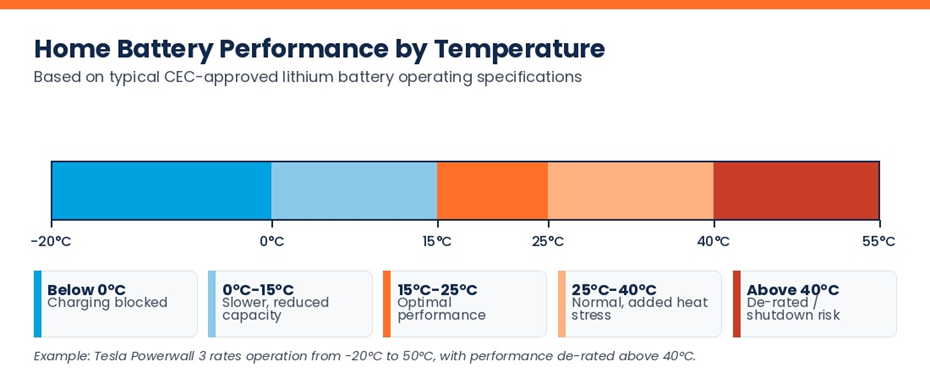
Most CEC-approved batteries include a battery management system that manages this risk automatically. The BMS reduces charge and discharge rates as internal temperatures climb, and it shuts the system down if temperatures become dangerous. Tesla’s Powerwall 3, for example, operates between -20°C and 50°C, but Tesla notes that performance is de-rated above 40°C. That de-rating behaviour is common across the industry, not a fault unique to one brand.
NSW felt this heat firsthand in January 2026. According to Bureau of Meteorology data reported by NASA’s Earth Observatory, Australia recorded its fourth-warmest January since 1910 that month. An intense heatwave swept across NSW, South Australia and Victoria between 26 and 30 January. Western Sydney suburbs such as Penrith topped 42°C for three consecutive days during that stretch. On days like these, an unshaded battery can sit well above its safe operating window for hours.
How Winter Cold Slows Down Your Battery
Cold weather causes a different problem. Lithium-ion chemistry slows down as temperatures drop, so your battery delivers less usable capacity. Charging is affected even more than discharging. Most lithium batteries reduce or completely stop charging below 0°C to prevent lithium plating, a process that can permanently damage the cells. This protection matters in places like the Southern Highlands, the Blue Mountains, and inland NSW towns such as Mudgee, where winter mornings regularly fall below freezing.
Unlike heat damage, cold-related capacity loss is usually temporary. Once the battery warms back up within its normal range, performance typically returns to normal. Even so, repeated cold starts add mild stress over time. Installing your battery in a sheltered, insulated space helps it recover faster each morning and keeps charging consistent through winter.
The Ideal Temperature Range for NSW Home Batteries
Most home battery manufacturers target an ideal operating range of roughly 15°C to 25°C. Inside this band, batteries charge efficiently, discharge smoothly, and experience minimal long-term stress. The chart above breaks down what happens outside that range, from blocked charging in freezing conditions to de-rated performance above 40°C.
NSW’s climate makes this range harder to hold naturally. Coastal Sydney suburbs sit closer to the ideal range for more of the year. Western Sydney locations, including Liverpool and Bankstown, regularly exceed 35°C in summer, pushing unshaded batteries toward the upper limit. Good site selection is therefore essential, not optional, for any solar battery company installing a system in a hot NSW suburb.
Where You Install Your Battery Changes Everything
Installation location has a bigger impact on temperature exposure than most homeowners expect. AS/NZS 5139:2019 includes requirements for battery installation locations. Amendment 1:2025 was published on 19 December 2025 and updated the standard. Installers should refer to the current edition of the standard for the latest requirements.
Batteries cannot sit in bedrooms, living areas, or ceiling cavities, since these locations trap heat and restrict airflow. A shaded, well-ventilated external wall or garage is usually the safer choice. Direct afternoon sun on an outdoor unit can push its internal temperature well above the surrounding air, even on a mild day. Coastal NSW properties face an added complication too: salt-laden air can corrode battery enclosures faster than expected, so installers often favour a sheltered position with stainless fittings.
An SAA-accredited installer will assess sun exposure, ventilation, and clearance requirements before choosing a final position.. This upfront planning protects performance, safety, and your battery’s warranty for years to come. It is one reason to choose an established, accredited installer rather than simply the cheapest quote.
4 Steps to Protect Your Battery From Temperature Extremes
You cannot control the weather, but you can control how your battery experiences it. These four steps help protect performance through both summer heatwaves and winter cold snaps.
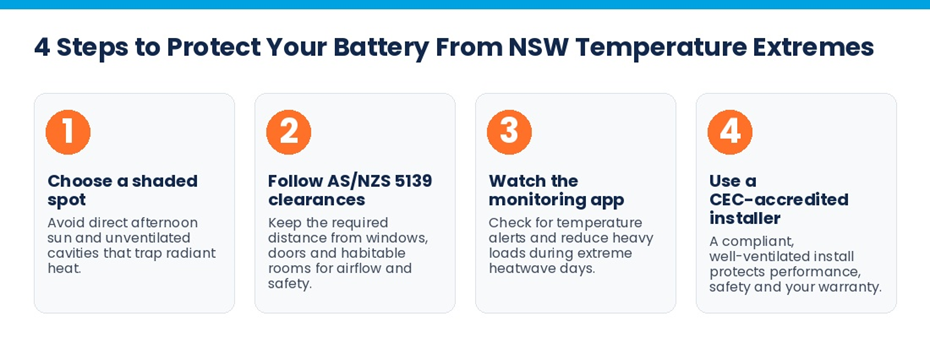
Together, these steps reduce cumulative thermal stress on your system. Over the life of your battery, that can help it keep more of its original capacity. A reliable solar battery company will walk you through each of these checks as part of a standard installation.
Frequently Asked Questions
Yes. Extended heat exposure accelerates internal wear and can permanently reduce how much energy your battery stores over time. Short-term heat mainly triggers automatic de-rating rather than permanent loss.
Yes, provided the battery is outdoor-rated and installed in a shaded, ventilated position that meets AS/NZS 5139 clearance requirements.
Most lithium batteries stop charging below 0°C to protect the cells. Performance typically returns once the battery warms up again.
Yes. Many manufacturers can void or limit warranty claims if a battery is installed in direct sun or a non-compliant location.
Check your battery’s monitoring app for temperature alerts, and contact your installer if you notice reduced performance during hot weather.
Ready to Heat-Proof Your Home Battery?
Thinking about where to install your next battery, or wondering if your current system copes with NSW summers? Solar Battery Outlet helps homeowners across Liverpool, Bankstown, and Mudgee choose the right battery and the right location for our climate. Call 1800 000 777 to book a tailored assessment with our team and SAA-accredited installers.
Disclaimer
This article provides general information about how temperature affects home battery performance in Australia. It does not constitute professional, technical, or financial advice, and every property, battery model, and installation site is different. Actual performance and lifespan depend on your specific battery, its installation location, and prevailing weather conditions. Always seek personalised advice before making a purchasing decision.
