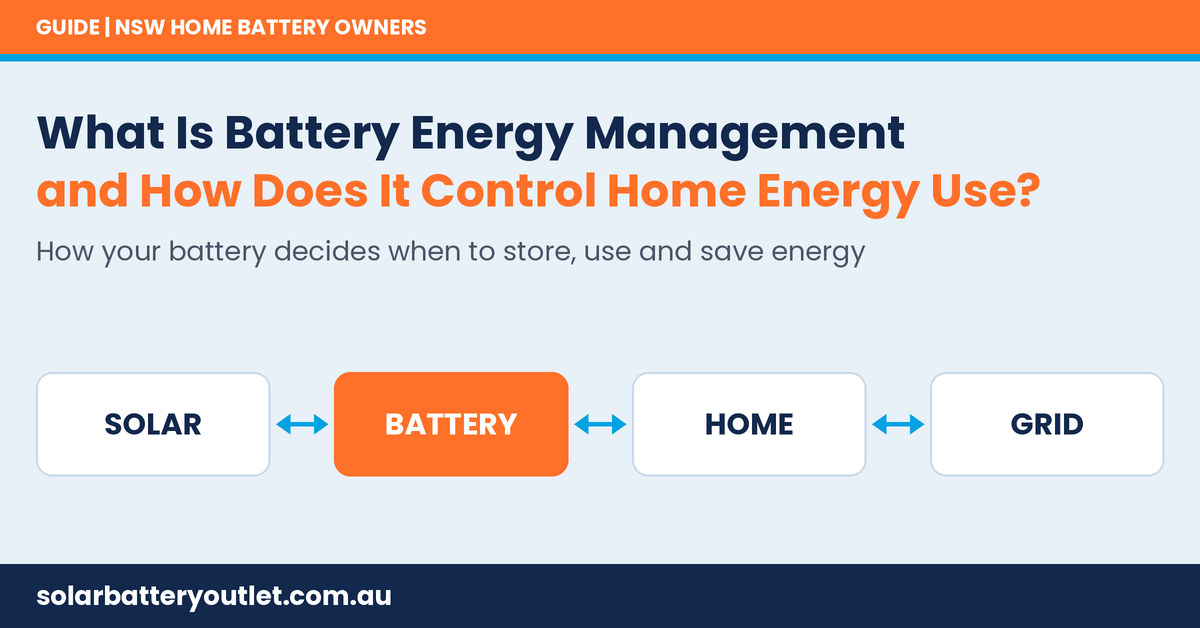
Battery energy management is the software that decides when your home battery charges, discharges, or holds its energy. Think of it as the brain of your battery. It reads your solar output, your household demand, and your electricity tariff. Then it acts automatically.
Most homeowners focus on battery size. However, settings matter just as much. Two homes with identical batteries can save very different amounts, because each battery follows different rules. In August 2026, Australia passed 500,000 home battery installations under the Cheaper Home Batteries Program. As a result, understanding this control layer matters more than ever.
This guide explains how battery energy management works, which modes you can choose, and which settings shape your bills.
Key takeaways
- Battery energy management controls when your battery charges and discharges.
- A battery management system (BMS) protects the cells. An energy management system (EMS) directs energy use.
- Quality batteries usually offer self-consumption, time-based, and backup-only modes.
- A virtual power plant (VPP) can add outside control if you opt in.
- Your reserve level, charging window, and tariff settings shape your results.
What Is Battery Energy Management?
Battery energy management is the set of rules that directs energy through your home. Specifically, it moves energy between your solar panels, battery, home, and the grid. These rules run inside your hybrid inverter or battery controller. You usually view and adjust them through a phone app.
The system decides in real time. For example, it sends solar power to your appliances first. Next, it stores any surplus. Finally, it releases that stored energy when your home needs it, usually after sunset.
Your system relies on a few key inputs. First, it reads solar generation. Second, it tracks household demand. Third, it checks the state of charge, which shows how full the battery is. Many systems also use tariff schedules, so they know when grid power costs more.
This control matters because solar generation and household demand rarely match. Solar output peaks around midday. Meanwhile, household demand often rises in the evening. Battery energy management closes that gap.
Battery Management System vs Energy Management System
People often confuse these two terms. However, they do different jobs.
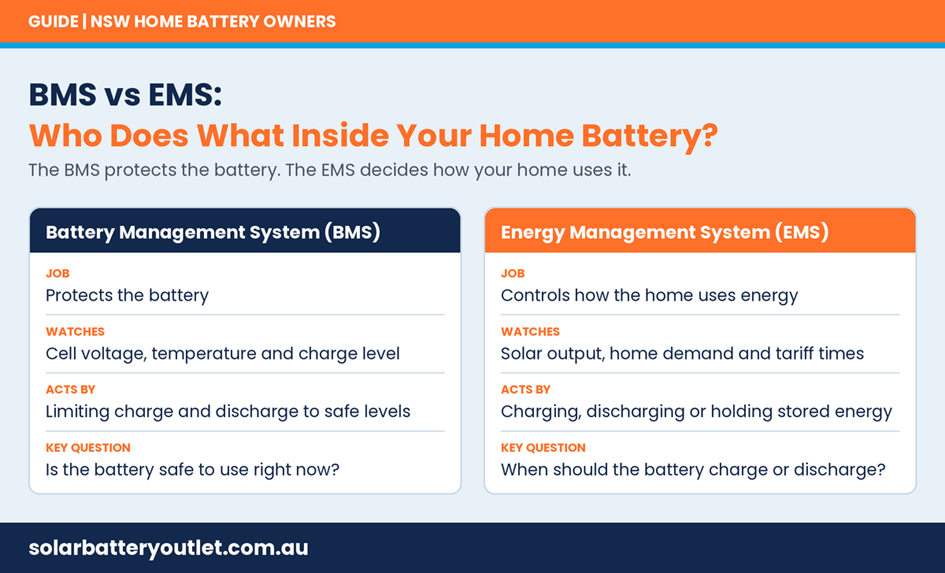
A battery management system (BMS) protects the battery itself. It monitors cell voltage, temperature, and charge level. It also keeps the battery within safe limits.
An energy management system (EMS) protects your bills. It decides when the battery should charge, discharge, or wait. In other words, the BMS keeps the battery safe, while the EMS makes it useful.
Some manufacturers bundle both functions under one brand name. Therefore, ask your installer which settings you can change yourself.
How Battery Energy Management Controls Home Energy Use
Most good batteries offer at least three control modes, according to SolarQuotes. Each mode suits a different tariff and lifestyle.
Self-Consumption Mode
This mode minimises the electricity you draw from the grid overall. Therefore, it suits households on flat-rate plans. The battery charges from surplus solar. Then it discharges whenever your home needs more power than the panels supply.
Time-Based Control Mode
This mode works with time-of-use (ToU) tariffs. Here, the battery avoids expensive grid power. It may even charge from the grid when electricity costs less. Time-of-use tariffs charge less during cheaper periods and more in the evening peak. Check your own NSW plan’s rates, because they vary widely between retailers.
NSW households now have another option. Since 1 July 2026, eligible households can opt in to the Solar Sharer Offer. It provides up to 24 kWh of free electricity between 11am and 2pm. However, you still pay supply charges and any usage outside that window. Depending on your plan and battery, you may shift some midday energy into the evening peak. Check your retailer’s terms first, and read our guide to free midday electricity in NSW.
Backup-Only Mode
This mode keeps the battery fully charged at all times. It prepares you for a blackout. However, it ignores bill savings. Consequently, it suits short periods, such as before a forecast storm.
Virtual Power Plant Control
A VPP adds a fourth layer of control. When wholesale prices spike, the VPP operator can discharge your battery. Wholesale prices can briefly reach very high levels, but what you earn depends on your VPP’s terms, not on the wholesale price. In return, you give up some control. Moreover, heavy use can burn through your battery’s warranted energy throughput faster.
Under the Cheaper Home Batteries Program, on-grid batteries must be VPP-capable. Joining a VPP remains optional, and it needs an ongoing internet connection, according to energy.gov.au.
What a Typical Day Looks Like
Picture a NSW home on a time-of-use or Solar Sharer plan. In the morning, solar powers the home. Between 11am and 2pm, the battery charges. During the evening peak, it discharges. Overnight, it covers low demand until it reaches your reserve level.
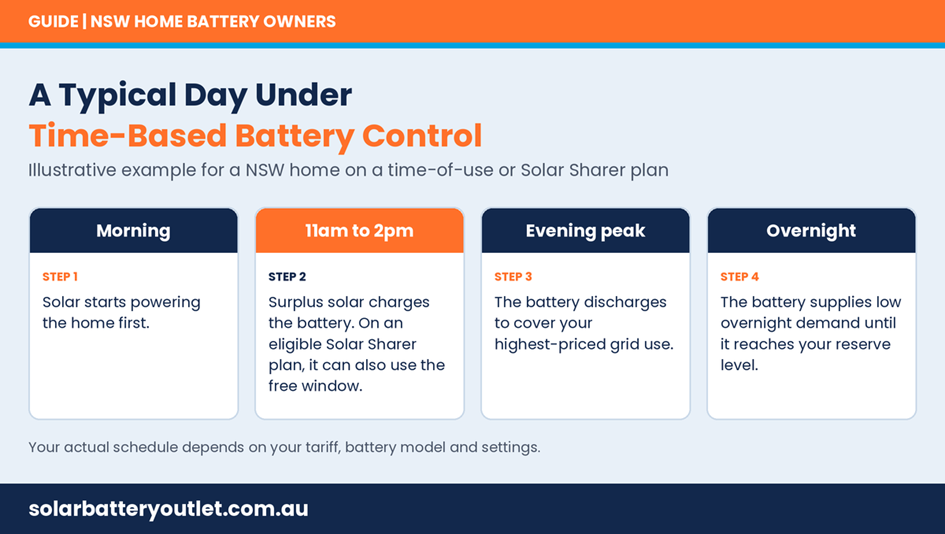
Your own schedule will differ, because it depends on your tariff, battery model, and settings.
Four Settings That Shape Battery Energy Management
Your battery follows the rules you set or the defaults your installer chose. Therefore, check these four settings. Also, ask any solar battery company which modes and settings your system supports.
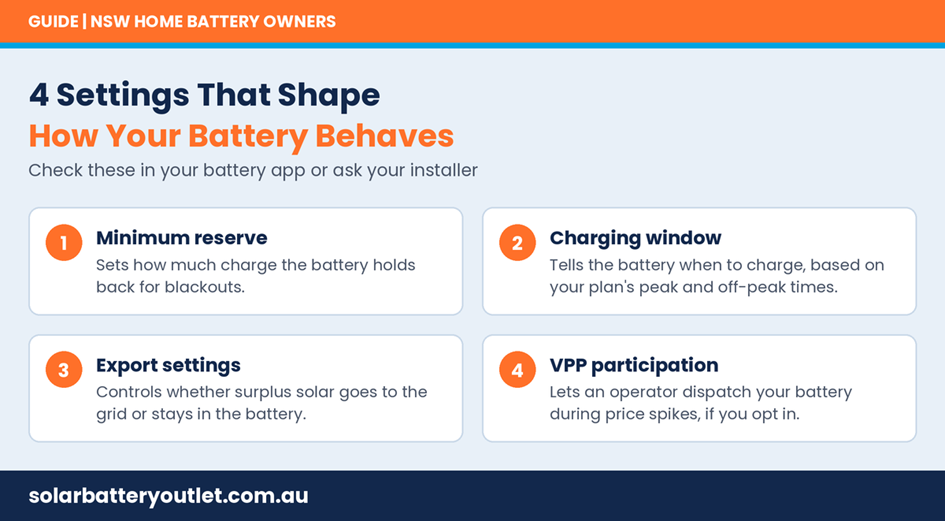
1. Minimum reserve. This setting holds back charge for blackouts. SolarQuotes says even 20% could keep essentials running for hours with efficient lighting and appliances. However, a higher reserve leaves less energy for bill savings.
2. Charging window. Match the schedule to your plan’s actual peak and off-peak times. These times vary between plans, so check your own.
3. Export settings. These settings control whether surplus solar flows to the grid or stays in the battery. Review them each season, because your solar output and usage change.
4. VPP participation. Decide whether outside control suits you. Compare programs carefully, because benefits vary.
Also, keep your battery online. SolarQuotes warns that some warranties can lapse if a battery stays offline too long.
Why Battery Energy Management Matters for NSW Homes
Without careful settings, a battery mainly stores your own solar and releases it later. With good management, it also responds to your tariff, your routine, and your backup needs.
For example, the same battery acts differently in self-consumption mode than in time-based mode. The hardware stays the same. Only the rules change.
NSW households now have more reasons to check their settings. The Cheaper Home Batteries Program has lifted battery uptake sharply. Meanwhile, the Solar Sharer Offer has created a new midday pricing window. As a result, the right settings can change how much grid power you buy.
However, savings vary. The Australian Government’s energy.gov.au site warns that savings may not repay a battery’s cost within its warranted lifetime. Your usage, tariff, and settings all matter. Therefore, ask for advice based on your own bills, not on averages.
Take Control of Your Battery Energy Management
Battery energy management turns a storage unit into a smarter energy tool. The BMS protects the cells, while the EMS steers your energy. Meanwhile, your settings decide how well the system fits your home.
Want your battery set up around your tariff and routine? Talk to Solar Battery Outlet. As a local solar battery company, we install and configure home batteries across Liverpool, Bankstown, and Mudgee. Our team can explain your mode options, backup needs, and VPP capability before you decide. Call 1800 000 777 or contact our team to discuss your home..
Frequently Asked Questions About Battery Energy Management
Battery energy management is the software that controls when a home battery charges, discharges, or holds energy. It uses data on solar output, household demand, and tariffs. As a result, it directs stored energy to the times when your home benefits most.
A battery management system (BMS) protects the battery cells by monitoring voltage, temperature, and charge level. An energy management system (EMS) decides when the battery charges or discharges. In short, the BMS focuses on safety, while the EMS focuses on how your home uses energy.
It depends on your electricity plan. Self-consumption mode suits flat-rate tariffs, while time-based control suits time-of-use tariffs. Backup-only mode prioritises blackout protection over savings. Ask your installer to match the mode to your plan and routine.
During a VPP event, the operator can discharge your battery, so you give up some control. VPP participation is optional. However, on-grid batteries under the Cheaper Home Batteries Program must be VPP-capable. Read the program terms and warranty conditions before you sign up.
No single level suits every home. SolarQuotes notes that even 20% could keep essential loads running for hours. However, a higher reserve reduces the energy available for bill savings. Decide which appliances you need in a blackout, then discuss the setting with your installer.
VPP participation needs an ongoing internet connection, according to energy.gov.au. SolarQuotes also warns that some warranties can lapse if a battery stays offline too long. Therefore, update your Wi-Fi details in the battery app whenever you change your router.
Disclaimer
This article provides general information about battery energy management only. It does not consider your personal circumstances, and it is not financial or electrical advice.
Battery modes, settings, and features differ between brands, models, and installations. Electricity tariffs, peak times, and incentives also differ between retailers and networks. Availability of the Solar Sharer Offer depends on your location, meter type, and retailer. Program rules can change, so check current details with official sources.
Savings depend on your usage, tariff, and settings. We cannot guarantee any specific result. Joining a VPP may reduce your control over the battery. It may also use up warranted throughput faster.
Always seek personalised advice before making a purchasing decision.
