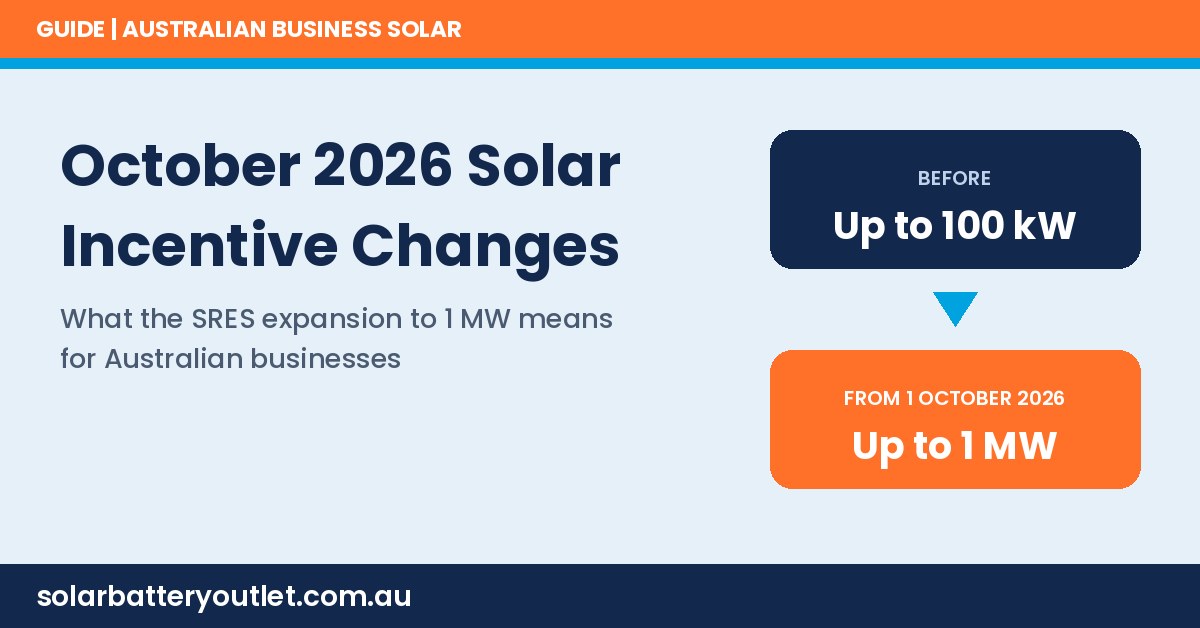
The October 2026 solar incentive changes give larger businesses a new way to cut upfront solar costs. From 1 October 2026, the Small-scale Renewable Energy Scheme (SRES) covers eligible solar PV systems up to 1 MW. Previously, the scheme stopped at 100 kW.
The Australian Government estimates the change could reduce the upfront cost of a mid-scale system by around 20 per cent. Your own result will depend on system size, location and eligibility checks. This guide explains who may qualify, how system size matters and how to estimate your potential saving.
What Are the October 2026 Solar Incentive Changes?
The Australian Government amended the Renewable Energy (Electricity) Regulations 2001 to expand SRES eligibility. Systems above 100 kW and up to 1 MW now fall inside the scheme. The Clean Energy Regulator (CER) calls this category mid-scale solar.
The SRES works through small-scale technology certificates, or STCs. Each STC represents a set amount of expected renewable generation. Installers or system owners create STCs, then sell or assign them. The proceeds reduce the upfront price of the system.
Three dates matter. Your installer must commission eligible systems on or after 1 October 2026. STC applications for mid-scale systems open in mid to late November 2026. After that, the CER begins assessing applications. Read the CER’s mid-scale solar guidance for the latest updates.
The Government is also preparing a rule change request for the Australian Energy Market Commission. This request aims to make it easier for businesses to connect larger solar systems to the network. That change is still in preparation, so connection timelines may not shift yet.
Who May Qualify Under the Expanded SRES?
The rules focus on the solar system, not the type of business. Even so, the Government expects the expansion to help farms, manufacturers, retailers, logistics centres, schools, hospitals and community organisations. Small businesses with larger roofs and strong daytime electricity use may also benefit.
A system must meet several requirements to qualify. The CER lists these in its transitional guidance:
- Capacity above 100 kW and up to 1 MW.
- Installation on or after 1 October 2026.
- Components that appear on the Clean Energy Council approved list.
- Installation that meets Solar Accreditation Australia (SAA) guidelines and electrical safety rules.
- Evidence of planning approvals and, where applicable, network connection approvals.
Installers must also keep geotagged, time-stamped photos that show their face during final testing and commissioning. Photos taken afterwards may not count. Therefore, confirm this step with your installer early.
Which Businesses May Benefit Most?
Not every business will gain equally. Several features usually improve the fit:
- Large roof space with little shading.
- High daytime electricity use, such as refrigeration, machinery or air conditioning.
- Planning approvals that look achievable, plus landlord consent for tenants.
- A site where a network connection looks realistic.
Warehouses, factories, farms, schools and supermarkets often meet several of these points. For example, a coolstore runs refrigeration through the day, which matches solar generation. However, a business with little roof space or low daytime use may see a smaller benefit.
System Size Considerations Under the 1 MW Limit
System size drives your certificate count, so plan it carefully. Five points matter.
First, know the size bands. A system at or below 100 kW stays under the existing SRES rules. A system above 1 MW stays in the Large-scale Renewable Energy Target.
Second, check extensions. Only the extra capacity installed on or after 1 October 2026 earns STCs. For example, an 80 kW system plus a 40 kW extension may count as a 120 kW system. In that case, only the extra 40 kW earns STCs.
Third, watch the combined site limit. The CER looks at related solar on the same or adjoining sites. If existing large-scale solar plus the new system exceeds 1 MW, the new system will not qualify as mid-scale.
Fourth, choose your certificate pathway. You can apply for STCs or join the Renewable Electricity Guarantee of Origin (REGO) scheme. If you choose STCs, you cannot create REGO certificates during the deeming period.
Finally, note the fixed deeming period. Mid-scale systems receive five years of deeming through to 2030. Systems up to 100 kW see a declining deeming period instead.
How to Assess Your Potential Upfront Savings
The STC formula is simple. Multiply system size in kW by your postcode’s zone rating. Then multiply by the deeming period in years. Mid-scale systems use five years. Zone 3 carries a rating of 1.382, and Sydney sits in that zone. Check your own postcode with the CER.
For example, a 250 kW system in Zone 3 earns about 1,727 STCs (250 × 1.382 × 5, rounded down). At $40 per STC, that equals roughly $69,080. The Minister cited about $68,000 for a 250 kW system, which sits close to this estimate. The chart below shows how the estimate scales.
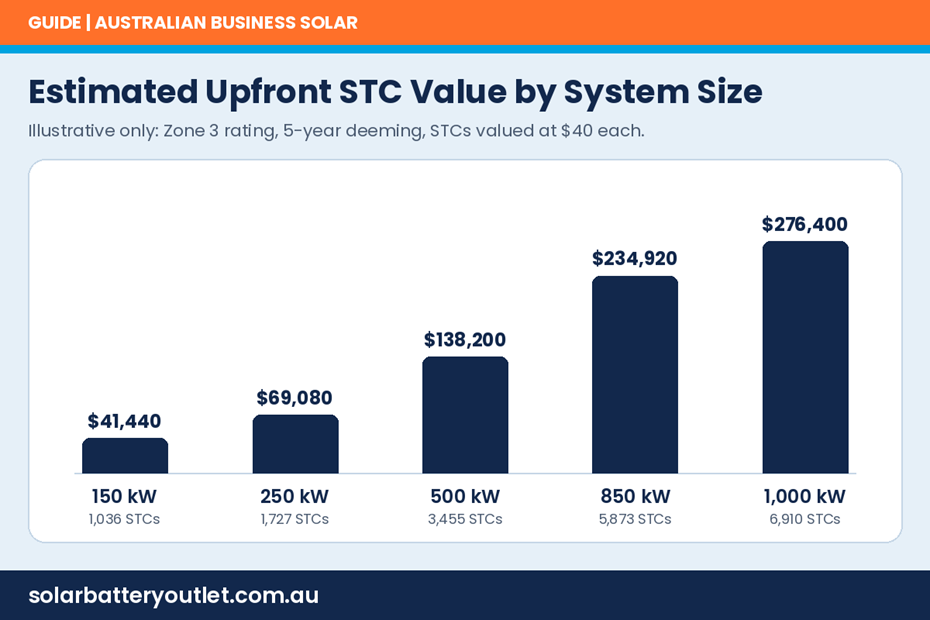
Treat $40 as an upper reference point. Certificate prices vary with how you sell them, and mid-scale sale arrangements may differ. Also remember that STC value reduces the upfront price only. It does not guarantee savings on your power bills.
Use these four steps to build your own estimate.
How to Estimate Your Upfront Saving
A four-step check before you compare quotes.
- Confirm system size. Check the size sits above 100 kW and up to 1 MW, including any solar already on site.
- Find your zone rating. Match your postcode to a CER zone. Most NSW population centres sit in Zone 3.
- Calculate your STCs. Multiply system kW by the zone rating, then by 5 deeming years.
- Compare net costs. Ask each installer to show quote costs with and without STC value.
After that, ask each installer to show the system price before and after STC value. This comparison keeps quotes transparent. It also shows whether the quoted discount matches your calculation.
What Should Businesses Do Before Signing a Quote?
Prepare early. These actions help protect your eligibility:
- Check the installation date. Eligibility depends on the testing and commissioning date, not the purchase date.
- Confirm accreditation. Ask for the installer’s SAA accreditation and the approved product details.
- Secure approvals. Gather planning, building and network connection approvals, plus structural engineering reports where needed.
- Keep records. Store design documents, metering details, electrical compliance certificates and commissioning records.
- Watch for updates. The CER plans more guidance on related systems, extensions and upgrades.
Talk to Solar Battery Outlet About Your Business Energy Plans
Solar Battery Outlet helps NSW customers understand their energy options. Our team in Liverpool, Bankstown and Mudgee can discuss your site’s daytime and evening electricity use. We can also explain how solar and battery storage may fit together. In addition, we can help you prepare questions for your solar quote.
Please note that this SRES expansion covers solar PV. Battery incentives follow separate rules, so confirm current eligibility before you add storage. When you are ready to talk, contact our team to discuss your business energy goals.
Frequently Asked Questions
The Australian Government expanded the Small-scale Renewable Energy Scheme from 100 kW to 1 MW. Eligible solar PV systems that installers commission on or after 1 October 2026 can now create small-scale technology certificates. The Government estimates this could cut the upfront cost of a mid-scale system by around 20 per cent.
Eligibility depends on the solar system, not the business type. The Government expects farms, manufacturers, retailers, logistics centres, schools, hospitals and community organisations to benefit. Your system must meet size, product, installer, approval and safety requirements.
No. The CER states that eligibility depends on the installation date. The installation date is when the system first produces and delivers electricity. Testing and commissioning records show that date.
The CER expects applications to open in mid to late November 2026. The CER will assess eligible systems installed on or after 1 October 2026 against the rules from that date. Your submission date does not change this.
Yes. Systems from 100 kW to 1 MW can apply for STCs. Alternatively, they can join the Renewable Electricity Guarantee of Origin scheme. If you choose STCs, you cannot create REGO certificates during the deeming period.
Possibly. Only the additional capacity installed on or after 1 October 2026 can earn STCs. The existing and new components must form one electrically connected system. The combined capacity must exceed 100 kW without passing 1 MW.
Disclaimer
This article provides general information about the expanded Small-scale Renewable Energy Scheme for mid-scale solar, as at 12 October 2026. It does not constitute financial, tax or legal advice. Scheme rules, certificate prices and Clean Energy Regulator guidance may change. The savings figures are illustrative estimates only. They use a Zone 3 rating, a five-year deeming period and $40 per STC. Your outcome depends on your site, system, approvals and how you sell certificates. This article does not guarantee eligibility or any saving. Always seek personalised advice before making a purchasing decision.
