

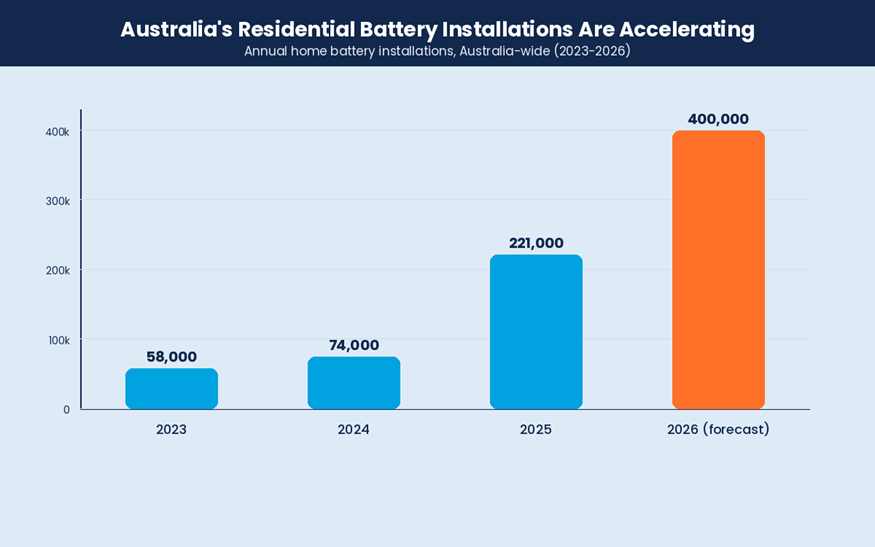
Home battery sales in Australia are no longer a niche trend — they are a mainstream shift in how solar households manage power. In 2025, Australians installed a record 221,000 residential battery systems, almost three times the volume installed in 2024, and industry analyst SunWiz expects the 2026 calendar year to add roughly 400,000 more. For NSW homeowners who already have rooftop solar, or are weighing it up, this surge changes the maths, the market, and the timing of a smart decision. Here is what is actually driving the boom, what it means for your household, and how to use the momentum to your advantage.
The scale of the shift is hard to overstate. Australians spent close to $8.69 billion on home batteries in just the first five months of 2026, according to a Reuters calculation built on SunWiz installation data. Between January and May 2026 alone, households installed 7.7 gigawatt-hours of battery storage — more than the previous six years combined. By mid-2026, more than 466,000 residential battery systems had been connected under the federal Cheaper Home Batteries Program since it launched in July 2025, delivering over 12 gigawatt-hours of new storage capacity nationwide.
NSW is playing a leading role in that growth. Government data to March 2026 shows four of the twelve highest-uptake postcode regions in the country sit in outer and western Sydney, accounting for 6,590 installations between them. Today, roughly one in twenty Australian homes has a battery, up from a small fraction just two years ago, and the trajectory keeps climbing. This is not a short-lived spike. It reflects a structural change in how solar households value the power they generate.
Why NSW Homeowners Are Buying Now, Not Later
Three forces are converging at once, and together they explain why so many solar owners are moving from “maybe one day” to “book a quote.”
1. Feed-in tariffs have kept shrinking
From 1 July 2026, NSW solar buyback rates dropped again, to as low as 3c/kWh on many plans, while the same household still pays roughly 30 to 40c/kWh to buy power back after dark. That gap is the entire financial case for storage: a solar-only home effectively gives away its cheap daytime power and buys it back at ten times the price a few hours later.
2. Electricity bills remain historically elevated
The average NSW household is paying close to $1,450 a year on a market offer, and while the 2026-27 Default Market Offer trimmed flat rates by roughly 3.4 to 5.0 percent, that follows a much larger increase the year before. A battery reduces exposure to further rises because it lets you use your own stored solar instead of buying from the grid at peak.
3. The federal rebate steps down on a schedule
Since 1 May 2026 the Cheaper Home Batteries Program has used a tiered structure, still discounting eligible systems by around 30 percent, with the rate reducing every six months through to 2030. Waiting does not remove the rebate; it just shrinks it a little further each cycle, which is exactly why installation volumes keep climbing rather than tapering off.
What the Surge Means If You Already Have Solar
If your panels have been running solar-only for a few years, you are part of the group installers now describe as their fastest-growing customer base. Industry reporting shows a majority of battery installations are retrofits onto existing rooftop solar rather than new combined systems, which means you do not need to replace your panels to benefit. Most modern inverters and panel setups are compatible with a retrofitted battery.
The surge also strengthens your negotiating position. More installers are competing for retrofit customers, more battery brands are available at competitive pricing, and virtual power plants (VPPs) are actively recruiting existing solar households to join, often stacking a separate NSW incentive on top of the federal rebate. That combination, a mature retrofit market plus rising VPP demand, means existing solar owners are, in many cases, well placed to get a fast, well-priced install.
What the Surge Means If You’re Still Deciding
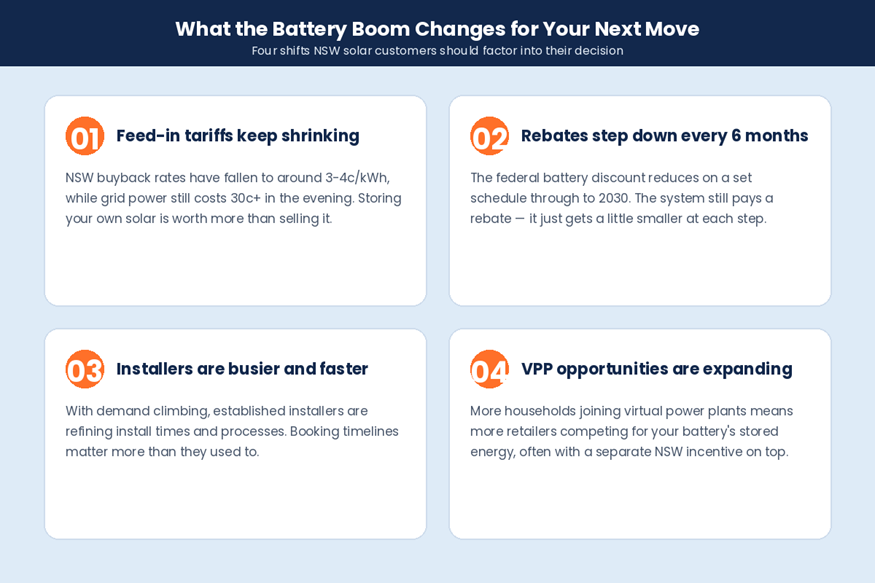
If you have not installed solar and a battery yet, the calculation has shifted from “is this worth it” to “what size and when.” Feed-in tariffs will likely keep falling rather than recovering, which increases the value of storing your own power over time. The rebate step-down is scheduled and predictable, so you can plan around it rather than react to it. Reputable installers are refining their processes to handle higher demand, so booking early in a rebate cycle tends to mean a shorter wait for your installation date. And VPP participation is becoming a genuine income stream, not just a bill offset, as more retailers compete for access to household batteries during peak demand periods.
None of this means every household should rush. It means the case for comparing a proper, itemised quote has become stronger, because the gap between a well-sized system and an oversized or poorly matched one is now worth more than it used to be.
Three Steps Before You Get a Quote
1. Pull your last 12 months of electricity bills and check how much power you use after sunset. This is what actually determines whether a battery pays for itself.
2. Confirm your existing solar system’s age and output before adding storage, since a battery cannot fix an underperforming or degraded solar array.
3. Compare at least three written quotes that show the federal rebate as a dollar figure, not a verbal promise, and ask each installer how the NSW VPP incentive applies to your postcode.
Working through these three steps before you sign anything protects you from both extremes: rushing into an oversized system, and delaying so long that a rebate step-down costs you more than waiting was worth.
You can see how this plays out in practice in our related breakdown of why home battery uptake in Australia is surging, and if your panels have been running solar-only for a while, our guide on adding a battery to an existing rooftop solar system walks through the retrofit process step by step.
Frequently Asked Questions
For many households, yes. Feed-in tariffs are low, bills remain elevated, and the federal rebate is still active. But “good time” depends on your usage pattern and your solar system’s condition, so compare written quotes before committing to a size or brand.
A combination of the federal Cheaper Home Batteries Program discount, falling feed-in tariffs, and elevated retail electricity prices has made storing solar power more valuable than exporting it. SunWiz data shows installations roughly tripled between 2024 and 2025.
Usually not. Most battery installations recorded in the last two years have been retrofits onto existing rooftop solar systems. A qualified installer can confirm your inverter and panels are compatible before quoting.
No. The Cheaper Home Batteries Program runs until 2030. The discount rate reduces gradually every six months rather than ending suddenly, so waiting reduces your rebate slightly but does not remove it.
It depends on how much electricity you use in the evening after your solar stops generating. A reputable installer should review your last 12 months of bills before recommending a battery size.
| Curious What This Means for Your Home? Solar Battery Outlet offers free, no-obligation quotes for households across Liverpool, Bankstown, and Mudgee. We will review your electricity bills, check your existing solar system, and explain honestly whether a battery makes sense for you right now — no pressure, just the numbers. Call us: 1800 000 777 Or visit solarbatteryoutlet.com.au to get started. |
Disclaimer
This article is general information about home battery trends in NSW and is not personal financial, legal, or energy advice. Rebate rates, feed-in tariffs, and electricity prices referenced here were accurate at the time of publication and are subject to change by the relevant government body or your retailer. Every home’s usage pattern, solar system, and eligibility differ, so actual savings and payback periods will vary. Always seek personalised advice before making a purchasing decision.
