

If you have been searching for a solar battery in NSW and wondering whether your shortlisted model actually qualifies for the federal rebate — you are not alone. The government’s Cheaper Home Batteries Program has attracted enormous interest since launching in July 2025, but the eligibility rules are specific, and not every battery on the market makes the cut.
This guide gives you a straight answer. It explains which batteries qualify, outlines the technical requirements, lists the approved brands, and shows how the 2026 tiered rebate structure affects your savings.
| → | What is the federal battery rebate in 2026? The Australian Government’s Cheaper Home Batteries Program provides a roughly 30% off the cost of an eligible home battery through Small-Scale Technology Certificates (STCs). The rebate is applied directly to your invoice—no forms, no waiting for a reimbursement. The program runs until 2030, with the discount rate reducing every six months. |
The 5 Rules That Determine Whether a Battery Qualifies
To be eligible for the federal rebate under the Cheaper Home Batteries Program, your battery and installation must meet five specific criteria. Miss any one of them and the rebate does not apply.
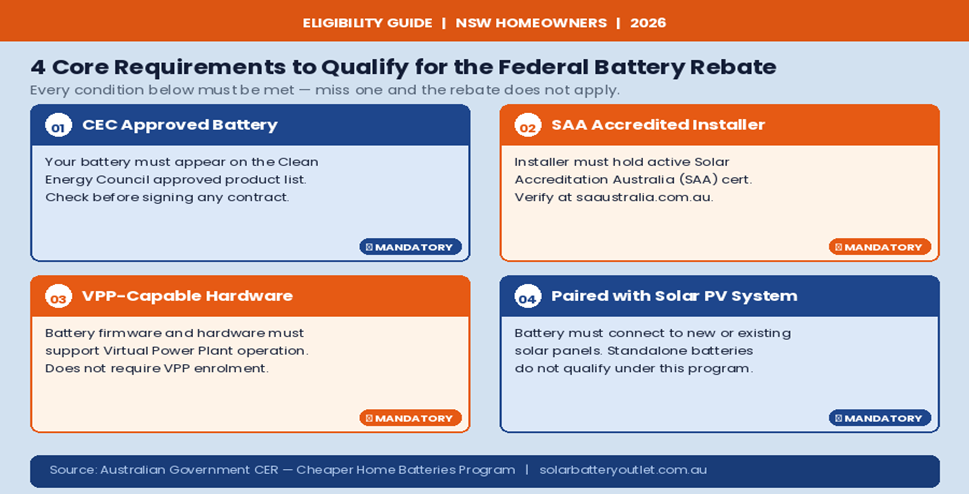
1. The Battery Must Be on the CEC Approved Product List
The Clean Energy Council (CEC) maintains a list of approved battery products. If your battery is not on this list, it is simply not eligible — regardless of brand name, price, or capacity. The list is updated regularly and contains hundreds of models from dozens of manufacturers.
The major brands available in NSW — Tesla, BYD, Sungrow, Enphase, Growatt, AlphaESS, GoodWe, Sonnen, and SolarEdge — all have qualifying models on the list. But here is the important nuance: not every model from every brand is automatically listed. Some older variants, grey imports, or uncertified sub-models of otherwise approved brands may not qualify.
| → | Always ask your installer to confirm the specific model and variant is CEC-listed before signing a contract. |
2. The Installer Must Hold Current SAA Accreditation
Since 2024, the accreditation body for solar installers in Australia changed from the Clean Energy Council to Solar Accreditation Australia (SAA). Your installer must hold a current, active SAA accreditation — not a historic CEC accreditation that predates the changeover.
You can verify an installer’s accreditation status directly at saaustralia.com.au. This check takes less than a minute and protects you from using an unqualified installer who cannot legally apply the rebate.
3. The Battery Must Be VPP-Capable
VPP stands for Virtual Power Plant. The federal government’s program requires that all eligible batteries are technically capable of participating in a VPP—meaning the battery’s hardware and firmware must support remote dispatch by a VPP operator.
You do not have to actually enrol in a VPP to claim the rebate. But the battery must be capable of it. This requirement rules out some older models and certain cheaper imported batteries that lack the communications hardware needed for VPP operation.
Every major brand installed by qualified NSW installers—Tesla Powerwall, BYD, Sungrow, Enphase, and Growatt—meets this requirement. Cheaper or unlisted brands may not.
4. The Battery Must Be Paired with a Solar PV System
This rule strictly requires you to connect your battery to a solar panel system to qualify for the federal rebate. You must either install the battery alongside a new solar system or retrofit it to an existing solar system already operating at the property.
However, off-grid properties are eligible for the federal rebate as long as the battery and solar pairing requirement is met. At the same time, off-grid systems cannot access the NSW VPP incentive, which requires grid connection by definition.
5. The Battery Must Have Between 5 kWh and 100 kWh Usable Capacity
The program covers batteries with a usable capacity of 5 kWh to 100 kWh. Batteries below 5 kWh do not qualify. Batteries above 100 kWh are eligible for installation under the program but receive no additional STC discount on capacity above 50 kWh.
For most NSW homeowners, the relevant range is 10–20 kWh. The tiered rebate structure introduced in May 2026 means the best rebate-per-dollar outcome sits in the 10–14 kWh range.
Which Battery Brands Are Approved in NSW?
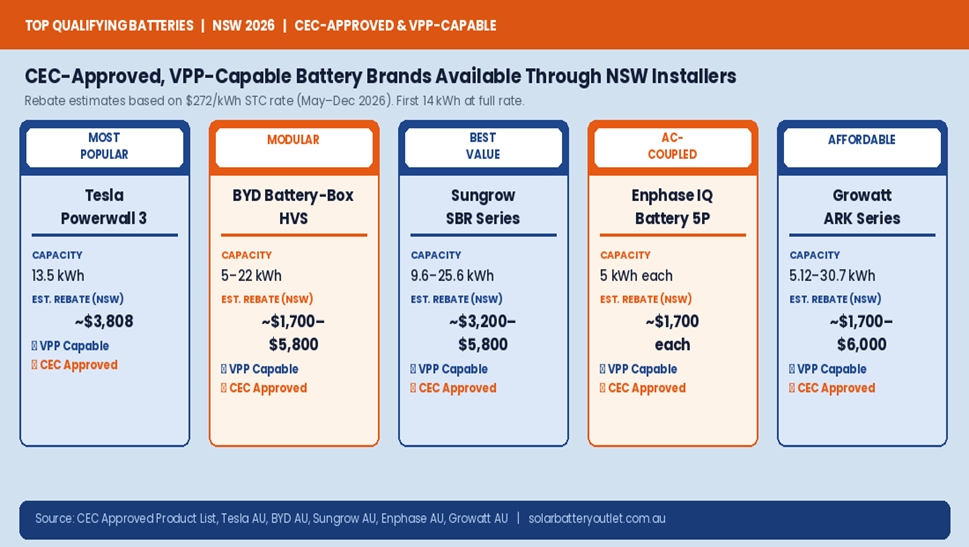
Qualified NSW installers commonly install the following CEC-approved, VPP-capable battery brands. All of these qualify for the federal Cheaper Home Batteries Program and the NSW Peak Demand Reduction Scheme (VPP incentive).
Key Approved Brands — NSW 2026
Tesla Powerwall 3 (13.5 kWh) — The most popular choice in NSW. Fully CEC-listed, VPP-capable, and eligible for both the federal rebate and the NSW PDRS incentive. Estimated rebate: approximately $4,500 at the post-May 2026 STC rate.
BYD Battery-Box Premium HVS (5–22 kWh, modular) — A modular system allowing homeowners to start smaller and expand later. All HVS variants currently listed are CEC-approved. Estimated rebate: $1,700–$5,800 depending on configured capacity.
Sungrow SBR Series (9.6–25.6 kWh) — Often cited as the best value option in NSW for mid-range capacity. CEC-listed, fully VPP-capable, and widely available through SAA-accredited installers. Estimated rebate: $3,200–$5,800.
Enphase IQ Battery 5P (5 kWh, stackable) — An AC-coupled system that stacks in 5 kWh increments. Excellent for homes with older DC-coupled solar systems. Fully CEC-listed and VPP-capable. Estimated rebate: approximately $1,700 per unit.
Growatt ARK Series (5.12–30.72 kWh) — A competitively priced option with growing installer support across NSW. CEC-listed variants available. Estimated rebate: $1,700–$6,000 depending on configuration.
Other brands with CEC-approved models available in NSW include AlphaESS, GoodWe Lynx Home, Sonnen, SolarEdge Energy Bank, and Fronius. Your installer can confirm which specific variants are currently listed and available.
| → | Important: “Brand approved” does not mean every model is approved. Always ask your installer to confirm the specific model number and serial-number-eligible variant is on the current CEC list. Some older variants from approved brands have been removed or not yet listed. |
How Much Rebate Do You Actually Get? The 2026 Tiered Structure
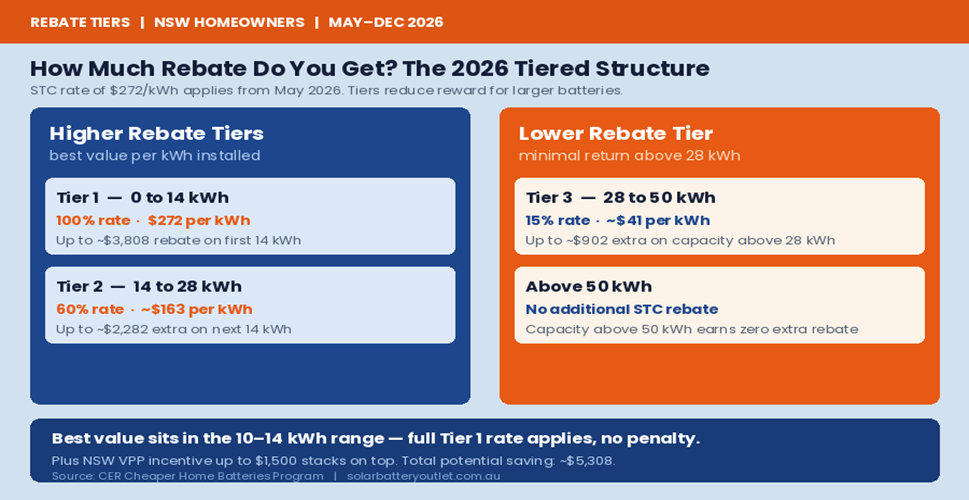
From 1 May 2026, the Cheaper Home Batteries Program introduced a tiered rebate structure. The STC rate from May to December 2026 is $272 per usable kWh of battery capacity — but this full rate only applies to the first 14 kWh.
The Three Tiers Explained
- Tier 1 (0–14 kWh): 100% of the STC rate — $272 per kWh. A 14 kWh battery earns approximately $3,808 in rebate.
- Tier 2 (14–28 kWh): 60% of the STC rate — approximately $163 per kWh. An additional 14 kWh in this band earns approximately $2,282.
- Tier 3 (28–50 kWh): 15% of the STC rate — approximately $41 per kWh. Minimal return for oversized systems.
For a standard 10–13.5 kWh battery (the most common size in NSW homes), the full Tier 1 rate applies, giving you the maximum rebate per kilowatt-hour of capacity installed.
In addition to the federal rebate, NSW homeowners can also access the NSW Peak Demand Reduction Scheme (PDRS) — a VPP incentive worth up to $1,500 for connecting your battery to a registered Virtual Power Plant. These two rebates can be stacked for maximum savings.
| → | Total potential savings in NSW (post May 2026): Federal Cheaper Home Batteries Program: up to ~$3,808 for 14 kWh + NSW VPP (PDRS): up to $1,500 = Up to ~$5,308 in combined upfront savings. |
Common Reasons a Battery Claim Is Rejected
The most common reasons homeowners find their rebate was not applied correctly or was rejected:
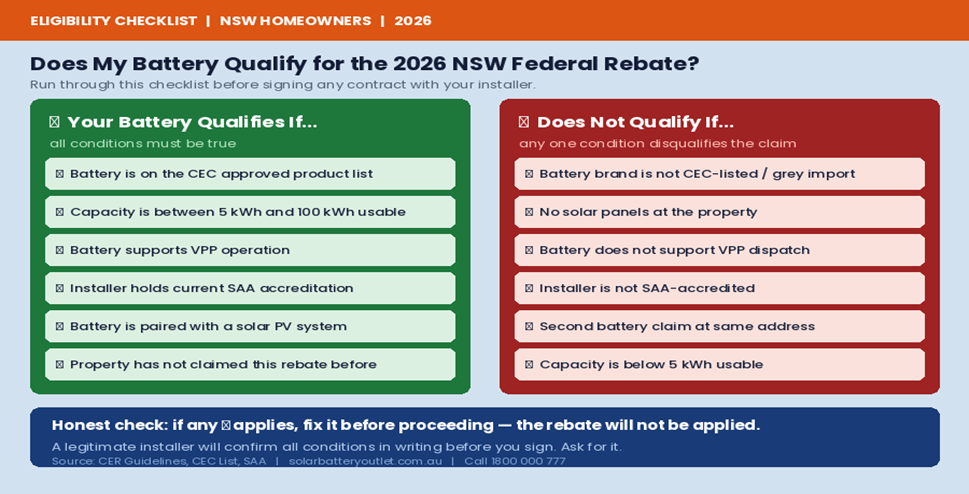
- The battery brand or specific model was not on the CEC approved list at the time of installation.
- The installer’s SAA accreditation had lapsed or they were never accredited — meaning the rebate cannot be claimed.
- The battery was installed as a standalone system with no solar panels connected.
- The property had previously claimed a battery STC rebate — one claim per address applies.
- The battery’s capacity was below 5 kWh usable, making it ineligible under the program rules.
- The installer quoted a “rebate” verbally but it was never applied as an STC deduction on the written invoice.
The simplest protection against all of these: check that your written quote clearly shows the rebate as a dollar deduction line item — not just a single “after-rebate price.” If it is not visible on paper, ask why before signing.
What About the NSW VPP Incentive — How Does It Stack?
The NSW Peak Demand Reduction Scheme (PDRS) is a separate state incentive that runs alongside the federal Cheaper Home Batteries Program. Furthermore, it rewards homeowners for connecting a new battery to a registered Virtual Power Plant operator, which allows the grid to draw on stored energy during peak periods.
The NSW VPP incentive is worth up to $1,500, paid through Peak Reduction Certificates (PRCs). Additionally, it is available to all NSW homeowners installing an eligible battery and can be combined with the federal rebate regardless of your installation timing — before or after 1 May 2026.
To access it, your installer registers your battery with a VPP operator and the local network operator (Ausgrid, for most of Sydney and NSW). You sign a VPP agreement, which covers the terms under which your battery can be remotely dispatched. Your installer handles all of this as part of the installation process.
| → | You do not have to manage the VPP yourself. Your installer connects everything. The incentive payment comes through separately after installation is confirmed. |
Frequently Asked Questions
Can I claim the rebate if I already have solar but no battery?
Yes. Adding a battery to an existing solar system is one of the most common claim types. The federal rebate applies as long as your new battery meets the eligibility requirements and an SAA-accredited installer installs it. The installer will retrofit the battery to your existing system and connect it accordingly.
Does the rebate apply if I am renting the property?
The federal Cheaper Home Batteries Program does not have an income test or homeowner restriction. Landlords, owner-occupiers, small businesses, and community organisations can all qualify. For renters looking to install a battery, the decision rests with the property owner — but the rebate would be available to them if they choose to proceed.
What happens if I want to install two batteries?
One rebate claim applies per property address. If you install a second battery at the same address, it is not eligible for a fresh STC rebate. However, if you install a modular system like BYD or Enphase that supports expansion, the installer can configure the initial setup to maximise your eligible capacity within the rebate tiers.
How do I verify that my installer is SAA-accredited?
Visit saaustralia.com.au and search the installer’s name or accreditation number. Verification takes less than 60 seconds and protects you from working with an uncertified installer. Any legitimate installer will give you their SAA number without hesitation.
Is there a deadline to claim the rebate?
The program runs until 2030. There is no single cut-off date, but the rebate value decreases over time. The STC factor reduces every six months, meaning the discount is slightly smaller in each subsequent period. The highest rebate available within the post-May 2026 period applies from May through December 2026.
Check If Your Battery Qualifies — Free Quote for NSW Homeowners
At Solar Battery Outlet, we install CEC-approved batteries across Liverpool, Bankstown, and Mudgee. SAA-accredited electricians complete all installations, and we handle all rebate paperwork on your behalf.
If you are unsure whether your shortlisted battery qualifies or want a written quote that clearly shows the rebate deduction, get in touch. We will look at your existing solar system, your electricity usage, and your budget—and give you an honest answer on whether a battery makes financial sense before you commit to anything.
| Get Your Free Solar Battery Quote — NSW Homeowners Find out exactly which batteries qualify for the 2026 federal rebate and how much you can save. No countdown timers. No pressure. Just the numbers. 📞 1800 000 777 | solarbatteryoutlet.com.au |
Data Sources & References
The information in this article is drawn from the following sources:
- Australian Government Clean Energy Regulator (CER) — Cheaper Home Batteries Program guidelines and STC rate tables
- Clean Energy Council (CEC) — Approved battery product list (accessed May 2026)
- Solar Accreditation Australia (SAA) — Installer accreditation database: saaustralia.com.au
- NSW Department of Climate Change, Energy, the Environment and Water — Peak Demand Reduction Scheme (PDRS) guidelines
- Tesla Australia — Powerwall 3 Cheaper Home Batteries Program eligibility page (tesla.com/en_au/support/energy/powerwall)
- Solar Choice — Federal Solar Battery Rebate 2026 guide (solarchoice.net.au)
- Solar Scorecard — Battery Rebates Australia 2026 (solarscorecard.com.au)
- PSC Energy — Ultimate Guide to Australia Solar and Battery Rebates 2026 (pscenergy.com.au)
- Solar Battery Outlet — Federal Battery Rebate NSW 2026 guide (solarbatteryoutlet.com.au)
Rebate estimates in this article are based on the post-May 2026 STC rate of $272 per usable kWh. Actual rebate amounts vary based on battery capacity, STC market price at time of installation, and installer calculations. Always confirm figures with your SAA-accredited installer before signing a contract.
