Best Solar Batteries Australia 2026: Our Top Picks for NSW Homes

There are over 30 solar battery brands available in Australia right now. Most of them will tell you they are the best. A few of them actually are.

We install solar batteries every week across Liverpool, Bankstown, Campbelltown and South West Sydney. We see which ones perform well, which ones give customers headaches, and which ones represent genuinely good value after rebates. This guide is based on that real-world experience — not sponsored rankings.

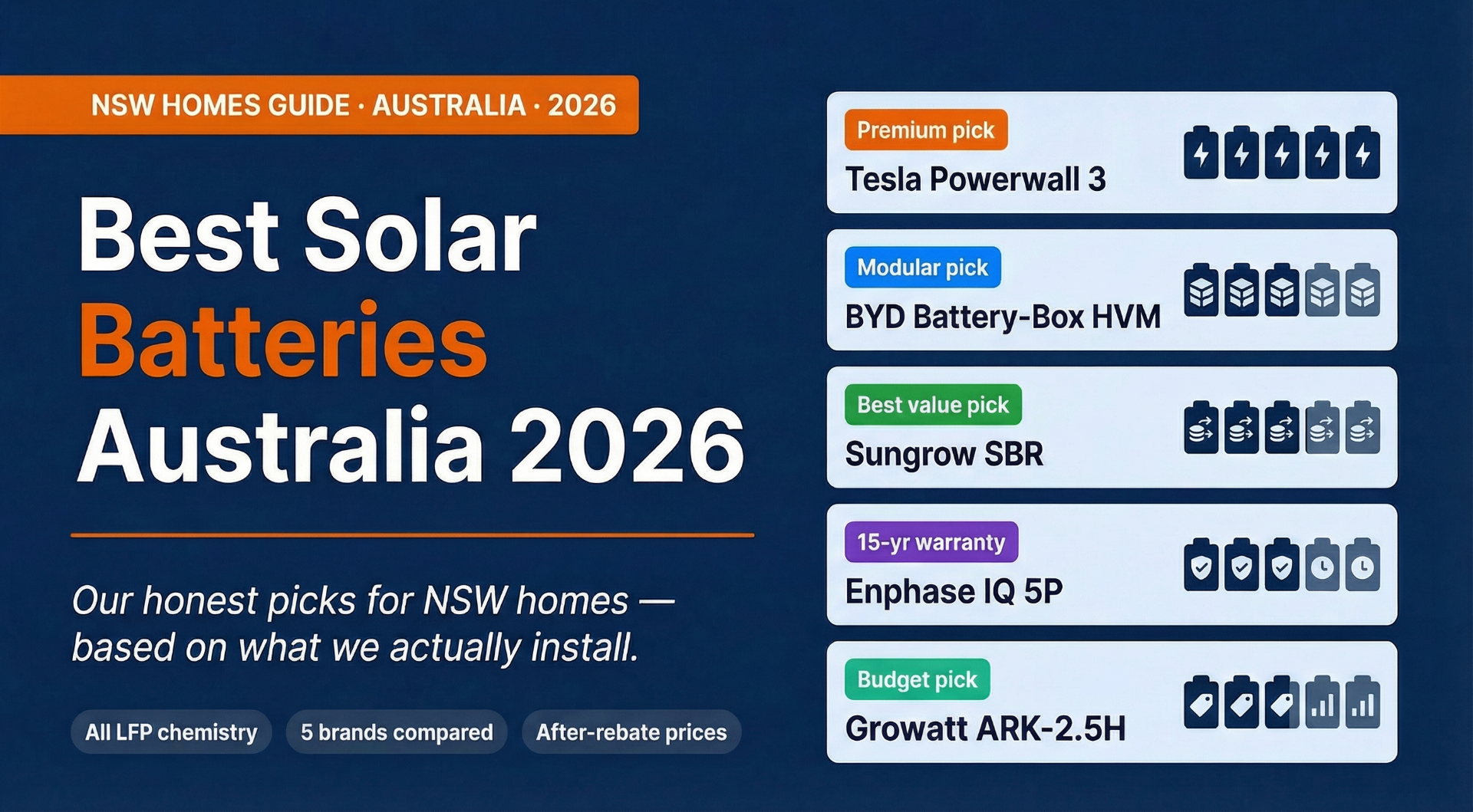
We have narrowed it down to six batteries that we are confident recommending to NSW homeowners in 2026. Here is how they compare, what each one is best for, and the real numbers after the federal rebate.

One thing before we start: Every battery on this list uses LFP (Lithium Iron Phosphate) chemistry. This is now the standard for quality home batteries in Australia — safer, longer-lived, and more heat-stable than older lithium-ion chemistries. If anyone quotes you a non-LFP battery for home storage in 2026, ask why.

The Quick Comparison — All Six Batteries Side by Side
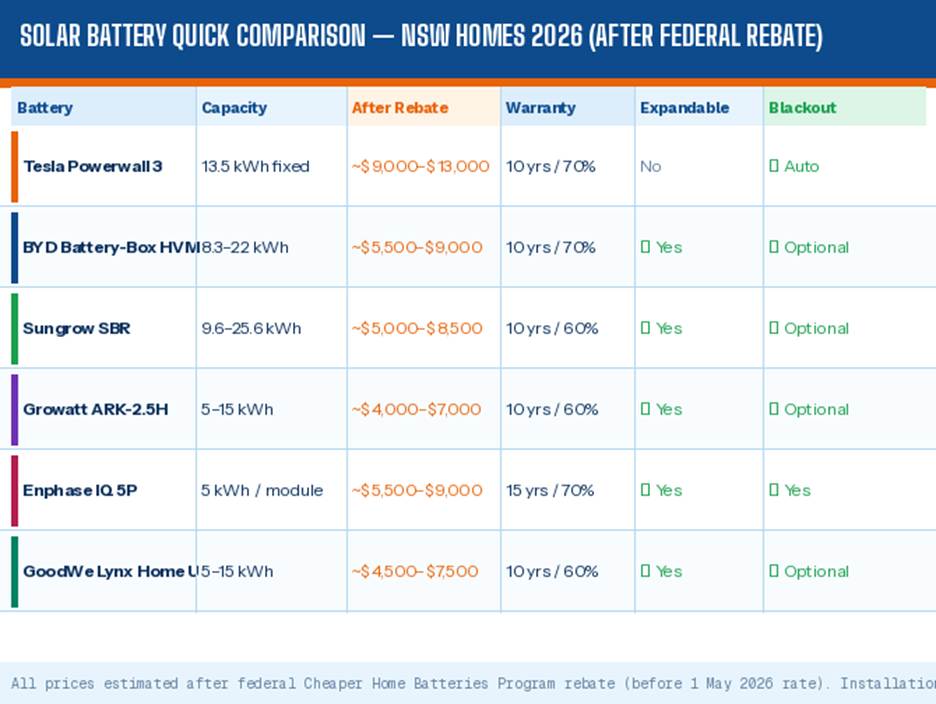
A few things to note about this table before we go deeper:

  • All prices shown are after the federal Cheaper Home Batteries Program rebate (before 1 May 2026 rate of $311/kWh usable). NSW VPP incentive is additional.
  • Blackout protection is available on most batteries but is not automatic on all of them — you need to confirm with your installer that backup mode is included in the system design.
  • Expandable means you can add more battery modules later without replacing the whole system. This matters if you are planning to get an EV or expect your energy needs to grow.

The Real Numbers for NSW Homes — After All Rebates
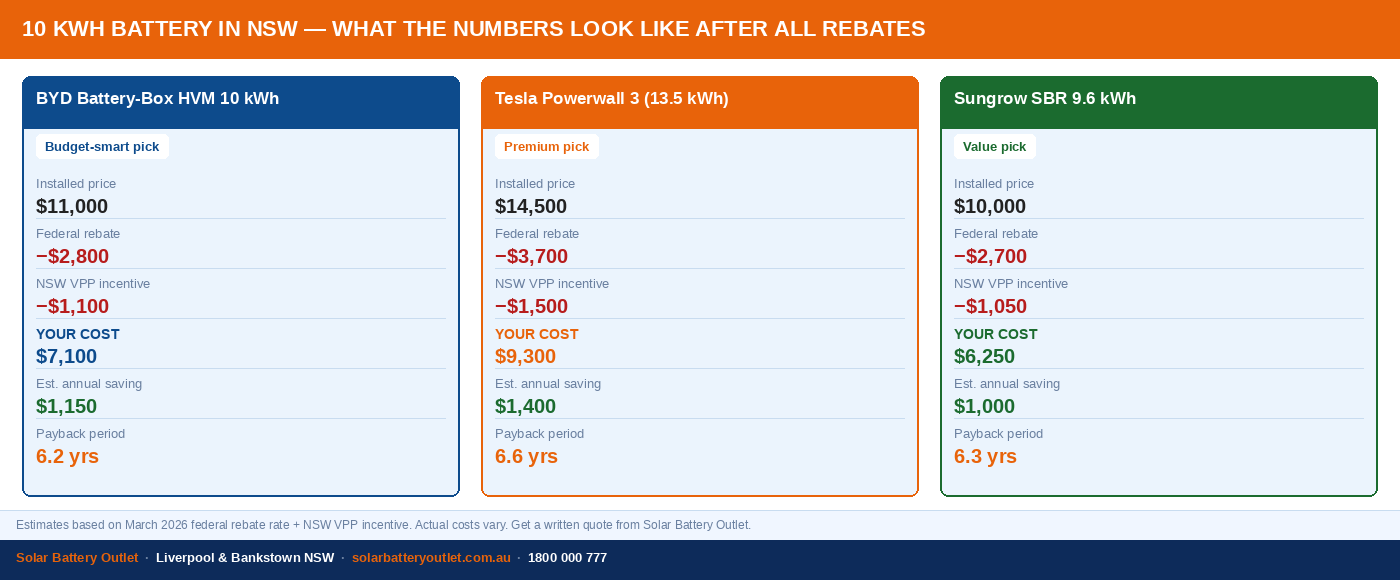
These numbers assume a NSW homeowner claiming both the federal rebate and the NSW VPP incentive. The annual saving estimate is based on NSW peak electricity rates (~32 cents per kWh) versus the typical feed-in tariff (~6 cents), cycling a 9–10 kWh battery about 300 days per year.

Your actual numbers will vary depending on your tariff plan, how much power you use in the evenings, and whether you are connecting an EV. The point of this table is to show the relative value of each option — not to give you an exact quote.

The rebate deadline is real: The federal rebate rate drops after 1 May 2026. For a 10 kWh battery, installing before that date saves an extra $530 compared to installing in June 2026. It is not a trick — it is how the STC scheme works. Your installer applies the rebate directly on your invoice.

Each Battery — What We Actually Think

Tesla Powerwall 3 — Best for Premium Homes and EV Owners

The Tesla Powerwall 3 is the most recognised name in home batteries and it earns that recognition. It is a single 13.5 kWh unit with a built-in inverter, which simplifies installation and reduces the number of components that can fail over time.

What sets the Powerwall 3 apart in 2026 is its EV integration. If you have a Tesla vehicle — or are planning to get one — the Powerwall manages solar charging, home storage and car charging as one system through the Tesla app. That level of integration is not matched by any other battery on this list.

The blackout protection is also the best available — it switches automatically when the grid goes down, with no manual intervention. For families with medical equipment, young children, or just a strong preference for reliability, this matters.

  • Best for: EV owners, premium builds, households wanting best-in-class backup
  • Watch out for: Fixed capacity — you cannot expand it. If your needs grow significantly, you add a second unit
  • After rebates (NSW): Approximately $9,000–$13,000 installed for the 13.5 kWh system

BYD Battery-Box HVM — Our Most Recommended All-Rounder

BYD is one of the largest battery manufacturers in the world. Their Battery-Box HVM range is the battery we recommend most often to average NSW families — and for good reason.

It is modular. You can start with 8.3 kWh and expand up to 22.1 kWh by adding modules. If you are not sure how much storage you need right now, or if you expect to add an EV in a couple of years, this flexibility is genuinely valuable. You are not locked in.

The 10-year warranty covers 70% capacity retention, which is the better warranty threshold among the mid-range options. Installation is straightforward and it works with a wide range of inverters, which means it is a good retrofit option if you already have a solar system.

  • Best for: Families wanting flexibility to expand, good all-round performance, strong value
  • Watch out for: Needs a compatible hybrid inverter — confirm compatibility before quoting
  • After rebates (NSW): Approximately $5,500–$9,000 installed depending on module count

Sungrow SBR — Best Value for Performance

Sungrow is the world’s largest solar inverter manufacturer and their SBR battery range has benefited from that engineering heritage. The SBR delivers one of the best cycle ratings in this price range — rated at around 6,000 cycles — and scales from 9.6 kWh up to 25.6 kWh.

If your main priority is getting the most battery for your dollar without sacrificing quality, the Sungrow SBR is the one to look at closely. The 10-year warranty carries a 60% capacity threshold rather than 70%, which is slightly lower than BYD and Tesla — but at this price point, that trade-off makes sense for most households.

It pairs naturally with Sungrow’s inverter range, which many NSW homes already have installed. If you have a Sungrow inverter, this is often the most cost-effective and technically compatible upgrade.

  • Best for: Value-focused buyers, homes with existing Sungrow inverters, larger storage needs
  • Watch out for: Works best with Sungrow inverters. AC-coupling to other brands is possible but adds cost
  • After rebates (NSW): Approximately $5,000–$8,500 installed

Enphase IQ Battery 5P — The 15-Year Warranty Option

The Enphase IQ Battery 5P stands apart from everything else on this list for one reason: it is the only battery available in Australia with a 15-year warranty. For homeowners who want certainty beyond the standard 10-year window, that is a genuine differentiator.

It is also fully AC-coupled, which means it works with almost any existing solar inverter. If your current setup is a few years old and you want to add a battery without replacing anything else, Enphase is often the cleanest option technically.

The modular design means you can add units as needed. Each 5 kWh module can be installed independently, which is useful if you want to start small and grow. Fire safety credentials are also notable — the IQ 5P carries UL 9540 and UL 9540A fire safety certification, which is the highest standard available.

  • Best for: Long-term homeowners wanting 15-year coverage, retrofits onto any existing inverter, fire-safety conscious buyers
  • Watch out for: Higher cost per kWh than BYD or Sungrow. Physical stacking is not possible — separate units side by side
  • After rebates (NSW): Approximately $5,500–$9,000 for a 10 kWh setup

Growatt ARK-2.5H — Solid Budget Option

Growatt has grown quickly in Australia and their ARK-2.5H battery is worth considering if budget is the primary concern and you still want a quality system with a proper warranty.

The ARK-2.5H is modular starting from 5 kWh and scales up to 15 kWh. It pairs well with Growatt’s own inverter range. The 10-year warranty covers 60% capacity — the same as Sungrow — and the price point often makes it the most accessible entry into home battery storage.

It is a newer product in Australia compared to BYD and Tesla, which means the long-term real-world track record is shorter. That is not a reason to avoid it, but it is worth knowing.

  • Best for: Tighter budgets, smaller households, homes already using Growatt inverters
  • Watch out for: Shorter Australian track record than BYD or Tesla. Ask your installer about local warranty support
  • After rebates (NSW): Approximately $4,000–$7,000 installed

GoodWe Lynx Home U — Reliable Mid-Range Pick

GoodWe is a solid mid-range option that does not get as much attention as Tesla or BYD but consistently performs well in Australian conditions. The Lynx Home U works with GoodWe’s hybrid inverter range and delivers dependable performance for households that want a straightforward, no-fuss system.

Like Sungrow and Growatt, the 10-year warranty covers 60% capacity retention. Pricing is competitive and GoodWe has good local support in Australia — something worth checking for any brand you buy.

  • Best for: GoodWe inverter owners, households wanting a reliable mid-range option
  • Watch out for: Works best paired with GoodWe inverters — confirm compatibility
  • After rebates (NSW): Approximately $4,500–$7,500 installed

Which One Is Right for Your Home?
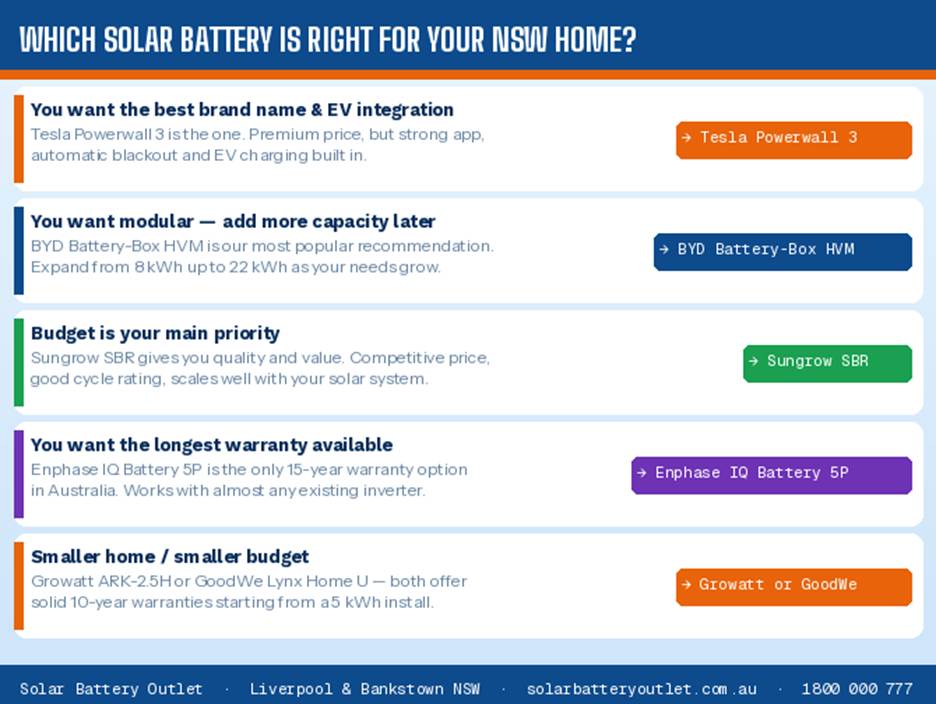
The honest answer is that the right battery depends more on your situation than on any feature comparison table. Here are the questions that actually drive the decision:

  • Do you already have a solar inverter? If yes — check which batteries are compatible before anything else. Retrofitting a compatible battery is cheaper and simpler than replacing your inverter.
  • Do you have or plan to get an EV? If yes — Tesla Powerwall 3 or a larger modular system like BYD is worth the premium for the integrated charging management.
  • Is budget your main driver? Sungrow SBR or Growatt ARK give you solid performance at the best price point. Do not let anyone pressure you into spending more than you need to.
  • Do you want maximum peace of mind over 15 years? Enphase IQ Battery 5P is the only option with a 15-year warranty in Australia right now.
  • Do you want to start small and expand later? BYD Battery-Box HVM or Sungrow SBR both allow modular expansion. Start with what you need today.
A note on brands we do not stock: There are other brands available in Australia — Alpha ESS and Sigenergy get mentioned often. We do not install them ourselves, so we are not going to pretend we can give you a fair comparison. Our recommendation is always to ask any installer specifically why they recommend what they recommend — and to get at least three quotes.

What to Watch Out For When Getting Quotes

A few things we see regularly that are worth knowing before you start talking to installers:

  • The cheapest quote is not always the best value — a low-cost battery with an incompatible inverter or poor installation will cost you more in the long run
  • Make sure the federal rebate is shown as a line item on the quote — not promised verbally or ‘applied later’
  • Ask specifically about blackout protection — not all system designs include it by default even when the battery supports it
  • Check if the installer will handle the NSW VPP incentive paperwork, not just the federal rebate
  • Verify SAA accreditation at saaustralia.com.au before accepting any quote

Frequently Asked Questions

Which battery has the best warranty in Australia in 2026?

Enphase IQ Battery 5P offers the longest warranty at 15 years with 70% capacity retention. For 10-year warranties, Tesla Powerwall 3 and BYD Battery-Box HVM both guarantee 70% capacity at end of warranty — slightly better than the 60% threshold offered by Sungrow, Growatt and GoodWe.

Can I use any battery with my existing solar system?

Not necessarily. DC-coupled batteries generally need to be matched to a compatible hybrid inverter. AC-coupled batteries like Enphase IQ Battery 5P work with almost any existing system, which makes them a popular choice for retrofits. Always confirm compatibility with your installer before committing.

Does it matter which brand I choose if the installation is good?

Installation quality matters a lot — a poorly installed premium battery will underperform a well-installed mid-range one. But brand does matter for warranty support, firmware updates, and the quality of the battery management system over time. The brands on this list all have real Australian presence and established warranty processes.

Are these batteries safe to have in the house?

LFP batteries have a very strong safety record in residential installations in Australia. They do not suffer from the thermal runaway issues associated with older lithium-ion chemistries. All the batteries on this list meet Australian safety standards. Your installer will position the battery in a compliant location as part of the installation.

Get a Quote for Any of These Batteries — Solar Battery Outlet
We stock and install Tesla Powerwall 3, BYD Battery-Box HVM, Sungrow SBR, Growatt ARK-2.5H, Enphase IQ Battery 5P and GoodWe Lynx Home U across Liverpool, Bankstown, Campbelltown and South West Sydney. We handle all rebate paperwork — federal and NSW VPP incentive.
Call us: 1800 000 777
Or visit: solarbatteryoutlet.com.au
About Solar Battery Outlet We are a Liverpool-based solar battery installer, part of GWM Group Pty Ltd, servicing homes across South West Sydney, Bankstown, Campbelltown, and the greater NSW region. All installations are done by SAA-accredited electricians. We handle all rebate paperwork so you do not have to.

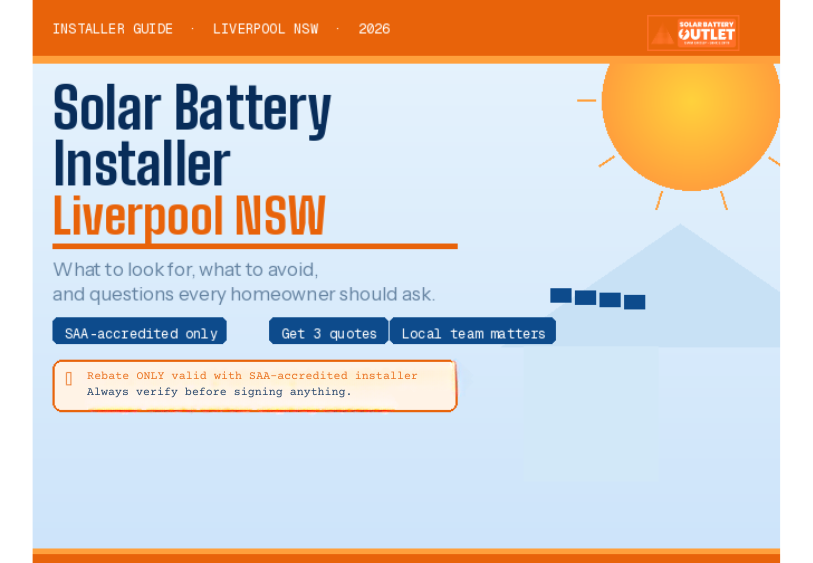
Getting a solar battery quote is the easy part. Getting the right installer — one who actually knows what they’re doing, handles all the rebate paperwork, and will still be around in three years when you have a question — that’s the part most people underestimate.

And in Liverpool and South West Sydney right now, the quality of installers varies enormously. The government rebate has brought a lot of new companies into the market — some excellent, some not. Knowing who to trust before you sign anything could save you thousands.

This guide covers the exact things to check, the green flags that tell you an installer knows their stuff, the red flags that should make you walk away, and the five questions every Liverpool homeowner should ask before handing over a deposit.

Why the Installer Matters More Than the Brand Most homeowners spend hours researching battery brands — Tesla vs BYD vs Sungrow — and about ten minutes checking the installer. That’s the wrong way around. A good battery installed poorly will underperform for its entire 10-year life. A great installer who knows your suburb, handles your rebate paperwork, and is still taking calls in year five is worth far more than the brand name on the wall.

The One Non-Negotiable: SAA Accreditation

This is not optional. Any installer doing a battery installation in NSW must be accredited by Solar Accreditation Australia (SAA). This replaced the old CEC (Clean Energy Council) accreditation system from mid-2024.

Here’s why it matters directly to you: if your installer is not SAA-accredited, you cannot claim the federal Cheaper Home Batteries rebate. That’s up to $4,200 off a Powerwall or $3,100 off a BYD system — gone, just because you didn’t check a number.

You can verify any installer’s accreditation free of charge at saaustralia.com.au. It takes about 30 seconds. Do it before you agree to anything.

Important: CEC vs SAA — What Changed From 30 May 2024, the Clean Energy Council (CEC) handed over all accreditation to Solar Accreditation Australia (SAA). Any installer who was CEC-accredited should now hold an SAA accreditation number. If an installer gives you a CEC number and claims it’s still valid, that’s a red flag — ask for their SAA number specifically.

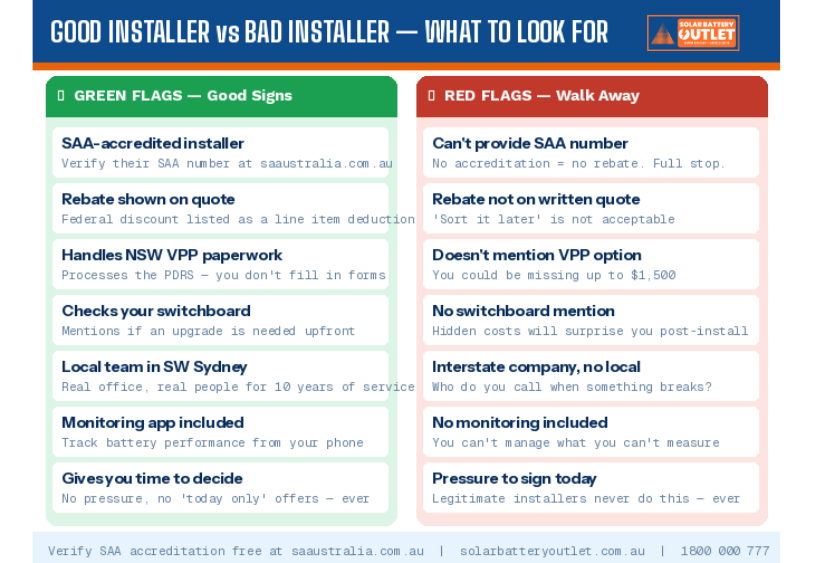
Green Flags vs Red Flags — What to Look For

Here’s a plain-English guide to what separates a good installer from one you should avoid:

Green flags that show a trustworthy installer vs red flags that mean walk away — Liverpool NSW 2026

A few of those red flags are worth expanding on:

  • ‘We’ll sort the rebate later’ is never acceptable. The federal rebate must be shown as a line item deduction on your written quote. If an installer says they’ll ‘process it afterwards’ or ‘you’ll get it as cashback’, that’s either incompetence or dishonesty. Either way, get a different quote.
  • Door-to-door solar sales are still common in Liverpool. We hear from customers regularly who were pressured into signing at the door. A legitimate installer will always give you time to compare quotes. If anyone tells you a deal expires today — hang up or close the door.
  • Interstate companies with no local team are a real risk. Your battery needs to work for 10 years. If your installer is based in Brisbane or Melbourne and has no service team in South West Sydney, who do you call when something goes wrong in year four? Always ask where the service technicians are physically based.

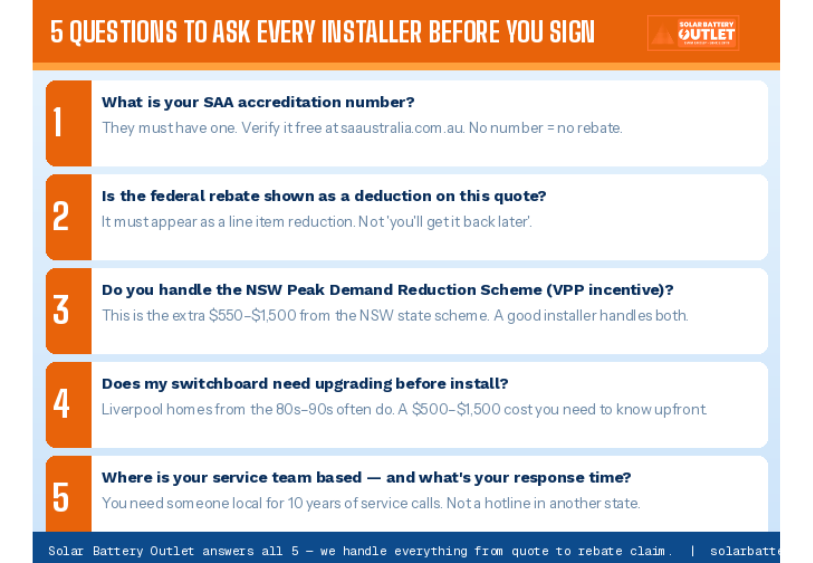
5 Questions to Ask Every Installer Before You Sign

These questions take two minutes to ask. The answers will tell you everything you need to know about whether an installer is worth trusting:

The 5 questions every Liverpool homeowner should ask before signing a solar battery quote

Question 1: What is your SAA accreditation number?

A confident, reputable installer will give you this number without hesitation. Take it, write it down, and verify it at saaustralia.com.au before you go any further. If they can’t give you a number or become evasive — stop right there.

Question 2: Is the federal rebate shown as a deduction on this quote?

It must appear as a clear dollar deduction on the written quote — not a verbal promise, not ‘we’ll sort it at invoice stage’. The rebate should read something like: ‘Federal Cheaper Home Batteries discount: – $3,100’. If it’s not there, ask them to redo the quote.

Question 3: Do you process the NSW VPP incentive (PDRS)?

This is the NSW state incentive of $550 to $1,500 for connecting your battery to a Virtual Power Plant. Some installers skip this because it involves extra compliance steps. If they look confused when you ask — or say they don’t handle it — that’s money you’re leaving on the table. Find an installer who does both.

Question 4: Does my switchboard need upgrading?

Liverpool homes built in the 1980s and 1990s often have older switchboards that can’t safely handle a battery installation. A switchboard upgrade typically costs $500 to $1,500. A good installer will check this during the site assessment and tell you upfront. An installer who doesn’t raise this at all — and then hits you with an extra charge after you’ve signed — is one to avoid.

Question 5: Where is your service team based?

Ask specifically: ‘Where are your technicians physically based? What is your typical response time for a service call in Liverpool?’ A company with a local South West Sydney team can have someone at your door within a day or two. A company whose nearest team is in another state might take weeks — or worse, subcontract to someone unfamiliar with your system.

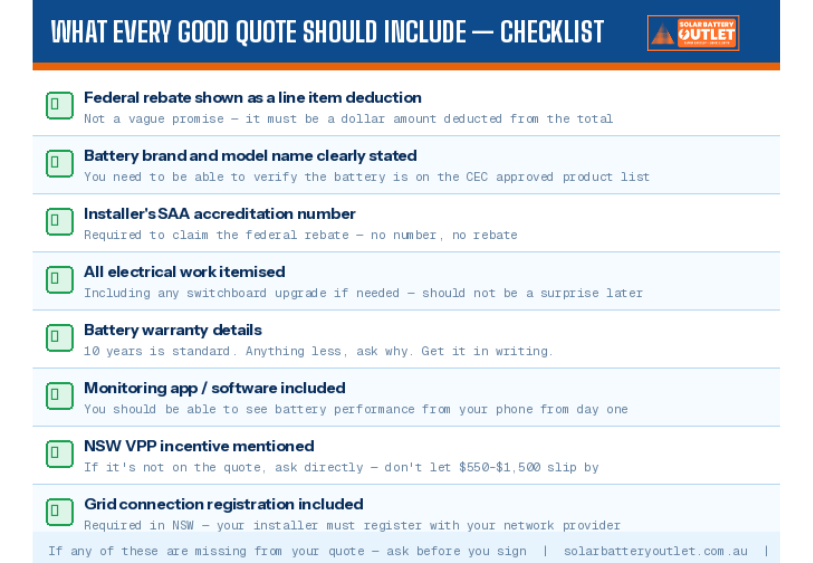
What Every Good Quote Should Include

Once you’ve asked your questions and you’re ready to compare written quotes, here’s exactly what should be on every page:

Full checklist of what a trustworthy solar battery quote must include — Liverpool NSW 2026

The most commonly missing items we see on Liverpool quotes are:

  • The NSW VPP incentive. Many quotes show the federal rebate but not the NSW state incentive. If it’s missing, ask explicitly — don’t assume they’ll add it later.
  • Switchboard work. If a switchboard upgrade is needed, it must be on the quote before you sign — not added as a surprise on installation day.
  • Grid connection registration. This is a legal requirement in NSW. Your installer must register the system with your network provider (e.g. Ausgrid or Endeavour Energy). If it’s not mentioned, ask who handles it.

How Many Quotes Should You Get?

Three is the right number. Not two, not five — three. Here’s why:

  • One quote gives you no reference point — you have nothing to compare it against
  • Two quotes and you might still pick the wrong one based on a coin flip
  • Three quotes gives you a genuine picture of what the market looks like in Liverpool right now
  • Beyond three, you’re spending time comparing minor differences and creating decision fatigue

When you compare quotes, always compare the after-rebate price — not the sticker price. And make sure all three quotes are for the same battery model and capacity, otherwise you’re comparing apples with oranges.

A Note on Cheap Quotes

The cheapest quote in Liverpool is rarely the best value. Here’s what cheap quotes often hide:

  • A lower-grade battery brand not on the CEC approved product list
  • Missing switchboard work that will be charged separately on the day
  • No monitoring software included — you’ll pay for it later
  • An interstate company with no local service team
  • The NSW VPP incentive not processed — saving them admin, costing you money

A difference of $500–$800 on a quote from a fully accredited local company with a solid service team is almost always worth it over a decade of battery ownership.

Frequently Asked Questions

How do I verify an installer’s SAA accreditation?

Go to saaustralia.com.au and use the accreditation status check tool. Enter the installer’s name or their SAA number. It’s free and takes about 30 seconds. If their name doesn’t appear or their accreditation has lapsed — do not proceed.

Can I use any installer or does it have to be someone specific?

You can use any SAA-accredited installer — you’re not locked to one company. What matters is that whoever does your installation is SAA-accredited at the time of installation. The installer then processes the rebate paperwork with the Clean Energy Regulator on your behalf.

What if something goes wrong after installation?

Your battery and inverter come with manufacturer warranties (typically 10 years). For installation workmanship, your installer is responsible. This is exactly why a local company with a real team in South West Sydney matters — you need someone you can actually reach. Always ask about the installer’s own warranty on their workmanship before signing.

Is it okay to get quotes from companies I find online vs local?

Online quotes and comparison sites are fine as a starting point. But always confirm the company has actual installers and service technicians based in Liverpool or South West Sydney — not just a national call centre. Ask directly: ‘Who will physically do my installation and where are they based?’

Get a Quote from a Liverpool-Based, SAA-Accredited Installer

We’re based locally in Liverpool and service all of South West Sydney. SAA-accredited electricians. We handle the federal rebate and NSW VPP incentive paperwork — and we’ll always tell you if your switchboard needs upgrading before you sign.

Call us: 1800 000 777

Or fill in our 60-second eligibility form at solarbatteryoutlet.com.au
About Solar Battery Outlet We’re a Liverpool-based solar battery installer, part of GWM Group Pty Ltd, servicing homes across South West Sydney, Bankstown, Campbelltown, Mudgee, and the greater NSW region. All installations by SAA-accredited electricians. We handle all rebate paperwork — federal and NSW — so you don’t have to.

It’s the million-dollar question every Australian homeowner with solar panels eventually asks: “Is a solar battery actually worth it?”

You’ve heard the debates. Your neighbour swears by it, but a forum you read said the payback period is over a decade. Some articles say it’s the key to energy independence, while others claim it’s an expensive gadget for green enthusiasts.

So, what’s the real answer?

As expert installers who live and breathe this technology every day, we’ll give you the honest, no-fluff truth: Yes, a solar battery is absolutely worth it in 2026, but with two huge conditions:

  1. You have to choose the right system for your home.
  2. You need to act before the government rebate drops significantly on May 1, 2026.

This isn’t a sales pitch; it’s a financial reality. In this guide, we’ll break down the real payback period, show you why now is the most critical time to buy, and help you figure out if a battery is the right move for you.

The Payback Period: It’s More Than Just a Number

Most people think the “payback period” is just about how long it takes for your electricity bill savings to equal the cost of the battery. While that’s part of it, the true value is much bigger.

The Real Return on Investment (ROI) includes:

  • Energy Independence: The freedom of generating, storing, and using your own power. You’re no longer at the mercy of rising electricity prices.
  • Blackout Protection: When the grid goes down in a storm, your lights, fridge, and internet stay on. What is that peace of mind worth to your family?
  • Future-Proofing Your Home: With the rise of electric vehicles and all-electric homes, having your own energy storage is becoming less of a luxury and more of a necessity.
  • Maximizing Your Solar Investment: You paid for your solar panels. A battery ensures you use every last drop of the free energy they generate instead of selling it back to the grid for pennies.

When you factor in these benefits, the “worth it” question starts to look very different.

How to Calculate Your REAL Payback Period

The payback period for a solar battery in Australia typically ranges from 5 to 10 years. Where you fall in that range depends on four key factors:

  1. Your Electricity Usage: The more power you use, especially in the evening, the faster your battery will pay for itself.
  2. Your Feed-in Tariff: The lower your feed-in tariff (the amount you get for selling excess solar back to the grid), the more sense it makes to store and use that power yourself.
  3. Your System Size: A correctly sized battery that matches your consumption is crucial for maximizing your return.
  4. Your Upfront Cost: This is the big one, and it’s about to change dramatically.


Want a precise payback calculation for your home?
Our free online tool analyzes your energy bills and system size to give you a personalized payback estimate in under 60 seconds.


The 2026 Rebate Cliff: Why You Must Act Before May 1st

This is the most important part of this entire article.

The Australian Federal Government’s solar battery rebate (known as the STC program) is being reduced. This isn’t a maybe; it’s a legislated change.

On May 1, 2026, the rebate value will drop significantly.

What does this mean for you in real dollar terms? For an average 10kWh battery system, you could receive hundreds, if not thousands, of dollars less in upfront discount if you install after this date.

This single change has a massive impact on your payback period. A system that has a 7-year payback today could have a 9-year payback if you wait until June. The time to act is now, while the full rebate is still available.


Don’t Miss Out on Thousands in Savings!
The May 1st deadline is fast approaching. Lock in the full government rebate by getting a quote and booking your installation today.

Case Study: The Miller Family in Sydney

  • Before Battery: A family of four with a 6.6kW solar system. They were exporting 70% of their solar energy during the day for a tiny feed-in tariff, only to buy expensive electricity back from the grid every evening.
  • After Installing a 10kWh Sigenergy Battery: They now store all their excess solar energy and use it to power their home at night.
  • The Result: Their quarterly electricity bill dropped from $550 to just $50 (the daily grid connection charge). Their calculated payback period is just 6.5 years, and they are fully protected from blackouts.

The Final Verdict: Is a Battery Worth It For YOU?

So, let’s circle back to the big question. A solar battery is worth it in 2026 if:

  • You want to slash your electricity bills and gain independence from the grid.
  • You want to be protected from blackouts and rising energy prices.
  • You want to maximize the return on your existing solar panels.
  • And most importantly, you are ready to act before the May 1st rebate deadline.

If you wait, the financial case becomes much harder to justify. The window of opportunity to get the best possible return on your investment is closing fast.

Your Last Chance for Maximum Savings

Don’t look back in July and wish you had acted sooner. Take the first step to energy independence today.

Option 1: See if You Qualify

Take our quick 30-second quiz to see if your home is a good fit for a solar battery and to get an instant rebate estimate.

Option 2: Get a Free, Detailed Savings Plan

Let our experts provide a free, no-obligation quote. You’ll get a fixed price, a detailed payback calculation, and a clear projection of your savings before and after the rebate change.

Blog Post Tags

are solar batteries worth it, solar battery payback period, solar battery Australia 2026, is a solar battery worth it, solar battery rebate 2026, home battery storage, solar power savings, energy independence

If you’ve been searching for Australian electricity cost-saving tips, you’ve probably noticed one thing, there’s too much advice and very little clarity.

Turn off the lights.
Run appliances at night.
Upgrade everything.

Yet for many households, the bills keep rising anyway.

This guide cuts through the noise and focuses on what actually works for real Australian homes, without pushing you into rushed or expensive decisions.

Start With This: Not All Energy-Saving Tips Are Equal

Before diving into tactics, it’s important to understand one thing:

Some tips help you use less electricity,
others help you pay less for electricity,
and only a few help you protect yourself long term.

Knowing the difference saves you time, money, and regret.

Practical Australian Electricity Cost-Saving Tips You Can Trust

cost saving tips for australians

1. Understand When Your Home Uses the Most Power

Many households focus on how much electricity they use, but when you use it matters just as much.

Peak-time usage often costs more and increases reliance on the grid. Identifying these patterns is one of the simplest ways to reduce electricity expenses without changing your lifestyle.

2. Reduce Dependence on the Grid (Not Just Usage)

Turning appliances off helps…but it doesn’t protect you from future price rises.

Homes that rely entirely on the grid remain exposed to:

  • Network charges
  • Peak pricing
  • Ongoing electricity increases

Reducing grid dependence, even partially, is where long-term savings start to appear.

3. Avoid “Cheap Fixes” That Don’t Last

Many popular tips promise quick wins but fade fast.

For example:

  • Ultra-cheap upgrades that underperform
  • One-off changes that don’t scale with your household
  • Solutions that don’t adapt as energy prices rise

Real energy bill savings strategies are designed to work year after year, not just next quarter.

4. Match Solutions to Your Actual Home

What works in one house may fail completely in another.

Your results depend on:

  • Roof type and orientation
  • Household size
  • Daily energy habits
  • Future plans (like EV charging or home offices)

This is why one-size-fits-all advice often leads to disappointment.

Energy Bill Savings Strategies That Support Long-Term Stability

save money in long term.

If your goal is to lower electricity costs in Australia consistently, focus on strategies that bring predictability.

These strategies:

  • Reduce exposure to price rises
  • Make monthly expenses more stable
  • Help your home work with you, not against you

Many Australian families are now shifting from “cutting usage” to creating control over how their home consumes and sources power.

Affordable Energy-Saving Solutions: What “Affordable” Really Means

Affordable doesn’t always mean cheap.

True affordable energy-saving solutions are:

  • Designed for Australian conditions
  • Backed by performance data
  • Supported over time
  • Built to adapt as your household changes

A solution that costs less upfront but fails to deliver long-term savings often ends up being the most expensive option of all.

Common Mistakes That Cancel Out Savings

Many households unknowingly undo their own efforts by:

  • Chasing trends instead of fit
  • Choosing systems that are too small or poorly matched
  • Making decisions without understanding long-term costs

This is why understanding the bigger picture matters. If you want a broader overview of how everything fits together, this guide on how to save money on electricity bills explains the full decision framework.

The Real Goal: Confidence, Not Just Lower Bills

Cost-saving tips are useful, but confidence is what actually changes outcomes.

When you understand:

  • Why your bills are rising
  • Which tips genuinely work
  • How to avoid short-term fixes

You’re far less likely to make rushed or regret-driven decisions.

Final Thoughts

Australian electricity cost-saving tips work best when they’re applied with context, not pressure.

You don’t need to overhaul everything overnight.
You don’t need to chase every new idea.

What you do need is clarity — and a strategy that makes sense for your home, your family, and your future.

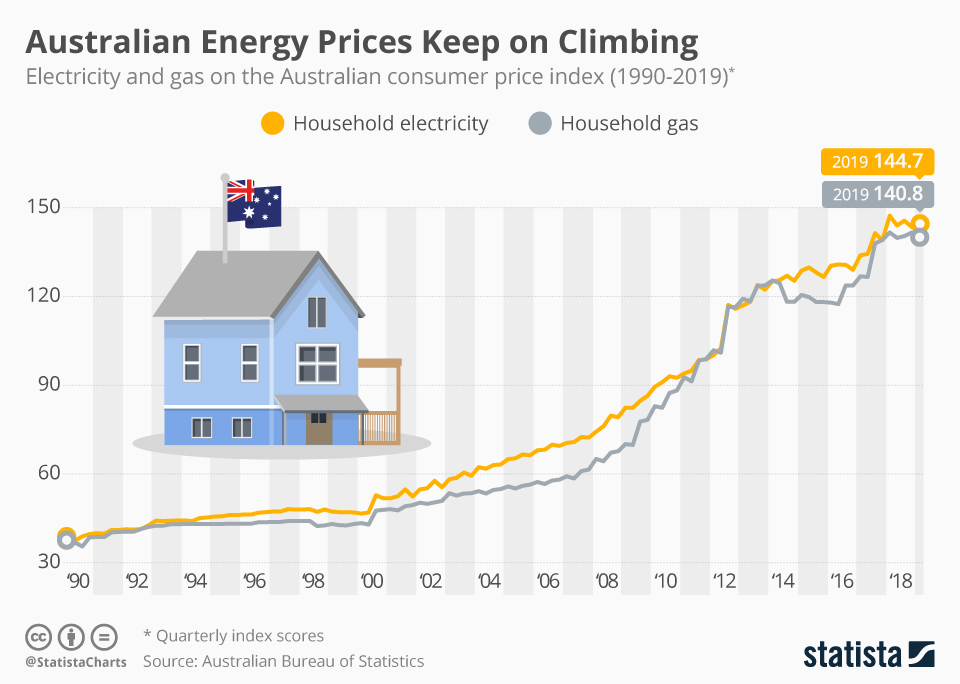
If you’re trying to save money on electricity bills, you’re not alone. Across Australia, households are opening their power bills each quarter and wondering the same thing: Why does it keep going up? and what can I actually do about it?

Rising energy prices aren’t just a line item anymore. They affect how you run your home, how comfortable your family feels day to day, and how confident you are about the future. And while there’s no shortage of advice online, most of it either feels too technical, too sales-driven, or too vague to trust.

This guide is designed to help you understand what’s really happening with electricity costs in Australia , and how to reduce electricity expenses without rushing into decisions you might regret later.

Why Electricity Costs in Australia Keep Rising

Before you can lower electricity costs in Australia, it helps to understand why bills are climbing in the first place.

For most households, it’s a mix of:

  • Increasing wholesale energy prices
  • Network and infrastructure costs
  • Greater household energy use (air conditioning, home offices, EV charging)
  • Dependence on grid power during peak times

Even if you haven’t changed how you use electricity, the system around you has…and that’s why so many families feel stuck on an endless price-rise cycle.

The good news? You’re not powerless here. But the solution isn’t always as simple as “use less power”.

What Rising Power Bills Mean for You at Home

If you’re a homeowner, electricity costs don’t just affect your monthly budget, they affect long-term financial stability.

You might be noticing:

  • Bills creeping up every year
  • More hesitation around running appliances or air conditioning
  • Worry about future costs as your family grows or your lifestyle changes
  • Confusion around which “energy-saving” options are actually worth it

For many Australian families, the real stress isn’t just the bill itself…it’s the fear of making the wrong decision and wasting thousands of dollars.

A Familiar Australian Scenario

You own a home in the suburbs. The mortgage is under control, both adults work, and life is busy. Electricity bills weren’t a huge concern a few years ago, but now they’re impossible to ignore.

You’ve looked online.
You’ve heard neighbours talk about solar, batteries, and energy upgrades.
Every company claims savings, but no one explains it in a way that feels clear.

So you wait.
And while you wait, the bills keep rising.

If that sounds familiar, you’re exactly who this guide is for.

Australian Electricity Cost-Saving Tips That Actually Make Sense

There are plenty of Australian electricity cost-saving tips out there, but not all of them deliver meaningful results.

Here’s what tends to work when applied properly:

1. Understand Your Energy Usage First

Before making changes, you need clarity. Knowing when and how your household uses electricity helps avoid overpaying for solutions that don’t match your needs.

2. Focus on Reducing Grid Dependence

Households that rely entirely on the grid are the most exposed to price rises. Reducing that reliance, even partially can stabilise long-term costs.

3. Prioritise Long-Term Value Over Quick Wins

Cheap fixes often lead to expensive regrets. Real energy bill savings strategies are built around durability, performance, and suitability for your home.

4. Avoid One-Size-Fits-All Solutions

What works for your neighbour may not work for you. Roof type, household size, usage patterns, and future plans (like EVs) all matter.

How to Reduce Electricity Expenses Without Regret

The biggest mistake homeowners make isn’t spending money…it’s spending money without clarity.

To reduce electricity expenses safely, look for solutions that:

  • Are designed for Australian homes
  • Come with clear performance expectations
  • Include ongoing support, not just installation
  • Make sense for where your household is heading in the next 10–20 years

The goal isn’t just a lower bill next quarter. It’s confidence that you’ve made a smart, future-proof decision.

Energy Bill Savings Strategies That Support Long-Term Stability

Effective energy bill savings strategies do more than cut costs, they create predictability.

When your energy setup works properly:

  • Monthly expenses become more stable
  • You’re less affected by external price hikes
  • Your home works for you, not against you
  • Planning for the future feels easier

That peace of mind is what many Australian families are really looking for.. even if they don’t say it out loud.

Choosing Affordable Energy-Saving Solutions That Last

Affordable energy-saving solutions aren’t about being cheap, they’re about being worth it.

The right solution should:

  • Deliver measurable savings over time
  • Be supported locally
  • Adapt to future needs
  • Reduce stress, not add to it

If a solution feels rushed, confusing, or overly sales-driven, it’s okay to pause. Smart decisions don’t come from pressure.. they come from understanding.

The Bigger Picture: Protecting Your Family’s Financial Future

When you take control of electricity costs, you’re doing more than trimming a bill.

You’re:

  • Protecting your household budget
  • Reducing long-term financial stress
  • Making your home more resilient
  • Creating stability for the people who matter most

And that’s what truly matters, not chasing trends, but making choices you’ll feel good about years from now.

Final Thoughts

Rising electricity prices are a reality in Australia…but feeling helpless about them doesn’t have to be.

When you focus on clarity, long-term value, and solutions that fit your home, saving money on electricity bills becomes less about guesswork and more about confidence. You don’t need to decide everything today.
But you do deserve clear information, honest guidance, and solutions that genuinely support your future.