
Solar Battery Guide | NSW | Updated March 2026
Is Adding a Battery to Existing Solar Worth It in 2026? (NSW Analysis)
You already have solar panels. Good. They’ve been doing their job — generating power during the day, cutting your bills, and for a while there, earning you a decent feed-in tariff.
But here’s what’s changed. The money you get for sending power back to the grid has dropped to almost nothing. Most NSW households are now getting 5 to 8 cents per kilowatt-hour — while buying power at night for 30 cents or more. You’re giving away solar energy for almost nothing, then paying full price to run your house after dark.
That gap — and the government rebate that now makes batteries roughly 30% cheaper upfront — is why the question of adding a battery to existing solar has shifted from ‘probably not yet’ to ‘this actually makes sense for a lot of homes’.
This guide is for NSW homeowners who already have solar and want an honest look at whether a battery is worth it in 2026. No fluff, no sales pitch. Just the numbers and the honest answer.
| The Short Answer For most NSW households who use power mainly in the evenings, have a feed-in tariff below 8¢/kWh, and get electricity bills above $300/quarter despite having solar — yes, adding a battery in 2026 is worth it. The combination of low feed-in tariffs, rising grid electricity prices, and the current government rebate makes the payback period shorter than it has ever been. |
Why the Numbers Finally Make Sense in NSW
For years, solar batteries were the answer to a question the maths hadn’t quite justified yet. The panels paid for themselves easily, but the batteries were expensive and the payback stretched beyond the warranty period.
Two things changed that:
- Feed-in tariffs collapsed. Where NSW households were once earning 15–20¢ per kWh for exported solar, most are now on 5–8¢. Some retailers are offering as little as 3¢. The incentive to send power to the grid has almost disappeared.
- The federal rebate arrived. From July 2025, the Cheaper Home Batteries Program cut roughly 30% off the upfront cost of an eligible battery — applied directly to your invoice. That one change shortened payback periods by years.
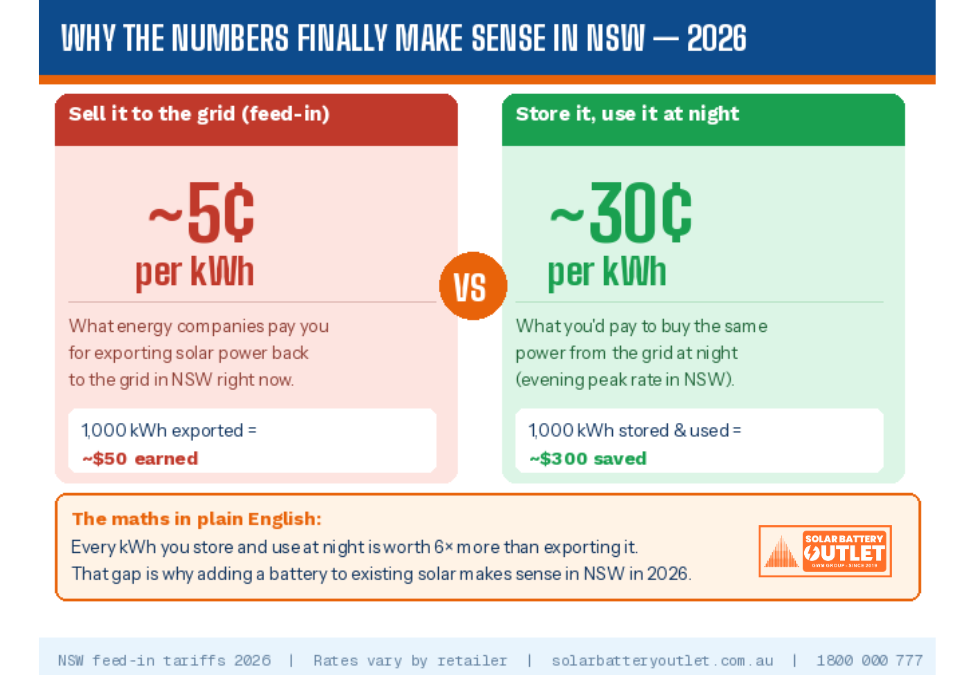
The core reason a battery makes sense in NSW: every kWh you store is worth 6× more than every kWh you export
The maths is this simple: right now in NSW, every kilowatt-hour of solar you export earns you roughly 5 cents. Every kilowatt-hour you store in a battery and use at night saves you roughly 30 cents. That’s a 6-to-1 difference in value.
A household that exports 4,000 kWh per year earns about $200 from the grid. That same 4,000 kWh stored and used at night saves roughly $1,200 off the electricity bill. Same solar energy. Very different outcome.
Is a Battery Actually Worth It for Your Home?
The honest answer depends entirely on your usage patterns, your existing solar system, and your electricity bills. Here’s a plain breakdown:
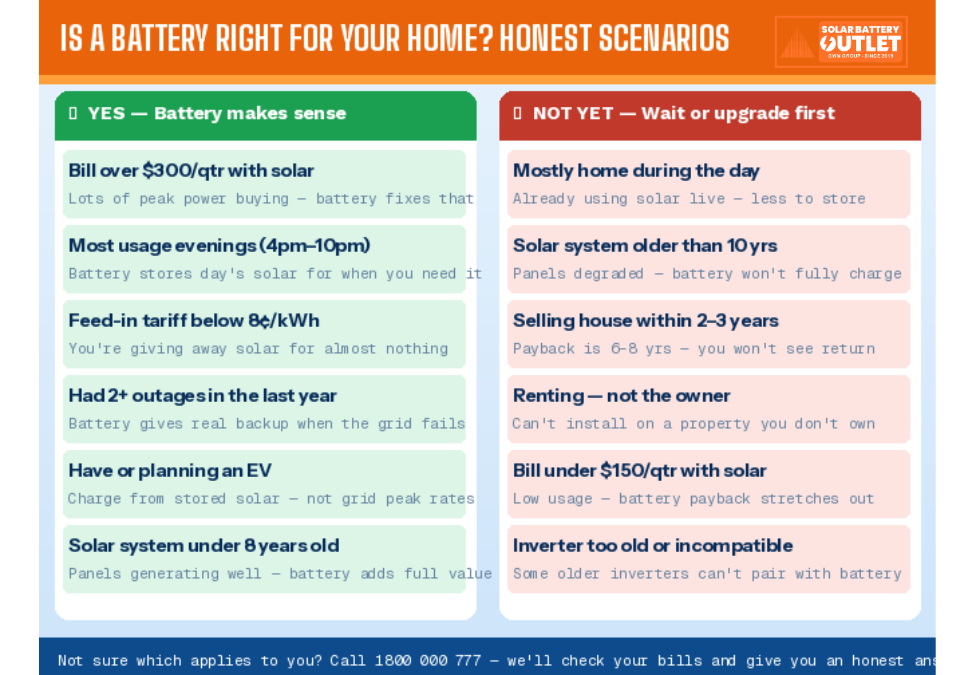
When a battery makes sense for your NSW home — and when it’s better to wait
The situations where it makes the most sense
- Your electricity bill is still over $300 per quarter despite having solar. This tells us you’re drawing a lot of power from the grid — usually in the evenings. A battery captures your daytime solar and uses it to power those evening hours instead of buying grid power at peak rates.
- Most of your household usage happens between 4pm and 10pm. Families with kids home from school, people finishing work in the evening — this is the most common pattern in Liverpool and South West Sydney. It’s also the most expensive time to use grid power. A battery flips that.
- Your feed-in tariff is below 8 cents per kWh. If you’re getting 5–8¢ for every kWh you export, you’re effectively gifting your solar energy to the grid for a fraction of its real value. Storing it instead is the financially smarter move.
- You have an electric vehicle, or you’re planning to get one. Charging an EV overnight from the grid at peak rates costs significantly more than charging it from stored solar. If an EV is on your radar in the next year or two, a battery starts paying back even faster.
- You’ve experienced power outages. South West Sydney gets more grid outages than people realise, especially in summer storms. A battery with backup capability keeps your lights, fridge, and essentials running when the grid goes down.
The situations where it’s better to wait
- Your solar system is older than 10 years. Panels degrade over time — typically losing around 0.5% output per year. A system that’s 10-plus years old might be generating 30–40% less than it did when new. Adding a battery to a weak solar system means the battery may rarely fully charge. In this case, a full solar and battery upgrade together often makes more financial sense.
- You’re mostly home during the day. If you work from home and run appliances through the day, you’re already using your solar as it generates. There’s less surplus to store — and a battery adds less value than it would for a household that’s out all day.
- You’re planning to sell within 2–3 years. Battery payback periods in NSW currently sit at 6–8 years. If you’re selling before you see the return, the investment benefits the next owner more than you. It may add some value to the property, but not dollar for dollar.
- Your inverter is very old or incompatible. Some older inverters — particularly those more than 8–10 years old — can’t integrate with a modern battery. Ask an installer to check your existing inverter before you commit to anything. You may need an inverter upgrade, which adds cost.
What the Rebates Actually Mean for Your Out-of-Pocket Cost
The cost conversation changed significantly when the federal Cheaper Home Batteries Program launched. Here’s what’s currently available for NSW homeowners:
- Federal Cheaper Home Batteries Program: Roughly 30% off the upfront installed cost of an eligible battery. Applied directly to your invoice — you don’t apply for it separately. For a 10 kWh system that’s around $3,100 off automatically.
- NSW VPP Incentive (Peak Demand Reduction Scheme): Up to $1,500 for connecting your battery to a Virtual Power Plant. A VPP just means your battery joins a software network that helps stabilise the grid at peak times. Your battery stays in your home. Most homeowners are comfortable with it, and you can claim this on top of the federal rebate.
| Important: Rebate Rate Drops After 1 May 2026 The federal rebate is currently at $311 per usable kWh of battery capacity. From 1 May 2026, this drops to $252 per usable kWh — and will decrease again every 6 months after that. If you’re seriously considering a battery this year, getting your installation done before May 2026 locks in the higher rate. For a 10 kWh battery, the difference is around $600. |
What Does the Payback Actually Look Like?
This is the question that matters most. Here’s an honest picture for three common NSW household types:
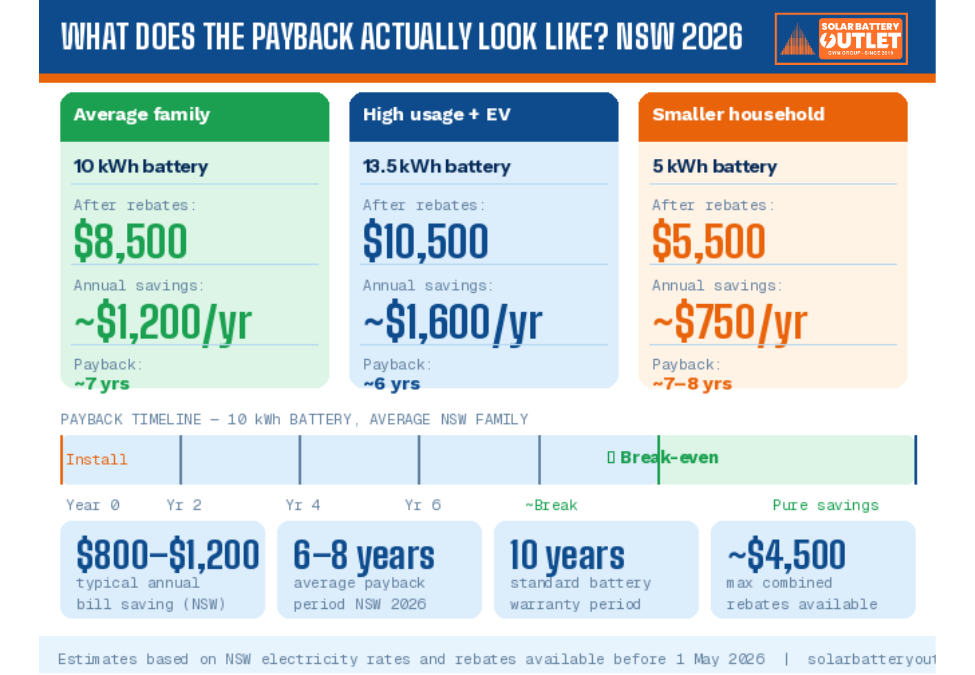
Estimated payback scenarios for NSW households adding a battery to existing solar in 2026
A few important notes on those numbers:
- These figures assume NSW electricity rates of around 30¢/kWh at peak times, which is consistent with what most Liverpool and South West Sydney households are currently paying
- Annual savings can increase over time as electricity prices rise — which they have done consistently in NSW
- Joining a VPP adds modest ongoing payments or bill credits on top of the bill savings shown above
- The payback clock starts from installation day — not from when you first get interest in buying
Does Your Existing Solar System Work With a Battery?
This is a practical question many homeowners skip, and it matters. Not every existing solar setup is battery-ready without changes.
- Inverter compatibility: Battery-ready hybrid inverters are now standard in new installs, but older systems often have a basic string inverter that can’t directly interface with a battery. You may need an AC-coupled battery (which works alongside your existing inverter) or an inverter replacement. A good installer will tell you which applies before you sign.
- Solar system size: Most batteries work best when paired with at least 6.6 kW of solar panels. If your existing system is smaller — say 3–4 kW — it may not generate enough surplus to charge a 10 kWh battery fully each day. A battery sized to match your actual solar output is worth discussing with your installer.
- System age and output: Ask your installer to check your current generation data before recommending a battery size. If your panels are performing well, great. If output has degraded significantly, a smaller battery — or a full system upgrade — may be the smarter path.
| What to Ask Your Installer Before You Commit Before agreeing to anything, ask your installer three questions specific to your existing system: (1) Is my current inverter compatible with the battery you’re recommending? (2) Is my solar system generating enough to fully charge a battery most days? (3) Does my switchboard need upgrading before installation? Any reputable installer will check all three before quoting — not after you’ve signed. |
The Right Battery Size for an Existing Solar Home
Bigger isn’t always better. The right battery size depends on how much solar surplus you generate and how much power you use after dark.
A rough guide for NSW homes adding a battery to existing solar:
- 5 kWh battery: Good for smaller households with lower evening usage. Lower upfront cost, shorter payback. Less useful if you have high power loads after dark or an EV.
- 10 kWh battery: The sweet spot for most average NSW families. Covers typical evening usage, charges reasonably from a standard 6.6 kW solar system, and qualifies for good rebate value.
- 13–15 kWh battery: Worth considering if you have high evening usage, an EV, or you want stronger blackout protection. Make sure your solar system is large enough to charge it reliably.
The most common mistake we see is homeowners buying the largest battery available because it feels like better value. A battery that doesn’t fully charge every day because your solar system can’t fill it is not giving you the return the numbers suggest.
Frequently Asked Questions
Can I add a battery if I already claimed the old NSW battery rebate?
The old NSW Empowering Homes program ended on 30 June 2025. If you claimed that previously, you may still be eligible for the current NSW VPP Incentive — provided your battery meets the technical requirements for VPP participation. Ask an installer to check your existing setup.
Do I need to switch electricity retailers to get a battery?
Not necessarily, but some VPP providers do require you to use their energy retail partner to join the VPP incentive. This is worth understanding before signing up — some VPP offers are genuinely good value, others are less clear. Ask your installer to explain the full terms of any VPP they recommend.
Will a battery work during a blackout?
Only if it’s installed with blackout protection capability enabled — and not all battery and inverter combinations support this by default. When getting quotes, always ask specifically: ‘Does this installation include automatic blackout protection?’ and confirm it’s included in the system design, not an optional extra.
How long does the installation take on an existing solar home?
For a home with a compatible inverter and a switchboard that’s already up to standard, a battery installation typically takes 4 to 6 hours. If a switchboard upgrade is needed or the inverter needs replacing, it may take a full day. Your installer should give you a clear time estimate when they quote.
What happens to my feed-in tariff when I add a battery?
Your feed-in tariff stays the same. Adding a battery doesn’t change your contract with your energy retailer. What changes is how much you export — because instead of sending surplus solar to the grid for 5¢, you’re storing it for use at night instead. You’ll likely export less, which is the whole point.
| Want to Know If a Battery Makes Sense for Your Specific Home? We’re a Liverpool-based installer servicing all of South West Sydney. We’ll check your existing solar system, your bills, and your inverter compatibility before recommending anything. No obligation, no pressure. Call us: 1800 000 777 Or fill in our 60-second eligibility check at solarbatteryoutlet.com.au |
| About Solar Battery Outlet We’re a Liverpool-based solar battery installer, part of GWM Group Pty Ltd, servicing homes across South West Sydney, Bankstown, Campbelltown, Mudgee, and the greater NSW region. All installations by SAA-accredited electricians. We handle federal rebate and NSW VPP incentive paperwork so you don’t have to. |