
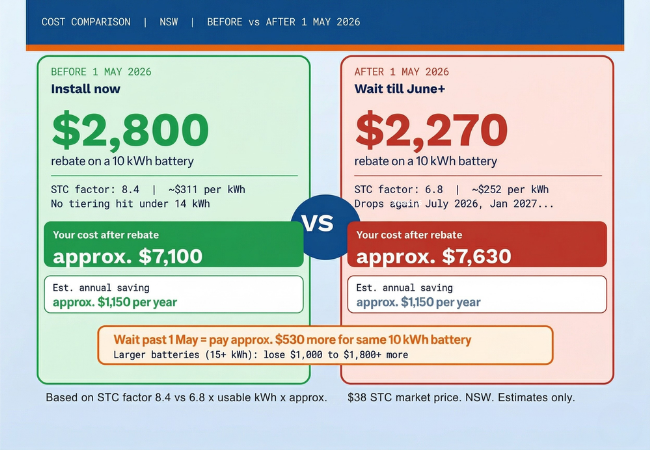
How Much More Does a Solar Battery Cost After 1 May 2026?
Short answer: for a standard 10 kWh battery, about $530 more. For a 13.5 kWh system like the Tesla Powerwall 3, about $760 more. For anything above 15 kWh, the gap widens significantly — $1,000 to over $1,800.
Here is exactly how those numbers work, why they are what they are, and what it actually means for your decision.
| Why is the rebate dropping on 1 May? The federal Cheaper Home Batteries Program has been wildly popular since launching in July 2025 — installations jumped from about 200 per day to over 1,500 per day. The government expanded funding from $2.3 billion to $7.2 billion to keep the program running to 2030, but adjusted the rate downward to keep it sustainable. The rebate was always designed to reduce as battery prices fall over time. |
The Full Cost Comparison — Every Common Battery Size
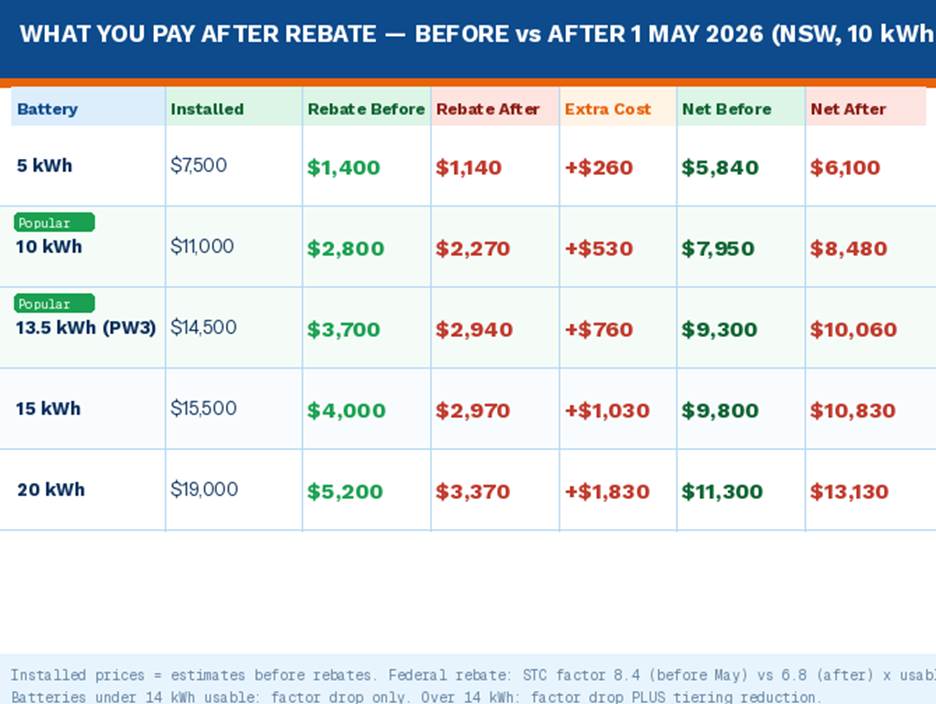
A few things worth noting from this table:
- The ‘extra cost’ column is the difference in rebate between installing before and after 1 May 2026. It is not what the battery costs in total — it is what you lose in rebate value.
- For batteries under 14 kWh usable capacity, the only hit is the STC factor dropping from 8.4 to 6.8. No tiering penalty applies.
- For batteries over 14 kWh, there is a double hit — the factor drop AND the new tiered structure that applies reduced STC rates to capacity above 14 kWh. That is why the 20 kWh column jumps to $1,830 extra.
- The annual saving from the battery itself does not change — that is determined by your electricity tariff and usage. The difference is purely in how much you pay upfront.
The Rebate Keeps Declining — Not Just in May
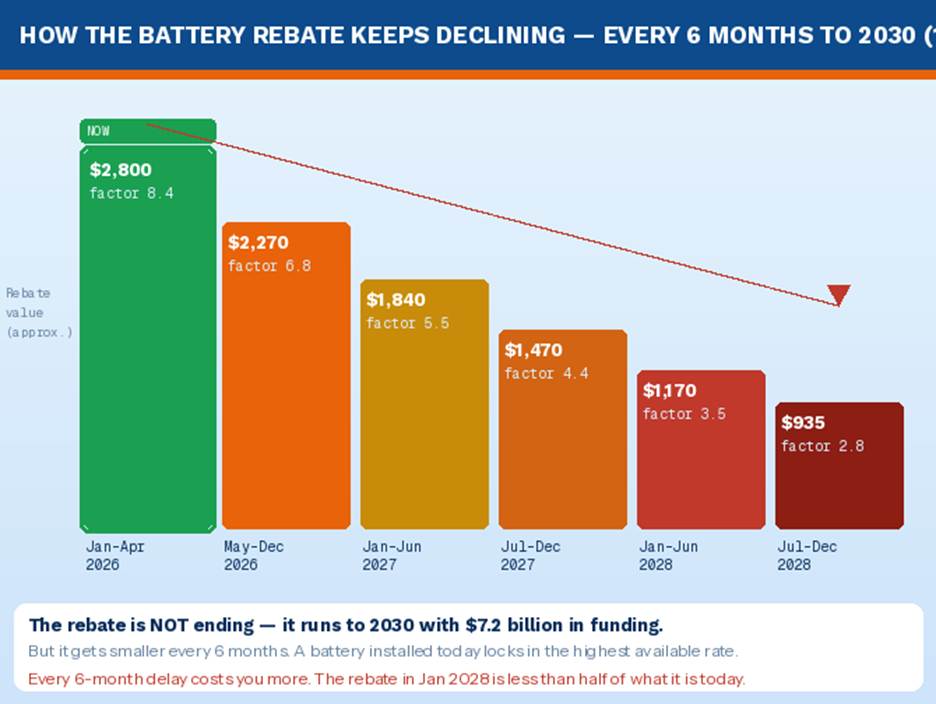
This is the part most people do not realise. The 1 May change is not a one-off. From May 2026, the STC factor steps down every six months. By January 2028, a 10 kWh battery that gets you $2,800 today will only get you around $1,170 in rebate — less than half.
The rebate does not disappear. The program runs to 2030 and has $7.2 billion behind it. But it is designed to wind down gradually as battery prices fall. Every six months you wait, the rebate is a little smaller.
| The honest take on timing: If you are seriously considering a battery, the best time to install has always been before the next step-down. That is not a scare tactic — it is just how the scheme was designed. Whether that means acting before 1 May 2026 or before January 2027 depends on your situation. What it does mean is that waiting years to install will cost you significantly more than waiting months. |
So Is the Extra Cost Worth Rushing For?
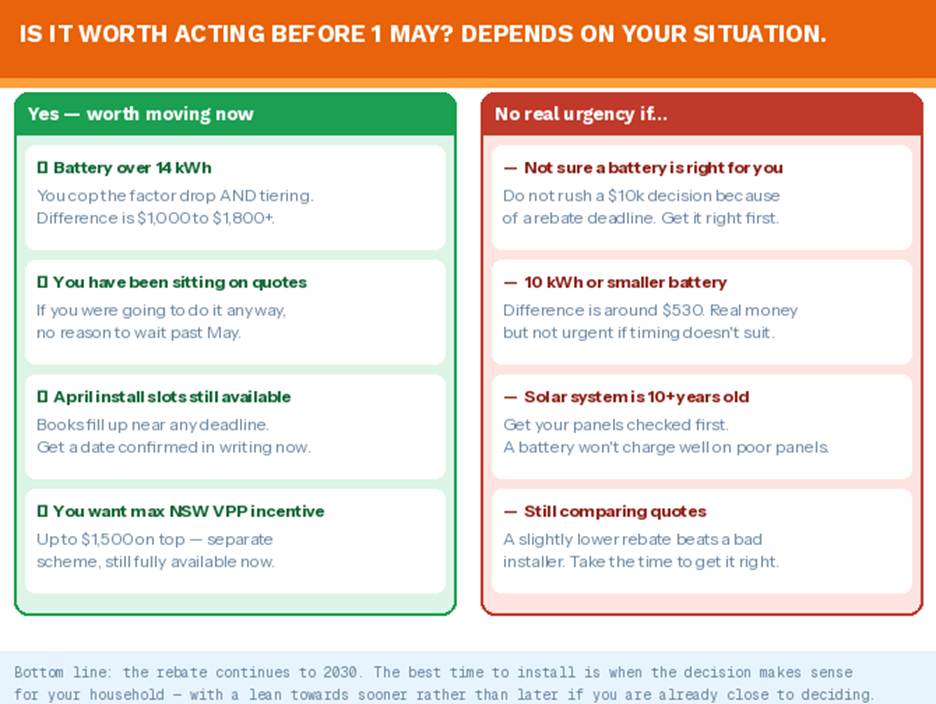
Whether $530 to $760 more is worth acting on before 1 May depends entirely on where you are in your decision. Let us be straight about it.
Worth moving now if…
- You are considering a battery over 14 kWh — the tiering adds a second hit on top of the factor drop, so the cost difference is more substantial
- You have already compared quotes and were getting around to booking — there is no good reason to delay past May
- Your installer has April slots available — books do fill closer to any deadline, and the last thing you want is a rushed job
- You want to claim the NSW VPP incentive alongside — up to $1,500 on top of the federal rebate, and fully available right now
No real rush if…
- You are not yet sure a battery is right for your home — do not let a rebate deadline push you into a $10,000 decision you are not ready to make
- You are still comparing quotes and need more time — a $530 saving means nothing if you end up with the wrong installer
- Your solar system is old and needs checking first — a battery will not perform well on a degraded solar system
- Your household does not yet use much power in the evenings — sort that question first before committing to storage
The bottom line is this: the rebate is real, the decline is real, and for most NSW families considering a battery, there is no compelling reason to wait past May if you are already close to deciding. But it should not be the thing that makes the decision for you.
What the Maths Actually Looks Like on Payback
Some people hear $530 and think that changes their payback calculation dramatically. It does not — at least not at the 10 kWh level. Here is a quick comparison:
| Payback comparison — 10 kWh battery, NSW family: Install before May 2026: Net cost ~$7,100 | Annual saving ~$1,150 | Payback ~6.2 years Install after May 2026: Net cost ~$7,630 | Annual saving ~$1,150 | Payback ~6.6 years Difference: 5 months on the payback period. Meaningful — but not dramatic for a 10+ year battery. |
For a 20 kWh battery the gap is larger — about 18 months difference in payback. If you are planning a big system and the timing works, acting before May genuinely makes financial sense.
Frequently Asked Questions
Does the NSW VPP incentive also drop on 1 May?
No. The NSW Peak Demand Reduction Scheme is a separate state incentive — up to $1,500 for connecting your battery to a Virtual Power Plant. It is not affected by the 1 May federal changes. You can still stack both incentives.
If I sign a contract before 1 May, do I get the old rate?
No — and this is important. Your rebate is determined by the date the battery is physically installed and registered, not the date you sign. An installer who tells you to ‘sign now to lock in the rate’ without giving you an actual installation date before 1 May is not being straight with you. Get the confirmed install date in writing.
What if battery prices fall after May to make up the difference?
Possibly over time, but not on 2 May. Battery hardware prices have been falling slowly and gradually over years. The government rebate is designed to step down as those prices fall — the idea is that your net cost stays roughly similar over time. Whether that plays out exactly depends on market conditions, exchange rates and supply chains. No one can tell you with certainty what battery prices will do in June 2026.
Is it worth installing a bigger battery before May just to maximise the rebate?
Probably not. The tiering structure after May is specifically designed to reduce the incentive for oversizing. But even before May, you should size your battery for what your household actually needs — not to maximise certificate count. A battery that is too large for your solar and usage pattern will not charge fully most days, which wastes money and stresses the battery. Any good installer will tell you the same thing.
| Want the Numbers for Your Specific Home? Every home is a bit different — your bill, your solar size, your tariff and your evening usage all affect the real payback numbers. We are based in Liverpool and Bankstown and do a free no-obligation quote for NSW homeowners. We will show you the exact rebate you qualify for, both federal and NSW VPP, and the honest payback estimate for your situation. Call us: 1800 000 777 Or visit solarbatteryoutlet.com.au — 60-second eligibility form, no sales call if you do not want one. |
| About Solar Battery Outlet We are a Liverpool-based solar battery installer, part of GWM Group Pty Ltd, servicing homes across South West Sydney, Bankstown, Campbelltown, and the greater NSW region. All installations are done by SAA-accredited electricians. We handle all rebate paperwork so you do not have to. |