How Much More Does a Solar Battery Cost After 1 May 2026?

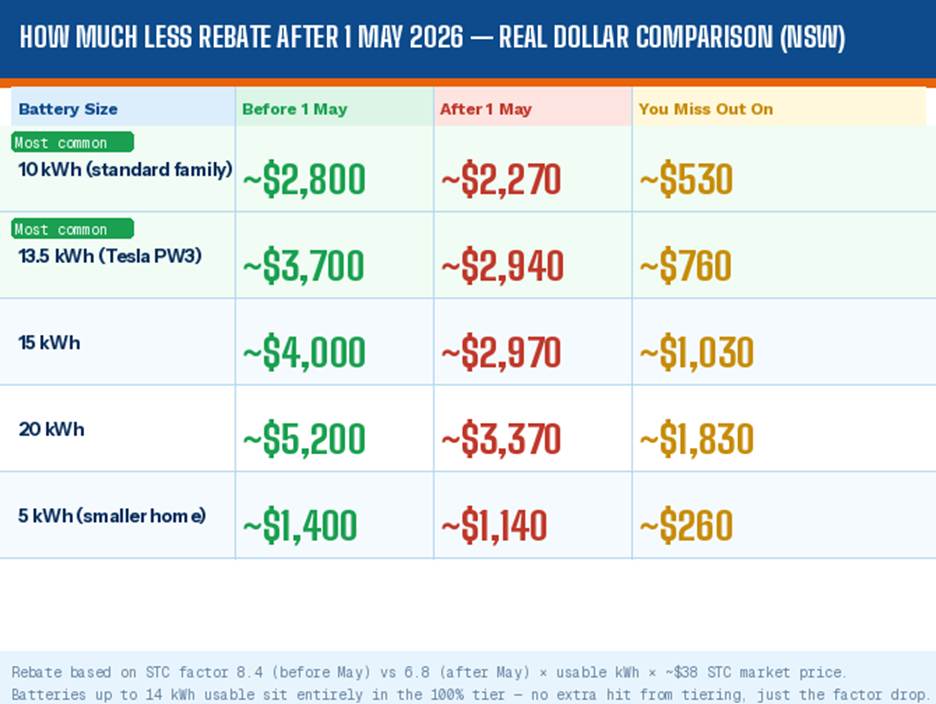
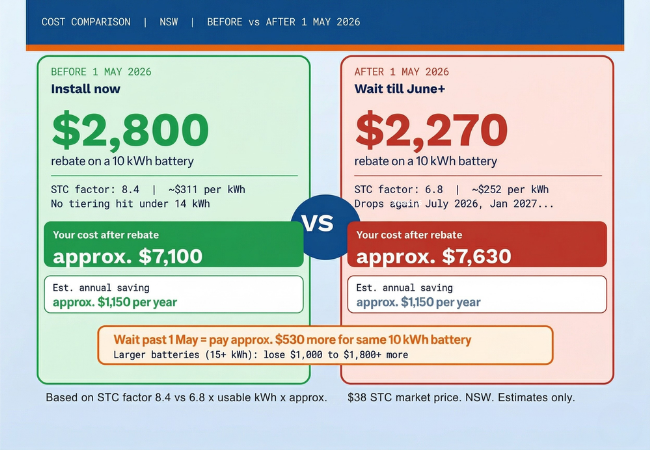
Short answer: for a standard 10 kWh battery, about $530 more. For a 13.5 kWh system like the Tesla Powerwall 3, about $760 more. For anything above 15 kWh, the gap widens significantly — $1,000 to over $1,800.

Here is exactly how those numbers work, why they are what they are, and what it actually means for your decision.

Why is the rebate dropping on 1 May? The federal Cheaper Home Batteries Program has been wildly popular since launching in July 2025 — installations jumped from about 200 per day to over 1,500 per day. The government expanded funding from $2.3 billion to $7.2 billion to keep the program running to 2030, but adjusted the rate downward to keep it sustainable. The rebate was always designed to reduce as battery prices fall over time.

The Full Cost Comparison — Every Common Battery Size
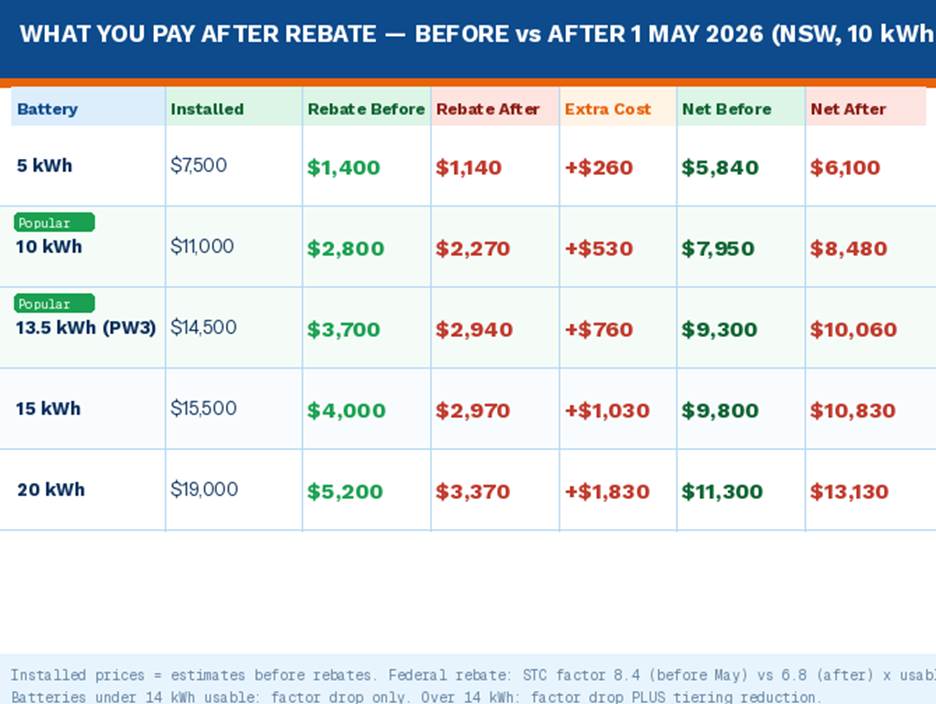
A few things worth noting from this table:

  • The ‘extra cost’ column is the difference in rebate between installing before and after 1 May 2026. It is not what the battery costs in total — it is what you lose in rebate value.
  • For batteries under 14 kWh usable capacity, the only hit is the STC factor dropping from 8.4 to 6.8. No tiering penalty applies.
  • For batteries over 14 kWh, there is a double hit — the factor drop AND the new tiered structure that applies reduced STC rates to capacity above 14 kWh. That is why the 20 kWh column jumps to $1,830 extra.
  • The annual saving from the battery itself does not change — that is determined by your electricity tariff and usage. The difference is purely in how much you pay upfront.

The Rebate Keeps Declining — Not Just in May
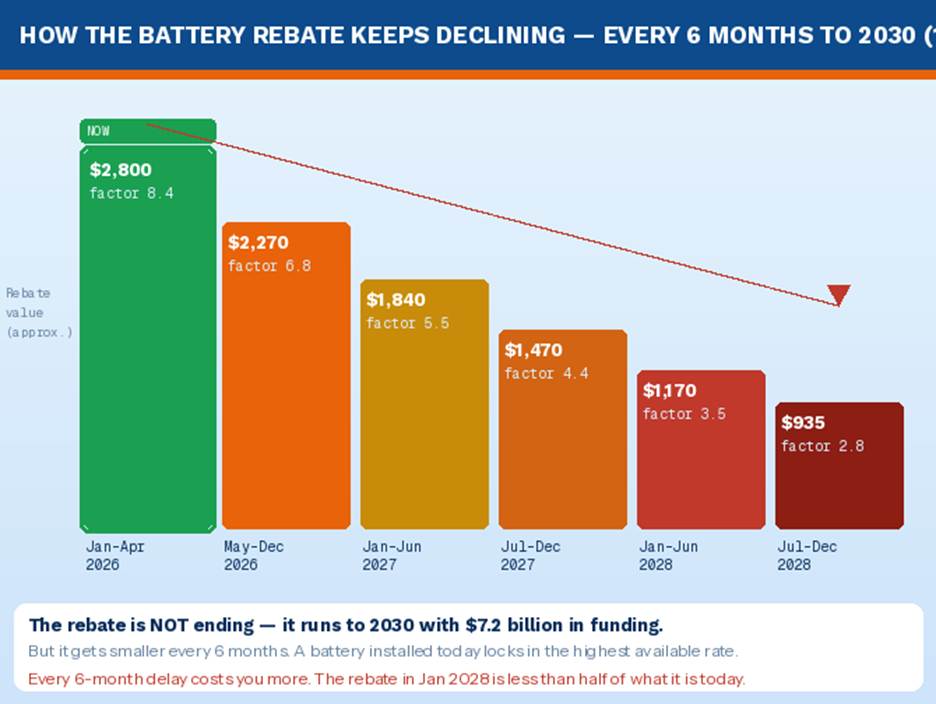
This is the part most people do not realise. The 1 May change is not a one-off. From May 2026, the STC factor steps down every six months. By January 2028, a 10 kWh battery that gets you $2,800 today will only get you around $1,170 in rebate — less than half.

The rebate does not disappear. The program runs to 2030 and has $7.2 billion behind it. But it is designed to wind down gradually as battery prices fall. Every six months you wait, the rebate is a little smaller.

The honest take on timing: If you are seriously considering a battery, the best time to install has always been before the next step-down. That is not a scare tactic — it is just how the scheme was designed. Whether that means acting before 1 May 2026 or before January 2027 depends on your situation. What it does mean is that waiting years to install will cost you significantly more than waiting months.

So Is the Extra Cost Worth Rushing For?
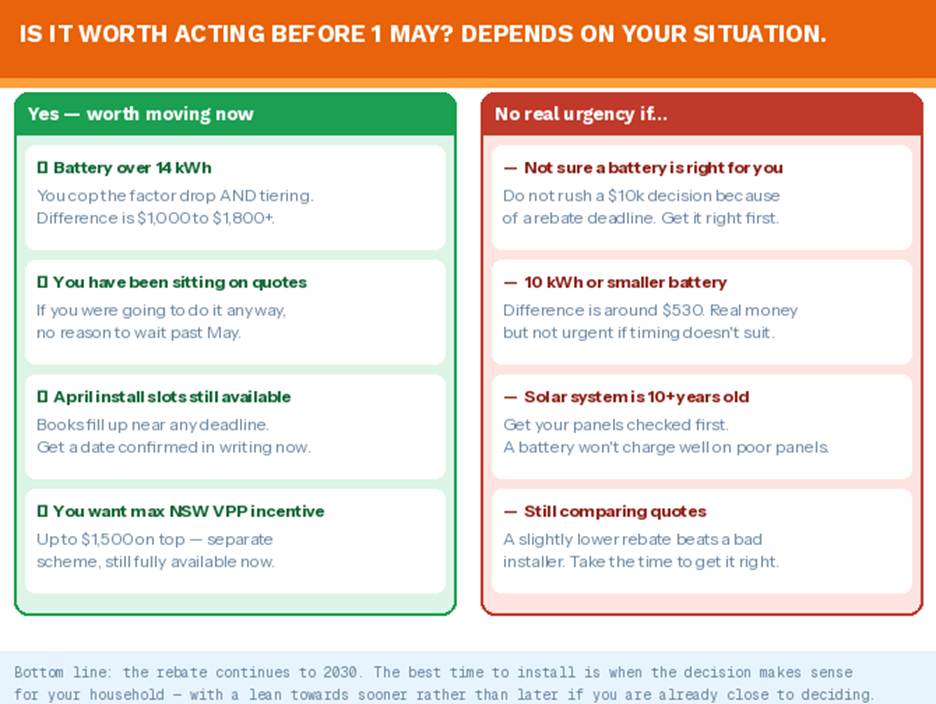
Whether $530 to $760 more is worth acting on before 1 May depends entirely on where you are in your decision. Let us be straight about it.

Worth moving now if…

  • You are considering a battery over 14 kWh — the tiering adds a second hit on top of the factor drop, so the cost difference is more substantial
  • You have already compared quotes and were getting around to booking — there is no good reason to delay past May
  • Your installer has April slots available — books do fill closer to any deadline, and the last thing you want is a rushed job
  • You want to claim the NSW VPP incentive alongside — up to $1,500 on top of the federal rebate, and fully available right now

No real rush if…

  • You are not yet sure a battery is right for your home — do not let a rebate deadline push you into a $10,000 decision you are not ready to make
  • You are still comparing quotes and need more time — a $530 saving means nothing if you end up with the wrong installer
  • Your solar system is old and needs checking first — a battery will not perform well on a degraded solar system
  • Your household does not yet use much power in the evenings — sort that question first before committing to storage

The bottom line is this: the rebate is real, the decline is real, and for most NSW families considering a battery, there is no compelling reason to wait past May if you are already close to deciding. But it should not be the thing that makes the decision for you.

What the Maths Actually Looks Like on Payback

Some people hear $530 and think that changes their payback calculation dramatically. It does not — at least not at the 10 kWh level. Here is a quick comparison:

Payback comparison — 10 kWh battery, NSW family: Install before May 2026: Net cost ~$7,100 | Annual saving ~$1,150 | Payback ~6.2 years Install after May 2026: Net cost ~$7,630 | Annual saving ~$1,150 | Payback ~6.6 years Difference: 5 months on the payback period. Meaningful — but not dramatic for a 10+ year battery.

For a 20 kWh battery the gap is larger — about 18 months difference in payback. If you are planning a big system and the timing works, acting before May genuinely makes financial sense.

Frequently Asked Questions

Does the NSW VPP incentive also drop on 1 May?

No. The NSW Peak Demand Reduction Scheme is a separate state incentive — up to $1,500 for connecting your battery to a Virtual Power Plant. It is not affected by the 1 May federal changes. You can still stack both incentives.

If I sign a contract before 1 May, do I get the old rate?

No — and this is important. Your rebate is determined by the date the battery is physically installed and registered, not the date you sign. An installer who tells you to ‘sign now to lock in the rate’ without giving you an actual installation date before 1 May is not being straight with you. Get the confirmed install date in writing.

What if battery prices fall after May to make up the difference?

Possibly over time, but not on 2 May. Battery hardware prices have been falling slowly and gradually over years. The government rebate is designed to step down as those prices fall — the idea is that your net cost stays roughly similar over time. Whether that plays out exactly depends on market conditions, exchange rates and supply chains. No one can tell you with certainty what battery prices will do in June 2026.

Is it worth installing a bigger battery before May just to maximise the rebate?

Probably not. The tiering structure after May is specifically designed to reduce the incentive for oversizing. But even before May, you should size your battery for what your household actually needs — not to maximise certificate count. A battery that is too large for your solar and usage pattern will not charge fully most days, which wastes money and stresses the battery. Any good installer will tell you the same thing.

Want the Numbers for Your Specific Home?
Every home is a bit different — your bill, your solar size, your tariff and your evening usage all affect the real payback numbers. We are based in Liverpool and Bankstown and do a free no-obligation quote for NSW homeowners. We will show you the exact rebate you qualify for, both federal and NSW VPP, and the honest payback estimate for your situation.
Call us: 1800 000 777
Or visit solarbatteryoutlet.com.au — 60-second eligibility form, no sales call if you do not want one.
About Solar Battery Outlet We are a Liverpool-based solar battery installer, part of GWM Group Pty Ltd, servicing homes across South West Sydney, Bankstown, Campbelltown, and the greater NSW region. All installations are done by SAA-accredited electricians. We handle all rebate paperwork so you do not have to.

The Solar Battery Rebate Is Dropping on 1 May 2026 — Here Is What It Actually Means for NSW Homeowners

You have probably seen the ads. Maybe someone has knocked on your door. The message is always the same: the battery rebate is ending, act now, limited time, call today.

The rebate is not ending. That part is wrong.

But something IS changing on 1 May 2026, and it is worth understanding properly — because depending on the size of battery you are considering, it could mean anywhere from $260 to well over $1,800 less in your pocket if you install after that date.

This guide explains exactly what is changing, who it affects most, who barely notices, and what you should actually do about it — without the panic and without the pushy sales pitch.

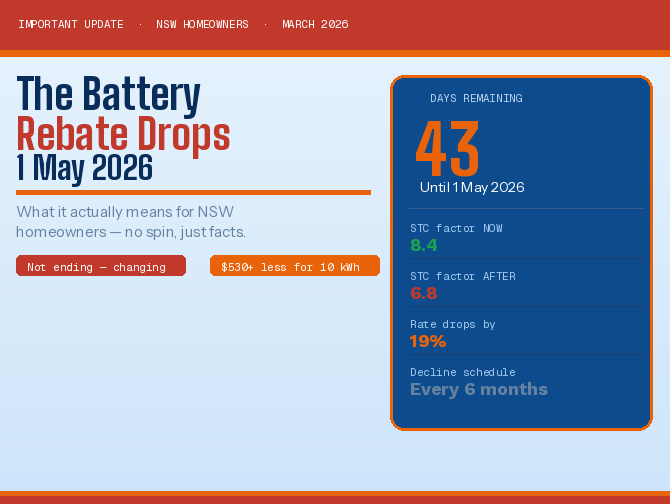
The short version: The federal rebate (called the Cheaper Home Batteries Program) continues until 2030. On 1 May 2026, the rate used to calculate the rebate drops. For a standard 10 kWh battery, that means roughly $530 less in rebate. For bigger systems over 14 kWh, the hit is larger due to a new tiered structure. The rebate continues after May — it just keeps getting a little smaller every six months.

How the Rebate Actually Works — Plain English

The federal battery rebate is delivered through something called Small-scale Technology Certificates — STCs. You do not need to understand the detail, but knowing the basics helps make sense of what is changing.

When you install a battery, your SAA-accredited installer creates a number of STCs based on your battery’s usable capacity. Those certificates have a market value — currently around $38 each. Your installer sells them and passes the savings directly to you as a discount on your invoice. You never see a government form. You never chase a cashback. It comes straight off the price.

The number of STCs your battery earns is calculated using a multiplier called the STC factor. Right now, that factor sits at 8.4. On 1 May 2026, it drops to 6.8. That is a 19% reduction. Smaller factor = fewer certificates = less money off your bill.

The Dollars — Before and After

These numbers are based on the STC factor dropping from 8.4 to 6.8, using a current STC market price of around $38 per certificate. The STC price does fluctuate slightly, so your actual rebate will vary — but the direction is clear.

For the most common battery size — 10 kWh — the difference is around $530. That is real money, but it is not the thousands some ads would have you believe. Be sceptical of anyone quoting you dramatic figures without showing you the maths.

Where the change does bite harder is on bigger batteries — anything above 14 kWh. That brings in the tiered structure.

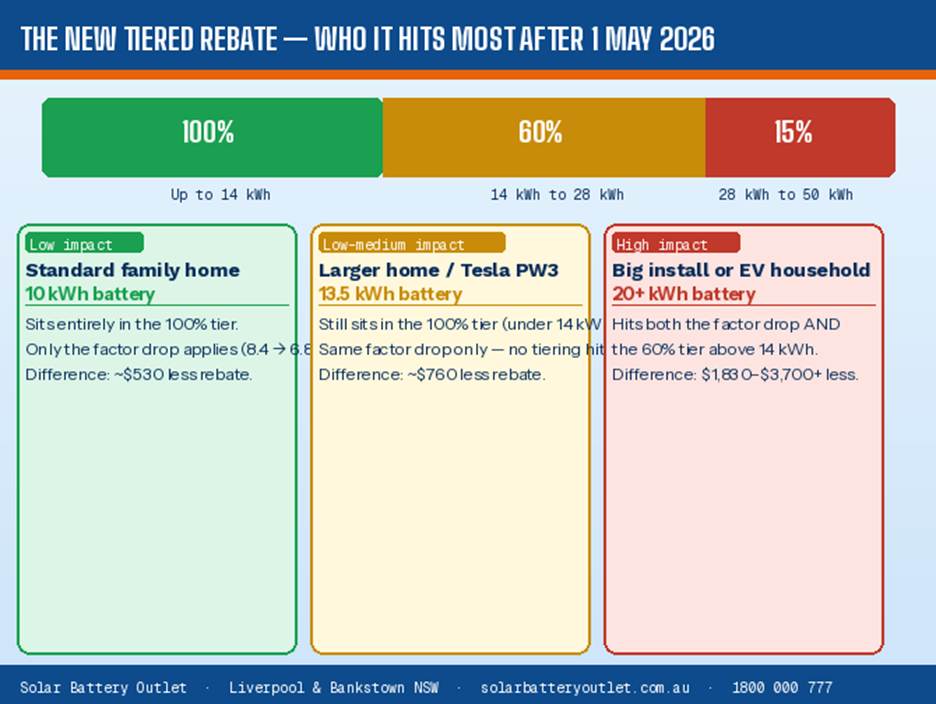
The New Tiered Structure — Who It Hits Most

From 1 May 2026, there is also a new tiered rebate structure for larger batteries. This is separate from the factor drop and only affects systems above 14 kWh.

  • First 14 kWh of usable capacity: full STC factor applies — 100%
  • Between 14 and 28 kWh usable: STC factor applies at 60% — reduced support
  • Between 28 and 50 kWh usable: STC factor applies at just 15% — minimal support

The thing most people miss: if you are buying a standard 10 kWh or 13.5 kWh battery — which covers roughly 80% of residential installs in Australia — the tiering does not touch you at all. Your entire battery sits within the 100% tier. The only difference you feel is the factor drop from 8.4 to 6.8.

The tiering really bites for bigger systems — 20 kWh setups, whole-home installs, or anyone planning a large EV-charging-capable battery. If that is you, the maths on timing is pretty clear.

Why is the government doing this? Federal Energy Minister Chris Bowen called it ‘a victim of its own success.’ The program launched in July 2025 and immediately went off. Installations jumped from about 200 per day to over 1,500 per day. The original $2.3 billion budget was on track to run out well ahead of schedule. The government has now added $4.9 billion to keep the program going until 2030 — but adjusted the rate to make it more sustainable. The rebate is not going away. It is just being calibrated.

So — Is There Actually Any Rush?

Depends on your situation. Here is an honest breakdown.

You should probably get moving if…

  • You are considering a battery over 14 kWh — the tiering adds a meaningful extra hit on top of the factor drop
  • You have been sitting on quotes for a while and were going to get around to it — now is a sensible time to act
  • You want to lock in the current NSW VPP incentive rate as well — that is up to $1,500 on top of the federal rebate, and separate to all of this
  • Your installer is already booked out — April books tend to fill up as the deadline approaches

There is no real urgency if…

  • You are not yet sure a battery is right for your home — do not rush into a $10,000 decision because of a deadline
  • You are planning a 10 kWh or smaller battery and $530 is not the deciding factor in your budget
  • Your solar system is over 10 years old and needs checking first — get that sorted before adding a battery
  • You are comparing quotes and still need time — a slightly smaller rebate is better than the wrong installer

The rebate continues after 1 May. It does not fall off a cliff. It drops again in July 2026, then January 2027, and so on until 2030. The program was always designed to wind down gradually as battery prices fall. The best time to install is whenever the decision makes sense for your household — with a lean towards sooner rather than later.

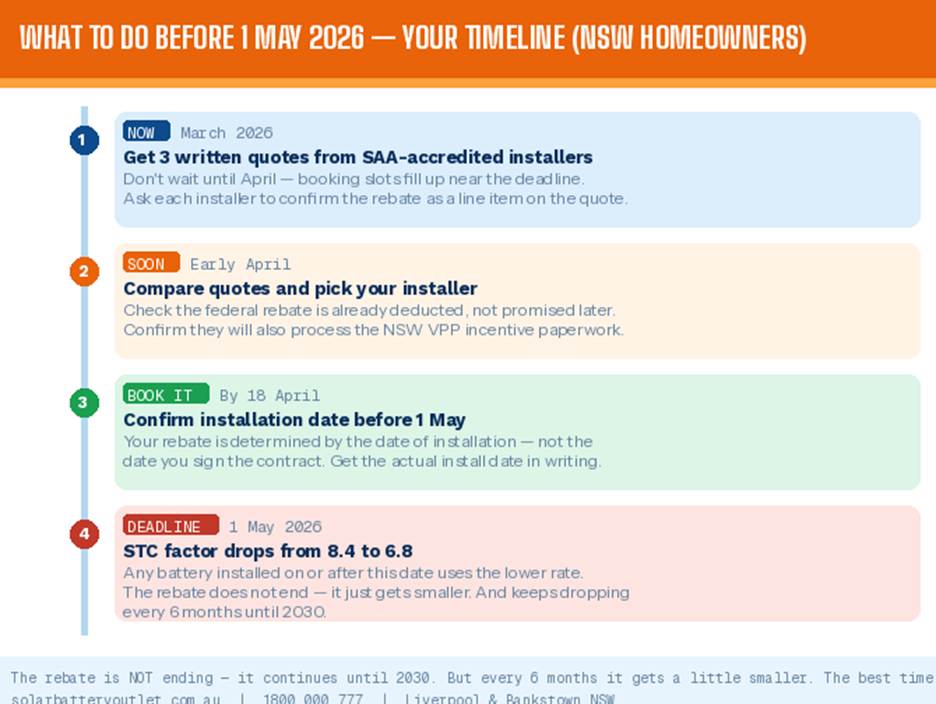
What to Do Before 1 May — A Sensible Order

  • Get 3 written quotes from SAA-accredited installers now — not in late April when everyone else is scrambling
  • Ask each installer to confirm the rebate as a line item on the quote, not a verbal promise
  • Check they are also processing the NSW VPP incentive — up to $1,500 on top, and a separate step most homeowners miss
  • Confirm your actual installation date in writing — your rebate is calculated on the date the battery is physically installed, not the date you sign the contract
  • Verify SAA accreditation before accepting any quote at saaustralia.com.au
One thing to watch out for near any deadline: Some installers will use the 1 May date as a high-pressure sales tactic — door knockers especially. A legitimate installer will show you the maths, give you time to compare, and never pressure you to sign on the spot. If anyone refuses to put things in writing or pushes you for a same-day decision, walk away.

Frequently Asked Questions

Is the solar battery rebate ending in 2026?

No. The federal Cheaper Home Batteries Program continues until 2030. The rate used to calculate the rebate is being reduced from 1 May 2026, and will step down again every six months. The rebate gets smaller over time — it does not disappear.

Does the 1 May change affect the NSW VPP incentive as well?

No. The NSW Peak Demand Reduction Scheme incentive — worth up to $1,500 for connecting your battery to a Virtual Power Plant — is a separate state scheme and is not affected by the 1 May federal changes. You can still stack both.

My installer said I need to sign by a certain date to get the old rate. Is that true?

Partially. Your rebate is determined by the date the battery is physically installed and registered — not the date you sign a contract. Some installers do lock in installation slots in advance and will commit to booking you in before May. That is legitimate. What is not legitimate is pressure to hand over money based on a contract date alone. Get the actual installation date confirmed in writing.

What if I cannot get an installation slot before 1 May?

The rebate still applies after 1 May — just at a lower rate. A battery installed in June 2026 will receive around $530 less rebate than one installed in April (for a 10 kWh system). That is meaningful but not catastrophic. If the wait gets you a better installer or a better price, it can still be the right call.

Will battery prices drop after May to offset the rebate reduction?

Possibly over time, but not immediately on 2 May. Battery hardware prices in Australia have been gradually falling over several years. The federal rebate was designed to step down as prices fall, keeping the net cost relatively steady for homeowners. Whether that actually plays out depends on exchange rates, supply chains, and demand — which no one can predict reliably.

Want a Quote Before 1 May? We Are Based in Liverpool and Bankstown.
Our installation calendar for April is filling up. If you want to lock in the current rebate rate, now is a good time to get a written quote. No obligation, no pressure — just the numbers for your home. We handle both the federal rebate and NSW VPP incentive paperwork. You do not need to do a thing except say yes.
Call us: 1800 000 777
Or visit solarbatteryoutlet.com.au and fill in the 60-second eligibility form.
About Solar Battery Outlet We are a Liverpool-based solar battery installer, part of GWM Group Pty Ltd, servicing homes across South West Sydney, Bankstown, Campbelltown, and the greater NSW region. All installations are done by SAA-accredited electricians. We handle all rebate paperwork so you do not have to.