
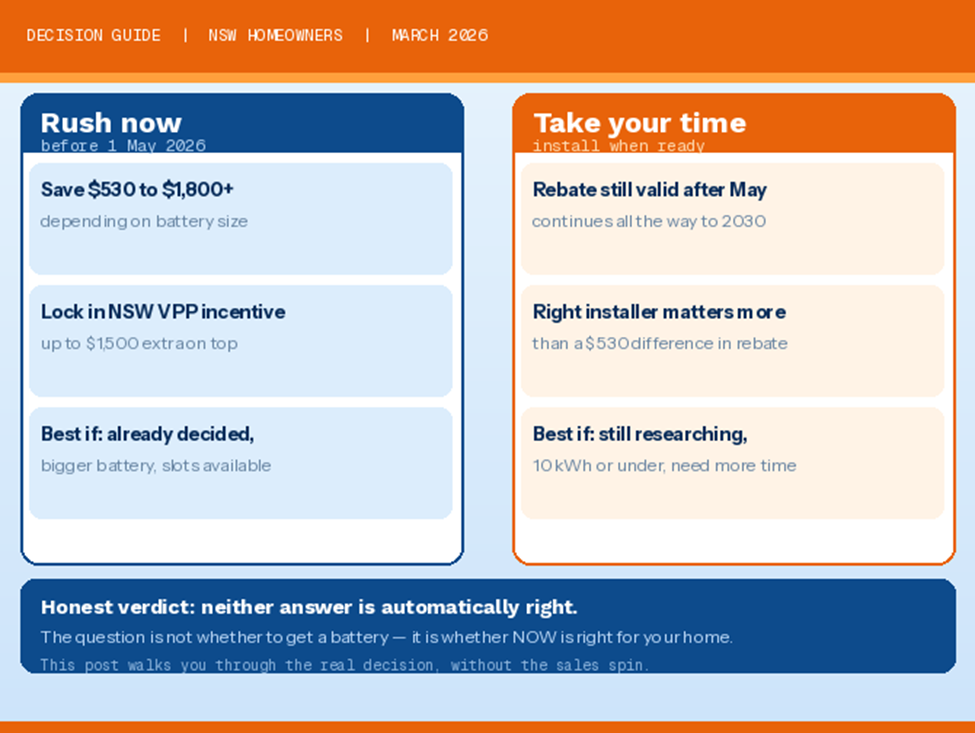
If you are reading this, you have probably already seen the ads. The countdown timers. The ‘act now before it is too late’ messaging that has been all over social media since the government announced the 1 May rebate change.
Here is the honest answer: it depends on your situation. And anyone who tells you otherwise — without knowing anything about your home, your electricity usage, your solar system, or your budget — is trying to sell you something.
This guide gives you five straightforward questions to work through. Answer them honestly and you will know exactly whether you should be moving quickly or taking your time.
| First — what is actually happening on 1 May 2026? The federal battery rebate is not ending. It runs until 2030. What is changing is the rate used to calculate the rebate — the STC factor drops from 8.4 to 6.8. For a standard 10 kWh battery, that means roughly $530 less rebate. For larger batteries above 14 kWh, the hit is bigger due to a new tiered structure. The rebate continues after May — it just keeps getting a little smaller every six months. |
Five Questions That Tell You Whether to Rush or Wait
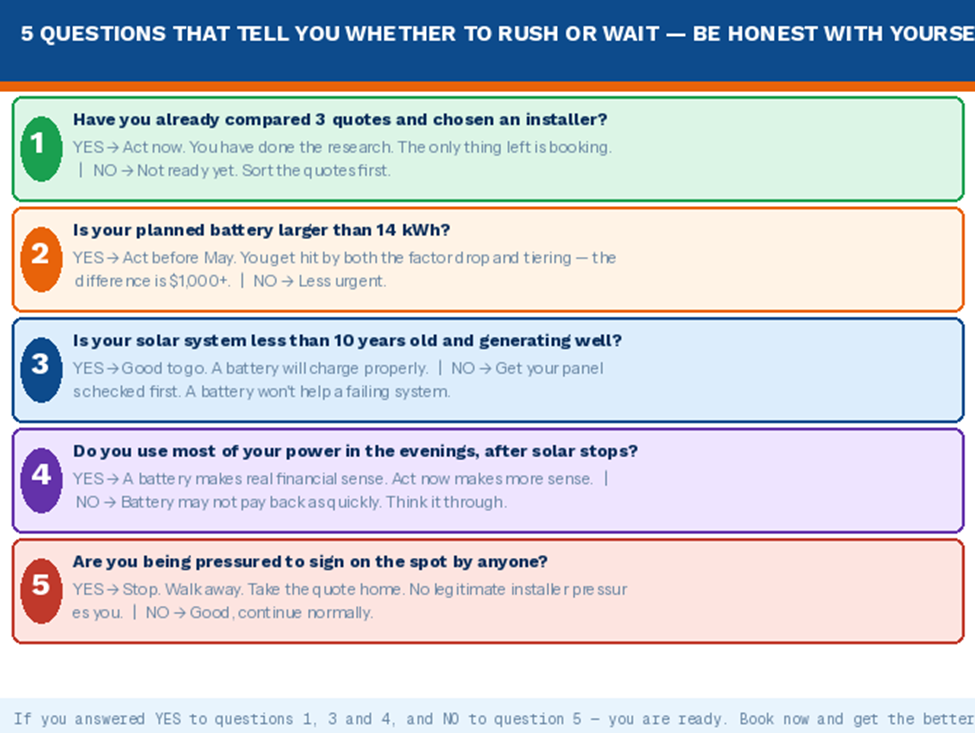
Work through these in order. Be straight with yourself.
Question 1: Have you already compared at least 3 written quotes?
This is the most important question. If the answer is no, you are not ready to book — and rushing into a booking without comparing quotes is the most expensive mistake you can make with solar batteries.
A difference of $530 in rebate savings means nothing if you end up with the wrong installer, the wrong battery size, or a quote that has not accounted for a switchboard upgrade you need. Get your three quotes first. Then make the timing decision.
If yes: you have done the work. There is no good reason to delay past 1 May if you are already ready to book.
If no: start there. Get the quotes. Then come back to the timing question.
Question 2: Is your planned battery larger than 14 kWh?
From 1 May 2026, there is a new tiered rebate structure that reduces support for batteries above 14 kWh of usable capacity. If you are planning a 20 kWh system, a whole-home setup, or anything that pushes above that threshold, the cost difference between installing before and after May is not $530 — it is $1,000 to $1,800 or more.
At that level the maths on timing is pretty clear, assuming you are already ready to go.
If yes: this is a meaningful saving. Worth acting before May if your other questions check out.
If no: the factor drop alone gives you a $530 difference. Real money, but not urgent.
Question 3: Is your solar system less than 10 years old and generating well?
A battery will not help you much if your solar panels are degraded and not generating properly. Before adding storage, it is worth knowing how your existing system is performing.
If your system is over 10 years old, get a quick health check from a solar technician before booking a battery. Adding a $10,000 battery to a solar system that generates poorly is throwing money at the wrong problem.
If yes: your system should charge a battery well. Good to proceed.
If no: sort the solar first. The battery can wait.
Question 4: Do you use most of your power in the evenings, after solar stops generating?
This is the core question about whether a battery will actually save you meaningful money. A battery stores the solar power your panels generate during the day and releases it at night when electricity is expensive — typically 30 cents or more per kWh in NSW.
If you work from home, are retired, or are home all day, you might already be using a lot of your solar output directly. A battery will help less in that case than for a family that is out all day and runs the dishwasher, oven and TV from 5pm onwards.
If yes: a battery is likely to give you a solid return. The timing decision becomes more financially meaningful.
If no: take the time to understand your usage pattern before committing. A free quote assessment from a good installer will look at your bills and advise you properly.
Question 5: Is anyone pressuring you to sign on the spot?
This one is a bit different. It is not about your home — it is about protecting yourself from a common tactic that spikes around any rebate deadline.
Door knockers. Cold callers. ‘Limited spots available.’ ‘Sign today to guarantee your rate.’ These are not legitimate sales techniques — they are pressure tactics that solar regulators in NSW have repeatedly warned about.
A legitimate installer will: give you a written quote, leave it with you to compare, answer questions honestly, and respect your timeline.
If you are being pressured: stop. Take the quote home. Call the installer back in your own time. If they will not give you a written quote to take away, that is your answer.
What the Payback Numbers Actually Look Like
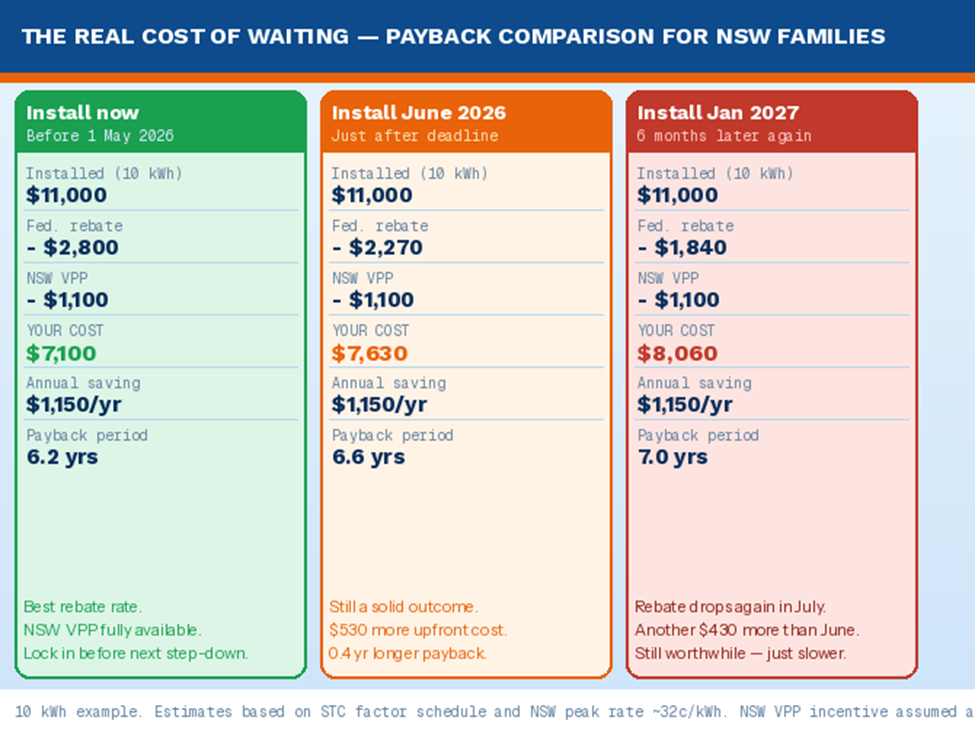
The payback comparison puts the timing decision in perspective. For a 10 kWh battery in NSW:
- Install before 1 May 2026: net cost around $7,100, payback around 6.2 years
- Install June 2026: net cost around $7,630, payback around 6.6 years — half a year longer
- Install January 2027: net cost around $8,060, payback around 7.0 years — a full year longer than today
The annual saving from the battery itself does not change — that is determined by how much electricity you use at night and what your tariff is. The only difference is in the upfront cost, which affects how long until you break even.
The takeaway: every six months you delay adds roughly four to six months to your payback period. Over years, that compounds. But for a 10 kWh battery, the difference between installing in April 2026 and June 2026 is about half a year on payback — meaningful but not dramatic.
| The one scenario where timing really matters: If you are planning a larger battery — 15 kWh, 20 kWh, or anything above 14 kWh — the 1 May change hits harder because of the tiered structure on top of the factor drop. A 20 kWh system loses over $1,800 in rebate after May. At that level, if you are already ready to go, the case for acting before May is genuinely strong. |
Before You Book Anything — Know What to Look For
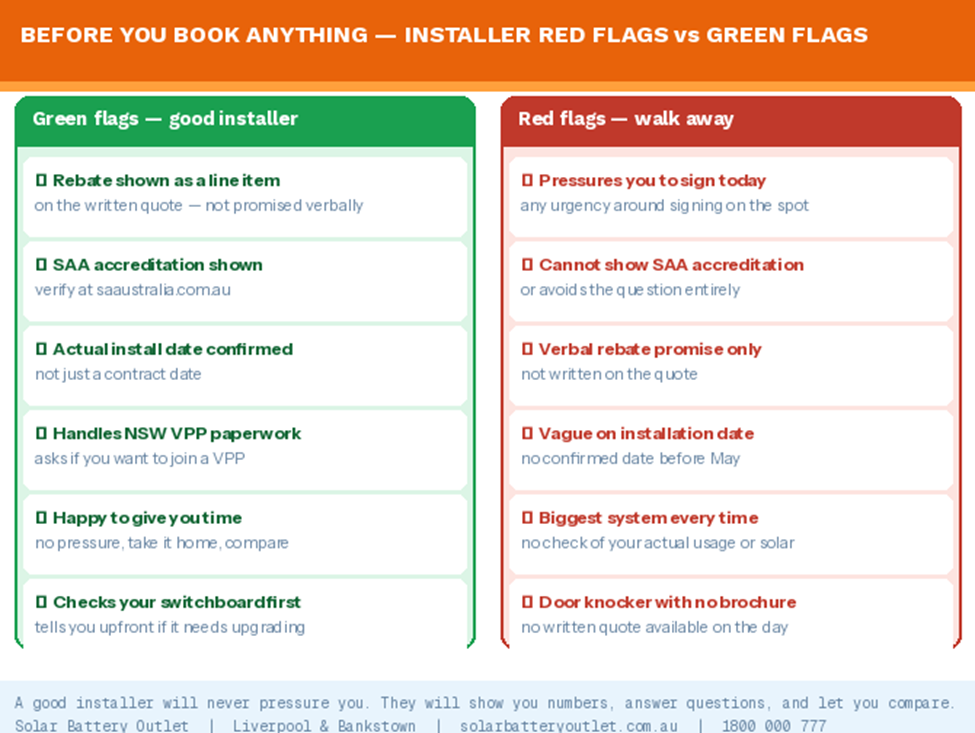
Whether you are booking before May or later, the quality of your installer matters more than any rebate timing. Here is what separates a good installer from a poor one.
Green flags — signs of a good installer
- The federal rebate appears as a dollar deduction on the written quote — not a verbal promise
- They can show you their SAA accreditation number — verify it yourself at saaustralia.com.au
- They give you an actual confirmed installation date, not just a contract signing date
- They ask about your electricity usage and solar system before recommending a battery size
- They mention the NSW VPP incentive and ask if you want to participate
- They are happy for you to take the quote home and compare it
Red flags — walk away
- Any pressure to sign on the same day — ‘this price is only available today’
- Cannot produce an SAA accreditation number or avoids the question
- Rebate mentioned verbally but not shown on the written quote
- No confirmed installation date before 1 May — just a contract date
- Recommends the biggest possible system without looking at your bills or usage
- Door knocker with no leave-behind quote — nothing in writing on the day
So — Should You Rush?
Here is the straight answer:
Rush if: you have compared quotes, chosen an installer, your solar is in good shape, you use power in the evenings, and you are planning a battery over 14 kWh. In that case, there is no good reason to wait past May.
Take your time if: you are still researching, not sure a battery is right for you, have an older solar system that needs checking, or are being pressured by anyone. A $530 difference in rebate is not worth making a rushed decision on a $10,000 purchase.
Either way: the rebate continues to 2030. Batteries still make financial sense after May. The decision should be driven by your readiness — not by a deadline.
| One last thing worth saying plainly: We install solar batteries for a living. It would be easy for us to tell you to rush, book now, do not wait. But the homeowners who get the best outcome from a battery are the ones who made the decision properly — not the ones who were panicked into it. If you are not ready, take more time. We will still be here in June. |
Frequently Asked Questions
If I wait until June, will I still qualify for the NSW VPP incentive?
Yes. The NSW Peak Demand Reduction Scheme — up to $1,500 for connecting to a Virtual Power Plant — is a separate state incentive and is not affected by the 1 May federal changes. You can claim both rebates regardless of when you install.
Can I lock in the current rebate rate by signing a contract now, even if installation is after May?
No. Your rebate is determined by the date the battery is physically installed and commissioned — not the date you sign a contract. Any installer who tells you otherwise is not being straight with you. Get the actual installation date confirmed in writing before May if you want the current rate.
I am not sure if my electricity usage justifies a battery. How do I find out?
Ask any reputable installer to look at your last 12 months of electricity bills. A good installer will tell you honestly whether a battery makes financial sense for your home before recommending one. Be cautious of anyone who recommends a battery without looking at your bills first.
Are there any battery brands I should avoid buying near a deadline?
The brand is less important than the installer. Near any deadline, some less reputable operators push cheap or uncertified batteries because margins are easier to hide. Stick to established brands — Tesla Powerwall, BYD, Sungrow, Enphase, Growatt — and make sure the battery is SAA product-listed. Ask your installer to show you the product listing if you are unsure.
| Not Sure If You Are Ready? Talk to Us First. We do free no-obligation quotes for NSW homeowners across Liverpool, Bankstown, and Mudgee. We will look at your bills, check your solar setup, and tell you honestly whether a battery makes sense — and whether timing matters for your situation. No countdown timer. No pressure. Just the numbers. Call us: 1800 000 777 Or visit solarbatteryoutlet.com.au — fill in the 60-second eligibility form and we will be in touch. |
| About Solar Battery Outlet: We are a Liverpool-based solar battery installer, part of GWM Group Pty Ltd, servicing homes across Bankstown and Mudgee. All installations are done by SAA-accredited electricians. We handle all rebate paperwork, so you do not have to. |