
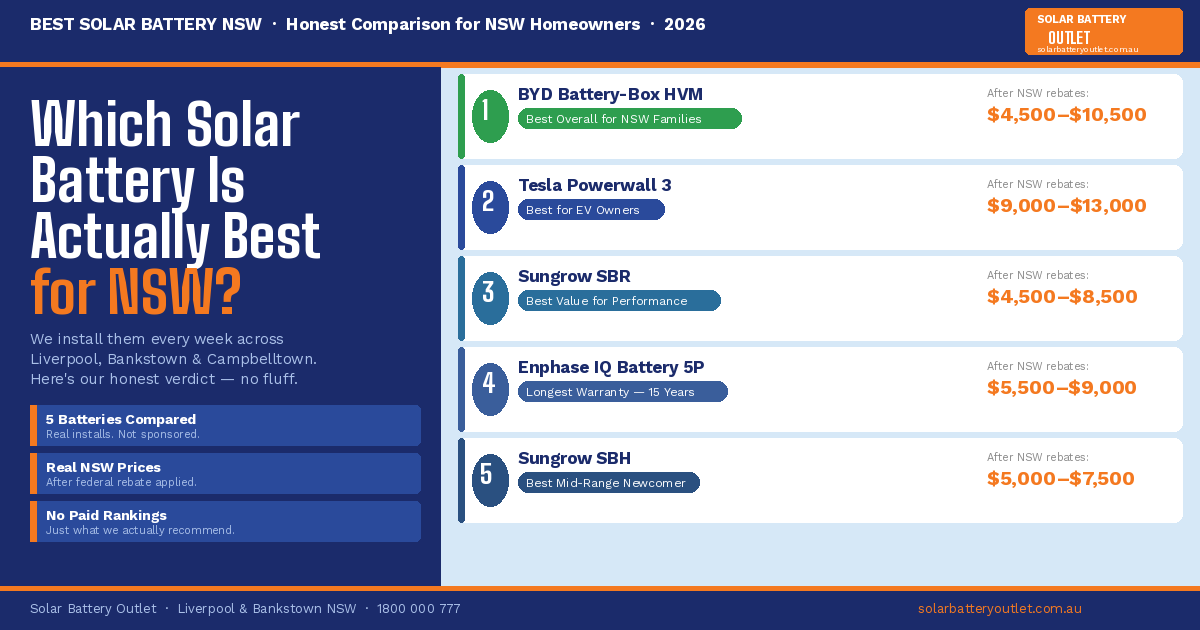
Best Solar Battery NSW 2026: What We Actually Recommend After Installing Hundreds of Them
Here’s the honest truth about “best solar battery” lists you find online.
Most of them are written by people who’ve never installed a battery in their life. They copy spec sheets, rank by storage capacity, and slap an affiliate link at the bottom. The brand that pays the most commission usually wins.
We do this differently.
Our team installs solar batteries every week across Liverpool, Bankstown, Campbelltown and South West Sydney. We see which batteries perform quietly for years. We see which ones throw error codes at 2am. We see which brands actually show up when something goes wrong under warranty — and which ones leave homeowners waiting months for a response.
This guide is based on that experience. Not sponsored rankings. Not manufacturer spec sheets. Just what we’ve genuinely seen work well in NSW homes in 2026 — and what the right choice looks like depending on your situation.
Before we get into it: The federal battery rebate rate drops after 1 May 2026. Every battery on this list qualifies for it. For a 10 kWh system, installing before May saves around $530 compared to waiting. All prices in this guide are shown after the current rebate rate. See exactly how the rebate works here.
First — What Makes a Battery “Best” in NSW Specifically?
This matters because NSW has specific conditions that affect which battery suits your home.
Heat. Western Sydney summers are brutal. Batteries sitting in garages or on west-facing walls in Bankstown, Liverpool and Campbelltown experience higher ambient temperatures than coastal suburbs. Heat degrades batteries faster. Battery chemistry and thermal management matter more here than they do in Melbourne or Adelaide.
Ausgrid network requirements. Most of NSW — including all of South West Sydney — runs on the Ausgrid network. Ausgrid has specific requirements around how batteries connect and register. Not every battery brand’s firmware plays nicely with every network. An experienced local installer knows which combinations work cleanly.
VPP eligibility. The NSW Peak Demand Reduction Scheme pays you up to $1,500 for connecting your battery to a Virtual Power Plant. Not all batteries are VPP-capable under the scheme. Every battery we recommend below qualifies — but it’s worth knowing this is a NSW-specific filter that rules out some cheaper imported options.
Storm season backup. South West Sydney gets hit hard in summer storms. Blackout protection isn’t just a nice feature here — for a lot of families it’s the whole point. How reliably a battery switches to backup mode when the grid drops is a real performance question, not a marketing checkbox.
With that context, here’s what we actually recommend.
The Best Solar Batteries for NSW Homes in 2026
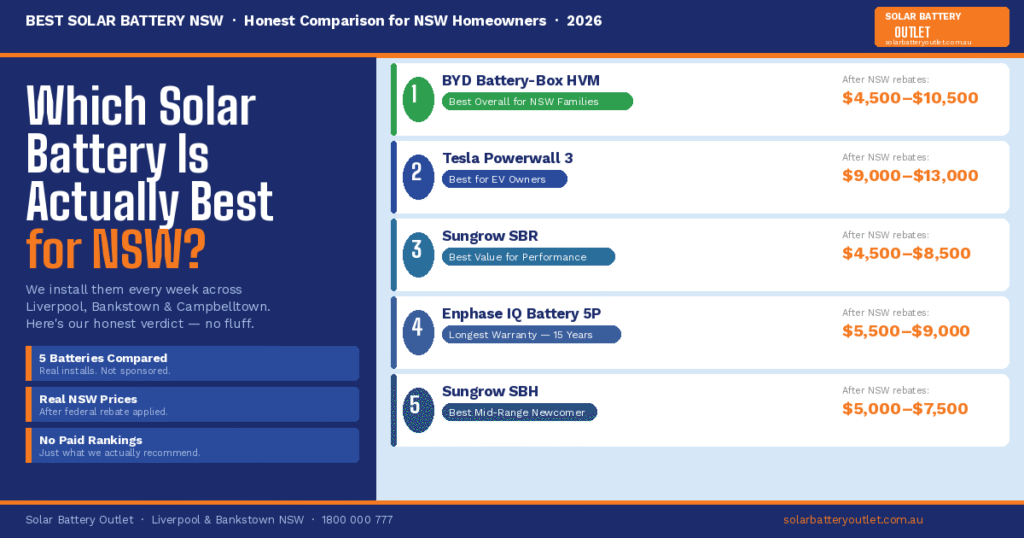
1. BYD Battery-Box HVM — Best Overall for NSW Families
Best for: Most NSW homeowners. Families wanting flexibility. Anyone planning an EV in the next few years.
If we had to recommend one battery to the average NSW family in 2026 — this is it. Not because it’s the flashiest. Because it’s the most sensible combination of performance, price, flexibility and warranty we’ve seen at this price point.
BYD is the world’s largest battery manufacturer. They make batteries for everything from home storage to electric buses to grid-scale projects. That manufacturing scale shows up in consistent quality and genuinely responsive warranty support in Australia.
The modularity is the standout. You start at 8.3 kWh and add modules later up to 22.1 kWh. If you’re not sure how much storage you need right now — or if an EV is coming in the next couple of years — this lets you start with what makes sense today and grow without replacing anything.
The 10-year warranty covers 70% capacity retention. That’s the higher threshold among mid-range options and it means in year 10, your battery should still hold more than two-thirds of its original capacity.
Real numbers for NSW after rebates:
- 8.3 kWh: approximately $4,500–$6,500 installed
- 10 kWh: approximately $5,500–$8,000 installed
- 13.8 kWh: approximately $7,500–$10,500 installed
Watch out for: Needs a compatible hybrid inverter. If you have an older string inverter, confirm compatibility before accepting a quote. This is the most common issue we see with BYD retrofits.
2. Tesla Powerwall 3 — Best Premium Option and Best for EV Owners
Best for: EV owners. Families who want automatic blackout protection. Homes wanting a single all-in-one unit.
The Powerwall 3 earns its reputation. It’s a single 13.5 kWh unit with a built-in inverter — everything in one box, fewer components, cleaner installation, fewer failure points over 10 years.
The blackout protection is the best we’ve seen in a residential battery. When the grid drops, the Powerwall switches automatically. No manual input, no delay, no noticing it happened. For families with medical equipment or just anyone who’s been through one too many summer blackouts in South West Sydney, this matters.
The EV integration is genuinely useful if you’re in the Tesla ecosystem. The Powerwall manages solar generation, home storage and car charging as one system through the Tesla app — deciding when to charge the car from solar versus battery versus grid based on your usage patterns and time-of-use pricing. No other battery on this list matches that level of integration.
Real numbers for NSW after rebates:
- 13.5 kWh: approximately $9,000–$13,000 installed
Watch out for: Fixed capacity — you can’t expand it modularly. If your storage needs grow significantly, you add a second unit. Also the most expensive option on this list. If you’re not in the Tesla EV ecosystem, you’re paying a premium for features you may not fully use.
For a full head-to-head between Powerwall 3 and BYD, we’ve written a detailed Tesla Powerwall 3 vs BYD Battery-Box comparison specifically for NSW homeowners.
3. Sungrow SBR — Best Value for Performance
Best for: Value-focused buyers. Homes already running a Sungrow inverter. Households wanting larger storage without Tesla’s price tag.
Sungrow is the world’s largest solar inverter manufacturer. Their SBR battery range is built on the same engineering heritage — and it shows. The cycle rating on the SBR is among the best in this price bracket, rated at around 6,000 cycles. Over a 10-year period, that’s solid.
It scales from 9.6 kWh up to 25.6 kWh, which makes it a strong option for larger homes or households with higher evening usage. If you’ve already got a Sungrow inverter from a previous solar install — which is common across South West Sydney — the SBR is usually the cleanest and most cost-effective battery to add. No inverter replacement needed.
The 10-year warranty covers 60% capacity retention — slightly lower than BYD and Tesla’s 70% threshold, but at this price point the trade-off is reasonable for most households.
Real numbers for NSW after rebates:
- 9.6 kWh: approximately $4,500–$7,000 installed
- 12.8 kWh: approximately $6,000–$8,500 installed
Watch out for: Works best with Sungrow inverters. AC-coupling to other brands is possible but adds cost and complexity. Confirm your inverter compatibility before getting a quote.
4. Enphase IQ Battery 5P — Best for Long-Term Peace of Mind
Best for: Long-term homeowners who want the longest warranty available. Retrofits onto any existing inverter. Fire-safety conscious buyers.
The Enphase IQ Battery 5P is the only battery available in Australia right now with a 15-year warranty. Everything else on this list is 10 years. If you’re planning to stay in your home for 15 years and you want certainty over that entire window, that warranty alone is a significant differentiator.
It’s fully AC-coupled, which means it connects to almost any existing solar inverter without replacing anything. If your current setup is a few years old and you want to add a battery with the least disruption, Enphase is often the cleanest retrofit technically.
Fire safety credentials are worth mentioning given how hot South West Sydney gets. The IQ 5P carries UL 9540 and UL 9540A certification — the highest fire safety standard available for residential batteries. For homes in bushfire-adjacent areas west of Sydney, this isn’t a small thing.
Real numbers for NSW after rebates:
- 10 kWh setup: approximately $5,500–$9,000 installed
Watch out for: Higher cost per kWh than BYD or Sungrow. Each module is a separate physical unit — you can’t stack them, they sit side by side. For tight spaces this can be a consideration.
5. Sungrow SBH — Best Mid-Range Newcomer Worth Watching
Best for: Mid-range buyers wanting newer technology. Homes with Sungrow inverters wanting an upgrade path.
The SBH is Sungrow’s newer residential battery range and it’s been getting strong reviews from installers across NSW. Better thermal management than the SBR, slightly cleaner firmware, and good compatibility with Sungrow’s latest hybrid inverters.
We’ve been installing it for a few months now and the early feedback from customers has been solid. It’s not as proven in the long-term as BYD or Tesla simply because it hasn’t been around as long — but the engineering behind it is strong and Sungrow’s local support in Australia is responsive.
Real numbers for NSW after rebates:
- 9.6 kWh: approximately $5,000–$7,500 installed
Watch out for: Shorter Australian track record than BYD and Tesla. Ask your installer specifically about local warranty support before committing.
Quick Comparison — All Five Side by Side
| Battery | Capacity | Expandable | Warranty | After NSW Rebates | Best For |
|---|---|---|---|---|---|
| BYD Battery-Box HVM | 8.3–22.1 kWh | Yes | 10yr / 70% | $4,500–$10,500 | Most NSW families |
| Tesla Powerwall 3 | 13.5 kWh | No (add unit) | 10yr / 70% | $9,000–$13,000 | EV owners, premium |
| Sungrow SBR | 9.6–25.6 kWh | Yes | 10yr / 60% | $4,500–$8,500 | Value, Sungrow homes |
| Enphase IQ 5P | 5–15 kWh | Yes | 15yr / 70% | $5,500–$9,000 | Long-term owners |
| Sungrow SBH | 9.6–19.2 kWh | Yes | 10yr / 70% | $5,000–$7,500 | Mid-range upgrade |
How to Choose the Right One for Your NSW Home
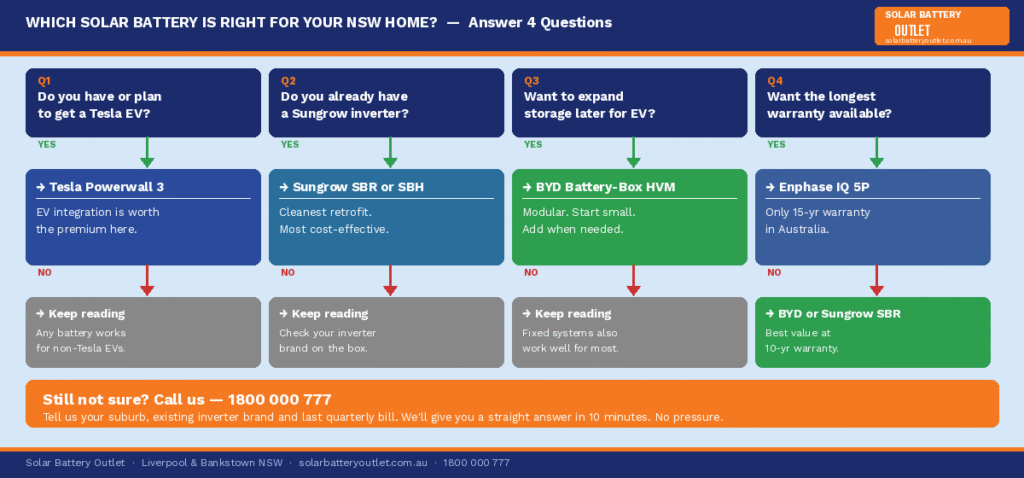
Stop looking at the spec table and ask yourself these four questions instead. They’ll narrow it down faster than any comparison chart.
Do you have or plan to get a Tesla EV? Yes → Powerwall 3. The integration is genuinely worth the premium in this case.
Do you already have a Sungrow inverter? Yes → Sungrow SBR or SBH. Cleanest retrofit, most cost-effective.
Do you want to expand storage later — especially for an EV? Yes → BYD Battery-Box HVM. Start where you need to and add modules.
Do you want the longest warranty and simplest retrofit onto any existing system? Yes → Enphase IQ Battery 5P.
Is value your main driver and you want solid performance without the premium? Sungrow SBR or BYD depending on your inverter.
If you’ve answered those questions and you’re still not sure — that’s what a no-obligation quote call is for. Any reputable installer, including us, should be able to look at your existing setup and give you a straight recommendation in 10 minutes.
What the NSW Rebates Look Like for Each Battery
Every battery on this list qualifies for both the federal Cheaper Home Batteries Program and the NSW VPP incentive. Here’s how that stacks for a typical 10 kWh install:
- Federal rebate: ~$3,100 off upfront (applied directly on your invoice by your installer)
- NSW VPP incentive: up to $1,500 paid to you after installation for connecting to a Virtual Power Plant
Combined: up to $4,600 in savings before your first electricity bill reduction kicks in.
The federal rate drops after 1 May 2026. For anything over 14 kWh — like the Powerwall 3 — the drop is more significant because of the new tiered structure. For standard 10 kWh batteries, it’s around $530 less if you wait past May. Not a cliff, but real money.
For the exact numbers on what changes and when, our Solar Battery Rebate Drops 1 May 2026 guide has the full breakdown.
What to Ask Any Installer Before You Sign
A few things we see trip people up when getting quotes for any of these batteries across NSW:
The cheapest quote is not always the best value. A BYD installed with the wrong inverter or poor cable management will give you more headaches than a Sungrow installed properly at a higher price.
Make sure the federal rebate shows as a line item on the quote — not a verbal promise. You should be able to see exactly how much the rebate is reducing your invoice.
Ask specifically: does this installation include blackout protection? Not all system designs include automatic backup even when the battery supports it.
Confirm the installer is SAA-accredited before signing anything. Verify at saaustralia.com.au — takes 30 seconds. Without SAA accreditation your installer cannot process the federal rebate.
Ask who handles the NSW VPP paperwork. Some installers skip this step because it’s extra compliance work. A good installer processes both rebates as standard.
For everything else to check — including the questions that catch installers out — our Solar Battery Installer Liverpool NSW guide covers what to look for and what to avoid.
Frequently Asked Questions
Is the BYD Battery-Box actually as good as Tesla?
For most NSW families — yes. Tesla wins on automatic blackout switching and EV integration. BYD wins on price, flexibility and the ability to expand. If you’re not in the Tesla ecosystem, BYD gives you equivalent quality at a lower cost. That’s why it’s our most installed battery across Liverpool, Bankstown and Campbelltown.
Which battery lasts longest in Australian heat?
All five batteries on this list use LFP chemistry, which handles heat better than older lithium-ion. Enphase has the longest warranty at 15 years. In terms of real-world longevity in hot Western Sydney conditions, BYD and Sungrow have the largest local install base and the longest track record in Australian conditions. For more on what actually affects lifespan, see our How Long Does a Solar Battery Last in Australia guide.
Can I get a solar battery without existing solar panels?
No — the federal rebate requires existing or simultaneously installed solar panels. A battery alone doesn’t qualify. If you don’t have panels yet, a combined solar and battery install is actually good timing and the rebate applies to the battery portion. For the full eligibility checklist, see our Federal Battery Rebate NSW 2026 guide.
What size battery do I actually need for a NSW home?
For most families in South West Sydney using power mainly in evenings, 10 kWh covers the majority of overnight usage comfortably. If you have an EV or high usage, 13–15 kWh makes more sense. A good installer will look at your last 3 electricity bills and size it properly rather than just recommending the biggest option. Our Solar Battery Cost Sydney 2026 guide breaks down sizing and cost together.
Are solar batteries worth it in NSW right now?
For most homeowners with existing solar and evening-heavy usage — yes. The combination of low feed-in tariffs, high evening rates and the current rebate makes the numbers work better than they have at any point in the last five years. For an honest payback analysis, our Are Solar Batteries Worth It in Australia guide covers the full case.
Want a straight recommendation for your home? Tell us your suburb, your existing inverter brand, and your last quarterly bill — and we’ll tell you exactly which battery makes sense and what it’ll cost after rebates.
Call 1800 000 777 or fill in our 60-second form at solarbatteryoutlet.com.au We’re based in Liverpool and Bankstown. No pressure, no pushy sales.