


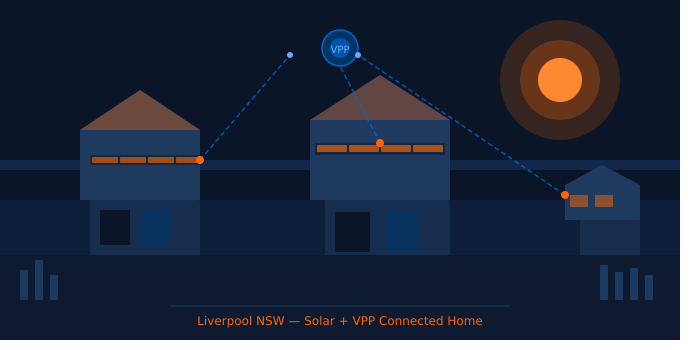
Most Liverpool homeowners looking at solar batteries in 2026 know about the federal rebate. What most don’t realise is that the NSW State Bonus comes with a condition: your battery must be connected to a Virtual Power Plant. No VPP, no bonus. This article explains what that means for your money, your control, and your privacy.
The Rebate That Has Strings Attached
For a typical Liverpool household installing a 10 kWh system, the NSW VPP incentive contributes approximately $1,000 to $1,100, with estimated annual electricity savings of $1,800 to $2,300 per year and a payback period of around five to seven years.
But here is what catches most people off guard: non-VPP batteries do not qualify for the NSW Battery Incentive. Participation in the Peak Demand Reduction Scheme requires VPP-capable hardware with active communications enabled.
What Is a Virtual Power Plant?
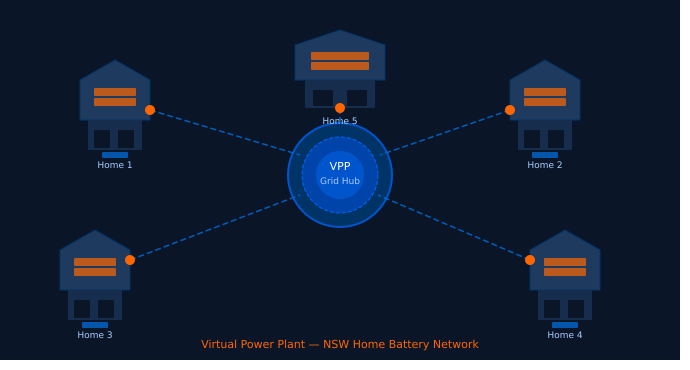
A Virtual Power Plant is a group of home batteries connected through the internet. The batteries don’t have extra wires or special hardware — they stay right where they are in your home. A VPP works by linking these batteries together through software, allowing them to all respond to energy demand simultaneously. When the grid comes under pressure — such as during a heatwave — the VPP can draw a small amount of stored power from the network to help stabilise it.
The bidirectional data exchange between the individual batteries and the VPP enables not just control commands but also real-time data on capacity utilisation, feed-in levels, consumption data, and storage charge levels.
The NSW State Bonus: What the 2026 Scheme Actually Looks Like
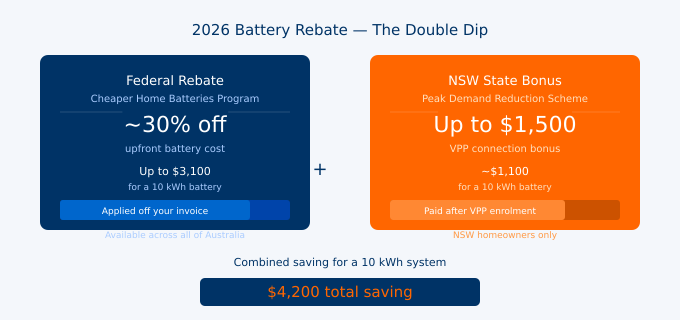
From 1 July 2025, the NSW Government introduced the Virtual Power Plant (VPP) Incentive, replacing the previous battery installation rebate which ended on 30 June 2025. The Federal Government pays for the physical hardware — the tank — while the NSW Government pays for the grid flexibility — the tap. By allowing a VPP to occasionally draw from your battery during peak demand, you receive an additional incentive of up to A$1,500.
| Battery Size | Federal Rebate | NSW VPP Incentive | Total Saving |
| 5 kWh | ~$1,550 | ~$550 | ~$2,100 |
| 10 kWh | ~$3,100 | ~$1,100 | ~$4,200 |
| 13.5 kWh | ~$3,720 | ~$1,350 | ~$5,070 |
| 15 kWh | ~$4,200 | ~$1,500 | ~$5,700 |
In practice, households receive roughly 60% of what the Peak Reduction Certificates are worth — the Accredited Certificate Provider takes a share before passing the remainder to you.
The Privacy Question Most Installers Don’t Raise
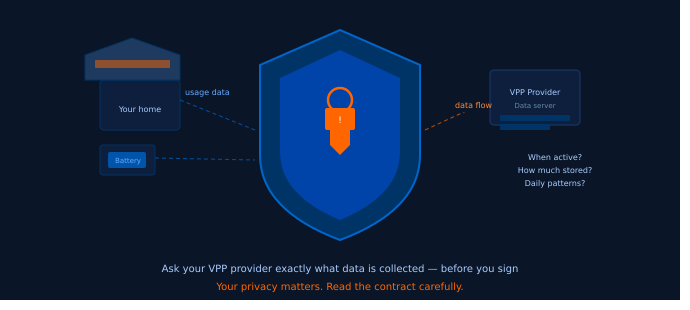
VPP operators can see which assets are producing energy, which are consuming energy, and which have energy stored. The biggest practical trade-off of joining a VPP is giving that operator visibility over your home devices.
As VPPs require collecting and sharing large amounts of data, there are genuine concerns about data privacy and the potential misuse of consumer information.
Ongoing efforts to improve cybersecurity measures for VPPs are underway, but it remains a risk worth considering. Experts recommend asking your VPP provider directly about what data they collect and what security measures they use to protect it.
“You’re in Control” — What That Actually Means
If you want the NSW State Bonus, VPP enrolment is a requirement, not a suggestion. Given that NSW residential electricity prices rose by up to 9.7% from July 2025, according to the Australian Energy Regulator, and have continued rising a further 4.3% over the past six months, EnergyPlans, that is real money for most Liverpool households.
The Hardware Requirement That Locks It In
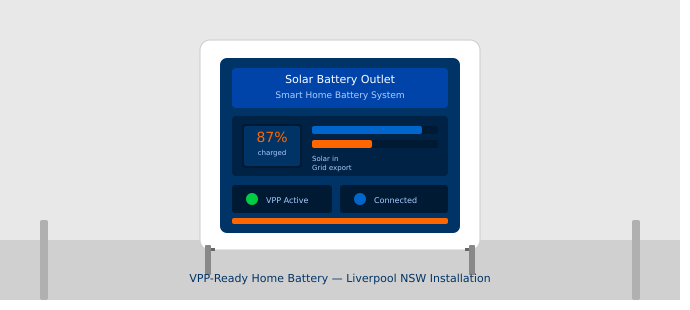
VPP readiness requires the system to be internet-connectable and capable of responding to remote signals at all times.
If a system is installed in self-consumption only mode without VPP capability enabled, the NSW Battery Incentive is invalid.
The Grid Stability Case — It’s a Real Argument
Connecting more batteries across NSW to Virtual Power Plants is a core part of the state’s plan to reduce NSW emissions by 70% by 2035 and achieve net zero by 2050. NSW Government
Australians installed 85,000 home battery units in the first half of 2025 alone — a 191% increase on the same period the year prior. That momentum accelerated further with 183,245 batteries installed in the second half of 2025 after the Cheaper Home Batteries Program launched.
The Numbers Liverpool Residents Should Know
- More than 236,000 batteries have been installed nationally since the Cheaper Home Batteries Program launched in July 2025.
- NSW recorded 4,782 new residential battery installations in the first half of 2025 alone — the highest of any Australian state.
- Battery adoption in Australia sits at just 15% of households despite solar penetration reaching 43%.
- NSW residential electricity prices rose up to 9.7% from July 2025, making the financial case for battery storage stronger than ever.
What Liverpool Homeowners Should Do Before Signing
- Ask your installer which VPP provider they work with — then read that provider’s privacy policy before signing.
- Confirm the contract terms around dispatch events and minimum charge reserve settings.
- Verify your installer is SAA-accredited at saaustralia.com.au before accepting any quote.
- Ask directly: “Do you process the NSW Peak Demand Reduction Scheme incentive?” — not all installers bother because it involves extra compliance steps.
- Compare VPP providers — you are not obligated to use the one your installer recommends.
FAQs
Q: Is VPP participation mandatory to get the NSW State Bonus?
Yes. Batteries running in self-consumption only mode are not eligible for the PDRS incentive worth up to $1,500.
Q: Does joining a VPP mean I lose control of my home battery?
Not entirely — but you do share access. The operator can draw from your battery around 20–30 times per year. You set a minimum charge reserve through your app.
Q: What happens to my personal data when I join a VPP?
Your provider gains real-time visibility of your energy patterns. Each provider has their own privacy policy — read it before enrolling.
Q: Can Liverpool homeowners combine both rebates?
Yes. Federal rebate (~30% off upfront) plus NSW VPP incentive (up to $1,500) can be stacked. The federal rate steps down after 1 May 2026 — the NSW incentive is not affected.
📞 Not Sure Where to Start? We’ll Walk You Through It — Free
At Solar Battery Outlet, we handle the full process — federal rebate, NSW VPP incentive, SAA-accredited installation, and VPP enrolment — so you never leave money on the table.
✅ Up to $18,600 in combined rebates available ✅ NSW VPP incentive processed on your behalf ✅ Servicing Liverpool, Bankstown, South West Sydney and beyond ✅ No obligation. No pushy sales. Just straight answers.
