If you have been following Australia’s home energy space in 2026, you have probably heard two things: the federal battery rebate changed on 1 May, and installation numbers have been breaking records. Both are true — and they are connected. This article pulls together what actually happened, what the numbers mean, and what they tell NSW homeowners right now.
At the centre of it all is the Australian Government’s $1 billion Household Energy Upgrades Fund (HEUF), which crossed a major milestone in the quarter to December 2025: more than 10,000 energy upgrades financed across over 4,100 Australian homes. But that milestone, significant as it is, has now been overtaken by an even bigger story in 2026 — the Cheaper Home Batteries Program (CHBP) surge that saw daily battery installations jump from 200 to over 1,500 per day.
Here is the full picture, with verified data from the Australian Government and the Clean Energy Regulator.
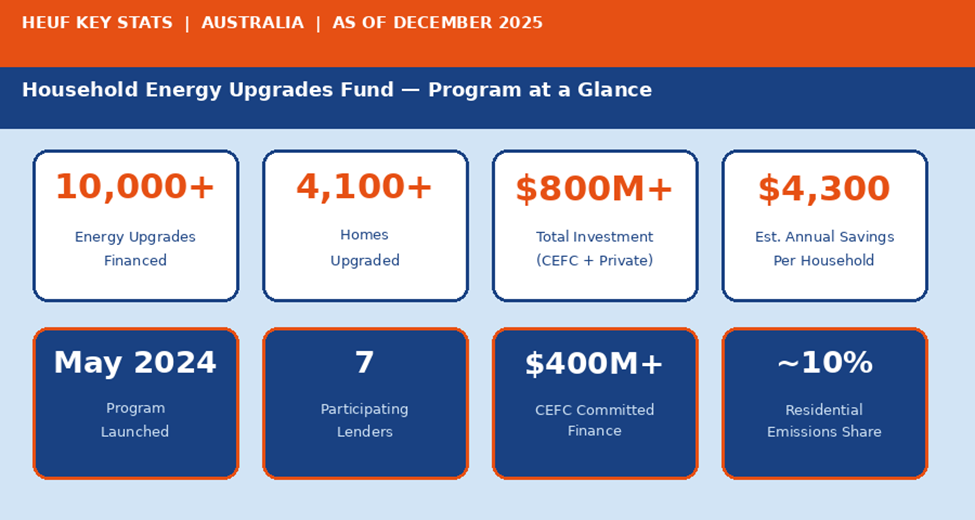
HEUF Key Program Statistics — as at December 2025 (Source: energy.gov.au)
What Is the Household Energy Upgrades Fund?
The HEUF is a $1 billion federal initiative delivered through the Clean Energy Finance Corporation (CEFC). It does not hand you cash directly — instead, it works with banks and lenders to offer discounted finance products so that upgrading your home becomes more affordable upfront. Think of it as the government subsidising your interest rate, not writing you a cheque.
Running since May 2024, the HEUF targets existing homes — many built before modern energy efficiency standards. The aim is to bring down the practical barrier of upfront cost so more households can access solar, batteries, insulation, and other upgrades that lower bills and reduce emissions.
★ Key distinction: The HEUF provides discounted finance (loans). The Cheaper Home
Batteries Program (CHBP) provides a direct rebate on battery purchase price. They are separate programs — and they can be stacked together for maximum savings.
The 10,000 Milestone — What the December 2025 Numbers Say
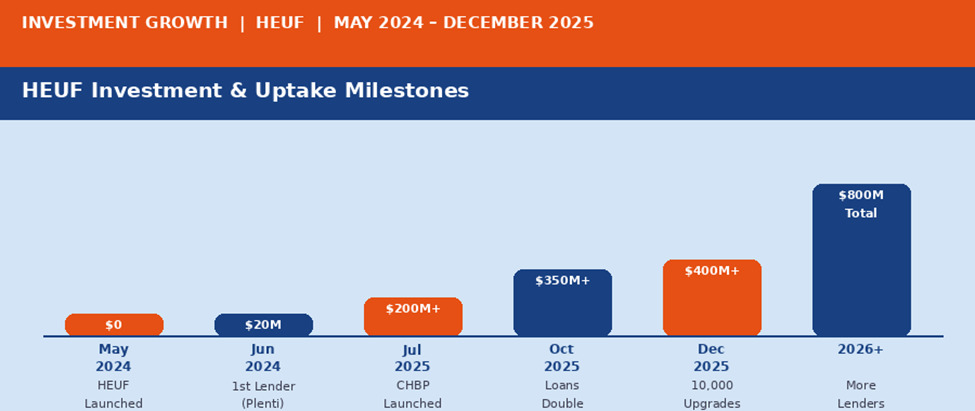
The HEUF reached 10,000 financed upgrades across more than 4,100 homes in the quarter to December 2025. Here is what the data behind that number reveals:
Loans Nearly Doubled in One Quarter
In the last quarter of 2025 alone, HEUF loan volumes almost doubled. This was not a gradual climb — it was a sharp acceleration driven directly by the July 2025 launch of the CHBP. When the battery rebate arrived, homeowners started bundling finance and rebate together, and uptake tripled across batteries, inverters and solar PV under the HEUF in the six months that followed.
Queensland and NSW Are Leading
Around 2,600 households in Queensland and NSW combined have accessed HEUF discounted finance — making these two states the most active in the country. If you are an NSW homeowner, you are in the heart of where this is happening.
$800 Million in Total Investment Committed
The CEFC has committed over $400 million through seven participating lenders. Those lenders have matched it with a further $400 million in private capital, bringing total committed investment to over $800 million. With more lender deals expected in 2026 and beyond, competition for your finance business is likely to increase — which is good for borrowers.
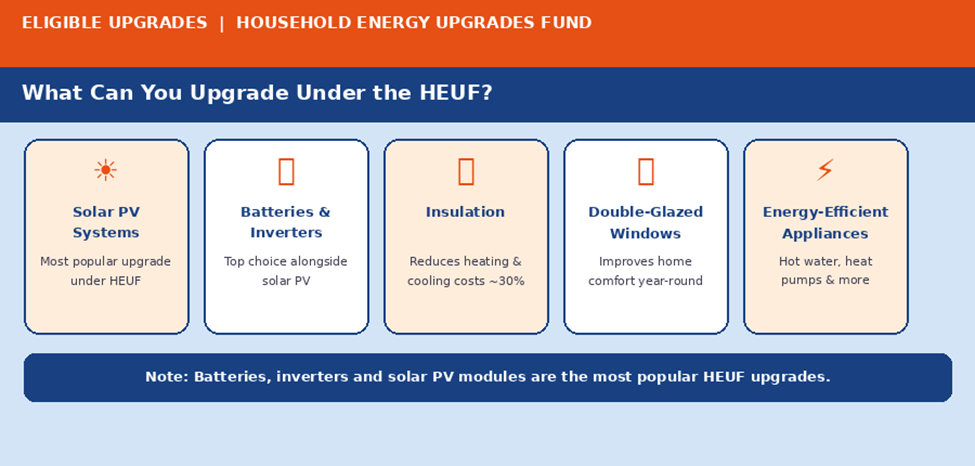
Batteries, Inverters and Solar Are the Top Choices
The most popular HEUF upgrades by a clear margin have been batteries, inverters and solar PV systems. This is consistent with broader market trends — solar and storage offer the most direct, measurable reduction in electricity bills, and they pair naturally with the CHBP rebate.
The 2026 Story: Australia’s Battery Boom in Numbers
The HEUF milestone is impressive. But to understand where Australia’s home energy market stands in May 2026, you need the full CHBP picture alongside it. The numbers are genuinely remarkable.
350,000+ Batteries Installed in 10 Months
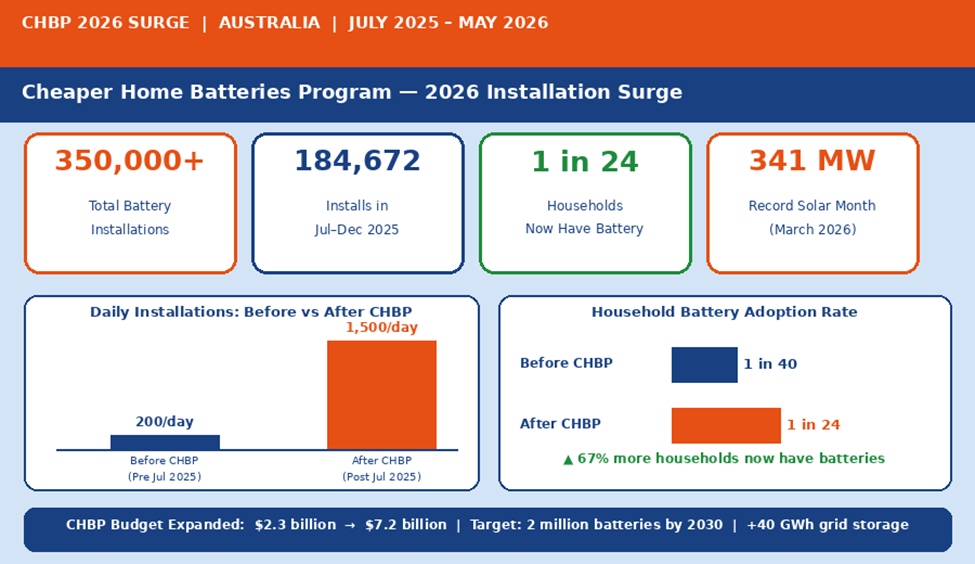
From July 2025 to May 2026, more than 350,000 home battery installations were completed under the CHBP. That is not a typo. To put it in context: in the entire year before the CHBP launched, Australia averaged around 200 battery installations per day. After the program started, that figure jumped to over 1,500 per day — a 7.5x increase.
184,672 Batteries in Just the Second Half of 2025
Federal Minister for Climate Change and Energy Chris Bowen confirmed that from 1 July to 31 December 2025, Australians installed 184,672 home batteries, adding 4.27 gigawatt-hours of storage capacity. The average battery size also doubled compared to 2024 — from 10–12 kWh to around 23 kWh — as households took advantage of the rebate structure to install larger systems.
From 1 in 40 to 1 in 24 Households
Before the CHBP launched, only 1 in 40 Australian households had a home battery. By May 2026, that figure had shifted to 1 in 24 — a 67% increase in household adoption in under a year. This is the fastest shift in home battery penetration Australia has ever recorded.
Record Solar Month: 341 MW in March 2026
Australia’s rooftop solar market hit an all-time record in March 2026, with 341 MW of small-scale solar capacity installed in a single month — a 19% jump from February. Industry analyst firm SunWiz noted the market was already 16% ahead of the same point in 2025, with battery demand pulling larger solar systems along with it. As of early 2026, Australia’s total rooftop solar capacity stands at 28.3 GW across approximately 4.3 million installations — making Australia the world leader in per capita rooftop solar.
★ 2026 Data Snapshot — Verified Sources
350,000+ total CHBP installations (Jul 2025–May 2026): PV Magazine Australia
184,672 installs / 4.27 GWh added in H2 2025: Minister Bowen / DCCEEW
1 in 24 households now have a battery (up from 1 in 40): DCCEEW
341 MW record solar month (March 2026): SunWiz / Daily Energy News
28.3 GW total rooftop solar, 4.3M installations: PV Magazine / SurgePV CHBP budget expanded: $2.3B → $7.2B, targeting 2M batteries by 2030: DCCEEW
How HEUF and CHBP Work Together
With both programs now running at scale, the most financially savvy move for an NSW homeowner is to use them in combination. Here is how they fit together:
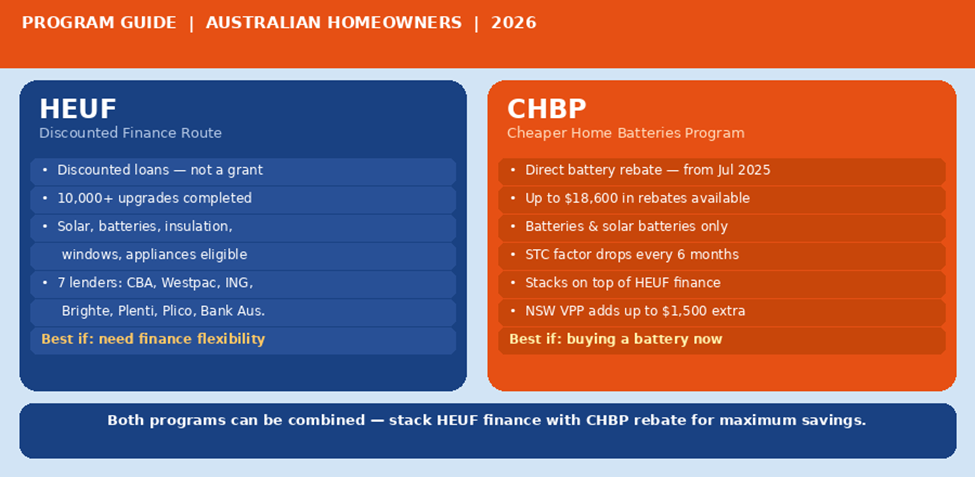
The HEUF provides the discounted loan to spread the cost over time. The CHBP reduces the purchase price of the battery upfront — around 30% off, delivered through your installer. On top of both, the NSW Peak Demand Reduction Scheme (PDRS) VPP incentive adds up to $1,500 for battery owners who connect to a Virtual Power Plant.
The three stacked together — HEUF finance + CHBP rebate + NSW VPP — represent the most comprehensive government support package for home batteries that has ever existed in NSW. The fact that CHBP uptake through HEUF tripled in the six months after July 2025 shows that homeowners have already figured this out.
▶ Important: From 1 May 2026, the CHBP rebate calculation changed.
The STC factor now declines every 6 months (previously annually), and a tiered structure applies to batteries above 14 kWh. The rebate continues until 2030—but each six-month window it reduces. The rebate amount depends on the installation date, battery size and the applicable program settings at the time of installation. For 20 kWh+ systems, it is $1,000–$1,800 or more. As the STC factor is scheduled to reduce over time, the discount available for later installations may be lower. Your installer’s quote will show the rebate available to your installation.
What the Budget Expansion Means for You
On 13 December 2025, the Australian Government announced the CHBP budget would be expanded from the original estimate of $2.3 billion to $7.2 billion over four years. This is important for a few reasons:
- The program is not going anywhere. It runs through to 2030 with massively increased funding.
- More than 2 million Australians are expected to install a battery by 2030 — adding around 40 GWh of grid storage.
- The expansion was triggered by uptake far exceeding forecasts, confirming the market is real and the demand is genuine.
- All CHBP batteries must be VPP-capable (this has applied since the program started in July 2025) — meaning the hardware is already set up to participate in grid programs like the NSW PDRS.
According to analysis cited by the Australian Energy Market Commission (AEMC), increased home battery uptake could reduce electricity bills across the energy system by around 3% annually by helping to smooth periods of peak demand.
What This Means for NSW Homeowners Right Now
Pulling the HEUF milestone and the 2026 CHBP data together, here is the practical picture for an NSW homeowner considering solar or batteries today:
The market has validated the technology
350,000+ installations in 10 months is not a niche movement. Batteries are now mainstream in Australian homes — 1 in 24 households have one. The installers, the products, and the programs are all mature. Batteries are now common in Australian homes.
Government support is substantial and funded to 2030
The CHBP has $7.2 billion behind it. The HEUF has $800 million in committed capital from seven lenders. The NSW VPP incentive is active. The program is funded to 2030, though the rebate amount steps down over time and rules can change.
The rebate declines over time — but not off a cliff
The most common misconception right now is that the rebate ‘ended’ on 1 May 2026. It did not. What changed is that the STC factor now steps down every six months rather than annually, and larger batteries above 14 kWh attract a tapered rate. The program continues to deliver around 30% off battery costs across a range of sizes. Choosing the right system matters more than rushing.
The combination of programs is where the real value lies
According to Treasury modelling, a typical household could save up to approximately $4,300 per year by electrifying household energy use and adopting technologies such as rooftop solar, battery storage and an electric vehicle, after accounting for upfront, financing and ongoing costs. Even just adding a battery to an existing solar system can deliver meaningful bill reductions, particularly for households with high evening electricity usage. The HEUF + CHBP + NSW VPP combination makes this more accessible than it has ever been.
★ Bottom line for NSW homeowners: The rebate still exists, finance is available, and what matters most is choosing the right system size and installer. The rebate still exists. The finance is available. The market is proven. What matters most is choosing the right system size, the right installer, and making sure you understand what you are eligible for before you sign anything.
How to Access These Programs — Step by Step
- Decide on your upgrade: for most NSW homeowners, this is solar + battery, or battery-only if you already have solar panels.
- Get written quotes from at least three SAA-accredited installers — compare size, brand, installation date, and what rebates are shown on the quote.
- Speak to a participating HEUF lender about discounted finance options: Brighte, Plenti, Plico, Commonwealth Bank, Westpac, ING, or Bank Australia.
- Confirm the CHBP rebate appears as a dollar deduction on your written quote — not just mentioned verbally.
- Ask your installer about the NSW VPP incentive and whether your battery will be enrolled in a Virtual Power Plant.
- Confirm an actual installation date in writing — your rebate is determined by installation date, not contract signing date.
Frequently Asked Questions
Is the HEUF still open in 2026?
Yes. The HEUF is active with seven participating lenders and more expected to be announced in 2026. It is open to homeowners with or without a mortgage, rental property owners, and strata properties. High-value properties are excluded — speak to your lender for eligibility details.
Did the battery rebate end on 1 May 2026?
No. The CHBP continues until 2030 with a significantly expanded $7.2 billion budget. What changed on 1 May 2026 is the calculation method: the STC factor now steps down every six months instead of annually, and batteries above 14 kWh attract a tiered rate. The government states the around 30% discount is maintained across a range of battery sizes under the new structure.
How many batteries have been installed under the CHBP so far?
More than 350,000 installations were completed in the ten months from July 2025 to May 2026, according to PV Magazine Australia and CER public data. In the second half of 2025 alone, 184,672 batteries were installed, adding 4.27 GWh of storage capacity to the grid.
Can I still use HEUF finance and the CHBP rebate together?
Yes — and it is the recommended approach. The HEUF reduces your interest rate on the finance. The CHBP reduces the upfront purchase price. They are complementary programs. On top of both, the NSW PDRS VPP incentive adds up to $1,500. Your installer and lender can help you access all three.
What is the average battery size being installed in 2026?
The average has grown significantly. Before the CHBP launched, the average battery usable capacity was 10–12 kWh. In the second half of 2025, it jumped to around 23 kWh as households took advantage of the rebate structure to install larger systems. From May 2026, the tiered structure is designed to encourage right-sizing rather than over-sizing.
Ready to Work Out What You Are Eligible For?
We do free, no-obligation quotes for NSW homeowners across Liverpool, Bankstown, and Mudgee. We will review your electricity bills, check your existing solar setup, and walk you through the HEUF, CHBP and NSW VPP incentives that apply to your specific situation. No countdown timers. No pressure. Just the numbers.
Call us: 1800000777. Or visit solarbatteryoutlet.com.au — fill in the 60-second eligibility form, and we will be in touch within one business day.
Data Sources
All data in this article is sourced from official Australian Government publications and verified industry sources:
1. energy.gov.au/news/household-energy-upgrades-fund-reaches-10000-installations
2. dcceew.gov.au/energy/programs/cheaper-home-batteries
3. pv-magazine-australia.com — 350,000 installations in 10 months under CHBP (May 2026)
4. minister.dcceew.gov.au — Joint media release: 10,000 home energy upgrades (April 2026)
5. cer.gov.au/batteries — Clean Energy Regulator CHBP postcode data to 31 March 2026
6. dailyenergynews.com.au — Record 341 MW solar month, March 2026
7. solarchoice.net.au — CHBP 1 May 2026 changes explained
8. solarquotes.com.au — Battery installation data H2 2025
About Solar Battery Outlet
Solar Battery Outlet is a Liverpool-based solar battery installer, part of GWM Group Pty Ltd, servicing homes across Bankstown and Mudgee. All installations are carried out by SAA-accredited electricians. We handle all rebate and incentive paperwork on your behalf.