Here’s a question we get asked almost every week at our Liverpool office.
Someone’s done their research, they’ve got a couple of quotes in hand, and they’ve narrowed it down to two batteries — Tesla Powerwall 3 or BYD Battery-Box. And then they ring us and ask: “Mate, which one should I actually go with?”
The honest answer is — it depends. But not in a wishy-washy way. There are genuinely specific situations where one beats the other, and we’re going to walk through exactly that here.
We install both of these batteries every week across Liverpool, Bankstown, Campbelltown and South West Sydney. This comparison is based on what we actually see on the job — not spec sheets from a manufacturer’s website.
Quick heads up on timing: The federal battery rebate rate drops after 1 May 2026. The federal rebate steps down every six months, and the amount is set by your installation date (not your quote date), so your quote will show the current amount. — regardless of which one you choose. More on the rebate deadline here.
The Quick Side-by-Side
Before we get into the detail, here’s where they sit head to head:
| Comparison In | Tesla Powerwall 3 | BYD Battery-Box HVM |
|---|---|---|
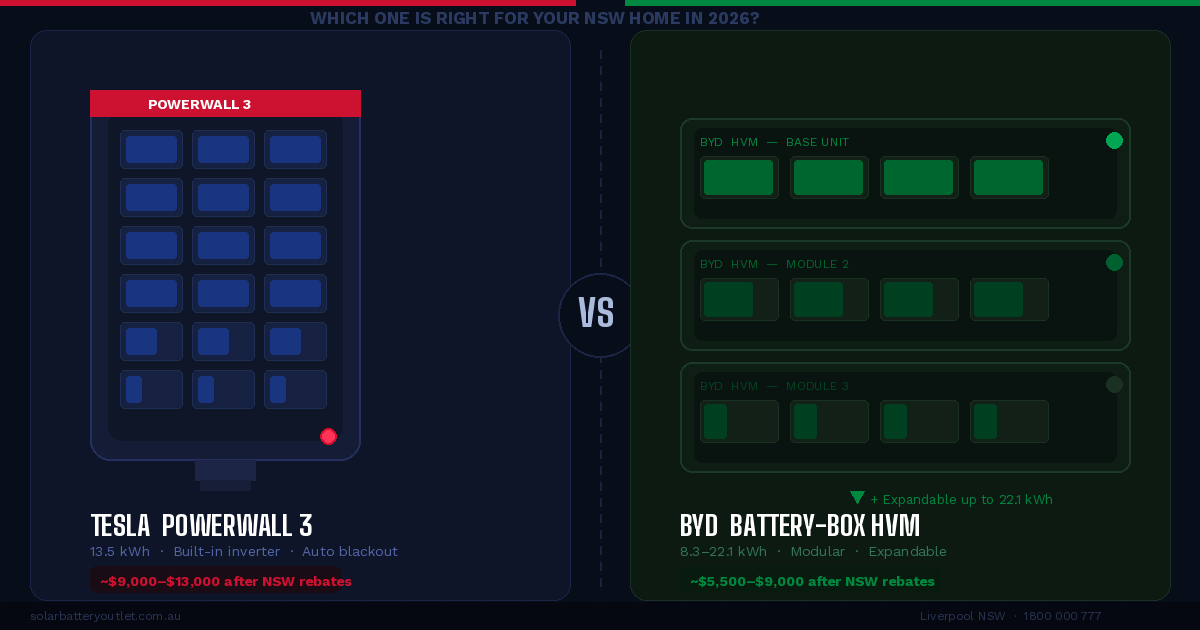
| Capacity | 13.5 kWh (fixed) | 8.3 kWh – 22.1 kWh (modular) |
| Chemistry | LFP | LFP |
| Inverter included | Yes — built in | No — needs separate inverter |
| Blackout protection | Automatic | Available (confirm with installer) |
| Expandable | No (add second unit) | Yes — add modules |
| Warranty | 10 years / 70% capacity | 10 years / 70% capacity |
| EV integration | Excellent (Tesla app) | Good |
| Approx. cost after rebates (NSW) | $9,000 – $13,000 installed | $5,500 – $9,000 installed |
Both use LFP chemistry — the safer, longer-lasting standard for home batteries in Australia. Both carry a solid 10-year warranty. On paper they look similar. In real life, the differences matter quite a bit.
What the Tesla Powerwall 3 Does Really Well
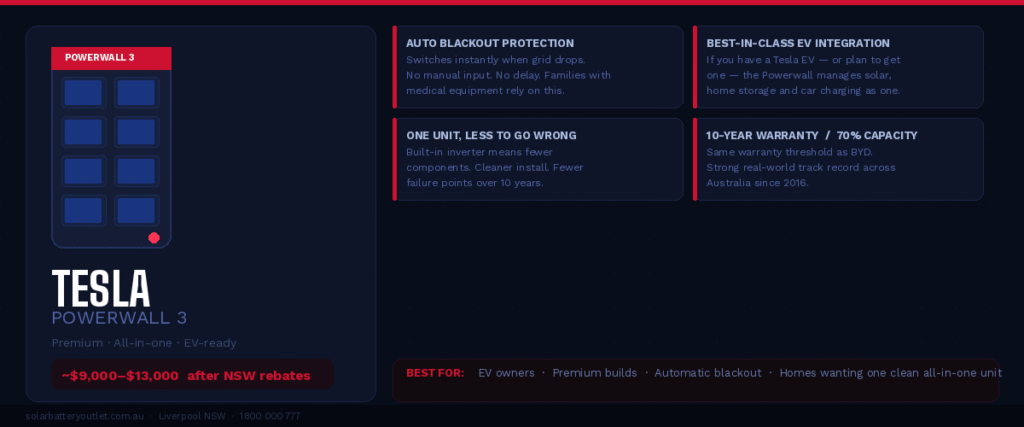
The Powerwall 3 is the most complete single-unit home battery available in Australia right now. Everything — the battery, the inverter, and the backup switching — is built into one box. That means fewer components, a cleaner installation, and fewer things that can go wrong over 10 years.
The blackout protection is genuinely impressive. When installed with backup set up, the Powerwall can switch over automatically, usually quickly. For families with someone who relies on medical equipment, or just anyone who’s sick of sitting in the dark during a South West Sydney storm, that seamless switchover matters.
The EV integration is also in a league of its own. If you have a Tesla vehicle — or you’re planning to get one — the Powerwall and the car talk to each other through the Tesla app. It decides when to charge the car from solar, when to pull from the battery, and when to use the grid based on time-of-use pricing. That level of automation is genuinely useful, not just a marketing gimmick.
Where it falls short:
The Powerwall 3 is fixed at 13.5 kWh. You can’t expand it — if you need more storage down the track, you add a second unit. That’s fine for most households, but if you’re not sure how your energy needs might grow, it’s worth thinking about.
It’s also the more expensive option. After the federal rebate, you’re generally looking at $9,000 to $13,000 installed in NSW. That’s not outrageous for what you’re getting — but it’s real money.
What the BYD Battery-Box Does Really Well
BYD is the largest battery manufacturer in the world. That’s not a marketing line — they produce batteries for everything from home storage to electric buses. The Battery-Box HVM is built on that same manufacturing foundation, and it shows in the consistency.
The biggest advantage of BYD over Tesla for a lot of NSW families is the modularity. You can start at 8.3 kWh and add modules up to 22.1 kWh as your needs change. Planning to get an EV next year? Just add a module. Energy usage going up as the kids get older? Add a module. You’re not locked into a fixed decision made in 2026.
It also tends to come in at a lower price point — $5,500 to $9,000 after rebates for a comparable setup. For households where the Powerwall’s premium price is a stretch, BYD gives you quality storage without compromising on warranty or safety.
Compatibility is another plus. BYD works with a wide range of inverters, which makes it a cleaner retrofit option if you already have an existing solar system. You’re less likely to need an inverter replacement alongside it.
Where it falls short:
BYD doesn’t include a built-in inverter — you need a separate compatible hybrid inverter. This adds to the installation complexity slightly, and if you don’t already have a compatible inverter, it adds to the cost. Always confirm inverter compatibility before you accept a quote.
The app and the EV integration, while solid, doesn’t match Tesla’s seamless experience if you’re in the Tesla ecosystem.
Who Should Get the Tesla Powerwall 3?
Get the Powerwall 3 if:
- You already have a Tesla EV, or you’re buying one in the next 12 months
- You want automatic backup in a single unit — no fiddling, no manual switching
- You want the cleanest single-unit installation with the fewest components
- Budget isn’t your primary concern and you want the premium option
- You have a larger home and 13.5 kWh fits your storage needs well
Who Should Get the BYD Battery-Box?
Get the BYD if:
- You want flexibility to expand storage later — especially if an EV is on the horizon but not confirmed yet
- You’re working with a tighter budget but don’t want to compromise on quality or warranty
- Your existing solar system already has a BYD-compatible inverter
- You’re looking at larger storage above 13.5 kWh — BYD scales better at the bigger end
- You want strong value from a globally proven manufacturer without paying Tesla’s premium
What About the Rebate — Does It Affect the Choice?
Both batteries qualify for the federal Cheaper Home Batteries Program rebate, so you get the same percentage discount regardless of which one you choose.
For the Powerwall 3 at 13.5 kWh, the rebate works out to around $3,600–$4,200 off the upfront cost before 1 May 2026. For a 10 kWh BYD setup, it’s around $2,800–$3,100 off.
On top of that, both qualify for the NSW VPP incentive — up to $1,500 extra for connecting to a Virtual Power Plant. That stacks with the federal rebate. So before your first electricity bill saving even kicks in, you could be $4,000 to $5,500 better off than the sticker price.
For the full breakdown on how the rebate works and what you actually need to do to claim it, read our Federal Battery Rebate NSW 2026 guide here.
The Price Gap — Is It Worth It?
This is the real question most people are sitting with.
The Powerwall 3 typically costs $2,000 to $4,000 more than a comparable BYD setup after rebates. Whether that’s worth it comes down to one main thing: the Tesla ecosystem.
If you’re an EV owner or planning to be one — that gap narrows fast. The energy management you get from pairing a Powerwall with a Tesla vehicle saves a meaningful amount in optimised charging over time, and that’s before you factor in the convenience of managing everything from one app.
If you’re not in the Tesla ecosystem and you just want reliable, expandable home battery storage with a strong warranty — BYD closes that gap completely. You’re not giving up quality. You’re just not paying for features you won’t use.
We’ve helped hundreds of families in Liverpool and South West Sydney work through exactly this decision. Most EV owners land on Powerwall. Most everyone else lands on BYD. That’s a genuine pattern, not a sales pitch.
A Note on Installation
Both batteries need to be installed by an SAA-accredited installer. This is not optional — if your installer isn’t SAA-accredited, you won’t qualify for the federal rebate. Full stop.
You can verify any installer’s accreditation at saaustralia.com.au before signing anything.
For what to look for (and what to avoid) when choosing an installer in the Liverpool area, our Solar Battery Liverpool NSW guide covers that in detail.
Frequently Asked Questions
Both carry a 10-year warranty with 70% capacity retention — so on paper they’re equal. Real-world lifespan for both is typically 10 to 15 years. For a deeper look at what actually affects battery lifespan in Australian conditions, see our How Long Does a Solar Battery Last in Australia guide.
Not in the traditional sense. You can add a second Powerwall 3 unit, which gives you 27 kWh total. It’s not modular like BYD — you’re adding a complete second unit rather than a storage module. For most households, one Powerwall 3 at 13.5 kWh is enough.
Not any — but it works with a wide range. It’s compatible with most hybrid inverters from Sungrow, Fronius, SolarEdge and others. Your installer should confirm compatibility before quoting. If you already have solar and you’re not sure what inverter you have, check the brand name on the grey box near your switchboard.
Tesla Powerwall 3 wins here. It switches to backup mode automatically with no manual input needed. BYD can handle blackouts too, but you need to confirm with your installer that backup mode is included in the system design — it’s not automatic on all setups.
Yes — both are strong options for retrofitting onto an existing solar system. Whether adding a battery makes financial sense for your specific situation is a separate question worth working through. Our Is Adding a Battery to Existing Solar Worth It guide has the honest numbers on that.
Ready to get a quote for Liverpool or South West Sydney?
We install both Tesla Powerwall 3 and BYD Battery-Box HVM. We’ll tell you honestly which one suits your home — and we handle all the rebate paperwork so you don’t have to.
Call 1800 000 777
or fill in our 60-second form at solarbatteryoutlet.com.au