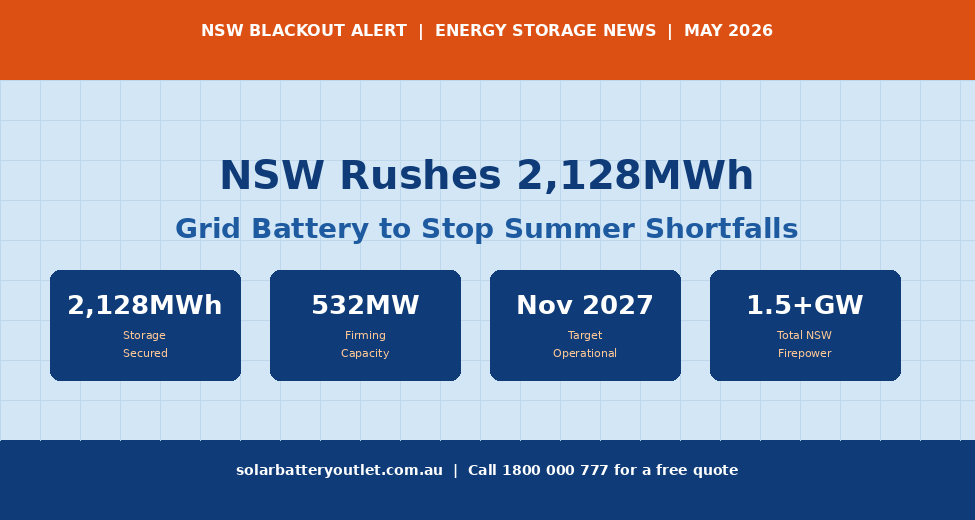
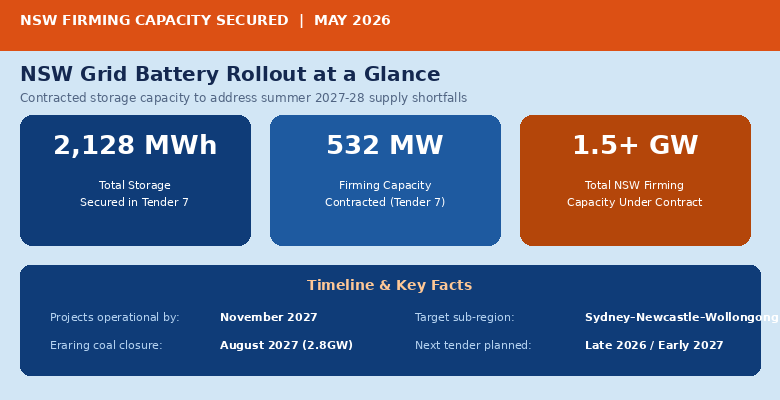
The NSW Government has contracted new battery storage to support the grid in 2027–28. Here’s what it means for your home. The New South Wales government has just contracted 532MW of new firming capacity, securing 2,128MWh of battery energy storage to prevent a forecast electricity shortfall in the summer of 2027 and 2028. The projects are required to be operational by November 2027.
That is a significant move. It reflects planning for the ongoing transition of the NSW electricity system as coal-fired generation is gradually replaced by new renewable energy, storage and network infrastructure.
Eraring, Australia’s largest coal-fired power station, is currently scheduled to retire on 30 April 2029 and has a generating capacity of approximately 2.88 GW. The newly contracted battery projects are intended to help support reliability and manage forecast supply risks during periods of high electricity demand.
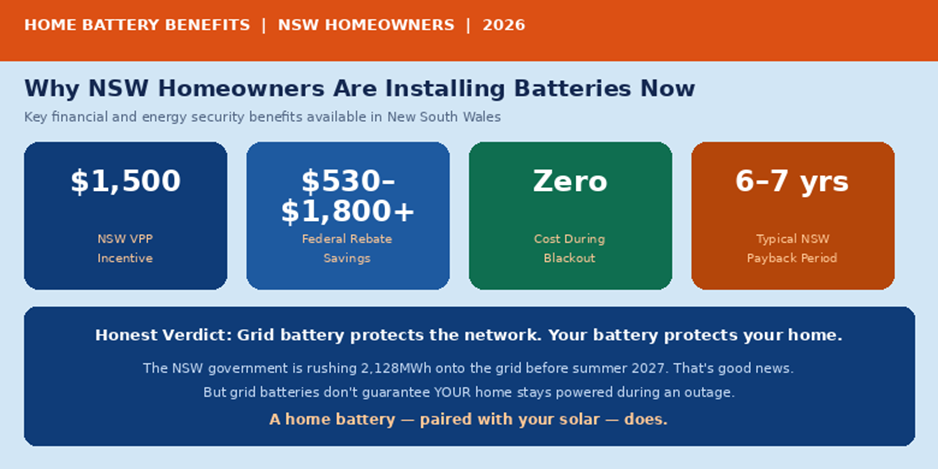
What it does not tell you is that any of this grid infrastructure will protect your home if there is a local fault, a heat event, or an outage on your street. For that, you need your own battery.
What Just Happened: The NSW 7th Firming Tender Explained
In October 2025, the NSW government opened its seventh infrastructure firming tender, inviting bids from battery storage projects, gas generators, demand response programs, and aggregated portfolios. The target was an indicative 500MW of firming capacity.
The result, announced in May 2026, exceeded that target. Two successful projects — one battery energy storage system (BESS) and one virtual power plant (VPP) — were awarded Long-Term Energy Service Agreements (LTESAs) of up to 15 years. Combined, they deliver 2,128MWh of storage capacity, with a focus on the Sydney-Newcastle-Wollongong corridor.
Why that region? It is home to the highest electricity demand concentration, the most critical transmission infrastructure, and the industrial load growth driven by electrification. It is also where supply pressure will be felt hardest when Eraring shuts.
Nevenka Codevelle, CEO of Australian Sustainability Limited (ASL), confirmed that the tender attracted strong competition and that both selected projects demonstrated value for NSW electricity customers. Under the contract terms, these projects must dispatch electricity during Lack of Reserve (LOR) events — the exact moments when the grid is most at risk of failing to meet demand.
In plain terms: the government has locked in over 1.5GW of total firming capacity across its tendering program. That is real infrastructure heading toward the grid. But it does not start operating until late 2027 — and it covers the regional network, not individual homes.
The Eraring Problem: 2.8GW Is Leaving the Grid
The reason all of this is happening urgently is Eraring. Origin Energy coal-fired power station at Lake Macquarie has a capacity of about 2.88GW. It is scheduled to close in April 2029.
Origin is transforming the Eraring site into a large-scale battery storage facility, ultimately planned at 700MW and 3,160MWh. The first stage — 460MW and 1,770MWh — is already operating, with Wartsila as the primary technology provider.
But replacing 2.8GW of always-available coal generation with storage and renewables is a complex challenge. Battery storage charges from intermittent solar and wind; it cannot simply run around the clock the way a coal station can. The grid needs multiple layers of firming to stay reliable.
The NSW government is moving to add those layers. Two additional NSW Roadmap tenders were announced for May 2026, targeting 2.5GW of generation projects and 12GWh of long-duration storage.
The Australian Energy Market Operator (AEMO) warned in its reliability outlook that the Sydney-Newcastle-Wollongong region faced forecast supply shortfalls in summer 2027-28. The government is racing to close that gap before Eraring goes dark.
What This Means for NSW Homeowners
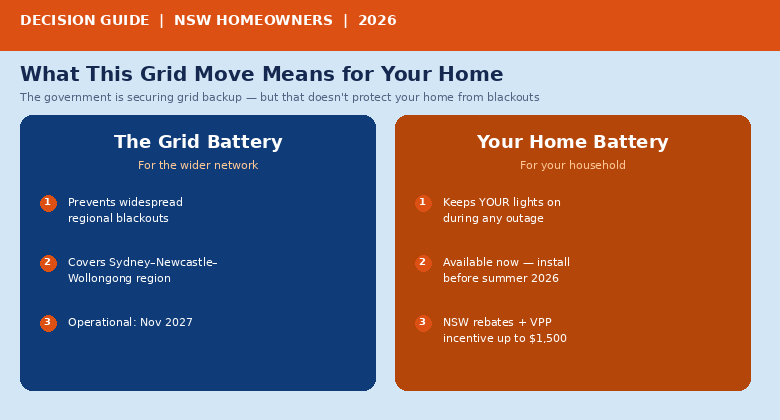
Here is the thing about grid-scale battery storage: it keeps the market running. It prevents widespread blackouts across regions. It is essential infrastructure — the same way a hospital generator is essential.
But it does not guarantee that your home stays powered.
A grid battery in the Sydney-Newcastle-Wollongong region reduces the probability of a regional supply event. It does not prevent the transformer on your street from overloading during a heat wave. It does not protect you when a bushfire or storm takes out local lines. A home battery can help — if it’s set up for backup. Some setups switch over automatically; others cover only essential circuits. The grid can do whatever it needs to do, and your home keeps running.
| The Summer 2026-27 Reality Check the Eraring closure is April 2029. The new grid batteries are operational from November 2027 at the earliest. That means summer 2026-27 and summer 2027-28 are both periods of elevated grid stress — and neither is fully covered by the new infrastructure yet. This is not a time to assume the grid has it handled. |
The Financial Case for a Home Battery
Beyond energy security, the financial case for home battery storage in NSW remains strong — and right now, Several incentives can be combined.
1. Federal Battery Rebate: The federal battery discount continues until 2030, with the amount determined by eligible battery capacity, certificate values and program rules at the time of installation. The value available to your installation will be shown in your quote. Choosing the right system for your household is generally more important than focusing on short-term changes in incentive levels.
2. NSW VPP Incentive: Eligible households who connect an approved battery to an approved Virtual Power Plant (VPP) may receive a one-off incentive under the NSW Peak Demand Reduction Scheme. The incentive amount depends on the battery, the VPP provider and the current value of Peak Reduction Certificates (PRCs) and should be confirmed in your quote.
3. Energy Bill Savings: A battery may allow households to store excess solar energy generated during the day and use it during periods when electricity prices are higher. Actual bill savings depend on electricity usage, tariff structure, battery performance and solar generation. Your quote should estimate savings based on your own bills.
Green Flags and Red Flags: Choosing the Right Installer
The grid battery news will generate renewed interest in home storage — and with that comes opportunistic sellers. Know what separates a genuine installer from a pressure-driven one.
Green Flags:
- Federal rebate appears as a dollar deduction on your written quote
- They show SAA accreditation number — verify at saaustralia.com.au
- Confirmed installation date, not just a contract date
- They review your electricity bills before recommending a size
- They explain the NSW VPP incentive clearly
- Happy for you to take the quote home and compare
Red Flags:
- Pressure to sign on the same day
- Cannot produce an SAA accreditation number
- Rebate mentioned verbally but not on the written quote
- No confirmed installation date — just a contract signing date
- Recommends the largest possible system without reviewing your bills
- Door knockers who will not leave a written quote
What Battery Brands Should NSW Homeowners Consider?
Tesla Powerwall 3: 13.5kWh usable, 11.5kW continuous output — best for larger homes with high evening load or EV charging. Includes integrated inverter.
BYD Battery-Box Premium HVS/HVM: Modular design 5.1kWh to 22.1kWh — flexible for small and large homes, ideal for families wanting to expand over time.
Sungrow SBR: Cost-competitive modular option 9.6kWh to 25.6kWh, strong NSW installer network, reliable in hot climates.
Enphase IQ Battery 5P: AC-coupled, works well with existing Enphase microinverter solar systems.
Frequently Asked Questions
Does the 2,128MWh grid battery protect my home during a blackout?
No. Grid batteries reduce risk of large-scale regional events. They do not protect individual homes from local faults. A home battery with backup capability does.
Is the federal battery rebate still available?
Yes — it runs until 2030. The multiplier factor reduces every six months, so installing sooner captures a higher rebate.
Can I claim both the federal rebate and the NSW VPP incentive?
Yes. The NSW Peak Demand Reduction Scheme (up to ,500) is separate from the federal rebate and can be claimed on top of it.
When will the new grid batteries be operational?
Both projects from the 7th tender are contracted to reach commercial operations by end of November 2027 — after the Eraring closure in August 2027.
What is a VPP, and how does it benefit me?
A VPP aggregates home batteries into a network responding to grid demand. In NSW, joining makes you eligible for up to ,500 in incentives — and, if your system is set up for backup, it can still power your home during outages.
| Want to Know if a Home Battery Suits You? NSW is investing billions in grid storage — but the grid protects the network, not your household. If it’s set up for backup, a home battery can keep essential appliances running when the grid goes down. Ask us which setups provide backup. Solar Battery Outlet’s battery systems are installed by SAA-accredited electricians across Liverpool, Bankstown, and Mudgee. We handle all rebate paperwork, explain the NSW VPP incentive, and give you a written quote — no pressure. Call us: 1800 000 777 | solarbatteryoutlet.com.au |
DATA SOURCES
1. Energy-Storage.News — NSW firming tender secures 2,128MWh, George Heynes, 15 May 2026. https://www.energy-storage.news/australia-nsw-firming-tender-secures-2128mwh-of-energy-storage-to-address-summer-shortfall/
2. Energy-Storage.News — Australia 1,770MWh Eraring Battery 1 commences commercial operations, 2026.
3. Energy-Storage.News — Origin selects Wartsila for expansion of Eraring BESS.
4. Australian Energy Market Commission (AEMC) — Battery storage growth and reliability gap forecasts, 2025.
5. NSW Peak Demand Reduction Scheme — NSW Government Energy Policy, May 2026. https://www.energy.nsw.gov.au/nsw-plans-and-progress/regulatory-plans-and-frameworks/changes-rules-and-frameworks/peak-demand-reduction-scheme
6. Clean Energy Regulator — STC deeming period and multiplier schedule, 2026.
