If you run a small business, manage a commercial property, or operate from a home office, you have probably wondered whether a solar battery can reduce your tax bill. The short answer is yes. Depending on your circumstances, eligible businesses may be able to claim a deduction for a solar battery through the tax system, including under the small business instant asset write-off and depreciation rules.
This guide cuts through the noise. No jargon, no sales pitch. Just a clear walkthrough of how the deduction works, who qualifies, what you can claim, and what mistakes to avoid.
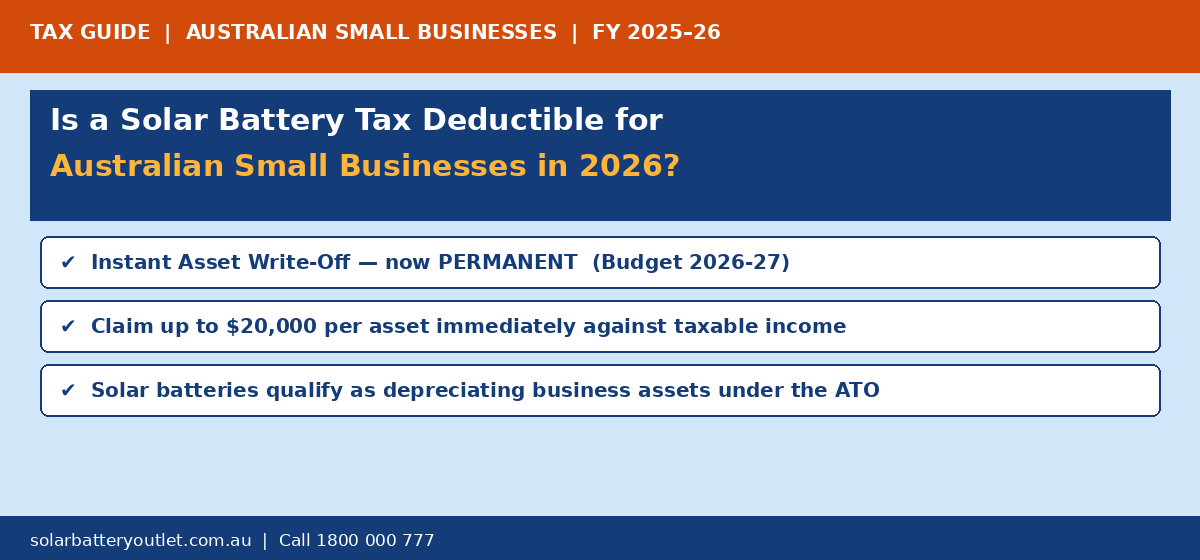
| ★ BIG NEWS: 2026-27 Federal Budget (announced 12 May 2026) Treasurer Jim Chalmers confirmed the $20,000 Instant Asset Write-Off will be made PERMANENT for small businesses with turnover under $10 million. Previously subject to temporary extensions, the measure was made permanent for eligible small businesses in the 2026–27 Federal Budget. This means solar batteries — as eligible depreciating assets — can be written off immediately, year after year, with no sunset clause. |
What Does Tax Deductible Actually Mean Here?
When we say a solar battery is “tax deductible” for a business, we mean you can reduce the taxable income your business reports to the ATO by the cost of the battery — either in full (if the asset qualifies for the Instant Asset Write-Off) or gradually over time (through depreciation).
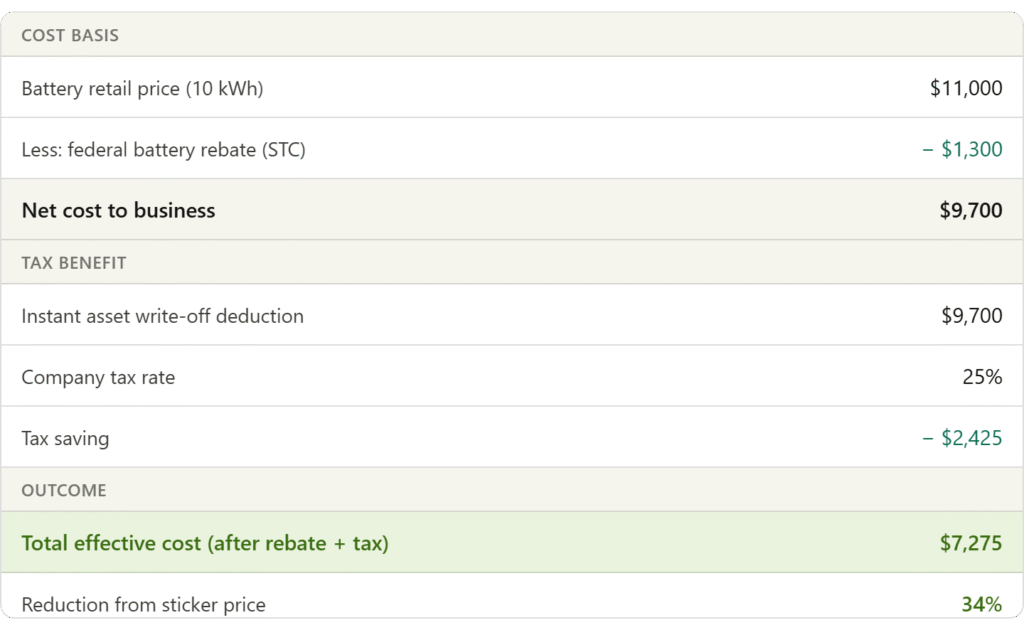
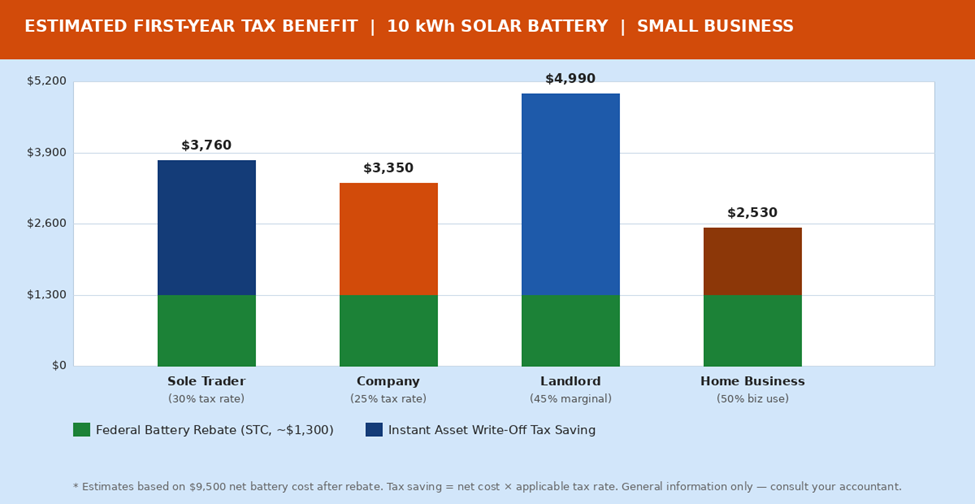
This is not the same as a rebate. The federal battery rebate (under the Cheaper Home Batteries Program) reduces your upfront purchase price. A tax deduction reduces the income you pay tax on. They are separate benefits, and eligible businesses can access both.
Example: How the two incentives stack up for a small business
The Instant Asset Write-Off: Your Main Vehicle in 2025-26
The Instant Asset Write-Off (IAWO) is the primary mechanism most small businesses will use to claim a solar battery deduction. It allows you to claim the full cost of the asset in the year it is installed and ready for use — rather than depreciating it over 20 years.
Who is eligible?
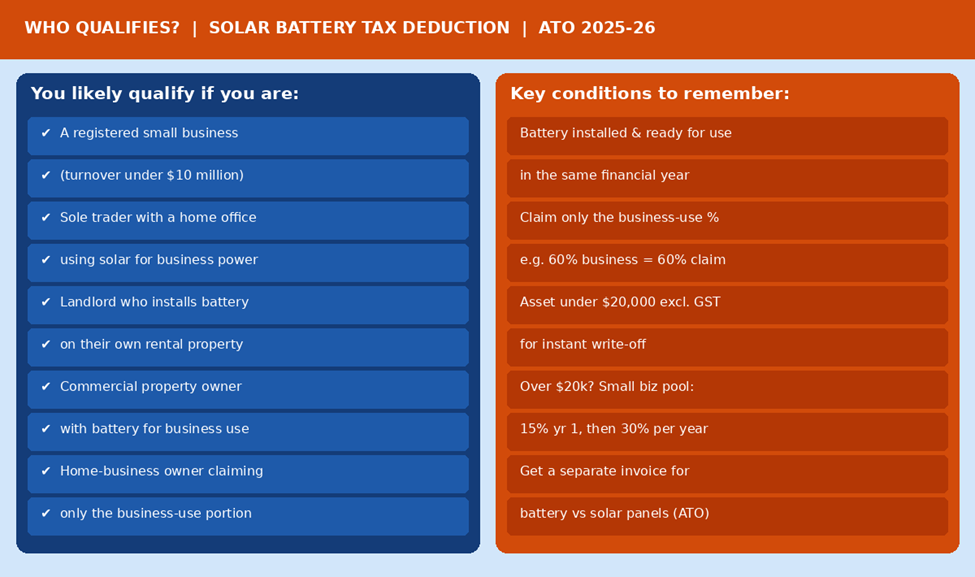
To use the instant asset write-off for a solar battery in 2025-26, your business must:
- Have an aggregated annual turnover of less than $10 million
- Have the battery installed and ready for use between 1 July 2025 and 30 June 2026 (for FY2025-26 claims)
- Use the battery wholly or primarily for business purposes
- Claim the GST-exclusive cost (if your business is GST registered)
What is the threshold?
For FY2025-26, the threshold is $20,000 per asset (excluding GST). If your solar battery costs less than $20,000 after the federal rebate, you can write it off immediately. The threshold applies per asset — you can write off multiple assets in the same financial year, each under $20,000.
| From FY2026–27 onward: The $20,000 Instant Asset Write-Off was made a permanent measure for eligible small businesses in the 2026–27 Federal Budget. Previously subject to temporary extensions, the measure now applies on an ongoing basis from 1 July 2026. |
What If the Battery Costs More Than $20,000?
Larger commercial battery systems — particularly those paired with rooftop solar installation for warehouses, offices, or multi-unit residential properties — may exceed the $20,000 threshold. In that case, the asset goes into the small business general depreciation pool.
| Year | Depreciation Rate | On a $28,000 Battery | Cumulative Claimed |
| Year 1 | 15% | $4,200 | $4,200 |
| Year 2 | 30% | $7,140 | $11,340 |
| Year 3 | 30% | $5,004 | $16,344 |
| Year 4 | 30% | $3,503 | $19,847 |
| Year 5 | 30% | $2,452 | $22,299 |
Note: The 15% first-year rate and 30% subsequent-year rate apply under the simplified small business depreciation pool. The ATO has assigned solar systems an effective life of 20 years, but the simplified pool rules allow faster write-down. Always verify with your registered tax agent.
Three Business Types That Can Claim—and How
1. Sole Traders and Small Business Owners
If you run a registered business — a cafe, trade business, retail shop, professional practice, or any other commercial enterprise — and you install a solar battery at your business premises, the ATO treats the battery as a depreciating business asset. You can claim the full cost under the Instant Asset Write-Off (if under $20,000 after rebate) in the year of installation.
If your business uses solar battery installation at premises that are also partly residential (e.g. a live-in shopfront), you need to apportion your claim to reflect only the business-use percentage.
2. Landlords and Commercial Property Owners
Landlords who install a solar battery on an income-producing residential or commercial rental property may be able to claim deductions under the tax depreciation rules, subject to their individual circumstances and ATO requirements. Generally, the battery must be purchased and installed by the property owner rather than the tenant.
For residential rental properties, the availability and extent of any deduction will depend on how the property is used and the applicable tax rules. Properties rented to tenants on a commercial basis may be eligible, while batteries installed solely for private residential use generally do not qualify for business-related tax deductions. Property owners should seek tax advice or refer to current ATO guidance before making a claim.
3. Home-Business Owners and Sole Traders Working Remotely
If you run your business from a dedicated area of your home—a home office, a workshop, a studio—you may be able to claim the business-use portion of your solar battery system. The Australian Taxation Office (ATO) states that eligible small businesses may be able to claim an immediate deduction under the $20,000 Instant Asset Write-Off for qualifying depreciating assets that are first used, or installed ready for use, in the relevant income year. Eligibility requirements apply.
The key requirement: you must make a genuine and defensible apportionment. If a solar battery is used for both business and private purposes, only the business-use portion may be claimable. For example, if 40% of the battery’s use relates to business activities, you may be able to claim that proportion. Keep records to support the business-use percentage claimed.
Can You Claim Both the Rebate and the Tax Deduction?
Yes. The federal battery rebate (delivered through the STC scheme under the Cheaper Home Batteries Program) and the Instant Asset Write-Off tax deduction are entirely separate incentives. You can access both, and doing so is the correct and legal approach.
Here is how they interact: the rebate reduces the upfront cost at the point of sale. Your tax deduction is then based on the net cost you actually paid (i.e. after the rebate is applied). You do not claim a deduction on the full retail price — only on what your business actually spent out of pocket.
For businesses looking at popular batteries such as—BYD, Tesla Powerwall 3, Sungrow, or Enphase—the combination of a rebate and a write-off makes the effective cost significantly lower than the sticker price suggests.
Key ATO Rules You Need to Know
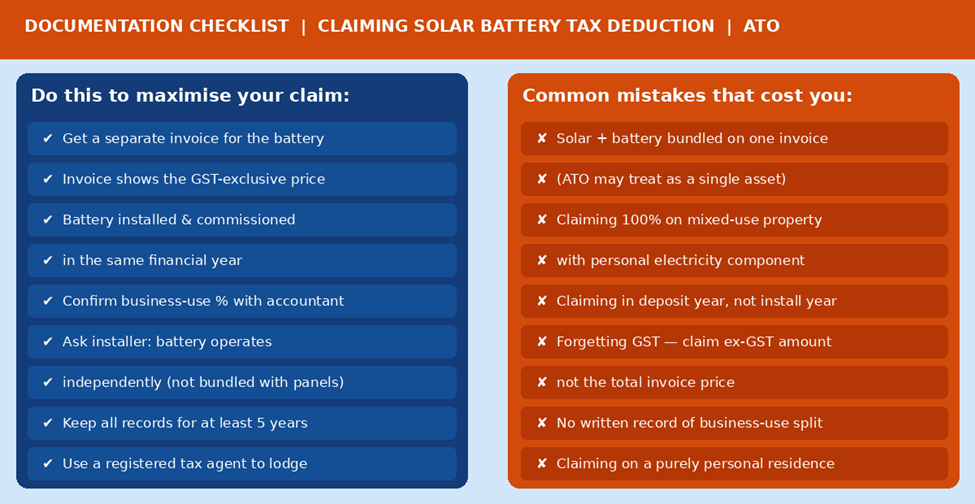
The ATO is specific about what is required to make a valid claim. Getting this wrong means lost deductions or, worse, a disallowance and penalties. Here are the rules that matter most:
| Records and requirements that support your claim ✔ Asset installed and ready for use in the relevant income year ✔ Separate documentation clearly identifying the battery component and installation costs ✔ GST-exclusive amount claimed if your business is registered for GST ✔ Written record of the business-use percentage claimed ✔ Battery must meet the relevant eligibility requirements for the tax treatment being claimed ✔ Keep records for at least 5 years | Common mistakes that may affect your claim ✔ Claiming the deduction before the asset is installed and ready for use ✔ Insufficient documentation identifying the battery component and associated costs ✔ Claiming 100% business use when the asset is also used for private purposes ✔ No records supporting the business-use percentage claimed ✔ Failing to account correctly for rebates, discounts or incentives when calculating the claimable cost ✔ Claiming a business deduction for a battery used solely for private residential purposes |
What About the NSW VPP Incentive?
If your commercial property or home business is in NSW, you may also be eligible for the Peak Demand Reduction Scheme (PDRS) which provides an incentive for eligible battery systems connected to an approved Virtual Power Plant (VPP). The incentive amount depends on the battery, the VPP provider and current scheme rules, and should be confirmed in your quote.
The NSW Peak Demand Reduction Scheme incentive may be available to eligible households and businesses, including homeowners, landlords and business operators, subject to the current scheme rules and eligibility requirements. It does not affect your tax claim — it simply adds another layer of upfront saving.
The Verdict: Is It Worth It for Your Business in 2026?
Let’s be direct. If you are a small business owner, landlord, or home-business operator with taxable income, a solar battery may provide access to a range of financial incentives and tax treatment options, depending on your circumstances and eligibility:
- The federal Cheaper Home Batteries Program provides an upfront discount on eligible battery installations. The amount depends on factors including battery capacity, certificate values and current program rules, and will be confirmed in your quote.
- The $20,000 Instant Asset Write-Off — now a permanent measure for eligible small businesses — may allow eligible businesses to immediately deduct the cost of qualifying assets, subject to ATO rules and eligibility requirements.
- The ongoing electricity savings from the battery reduce your operating costs for 10 to 15 years
- If in NSW, eligible households may also be able to receive a NSW Peak Demand Reduction Scheme incentive for connecting an approved battery to an approved Virtual Power Plant (VPP), subject to eligibility requirements and current scheme rules.
The businesses that benefit most are those with:
- A clear, documentable business use for the electricity stored in the battery
- A registered ABN and annual turnover under $10 million
- An accountant or registered tax agent who can structure the claim correctly
- A net battery cost (after rebate) under $20,000 — putting them squarely in Instant Asset Write-Off territory
The businesses that should take more care are those with mixed-use properties where personal and business electricity are difficult to separate, or those with purely residential properties. In those cases, the claim is still possible, but it requires careful apportionment and solid documentation.
| Important: This article is general information only and does not constitute tax advice. Tax rules can change, and your circumstances are unique. Always consult a registered tax agent or accountant before making a deduction claim. The ATO website (ato.gov.au) has the latest Instant Asset Write-Off guidance. |
Frequently Asked Questions
Can I claim a solar battery and solar panels separately under the write-off?
Yes — if they are invoiced separately and each costs less than $20,000 (excluding GST), you can claim both individually. The $20,000 threshold is per asset, not per project. Ask your installer to issue separate invoices for the solar system and the battery if you want to maximise this.
Does the solar battery have to be used exclusively for business?
No. You claim only the business-use portion. If your battery powers a mix of personal and business consumption, apportion the claim accordingly. Document the basis of your apportionment — the ATO expects a reasonable, defensible methodology.
What if I finance the battery through a chattel mortgage or commercial loan?
You can still claim the Instant Asset Write-Off even if you finance the purchase — you do not need to pay cash upfront. Under a chattel mortgage, the asset is legally treated as yours from day one, so you can claim the full deduction in the year of installation, then repay the finance over time. Discuss this structure with your accountant and your lender.
Can I claim the deduction if the battery is installed during June but I haven’t received the invoice yet?
The deduction applies in the financial year the asset is installed and ready for use — not the year the invoice is issued or paid. If the battery is commissioned in June 2026, it counts as FY2025-26 regardless of invoice timing. Keep the installation certificate as documentation.
Does the permanent instant asset write-off mean I can wait until next year?
For tax purposes, the permanent extension means there is no urgency created by a sunset clause. However, the federal battery rebate does continue to reduce in value every six months (the STC rate adjusts). The federal rebate steps down every six months, so your quote will show the current amount. Choosing the right system matters more than rushing.
| Ready to talk solar battery installation for your business? At Solar Battery Outlet, we work with business owners, landlords, and home-business operators across Liverpool, Bankstown, and Mudgee. We handle the rebate paperwork, provide separate invoices for panels and batteries (to support your tax claim), and work with SAA-accredited electricians on every job. We install popular battery brands including BYD, Tesla Powerwall 3, Sungrow, and Enphase—with transparent pricing and no pressure tactics. Call us: 1800000777. Or visit solarbatteryoutlet.com.au—complete the 60-second eligibility form, and we will be in touch with a no-obligation quote. |
Data Sources and References
The information in this article is drawn from the following sources:
- Australian Tax Office (ATO) — Instant Asset Write-Off guidance: ato.gov.au/businesses/depreciating-assets
- Australian Government business.gov.au — 2026-27 Federal Budget small business summary: business.gov.au/news/budget-2026-27
- SmartCompany — ‘$20,000 instant asset write-off to become permanent’, published May 2026
- SolarQuotes Australia — ‘Federal Budget 2026: What It Means For Home Electrification’, published May 2026
- Choice Energy Australia — ‘Solar Panels Tax Deduction for Businesses’ (AU-specific ATO interpretation): choiceenergy.com.au
- AusPac Solar — ‘How to Maximise Tax Deductions on Your Business Solar System’: auspacsolar.com.au
- Why Solar Australia — ‘Instant Asset Write-Off for Solar: Can Your Business Claim It in 2026?’: whysolar.com.au
- Energy Matters Australia — ‘Can I Claim a Home Solar System on Tax?’: energymatters.com.au
- Journey Finance Australia — ‘The $20,000 Write-Off Deadline Is 30 June 2026’: journeyfinance.com.au
- NSW Government — Peak Demand Reduction Scheme (VPP incentive): energysaver.nsw.gov.au
Note: All figures in this article are estimates for general illustration only. Tax outcomes depend on individual business circumstances, applicable tax rates, business-use percentages, and asset costs. Always consult a registered Australian tax agent before making a deduction claim.
