If you are planning to install a solar battery in NSW in 2026, the rules have changed — and not in a small way. Three separate regulatory updates have landed this year, covering how batteries are photographed at installation, how inverters must communicate with the grid, and how your installer registers the job.
None of these changes end the rebate or make batteries less worthwhile. However, they do change what you should be asking your installer before you sign anything. Therefore, this guide covers every new requirement in plain language and tells you what to do — and what to watch out for — when comparing quotes.
What Has Changed in 2026: The Three Key Updates
1. Mandatory Photo Documentation — From 1 March 2026
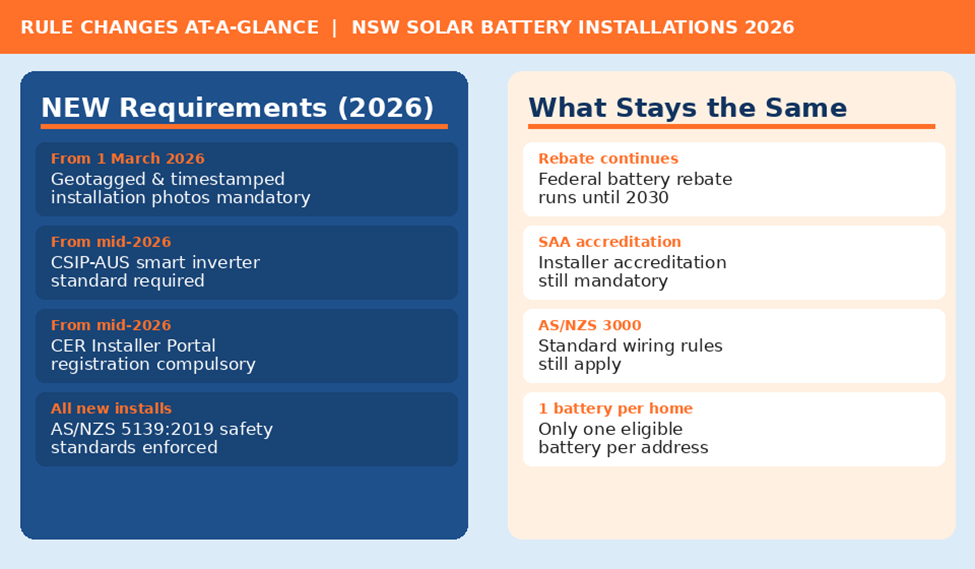
The Clean Energy Regulator (CER) introduced a mandatory photo requirement for every solar battery installation in Australia from 1 March 2026. This is now legislated under the Renewable Energy (Electricity) Regulations 2001 and applies to all accredited installers.
Every installer must now take geotagged and timestamped photos of critical labelling at the time of installation. These photos are submitted as part of the compliance paperwork, and the Clean Energy Regulator (CER) uses automated processes, including AI-assisted checks, to review submissions as part of the Small-scale Renewable Energy Scheme compliance process. If the photos are missing or incorrect, your rebate claim will be delayed or rejected.
What this means for you: Ask your installer upfront to confirm they will handle the photo documentation correctly. A compliant installer will do this automatically. One who is unaware of the requirement is a red flag.
| Why this rule exists According to the CER, inspection results identified compliant battery labelling as a key area for improvement in solar battery installations. The photo rule was introduced to catch labelling problems at the point of installation, before they become a costly problem for the homeowner. |
2. NSW Emergency Backstop Mechanism — From Mid-2026
From mid-2026, the NSW Government is implementing the Emergency Backstop Mechanism (EBM) — a technical requirement designed to protect the electricity grid during rare emergency conditions known as Minimum System Load events. These occur on mild, sunny days when rooftop solar exports can exceed the grid’s capacity to absorb them.
Under the new rules, all new and upgraded rooftop solar systems under 200 kW must be backstop-enabled. In practice, this means your system’s inverter must comply with a new Australian technical standard called Common Smart Inverter Profile Australia (CSIP-AUS). A compliant inverter can receive instructions from your distribution network to temporarily reduce exports during a grid emergency.
What this means for you: This mechanism is a last-resort safeguard and will be a rare event. It will not affect your daily solar savings under normal conditions. If you are installing after mid-2026, ask your installer to confirm your inverter is CSIP-AUS compliant. Many newer inverters support this standard, but not all — your installer should confirm your inverter model is listed as CSIP-AUS compliant. If you already have solar and are not adding or upgrading equipment, these requirements do not apply to you.
3. NSW CER Installer Portal — From Mid-2026
Alongside the Emergency Backstop Mechanism, the NSW Government is launching a new CER Installer Portal — a centralised registration system that replaces manual entry into AEMO’s DER Register.
From mid-2026, all solar and battery installers in NSW must use this portal to register every new installation. It creates a single registration process across all three NSW distribution networks (Ausgrid, Endeavour Energy, and Essential Energy) and automatically confirms each system meets national technical standards.
What this means for you: You do not interact with the portal directly — your installer handles it. However, a legitimate accredited installer will be aware of this requirement. An installer who seems unaware of the CER portal or CSIP-AUS standard should prompt caution.
Safety Rules That Have Not Changed — But Still Matter
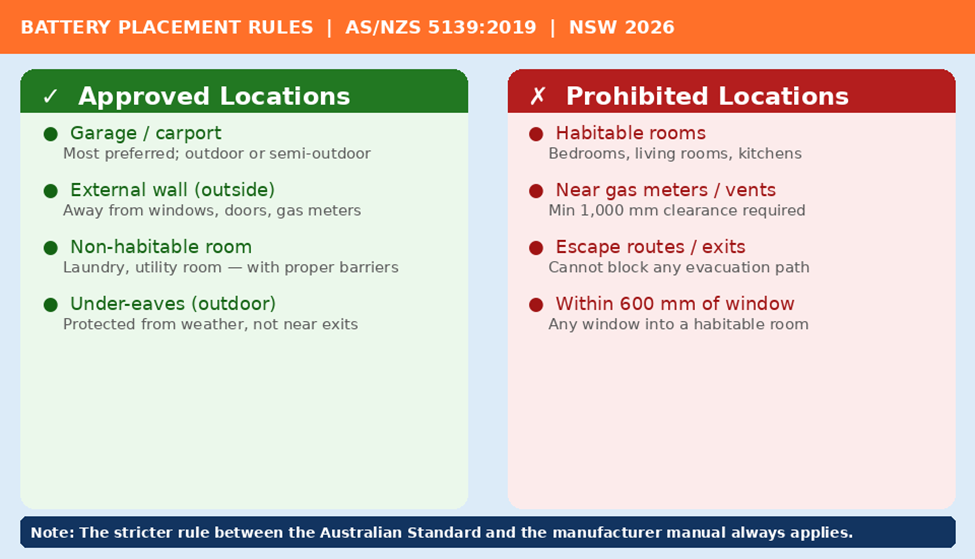
While the three updates above are new for 2026, the core safety rules for how and where a battery can be physically installed have been in place since AS/NZS 5139:2019. These rules are non-negotiable, and every reputable installer will already follow them.
Clearance Requirements
Your battery must maintain specific distances from potential hazards. Battery installations must comply with applicable safety requirements, including AS/NZS 5139 and any relevant gas network clearance requirements. Required separation distances can vary depending on the battery location, nearby equipment and site conditions. Your installer will confirm the exact clearances and installation requirements for your site.
Fire Barrier Requirements
If a battery is mounted on or within 300 mm of a wall backing onto a habitable room, a non-combustible fire barrier is required under AS/NZS 5139. Therefore, your installer should assess this automatically before recommending an installation location.
No Escape Route Obstruction
Under AS/NZS 5139 and NSW Fair Trading rules, installers cannot place a battery in an escape route or evacuation path. In practical terms, they should not install a battery where it could block a garage door or doorway used for emergencies.
The Stricter Rule Always Applies
When the manufacturer’s installation manual requires greater clearances than the Australian Standard, the manufacturer’s requirements apply. A compliant installer will check both and apply whichever is more demanding.
New Photo Requirements: What Your Installer Must Document
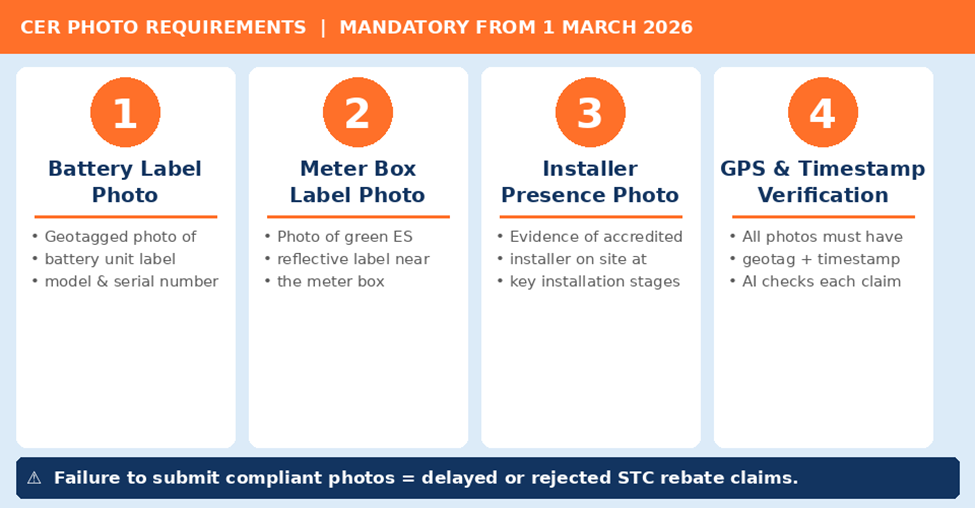
The CER’s mandatory photo requirements from 1 March 2026 cover four categories of documentation that your installer must submit for every job:
- A clear, geotagged photo of the battery unit label showing the model and serial number
- A photo of the green circular “ES” reflective label near the meter box — providing critical information for emergency services
- Evidence of the accredited installer’s presence on site during the main installation stages
- All photos must include GPS location data and a timestamp—the CER uses automated processes, including AI-assisted checks, to support the verification of submissions.
If labeling does not meet the required standard, the claim fails, and the installer must return to the site to rectify it before the STC rebate can be processed. That’s why choosing an experienced, CER-compliant installer matters more than ever—a poorly documented job can delay your rebate by weeks.
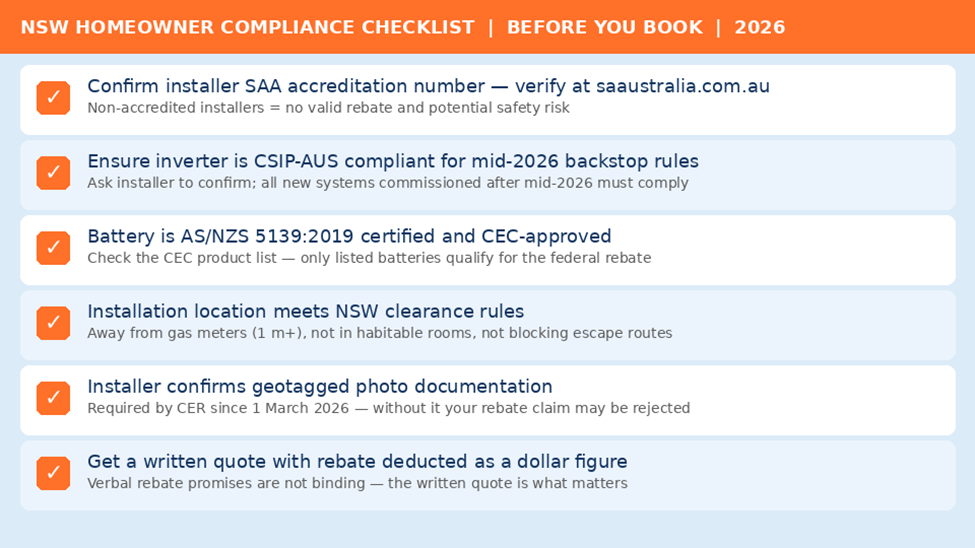
Your NSW Homeowner Compliance Checklist
Before you book any solar battery installation in NSW, work through this checklist. A legitimate, compliant installer will be able to answer yes to all of these without hesitation.
Questions to Ask Before Signing
- Is the installer who will do my job SAA-accredited? Can you give me their accreditation number to check at saaustralia.com.au?
- Will the inverter be CSIP-AUS compliant — is it on the Clean Energy Council’s approved list for the NSW Backstop Mechanism?
- Is the battery on the approved battery list and VPP-capable?
- Will you handle the geotagged photo documentation required by the CER from 1 March 2026?
- Can you provide a written quote showing the rebate as a dollar deduction — not just a verbal promise?
- What is the confirmed installation date — not just the contract signing date?
| A note on the federal battery rebate The 2026 regulatory changes do not affect the federal battery rebate (Cheaper Home Batteries Program). The rebate continues until 2030. The STC factor adjusts every six months, but the rebate itself has not ended. Only one solar battery system is eligible for STCs per premises. To be eligible, the battery system must be installed in a single job and be included on the Clean Energy Council (CEC) approved battery list. Eligibility requirements apply. |
Frequently Asked Questions
No. If you are not installing new equipment or upgrading your existing system, the Backstop Mechanism requirements do not apply. Existing systems continue to operate under their current arrangements.
Ask them for their accreditation number and check it yourself at saaustralia.com.au. If an installer won’t give you this number, be cautious — the federal rebate needs an SAA-accredited installer.
No. The rebate must appear as an itemised dollar deduction on your written quote. A verbal promise does not protect you if the rebate is processed incorrectly. Insist on seeing it in writing before you sign.
To qualify, the battery must be on the approved battery list, be VPP-capable, and be installed by an SAA-accredited installer following AS/NZS 5139. Well-known compliant brands include Tesla Powerwall, BYD, Sungrow, Enphase, and Growatt — but you should always verify that the specific model appears on the CEC approved list.
Yes. The NSW Peak Demand Reduction Scheme is a separate state incentive for eligible households that connect an approved battery to an approved Virtual Power Plant (VPP). The incentive amount depends on the battery, the VPP provider and current scheme rules. Eligibility requirements apply. Ask your installer whether your chosen battery is VPP-compatible.
Ready to Get Compliant Quotes for Your NSW Home?
Solar Battery Outlet installs CEC-approved solar batteries for homes across Liverpool, Bankstown, and Mudgee. Every installation is completed by SAA-accredited electricians, with full CER photo documentation and rebate paperwork handled for you.
If you have questions about the new 2026 rules — or want to know whether your home qualifies for the federal rebate and the NSW VPP incentive — we are happy to talk through it without any sales pressure
| Get a Free, No-Obligation Quote. We will look at your electricity bills, check your solar setup, and give you a written quote with the rebate clearly deducted—no countdown timers. No pressure. • Call us: 1800 000 777 • Visit: solarbatteryoutlet.com.au • Fill in our 60-second eligibility form and we will be in touch Servicing Liverpool, Bankstown, and Mudgee | Part of GWM Group Pty Ltd |
DATA SOURCES
1. Clean Energy Regulator — Solar Battery Photo Guide: cer.gov.au/document/solar-battery-photo-guide
2. Clean Energy Regulator — Solar Batteries eligibility rules: cer.gov.au
3. NSW Climate & Energy Action — Emergency Backstop Mechanism: energy.nsw.gov.au
4. NSW Climate & Energy Action — CER Installer Portal: energy.nsw.gov.au
5. Ausgrid — Information for Solar Installers / Emergency Backstop: ausgrid.com.au
6. Endeavour Energy — NSW Emergency Backstop Mechanism: endeavourenergy.com.au
7. AS/NZS 5139:2019 — Battery Energy Storage System installation safety standard
8. AS/NZS 4777.2:2020 — Grid connection of energy systems via inverters
9. ERAC — Battery Energy Storage System installation clarifications: erac.gov.au
