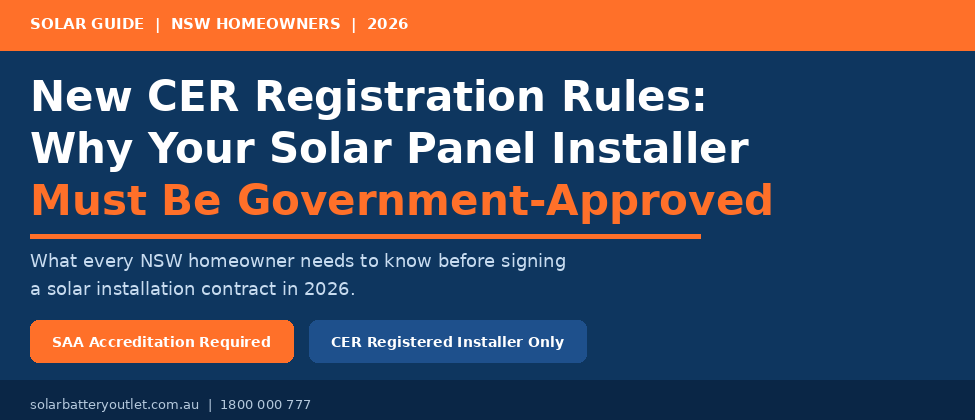
If you have been comparing solar quotes recently, you may have noticed that some installers clearly explain government rebates while others provide little detail. The reason often comes down to whether the installer is registered and approved under the Clean Energy Regulator (CER) requirements.
New rules introduced across 2025 and 2026 have tightened the requirements around who can legally install a solar system and claim the rebate on your behalf. For NSW homeowners — whether you are in Liverpool, Bankstown, or anywhere else in the state — this directly affects whether you receive your full entitlement, whether your installation is safe, and whether it will pass inspection.
This guide outlines the CER registration rules, explains why regulators introduced them, and shows you what to check before signing a contract with a solar installer.
What Is the CER and Why Does It Set the Rules?
The Clean Energy Regulator is the Australian Government body responsible for administering the Small-scale Renewable Energy Scheme (SRES) — the program that funds the rebate that reduces the upfront cost of solar panels and batteries for homes across Australia.
When a solar installer completes a job, they do not just put panels on your roof and leave. To trigger your rebate, they must create Small-scale Technology Certificates (STCs) in the government’s REC Registry. Those certificates are only valid — and your rebate is only real — if the installer meets a specific set of CER registration requirements at the time of installation.
The CER does not just set these rules once and walk away. It actively monitors compliance, suspends installers who breach the rules, and publishes regular compliance updates. As of the most recent update covering January to March 2026, the CER permanently suspended registration of Phenix Trading Pty Ltd following regulatory actions by state regulations in NSW and Victoria — a reminder that enforcement is real and ongoing.
The Core Rule: Only SAA Accredited Installers Can Legally Claim Your Rebate
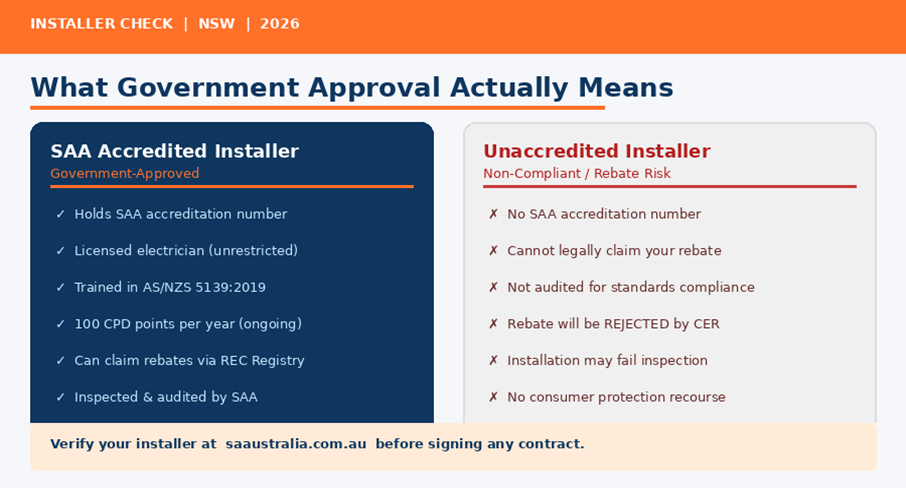
The single most important requirement is this: your solar system must be designed and installed by a Solar Accreditation Australia (SAA) accredited installer. This is not optional or a formality — it is a hard legal requirement under the Renewable Energy (Electricity) Regulations.
Solar Accreditation Australia (SAA) took over the accreditation role from the Clean Energy Council in 2024. As of 2024, only SAA accredited designers and installers can interact with the CER’s Small-scale Renewable Energy Scheme. Any installer claiming to offer you a rebate without holding a current SAA accreditation number is not legally able to do so.
To hold SAA accreditation, an installer must:
- Hold a current electrical licence (for install accreditation)
- Complete an approved solar training course for their accreditation category
- Complete a minimum of 100 continuing professional development (CPD) points every 12 months
- Carry current public liability insurance
- Comply with SAA guidelines, Australian Standards, and all relevant regulations
SAA requires accredited installers to maintain their skills through annual CPD training and may suspend or de-accredit those who fail to comply with Australian standards.
The 5 CER Registration Rules That Apply to Your Installation in 2026
Beyond SAA accreditation, the CER now requires installers and solar businesses to follow specific rules for registering, documenting, and reporting solar installations. Here is what every NSW homeowner should understand.
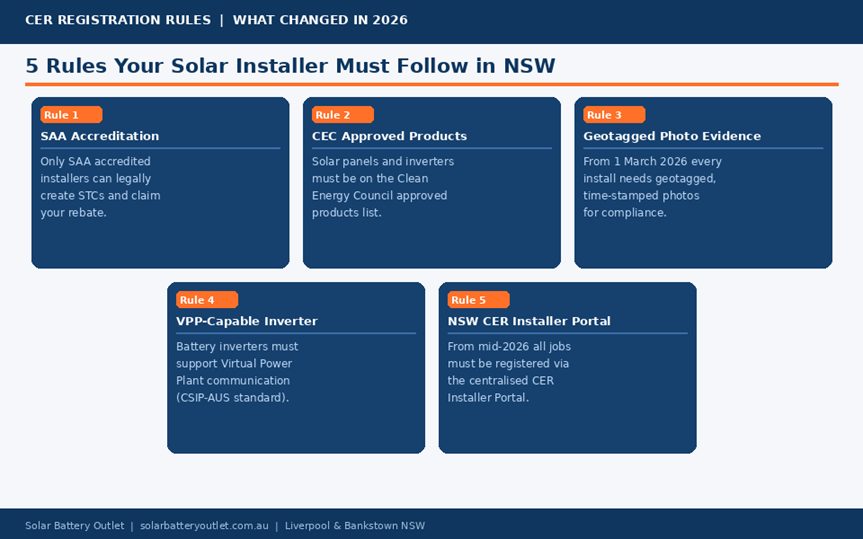
Rule 1 — SAA Accreditation Is Mandatory, Not Optional
As covered above, this requirement forms the foundation of STC eligibility. Every system claiming STCs must have an SAA-accredited installer complete the installation. The installer must be physically present on site, as phone-based supervision or remote oversight does not meet the requirement. SAA requires accredited installers to supervise installations on site and follow its installation rules.
Rule 2 — All System Components Must Be on the CEC Approved List
Your solar panels and inverters must appear on the Clean Energy Council’s approved products list. This list is maintained and updated by the CEC. Installing panels or inverters that are not on this list means your system is not eligible for STCs — regardless of who installs it. A legitimate installer will only quote products that are currently on the approved list and will confirm this if you ask. If you are looking at a home solar panel system Liverpool quote or anywhere else in NSW, this is one of the first things to verify.
Rule 3 — Geotagged, Time-Stamped Photo Evidence Is Now Required
From 1 March 2026, the CER introduced new photo evidence requirements for eligible solar battery installations claiming STCs, including geotagged and timestamped photos of critical safety labelling. Every installation must be accompanied by geotagged, time-stamped photographic evidence confirming that the system complies with Australian Standard labelling requirements.
The Clean Energy Regulator introduced these requirements after inspection programs identified compliant battery labelling as a key area for improvement in solar battery installations. An accredited installer will build this documentation into their standard process. If an installer seems unaware of this requirement or dismisses it, that is a significant warning sign.
Rule 4 — VPP-Capable Inverter Required for Battery Installations
To be eligible for the federal Cheaper Home Batteries Program, battery systems must be capable of participating in a Virtual Power Plant (VPP), subject to the program’s eligibility requirements. In NSW, new and upgraded systems may also need to comply with network requirements, including Common Smart Inverter Profile – Australia (CSIP-AUS) communications standards and Emergency Backstop requirements where applicable. Check the current eligibility and connection requirements before installation.
You do not have to actually join a VPP — but the system must have the technical capability. This requirement affects which inverters are eligible, and an accredited installer will be across it when specifying your system.
Rule 5 — The NSW Consumer Energy Resources (CER) Installer Portal
The NSW Government’s Consumer Energy Resources (CER) Installer Portal is a new system used to register new and upgraded rooftop solar and battery installations in NSW. The portal provides a single registration process across NSW distribution networks and supports reporting requirements such as the Australian Energy Market Operator’s (AEMO) Distributed Energy Resources Register (DERR).
According to the NSW Government, solar businesses will begin using the portal from 2 November 2026 for eligible new and upgraded rooftop solar and battery systems, subject to the implementation timetable published by the NSW Government. Source: NSW Consumer Energy Resources Installer Portal.
The portal covers all three NSW distribution networks — Ausgrid, Endeavour Energy, and Essential Energy — and automatically confirms that each system meets national technical standards.
As a homeowner, you do not interact with the portal yourself — your installer does. However, a legitimate accredited installer will be fully aware of this requirement. An installer who seems unfamiliar with the CER portal should prompt caution when you are getting quotes for solar panels Bankstown, Liverpool, or any other part of NSW.
How to Verify Your Installer Before You Sign Anything
Knowing the rules is useful. Knowing how to check that your installer actually follows them is what protects you. Here is a practical guide to verifying any installer before you commit.
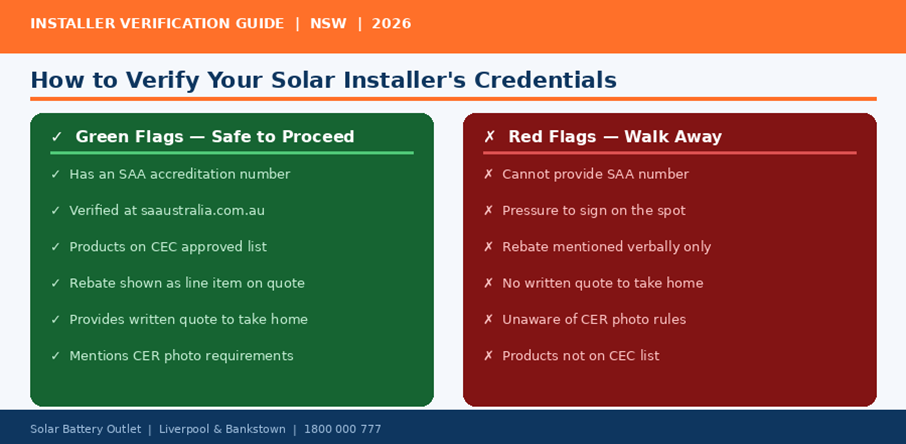
Step 1: Ask for the SAA Accreditation Number
Every SAA accredited installer has a publicly listed accreditation number. Ask for it — and then check it yourself at saaustralia.com.au. This takes under two minutes and tells you whether the accreditation is current, what category it covers (grid-connected PV, battery, standalone), and whether it is in good standing.
Step 2: Confirm Products Are on the CEC List
Ask the installer which solar panels and inverters they included in the quote, then verify those products in the Clean Energy Council’s approved products database. If you find that the products are not on the approved list, you could lose access to government rebates before the installation even begins.
Step 3: Ask How They Handle the CER Photo Requirements
A compliant installer will know exactly what you mean when you ask about the March 2026 photo requirements. They should be able to explain that they take geotagged, time-stamped photos at each installation phase as a standard part of their compliance process. Vagueness here is a red flag.
Step 4: Get Everything in Writing Before You Sign
The rebate should appear as a dollar figure on your written quote — not mentioned verbally and applied later. A legitimate installer will provide a written quote you can take home, compare, and consider. If anyone pressures you to sign on the day without providing a written quote, walk away. This applies whether you are looking at a home solar panel system in Liverpool, Bankstown, or anywhere else in NSW.
Why These Rules Exist — And Why They Protect You
It is worth being direct about something: these CER registration rules are not bureaucratic red tape. They exist because there has been a documented pattern of non-compliant installations in the Australian solar market — installers cutting corners on labelling, incorrect system sizing, products that do not meet Australian standards, and in some cases, outright fraud in the STC system.
| What happens if your installer is not properly registered? Your STC claim can be rejected by the CER, meaning your rebate disappears. Your installation may fail the state electrical inspection. Your home insurance could be affected if a non-compliant installation causes damage. Choosing an accredited installer, and a retailer that has signed the New Energy Tech Consumer Code, gives you extra protections on top of your rights under Australian Consumer Law. |
When you choose a properly registered installer, you are not just protecting the rebate. You are protecting the investment itself — the panels on your roof, the system’s performance over its 25-year design life, and the safety of your home.
If you are planning a full solar panels installation in NSW and want to understand the complete picture — from system sizing to battery storage options — the same rules apply. Every component of a compliant installation, from panels to batteries, must be covered by an accredited installer.
Frequently Asked Questions
Go to saaustralia.com.au and use the accreditation search. Enter the installer’s name or accreditation number. The result will show you the current accreditation status, the type of accreditation held (e.g. Grid-Connected PV, Battery), and whether it is currently active. Always verify this before signing any quote, whether you are getting a home solar panel system or solar panel installation services in Bankstown.
The CER and SAA are explicit: the accredited person must be present on site for the installation. Supervision must be on site and in accordance with SAA rules. Remote sign-off or paper-based oversight does not satisfy the requirement. If an installer’s arrangement does not meet this standard, any STCs created may be invalid.
Both. SAA accreditation is required for both solar PV installations and battery installations under the SRES. The category of accreditation differs (Grid-Connected PV vs Battery), but the core requirement — that only accredited installers can legally create STCs — applies to all system types claiming government rebates.
The installer handling the rebate paperwork (STC assignment) is standard practice and expected. What you want to verify is that they hold the accreditation themselves — not that someone else on the paperwork does. Ask for their SAA number and verify it directly. The paperwork process is separate from the accreditation requirement.
The CER regularly updates its compliance requirements as part of its annual enforcement priorities. The core requirement for SAA accreditation is unlikely to change. However, documentation requirements, photo evidence standards, and portal registration processes are updated periodically. A reputable installer stays current with these updates as part of their ongoing CPD requirements.
| Not Sure If Your Installer Is Government-Approved? Solar Battery Outlet installs solar panels and batteries across Liverpool, Bankstown, and NSW. Every installation is done by SAA-accredited electricians using CEC-approved products. We handle all rebate paperwork and registration — so you do not have to. We provide free, no-obligation written quotes. Ask for your installer’s SAA accreditation number and check it yourself at saaustralia.com.au. Call us: 1800 000 777 Or visit solarbatteryoutlet.com.au — complete the 60-second eligibility form and we will be in touch. |
DATA SOURCES & REFERENCES
Small-scale renewable energy systems: https://cer.gov.au/schemes/renewable-energy-target/small-scale-renewable-energy-scheme/small-scale-renewable-energy-systems
Solar battery installers and designers: https://cer.gov.au/schemes/renewable-energy-target/renewable-energy-target-participants-and-industry/solar-battery-installers-and-designers
Clean Energy Regulator—Compliance update January to March 2026: https://cer.gov.au/about-us/our-compliance-approach/compliance-and-enforcement-priorities/compliance-and-enforcement-priorities-2025-26/compliance-update-january-to-march-2026
Clean Energy Council — Approved Products List: https://www.cleanenergycouncil.org.au/industry-advocacy/renewable-energy-systems/approved-products
