


A practical, numbers-first guide for NSW homeowners weighing up a home battery in 2026
Every NSW homeowner researching solar batteries eventually runs into the same headline: “save up to $1,100 a year.” It sounds promising, but it also raises an obvious question — is that figure realistic for your home or just a marketing average? In 2026, with electricity prices climbing and battery rebates shifting, that question matters more than ever.
This guide breaks down exactly where the $1,100 figure comes from, how it changes depending on your battery size, household usage, and tariff plan, and what the real 10-year savings picture looks like once rebates, bill savings, and avoided peak charges are combined. We’ll also walk through a worked example using actual NSW electricity rates so you can sense-check the numbers against your own bill.
If you’re comparing options for solar batteries NSW wide, or specifically researching a solar battery Liverpool installers can supply and fit, the framework below applies regardless of postcode—only the inputs (your usage, your tariff, your roof) change.
Where Does the “$1,100 a Year” Figure Actually Come From?
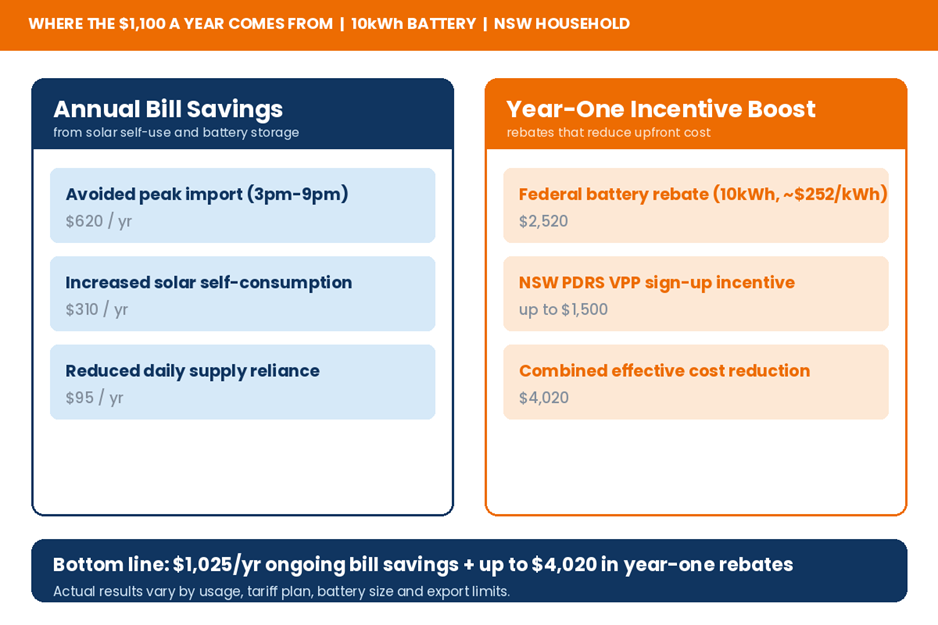
The $1,100 number isn’t pulled from thin air, but it also isn’t a guarantee. It typically represents the combined effect of three separate savings streams working together over a full year:
- Avoided peak import charges—using stored solar instead of grid power during the 3pm–9pm peak window, when NSW time-of-use rates often sit between 40 and 55 cents per kWh.
- Higher solar self-consumption — instead of exporting excess solar for a low feed-in tariff, the battery stores it for later use, effectively converting a 5–8 cent export credit into a 30+ cent saving.
- Reduced reliance on the grid during outages or price spikes — particularly relevant as wholesale prices become more volatile.
Independently, the New South Wales government’s home battery rebate explainer for the Cheaper Home Batteries Program confirms that NSW households can stack the federal rebate with the state’s VPP incentive, which is the second half of the savings equation alongside ongoing bill reductions.
For a household with average NSW consumption (around 14–16 kWh per day) and a 10kWh battery, the combined annual bill savings typically land between $950 and $1,200, depending on tariff structure and how much solar is already being self-consumed before the battery is installed.
The 2026 Rebate Landscape: Why Timing Still Matters
From 1 May 2026, the federal Cheaper Home Batteries Program moved to a tiered structure. Batteries up to 14kWh continue to receive the full STC rate, currently around $252 to $272 per usable kWh, while capacity between 14kWh and 28kWh receives roughly 60% of that rate, and capacity beyond that drops further still. For most NSW homes, a battery in the 10–14kWh range remains the sweet spot for rebate value.
On top of the federal rebate, NSW homeowners can apply for the Peak Demand Reduction Scheme (PDRS) VPP incentive, worth up to $1,500 when a battery is connected to an approved virtual power plant. Combined, a 10kWh battery installed in 2026 can attract a federal rebate of roughly $2,520, plus the VPP incentive, for a total reduction in upfront cost approaching $4,000.
None of this changes the underlying running-cost savings discussed in this article — those depend on your usage and tariff, not the rebate. But the rebate does affect how quickly your system pays for itself, which is why timing your install before further STC step-downs (the next is scheduled for January 2027) can meaningfully shorten your payback period.
A Worked Example: 10kWh Battery, Average NSW Household
Let’s use a realistic household profile. According to NSW energy data, the average household electricity bill currently sits around $1,800 to $1,900 per year, with a typical usage rate of roughly 30 to 34 cents per kWh and many homes now on time-of-use tariffs where peak rates climb above 40 cents.
Consider a household with 6.6kW of rooftop solar and a 10kWh battery added in 2026. Before the battery, this home self-consumes roughly 35% of its solar generation and exports the rest at a low feed-in tariff. After the battery is installed, self-consumption typically rises to 70–80%, because the battery soaks up midday solar surplus and discharges it during the evening peak instead of drawing from the grid.
Running the numbers across a full year produces three savings categories that, added together, comfortably reach the $1,100 mark in homes with above-average evening usage, and sit closer to $850–950 for smaller households. The breakdown image above shows the typical split: roughly $620 from avoided peak imports, $310 from improved solar self-consumption, and $95 from reduced reliance on the daily supply charge during outages or low-generation days.
It’s worth being transparent here: these figures will not be identical for every home. A single-person household using 7–8 kWh per day will see proportionally smaller savings, while a larger family running air conditioning, an EV charger, and a pool pump during peak hours could exceed $1,300 annually.
The 10-Year Picture: When Does a Battery Actually Pay for Itself?
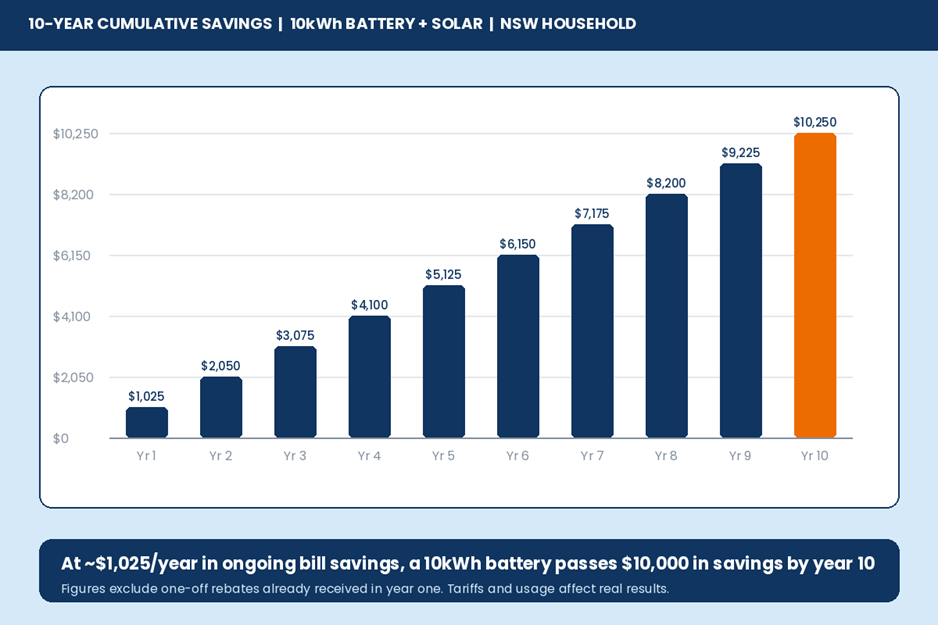
Annual savings are useful, but the real question most homeowners want answered is payback time. Using the $1,025/year average from our worked example, and assuming a net system cost (after rebates) of roughly $5,000 to $7,000 for a 10kWh battery added to existing solar, payback typically falls between 5 and 7 years. Most home batteries carry a 10-year warranty, meaning the system continues delivering savings well past the point it has paid for itself.
The chart below shows cumulative bill savings over a 10-year period at the $1,025/year rate, excluding the one-off rebate already banked in year one. By year 10, cumulative bill savings alone exceed $10,000 — and that’s before accounting for the likelihood that electricity prices, and therefore savings, will continue rising over that period.
A Simple Framework to Estimate Your Own Savings
Rather than relying on a generic average, you can estimate your own potential savings in four steps. This framework mirrors the approach used by energy analysts when calculating real bill impact rather than theoretical kWh totals.
- Find your actual evening usage. Pull a recent bill and identify how much electricity you use between 3pm and 9pm — this is the window a battery primarily offsets.
- Check your time-of-use rate for that window. Multiply your average evening kWh usage by your peak rate (often 40–55c/kWh) to estimate your current peak spend.
- Estimate your battery’s usable discharge. A 10kWh battery typically delivers 8–9kWh of usable evening discharge per day after accounting for depth-of-discharge limits and standby losses.
- Multiply and annualise. Multiply your usable discharge by your peak rate, then by 365 days, to estimate annual peak-avoidance savings. Add your expected solar self-consumption uplift (usually $250–$400/year) for a total estimate.
This four-step approach consistently produces estimates within 10–15% of actual post-installation savings reported by NSW households, making it a far more reliable starting point than a flat headline figure.
Common Mistakes That Inflate or Deflate Battery Savings Estimates
- Ignoring tariff structure. A flat-rate tariff produces very different savings to a time-of-use tariff, sometimes by a factor of two.
- Assuming 100% battery efficiency. Real-world round-trip efficiency for most lithium batteries sits between 85% and 95%, which should be factored into any estimate.
- Overlooking export tariff changes. Some NSW retailers now apply negative feed-in tariffs during solar-flush periods, which increases the relative value of storing solar rather than exporting it.
- Comparing battery size to roof size, not usage. A larger battery only delivers proportionally larger savings if your evening usage is high enough to draw down that extra capacity each day.
Getting these details right is where working with an experienced, CEC-accredited installer makes a measurable difference — not just in installation quality, but in correctly sizing the system to your actual usage pattern rather than a generic recommendation.
Frequently Asked Questions
It’s realistic for households with above-average evening electricity use and a 10kWh or larger battery on a time-of-use tariff. Smaller households or those on flat tariffs may see figures closer to $700–$950 per year, while larger households with high peak-period consumption can exceed $1,100.
Solar savings come from generating your own electricity during the day. Battery savings come from storing that solar for use later, particularly during the evening peak when grid electricity is most expensive. The two work together, but a battery specifically targets the gap between cheap daytime solar and expensive evening grid power.
No. The May 2026 changes to the Cheaper Home Batteries Program affect the upfront rebate amount, particularly for batteries over 14kWh, but they don’t change how much you save on your electricity bill each year. Ongoing savings depend entirely on your usage and tariff, not the rebate structure.
Based on current rebate levels and average NSW usage, most 10kWh batteries reach payback within 5 to 7 years, with a typical 10-year warranty meaning several years of savings continue after the system has paid for itself.
A time-of-use tariff generally maximises battery savings because it creates a larger gap between cheap off-peak rates and expensive peak rates. However, batteries still provide savings on flat tariffs through improved solar self-consumption, just at a slightly lower rate.
Get Your Personalised Savings Estimate
The numbers in this guide are based on average NSW usage patterns, but your actual savings depend on your roof, your bill, and how your household uses electricity. At Solar Battery Outlet, we use your real usage data to model expected savings before you commit to a system size — so you know what to expect, not just a headline figure.
Whether you’re comparing solar batteries NSW-wide or you’re specifically after a solar battery Liverpool homeowners can have installed quickly, our team can walk you through current rebate eligibility, VPP options, and a savings estimate based on your own electricity bill—not an industry average.
Get a free, no-obligation battery savings estimate at solarbatteryoutlet.com.au — and find out what your real number looks like in 2026.