

Solar Battery Comparison | Sydney NSW | Updated March 2026
Tesla Powerwall 3 vs BYD Battery: Which Is Better for Sydney Homes in 2026?
If you’ve gotten past the ‘should I get a battery?’ question and now you’re comparing brands, you’ve probably landed on these two names. Tesla Powerwall. BYD Battery-Box. They come up in every online comparison, and half the time those comparisons leave you more confused than when you started.
So here’s a straight answer, written for NSW homeowners — not for people who enjoy reading spec sheets.
Short version: both are excellent batteries. The differences are real, but they’re not dramatic. Which one is right for you comes down to your budget, your existing solar setup, and what you actually want the battery to do.
Let’s go through it properly.
| What Both Batteries Have in Common Before we compare them, it helps to know what they share. Both Tesla Powerwall 3 and BYD Battery-Box HVM use LFP (lithium iron phosphate) chemistry — which means they’re safe, long-lasting, and thermally stable in Australian heat. Both carry 10-year warranties. Both are on the CEC approved product list and eligible for the federal Cheaper Home Batteries rebate and the NSW VPP incentive. Neither is a bad choice. The question is which one fits your situation better. |
Quick Specs Side by Side
Let’s get the technical stuff out of the way first. Here’s how they compare on the key numbers:
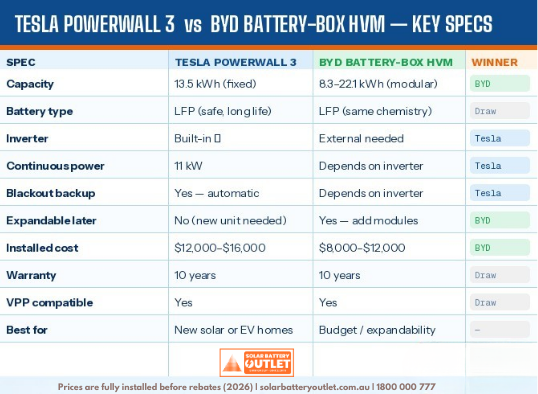
Tesla Powerwall 3 vs BYD Battery-Box HVM — full specs comparison including winner per category
A few things worth explaining from that table:
- The built-in inverter is Tesla’s biggest practical advantage. Most batteries need a separate ‘hybrid’ inverter to work. Tesla has one built in. If you’re installing from scratch or your old inverter is due for replacement anyway, this saves you $1,500–$2,500 right away.
- BYD’s modularity is its biggest practical advantage. You can start with a 10 kWh system and add more modules later without replacing the whole battery. Tesla requires a whole new unit if you want to expand beyond 13.5 kWh.
- ‘Blackout backup’ depends on your setup. Tesla handles this automatically — if the grid goes down, it switches instantly. BYD can do it too, but only if paired with the right inverter. Ask your installer to confirm before buying.
What Does Each Battery Actually Cost in 2026?
This is what most people really want to know. Here’s the honest pricing picture after rebates are applied:
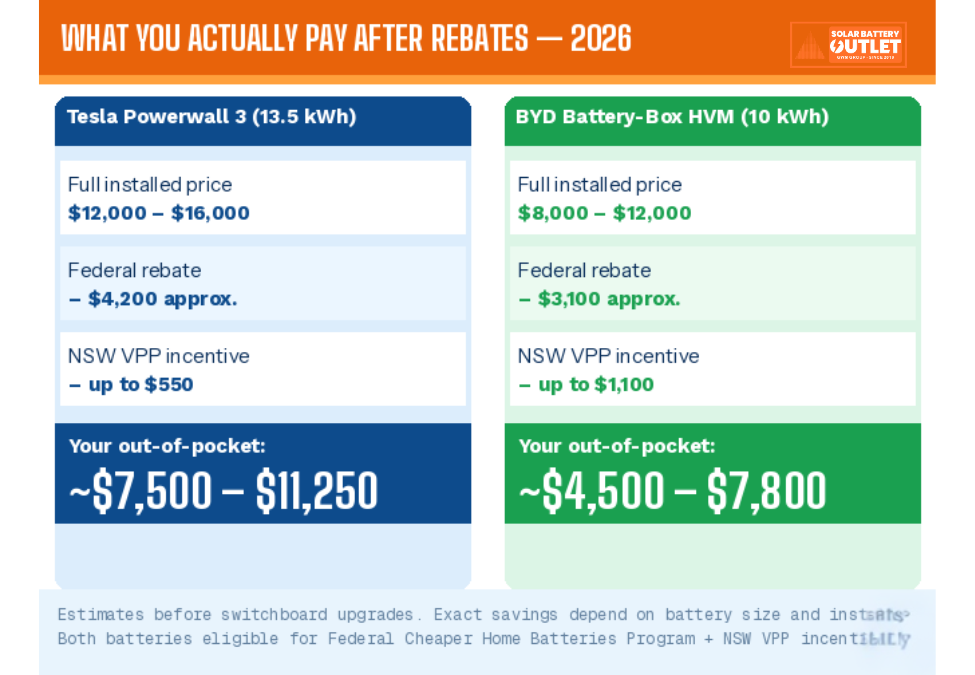
What you actually pay after the federal rebate and NSW VPP incentive — Tesla vs BYD 2026
The BYD comes in meaningfully cheaper — typically $2,000–$4,000 less out of pocket than Tesla after rebates. For a lot of Liverpool and South West Sydney families, that gap matters.
The Tesla commands a premium because of the integrated inverter, the polished app, and the brand name. If you’re doing a fresh solar + battery install or your old inverter needs replacing, that premium shrinks significantly — because you’d have to buy an inverter for BYD anyway.
Bottom line: if budget is your main concern, BYD wins clearly. If you’re doing a full system install and want one product to do everything, Tesla’s price gap narrows fast.
| The 1 May 2026 Rebate Deadline — Applies to Both The federal Cheaper Home Batteries rebate rate drops from 1 May 2026. This applies equally to Tesla and BYD. Getting your installation confirmed before that date locks in the current (higher) rebate regardless of which brand you choose. If you’re reading this in March or April 2026, now is the time to get your quotes sorted. |
Which One Should You Actually Buy?
Honest answer: it depends on your situation. Here’s our plain-English guide:
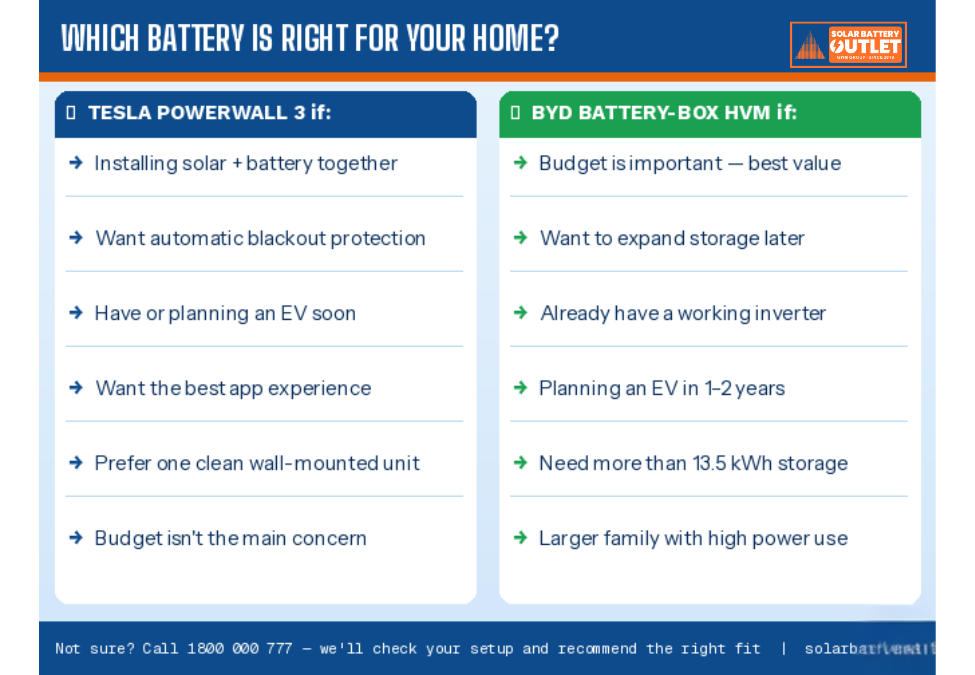
Decision guide — choose Tesla Powerwall 3 or BYD Battery-Box based on your actual situation
Choose Tesla Powerwall 3 if:
- You’re installing solar panels and a battery together (the integrated inverter saves real money)
- You want true automatic blackout protection — Tesla switches seamlessly, no configuration needed
- You have an EV or plan to get one — Tesla’s app handles smart EV charging really well
- You want the cleanest, most user-friendly app experience for monitoring your energy
- Your existing inverter is old and needs replacing anyway — factor that cost in
- Design matters to you — the Powerwall is wall-mounted and genuinely looks good
Choose BYD Battery-Box HVM if:
- Budget is your priority — BYD is typically $2,000–$4,000 cheaper after rebates
- You want to expand your storage capacity later as your needs grow (e.g. when you get an EV)
- You already have a compatible hybrid inverter (Fronius, Sungrow, GoodWe, etc.) working fine
- You’re a larger family or run a home office and need more than 13.5 kWh of storage
- You want a proven, reliable system without paying for the Tesla brand premium
- Your installer is more experienced with BYD — installation quality matters more than brand
What About Other Brands?
Tesla and BYD get most of the attention, but they’re not the only strong options available in NSW. If you’re getting quotes, it’s worth asking about:
- Sungrow SBR: The best value per kWh on the market right now. Requires a Sungrow hybrid inverter, so it’s most cost-effective if you’re doing a combined solar + battery install. Excellent reliability.
- Growatt ARK: Newer to the Australian market but growing fast. Good tech at a competitive price point. Worth considering for smaller homes or tighter budgets.
- Enphase: The premium modular option — each panel gets its own microinverter and battery module. More expensive, but the most resilient system design. Good for shaded roofs.
We install all of these. The ‘best’ brand for your home really does depend on what inverter you already have, your storage needs, and your budget. A good installer will go through this with you honestly — not just push the brand with the highest margin.
Questions to Ask Before You Decide
Before you lock in any brand, ask your installer these questions:
- “What inverter do I currently have — and is it compatible with this battery?” If you have a working hybrid inverter, BYD might pair perfectly at lower cost. If you don’t, Tesla’s all-in-one is worth considering.
- “Does this battery support automatic blackout switching?” Tesla yes. BYD depends on inverter — confirm this explicitly before buying.
- “Is this battery modular? Can I add capacity later?” BYD yes. Tesla requires a second unit. Important if you’re planning an EV in the next 2–3 years.
- “What’s the net cost after the federal rebate and NSW VPP incentive?” Always compare after-rebate prices. The sticker price gap between Tesla and BYD is bigger than the real gap after rebates.
Frequently Asked Questions
Can I retrofit either battery to my existing solar system?
Yes — both can be added to an existing system. Tesla is AC-coupled, meaning it connects directly without needing a new inverter. BYD is DC-coupled, which means it needs a compatible hybrid inverter. If you already have a compatible inverter, BYD is a great retrofit option. If you don’t, you’ll need to factor in the inverter cost.
Which battery has better blackout protection?
Tesla Powerwall 3 handles blackouts automatically — the switch happens within milliseconds and most people don’t even notice the grid went down. BYD can provide blackout protection too, but it depends entirely on the inverter it’s paired with. If blackout backup is important to you, confirm this in writing before you sign any quote.
Is BYD a reliable brand?
Absolutely. BYD (Build Your Dreams) is one of the largest battery manufacturers in the world — they also make EV batteries for Toyota, Ford, and their own electric cars. Their battery tech is mature, widely tested, and the Battery-Box has a strong track record in Australia. The 10-year warranty is solid and backed by their Australian office.
What if I want more than 13.5 kWh of storage?
BYD is the better choice here. You can expand a BYD system by adding modules — either at installation or later. Tesla Powerwall 3 is fixed at 13.5 kWh per unit. You can install a second Powerwall to get 27 kWh, but that’s a much bigger upfront investment.
Which brand holds its value better if I sell my house?
Tesla has stronger brand recognition with buyers, which may add slightly more perceived value to a property listing. That said, any quality battery brand adds value — the bigger factor is the age of the system and remaining warranty at point of sale.
| Not Sure Which Battery Is Right for Your Home? We install both Tesla and BYD across Liverpool, Bankstown, Campbelltown, and South West Sydney. We’ll check your existing setup, compare the real after-rebate costs, and recommend the battery that gives you the best return — not the one with the highest margin. Call us: 1800 000 777 Or fill in our 60-second eligibility form at solarbatteryoutlet.com.au |
| About Solar Battery Outlet We’re a Liverpool-based solar battery installer, part of GWM Group Pty Ltd, servicing homes across South West Sydney, Bankstown, Campbelltown, Mudgee, and the greater NSW region. All installations by SAA-accredited electricians. We handle all rebate paperwork — federal and NSW — so you don’t have to. |